

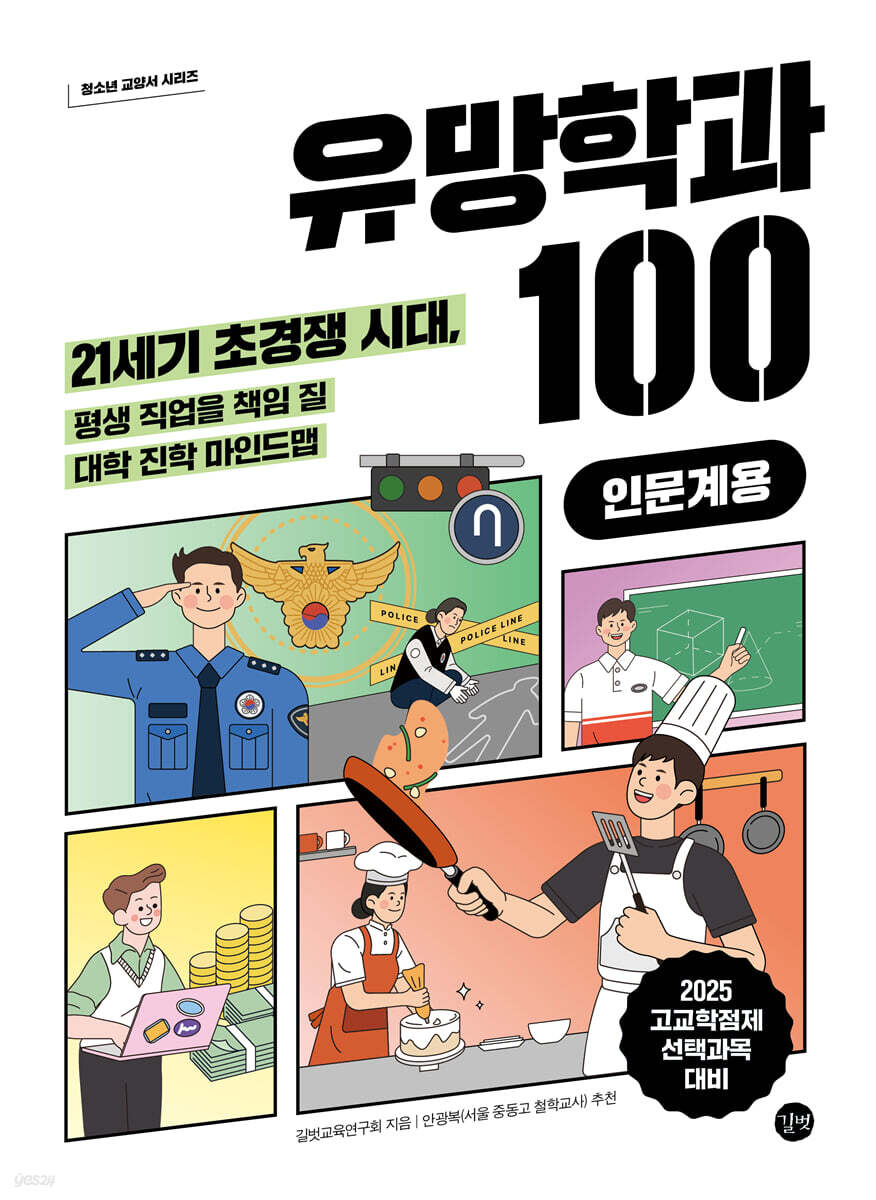
100 Promising Departments (for Humanities)
 |
Description
Book Introduction
The era of the 5th Industrial Revolution, driven by artificial intelligence, is fast approaching.
21st-century humanities departments cultivate M-shaped talents with expertise in various fields.
The book 『100 Promising Departments (for Humanities)』, which provides useful information for students, parents, and teachers, first shows at a glance the departments available at universities.
As Carl Gustav Jung said, "You can't dream of what you don't know," so first of all, you need to know as much as possible about what's available in the humanities.
Additionally, the related and adjacent departments are presented in a mind map on the relevant page to provide a variety of options.
Next, we will look at what you will learn and what you need to study and prepare for.
They kindly explain to students what kind of aptitude and interest they are best suited for, so you can match it with your personality.
We prepared for the future by informing students of their career paths after graduation.
Starting in 2025, the high school credit system will be fully implemented nationwide.
In the comprehensive student admissions process for rolling admissions, selecting appropriate subjects related to the major has become a major evaluation factor.
Therefore, rather than simply choosing subjects you like or subjects that you can get high grades in, you should choose subjects that are suitable for the department you want to pursue.
This book, "Preparing for the High School Credit System: How to Do It," organizes the subjects that students must take to advance to each department under the high school credit system.
The high school credit system information presented in this book helps students explore their career paths and easily identify the courses they should take.
21st-century humanities departments cultivate M-shaped talents with expertise in various fields.
The book 『100 Promising Departments (for Humanities)』, which provides useful information for students, parents, and teachers, first shows at a glance the departments available at universities.
As Carl Gustav Jung said, "You can't dream of what you don't know," so first of all, you need to know as much as possible about what's available in the humanities.
Additionally, the related and adjacent departments are presented in a mind map on the relevant page to provide a variety of options.
Next, we will look at what you will learn and what you need to study and prepare for.
They kindly explain to students what kind of aptitude and interest they are best suited for, so you can match it with your personality.
We prepared for the future by informing students of their career paths after graduation.
Starting in 2025, the high school credit system will be fully implemented nationwide.
In the comprehensive student admissions process for rolling admissions, selecting appropriate subjects related to the major has become a major evaluation factor.
Therefore, rather than simply choosing subjects you like or subjects that you can get high grades in, you should choose subjects that are suitable for the department you want to pursue.
This book, "Preparing for the High School Credit System: How to Do It," organizes the subjects that students must take to advance to each department under the high school credit system.
The high school credit system information presented in this book helps students explore their career paths and easily identify the courses they should take.
- You can preview some of the book's contents.
Preview
index
Recommended articles
PART 1 Humanities and Creative Writing
001 Department of Korean Language and Literature
002 Department of International Cultural Information
003 Department of International Area Studies
004 Department of Creative Writing
005 Department of Library and Information Science
006 Department of Cultural Anthropology
007 Department of Cultural Heritage Conservation
008 Department of Cultural Contents
009 Department of Social and Industrial Psychology
010 Storytelling Department
011 Department of History and Culture
012 Department of Convergence Archaeology
013 Department of Autonomous Major
014 Department of Philosophy and Counseling
PART 2 Language and Foreign Languages
015 Tourism Interpretation Department
016 Other Asian Languages Department
017 Other European Languages Department
018 Department of English Language and Literature
019 Department of Foreign Languages
020 Japanese Language and Literature Department
021 Department of Chinese Language and Literature
022 Department of Interpretation and Translation
023 Korean Language Department
PART 3 Social Studies
024 Department of Architecture
025 Department of Advertising and Public Relations
026 Department of Geriatric Welfare
027 Department of Multimedia
028 Department of Social Welfare
029 Department of Sociology
030 Department of Journalism and Broadcasting
031 Department of Child Welfare
032 Department of Journalism and Public Relations
033 Department of Food Service Industry
034 Department of Aviation Service
PART 4 Politics, Administration, and Diplomacy
035 Police Administration Department
036 Department of International Relations
037 Department of International Legal Studies
038 Military Science Department
039 Department of Urban Planning
040 Department of Law
041 Department of Health Administration
042 Department of Secretarial Administration
043 Department of Political Science and Diplomacy
044 Department of Regional Development
045 Marine Police Department
046 Department of Public Administration
PART 5 Education
047 Department of Educational Technology
048 Department of Speech-Language Therapy
049 Department of Early Childhood Education
050 Infant Special Rehabilitation Department
051 Youth Guidance Department
052 Department of Elementary Education
053 Department of Special Education
054 Special Physical Education Department
PART 6 Economics and Management
055 e-Business Department
056 Department of Management Information Systems
057 Department of Tourism Management
058 Department of International Trade
059 Department of Finance and Insurance
060 Department of Agricultural Economics
061 Marketing Management Department
062 Department of Trade
063 Department of Logistics
064 Venture Entrepreneurship Department
065 Real Estate Department
066 Department of Industrial Management
067 Department of Taxation
068 Sports Marketing Department
069 Distribution Department
070 Department of Healthcare Management
071 Hotel Management Department
072 Accounting Department
PART 7 Health and Sports
073 Security Department
074 Department of Health Management
075 Department of Leisure Sports
076 Department of Social Physical Education
077 Department of Sports Health Management
078 Sports Coaching Department
079 Department of Marine Sports
PART 8 Arts and Broadcasting
080 Industrial Design Department
081 Department of Craft Design
082 Department of Metal Crafts
083 Digital Design Department
084 Cartoon and Animation Department
085 Department of Companion Animal Science
086 Broadcasting Production Department
087 Department of Media and Visual Arts
088 Beauty and Cosmetology Department
089 Department of Photography and Film
090 Department of Industrial Design
091 Department of Textile Design
092 Department of Visual Design
093 Department of Interior Design
094 Department of Applied Music
095 Department of Theater and Film
096 Department of Visual Design
097 Department of Communication Design
098 Computer Design Department
099 Fashion Design Department
100 Department of Environmental Design
PART 1 Humanities and Creative Writing
001 Department of Korean Language and Literature
002 Department of International Cultural Information
003 Department of International Area Studies
004 Department of Creative Writing
005 Department of Library and Information Science
006 Department of Cultural Anthropology
007 Department of Cultural Heritage Conservation
008 Department of Cultural Contents
009 Department of Social and Industrial Psychology
010 Storytelling Department
011 Department of History and Culture
012 Department of Convergence Archaeology
013 Department of Autonomous Major
014 Department of Philosophy and Counseling
PART 2 Language and Foreign Languages
015 Tourism Interpretation Department
016 Other Asian Languages Department
017 Other European Languages Department
018 Department of English Language and Literature
019 Department of Foreign Languages
020 Japanese Language and Literature Department
021 Department of Chinese Language and Literature
022 Department of Interpretation and Translation
023 Korean Language Department
PART 3 Social Studies
024 Department of Architecture
025 Department of Advertising and Public Relations
026 Department of Geriatric Welfare
027 Department of Multimedia
028 Department of Social Welfare
029 Department of Sociology
030 Department of Journalism and Broadcasting
031 Department of Child Welfare
032 Department of Journalism and Public Relations
033 Department of Food Service Industry
034 Department of Aviation Service
PART 4 Politics, Administration, and Diplomacy
035 Police Administration Department
036 Department of International Relations
037 Department of International Legal Studies
038 Military Science Department
039 Department of Urban Planning
040 Department of Law
041 Department of Health Administration
042 Department of Secretarial Administration
043 Department of Political Science and Diplomacy
044 Department of Regional Development
045 Marine Police Department
046 Department of Public Administration
PART 5 Education
047 Department of Educational Technology
048 Department of Speech-Language Therapy
049 Department of Early Childhood Education
050 Infant Special Rehabilitation Department
051 Youth Guidance Department
052 Department of Elementary Education
053 Department of Special Education
054 Special Physical Education Department
PART 6 Economics and Management
055 e-Business Department
056 Department of Management Information Systems
057 Department of Tourism Management
058 Department of International Trade
059 Department of Finance and Insurance
060 Department of Agricultural Economics
061 Marketing Management Department
062 Department of Trade
063 Department of Logistics
064 Venture Entrepreneurship Department
065 Real Estate Department
066 Department of Industrial Management
067 Department of Taxation
068 Sports Marketing Department
069 Distribution Department
070 Department of Healthcare Management
071 Hotel Management Department
072 Accounting Department
PART 7 Health and Sports
073 Security Department
074 Department of Health Management
075 Department of Leisure Sports
076 Department of Social Physical Education
077 Department of Sports Health Management
078 Sports Coaching Department
079 Department of Marine Sports
PART 8 Arts and Broadcasting
080 Industrial Design Department
081 Department of Craft Design
082 Department of Metal Crafts
083 Digital Design Department
084 Cartoon and Animation Department
085 Department of Companion Animal Science
086 Broadcasting Production Department
087 Department of Media and Visual Arts
088 Beauty and Cosmetology Department
089 Department of Photography and Film
090 Department of Industrial Design
091 Department of Textile Design
092 Department of Visual Design
093 Department of Interior Design
094 Department of Applied Music
095 Department of Theater and Film
096 Department of Visual Design
097 Department of Communication Design
098 Computer Design Department
099 Fashion Design Department
100 Department of Environmental Design
Detailed image
.jpg)
Publisher's Review
In the past, during the industrialization era, 'I-type talents' who dug deep into one well and became experts were preferred.
In the age of information and globalization, there is talk of becoming a "T-shaped talent" who delves deeply into one field while understanding various fields.
And now we have entered the era of artificial intelligence.
At the same time, stories that "the humanities are ruined" were spreading everywhere.
However, there is also a counterargument that emphasizes the importance of a humanistic foundation.
In the era of the Fifth Industrial Revolution, humanities departments are fostering "M-shaped talents" who create new value through integrated thinking based on in-depth knowledge across multiple fields.
In short, M-type talents are planners who can utilize all the world's data with humanistic insight.
Are you a middle or high school student at a crucial juncture, preparing for the future you're about to encounter? You're thinking about choosing a humanities major because you're not naturally suited for the natural sciences, but you're unsure how to prepare for your future? Worried that a humanities major will hinder your job prospects? There are many more exciting and promising departments in the humanities than you might think.
However, there are not many academic materials that systematically inform about this.
Feelings of helplessness and helplessness often stem from not knowing what path to take.
Middle and high school students should not be afraid of failure, but rather actively seek out what they want to do by gaining experience related to their interests and challenging themselves in various activities.
I hope that through this book, students' fears about the future will be transformed into hope and anticipation, and furthermore, that their specific knowledge of future majors will lead to a strong motivation to pursue further studies and practical learning.
Furthermore, this book serves as a valuable guide for parents and teachers who need resources for career guidance and counseling.
(This book was written based on the high school credit system for high school sophomores and juniors in 2025.
Currently, high school freshmen, who are in full implementation of the high school credit system, must take common subjects in their first year and then take elective subjects based on their career path and aptitude starting in their second year.
Subject names may change according to the revised curriculum in 2022.)
◆ Features of this book ◆
1.
In preparation for the nationwide implementation of the high school credit system in 2025: We've included a list of subjects that will serve as a guide for students to prioritize their studies in high school to help them advance to their desired majors, helping teachers, parents, and students better understand the system.
2.
A mind map for college advancement that broadens your options by showing related departments at a glance: These days, the names of humanities departments are changing to emphasize creative convergence.
Accordingly, we have spread out various related and adjacent departments under the standard department in the form of a mind map so that they can be understood at a glance.
3.
Includes information on departmental characteristics, major courses, career exploration and preparation, interests, and aptitude: In keeping with the changing times, we've included the ideal talent the department strives to cultivate, as well as the subjects the department teaches as a fundamental resource.
We also included information on what preparations are needed to advance to the department, as well as what interests and aptitudes students have that would be best suited to study there.
4.
Added information on fields of study, related qualifications, and related institutions after graduation: Although the humanities are highly versatile, we've included fields that many graduates particularly pursue. We've also added qualifications and institution names related to the department, so you can find more information if needed.
In the age of information and globalization, there is talk of becoming a "T-shaped talent" who delves deeply into one field while understanding various fields.
And now we have entered the era of artificial intelligence.
At the same time, stories that "the humanities are ruined" were spreading everywhere.
However, there is also a counterargument that emphasizes the importance of a humanistic foundation.
In the era of the Fifth Industrial Revolution, humanities departments are fostering "M-shaped talents" who create new value through integrated thinking based on in-depth knowledge across multiple fields.
In short, M-type talents are planners who can utilize all the world's data with humanistic insight.
Are you a middle or high school student at a crucial juncture, preparing for the future you're about to encounter? You're thinking about choosing a humanities major because you're not naturally suited for the natural sciences, but you're unsure how to prepare for your future? Worried that a humanities major will hinder your job prospects? There are many more exciting and promising departments in the humanities than you might think.
However, there are not many academic materials that systematically inform about this.
Feelings of helplessness and helplessness often stem from not knowing what path to take.
Middle and high school students should not be afraid of failure, but rather actively seek out what they want to do by gaining experience related to their interests and challenging themselves in various activities.
I hope that through this book, students' fears about the future will be transformed into hope and anticipation, and furthermore, that their specific knowledge of future majors will lead to a strong motivation to pursue further studies and practical learning.
Furthermore, this book serves as a valuable guide for parents and teachers who need resources for career guidance and counseling.
(This book was written based on the high school credit system for high school sophomores and juniors in 2025.
Currently, high school freshmen, who are in full implementation of the high school credit system, must take common subjects in their first year and then take elective subjects based on their career path and aptitude starting in their second year.
Subject names may change according to the revised curriculum in 2022.)
◆ Features of this book ◆
1.
In preparation for the nationwide implementation of the high school credit system in 2025: We've included a list of subjects that will serve as a guide for students to prioritize their studies in high school to help them advance to their desired majors, helping teachers, parents, and students better understand the system.
2.
A mind map for college advancement that broadens your options by showing related departments at a glance: These days, the names of humanities departments are changing to emphasize creative convergence.
Accordingly, we have spread out various related and adjacent departments under the standard department in the form of a mind map so that they can be understood at a glance.
3.
Includes information on departmental characteristics, major courses, career exploration and preparation, interests, and aptitude: In keeping with the changing times, we've included the ideal talent the department strives to cultivate, as well as the subjects the department teaches as a fundamental resource.
We also included information on what preparations are needed to advance to the department, as well as what interests and aptitudes students have that would be best suited to study there.
4.
Added information on fields of study, related qualifications, and related institutions after graduation: Although the humanities are highly versatile, we've included fields that many graduates particularly pursue. We've also added qualifications and institution names related to the department, so you can find more information if needed.
GOODS SPECIFICS
- Date of issue: March 15, 2025
- Page count, weight, size: 228 pages | 188*257*20mm
- ISBN13: 9791140714476
- ISBN10: 1140714473
You may also like
카테고리
korean


korean

![GQ KOREA Mark (Monthly): December [2025]](http://librairie.coreenne.fr/cdn/shop/files/8ef265dbbfbf186523ed75ba7319009d.jpg?v=1765340328&width=3840)


