

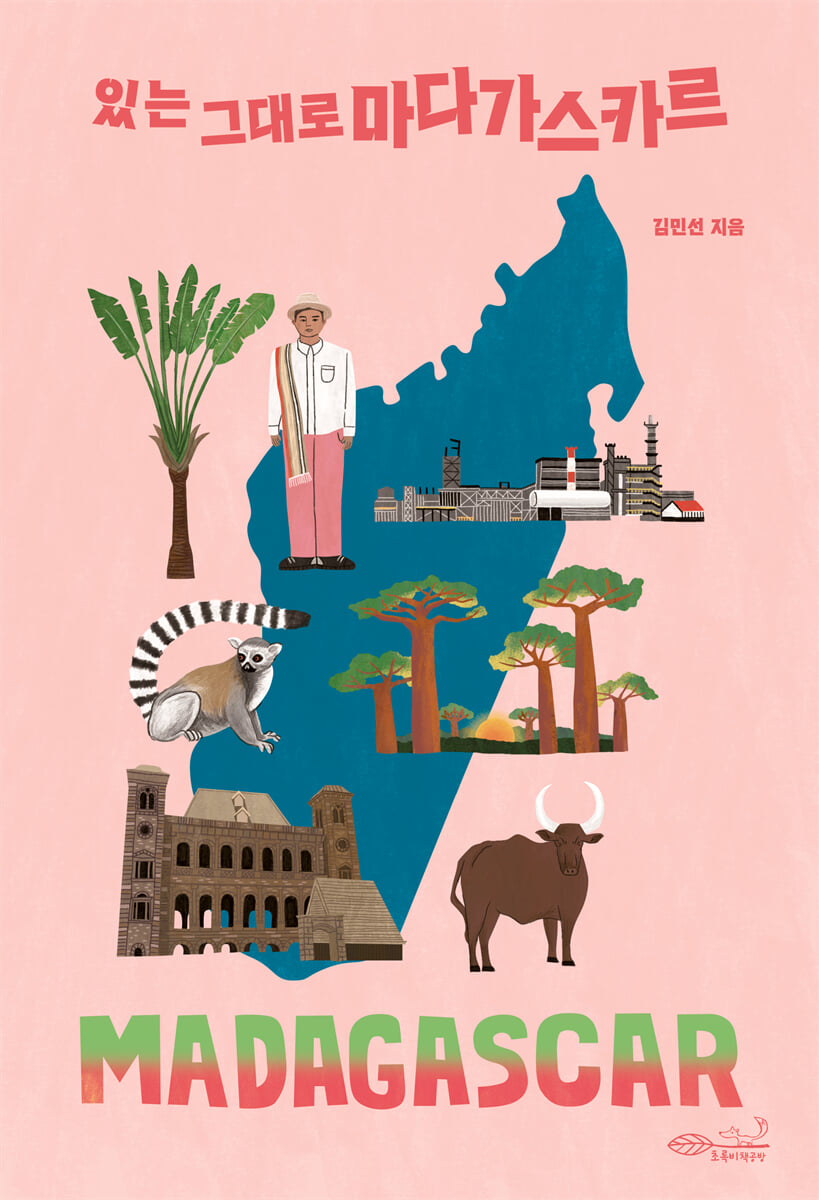
Madagascar as it is
 |
Description
Book Introduction
A place where wondrous ecosystems and unique cultures come alive
The world's fourth largest giant red island
Asia in Africa, Madagascar
Madagascar is an island nation located approximately 400 kilometers off the African continent, and is a unique country whose main population is people who came from the Asian continent, more than 4,800 kilometers away.
The indigenous language they use also has many similarities with languages used in Asia.
Malagasy people, who are familiar with Asian sentiments and culture, also show great interest in Korea.
We aim to move beyond low growth and onto the path of development, taking South Korea as an example, which has achieved both democracy and economic growth.
Thanks to the Korean Wave, people are becoming more familiar with Korean culture, including Taekwondo and the Korean language, and have a deep affection for Korea.
However, we have little interest in this island nation on the other side of the globe, and even very little information about it.
"Madagascar as It Is" is a book written by an author who worked as a diplomat in many countries around the world for over 20 years, introducing Madagascar, the poorest country in the world but the country that brought the biggest smiles.
You can get a glimpse of Madagascar's natural wonders, as well as its politics, economy, history, and culture, and the charm of the Malagasy people who are moving toward a better future despite difficult circumstances.
The world's fourth largest giant red island
Asia in Africa, Madagascar
Madagascar is an island nation located approximately 400 kilometers off the African continent, and is a unique country whose main population is people who came from the Asian continent, more than 4,800 kilometers away.
The indigenous language they use also has many similarities with languages used in Asia.
Malagasy people, who are familiar with Asian sentiments and culture, also show great interest in Korea.
We aim to move beyond low growth and onto the path of development, taking South Korea as an example, which has achieved both democracy and economic growth.
Thanks to the Korean Wave, people are becoming more familiar with Korean culture, including Taekwondo and the Korean language, and have a deep affection for Korea.
However, we have little interest in this island nation on the other side of the globe, and even very little information about it.
"Madagascar as It Is" is a book written by an author who worked as a diplomat in many countries around the world for over 20 years, introducing Madagascar, the poorest country in the world but the country that brought the biggest smiles.
You can get a glimpse of Madagascar's natural wonders, as well as its politics, economy, history, and culture, and the charm of the Malagasy people who are moving toward a better future despite difficult circumstances.
index
Recommendation
Prologue | Where Baobabs, Lemurs, and Beautiful People Are
Madagascar through quizzes
Part 1: Madagascar
The world's fourth largest island nation
A giant red island where droughts and floods occur simultaneously
Basic information about Madagascar
The Eighth Continent, a Treasure Trove of Biodiversity
All roads lead to 'Tana'
People living in Madagascar
Malagasy, the native language of Madagascar
Part 2: The Ins and Outs of the People of Madagascar
People who are hard-working, honest, and skilled with their hands
Sports loved by the people of Madagascar
Still, education is the only hope.
Leisure activities of teenagers
Transportation in Madagascar
Madagascar's best-selling products: rice and vanilla
Madagascar's largest nickel mine operated by South Korea
People who dig for gems with their bare hands
Madagascar, a country conducive to solar power generation
Beyond the Mystery of Madagascar
Part 3: Madagascar Through History
Early History of Madagascar
From unified Madagascar to colonization
Desire for independence
The dreams and frustrations of a newly independent nation
Back to democracy
Madagascar's foreign relations
Part 4: Madagascar through Culture
The worldview and identity of the Malagasy people, Padi
Kavari, Madagascar's unique literary performing art
From wedding to funeral
Made in Madagascar
The Madagascan people's love of music
Madagascar's food culture
The Diverse Religions of Madagascar
Part 5: If you go here, you will see Madagascar.
Where to see lemurs
The majestic Baobab Avenue, Murundaba
Fantasy Island, Nojibe
The romantic road to Ijalu National Park
UNESCO World Heritage Site, Ambu-i-Manga
Epilogue | Korea in Madagascar, Madagascar in Korea
References
Photo source
Prologue | Where Baobabs, Lemurs, and Beautiful People Are
Madagascar through quizzes
Part 1: Madagascar
The world's fourth largest island nation
A giant red island where droughts and floods occur simultaneously
Basic information about Madagascar
The Eighth Continent, a Treasure Trove of Biodiversity
All roads lead to 'Tana'
People living in Madagascar
Malagasy, the native language of Madagascar
Part 2: The Ins and Outs of the People of Madagascar
People who are hard-working, honest, and skilled with their hands
Sports loved by the people of Madagascar
Still, education is the only hope.
Leisure activities of teenagers
Transportation in Madagascar
Madagascar's best-selling products: rice and vanilla
Madagascar's largest nickel mine operated by South Korea
People who dig for gems with their bare hands
Madagascar, a country conducive to solar power generation
Beyond the Mystery of Madagascar
Part 3: Madagascar Through History
Early History of Madagascar
From unified Madagascar to colonization
Desire for independence
The dreams and frustrations of a newly independent nation
Back to democracy
Madagascar's foreign relations
Part 4: Madagascar through Culture
The worldview and identity of the Malagasy people, Padi
Kavari, Madagascar's unique literary performing art
From wedding to funeral
Made in Madagascar
The Madagascan people's love of music
Madagascar's food culture
The Diverse Religions of Madagascar
Part 5: If you go here, you will see Madagascar.
Where to see lemurs
The majestic Baobab Avenue, Murundaba
Fantasy Island, Nojibe
The romantic road to Ijalu National Park
UNESCO World Heritage Site, Ambu-i-Manga
Epilogue | Korea in Madagascar, Madagascar in Korea
References
Photo source
Detailed image

Into the book
Madagascar has evolved into a unique ecosystem since it separated from other continents approximately 90 million years ago.
Until the 5th century AD, when human habitation began, the introduction of foreign flora and fauna was extremely rare, and as a result, 90 percent of the flora and fauna currently living in Madagascar are endemic.
For this reason, Madagascar is a treasure trove of biodiversity and is called the 'eighth continent'.
Madagascar is home to a diverse range of ecosystems, including forests, grasslands, plains, rivers, lakes, wetlands, mangrove forests, deserts and coral reefs.
About 2,300 species of plants are used as medicinal herbs, but many of them are not commercialized and are only used as traditional medicines.
There are about 50 species of plants exported as medicinal herbs, and among them, Centella asiatica, a representative medicinal herb, is the main ingredient in the familiar Madecassol and Madeca cream.
The name 'Madeca' also comes from Madagascar.
If research and development of plants used as medicinal herbs proceeds, it is expected to greatly contribute to the advancement of medicine and to increasing income in Madagascar.
--- pp.40-41
Malagasy people are hard-working, honest, and skilled with their hands.
Many people who have done business in developing countries say that Malagasy workers have low absenteeism and are quick learners of manual tasks.
Their dexterity is particularly renowned, as can be seen in their traditional handicrafts.
The wages of Madagascar workers are very low.
The minimum wage is $41 per month, which is considerably low compared to countries like Bangladesh or Sri Lanka.
The availability of such a talented workforce at low wages provides a favorable environment for the development of the textile industry.
(…) Light industry for export contributes to the economic development of developing countries in many ways.
First, foreign currency earned through exports can be reinvested for economic development purposes such as infrastructure development.
Second, light industry has a greater job creation effect than service or heavy industry, and also contributes to income redistribution.
Third, industries with a high proportion of female workers, such as the textile industry, also contribute to women's education and empowerment.
--- pp.74-77
Taekwondo was first introduced to Madagascar from North Korea in the 1970s and 1980s.
Since the 2000s, the number of Taekwondo practitioners has gradually increased thanks to the efforts of Korean instructors, and currently, about 2,500 people are practicing Taekwondo.
Taekwondo is mainly practiced by people from the middle class and above, and there are about 20 active regional clubs.
Since President Andriy Rajoelina took office in 2019, interest in Taekwondo has grown even more.
The president's son also won the Madagascar Junior Taekwondo Championships.
President Andriy Rajoelina's love of Taekwondo was also reflected in state events.
Since 2019, a Taekwondo demonstration has been included in the annual Independence Day celebrations in June, an addition made at the request of the President himself.
Madagascar's Independence Day celebrations are the country's biggest events, held at the Mahamasina Stadium.
The event, attended by the President, key government officials, diplomatic corps and an estimated 40,000 spectators, is broadcast live across the country along with a military parade.
The Taekwondo demonstration also became one of the main attractions at the event.
--- pp.80-81
Investment in the Ambatovy nickel mine began in 2006, and full-scale production began in 2014.
There are large mineral deposits here that could produce for more than 30 years.
Initially, there was controversy over whether it was a good investment due to its lack of profitability, but recently, with the growth of the electric vehicle market, demand for nickel, a key raw material for secondary batteries, has skyrocketed, and its investment value is once again receiving attention.
Mineral development, especially overseas mineral resource development, is not something that can produce results in a short period of time.
Taking a longer-term view, we need to be patient and wait for results at the national level, not just for short-term gains, but to ensure the stability of the global supply chain in the medium to long term.
Expectations are high for the Ambatovy Nickel Plant, a state-of-the-art facility even for Madagascar.
The Ambatovy Nickel Plant is considered a national project, and its image appears on Madagascar's highest denomination banknote, the 20,000 ariary.
In addition to producing nickel, Ambatovy is also actively involved in environmental protection and social contribution activities for local residents.
If this mine continues to operate successfully, it will provide our country with a stable supply of key minerals and will also contribute significantly to Madagascar's economic development.
--- pp.113-115
Solar power is a new hope for Madagascar's poor power situation.
Madagascar has abundant sunlight, with an average annual sunshine duration of over 2,800 hours due to its low latitude, making it suitable for solar power generation.
(…) Solar streetlights with solar panels installed on wooden poles can be easily seen not only in the vicinity of Tana but also in remote rural areas.
Solar streetlights, which store electricity generated by solar energy during the day and are equipped with sensors that automatically turn on when it gets dark, are brightening up the pitch-black nights of a Madagascar village.
Several NGOs and renewable energy companies have formed a consortium called Solar United, which provides electricity to schools without electricity by installing solar panels, and is also running an interesting project called "Libraries of Light."
Just as you borrow books from the library to read, this library lends you light.
The idea is to charge solar flashlights during the day using solar panels installed in schools, and then lend these flashlights to children on their way home from school so they can turn them on and study in the evening.
Even if the electricity runs out, it can be recharged the next day, so children who receive solar flashlights can do their homework and read books without worry.
--- pp.122-123
Two peaceful transfers of power are often cited as the standard for democracy, and Madagascar, which achieved a peaceful transfer of power in the 2013 election and the 2018 election, has now become a true new democracy in Africa.
This marks the return of President Andriy Rajoelina to the presidency, 10 years after he seized power in a 2009 coup and five years after he was forced out of power by President Eri in 2014.
Because Madagascar's political situation was so chaotic from 2009 to 2014, there were significant concerns about political stability in the early days of the new government.
However, President Andriy Rajoelina has been running the country relatively stably, reflecting on past failures.
(…) In the November 2023 presidential election, President Andriy Rajoelina won 59 percent of the vote and was re-elected for a five-year term starting in January 2024.
I sincerely hope that he will go down in history as a successful president who restored Madagascar's economy and improved the lives of its people after the COVID-19 pandemic.
--- pp.157-158
In Malagasy society, there are traditional 'don'ts', called 'Fady'.
It is usually translated as 'taboo', but it does not necessarily refer only to taboos.
Treating a place as sacred is also a form of padi.
Padi refers to the totality of rules that govern the world, from situations, people, animals, and places to behavior.
Padi, which is closely linked to the worldview and identity of the Malagasy people, is combined with the practice of ancestor worship, leading to the natural logic that if Padi is not observed, one will be cursed by one's ancestors.
(…) There is no need to dismiss Padi as a superstition or an outdated custom.
If you think about it, there are countless Korean customs in our country, such as writing your name in red is considered unlucky, sticking a spoon in a rice bowl is something you only do for the dead, and finding an auspicious day when deciding on a moving or wedding date.
The Madagascar Fadi, which requires pointing to ancestral graves with the palm of one's hand instead of one's finger and not wearing red to funerals, is not much different from our own, which considers pointing at people or wearing flashy clothes to funerals to be rude.
No matter which country or region you go to, there are bound to be unique customs.
As a foreigner, keeping the customs as much as possible is also an expression of respect for the local people.
--- pp.167-169
French is often referred to as the language of romantic love, but Malagasy is a literary language in itself.
In Madagascar, time is not expressed in numbers, but rather in words that best describe the moment.
2 a.m. is called 'the time when frogs croak', 5 a.m. is called 'the time when crows croak', and 5 p.m. is called 'the time when the sun touches the western wall'.
Malagasy literature, with its remarkable expressive power, was transmitted primarily through oral tradition.
Among them, the unique literary performance art called 'Kabary' is famous.
Kavari, which is also registered as a UNESCO Intangible Cultural Heritage, is a literary work that mixes poetry and prose presented in the form of a speech in front of an audience.
It has a similar format to stand-up comedy, but the content ranges from serious to sad to funny.
Kabari was originally a form used by village leaders to inform residents of administrative notices or social ceremonies.
Nowadays, it is performed in various occasions such as festivals, official events, weddings and funerals.
Kavari is practiced throughout Madagascar and all over the world, wherever there are Malagasy immigrants.
--- pp.172-173
In Madagascar, there is a traditional funeral custom called 'Famadihana'.
First, when a family member dies, the body is placed in the family grave.
After a certain amount of time has passed (usually 5 to 7 years, it is said that the ancestral spirit appears in a dream and tells the person that it is time to perform a permadi), the body is taken out, the remains are cleaned, wrapped in a new silk cloth, and the name is written on it.
Then, several people carry the body over their heads and parade it around the village, performing the Kabari ritual, before placing the body back in the family grave.
At this time, relatives sometimes put money or alcohol they brought for the deceased.
When marching, not only immediate family members but also relatives and villagers participate, singing and dancing to celebrate happily.
Pamadhihana is based on the belief that the soul of the deceased must undergo appropriate rituals when the body has completely decomposed and only bones remain in order to enter the world of the ancestors.
What's unusual is that they don't sing sad songs, but happy songs and dance cheerfully.
Rather than missing and grieving the deceased, it is better to remember the deceased's life happily and to remember that he or she will not disappear forever but will remain with us forever as an ancestral spirit.
----- pp.178-179
Even though I've seen many pictures of the giant baobab tree standing tall on the barren land, I can't help but exclaim in awe.
You can see baobabs all over the city, but Baobab Avenue is especially special because it is lined with baobabs on both sides of the street.
This place is also beautiful for its sunsets, so I recommend visiting once during the day and once at sunset.
Of course, if you are a diligent traveler, it is worth stopping by again at sunrise.
There isn't really anything special to see, but just looking at the baobab trees makes you lose track of time.
Because the sunset time is short, you should check the time in advance and leave with plenty of time to fully enjoy the scenery from sunset to sunset.
When you reach Baobab Street, you may be surprised to suddenly see the Taegeukgi and Korean signs.
This is the ‘Dreaming Library’ built by photographer Shin Mi-sik and donated to the local community.
It is a small but peaceful place in Murundaba, where many people dream and hope to achieve their dreams.
Until the 5th century AD, when human habitation began, the introduction of foreign flora and fauna was extremely rare, and as a result, 90 percent of the flora and fauna currently living in Madagascar are endemic.
For this reason, Madagascar is a treasure trove of biodiversity and is called the 'eighth continent'.
Madagascar is home to a diverse range of ecosystems, including forests, grasslands, plains, rivers, lakes, wetlands, mangrove forests, deserts and coral reefs.
About 2,300 species of plants are used as medicinal herbs, but many of them are not commercialized and are only used as traditional medicines.
There are about 50 species of plants exported as medicinal herbs, and among them, Centella asiatica, a representative medicinal herb, is the main ingredient in the familiar Madecassol and Madeca cream.
The name 'Madeca' also comes from Madagascar.
If research and development of plants used as medicinal herbs proceeds, it is expected to greatly contribute to the advancement of medicine and to increasing income in Madagascar.
--- pp.40-41
Malagasy people are hard-working, honest, and skilled with their hands.
Many people who have done business in developing countries say that Malagasy workers have low absenteeism and are quick learners of manual tasks.
Their dexterity is particularly renowned, as can be seen in their traditional handicrafts.
The wages of Madagascar workers are very low.
The minimum wage is $41 per month, which is considerably low compared to countries like Bangladesh or Sri Lanka.
The availability of such a talented workforce at low wages provides a favorable environment for the development of the textile industry.
(…) Light industry for export contributes to the economic development of developing countries in many ways.
First, foreign currency earned through exports can be reinvested for economic development purposes such as infrastructure development.
Second, light industry has a greater job creation effect than service or heavy industry, and also contributes to income redistribution.
Third, industries with a high proportion of female workers, such as the textile industry, also contribute to women's education and empowerment.
--- pp.74-77
Taekwondo was first introduced to Madagascar from North Korea in the 1970s and 1980s.
Since the 2000s, the number of Taekwondo practitioners has gradually increased thanks to the efforts of Korean instructors, and currently, about 2,500 people are practicing Taekwondo.
Taekwondo is mainly practiced by people from the middle class and above, and there are about 20 active regional clubs.
Since President Andriy Rajoelina took office in 2019, interest in Taekwondo has grown even more.
The president's son also won the Madagascar Junior Taekwondo Championships.
President Andriy Rajoelina's love of Taekwondo was also reflected in state events.
Since 2019, a Taekwondo demonstration has been included in the annual Independence Day celebrations in June, an addition made at the request of the President himself.
Madagascar's Independence Day celebrations are the country's biggest events, held at the Mahamasina Stadium.
The event, attended by the President, key government officials, diplomatic corps and an estimated 40,000 spectators, is broadcast live across the country along with a military parade.
The Taekwondo demonstration also became one of the main attractions at the event.
--- pp.80-81
Investment in the Ambatovy nickel mine began in 2006, and full-scale production began in 2014.
There are large mineral deposits here that could produce for more than 30 years.
Initially, there was controversy over whether it was a good investment due to its lack of profitability, but recently, with the growth of the electric vehicle market, demand for nickel, a key raw material for secondary batteries, has skyrocketed, and its investment value is once again receiving attention.
Mineral development, especially overseas mineral resource development, is not something that can produce results in a short period of time.
Taking a longer-term view, we need to be patient and wait for results at the national level, not just for short-term gains, but to ensure the stability of the global supply chain in the medium to long term.
Expectations are high for the Ambatovy Nickel Plant, a state-of-the-art facility even for Madagascar.
The Ambatovy Nickel Plant is considered a national project, and its image appears on Madagascar's highest denomination banknote, the 20,000 ariary.
In addition to producing nickel, Ambatovy is also actively involved in environmental protection and social contribution activities for local residents.
If this mine continues to operate successfully, it will provide our country with a stable supply of key minerals and will also contribute significantly to Madagascar's economic development.
--- pp.113-115
Solar power is a new hope for Madagascar's poor power situation.
Madagascar has abundant sunlight, with an average annual sunshine duration of over 2,800 hours due to its low latitude, making it suitable for solar power generation.
(…) Solar streetlights with solar panels installed on wooden poles can be easily seen not only in the vicinity of Tana but also in remote rural areas.
Solar streetlights, which store electricity generated by solar energy during the day and are equipped with sensors that automatically turn on when it gets dark, are brightening up the pitch-black nights of a Madagascar village.
Several NGOs and renewable energy companies have formed a consortium called Solar United, which provides electricity to schools without electricity by installing solar panels, and is also running an interesting project called "Libraries of Light."
Just as you borrow books from the library to read, this library lends you light.
The idea is to charge solar flashlights during the day using solar panels installed in schools, and then lend these flashlights to children on their way home from school so they can turn them on and study in the evening.
Even if the electricity runs out, it can be recharged the next day, so children who receive solar flashlights can do their homework and read books without worry.
--- pp.122-123
Two peaceful transfers of power are often cited as the standard for democracy, and Madagascar, which achieved a peaceful transfer of power in the 2013 election and the 2018 election, has now become a true new democracy in Africa.
This marks the return of President Andriy Rajoelina to the presidency, 10 years after he seized power in a 2009 coup and five years after he was forced out of power by President Eri in 2014.
Because Madagascar's political situation was so chaotic from 2009 to 2014, there were significant concerns about political stability in the early days of the new government.
However, President Andriy Rajoelina has been running the country relatively stably, reflecting on past failures.
(…) In the November 2023 presidential election, President Andriy Rajoelina won 59 percent of the vote and was re-elected for a five-year term starting in January 2024.
I sincerely hope that he will go down in history as a successful president who restored Madagascar's economy and improved the lives of its people after the COVID-19 pandemic.
--- pp.157-158
In Malagasy society, there are traditional 'don'ts', called 'Fady'.
It is usually translated as 'taboo', but it does not necessarily refer only to taboos.
Treating a place as sacred is also a form of padi.
Padi refers to the totality of rules that govern the world, from situations, people, animals, and places to behavior.
Padi, which is closely linked to the worldview and identity of the Malagasy people, is combined with the practice of ancestor worship, leading to the natural logic that if Padi is not observed, one will be cursed by one's ancestors.
(…) There is no need to dismiss Padi as a superstition or an outdated custom.
If you think about it, there are countless Korean customs in our country, such as writing your name in red is considered unlucky, sticking a spoon in a rice bowl is something you only do for the dead, and finding an auspicious day when deciding on a moving or wedding date.
The Madagascar Fadi, which requires pointing to ancestral graves with the palm of one's hand instead of one's finger and not wearing red to funerals, is not much different from our own, which considers pointing at people or wearing flashy clothes to funerals to be rude.
No matter which country or region you go to, there are bound to be unique customs.
As a foreigner, keeping the customs as much as possible is also an expression of respect for the local people.
--- pp.167-169
French is often referred to as the language of romantic love, but Malagasy is a literary language in itself.
In Madagascar, time is not expressed in numbers, but rather in words that best describe the moment.
2 a.m. is called 'the time when frogs croak', 5 a.m. is called 'the time when crows croak', and 5 p.m. is called 'the time when the sun touches the western wall'.
Malagasy literature, with its remarkable expressive power, was transmitted primarily through oral tradition.
Among them, the unique literary performance art called 'Kabary' is famous.
Kavari, which is also registered as a UNESCO Intangible Cultural Heritage, is a literary work that mixes poetry and prose presented in the form of a speech in front of an audience.
It has a similar format to stand-up comedy, but the content ranges from serious to sad to funny.
Kabari was originally a form used by village leaders to inform residents of administrative notices or social ceremonies.
Nowadays, it is performed in various occasions such as festivals, official events, weddings and funerals.
Kavari is practiced throughout Madagascar and all over the world, wherever there are Malagasy immigrants.
--- pp.172-173
In Madagascar, there is a traditional funeral custom called 'Famadihana'.
First, when a family member dies, the body is placed in the family grave.
After a certain amount of time has passed (usually 5 to 7 years, it is said that the ancestral spirit appears in a dream and tells the person that it is time to perform a permadi), the body is taken out, the remains are cleaned, wrapped in a new silk cloth, and the name is written on it.
Then, several people carry the body over their heads and parade it around the village, performing the Kabari ritual, before placing the body back in the family grave.
At this time, relatives sometimes put money or alcohol they brought for the deceased.
When marching, not only immediate family members but also relatives and villagers participate, singing and dancing to celebrate happily.
Pamadhihana is based on the belief that the soul of the deceased must undergo appropriate rituals when the body has completely decomposed and only bones remain in order to enter the world of the ancestors.
What's unusual is that they don't sing sad songs, but happy songs and dance cheerfully.
Rather than missing and grieving the deceased, it is better to remember the deceased's life happily and to remember that he or she will not disappear forever but will remain with us forever as an ancestral spirit.
----- pp.178-179
Even though I've seen many pictures of the giant baobab tree standing tall on the barren land, I can't help but exclaim in awe.
You can see baobabs all over the city, but Baobab Avenue is especially special because it is lined with baobabs on both sides of the street.
This place is also beautiful for its sunsets, so I recommend visiting once during the day and once at sunset.
Of course, if you are a diligent traveler, it is worth stopping by again at sunrise.
There isn't really anything special to see, but just looking at the baobab trees makes you lose track of time.
Because the sunset time is short, you should check the time in advance and leave with plenty of time to fully enjoy the scenery from sunset to sunset.
When you reach Baobab Street, you may be surprised to suddenly see the Taegeukgi and Korean signs.
This is the ‘Dreaming Library’ built by photographer Shin Mi-sik and donated to the local community.
It is a small but peaceful place in Murundaba, where many people dream and hope to achieve their dreams.
----- pp.214-216
Publisher's Review
A country with a blessed natural environment and abundant natural resources
Breaking free from the swamp of low growth and preparing for a new future
Modern people often dream of escaping reality and entering an unknown world.
Perhaps due to the influence of Disney animation, Madagascar is perceived by us as a paradise where we would like to escape to one day.
In Madagascar, lemurs, found nowhere else on Earth, leap between baobabs and cypresses, and bizarre rock formations that predate human habitation create a spectacular sight.
Also, in a world with emerald beaches, exotic people live peacefully, speaking their own language.
This is similar to the appearance of an imaginary utopia.
But the reality in Madagascar is far from ideal.
Madagascar is ranked as one of the poorest countries in the world in terms of various economic indicators, including national income, absolute poverty line, and human development index.
Why has Madagascar fallen into a swamp of low growth without major catastrophes like natural disasters or civil wars? The answer lies in policy failure.
Madagascar, which suffered a major economic crisis due to the failure of its socialist economic policies, is now preparing for a new future based on its abundant young workforce and the government's economic development policies.
For Madagascar, which dreams of such change, South Korea is a country that provides great inspiration.
The development of South Korea, which rose from a country under the colonial rule of a powerful nation to an economic powerhouse, offers hope to Madagascar.
Created by unique traditions and culture
Malagasy identity and national character
Become a driving force for development
Although Madagascar is part of the African continent, most of its population is of Asian descent, and Asian sentiments permeate every aspect of life.
Madagascar, which calls itself the 'Asia of Africa', has its own unique traditions and culture.
A representative example is the funeral ritual called 'Pamadhihana', in which the body of the deceased is taken out, the remains are cleaned, wrapped in new silk cloth, and then the ritual is performed around the village.
There are also unique cultures such as the literary and performing arts called 'Kavari', but there are also many aspects that are similar to our country.
First of all, the social atmosphere of worshipping ancestors and respecting elders is not unfamiliar.
It is also interesting to note that Malagasy, the native language of Madagascar, has honorifics.
Madagascar's worldview and identity, 'Fadi', has many things in common with customs that are taboo in our country, and the Madagascar song 'Hiragashi' is similar to our sadangpae.
Also, the food culture of eating rice, soup, and side dishes as staple foods is surprisingly similar to our dining table.
Above all, the Malagasy people, with their hard-working and honest national character, look like Koreans.
Just as South Korea, which developed by focusing on light industry during its economic growth period and relying on cheap and abundant labor, the national character of Madagascar will become a powerful driving force for the country's economic growth.
The power struggle between the US and China, the Russia-Ukraine war, and the logistics crisis in the Middle East…
A time of intensifying geopolitical conflict
Why You Should Care About Madagascar
Looking at the current relationship between Madagascar and Korea, Madagascar has been consistently sending us love calls, both economically and culturally.
In particular, the Ambatovy Nickel Plant, a national project in Madagascar, is operated in cooperation with our country.
Furthermore, Korean culture has already deeply permeated Madagascar, with the popularity of K-pop and K-dramas, Taekwondo performances becoming a main event at Madagascar's Independence Day celebrations, and Korean language contests with hundreds of participants.
However, it is difficult to find information about Madagascar in our country.
This shows that we lack interest in Madagascar.
We can no longer overlook this.
In a current climate of deepening geopolitical conflicts, including the US-China rivalry, the Russia-Ukraine war, and the logistics crisis in the Middle East, Madagascar, with its abundant natural resources, can serve as a stable source of raw materials.
Additionally, Madagascar products, with their low labor costs and tariff benefits in the U.S. and European markets, can provide a stable production and export environment for our country's manufacturing industry.
I hope that this book, filled with a loving perspective and objective analysis of Madagascar, will serve as a catalyst for stimulating interest in the country.
Furthermore, I hope this will serve as an opportunity to think about what role we should play in low-growth countries around the world, starting with Madagascar.
*** This book is composed of post-reading activity sheets with topics and questions related to various topics.
What is my first multicultural class series?
In today's world where we live with people of all nationalities, we need to understand cultural diversity.
The 'My First Multicultural Class Series' tells stories from various countries around the world that young people have heard of but are not familiar with, in an easy and fun way that is tailored to the perspective of young people.
This series is designed to foster cultural diversity and an open-minded perspective, and to help develop a broader perspective on the world.
Breaking free from the swamp of low growth and preparing for a new future
Modern people often dream of escaping reality and entering an unknown world.
Perhaps due to the influence of Disney animation, Madagascar is perceived by us as a paradise where we would like to escape to one day.
In Madagascar, lemurs, found nowhere else on Earth, leap between baobabs and cypresses, and bizarre rock formations that predate human habitation create a spectacular sight.
Also, in a world with emerald beaches, exotic people live peacefully, speaking their own language.
This is similar to the appearance of an imaginary utopia.
But the reality in Madagascar is far from ideal.
Madagascar is ranked as one of the poorest countries in the world in terms of various economic indicators, including national income, absolute poverty line, and human development index.
Why has Madagascar fallen into a swamp of low growth without major catastrophes like natural disasters or civil wars? The answer lies in policy failure.
Madagascar, which suffered a major economic crisis due to the failure of its socialist economic policies, is now preparing for a new future based on its abundant young workforce and the government's economic development policies.
For Madagascar, which dreams of such change, South Korea is a country that provides great inspiration.
The development of South Korea, which rose from a country under the colonial rule of a powerful nation to an economic powerhouse, offers hope to Madagascar.
Created by unique traditions and culture
Malagasy identity and national character
Become a driving force for development
Although Madagascar is part of the African continent, most of its population is of Asian descent, and Asian sentiments permeate every aspect of life.
Madagascar, which calls itself the 'Asia of Africa', has its own unique traditions and culture.
A representative example is the funeral ritual called 'Pamadhihana', in which the body of the deceased is taken out, the remains are cleaned, wrapped in new silk cloth, and then the ritual is performed around the village.
There are also unique cultures such as the literary and performing arts called 'Kavari', but there are also many aspects that are similar to our country.
First of all, the social atmosphere of worshipping ancestors and respecting elders is not unfamiliar.
It is also interesting to note that Malagasy, the native language of Madagascar, has honorifics.
Madagascar's worldview and identity, 'Fadi', has many things in common with customs that are taboo in our country, and the Madagascar song 'Hiragashi' is similar to our sadangpae.
Also, the food culture of eating rice, soup, and side dishes as staple foods is surprisingly similar to our dining table.
Above all, the Malagasy people, with their hard-working and honest national character, look like Koreans.
Just as South Korea, which developed by focusing on light industry during its economic growth period and relying on cheap and abundant labor, the national character of Madagascar will become a powerful driving force for the country's economic growth.
The power struggle between the US and China, the Russia-Ukraine war, and the logistics crisis in the Middle East…
A time of intensifying geopolitical conflict
Why You Should Care About Madagascar
Looking at the current relationship between Madagascar and Korea, Madagascar has been consistently sending us love calls, both economically and culturally.
In particular, the Ambatovy Nickel Plant, a national project in Madagascar, is operated in cooperation with our country.
Furthermore, Korean culture has already deeply permeated Madagascar, with the popularity of K-pop and K-dramas, Taekwondo performances becoming a main event at Madagascar's Independence Day celebrations, and Korean language contests with hundreds of participants.
However, it is difficult to find information about Madagascar in our country.
This shows that we lack interest in Madagascar.
We can no longer overlook this.
In a current climate of deepening geopolitical conflicts, including the US-China rivalry, the Russia-Ukraine war, and the logistics crisis in the Middle East, Madagascar, with its abundant natural resources, can serve as a stable source of raw materials.
Additionally, Madagascar products, with their low labor costs and tariff benefits in the U.S. and European markets, can provide a stable production and export environment for our country's manufacturing industry.
I hope that this book, filled with a loving perspective and objective analysis of Madagascar, will serve as a catalyst for stimulating interest in the country.
Furthermore, I hope this will serve as an opportunity to think about what role we should play in low-growth countries around the world, starting with Madagascar.
*** This book is composed of post-reading activity sheets with topics and questions related to various topics.
What is my first multicultural class series?
In today's world where we live with people of all nationalities, we need to understand cultural diversity.
The 'My First Multicultural Class Series' tells stories from various countries around the world that young people have heard of but are not familiar with, in an easy and fun way that is tailored to the perspective of young people.
This series is designed to foster cultural diversity and an open-minded perspective, and to help develop a broader perspective on the world.
GOODS SPECIFICS
- Date of issue: December 30, 2024
- Page count, weight, size: 236 pages | 304g | 140*205*15mm
- ISBN13: 9791193296790
You may also like
카테고리
korean


korean

![GQ KOREA Mark (Monthly): December [2025]](http://librairie.coreenne.fr/cdn/shop/files/8ef265dbbfbf186523ed75ba7319009d.jpg?v=1765340328&width=3840)


