

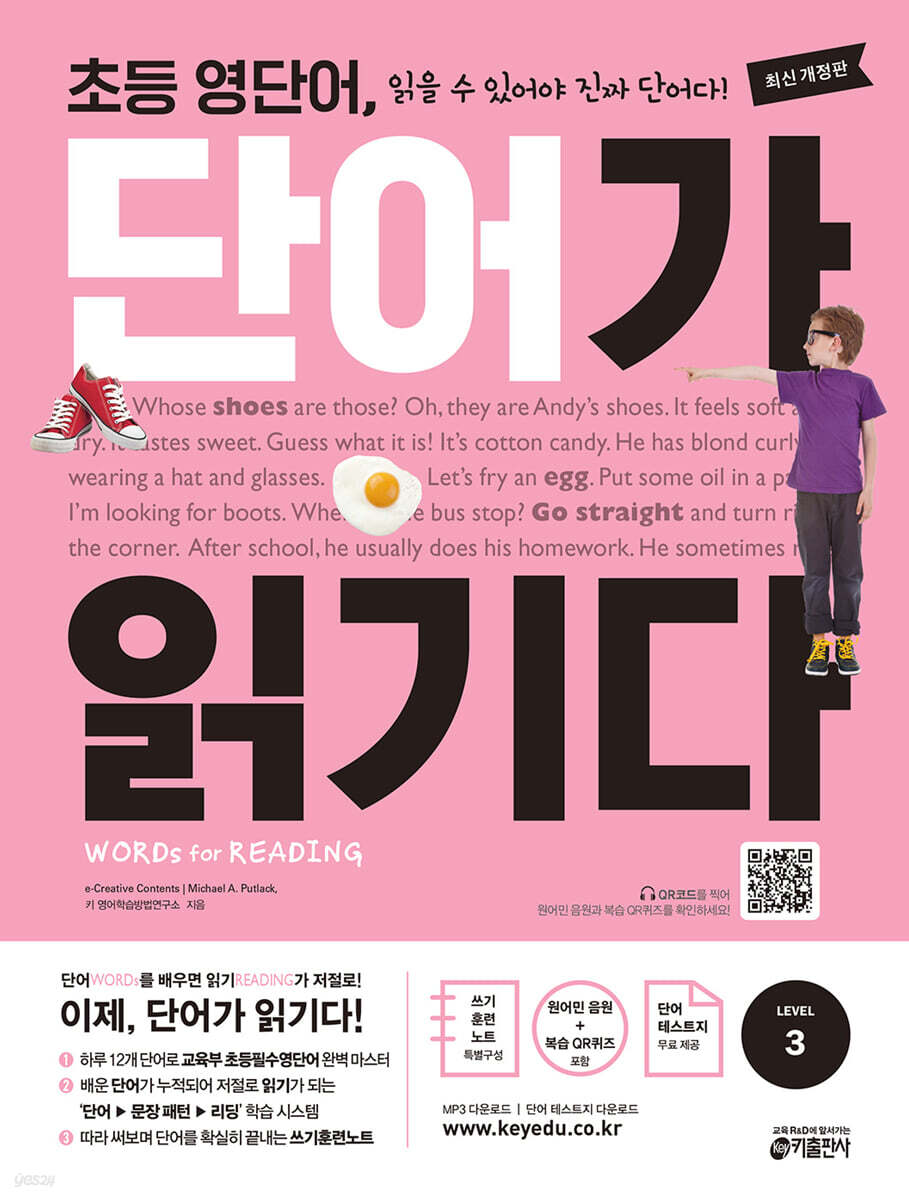
Elementary English Vocabulary Word Reading Level 3
 |
Description
Book Introduction
The latest revised edition of the "Elementary Words for Reading" series has been released.
Learn elementary vocabulary and read sentences all at once!
The "Elementary Words are Reading" series, which has been consistently loved since its publication, has returned with a new, revised edition that enhances sentence learning and review functions.
This series, which has been well-received by many learners with its spiral expansion learning system that goes from words → sentence patterns → reading, is structured so that students can gradually learn 1,000 essential elementary English words recommended by the Ministry of Education, 100 key sentences from textbooks, and 90 reading pieces.
This revised edition has been further improved in terms of structure, focusing on strengthening sentence structure and expanding review functions.
In line with the latest curriculum trends, writing activities have been added for each unit, allowing students to write representative sentences directly, making sentence writing practice more systematic.
Additionally, we've added a new review quiz with a total of 1,800 questions that can be accessed directly via QR code, allowing you to review the words and sentences you've learned on your own.
Even if you memorize just one word, you can connect it to a sentence, and thanks to the structure that naturally repeats in the reading passage, you can go beyond simple memorization and make it your own by reading and writing.
This revised edition maintains the easy and fun structure suited to elementary school students, while evolving into the most effective vocabulary book that develops both sentence structure and reading skills.
Learn elementary vocabulary and read sentences all at once!
The "Elementary Words are Reading" series, which has been consistently loved since its publication, has returned with a new, revised edition that enhances sentence learning and review functions.
This series, which has been well-received by many learners with its spiral expansion learning system that goes from words → sentence patterns → reading, is structured so that students can gradually learn 1,000 essential elementary English words recommended by the Ministry of Education, 100 key sentences from textbooks, and 90 reading pieces.
This revised edition has been further improved in terms of structure, focusing on strengthening sentence structure and expanding review functions.
In line with the latest curriculum trends, writing activities have been added for each unit, allowing students to write representative sentences directly, making sentence writing practice more systematic.
Additionally, we've added a new review quiz with a total of 1,800 questions that can be accessed directly via QR code, allowing you to review the words and sentences you've learned on your own.
Even if you memorize just one word, you can connect it to a sentence, and thanks to the structure that naturally repeats in the reading passage, you can go beyond simple memorization and make it your own by reading and writing.
This revised edition maintains the easy and fun structure suited to elementary school students, while evolving into the most effective vocabulary book that develops both sentence structure and reading skills.
- You can preview some of the book's contents.
Preview
index
[Main book]
Day 1 Where are you from?
Day 2 This camera is mine.
Day 3 My favorite subject is PE
Day 4 Do you want some more?
Day 5 It tastes good.
Review Test 1
Day 6 There is a mirror on the wall.
Day 7 Put some salt on the egg.
Day 8 Do you know this man?
Day 9 What does he look like?
Day 10 She is so smart.
Review Test 2
Day 11 We have many high mountains.
Day 12 What a clear lake!
Day 13 I'm looking for jeans.
Day 14 I work at an airport.
Day 15 Where is the bank?
Review Test 3
Day 16 Can you come to my concert?
Day 17 Can I borrow a pen, please?
Day 18 May I speak to Andy?
Day 19 I get up at 8 AM
Day 20 I usually read books.
Review Test 4
Day 21 How about eating out?
Day 22 Ants and bees are small.
Day 23 You need to exercise.
Day 24 I have to hurry up.
Day 25 You should ask questions in class.
Review Test 5
Answer and explanation
[Workbook]
- Review box
- Word and sentence writing notes
Day 1 Where are you from?
Day 2 This camera is mine.
Day 3 My favorite subject is PE
Day 4 Do you want some more?
Day 5 It tastes good.
Review Test 1
Day 6 There is a mirror on the wall.
Day 7 Put some salt on the egg.
Day 8 Do you know this man?
Day 9 What does he look like?
Day 10 She is so smart.
Review Test 2
Day 11 We have many high mountains.
Day 12 What a clear lake!
Day 13 I'm looking for jeans.
Day 14 I work at an airport.
Day 15 Where is the bank?
Review Test 3
Day 16 Can you come to my concert?
Day 17 Can I borrow a pen, please?
Day 18 May I speak to Andy?
Day 19 I get up at 8 AM
Day 20 I usually read books.
Review Test 4
Day 21 How about eating out?
Day 22 Ants and bees are small.
Day 23 You need to exercise.
Day 24 I have to hurry up.
Day 25 You should ask questions in class.
Review Test 5
Answer and explanation
[Workbook]
- Review box
- Word and sentence writing notes
Detailed image
.jpg)
Publisher's Review
An elementary English vocabulary series that will make reading a breeze once you learn the words!
I memorize a lot of words, but why do I have trouble with sentences?
Have you ever wondered why children who diligently memorize English vocabulary often get stuck and struggle to understand sentences when they actually read them? It's because they know the meaning of the words, but they don't know how they're used in a sentence.
Ultimately, these children are unable to accurately grasp the meaning of sentences and develop a habit of vaguely 'guessing' sentences based on their background knowledge.
This habit gradually reduces the ability to understand accurate sentences, and ultimately becomes a major obstacle in difficult English learning situations such as the CSAT and in situations where information must be received in English.
A sentence is not a list or combination of words, but a unit of meaning in which each word performs its own role within a set structure.
Therefore, it is essential to learn not only the meaning of words but also how to use them in sentences.
Learning words in sentences will change your English skills.
The “Words are Reading” series does not simply memorize words.
It is structured so that you can learn how to use words naturally in sentences.
Through this learning process, children can naturally learn the meaning and usage of words, develop the ability to interpret sentences, and even develop a sense of English across all areas of reading, speaking, and writing.
This organic system, which moves from words to sentences and from sentences to reading, helps children grow not only into children with a large vocabulary, but also into children who can accurately understand and express English sentences.
Why is the "Words are Reading" series good?
1.
School English becomes easier with textbooks as the foundation.
We thoroughly analyzed English textbooks for 3rd to 6th grade elementary school students to include topics and sentences that are actually taught in class.
Based on the 800 elementary school words designated by the Ministry of Education, it is naturally linked to public education classes and builds confidence in school English.
It's long.
2.
Learn 10 to 12 words a day, easily and consistently, by topic.
With a 10-word daily learning structure, even children who are just beginning to learn English can start without any burden and build a consistent learning habit.
Because you learn words by topic, it's easy to remember, and because you learn words with pictures, pronunciation, and spelling, you can learn easily and efficiently.
3.
Expand from word - phrase - sentence - reading.
Don't just memorize words; learn how to use them in sentences.
You can naturally develop your real English skills by learning how the words you learn are used in real sentences.
4.
Vocabulary skills are linked to sentence skills.
It is designed to allow children who only know the meaning of words but have difficulty applying them to sentences to repeatedly expose and practice their usage in sentences.
You can develop both sentence structure and comprehension through a learning method that expands from 'word - phrase - sentence - reading'.
I memorize a lot of words, but why do I have trouble with sentences?
Have you ever wondered why children who diligently memorize English vocabulary often get stuck and struggle to understand sentences when they actually read them? It's because they know the meaning of the words, but they don't know how they're used in a sentence.
Ultimately, these children are unable to accurately grasp the meaning of sentences and develop a habit of vaguely 'guessing' sentences based on their background knowledge.
This habit gradually reduces the ability to understand accurate sentences, and ultimately becomes a major obstacle in difficult English learning situations such as the CSAT and in situations where information must be received in English.
A sentence is not a list or combination of words, but a unit of meaning in which each word performs its own role within a set structure.
Therefore, it is essential to learn not only the meaning of words but also how to use them in sentences.
Learning words in sentences will change your English skills.
The “Words are Reading” series does not simply memorize words.
It is structured so that you can learn how to use words naturally in sentences.
Through this learning process, children can naturally learn the meaning and usage of words, develop the ability to interpret sentences, and even develop a sense of English across all areas of reading, speaking, and writing.
This organic system, which moves from words to sentences and from sentences to reading, helps children grow not only into children with a large vocabulary, but also into children who can accurately understand and express English sentences.
Why is the "Words are Reading" series good?
1.
School English becomes easier with textbooks as the foundation.
We thoroughly analyzed English textbooks for 3rd to 6th grade elementary school students to include topics and sentences that are actually taught in class.
Based on the 800 elementary school words designated by the Ministry of Education, it is naturally linked to public education classes and builds confidence in school English.
It's long.
2.
Learn 10 to 12 words a day, easily and consistently, by topic.
With a 10-word daily learning structure, even children who are just beginning to learn English can start without any burden and build a consistent learning habit.
Because you learn words by topic, it's easy to remember, and because you learn words with pictures, pronunciation, and spelling, you can learn easily and efficiently.
3.
Expand from word - phrase - sentence - reading.
Don't just memorize words; learn how to use them in sentences.
You can naturally develop your real English skills by learning how the words you learn are used in real sentences.
4.
Vocabulary skills are linked to sentence skills.
It is designed to allow children who only know the meaning of words but have difficulty applying them to sentences to repeatedly expose and practice their usage in sentences.
You can develop both sentence structure and comprehension through a learning method that expands from 'word - phrase - sentence - reading'.
GOODS SPECIFICS
- Date of issue: September 26, 2025
- Page count, weight, size: 264 pages | 210*277*12mm
- ISBN13: 9791165263386
- ISBN10: 1165263386
- KC Certification: Certification Type: Conformity Confirmation
You may also like
카테고리
korean


korean

![GQ KOREA Mark (Monthly): December [2025]](http://librairie.coreenne.fr/cdn/shop/files/8ef265dbbfbf186523ed75ba7319009d.jpg?v=1765340328&width=3840)


