

Korean History vs. World History 4
 |
Description
Book Introduction
*Seoul National University's three history-related departments were integrated into the Department of History.
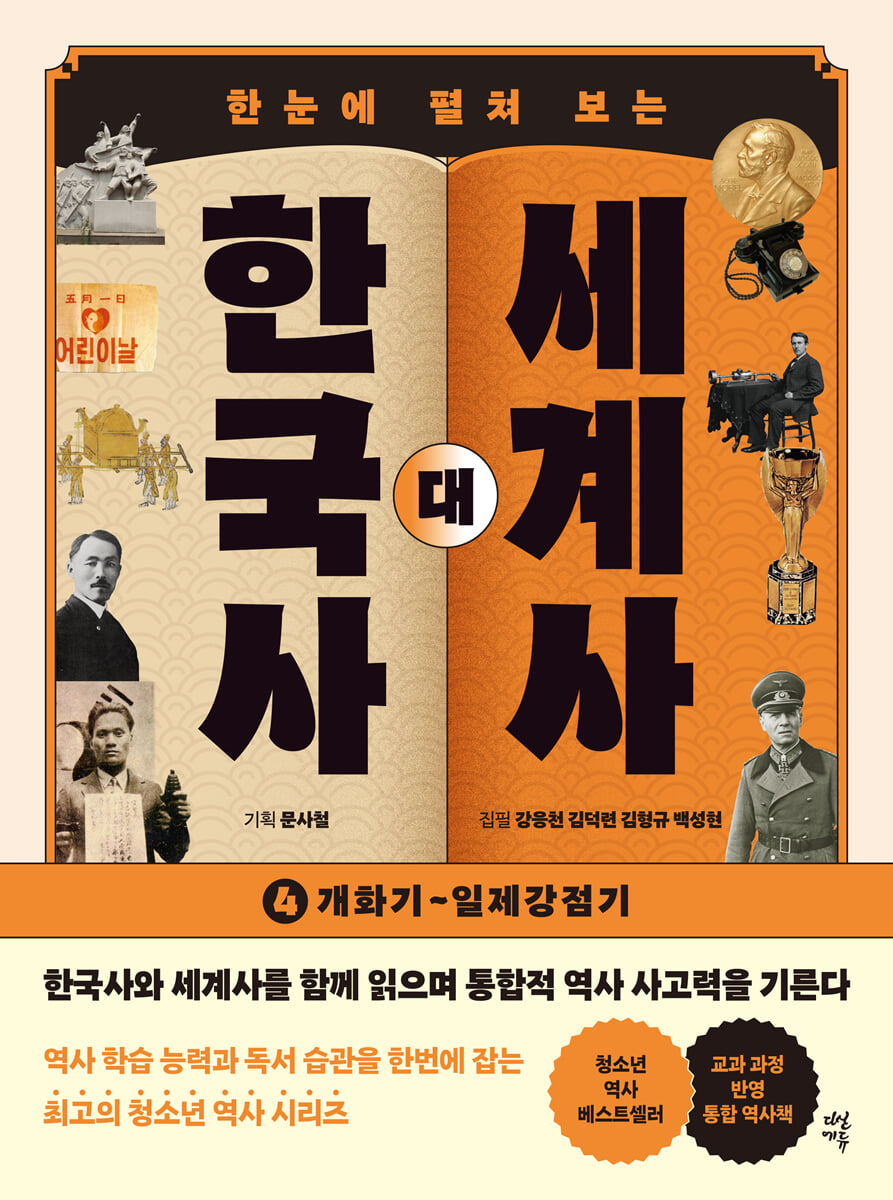
*A one-to-one comparison of 'Korean History' on the left and 'World History' on the right.
*Integrated history book reflecting the curriculum
*Youth History Bestseller
There are growing voices calling for the unification of history education, which is currently divided into Korean history and world history.
In fact, Seoul National University integrated three history-related departments into the Department of History.
Based on these demands, the bestselling youth history series, "Korean History in Timeline with World History," which presented a new concept for reading Korean history, is being re-released under the new name, "Korean History vs. World History."
This series, designed to allow readers to understand Korean history simultaneously with world history, was planned by Munsacheol, Korea's leading humanities planning group, and co-authored by history experts affiliated with Munsacheol.
From the beginning of mankind to the present day, major events in Korean and world history are organized in chronological order, allowing Korean and world history to be understood within the same timeline.
Because it is structured to compare and describe Korean history on the left and world history on the right, it is easy to compare and examine events that occurred in Korea and the world during the same period.
*A one-to-one comparison of 'Korean History' on the left and 'World History' on the right.
*Integrated history book reflecting the curriculum
*Youth History Bestseller
There are growing voices calling for the unification of history education, which is currently divided into Korean history and world history.
In fact, Seoul National University integrated three history-related departments into the Department of History.
Based on these demands, the bestselling youth history series, "Korean History in Timeline with World History," which presented a new concept for reading Korean history, is being re-released under the new name, "Korean History vs. World History."
This series, designed to allow readers to understand Korean history simultaneously with world history, was planned by Munsacheol, Korea's leading humanities planning group, and co-authored by history experts affiliated with Munsacheol.
From the beginning of mankind to the present day, major events in Korean and world history are organized in chronological order, allowing Korean and world history to be understood within the same timeline.
Because it is structured to compare and describe Korean history on the left and world history on the right, it is easy to compare and examine events that occurred in Korea and the world during the same period.
index
How to read this book
preface
1870 - The wave of Westernization surges, and Joseon opens its ports.
1870s Chronology
Voices of the 1870s
1880 - Joseon begins to open its doors, and the great powers begin to engage in a full-scale struggle for colonies.
1880s Chronology
Voices of the 1880s
1890 - The Donghak Peasant Revolution takes place in Joseon, and imperialist nations engage in a battle for colonies.
1890s Timeline
A Magnifying Glass of History: The Donghak Peasant Revolution that Rocked Joseon
Voices of the 1890s
1900 - Korea becomes a Japanese colony, and the world is filled with hope for a new century.
1900s Timeline
Voices of the 1900s
1910 - The March Movement arises amidst the turmoil of World War I and the Russian Revolution.
1910s Chronology
A Magnifying Glass of History ● The Russian Revolution
A Magnifying Glass on History ● What the March 1st Movement Brought to Us
Voices of the 1910s
1920 - Fascism rises in Europe, and left-wing and right-wing independence movements in Korea join hands.
1920s Timeline
A Magnifying Glass of History ● The Great Depression
Voices of the 1920s
1930 - Japan uses the Korean Peninsula as a war base, and the Nazis expand their power.
1930s Timeline
Voices of the 1930s
1940 - The world is engulfed in the devastation of World War II.
1940s Timeline
Voices of the 1940s
Search
Data provided and sourced
preface
1870 - The wave of Westernization surges, and Joseon opens its ports.
1870s Chronology
Voices of the 1870s
1880 - Joseon begins to open its doors, and the great powers begin to engage in a full-scale struggle for colonies.
1880s Chronology
Voices of the 1880s
1890 - The Donghak Peasant Revolution takes place in Joseon, and imperialist nations engage in a battle for colonies.
1890s Timeline
A Magnifying Glass of History: The Donghak Peasant Revolution that Rocked Joseon
Voices of the 1890s
1900 - Korea becomes a Japanese colony, and the world is filled with hope for a new century.
1900s Timeline
Voices of the 1900s
1910 - The March Movement arises amidst the turmoil of World War I and the Russian Revolution.
1910s Chronology
A Magnifying Glass of History ● The Russian Revolution
A Magnifying Glass on History ● What the March 1st Movement Brought to Us
Voices of the 1910s
1920 - Fascism rises in Europe, and left-wing and right-wing independence movements in Korea join hands.
1920s Timeline
A Magnifying Glass of History ● The Great Depression
Voices of the 1920s
1930 - Japan uses the Korean Peninsula as a war base, and the Nazis expand their power.
1930s Timeline
Voices of the 1930s
1940 - The world is engulfed in the devastation of World War II.
1940s Timeline
Voices of the 1940s
Search
Data provided and sourced
Detailed image

Publisher's Review
“Seoul National University’s three history-related departments will be merged into the Department of History!”
Korean history, now viewed in greater depth when viewed alongside world history!
The ultimate history series for all generations, from youth to adults.
The history book series "Korean History vs. World History," which presents a new concept for reading Korean history, is presented in a new form.
This series, designed to allow readers to understand Korean history simultaneously with world history, was planned by Munsacheol, Korea's leading humanities planning group, and co-authored by history experts affiliated with Munsacheol.
Interest in history education has been steadily growing in recent years.
Controversy surrounding historical issues is intensifying both domestically and internationally, with differences of opinion between progressives and conservatives regarding modern and contemporary history, Japan's provocation of past history, and China's distortion of history.
There are also growing concerns about the poor historical awareness among young people and teenagers, such as misunderstanding the Yasukuni Shrine as a shrine.
In this situation, the need to understand both Korean and world history is becoming increasingly important.
This is because of the reflection that history education has been biased towards one side.
Therefore, the "Korean History vs. World History" series organizes major events in Korean and world history in chronological order from the beginning of mankind to the present day, allowing for understanding Korean and world history within the same timeline.
Because it is structured to compare and describe Korean history on the left and world history on the right, it is easy to compare and examine events that occurred in Korea and the world during the same period.
If you understand Korean history along with world history in this way, you will discover surprising and interesting facts.
It is possible to see at a glance that events in Korean history and world history that were previously known separately occurred in the same era or are related to each other.
In this process, readers can naturally broaden their understanding of history by catching two rabbits: Korean history and world history.
Top-notch historical writing team, 3 years of development,
Rich related materials including 1,300 photos and 150 maps and graphs
Munsacheol, which planned this series, is a representative humanities planning group in Korea, and has raised the standard of Korean history books by publishing series such as the "Chain of Knowledge" series and the "Modern and Contemporary History Newspaper" series.
The "Korean History vs. World History" series is a book that Moon Sa-cheol prepared after three years of development to provide readers with a new historical textbook.
Kang Eung-cheon, CEO of Munsa-cheol, famous for the “Korean Lifestyle Museum” series, participated as an author and took charge of the development of this series.
To enhance the completeness of the content and aid readers' understanding, this series contains a wealth of related materials, including 1,300 photographs and 150 maps and graphs.
In addition, rather than simply listing historical events, the content and historical context of the events were described together so that the overall historical flow could be understood.
In addition to political change, it also included significant developments in various fields such as society, culture, religion, and science, and broadly viewed a single event from the context of a wider region or cultural sphere beyond the boundaries of a nation or ethnicity.
Series composition
[Volume 1] Prehistoric times to the Three Kingdoms period (4,000,000 BC to 700 AD)
Modern humans emerge and move forward on the path to civilization.
On the Korean Peninsula, the three kingdoms competed to strengthen their centralized systems, and Silla achieved unification.
In the world, many vassal states rose and fell in China, and Rome was reborn as a Christian nation.
[Volume 2] North-South States Period - Goryeo Dynasty (701-1400)
On the Korean Peninsula, Goryeo unified the Later Three Kingdoms and flourished its culture, but was invaded by the Mongol Empire.
In the world, Islamic empires prosper, and Europe begins a Renaissance after the Crusades.
[Volume 3] Joseon Dynasty (1401–1875)
On the Korean Peninsula, Joseon flourished with Confucian culture and created new traditions.
In the world, Europe brought about the Industrial Revolution and the Civil Revolution after the Age of Exploration and the absolute monarchy.
[Volume 4] Enlightenment Period - Japanese Colonial Period (1876-1945)
On the Korean Peninsula, Joseon began to open its doors due to the impact of foreign powers, but eventually lost its sovereignty to Japan.
In the world, imperialist powers fight for colonies, and two world wars occur in succession.
[Volume 5] Modern and Contemporary Times (1945–2010)
After experiencing the pain of the division of the Korean Peninsula into two, Korea moved toward economic development and democratization.
After the collapse of the Eastern European socialist bloc at the end of the Cold War, capitalism also faced a crisis.
Korean history, now viewed in greater depth when viewed alongside world history!
The ultimate history series for all generations, from youth to adults.
The history book series "Korean History vs. World History," which presents a new concept for reading Korean history, is presented in a new form.
This series, designed to allow readers to understand Korean history simultaneously with world history, was planned by Munsacheol, Korea's leading humanities planning group, and co-authored by history experts affiliated with Munsacheol.
Interest in history education has been steadily growing in recent years.
Controversy surrounding historical issues is intensifying both domestically and internationally, with differences of opinion between progressives and conservatives regarding modern and contemporary history, Japan's provocation of past history, and China's distortion of history.
There are also growing concerns about the poor historical awareness among young people and teenagers, such as misunderstanding the Yasukuni Shrine as a shrine.
In this situation, the need to understand both Korean and world history is becoming increasingly important.
This is because of the reflection that history education has been biased towards one side.
Therefore, the "Korean History vs. World History" series organizes major events in Korean and world history in chronological order from the beginning of mankind to the present day, allowing for understanding Korean and world history within the same timeline.
Because it is structured to compare and describe Korean history on the left and world history on the right, it is easy to compare and examine events that occurred in Korea and the world during the same period.
If you understand Korean history along with world history in this way, you will discover surprising and interesting facts.
It is possible to see at a glance that events in Korean history and world history that were previously known separately occurred in the same era or are related to each other.
In this process, readers can naturally broaden their understanding of history by catching two rabbits: Korean history and world history.
Top-notch historical writing team, 3 years of development,
Rich related materials including 1,300 photos and 150 maps and graphs
Munsacheol, which planned this series, is a representative humanities planning group in Korea, and has raised the standard of Korean history books by publishing series such as the "Chain of Knowledge" series and the "Modern and Contemporary History Newspaper" series.
The "Korean History vs. World History" series is a book that Moon Sa-cheol prepared after three years of development to provide readers with a new historical textbook.
Kang Eung-cheon, CEO of Munsa-cheol, famous for the “Korean Lifestyle Museum” series, participated as an author and took charge of the development of this series.
To enhance the completeness of the content and aid readers' understanding, this series contains a wealth of related materials, including 1,300 photographs and 150 maps and graphs.
In addition, rather than simply listing historical events, the content and historical context of the events were described together so that the overall historical flow could be understood.
In addition to political change, it also included significant developments in various fields such as society, culture, religion, and science, and broadly viewed a single event from the context of a wider region or cultural sphere beyond the boundaries of a nation or ethnicity.
Series composition
[Volume 1] Prehistoric times to the Three Kingdoms period (4,000,000 BC to 700 AD)
Modern humans emerge and move forward on the path to civilization.
On the Korean Peninsula, the three kingdoms competed to strengthen their centralized systems, and Silla achieved unification.
In the world, many vassal states rose and fell in China, and Rome was reborn as a Christian nation.
[Volume 2] North-South States Period - Goryeo Dynasty (701-1400)
On the Korean Peninsula, Goryeo unified the Later Three Kingdoms and flourished its culture, but was invaded by the Mongol Empire.
In the world, Islamic empires prosper, and Europe begins a Renaissance after the Crusades.
[Volume 3] Joseon Dynasty (1401–1875)
On the Korean Peninsula, Joseon flourished with Confucian culture and created new traditions.
In the world, Europe brought about the Industrial Revolution and the Civil Revolution after the Age of Exploration and the absolute monarchy.
[Volume 4] Enlightenment Period - Japanese Colonial Period (1876-1945)
On the Korean Peninsula, Joseon began to open its doors due to the impact of foreign powers, but eventually lost its sovereignty to Japan.
In the world, imperialist powers fight for colonies, and two world wars occur in succession.
[Volume 5] Modern and Contemporary Times (1945–2010)
After experiencing the pain of the division of the Korean Peninsula into two, Korea moved toward economic development and democratization.
After the collapse of the Eastern European socialist bloc at the end of the Cold War, capitalism also faced a crisis.
GOODS SPECIFICS
- Date of issue: December 4, 2024
- Page count, weight, size: 216 pages | 672g | 190*255*15mm
- ISBN13: 9791130660899
- ISBN10: 1130660893
You may also like
카테고리
korean


korean

![GQ KOREA Mark (Monthly): December [2025]](http://librairie.coreenne.fr/cdn/shop/files/8ef265dbbfbf186523ed75ba7319009d.jpg?v=1765340328&width=3840)


