

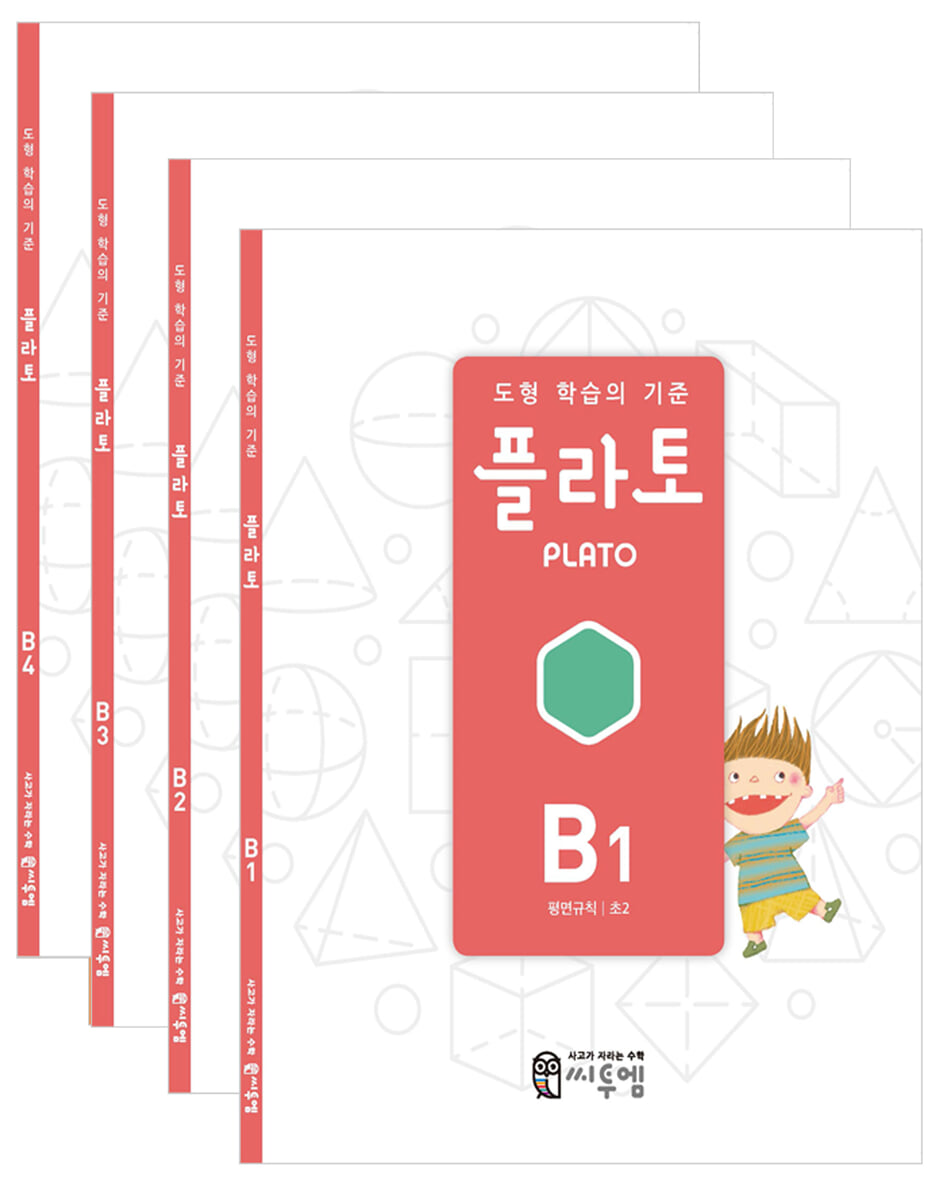
Plato B set, the standard for learning shapes
 |
Description
Book Introduction
『Standard for Shape Learning - Plato』 is a shape learning book that covers all shape learning from age 6 to 6th grade in elementary school.
It was created under the motto of 'making learning shapes easy and light', so that children can take their first step in their long journey of learning mathematics like Plato.
Despite being a major subject, there are many students who fail. We thought that we should approach learning shapes and even mathematics in a simpler and more lighthearted way, and many children and parents who have studied with Plato over the past few years have sent us grateful reviews saying that Plato has helped them enjoy and gain confidence in mathematics.
I recommend Plato to anyone who wants their children to learn shapes and math with joy and confidence.
It was created under the motto of 'making learning shapes easy and light', so that children can take their first step in their long journey of learning mathematics like Plato.
Despite being a major subject, there are many students who fail. We thought that we should approach learning shapes and even mathematics in a simpler and more lighthearted way, and many children and parents who have studied with Plato over the past few years have sent us grateful reviews saying that Plato has helped them enjoy and gain confidence in mathematics.
I recommend Plato to anyone who wants their children to learn shapes and math with joy and confidence.
- You can preview some of the book's contents.
Preview
index
〈B-1〉 Plane Rule
Week 1: Circles and Polygons
Week 2: Drawing Shapes
Week 3: Counting Shapes
Week 4: Dot Drawing
〈B-2〉 Shape manipulation
Week 1: Measuring Length
Week 2: Chilgyo Board
Week 3: Sum and Difference of Lengths
Week 4: Creating Shapes
〈B-3〉 3D design
Week 1: Study of Solids
Week 2: Modeling
Week 3: Stacking Tree Footprints
Week 4: Counting Stacked Wood
〈B-4〉 Spatial perception
Week 1: Paper Crafts
Week 2: Multi-directional stacking
Week 3: Overlapping Transparent Paper
Week 4: Shadow Reasoning
Week 1: Circles and Polygons
Week 2: Drawing Shapes
Week 3: Counting Shapes
Week 4: Dot Drawing
〈B-2〉 Shape manipulation
Week 1: Measuring Length
Week 2: Chilgyo Board
Week 3: Sum and Difference of Lengths
Week 4: Creating Shapes
〈B-3〉 3D design
Week 1: Study of Solids
Week 2: Modeling
Week 3: Stacking Tree Footprints
Week 4: Counting Stacked Wood
〈B-4〉 Spatial perception
Week 1: Paper Crafts
Week 2: Multi-directional stacking
Week 3: Overlapping Transparent Paper
Week 4: Shadow Reasoning
Detailed image

Publisher's Review
1.
A solid curriculum that doesn't slow down
When you first look at Plato's curriculum from an adult's perspective, you might think, "Isn't it going too slowly?" or "Can't it all be taught at once?"
But one volume, two volumes...
As your studies progress, you will naturally come to understand why the curriculum is divided in this way.
From a general adult's perspective, it may be okay to proceed with everything at once, but for a child, it is all a new concept, so if an adult rushes ahead with greed, it may feel like the child is following along at the time, but as the learning progresses, you will realize that there is a hole in that part of the learning.
It is difficult to fill in the gaps in learning, so we have implemented a thorough and solid curriculum from the beginning.
2.
The composition of the Plato series
Plato is a geometry workbook that covers the entire geometry learning process from age 6 to 6th grade.
Plato has four volumes for each grade level, each with a different theme: planes, shapes, solids, and space.
3.
Plato's Volume Composition and Characteristics
(1) One volume of Plato has a total of 4 weeks of study time, and is structured to be studied 5 days per week.
The daily study volume is 2 pages per day, which takes about 10 minutes to study. After completing each week's study, a review study is provided to check the study content of that week.
(2) Plato provides formative assessments five times after completing all four weeks of learning to remind students of the content learned in each book.
(3) Provision of parish supplies
Plato includes teaching materials necessary for learning, and among the teaching materials, paper teaching materials and transparent paper teaching materials are provided together at the end of each volume.
(4) Friendly answers and explanations
In addition to providing correct answers and explanations of questions, we also provide helpful answers to frequently asked questions and problem-solving tips while learning about shapes.
♣ The necessity and method of learning shapes
1.
The need for learning shapes
In elementary school, the time gap between units for learning shapes is quite large, so children have difficulty understanding shapes.
There is difficulty in learning by connecting basic concepts, and these difficulties accumulate
In the geometry area of middle school, you will face greater difficulties.
Therefore, the shapes are systematically organized separately.
There is a need to continuously learn.
2.
The necessity of teaching aids in learning shapes
Children who have handled geometrical objects in their early childhood and those who have not,
There is a significant difference in learning achievement.
Therefore, shapes are important for infants and toddlers.
I think the parish is necessary.
In the early childhood years, parish learning is centered on the parish, and in the process of proceeding with Plato, parish learning is centered on the parish.
It is recommended that you use it as a shape assistance tool to proceed with your learning.
3.
Plato's learning method
Plato aims to study for 10 minutes per day.
However, if children progress more quickly of their own volition, Plato may be able to
Since learning at levels 2 to 3 above is possible, school classes must be included.
If you are not at that level of learning, you can continue to progress through the steps above.
Then, at the stage where Plato must pause for a moment, the operations required for learning the upper level shapes
If you conduct thinking skills education that can develop both learning and empathy, your child will be able to do better.
You can move on to learning extended shapes.
A solid curriculum that doesn't slow down
When you first look at Plato's curriculum from an adult's perspective, you might think, "Isn't it going too slowly?" or "Can't it all be taught at once?"
But one volume, two volumes...
As your studies progress, you will naturally come to understand why the curriculum is divided in this way.
From a general adult's perspective, it may be okay to proceed with everything at once, but for a child, it is all a new concept, so if an adult rushes ahead with greed, it may feel like the child is following along at the time, but as the learning progresses, you will realize that there is a hole in that part of the learning.
It is difficult to fill in the gaps in learning, so we have implemented a thorough and solid curriculum from the beginning.
2.
The composition of the Plato series
Plato is a geometry workbook that covers the entire geometry learning process from age 6 to 6th grade.
Plato has four volumes for each grade level, each with a different theme: planes, shapes, solids, and space.
3.
Plato's Volume Composition and Characteristics
(1) One volume of Plato has a total of 4 weeks of study time, and is structured to be studied 5 days per week.
The daily study volume is 2 pages per day, which takes about 10 minutes to study. After completing each week's study, a review study is provided to check the study content of that week.
(2) Plato provides formative assessments five times after completing all four weeks of learning to remind students of the content learned in each book.
(3) Provision of parish supplies
Plato includes teaching materials necessary for learning, and among the teaching materials, paper teaching materials and transparent paper teaching materials are provided together at the end of each volume.
(4) Friendly answers and explanations
In addition to providing correct answers and explanations of questions, we also provide helpful answers to frequently asked questions and problem-solving tips while learning about shapes.
♣ The necessity and method of learning shapes
1.
The need for learning shapes
In elementary school, the time gap between units for learning shapes is quite large, so children have difficulty understanding shapes.
There is difficulty in learning by connecting basic concepts, and these difficulties accumulate
In the geometry area of middle school, you will face greater difficulties.
Therefore, the shapes are systematically organized separately.
There is a need to continuously learn.
2.
The necessity of teaching aids in learning shapes
Children who have handled geometrical objects in their early childhood and those who have not,
There is a significant difference in learning achievement.
Therefore, shapes are important for infants and toddlers.
I think the parish is necessary.
In the early childhood years, parish learning is centered on the parish, and in the process of proceeding with Plato, parish learning is centered on the parish.
It is recommended that you use it as a shape assistance tool to proceed with your learning.
3.
Plato's learning method
Plato aims to study for 10 minutes per day.
However, if children progress more quickly of their own volition, Plato may be able to
Since learning at levels 2 to 3 above is possible, school classes must be included.
If you are not at that level of learning, you can continue to progress through the steps above.
Then, at the stage where Plato must pause for a moment, the operations required for learning the upper level shapes
If you conduct thinking skills education that can develop both learning and empathy, your child will be able to do better.
You can move on to learning extended shapes.
GOODS SPECIFICS
- Date of issue: June 1, 2022
- Page count, weight, size: 430 pages | 817g | 210*270*30mm
- ISBN13: 9791162293805
- ISBN10: 1162293802
- Reference book for use in grades: 2nd grade elementary school
- KC Certification: Certification Type: Confirming Certification Number: -
You may also like
카테고리
korean


korean

![GQ KOREA Mark (Monthly): December [2025]](http://librairie.coreenne.fr/cdn/shop/files/8ef265dbbfbf186523ed75ba7319009d.jpg?v=1765340328&width=3840)


