

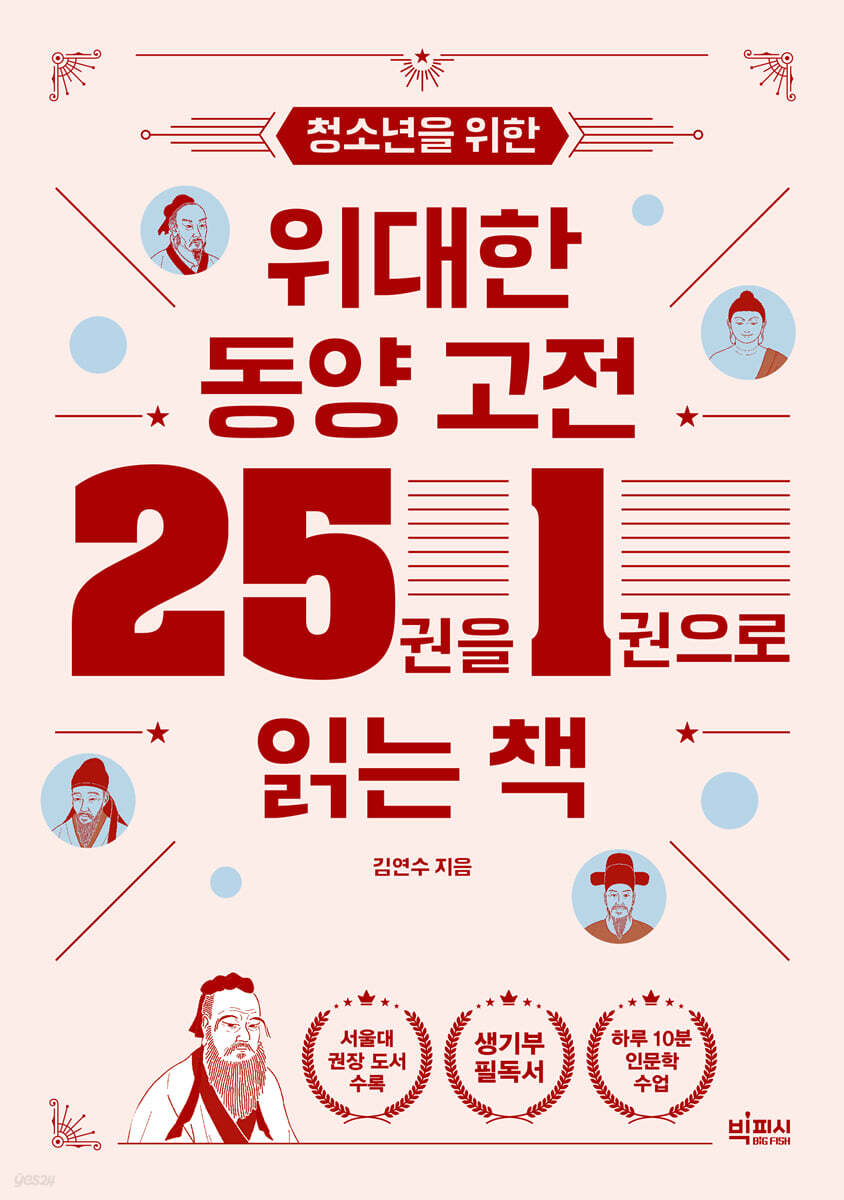
A book that contains 25 great Eastern classics for teenagers in one volume.
 |
Description
Book Introduction
Shine in college entrance exams, essay writing, and future life
10 minutes of Oriental classics a day
The 25 books introduced here are considered great classics that are considered the most important in the approximately 3,000 years of Eastern history.
These are books that frequently appear in various tests and entrance exams, and are must-reads that you must read at least once in your life.
The great teachings of Chinese philosophers such as Confucius, Mencius, and Laozi, as well as representative Korean philosophers such as Yi Hwang, Park Ji-won, and Jeong Yak-yong, transcend time and continue to serve as a guide for our lives to come.
10 minutes of Oriental classics a day
The 25 books introduced here are considered great classics that are considered the most important in the approximately 3,000 years of Eastern history.
These are books that frequently appear in various tests and entrance exams, and are must-reads that you must read at least once in your life.
The great teachings of Chinese philosophers such as Confucius, Mencius, and Laozi, as well as representative Korean philosophers such as Yi Hwang, Park Ji-won, and Jeong Yak-yong, transcend time and continue to serve as a guide for our lives to come.
- You can preview some of the book's contents.
Preview
index
Chapter 1.
A classic that is like the root of Eastern thought
1.
How should we live to live a human life?
Confucius's Analects, 5th century BC
2.
The way to regain your lost original heart
Mencius, 3rd century BC
3.
Aesop's Fables, an oriental tale full of amusing tales
Zhuangzi, 3rd century BC
4.
The philosophy of emptiness that leads to true wisdom and happiness
Lao Tzu's "Tao Te Ching" (5th century BC)
5.
How can we live without pain?
Buddha's Dhammapada, 1st century BC
Chapter 2.
A classic of wisdom that soothes life's worries
6.
A life that cultivates the vessel of the mind and brightens the surroundings
Zengzi's Great Learning, 5th century BC
7.
Know when to stop and when to move forward
The Doctrine of the Mean, 5th century BC
8.
People can change positively at any time.
Xunzi (Xunzi), 3rd century BC
9.
What it means to stick to your convictions and beliefs until the end
Mozi (Mozi), 4th century BC
10.
The classic that made Qin Shi Huang's unification of the world possible
Han Feizi, Han Feizi, 3rd century BC
Chapter 3.
Must-read classics frequently encountered in textbooks and college entrance exams
11.
A children's educational book to teach the principles of daily life
Ju Hee and Yu Cheong-ji, 《Elementary Learning》, 1187
12.
The meaning of knowing and cultivating one's mind
Jinul, "Susimgyeol" 1198
13.
The most brilliant book written in the darkest of times
Il-yeon, Samguk Yusa, 1281
14.
A travelogue that went from a secretly read book to a masterpiece.
Park Ji-won's "Yeolha Diary" 1780
15.
A national classic that remains a treasure of modern and contemporary Korean history.
Kim Gu's "Baekbeom Ilji" (1947)
Chapter 4.
A representative Korean classic that will make you admire it on its own once you know it.
16.
Everything about Neo-Confucianism in 10 Card News
Yi Hwang, "Seonhak Sipdo" (1568)
17.
A powerful voice for reform toward a new world
Yi I, Seonghakjipyo, 1575
18.
A Joseon-era encyclopedia, from science to literature, all in one volume.
Lee Ik, Seonghosaseol, 1760
19.
Korea's first book on capitalist thought that focused on the importance of consumption
Park Je-ga, "Bukhakui" 1778
20.
A guide to public officials' administration, written after observing the suffering of the people.
Jeong Yak-yong's "Mokminsimseo" (1818)
Chapter 5.
A must-read classic for intellectual conversation
21.
From kings to killers, immortal masterpieces as entertaining as novels.
Sima Qian, Records of the Grand Historian, 91 BC
22.
If you want to die, you will live, and if you want to live, you will die.
Yi Sun-sin's Nanjung Ilgi (War Diary), 1598
23.
A record of reflection and lessons, detailing the tragedy of the Imjin War.
Ryu Seong-ryong, Jingbirok, 1604
24.
A Joseon astronomer who shattered old beliefs with scientific thinking
Hong Dae-yong, "Uisan Questions and Answers," 1766
25.
Our Lost Ancient History Serialized in Prison
Shin Chae-ho, Ancient History of Joseon, 1948
A classic that is like the root of Eastern thought
1.
How should we live to live a human life?
Confucius's Analects, 5th century BC
2.
The way to regain your lost original heart
Mencius, 3rd century BC
3.
Aesop's Fables, an oriental tale full of amusing tales
Zhuangzi, 3rd century BC
4.
The philosophy of emptiness that leads to true wisdom and happiness
Lao Tzu's "Tao Te Ching" (5th century BC)
5.
How can we live without pain?
Buddha's Dhammapada, 1st century BC
Chapter 2.
A classic of wisdom that soothes life's worries
6.
A life that cultivates the vessel of the mind and brightens the surroundings
Zengzi's Great Learning, 5th century BC
7.
Know when to stop and when to move forward
The Doctrine of the Mean, 5th century BC
8.
People can change positively at any time.
Xunzi (Xunzi), 3rd century BC
9.
What it means to stick to your convictions and beliefs until the end
Mozi (Mozi), 4th century BC
10.
The classic that made Qin Shi Huang's unification of the world possible
Han Feizi, Han Feizi, 3rd century BC
Chapter 3.
Must-read classics frequently encountered in textbooks and college entrance exams
11.
A children's educational book to teach the principles of daily life
Ju Hee and Yu Cheong-ji, 《Elementary Learning》, 1187
12.
The meaning of knowing and cultivating one's mind
Jinul, "Susimgyeol" 1198
13.
The most brilliant book written in the darkest of times
Il-yeon, Samguk Yusa, 1281
14.
A travelogue that went from a secretly read book to a masterpiece.
Park Ji-won's "Yeolha Diary" 1780
15.
A national classic that remains a treasure of modern and contemporary Korean history.
Kim Gu's "Baekbeom Ilji" (1947)
Chapter 4.
A representative Korean classic that will make you admire it on its own once you know it.
16.
Everything about Neo-Confucianism in 10 Card News
Yi Hwang, "Seonhak Sipdo" (1568)
17.
A powerful voice for reform toward a new world
Yi I, Seonghakjipyo, 1575
18.
A Joseon-era encyclopedia, from science to literature, all in one volume.
Lee Ik, Seonghosaseol, 1760
19.
Korea's first book on capitalist thought that focused on the importance of consumption
Park Je-ga, "Bukhakui" 1778
20.
A guide to public officials' administration, written after observing the suffering of the people.
Jeong Yak-yong's "Mokminsimseo" (1818)
Chapter 5.
A must-read classic for intellectual conversation
21.
From kings to killers, immortal masterpieces as entertaining as novels.
Sima Qian, Records of the Grand Historian, 91 BC
22.
If you want to die, you will live, and if you want to live, you will die.
Yi Sun-sin's Nanjung Ilgi (War Diary), 1598
23.
A record of reflection and lessons, detailing the tragedy of the Imjin War.
Ryu Seong-ryong, Jingbirok, 1604
24.
A Joseon astronomer who shattered old beliefs with scientific thinking
Hong Dae-yong, "Uisan Questions and Answers," 1766
25.
Our Lost Ancient History Serialized in Prison
Shin Chae-ho, Ancient History of Joseon, 1948
Detailed image
.jpg)
Into the book
As the French philosopher Voltaire said, history does not repeat itself, but human actions do.
Because human psychology, thoughts, desires and emotions remain the same.
So, even though times change and lifestyles change, the concerns that humanity holds in its hearts do not change much.
Oriental classics are commentaries on these fundamental questions of life written by great figures who are called the teachers of humanity.
The 30 Oriental classics contained in this book are familiar classics that have had a great influence on our society and daily life.
These are great classics that represented their eras or changed the course of time, and they are also books that serve as indicators of life, giving us a weighty message even today.
--- From the "Preface"
Even during the Warring States period, which lasted for over 200 years, the continuous war left mountains of corpses, and the living starved or were separated from their families.
Perhaps it resembles our current situation, where we are forced into endless competition in the capitalist era.
Sometimes, when we are so exhausted physically and mentally that we reach our limit, we feel lethargic and dizzy.
And it asks the fundamental questions of life.
"Who am I? Where am I?" Confucius, who lived during the Spring and Autumn Period, asked the same question.
In a time when humans could not be human, and when living hard today could not guarantee a stable tomorrow, Confucius also asked the most fundamental question of life.
'How should we live to live a humane life?' Confucius's answer to that question is the Analects.
--- From Confucius, The Analects
'The Doctrine of the Mean' is not only the title of a book, but is also a common noun that refers to an attitude toward life and virtue.
It is a concept that is also treated as important in Western philosophy.
Aristotle, in his Nicomachean Ethics, mentions moderation as an important element of happiness.
He believed that all humans have impulses and desires, but that they must be controlled by reason to avoid going to extremes.
The passage that emphasizes the need to find a balance between deficiency and excess in order to live a moral life is exactly the Western version of too much is as bad as too little.
--- From "Zisa, The Doctrine of the Mean"
“Blue comes from indigo, but it is bluer than indigo; ice is made from frozen water, but it is colder than water.”
This is the first sentence of the "Xunzi" and the original text of the famous four-character idiom, "靑出於藍" (blue emerges from indigo).
The saying "the disciple is better than the teacher" is widely known as a metaphor for a student being better than the teacher, but that is only part of the meaning of the saying.
If you look at the original text, the phrase “learning cannot be stopped” appears before this sentence, so it would be correct to see the blue and ice as the result of continuous dedication to learning.
It means that we must pursue complete self-change and development through learning.
I believe that education plays a similar role for humans as a seemingly insignificant chrysalis completely transforms into a beautiful butterfly.
--- From "Sunja, 《Sunja》"
There are many contents in the 《Myeongsimbogam》 that are surprisingly accurate and still apply today.
“If you talk too much and make mistakes, it’s all because of alcohol. If you break loyalty and distance yourself from friends, it’s only because of money.” “Don’t employ suspicious people, and don’t be suspicious of those you’ve hired.” These sentences point out life wisdom that hasn’t changed since the past.
Su Dongpo warns those who dream of making a fortune overnight by buying lottery tickets every day or making excessive investments, saying, “If you gain a fortune without a reason, it will not bring great fortune, but great disaster.”
The power that has sustained the 《Myeongsimbogam》 for so long lies in its universal values that transcend time.
--- From "Beomlipbon, 《Myeongsimbogam》"
Yi Sun-sin was someone's son, someone's father, and a subject of a nation who had to endure the weight of loneliness and responsibility.
《Nanjung Ilgi》 shows the process of how one person turns fear into courage.
We find comfort, hope, and teaching in Nanjung Ilgi.
Yi Sun-sin was not made a hero by someone else, but he became a hero himself through the record called “Nanjung Ilgi.”
Because human psychology, thoughts, desires and emotions remain the same.
So, even though times change and lifestyles change, the concerns that humanity holds in its hearts do not change much.
Oriental classics are commentaries on these fundamental questions of life written by great figures who are called the teachers of humanity.
The 30 Oriental classics contained in this book are familiar classics that have had a great influence on our society and daily life.
These are great classics that represented their eras or changed the course of time, and they are also books that serve as indicators of life, giving us a weighty message even today.
--- From the "Preface"
Even during the Warring States period, which lasted for over 200 years, the continuous war left mountains of corpses, and the living starved or were separated from their families.
Perhaps it resembles our current situation, where we are forced into endless competition in the capitalist era.
Sometimes, when we are so exhausted physically and mentally that we reach our limit, we feel lethargic and dizzy.
And it asks the fundamental questions of life.
"Who am I? Where am I?" Confucius, who lived during the Spring and Autumn Period, asked the same question.
In a time when humans could not be human, and when living hard today could not guarantee a stable tomorrow, Confucius also asked the most fundamental question of life.
'How should we live to live a humane life?' Confucius's answer to that question is the Analects.
--- From Confucius, The Analects
'The Doctrine of the Mean' is not only the title of a book, but is also a common noun that refers to an attitude toward life and virtue.
It is a concept that is also treated as important in Western philosophy.
Aristotle, in his Nicomachean Ethics, mentions moderation as an important element of happiness.
He believed that all humans have impulses and desires, but that they must be controlled by reason to avoid going to extremes.
The passage that emphasizes the need to find a balance between deficiency and excess in order to live a moral life is exactly the Western version of too much is as bad as too little.
--- From "Zisa, The Doctrine of the Mean"
“Blue comes from indigo, but it is bluer than indigo; ice is made from frozen water, but it is colder than water.”
This is the first sentence of the "Xunzi" and the original text of the famous four-character idiom, "靑出於藍" (blue emerges from indigo).
The saying "the disciple is better than the teacher" is widely known as a metaphor for a student being better than the teacher, but that is only part of the meaning of the saying.
If you look at the original text, the phrase “learning cannot be stopped” appears before this sentence, so it would be correct to see the blue and ice as the result of continuous dedication to learning.
It means that we must pursue complete self-change and development through learning.
I believe that education plays a similar role for humans as a seemingly insignificant chrysalis completely transforms into a beautiful butterfly.
--- From "Sunja, 《Sunja》"
There are many contents in the 《Myeongsimbogam》 that are surprisingly accurate and still apply today.
“If you talk too much and make mistakes, it’s all because of alcohol. If you break loyalty and distance yourself from friends, it’s only because of money.” “Don’t employ suspicious people, and don’t be suspicious of those you’ve hired.” These sentences point out life wisdom that hasn’t changed since the past.
Su Dongpo warns those who dream of making a fortune overnight by buying lottery tickets every day or making excessive investments, saying, “If you gain a fortune without a reason, it will not bring great fortune, but great disaster.”
The power that has sustained the 《Myeongsimbogam》 for so long lies in its universal values that transcend time.
--- From "Beomlipbon, 《Myeongsimbogam》"
Yi Sun-sin was someone's son, someone's father, and a subject of a nation who had to endure the weight of loneliness and responsibility.
《Nanjung Ilgi》 shows the process of how one person turns fear into courage.
We find comfort, hope, and teaching in Nanjung Ilgi.
Yi Sun-sin was not made a hero by someone else, but he became a hero himself through the record called “Nanjung Ilgi.”
--- From "Yi Sun-sin, Nanjung Ilgi"
Publisher's Review
★★★ Supplementary materials for reading classics linked to middle and high school curriculum
★★★ Must-read books for students enrolled in the Life Science Department and recommended books for Seoul National University
★★★ The power of 3,000 years of Eastern thought that captivated even Steve Jobs, Schopenhauer, and Hermann Hesse.
From Confucius's Analects to Jeong Yak-yong's Mokminsimseo
Developing youth's thinking, logical thinking, and background knowledge
The world's easiest introduction to Eastern classics
Confucius, Buddha, and Lao Tzu are great Eastern thinkers whose names alone are familiar.
The titles of classics such as the Analects of Confucius, the Book of Changes, the Tao Te Ching, and the Mirror of Mind are also familiar.
This is because these Eastern classics and philosophers appear in elementary school textbooks, and as we move into middle and high school, we encounter them more frequently in Korean language, ethics, and history subjects.
However, many students do not have a proper understanding of the lives of scholars or the contents of classics.
Since it is frequently tested on exams, I decide to skim through it at least once, but it is by no means easy for middle and high school students who are busy with their studies to find and read a vast number of classics and understand their deep meaning on their own.
“25 Great Eastern Classics for Teenagers in One Volume” is a book specifically for teenagers like this.
From the foundations of Eastern thought to representative Korean classics, including major classics included in textbooks, works frequently tested on the College Scholastic Ability Test (CSAT), and even books recommended by Seoul National University, this book carefully selects 25 Eastern classics that young people must read and introduces them in one volume.
By covering the core ideas of each classic, the author's life, and the historical background, you can grasp the vast flow of Eastern thought at a glance, and by using easy-to-understand explanations instead of difficult original texts, you can easily understand complex philosophical concepts.
If you have a child who knows the importance of reading classics but doesn't know where or how to start, give them this book.
By quickly grasping the core content of major classics, you will not only build background knowledge but also gain depth in your thinking, which will greatly increase the efficiency of your studies for the entrance exam.
With the rich educational experience of a current teacher
Only the key concepts are explained in detail.
The author of this book is a current teacher who has taught Chinese characters and classic reading in middle and high schools for 14 years.
Having long observed students who found classics difficult in the classroom, the author pondered how to make classics more accessible and accessible to students.
And the results are fully reflected in this book.
First, the introduction begins with a portrait of an Eastern philosopher drawn in a modern illustration to make children feel familiar, and then it points out the classics that children must know, and the core philosophical concepts are explained simply and in an easy-to-understand manner using illustrations.
Also, the lives of scholars such as Sima Qian, who completed the Records of the Grand Historian despite the pain of castration, Han Feizi, who contributed to Qin Shi Huang's unification of the country with his outstanding insight but met a tragic end, and Jeong Yak-yong, who continued to pursue scholarship even in exile and left behind the Book of Moral Affairs, are described in an exciting drama-like manner, naturally drawing one into the charm of Eastern classics.
After reading each classic, we present three questions from the "Let's Think About It" section to help readers review the main content.
Here, we provide simple knowledge questions such as, “What is the core idea of Confucius expressed in one word?” as well as in-depth questions that expand thinking skills to the next level, such as, “Let’s compare Mencius’s theory of human nature as good and Xunzi’s theory of human nature as evil, and discuss with friends which one I agree with more.”
Furthermore, it guides you through exploratory activities that broaden your perspective beyond the classics, such as, “Let’s explain why Park Ji-won chose a broken piece of roof tile and a pile of manure as the best ministers of the Qing Dynasty, along with the meaning of ‘utility and welfare.’”
The author's expertise in teaching classics at a level suitable for young people in educational settings shines through throughout the book.
★★★ Must-read books for students enrolled in the Life Science Department and recommended books for Seoul National University
★★★ The power of 3,000 years of Eastern thought that captivated even Steve Jobs, Schopenhauer, and Hermann Hesse.
From Confucius's Analects to Jeong Yak-yong's Mokminsimseo
Developing youth's thinking, logical thinking, and background knowledge
The world's easiest introduction to Eastern classics
Confucius, Buddha, and Lao Tzu are great Eastern thinkers whose names alone are familiar.
The titles of classics such as the Analects of Confucius, the Book of Changes, the Tao Te Ching, and the Mirror of Mind are also familiar.
This is because these Eastern classics and philosophers appear in elementary school textbooks, and as we move into middle and high school, we encounter them more frequently in Korean language, ethics, and history subjects.
However, many students do not have a proper understanding of the lives of scholars or the contents of classics.
Since it is frequently tested on exams, I decide to skim through it at least once, but it is by no means easy for middle and high school students who are busy with their studies to find and read a vast number of classics and understand their deep meaning on their own.
“25 Great Eastern Classics for Teenagers in One Volume” is a book specifically for teenagers like this.
From the foundations of Eastern thought to representative Korean classics, including major classics included in textbooks, works frequently tested on the College Scholastic Ability Test (CSAT), and even books recommended by Seoul National University, this book carefully selects 25 Eastern classics that young people must read and introduces them in one volume.
By covering the core ideas of each classic, the author's life, and the historical background, you can grasp the vast flow of Eastern thought at a glance, and by using easy-to-understand explanations instead of difficult original texts, you can easily understand complex philosophical concepts.
If you have a child who knows the importance of reading classics but doesn't know where or how to start, give them this book.
By quickly grasping the core content of major classics, you will not only build background knowledge but also gain depth in your thinking, which will greatly increase the efficiency of your studies for the entrance exam.
With the rich educational experience of a current teacher
Only the key concepts are explained in detail.
The author of this book is a current teacher who has taught Chinese characters and classic reading in middle and high schools for 14 years.
Having long observed students who found classics difficult in the classroom, the author pondered how to make classics more accessible and accessible to students.
And the results are fully reflected in this book.
First, the introduction begins with a portrait of an Eastern philosopher drawn in a modern illustration to make children feel familiar, and then it points out the classics that children must know, and the core philosophical concepts are explained simply and in an easy-to-understand manner using illustrations.
Also, the lives of scholars such as Sima Qian, who completed the Records of the Grand Historian despite the pain of castration, Han Feizi, who contributed to Qin Shi Huang's unification of the country with his outstanding insight but met a tragic end, and Jeong Yak-yong, who continued to pursue scholarship even in exile and left behind the Book of Moral Affairs, are described in an exciting drama-like manner, naturally drawing one into the charm of Eastern classics.
After reading each classic, we present three questions from the "Let's Think About It" section to help readers review the main content.
Here, we provide simple knowledge questions such as, “What is the core idea of Confucius expressed in one word?” as well as in-depth questions that expand thinking skills to the next level, such as, “Let’s compare Mencius’s theory of human nature as good and Xunzi’s theory of human nature as evil, and discuss with friends which one I agree with more.”
Furthermore, it guides you through exploratory activities that broaden your perspective beyond the classics, such as, “Let’s explain why Park Ji-won chose a broken piece of roof tile and a pile of manure as the best ministers of the Qing Dynasty, along with the meaning of ‘utility and welfare.’”
The author's expertise in teaching classics at a level suitable for young people in educational settings shines through throughout the book.
GOODS SPECIFICS
- Date of issue: July 10, 2024
- Page count, weight, size: 256 pages | 140*210*20mm
- ISBN13: 9791193128060
- ISBN10: 1193128064
You may also like
카테고리
korean


korean

![GQ KOREA Mark (Monthly): December [2025]](http://librairie.coreenne.fr/cdn/shop/files/8ef265dbbfbf186523ed75ba7319009d.jpg?v=1765340328&width=3840)


