

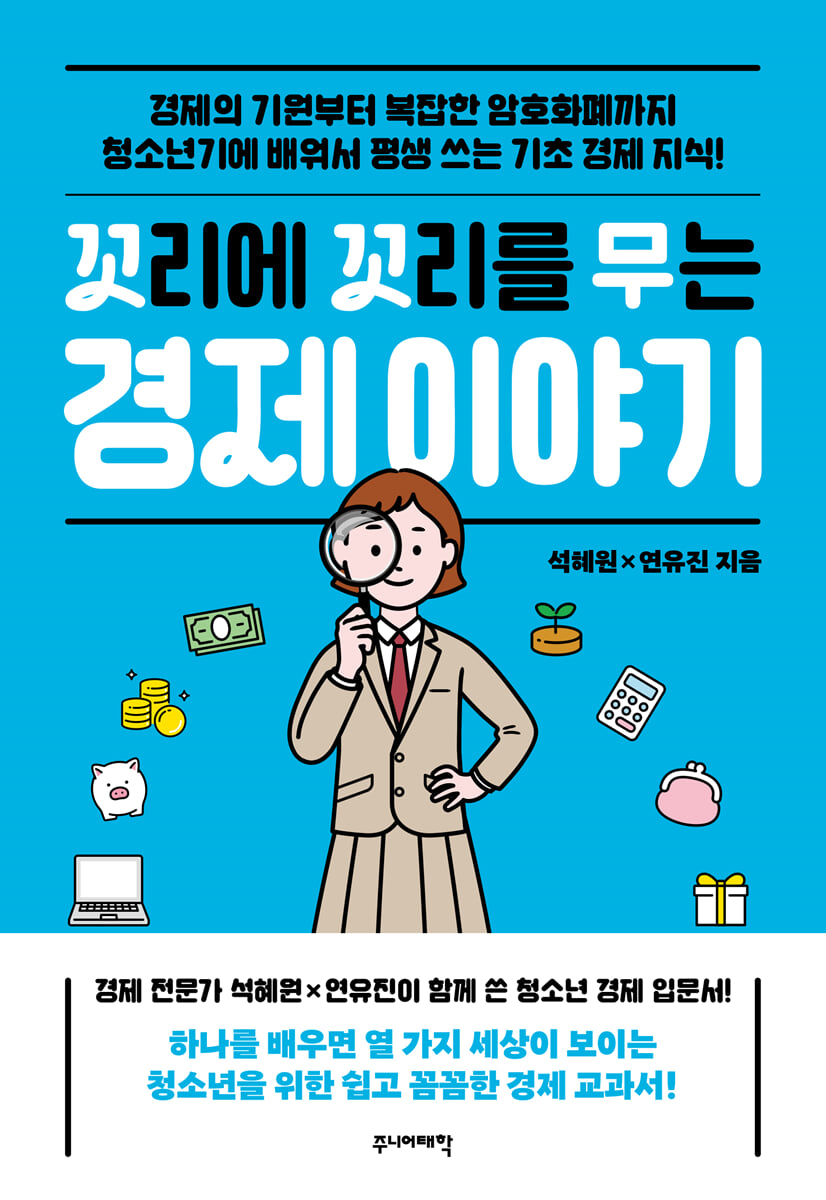
A tail-chasing economic story
 |
Description
Book Introduction
“I should have done it when I was told to.”
Start studying economics as a teenager before you regret it!
Two economic experts with a keen eye for the real economy have joined forces.
Practical economics class with Seok Hye-won and Yeon Yu-jin!
"The Story of an Economic Trap" is an introductory economics book that provides information on the overall economy, focusing on economic trends.
From ancient barter to modern cryptocurrencies, the book covers the history of the economy, covering key economic topics such as exchange rates, banking, and cryptocurrencies in an easy and engaging way.
By covering the economy within the larger framework of human history and then separately highlighting Korea's economic history, it also fosters readers' ability to view the Korean economy from a broader perspective.
Through this book, young people can acquire specific economic knowledge and interpret various phenomena and problems related to economic issues through their own economic perspectives.
And we will be able to view the problems occurring in the world surrounding our lives through an economic lens and develop an attitude that allows us to prepare for the future.
Start studying economics as a teenager before you regret it!
Two economic experts with a keen eye for the real economy have joined forces.
Practical economics class with Seok Hye-won and Yeon Yu-jin!
"The Story of an Economic Trap" is an introductory economics book that provides information on the overall economy, focusing on economic trends.
From ancient barter to modern cryptocurrencies, the book covers the history of the economy, covering key economic topics such as exchange rates, banking, and cryptocurrencies in an easy and engaging way.
By covering the economy within the larger framework of human history and then separately highlighting Korea's economic history, it also fosters readers' ability to view the Korean economy from a broader perspective.
Through this book, young people can acquire specific economic knowledge and interpret various phenomena and problems related to economic issues through their own economic perspectives.
And we will be able to view the problems occurring in the world surrounding our lives through an economic lens and develop an attitude that allows us to prepare for the future.
- You can preview some of the book's contents.
Preview
index
In publishing a book
Chapter 1: Me and the Economy
When did economic activity begin?
How has technology changed economic activity?
Why should we know about economics?
How do people make money?
How to manage money
Economic Spotlight: Is Fast Fashion Rational?
Chapter 2 Markets and the Economy
How was the market created?
How are prices determined?
What is the invisible hand?
What is an oil shock?
Why do we want to buy something just by seeing an advertisement?
Economic Spotlight: Is the Free Market a Magic Key?
Chapter 3: Money and the Economy
How was currency created?
Why do central banks issue currency?
What will the bank do?
What should money be called?
What is cryptocurrency?
Economic Spotlight: How the Dollar Became a Reserve Currency
Chapter 4: The State and the Economy
How are taxes spent?
What is the relationship between corporations and the national economy?
What happens when the money supply increases?
Should economic activity be controlled?
How do we know that the economy is growing?
Is there no way to divide the pie fairly?
Economic Magnifier: Why Did Marx Study Capitalism?
Chapter 5: The World and the Economy
When did trade begin?
Who benefits from trade?
Why did the US-China trade war break out?
How are exchange rates determined?
What is a multinational corporation?
Economic Spotlight: What Does the Semiconductor Industry Have to Do with National Security?
Chapter 6 Korea and the Economy
How did Korea's economy develop?
What does Korea's industrial structure look like?
Is Korea an economically advanced country?
Are there any problems with Korea's trade?
How will low birth rates affect the economy?
Economic Spotlight: Why Did Young Jeon Tae-il Burn the Labor Standards Act?
Image source
main
Chapter 1: Me and the Economy
When did economic activity begin?
How has technology changed economic activity?
Why should we know about economics?
How do people make money?
How to manage money
Economic Spotlight: Is Fast Fashion Rational?
Chapter 2 Markets and the Economy
How was the market created?
How are prices determined?
What is the invisible hand?
What is an oil shock?
Why do we want to buy something just by seeing an advertisement?
Economic Spotlight: Is the Free Market a Magic Key?
Chapter 3: Money and the Economy
How was currency created?
Why do central banks issue currency?
What will the bank do?
What should money be called?
What is cryptocurrency?
Economic Spotlight: How the Dollar Became a Reserve Currency
Chapter 4: The State and the Economy
How are taxes spent?
What is the relationship between corporations and the national economy?
What happens when the money supply increases?
Should economic activity be controlled?
How do we know that the economy is growing?
Is there no way to divide the pie fairly?
Economic Magnifier: Why Did Marx Study Capitalism?
Chapter 5: The World and the Economy
When did trade begin?
Who benefits from trade?
Why did the US-China trade war break out?
How are exchange rates determined?
What is a multinational corporation?
Economic Spotlight: What Does the Semiconductor Industry Have to Do with National Security?
Chapter 6 Korea and the Economy
How did Korea's economy develop?
What does Korea's industrial structure look like?
Is Korea an economically advanced country?
Are there any problems with Korea's trade?
How will low birth rates affect the economy?
Economic Spotlight: Why Did Young Jeon Tae-il Burn the Labor Standards Act?
Image source
main
Into the book
The economy began with agriculture and livestock farming, and the Industrial Revolution that took place in 18th century England brought about a major turning point in the economy.
With the introduction of machines, production in all fields has increased tremendously.
The world has changed dynamically, with transportation systems developing to move raw materials and products.
As the basis of industry changed from agriculture to industry, capitalists accumulated a lot of wealth, and the era of capitalism began.
--- p.16
So, what is the economy? The economy encompasses not only economic activity but also the order and institutions associated with it.
--- p.19
Advances in production technology led to the invention of new machines, ultimately transforming the industrial base from handcraft workshops to mechanized factories.
This change is called the 'Industrial Revolution'.
As the number of people working in factories increases, work and home begin to separate.
-- p.23
With the advancement of technology, the economic environment surrounding humans has constantly changed.
But the nature of people's economic activities has not changed.
It's to make you happier by making better choices.
People make choices even when they don't realize it.
So why do we make choices? To achieve the greatest effect while minimizing cost.
But when considering costs, you have to consider not only money, but also time, effort, etc.
--- pp.34-35
Choosing a career is one of the most important decisions you will make in life.
The dictionary defines a job as 'a job that one continuously engages in for a certain period of time according to one's aptitude and ability to make a living.'
In other words, choosing a career is like deciding how we will earn our income.
-- p.38
The greatest advantage of the market is that it connects transactions for buying and selling goods.
If the producer who makes the product were to sell it himself, he would have so much to worry about that he wouldn't have time to make the product.
However, if the producer entrusts the production of the product to someone else and sells it, the producer can only focus on developing the technology to make high-quality products.
In this way, the market increases the efficiency of production activities by dividing industry into labor.
--- p.56
If either production or consumption stops, the product disappears from the market.
For a market to continue to trade, consumers must continue to buy the goods produced by producers.
It is the 'price' that determines whether a good or service can be traded.
So to speak, prices act as a traffic light that determines production and consumption activities.
--- p.63
The lifeblood of money is trust.
Coins made of metal have value in themselves, but banknotes are nothing more than pieces of paper without faith.
When did people begin to trust and use paper money? While paper money is now used far more than coins, the history of paper money is much shorter than that of coins.
It is said that when paper money first appeared, people did not use it as a means of payment because they did not trust the value of paper money.
--- p.98
Blood circulates throughout our body, providing us with the nutrients we need.
In an economy, money acts as blood.
For the economy to run smoothly, money must flow to where economic activity takes place.
The process of helping money function as the lifeblood of the economy is called 'finance.'
It means connecting people who have spare money with people who want to borrow money.
--- p.106
You might think of taxes as money that the government forcibly takes from its citizens.
But without taxes, we can't build subways or roads, and we can't maintain the water and electricity facilities that are essential for our lives.
Without school education and police presence, crime cannot be prevented.
If you can't run an army, you can't defend your country from invasion by other countries.
In other words, without taxes, we cannot build basic social infrastructure, educate our citizens, or ensure national security.
--- p.135
Have you ever heard the expression "the pie is getting bigger"? This expression compares the size of the economy to a pie, indicating economic growth.
This kind of economic growth is often seen in economic news.
'Economic growth' means that the 'gross domestic product', which indicates the size of the country's economy, has increased compared to the previous year.
For example, if a country that produced an average of 300 loaves of bread per day last year increases production this year to 350 loaves of bread, then the economy can be said to have grown.
--- p.159
The 'exchange rate' is the rate at which the currencies of different countries are exchanged.
Because there are so many different types of currencies, there are many different types of exchange rates, such as 'the rate for exchanging Korean Won and US Dollars', 'the rate for exchanging Korean Won and Euros', and 'the rate for exchanging Euros and US Dollars'.
However, in our country, when we say exchange rate without mentioning the type of currency, we mean the rate at which the Korean Won and the US Dollar are exchanged.
--- p.201
One of the reasons for becoming a multinational corporation is to overcome trade barriers.
When trade barriers are raised in a trading partner country, exports become difficult, so the method is to build a factory in that country and produce there.
Additionally, becoming a multinational corporation allows you to quickly respond to market changes, which is advantageous for developing overseas markets.
Rather than looking at the reactions of foreign markets in one's own country, if you look at and accurately understand what products local people like, you can develop products that perfectly suit their tastes.
--- pp.209-210
Korea is growing its economy based on trade, making money by exporting semiconductors, automobiles, petrochemical products, etc.
We also import resources necessary for our lives, such as crude oil and food, from other countries.
Thanks to active trade, Korea overcame the limitations of its small territory and became prosperous.
This economic structure is called a 'small open economy'.
With the introduction of machines, production in all fields has increased tremendously.
The world has changed dynamically, with transportation systems developing to move raw materials and products.
As the basis of industry changed from agriculture to industry, capitalists accumulated a lot of wealth, and the era of capitalism began.
--- p.16
So, what is the economy? The economy encompasses not only economic activity but also the order and institutions associated with it.
--- p.19
Advances in production technology led to the invention of new machines, ultimately transforming the industrial base from handcraft workshops to mechanized factories.
This change is called the 'Industrial Revolution'.
As the number of people working in factories increases, work and home begin to separate.
-- p.23
With the advancement of technology, the economic environment surrounding humans has constantly changed.
But the nature of people's economic activities has not changed.
It's to make you happier by making better choices.
People make choices even when they don't realize it.
So why do we make choices? To achieve the greatest effect while minimizing cost.
But when considering costs, you have to consider not only money, but also time, effort, etc.
--- pp.34-35
Choosing a career is one of the most important decisions you will make in life.
The dictionary defines a job as 'a job that one continuously engages in for a certain period of time according to one's aptitude and ability to make a living.'
In other words, choosing a career is like deciding how we will earn our income.
-- p.38
The greatest advantage of the market is that it connects transactions for buying and selling goods.
If the producer who makes the product were to sell it himself, he would have so much to worry about that he wouldn't have time to make the product.
However, if the producer entrusts the production of the product to someone else and sells it, the producer can only focus on developing the technology to make high-quality products.
In this way, the market increases the efficiency of production activities by dividing industry into labor.
--- p.56
If either production or consumption stops, the product disappears from the market.
For a market to continue to trade, consumers must continue to buy the goods produced by producers.
It is the 'price' that determines whether a good or service can be traded.
So to speak, prices act as a traffic light that determines production and consumption activities.
--- p.63
The lifeblood of money is trust.
Coins made of metal have value in themselves, but banknotes are nothing more than pieces of paper without faith.
When did people begin to trust and use paper money? While paper money is now used far more than coins, the history of paper money is much shorter than that of coins.
It is said that when paper money first appeared, people did not use it as a means of payment because they did not trust the value of paper money.
--- p.98
Blood circulates throughout our body, providing us with the nutrients we need.
In an economy, money acts as blood.
For the economy to run smoothly, money must flow to where economic activity takes place.
The process of helping money function as the lifeblood of the economy is called 'finance.'
It means connecting people who have spare money with people who want to borrow money.
--- p.106
You might think of taxes as money that the government forcibly takes from its citizens.
But without taxes, we can't build subways or roads, and we can't maintain the water and electricity facilities that are essential for our lives.
Without school education and police presence, crime cannot be prevented.
If you can't run an army, you can't defend your country from invasion by other countries.
In other words, without taxes, we cannot build basic social infrastructure, educate our citizens, or ensure national security.
--- p.135
Have you ever heard the expression "the pie is getting bigger"? This expression compares the size of the economy to a pie, indicating economic growth.
This kind of economic growth is often seen in economic news.
'Economic growth' means that the 'gross domestic product', which indicates the size of the country's economy, has increased compared to the previous year.
For example, if a country that produced an average of 300 loaves of bread per day last year increases production this year to 350 loaves of bread, then the economy can be said to have grown.
--- p.159
The 'exchange rate' is the rate at which the currencies of different countries are exchanged.
Because there are so many different types of currencies, there are many different types of exchange rates, such as 'the rate for exchanging Korean Won and US Dollars', 'the rate for exchanging Korean Won and Euros', and 'the rate for exchanging Euros and US Dollars'.
However, in our country, when we say exchange rate without mentioning the type of currency, we mean the rate at which the Korean Won and the US Dollar are exchanged.
--- p.201
One of the reasons for becoming a multinational corporation is to overcome trade barriers.
When trade barriers are raised in a trading partner country, exports become difficult, so the method is to build a factory in that country and produce there.
Additionally, becoming a multinational corporation allows you to quickly respond to market changes, which is advantageous for developing overseas markets.
Rather than looking at the reactions of foreign markets in one's own country, if you look at and accurately understand what products local people like, you can develop products that perfectly suit their tastes.
--- pp.209-210
Korea is growing its economy based on trade, making money by exporting semiconductors, automobiles, petrochemical products, etc.
We also import resources necessary for our lives, such as crude oil and food, from other countries.
Thanks to active trade, Korea overcame the limitations of its small territory and became prosperous.
This economic structure is called a 'small open economy'.
--- p.241
Publisher's Review
Written by an economic expert
A thorough economics class
Authors Seok Hye-won and Yeon Yu-jin are economic experts with extensive experience in the field.
Author Seok Hye-won has worked in the real economic field for a long time, including as the head of the Seoul branch of Metro Bank and its representative in Korea.
The author has both theoretical and practical experience in economics.
It is because of this background that I was able to inform you about economic concepts such as trade and currency, as well as bank interest rates and finance, and actual investment targets such as ETFs and cryptocurrencies.
Author Yeon Yu-jin worked as a reporter at the Seoul Economic Daily for 10 years.
After giving economics lectures at elementary, middle, and high schools and libraries across the country for several years, I learned what kind of economic knowledge young people are truly curious about.
The questions in this book were carefully selected through this process.
To live in a capitalist society, it is essential to understand economics and finance, and young people, especially before becoming adults, must have their own economic concepts.
People who did not learn economics properly in their youth and became adults say that economics is complex and difficult to learn.
But if you lay the foundation by reading the fascinating history and principles of economics as a story, you will see the economy differently.
So, economic concepts should be learned from a young age, and they should be learned properly and accurately when first learned.
The reason authors Seok Hye-won and Yeon Yu-jin wrote this book was to show young people that economics is easy and fun.
An eye for economics
Must be raised
《Economics: A Guide to the Basics》 covers all the basic economic knowledge you need to know, while focusing on the essential core concepts.
By examining the development of basic economic concepts through historical events, we gain a perspective that allows us to understand today's society.
The book explains step by step why you need to know about economics.
It explains how markets are created, what banks do, and how money should be used, focusing on the history of the economy. At the same time, it also examines specific economic concepts such as supply and demand and the rule of 72, applying them to everyday examples.
It helps you understand how taxes are spent and how economic growth is measured through the national economy and businesses, and also helps you understand difficult concepts such as inflation, GDP, the Lorenz curve, and the Gini coefficient.
Finally, we look at economic history to gauge the economy of today and the future.
A thorough economics class
Authors Seok Hye-won and Yeon Yu-jin are economic experts with extensive experience in the field.
Author Seok Hye-won has worked in the real economic field for a long time, including as the head of the Seoul branch of Metro Bank and its representative in Korea.
The author has both theoretical and practical experience in economics.
It is because of this background that I was able to inform you about economic concepts such as trade and currency, as well as bank interest rates and finance, and actual investment targets such as ETFs and cryptocurrencies.
Author Yeon Yu-jin worked as a reporter at the Seoul Economic Daily for 10 years.
After giving economics lectures at elementary, middle, and high schools and libraries across the country for several years, I learned what kind of economic knowledge young people are truly curious about.
The questions in this book were carefully selected through this process.
To live in a capitalist society, it is essential to understand economics and finance, and young people, especially before becoming adults, must have their own economic concepts.
People who did not learn economics properly in their youth and became adults say that economics is complex and difficult to learn.
But if you lay the foundation by reading the fascinating history and principles of economics as a story, you will see the economy differently.
So, economic concepts should be learned from a young age, and they should be learned properly and accurately when first learned.
The reason authors Seok Hye-won and Yeon Yu-jin wrote this book was to show young people that economics is easy and fun.
An eye for economics
Must be raised
《Economics: A Guide to the Basics》 covers all the basic economic knowledge you need to know, while focusing on the essential core concepts.
By examining the development of basic economic concepts through historical events, we gain a perspective that allows us to understand today's society.
The book explains step by step why you need to know about economics.
It explains how markets are created, what banks do, and how money should be used, focusing on the history of the economy. At the same time, it also examines specific economic concepts such as supply and demand and the rule of 72, applying them to everyday examples.
It helps you understand how taxes are spent and how economic growth is measured through the national economy and businesses, and also helps you understand difficult concepts such as inflation, GDP, the Lorenz curve, and the Gini coefficient.
Finally, we look at economic history to gauge the economy of today and the future.
GOODS SPECIFICS
- Date of issue: June 20, 2024
- Page count, weight, size: 256 pages | 368g | 148*215*16mm
- ISBN13: 9791168102781
- ISBN10: 1168102782
You may also like
카테고리
korean


korean

![GQ KOREA Mark (Monthly): December [2025]](http://librairie.coreenne.fr/cdn/shop/files/8ef265dbbfbf186523ed75ba7319009d.jpg?v=1765340328&width=3840)


