

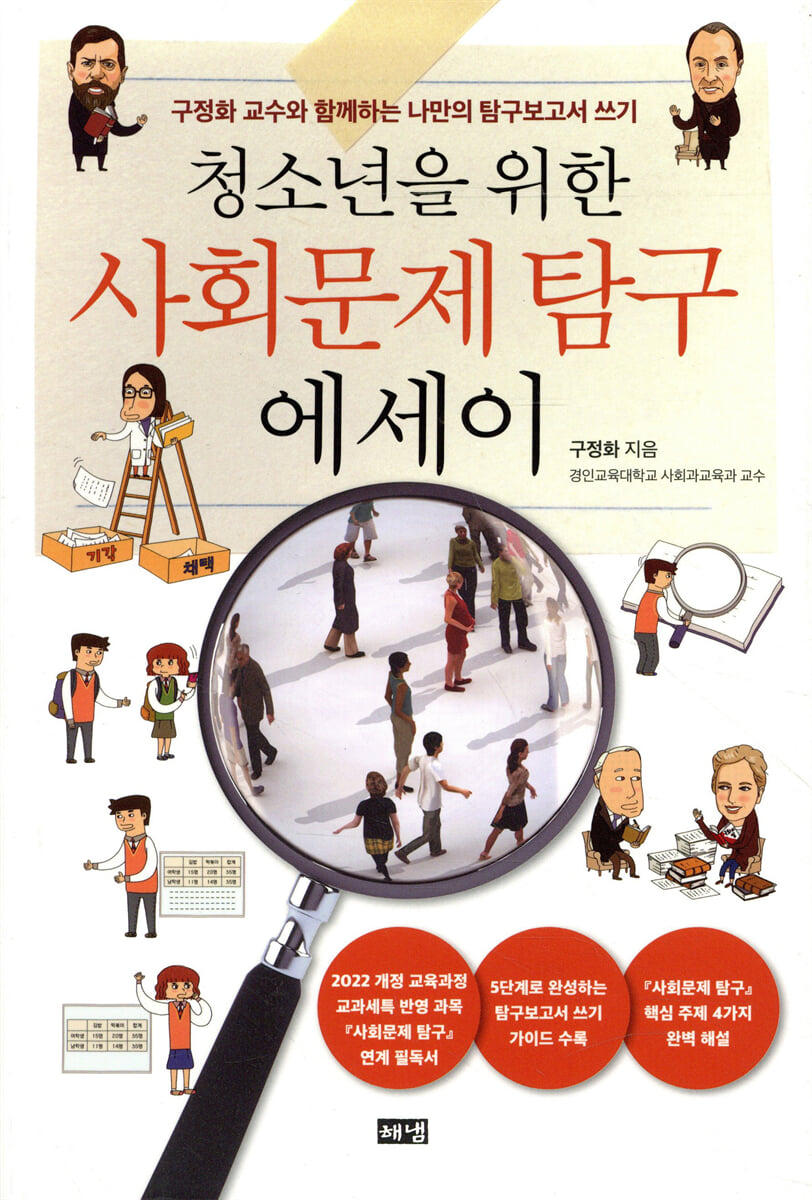
Essays on Social Issues for Youth
 |
Description
Book Introduction
When you look at the world with sociological curiosity, every scene in your daily life becomes a subject of exploration!
Professor Koo Jeong-hwa's social problem exploration classroom that fosters questioning and problem-solving skills.
『Exploring Social Issues』 is a course in which students discover problems in their own communities, find solutions, and write a research report on the process.
It was established in 2015 to foster the ability to actively ask questions and solve problems rather than passively answering given questions.
In the 2022 revision, it was changed from a career-choice subject to a convergence-choice subject. Since it is reflected in the 'curriculum tax special' of the high school student record and is an absolutely evaluated subject, many students choose it for their grades.
However, it is one of the subjects that both students and teachers feel at a loss due to the lack of proper textbooks or supplementary materials.
Accordingly, Professor Koo Jeong-hwa, a leading author of social studies textbooks and a teacher at Gyeongin National University of Education, published “Social Issues Exploration Essays for Youth.”
Professor Koo Jeong-hwa's social problem exploration classroom that fosters questioning and problem-solving skills.
『Exploring Social Issues』 is a course in which students discover problems in their own communities, find solutions, and write a research report on the process.
It was established in 2015 to foster the ability to actively ask questions and solve problems rather than passively answering given questions.
In the 2022 revision, it was changed from a career-choice subject to a convergence-choice subject. Since it is reflected in the 'curriculum tax special' of the high school student record and is an absolutely evaluated subject, many students choose it for their grades.
However, it is one of the subjects that both students and teachers feel at a loss due to the lack of proper textbooks or supplementary materials.
Accordingly, Professor Koo Jeong-hwa, a leading author of social studies textbooks and a teacher at Gyeongin National University of Education, published “Social Issues Exploration Essays for Youth.”
- You can preview some of the book's contents.
Preview
index
Introduction | A Little Guide for Beginners
Chapter 1: The First Step to Exploration: What You Need to Know
1.
You say you're scientifically exploring social phenomena?
2.
The sociological imagination becomes a question
3.
Quantitative research where accurate quantification is important
4.
Qualitative research that delves into deep meaning
5.
Is it possible to conduct research free from the researcher's values?
6.
Is it okay to violate ethics when conducting research that is necessary for society?
Writing a Research Report 1 | From Understanding Social Issues to Research Ethics
Chapter 2: Exploring Social Issues: What Topic Should We Choose?
1.
Low birth rates and aging population: are they unstoppable trends?
2.
Gender inequality: What kind of discrimination is occurring?
3.
Media, what's the problem?
4.
How will artificial intelligence change society?
Writing a Research Report 2 | From Topic Selection to Research Questions
Chapter 3: Before heading into the ground, let's look at prior research first.
1.
The most important benchmark, prior research
2.
Finding prior research is easy once you know how
3.
How to organize citations and references?
Writing a Research Report 3 | From Collecting and Citing Previous Research
Chapter 4: Data Collection Methods for Research Topics
1.
What kind of data is needed to investigate social phenomena?
2.
Literature research method that obtains data from various documents
3.
Experimental method of creating necessary situations and exploring them
4.
Questionnaire method to obtain answers through questions
5.
Interview method to hear the living story of the person involved
6.
Seeing is believing, Participatory Observation
Writing a Research Report 4 | From Selecting a Data Collection Method to Executing It
Chapter 5: Making Exploration Cool and Organizing Results
1.
How should I read and calculate statistical tables?
2.
How should I read the results table of statistical analysis?
3.
How should statistical tables be created and explained?
4.
How should I create and read graphs?
5.
The Fruit of Exploration: Writing an Exploration Report
6.
Going a step further in exploration, social engagement activities
Writing a Research Report 5 | From Organizing Research Results to Using Statistical Tables
In conclusion | Let's begin a journey of asking ourselves questions and finding answers.
Americas
Chapter 1: The First Step to Exploration: What You Need to Know
1.
You say you're scientifically exploring social phenomena?
2.
The sociological imagination becomes a question
3.
Quantitative research where accurate quantification is important
4.
Qualitative research that delves into deep meaning
5.
Is it possible to conduct research free from the researcher's values?
6.
Is it okay to violate ethics when conducting research that is necessary for society?
Writing a Research Report 1 | From Understanding Social Issues to Research Ethics
Chapter 2: Exploring Social Issues: What Topic Should We Choose?
1.
Low birth rates and aging population: are they unstoppable trends?
2.
Gender inequality: What kind of discrimination is occurring?
3.
Media, what's the problem?
4.
How will artificial intelligence change society?
Writing a Research Report 2 | From Topic Selection to Research Questions
Chapter 3: Before heading into the ground, let's look at prior research first.
1.
The most important benchmark, prior research
2.
Finding prior research is easy once you know how
3.
How to organize citations and references?
Writing a Research Report 3 | From Collecting and Citing Previous Research
Chapter 4: Data Collection Methods for Research Topics
1.
What kind of data is needed to investigate social phenomena?
2.
Literature research method that obtains data from various documents
3.
Experimental method of creating necessary situations and exploring them
4.
Questionnaire method to obtain answers through questions
5.
Interview method to hear the living story of the person involved
6.
Seeing is believing, Participatory Observation
Writing a Research Report 4 | From Selecting a Data Collection Method to Executing It
Chapter 5: Making Exploration Cool and Organizing Results
1.
How should I read and calculate statistical tables?
2.
How should I read the results table of statistical analysis?
3.
How should statistical tables be created and explained?
4.
How should I create and read graphs?
5.
The Fruit of Exploration: Writing an Exploration Report
6.
Going a step further in exploration, social engagement activities
Writing a Research Report 5 | From Organizing Research Results to Using Statistical Tables
In conclusion | Let's begin a journey of asking ourselves questions and finding answers.
Americas
Detailed image

Into the book
Young people who ask questions grow into citizens who seek answers!
A friendly guide that will lead you from passive study to active exploration.
The question, 'Why did that happen?'
Asking questions without taking anything for granted.
This is the beginning of exploration.
However, unlike the beginning, the exploration process is very complex.
Additionally, completing papers or reports to communicate the results of research is a difficult task.
The process of exploring social phenomena is a fascinating journey of finding answers to your own questions.
I've put together a little guide to help anyone getting started.
In fact, exploring and recording is a process that requires observing the process closely, making mistakes based on what you learn, and applying it yourself.
So, if I were to guide you through that journey in a book, I would have to go into great detail.
When I first started, I thought I'd make a really detailed guide.
However, when I look at what I wrote, I see that there are still many abstract and theoretical explanations.
Still, I hope this helps a little.
--- From "Entering"
Fully reflects the 2022 revised curriculum!
Exploring Social Issues with Friendly Explanations and Interesting Case Studies
Did you know there's a prize that's a twist on the Nobel Prize? It's called the Ig Nobel Prize.
The Ig Nobel Prizes are awarded annually around the time of the Nobel Prize ceremony, and are given to those who have conducted some of the most outrageous research that year.
(…) Although it is not a Nobel Prize or Ig Nobel Prize, many people research various things they are curious about in life and present the results in research journals.
There is an incredible amount of research being conducted.
Why do humans constantly study?
--- From the text
(…) Exploration is not something that is unique to the laboratory.
Research is when humans investigate, analyze, and organize various phenomena occurring around them from various perspectives.
After all, isn't it thanks to our observation and exploration of what's happening around us that we've been able to compete with other animals and reach where we are today?
--- From "Chapter 1: The First Step to Exploration, Things to Know"
For example, when self-driving cars are introduced, the job of taxi driver will disappear.
If restaurants take orders through kiosks and deliver food using service robots, the jobs of the people who used to do that work will also disappear.
(…) So far, the development of science and technology has had the tendency to reduce existing jobs, but it has also had a greater tendency to create new jobs.
However, it is said that cutting-edge technologies such as artificial intelligence, which are at the core of the Fourth Industrial Revolution, will replace a significant portion of jobs and will not create new ones.
The gap between rich and poor will widen and the number of people losing their jobs will increase.
Fortunately or unfortunately, there is still debate about this prediction.
--- From "Chapter 2: Exploring Social Issues, What Topic Should We Choose?"
Last year, a passage was discovered in the basement of a building in Cheongju, North Chungcheong Province.
It was only wide enough for one person to pass through, so why was this passage created? Its purpose was simple: to connect the building to an oil pipeline about six meters away, allowing the theft of oil.
The connecting passage was discovered when a team of oil thieves were arrested while renting a building and digging a passage using shovels and pickaxes.
The oil contained in the pipeline was clearly someone else's property, and it was a dangerous situation where the ground could collapse or a fire could break out if things went wrong.
Fortunately, the crime scene was found quickly and no major accident occurred.
We often see crimes like this in the news, where people steal other people's property.
The results of research written in a paper or report are also someone's property.
The story is that the prior research we are referencing is someone else's property.
Just like this incident where someone tried to steal someone else's oil without paying for it, using someone else's knowledge without paying for it can also be a crime.
--- From "Before heading into Chapter 3, let's look at prior research first"
The slums in Mexico are called 'Vecindads', and there is a book written by an American anthropologist couple who interviewed families living there for four years in the late 1950s in the Vecindads of Mexico City and recorded their lives.
It's called "The Sanchez Kids", named after the family.
(…) After reading the book, you will realize that poverty, which was thought to be a problem unique to their family, is actually due to the ‘sociocultural structure that creates poor families.’
A book that records interviews with one family can also play an important role in understanding the social structure and society related to poverty.
The reason this book was able to accurately portray the lives of the poor is because it interviewed the people involved directly.
So what does it mean to collect data through interviews?
A friendly guide that will lead you from passive study to active exploration.
The question, 'Why did that happen?'
Asking questions without taking anything for granted.
This is the beginning of exploration.
However, unlike the beginning, the exploration process is very complex.
Additionally, completing papers or reports to communicate the results of research is a difficult task.
The process of exploring social phenomena is a fascinating journey of finding answers to your own questions.
I've put together a little guide to help anyone getting started.
In fact, exploring and recording is a process that requires observing the process closely, making mistakes based on what you learn, and applying it yourself.
So, if I were to guide you through that journey in a book, I would have to go into great detail.
When I first started, I thought I'd make a really detailed guide.
However, when I look at what I wrote, I see that there are still many abstract and theoretical explanations.
Still, I hope this helps a little.
--- From "Entering"
Fully reflects the 2022 revised curriculum!
Exploring Social Issues with Friendly Explanations and Interesting Case Studies
Did you know there's a prize that's a twist on the Nobel Prize? It's called the Ig Nobel Prize.
The Ig Nobel Prizes are awarded annually around the time of the Nobel Prize ceremony, and are given to those who have conducted some of the most outrageous research that year.
(…) Although it is not a Nobel Prize or Ig Nobel Prize, many people research various things they are curious about in life and present the results in research journals.
There is an incredible amount of research being conducted.
Why do humans constantly study?
--- From the text
(…) Exploration is not something that is unique to the laboratory.
Research is when humans investigate, analyze, and organize various phenomena occurring around them from various perspectives.
After all, isn't it thanks to our observation and exploration of what's happening around us that we've been able to compete with other animals and reach where we are today?
--- From "Chapter 1: The First Step to Exploration, Things to Know"
For example, when self-driving cars are introduced, the job of taxi driver will disappear.
If restaurants take orders through kiosks and deliver food using service robots, the jobs of the people who used to do that work will also disappear.
(…) So far, the development of science and technology has had the tendency to reduce existing jobs, but it has also had a greater tendency to create new jobs.
However, it is said that cutting-edge technologies such as artificial intelligence, which are at the core of the Fourth Industrial Revolution, will replace a significant portion of jobs and will not create new ones.
The gap between rich and poor will widen and the number of people losing their jobs will increase.
Fortunately or unfortunately, there is still debate about this prediction.
--- From "Chapter 2: Exploring Social Issues, What Topic Should We Choose?"
Last year, a passage was discovered in the basement of a building in Cheongju, North Chungcheong Province.
It was only wide enough for one person to pass through, so why was this passage created? Its purpose was simple: to connect the building to an oil pipeline about six meters away, allowing the theft of oil.
The connecting passage was discovered when a team of oil thieves were arrested while renting a building and digging a passage using shovels and pickaxes.
The oil contained in the pipeline was clearly someone else's property, and it was a dangerous situation where the ground could collapse or a fire could break out if things went wrong.
Fortunately, the crime scene was found quickly and no major accident occurred.
We often see crimes like this in the news, where people steal other people's property.
The results of research written in a paper or report are also someone's property.
The story is that the prior research we are referencing is someone else's property.
Just like this incident where someone tried to steal someone else's oil without paying for it, using someone else's knowledge without paying for it can also be a crime.
--- From "Before heading into Chapter 3, let's look at prior research first"
The slums in Mexico are called 'Vecindads', and there is a book written by an American anthropologist couple who interviewed families living there for four years in the late 1950s in the Vecindads of Mexico City and recorded their lives.
It's called "The Sanchez Kids", named after the family.
(…) After reading the book, you will realize that poverty, which was thought to be a problem unique to their family, is actually due to the ‘sociocultural structure that creates poor families.’
A book that records interviews with one family can also play an important role in understanding the social structure and society related to poverty.
The reason this book was able to accurately portray the lives of the poor is because it interviewed the people involved directly.
So what does it mean to collect data through interviews?
--- From “Chapter 4: Data Collection Methods for Research Topics”
Publisher's Review
Guiding young people on their first journey of exploration!
The final assignment for ‘Exploring Social Issues’ is to write a ‘research report’ in the form of a thesis.
It is an integrated process that requires young people to generate questions about social phenomena, directly explore them, and record them in a thesis-style document, so it is bound to be unfamiliar and difficult for them.
To address these challenges, this book presents the entire process, from research to report writing, in order.
Chapter 1 covers what you need to know to write the 'Introduction' of your report.
We will learn about sociological concepts such as 'sociological imagination' and 'quantitative and qualitative research', and even examine the issue of research ethics through the case of Robert Oppenheimer, a scientist who became an anti-nuclear activist.
Chapter 2 corresponds to the report's "Research Questions," and provides detailed information on the four topics emphasized in "Exploring Social Issues": low birth rate and aging population, gender inequality, media, and artificial intelligence.
It will be useful for young people looking for research topics and questions by covering each topic in depth and providing examples of questions to explore on each topic.
Chapter 3 is about ‘theoretical background’.
It includes not only ways to find reliable prior research but also how to cite it while protecting copyright.
Chapter 4 is about ‘research methods.’
We introduce five data collection methods, from literature review to experimental methods, questionnaire methods, interviews, and participant observation, and help you choose the method that's right for you.
Chapter 5 explains how to organize the process so far into a research report.
Learn about the importance of statistics through the example of Florence Nightingale, the "angel in white," who contributed to reducing the number of deaths through statistics, and learn how to create actual graphs and infographics.
This book was written so that even adults, including college students, who have difficulty writing papers can refer to it.
It includes not only the elements included in the table of contents of a thesis, such as Korean and English abstracts, but also in-depth statistical analysis, such as descriptive statistics and inferential statistics.
If you use the [Write a Research Report] at the end of each chapter for class and assignments, you will be able to easily complete your research report or thesis.
Developing the essential skills of democratic citizens: questioning and problem-solving skills!
What you learn through exploring social issues isn't just report writing skills.
Ultimately, the goal is to learn universal problem-solving processes.
By exploring, referencing prior research, conducting your own research, and creating your own results, you will be training yourself to solve life's problems by asking for opinions from those around you and directly facing them.
Professor Koo Jeong-hwa, who has taught us how to view the world in a balanced way through numerous books, also hopes that this book will help young people take a step forward.
He said, “We need to ask ourselves questions and find answers based on objective evidence.
Otherwise, there is a high possibility that you will live a passive life following the baseless claims of others.”
Rather than stopping at passive answers, it emphasizes the attitude of thinking independently and actively exploring by exercising questioning and exploratory skills.
In an era where generative AI provides answers based on vast amounts of data, the ability to ask and solve questions on your own, rather than simply answering given questions, will become a crucial skill for survival.
To imagine and create a better world, we need the power to think beyond the given problem.
This book presents all the specific methods and means.
We hope that this book will serve as a practical guide to inquiry not only for young people and social studies teachers who have chosen to study social issues, but also for adults who are curious about how to write a thesis.
The final assignment for ‘Exploring Social Issues’ is to write a ‘research report’ in the form of a thesis.
It is an integrated process that requires young people to generate questions about social phenomena, directly explore them, and record them in a thesis-style document, so it is bound to be unfamiliar and difficult for them.
To address these challenges, this book presents the entire process, from research to report writing, in order.
Chapter 1 covers what you need to know to write the 'Introduction' of your report.
We will learn about sociological concepts such as 'sociological imagination' and 'quantitative and qualitative research', and even examine the issue of research ethics through the case of Robert Oppenheimer, a scientist who became an anti-nuclear activist.
Chapter 2 corresponds to the report's "Research Questions," and provides detailed information on the four topics emphasized in "Exploring Social Issues": low birth rate and aging population, gender inequality, media, and artificial intelligence.
It will be useful for young people looking for research topics and questions by covering each topic in depth and providing examples of questions to explore on each topic.
Chapter 3 is about ‘theoretical background’.
It includes not only ways to find reliable prior research but also how to cite it while protecting copyright.
Chapter 4 is about ‘research methods.’
We introduce five data collection methods, from literature review to experimental methods, questionnaire methods, interviews, and participant observation, and help you choose the method that's right for you.
Chapter 5 explains how to organize the process so far into a research report.
Learn about the importance of statistics through the example of Florence Nightingale, the "angel in white," who contributed to reducing the number of deaths through statistics, and learn how to create actual graphs and infographics.
This book was written so that even adults, including college students, who have difficulty writing papers can refer to it.
It includes not only the elements included in the table of contents of a thesis, such as Korean and English abstracts, but also in-depth statistical analysis, such as descriptive statistics and inferential statistics.
If you use the [Write a Research Report] at the end of each chapter for class and assignments, you will be able to easily complete your research report or thesis.
Developing the essential skills of democratic citizens: questioning and problem-solving skills!
What you learn through exploring social issues isn't just report writing skills.
Ultimately, the goal is to learn universal problem-solving processes.
By exploring, referencing prior research, conducting your own research, and creating your own results, you will be training yourself to solve life's problems by asking for opinions from those around you and directly facing them.
Professor Koo Jeong-hwa, who has taught us how to view the world in a balanced way through numerous books, also hopes that this book will help young people take a step forward.
He said, “We need to ask ourselves questions and find answers based on objective evidence.
Otherwise, there is a high possibility that you will live a passive life following the baseless claims of others.”
Rather than stopping at passive answers, it emphasizes the attitude of thinking independently and actively exploring by exercising questioning and exploratory skills.
In an era where generative AI provides answers based on vast amounts of data, the ability to ask and solve questions on your own, rather than simply answering given questions, will become a crucial skill for survival.
To imagine and create a better world, we need the power to think beyond the given problem.
This book presents all the specific methods and means.
We hope that this book will serve as a practical guide to inquiry not only for young people and social studies teachers who have chosen to study social issues, but also for adults who are curious about how to write a thesis.
GOODS SPECIFICS
- Date of issue: April 22, 2024
- Page count, weight, size: 300 pages | 532g | 153*224*19mm
- ISBN13: 9791167140807
- ISBN10: 116714080X
You may also like
카테고리
korean


korean

![GQ KOREA Mark (Monthly): December [2025]](http://librairie.coreenne.fr/cdn/shop/files/8ef265dbbfbf186523ed75ba7319009d.jpg?v=1765340328&width=3840)


