

Geography through the lens of food and indulgence
 |
Description
Book Introduction
Geography through the lens of food and indulgence
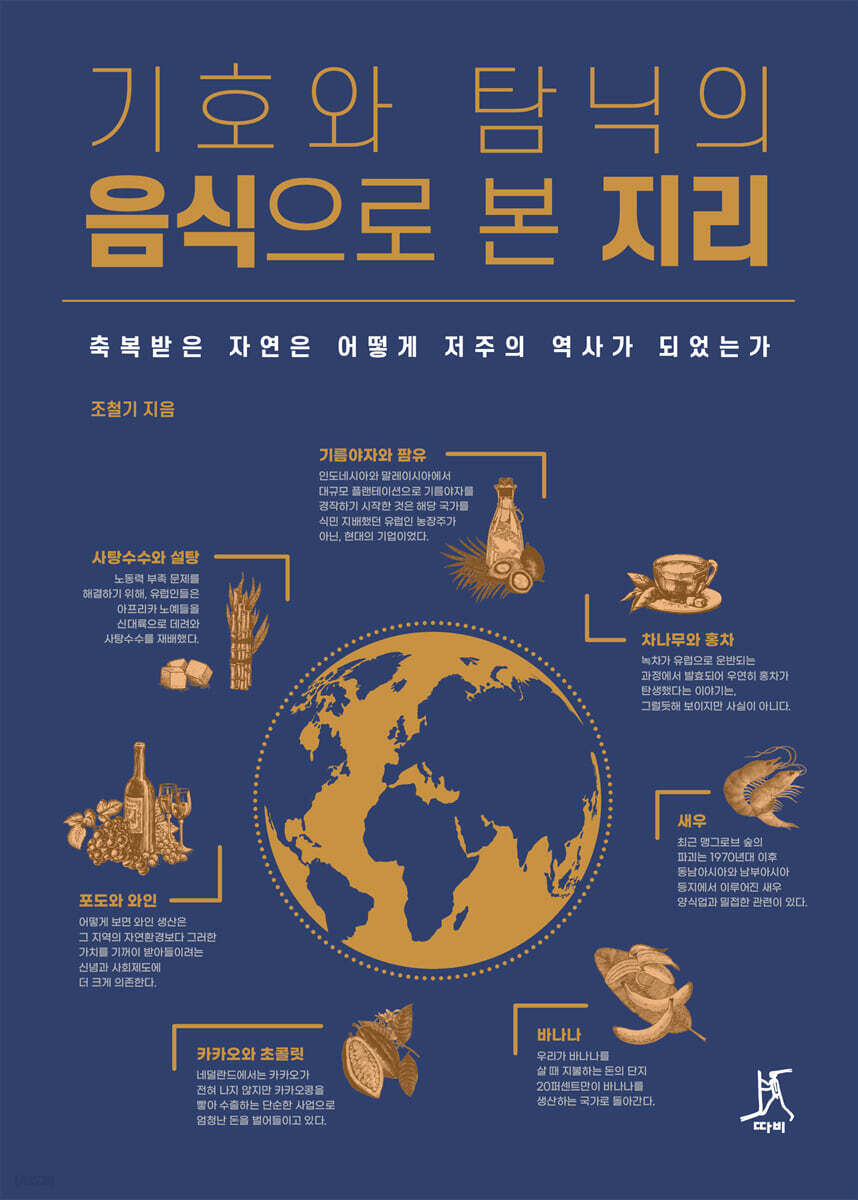
How Blessed Nature Became a Cursed History
The British tea time started an ugly war, and sweet sugar and chocolate are the products of slave and child labor.
Palm oil, which goes into almost every product, and shrimp that end up on people's tables around the world are destroying tropical rainforests and mangrove forests.
Black tea, sugar, chocolate, palm oil, bananas, shrimp, wine.
Through the seven foods that dominate our taste buds, we look back on the inseparable relationships between history and geography, producers and consumers, and humans and nature.
How Blessed Nature Became a Cursed History
The British tea time started an ugly war, and sweet sugar and chocolate are the products of slave and child labor.
Palm oil, which goes into almost every product, and shrimp that end up on people's tables around the world are destroying tropical rainforests and mangrove forests.
Black tea, sugar, chocolate, palm oil, bananas, shrimp, wine.
Through the seven foods that dominate our taste buds, we look back on the inseparable relationships between history and geography, producers and consumers, and humans and nature.
- You can preview some of the book's contents.
Preview
index
Entering 7
Chapter 1: Tea Trees and Black Tea
The Origin of Black Tea 19
The Tea Trade That Caused War 28
Who Rules Tea 36
Coffee, Tea's Eternal Rival: The Light and Shadow of Coffee Globalization 58
Chapter 2 Sugarcane and Sugar
Sugar, the irresistible temptation of sweetness 73
The Origins of Sugarcane and the Geography of Sugar Production and Consumption 76
Sugar Plantations and the Slave Trade in the New World 102
Why Alcoholic Tea Is So Popular in Brazil, the World's Largest Sugarcane Producer
Chapter 3: Cacao and Chocolate
From Cacao to Chocolate 129
The Geography of Cacao Plantations and Chocolate Production and Consumption 138
Sad Africa Through the Chocolate Commodity Chain 152
The Chocolate Truth You Don't Know: Vegetable Oil Instead of Cocoa Butter 172
Chapter 4 Oil Palm and Palm Oil
The Ramen Uji Wave and the Glorious Appearance of Palm Oil 179
Where does palm oil, the most widely used vegetable oil, come from? 182
Oil Palm Plantations and Rainforest Destruction 201
Palm Oil: How Sustainable Is It? 214
Chapter 5 Banana
Bananas, the first fruit cultivated by humans 225
Food in Asia, exports in Latin America 227
Multinational agribusinesses Chiquita and Dole, and the Banana Republic 240
Will we still be able to eat bananas in the future? 256
Chapter 6 Shrimp
Where do the shrimp we eat come from? 279
Mangrove forests disappearing for pink gold 292
The shrimp I ate yesterday were the product of slave labor. 305
Connected Worlds: The Relationship Between Nature and Humanity Through Shrimp 307
Chapter 7 Grapes and Wine
Wine, from the drink of the gods to the drink of all people 317
Terroir: The best wines come from the best vineyards. 330
The Geography and Culture of Wine Production and Consumption 339
Reference 366
Plate source 369
Chapter 1: Tea Trees and Black Tea
The Origin of Black Tea 19
The Tea Trade That Caused War 28
Who Rules Tea 36
Coffee, Tea's Eternal Rival: The Light and Shadow of Coffee Globalization 58
Chapter 2 Sugarcane and Sugar
Sugar, the irresistible temptation of sweetness 73
The Origins of Sugarcane and the Geography of Sugar Production and Consumption 76
Sugar Plantations and the Slave Trade in the New World 102
Why Alcoholic Tea Is So Popular in Brazil, the World's Largest Sugarcane Producer
Chapter 3: Cacao and Chocolate
From Cacao to Chocolate 129
The Geography of Cacao Plantations and Chocolate Production and Consumption 138
Sad Africa Through the Chocolate Commodity Chain 152
The Chocolate Truth You Don't Know: Vegetable Oil Instead of Cocoa Butter 172
Chapter 4 Oil Palm and Palm Oil
The Ramen Uji Wave and the Glorious Appearance of Palm Oil 179
Where does palm oil, the most widely used vegetable oil, come from? 182
Oil Palm Plantations and Rainforest Destruction 201
Palm Oil: How Sustainable Is It? 214
Chapter 5 Banana
Bananas, the first fruit cultivated by humans 225
Food in Asia, exports in Latin America 227
Multinational agribusinesses Chiquita and Dole, and the Banana Republic 240
Will we still be able to eat bananas in the future? 256
Chapter 6 Shrimp
Where do the shrimp we eat come from? 279
Mangrove forests disappearing for pink gold 292
The shrimp I ate yesterday were the product of slave labor. 305
Connected Worlds: The Relationship Between Nature and Humanity Through Shrimp 307
Chapter 7 Grapes and Wine
Wine, from the drink of the gods to the drink of all people 317
Terroir: The best wines come from the best vineyards. 330
The Geography and Culture of Wine Production and Consumption 339
Reference 366
Plate source 369
Detailed image
Into the book
I believe that the impact of commodity crops on the world today will become clearer through comparisons with shrimp, which is not a crop but has similar problems to plantation crops, and grapes (and wine), which are crops concentrated in specific climates but have different histories and consumer bases.
--- p.8~9
Why did the British prefer black tea over green tea? The reason is closely related to the mass production of sugar on sugarcane plantations in the West Indies, Central America, around the same time as the importation of black tea.
This is because black tea goes better with the sweetness of sugar than green tea.
Not only that, but London's water quality was also affected.
--- p.25
The powerful equatorial currents that led Cabral to Brazil also facilitated the transport of slaves across the Atlantic to Brazil, bringing millions of Africans to Brazil over the next 400 years.
Without sugar, there would be no Brazil; without slaves, there would be no sugar; without Angola, which was used as a source of slave labor for the Portuguese colonization of Brazil, there would be no slaves.
--- p.103
However, as cocoa prices plummeted due to cocoa production in Southeast Asia and other regions, Côte d'Ivoire's economy also collapsed.
Moreover, disputes continued surrounding the cocoa farms.
The military and paramilitary groups fought over control of Côte d'Ivoire's cocoa farming industry, where vast wealth rests.
Cocoa producers are under constant threat.
In the end, Côte d'Ivoire, once a paradise, has now fallen into the abyss.
--- p.148
According to the World Wildlife Fund (WWF), an area of rainforest equivalent to 300 soccer fields is currently burned every hour to make way for oil palm plantations.
If deforestation continues at this rate, it is predicted that the rainforests of Indonesia and Malaysia will disappear completely within 20 years.
--- p.202
Standard Fruit began exploring ways to transport the delicate Cavendish bananas intact.
It was a method of transporting bananas by cutting them into bunches and putting them in boxes instead of stacking them in bunches on the bottom of the ship.
This box packaging method opened a new chapter in the production and marketing of bananas for export.
--- p.244
In Samut Sakhon, Thailand's largest shrimp farming area, you won't hear Thai spoken.
Although people wearing factory uniforms are easily seen throughout the village, most of those working in the shrimp farming industry are Myanmar nationals, and 70 percent of them are low-wage migrant workers working illegally.
More than 500,000 Burmese people work in Thailand's shrimp industry, and a city has even been built for them (immigrants account for more than 90 percent of those working in Thailand's seafood processing industry).
--- p.306
As of 2018, France ranked third in wine production and exports, following Spain and Italy in Europe.
However, in terms of export value, it was larger than Italy and Spain.
This is because the unit price of French wine is higher than that of wine from other countries, which is evidence of the high preference for French wine among consumers around the world.
--- p.8~9
Why did the British prefer black tea over green tea? The reason is closely related to the mass production of sugar on sugarcane plantations in the West Indies, Central America, around the same time as the importation of black tea.
This is because black tea goes better with the sweetness of sugar than green tea.
Not only that, but London's water quality was also affected.
--- p.25
The powerful equatorial currents that led Cabral to Brazil also facilitated the transport of slaves across the Atlantic to Brazil, bringing millions of Africans to Brazil over the next 400 years.
Without sugar, there would be no Brazil; without slaves, there would be no sugar; without Angola, which was used as a source of slave labor for the Portuguese colonization of Brazil, there would be no slaves.
--- p.103
However, as cocoa prices plummeted due to cocoa production in Southeast Asia and other regions, Côte d'Ivoire's economy also collapsed.
Moreover, disputes continued surrounding the cocoa farms.
The military and paramilitary groups fought over control of Côte d'Ivoire's cocoa farming industry, where vast wealth rests.
Cocoa producers are under constant threat.
In the end, Côte d'Ivoire, once a paradise, has now fallen into the abyss.
--- p.148
According to the World Wildlife Fund (WWF), an area of rainforest equivalent to 300 soccer fields is currently burned every hour to make way for oil palm plantations.
If deforestation continues at this rate, it is predicted that the rainforests of Indonesia and Malaysia will disappear completely within 20 years.
--- p.202
Standard Fruit began exploring ways to transport the delicate Cavendish bananas intact.
It was a method of transporting bananas by cutting them into bunches and putting them in boxes instead of stacking them in bunches on the bottom of the ship.
This box packaging method opened a new chapter in the production and marketing of bananas for export.
--- p.244
In Samut Sakhon, Thailand's largest shrimp farming area, you won't hear Thai spoken.
Although people wearing factory uniforms are easily seen throughout the village, most of those working in the shrimp farming industry are Myanmar nationals, and 70 percent of them are low-wage migrant workers working illegally.
More than 500,000 Burmese people work in Thailand's shrimp industry, and a city has even been built for them (immigrants account for more than 90 percent of those working in Thailand's seafood processing industry).
--- p.306
As of 2018, France ranked third in wine production and exports, following Spain and Italy in Europe.
However, in terms of export value, it was larger than Italy and Spain.
This is because the unit price of French wine is higher than that of wine from other countries, which is evidence of the high preference for French wine among consumers around the world.
--- p.345
Publisher's Review
The sad tropics that began with imperialism and ended with an unequal trade structure
There is a saying, “Body and land are not two.”
The saying that the body and the land are not two but one expresses the fact that humans have no choice but to live by eating the products grown by the nature of the place where they live.
In fact, Europeans have survived on wheat as their staple food, and Asians on rice as their staple food.
Of course, humans have also avoided famine and enriched their tables by developing agricultural techniques that allow plants to adapt and grow in places other than their native land.
But what if these plants are difficult to adapt to? And what if we become so obsessed with the foods made from them that we can't seem to stop? Tabi Publishing's new book, "Geography Through the Food of Preference and Indulgence: How Blessed Nature Became a History of Curses," examines the geography and history of tropical and subtropical crops that consumers around the world have come to crave, using keywords like "preference foods," "commodity crops," "imperialism," "plantations," "free trade," and "commodity chains," seeking to understand the relationships between consumers and producers, and between humans and nature.
A taste that Europeans love, changing the map
This book covers tea trees and black tea, sugarcane and sugar, cacao and chocolate, oil palm and palm oil, bananas, shrimp, grapes and wine.
Excluding grapes grown in Mediterranean climates and wines made from them, all of these foods are grown on plantations in tropical and subtropical climates, processed by multinational corporations, and distributed around the world (shrimp is also similar in that it is grown on farms that are no different from plantations in tropical and subtropical countries).
To begin with, tea, sugar, chocolate, palm oil, and bananas were also staple foods for the local residents in my hometown.
But when Europeans got a taste for these foods, the fate of these foods and the people changed.
To cover the accumulated deficit from importing tea from China, Britain started the Opium War, and because of the excessive tariffs Britain imposed on black tea, the United States started the Boston Tea Party and moved toward independence.
As demand for sugar in Europe grew, a triangular trade was formed in which slaves were forcibly brought from Africa to secure labor that could be intensively used for short periods of time in sugarcane harvesting and sugar processing.
When European imperialism reached its limit in exploiting colonies, it even began to transplant plants.
Representative examples include tea and cocoa.
When Britain could not meet its own demand by importing tea from China, it simply smuggled tea trees out of China and transplanted them to its colonies of India, Sri Lanka, and Africa.
Tea, once a crop of temperate and subtropical regions, was moved to high altitudes in tropical regions and became a plantation crop.
In the late 18th century, when the horrific slave labor on American cacao plantations became a target of criticism, chocolate companies transplanted cacao trees to West Africa and Southeast Asia.
When it became impossible to bring slaves to Latin America, cocoa was taken to Africa, the slaves' homeland.
Côte d'Ivoire and the Netherlands: Who Dominates the Commodity Chain?
The world's largest cocoa producing country is Côte d'Ivoire in West Africa.
As of 2018, Côte d'Ivoire produced 38 percent of global cocoa.
However, the country with the largest cocoa trade volume is the Netherlands.
Which country does cocoa bring greater wealth? The chocolate commodity chain, where cocoa producers take 6.6 percent of the price paid by consumers for chocolate, processors and grinders 7.6 percent, and traders and brokers 2.1 percent, generates more wealth for the Netherlands than for Côte d'Ivoire, despite not cultivating a single cocoa tree domestically.
Europeans' obsession with exotic foods was a tragedy for the tropical and subtropical peoples who had long grown and consumed these crops.
The tragedy continues today, long after colonial rule ended and slavery disappeared.
If sugar in the imperialist era was produced by slave labor, chocolate in the modern free trade system is produced by child labor.
No matter how hard they work, farmers in Côte d'Ivoire, who have no choice but to sell their cocoa at the "beating" prices imposed by multinational corporations that dominate global distribution, barely manage to survive by locking up children sold from neighboring Burkina Faso, Mali, Benin, and Togo and forcing them to work.
Cocoa is not the only crop in this situation.
In 1999, when banana prices fell, Del Monte laid off all 4,300 workers on his large plantation in Costa Rica and then rehired them at 30 to 50 percent less wages.
This was because Del Monte had a global deal to supply large quantities of bananas at low prices to global retailer Walmart.
Monoculture on plantations not only leaves producers insensitive to market price fluctuations, but also destroys nature.
In Central America, tropical forests are being destroyed for banana plantations, and in Southeast Asia, mangrove forests are being cut down for shrimp farming.
In the Amazon basin, forests are being destroyed for sugarcane cultivation, and in Indonesia and Malaysia, large-scale fires are being carried out for palm oil, putting numerous species at risk of extinction.
Producers and consumers, humans and nature are 'connected'
The author, who teaches prospective geography teachers at universities, emphasizes that to understand the world, we must recognize that we are 'connected.'
These seven foods, produced in specific regions and consumed around the world, help us understand the connection not only between local producers and global consumers, but also between the humanities and the natural world.
The author persuasively unfolds, sometimes through stories and sometimes through statistics, the impact of the geographical characteristics of tropical and subtropical climates on history and the shadow that history casts on these climate regions.
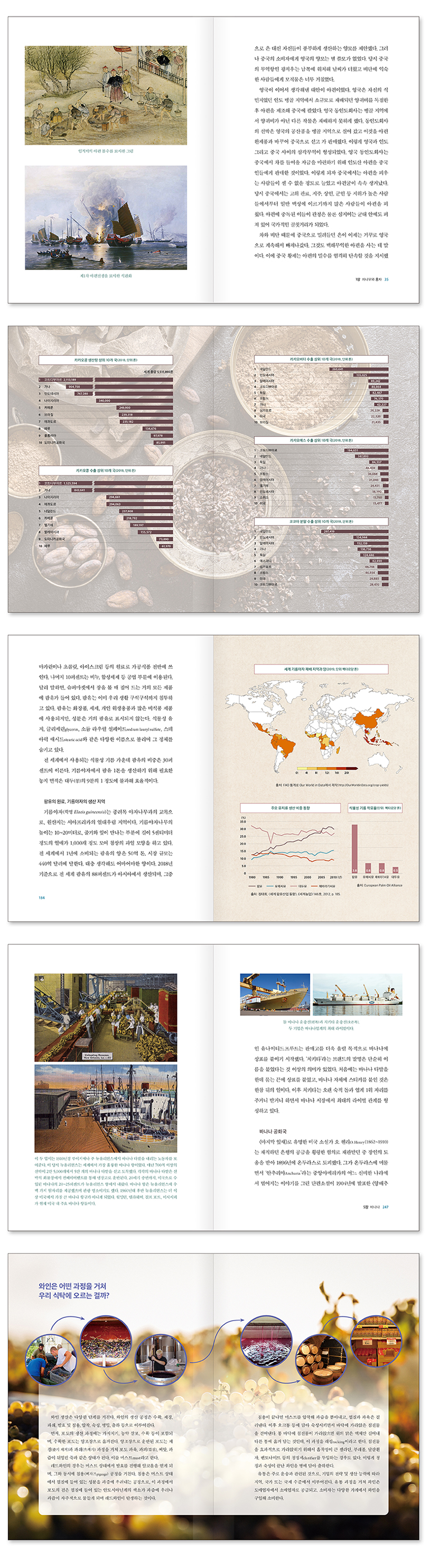
Additionally, various maps, tables, graphs, and illustrations help us understand the past of imperialism, the modern commodity chain, and the flow of production and trade in three dimensions.
Understanding that we are 'connected' through this will also give us insight into how we should act as consumers.
“The cocoa farmers in Côte d’Ivoire love their children as much as I love them.
We can't afford not to buy our kids chocolate.
That's why we need to find ways to support cocoa farmers through smart purchasing.
… very small things like a banana, a cup of tea, a piece of chocolate can change our lives and theirs.”
There is a saying, “Body and land are not two.”
The saying that the body and the land are not two but one expresses the fact that humans have no choice but to live by eating the products grown by the nature of the place where they live.
In fact, Europeans have survived on wheat as their staple food, and Asians on rice as their staple food.
Of course, humans have also avoided famine and enriched their tables by developing agricultural techniques that allow plants to adapt and grow in places other than their native land.
But what if these plants are difficult to adapt to? And what if we become so obsessed with the foods made from them that we can't seem to stop? Tabi Publishing's new book, "Geography Through the Food of Preference and Indulgence: How Blessed Nature Became a History of Curses," examines the geography and history of tropical and subtropical crops that consumers around the world have come to crave, using keywords like "preference foods," "commodity crops," "imperialism," "plantations," "free trade," and "commodity chains," seeking to understand the relationships between consumers and producers, and between humans and nature.
A taste that Europeans love, changing the map
This book covers tea trees and black tea, sugarcane and sugar, cacao and chocolate, oil palm and palm oil, bananas, shrimp, grapes and wine.
Excluding grapes grown in Mediterranean climates and wines made from them, all of these foods are grown on plantations in tropical and subtropical climates, processed by multinational corporations, and distributed around the world (shrimp is also similar in that it is grown on farms that are no different from plantations in tropical and subtropical countries).
To begin with, tea, sugar, chocolate, palm oil, and bananas were also staple foods for the local residents in my hometown.
But when Europeans got a taste for these foods, the fate of these foods and the people changed.
To cover the accumulated deficit from importing tea from China, Britain started the Opium War, and because of the excessive tariffs Britain imposed on black tea, the United States started the Boston Tea Party and moved toward independence.
As demand for sugar in Europe grew, a triangular trade was formed in which slaves were forcibly brought from Africa to secure labor that could be intensively used for short periods of time in sugarcane harvesting and sugar processing.
When European imperialism reached its limit in exploiting colonies, it even began to transplant plants.
Representative examples include tea and cocoa.
When Britain could not meet its own demand by importing tea from China, it simply smuggled tea trees out of China and transplanted them to its colonies of India, Sri Lanka, and Africa.
Tea, once a crop of temperate and subtropical regions, was moved to high altitudes in tropical regions and became a plantation crop.
In the late 18th century, when the horrific slave labor on American cacao plantations became a target of criticism, chocolate companies transplanted cacao trees to West Africa and Southeast Asia.
When it became impossible to bring slaves to Latin America, cocoa was taken to Africa, the slaves' homeland.
Côte d'Ivoire and the Netherlands: Who Dominates the Commodity Chain?
The world's largest cocoa producing country is Côte d'Ivoire in West Africa.
As of 2018, Côte d'Ivoire produced 38 percent of global cocoa.
However, the country with the largest cocoa trade volume is the Netherlands.
Which country does cocoa bring greater wealth? The chocolate commodity chain, where cocoa producers take 6.6 percent of the price paid by consumers for chocolate, processors and grinders 7.6 percent, and traders and brokers 2.1 percent, generates more wealth for the Netherlands than for Côte d'Ivoire, despite not cultivating a single cocoa tree domestically.
Europeans' obsession with exotic foods was a tragedy for the tropical and subtropical peoples who had long grown and consumed these crops.
The tragedy continues today, long after colonial rule ended and slavery disappeared.
If sugar in the imperialist era was produced by slave labor, chocolate in the modern free trade system is produced by child labor.
No matter how hard they work, farmers in Côte d'Ivoire, who have no choice but to sell their cocoa at the "beating" prices imposed by multinational corporations that dominate global distribution, barely manage to survive by locking up children sold from neighboring Burkina Faso, Mali, Benin, and Togo and forcing them to work.
Cocoa is not the only crop in this situation.
In 1999, when banana prices fell, Del Monte laid off all 4,300 workers on his large plantation in Costa Rica and then rehired them at 30 to 50 percent less wages.
This was because Del Monte had a global deal to supply large quantities of bananas at low prices to global retailer Walmart.
Monoculture on plantations not only leaves producers insensitive to market price fluctuations, but also destroys nature.
In Central America, tropical forests are being destroyed for banana plantations, and in Southeast Asia, mangrove forests are being cut down for shrimp farming.
In the Amazon basin, forests are being destroyed for sugarcane cultivation, and in Indonesia and Malaysia, large-scale fires are being carried out for palm oil, putting numerous species at risk of extinction.
Producers and consumers, humans and nature are 'connected'
The author, who teaches prospective geography teachers at universities, emphasizes that to understand the world, we must recognize that we are 'connected.'
These seven foods, produced in specific regions and consumed around the world, help us understand the connection not only between local producers and global consumers, but also between the humanities and the natural world.
The author persuasively unfolds, sometimes through stories and sometimes through statistics, the impact of the geographical characteristics of tropical and subtropical climates on history and the shadow that history casts on these climate regions.
Additionally, various maps, tables, graphs, and illustrations help us understand the past of imperialism, the modern commodity chain, and the flow of production and trade in three dimensions.
Understanding that we are 'connected' through this will also give us insight into how we should act as consumers.
“The cocoa farmers in Côte d’Ivoire love their children as much as I love them.
We can't afford not to buy our kids chocolate.
That's why we need to find ways to support cocoa farmers through smart purchasing.
… very small things like a banana, a cup of tea, a piece of chocolate can change our lives and theirs.”
GOODS SPECIFICS
- Publication date: November 25, 2023
- Page count, weight, size: 376 pages | 570g | 147*205*21mm
- ISBN13: 9791192169316
You may also like
카테고리
korean


korean

![GQ KOREA Mark (Monthly): December [2025]](http://librairie.coreenne.fr/cdn/shop/files/8ef265dbbfbf186523ed75ba7319009d.jpg?v=1765340328&width=3840)


