

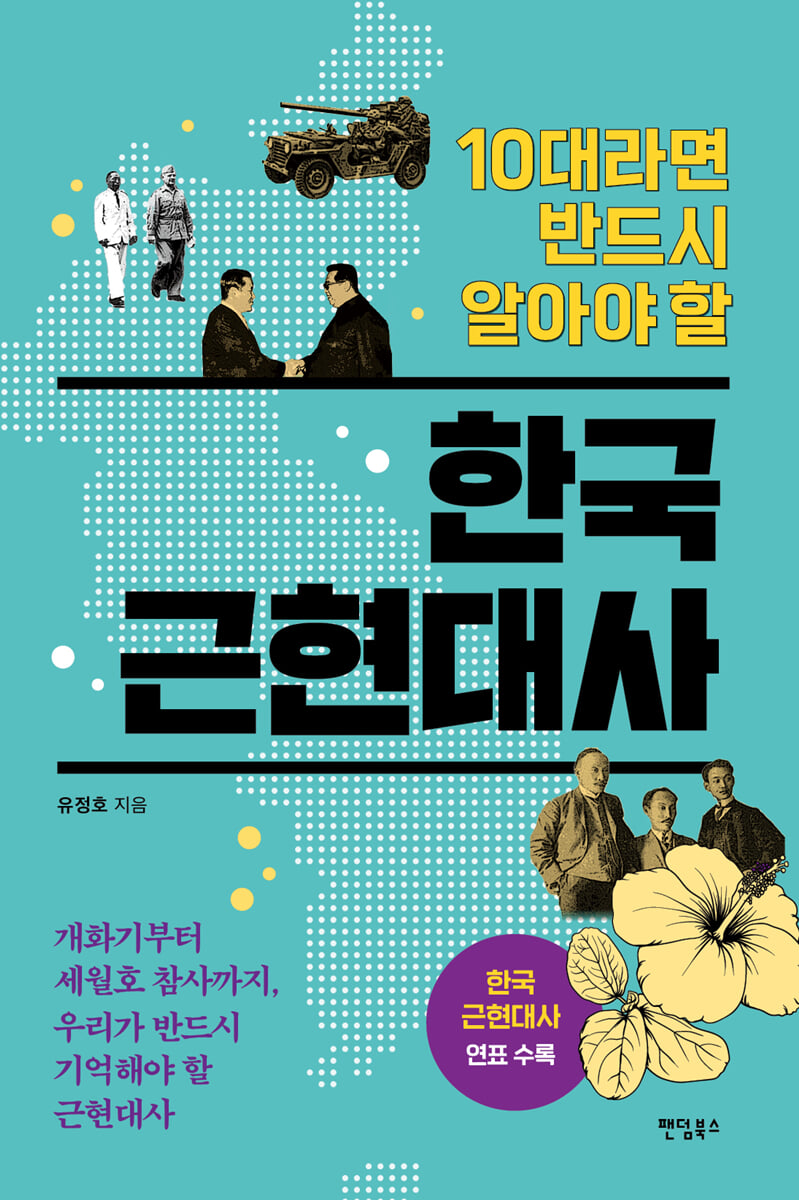
Modern and Contemporary Korean History Every Teenager Should Know
 |
Description
Book Introduction
From the Enlightenment Period to the Sewol Ferry Disaster, modern and contemporary Korean history
All clearly organized in one volume!
It's so heartbreaking, but we must remember
Events of modern and contemporary history!
In our history, changes in modern and contemporary history have been the most important factors determining the present state of the Republic of Korea.
However, modern and contemporary history was not actually covered in significant detail in history classes.
In general, history classes ended in 1945, the year of liberation, or during the Korean War and the Park Chung-hee military government, or history after that was largely omitted.
Modern and contemporary history classes have been neglected for reasons such as the limited class time that cannot cover all of history, the fact that exams focus more heavily on content up to the Joseon Dynasty, or the fact that it is most closely related to the present and therefore subject to historical controversy.
But now things are different.
The proportion of questions about modern and contemporary history has increased in the Korean History Proficiency Test and the College Scholastic Ability Test.
This is the result of recognizing that it is very important to properly understand modern and contemporary history for the past, present, and future of the Republic of Korea.
In that respect, this book clearly explains the trajectory of modern and contemporary Korean history, from the Enlightenment period under Heungseon Daewongun, the Japanese colonial period under the Gyeongsul National Shame, the founding of the Republic of Korea, the April 19 Revolution, the May 16 military coup, the December 12 military coup, the May 18 Gwangju Democratization Movement, the Sewol Ferry Disaster, and the impeachment of President Park Geun-hye.
All clearly organized in one volume!
It's so heartbreaking, but we must remember
Events of modern and contemporary history!
In our history, changes in modern and contemporary history have been the most important factors determining the present state of the Republic of Korea.
However, modern and contemporary history was not actually covered in significant detail in history classes.
In general, history classes ended in 1945, the year of liberation, or during the Korean War and the Park Chung-hee military government, or history after that was largely omitted.
Modern and contemporary history classes have been neglected for reasons such as the limited class time that cannot cover all of history, the fact that exams focus more heavily on content up to the Joseon Dynasty, or the fact that it is most closely related to the present and therefore subject to historical controversy.
But now things are different.
The proportion of questions about modern and contemporary history has increased in the Korean History Proficiency Test and the College Scholastic Ability Test.
This is the result of recognizing that it is very important to properly understand modern and contemporary history for the past, present, and future of the Republic of Korea.
In that respect, this book clearly explains the trajectory of modern and contemporary Korean history, from the Enlightenment period under Heungseon Daewongun, the Japanese colonial period under the Gyeongsul National Shame, the founding of the Republic of Korea, the April 19 Revolution, the May 16 military coup, the December 12 military coup, the May 18 Gwangju Democratization Movement, the Sewol Ferry Disaster, and the impeachment of President Park Geun-hye.
- You can preview some of the book's contents.
Preview
index
prolog
Chapter 1: Heungseon Daewongun (1863) - Gyeongsul National Shame (1910)
1. Heungseon Daewongun's reforms and failures
2 French invasion and Byeonginyangyo
3 American Invasion Shinmiyangyo
4. The First Treaty: Ganghwa Island Treaty
5. The first Treaty of Amity and Commerce between Korea and the United States with a Western country
The Im-o Incident, an uprising by the 6 new soldiers
7. The Gapsin Coup of the Radical Reformists
8 Japan's economic invasion and expropriation order
9 Gwanghyewon, the first Western-style hospital
Revolutionary Donghak Peasant Movement under 10
11 The Sino-Japanese War for control of Joseon
12 The Gabo Reforms, repeated three times
13 The Eulmi Incident that led to the assassination of Queen Myeongseong
14. The Aguan Pacheon took refuge in the Russian embassy
15 The Independence Association that attempted to change Joseon
16. Establishment of the Korean Empire and the Gwangmu Reform
17 The Russo-Japanese War over control of the Korean Peninsula
18. The Eulsa Treaty stripped Korea of its diplomatic rights
19 The Hague envoy who tried to publicize the injustice of the Eulsa Treaty
20 National Debt Redemption Movement to Repay National Debt
21 13th Degree Creative Army and Seoul Vacuum Operation
22. The Gando Convention left by Japan to the Qing Dynasty
23 An Jung-geun assassinates Ito Hirobumi
Chapter 2: Japanese colonial period (1910–1945)
1. Shinheung Training Center, the birthplace of the armed independence movement
2 Land survey project that takes away land
3. The corporate order that wiped out Korean capital
4 Domestic independence army in the 1910s
5 The Largest Anti-Japanese Struggle: The 3?1 Movement
6 The Provisional Government of the Republic of Korea established by the power of the people
7. The great victories of the Battle of Bongodong and the Battle of Cheongsanri
8 The Trials of the Independence Army: The Jayu City Massacre
9. The rice production expansion plan that plundered food
10 Uiyeoldan activities in the 1920s
11. The development of the Hyeongpyeongsa movement from a liberation movement to an independence movement
The Kanto Massacre, which killed 12 Koreans
13. The Public Security Preservation Act was created to capture independence activists.
14 Starting Point of the National Single Party Movement 6 ? 10 Manse Movement
15 New publications from the National Unity Party Movement
16. The Gwangju Student Independence Movement, Brought About by Discrimination
17. The victory of Yang Se-bong and the Korean Revolutionary Army
18 Korean Patriotic Corps that Changed World History
19 A reign of national extermination aimed at eradicating national consciousness
20. Transforming the Korean Peninsula into a logistics base
21 The Japanese military comfort women issue, still unresolved
22. The Korean Language Society incident that attempted to block the use of Hangul
23 Development of the National Unity Party Movement
24. Korean Liberation Army's Domestic Invasion Operation
Chapter 3: Organization of the Committee for the Preparation of the Establishment of the Joseon Nation (1945) - October 26 Incident (1979)
1. The Committee for the Preparation of the Establishment of the Joseon Nation in Preparation for Independence
2. The case of the Joseon Jeongpansa who issued counterfeit banknotes
The Moscow Trilateral Foreign Ministers' Meeting Marred by False Reports
4. The Joint Committee of the United States and the Soviet Union ended without any results.
5 The Two Faces of Inter-Korean Negotiations
6. The Tyranny of State Power: The Jeju 4-3 Incident
7 The first democratic republic of the Republic of Korea
8 Failed Special Committee on Anti-National Activities
9 Pros and Cons of Land Reform
Background of the outbreak of the 10/6/25 War
11 6 ? 25 The development of the war
12 6 ? Civilian massacres during the 25th War
13 The Long Armistice Agreement
14 The Fourth Amendment, which marked the beginning of dictatorship
The Progressive Party Incident that Unjustly Killed Jo Bong-am
16 The 3?15 election fraud that led to the downfall of the Syngman Rhee government
The April 19 Revolution that overthrew the 17th dictatorship
18 Jang Myun Cabinet and 5? 16 Coup
19 Jang Jun-ha receives the Magsaysay Award
20 Launch of the Third Republic and the Korea-Japan Agreement
21 The Two Sides of the Vietnam Troop Deployment
22 Five-Year Economic Development Plan
23 Self-immolation of labor activist Jeon Tae-il
24 History of the Saemaul Movement
25 The 7-4 Joint Statement of the South and the North, the Foundation of Unification
26 The Yushin system that concentrated all power in one place
27 The Million Signature Campaign and the People's Revolutionary Party Incident
28 Seoul Subway Opening
29 The first domestically produced car, Pony
30 North Korean military axe murder incident at Panmunjom
The YH Trading Incident: A Case of Tyranny of Public Power
The Busan-Masan Democratic Uprising that brought about the end of the Yushin regime
33 President Park Chung-hee's death 10-26 incident
Chapter 4: The 12th Coup (1979) - The 6th Declaration (1987)
1 The 12? 12 Coup that Destroyed Hopes for Democracy
2 Spring in Seoul and the Gwangju Democratization Movement of May 18
3. Kim Dae-jung's conspiracy to commit sedition
4. The military junta's media consolidation
5 Samcheong Education Corps Tramples on Human Rights
6 The Chun Doo-hwan government, which denied its own legitimacy
7. The 3S policy that led to political apathy
8. Gwangju, Busan, Daegu, and Seoul American Cultural Center arson incidents
9 School uniform autonomy
10 Special Live Broadcasts to Find Separated Families
Aung San terrorist attack that attempted to kill President 11
12 North Korea also provides unexpected flood relief
13. Submission of a resolution for a state investigation into the truth behind the Gwangju Democratization Movement.
14. The first inter-Korean symphony visit to separated families
15 86 Seoul Asian Games held
16 A Dam of Peace Built on Political Logic
The death of Park Jong-cheol, which marked the beginning of the June 17 Democracy Movement
The June Democracy Movement that ended dictatorship through the power of the people
19 Constitutional Amendment and Social Democratization Movement
20 Politically Exploited KAL Bombing Incident
21 History of the National Security Act
Chapter 5: 88 Seoul Olympics (1988) - Multicultural Family Support Act (2022)
1 88 Seoul Olympics held
2. The Beginning of Liberalization of Overseas Travel
3. The Basic Agreement between the South and the North that brought about the end of the Cold War
4. The real-name financial system that has shrunk the underground economy
5. The collapse of Seongsu Bridge caused by corruption
6. College Scholastic Ability Test (CSAT)
7 Local Autonomy and National Referendum
8 The collapse of Sampoong Department Store, caused by greed
Demolition of the Government-General Building, a remnant of Japanese colonial rule
10. Arrest of former Presidents Chun Doo-hwan and Roh Tae-woo
11 Shin Chang-won Prison Escape Incident
12 Korean World Heritage Sites
13 The Foreign Exchange Crisis and the International Monetary Fund (IMF)
14 Heads of State Visit Pyeongan 6? 15 Joint Declaration between the South and the North
15 President Kim Dae-jung receives the Nobel Peace Prize
16 Memories of the 2002 Korea-Japan World Cup
The Daegu subway disaster, recorded as a horrific disaster
18 The much-talked-about restoration of Cheonggyecheon
19. Return of the Meaningful Bukgwan Battle Monument
Establishment of the Truth and Reconciliation Commission on Pro-Japanese Collaborators and Anti-National Activities
21. Impeachment of President Roh Moo-hyun
22 The abolition of the now unfamiliar household system
The Sewol Ferry Disaster That Led to the Impeachment of the 23rd President
24. The Japanese Military Comfort Women Agreement, which violates national sentiment
25 The impeachment of President Park Geun-hye achieved through the power of the people.
Lee Chun-jae, the perpetrator of the 26 Mars serial murders, has been arrested.
27 Multicultural Family Support Act and Multicultural Family Support Center
supplement
Chronology of modern and contemporary Korean history
Chapter 1: Heungseon Daewongun (1863) - Gyeongsul National Shame (1910)
1. Heungseon Daewongun's reforms and failures
2 French invasion and Byeonginyangyo
3 American Invasion Shinmiyangyo
4. The First Treaty: Ganghwa Island Treaty
5. The first Treaty of Amity and Commerce between Korea and the United States with a Western country
The Im-o Incident, an uprising by the 6 new soldiers
7. The Gapsin Coup of the Radical Reformists
8 Japan's economic invasion and expropriation order
9 Gwanghyewon, the first Western-style hospital
Revolutionary Donghak Peasant Movement under 10
11 The Sino-Japanese War for control of Joseon
12 The Gabo Reforms, repeated three times
13 The Eulmi Incident that led to the assassination of Queen Myeongseong
14. The Aguan Pacheon took refuge in the Russian embassy
15 The Independence Association that attempted to change Joseon
16. Establishment of the Korean Empire and the Gwangmu Reform
17 The Russo-Japanese War over control of the Korean Peninsula
18. The Eulsa Treaty stripped Korea of its diplomatic rights
19 The Hague envoy who tried to publicize the injustice of the Eulsa Treaty
20 National Debt Redemption Movement to Repay National Debt
21 13th Degree Creative Army and Seoul Vacuum Operation
22. The Gando Convention left by Japan to the Qing Dynasty
23 An Jung-geun assassinates Ito Hirobumi
Chapter 2: Japanese colonial period (1910–1945)
1. Shinheung Training Center, the birthplace of the armed independence movement
2 Land survey project that takes away land
3. The corporate order that wiped out Korean capital
4 Domestic independence army in the 1910s
5 The Largest Anti-Japanese Struggle: The 3?1 Movement
6 The Provisional Government of the Republic of Korea established by the power of the people
7. The great victories of the Battle of Bongodong and the Battle of Cheongsanri
8 The Trials of the Independence Army: The Jayu City Massacre
9. The rice production expansion plan that plundered food
10 Uiyeoldan activities in the 1920s
11. The development of the Hyeongpyeongsa movement from a liberation movement to an independence movement
The Kanto Massacre, which killed 12 Koreans
13. The Public Security Preservation Act was created to capture independence activists.
14 Starting Point of the National Single Party Movement 6 ? 10 Manse Movement
15 New publications from the National Unity Party Movement
16. The Gwangju Student Independence Movement, Brought About by Discrimination
17. The victory of Yang Se-bong and the Korean Revolutionary Army
18 Korean Patriotic Corps that Changed World History
19 A reign of national extermination aimed at eradicating national consciousness
20. Transforming the Korean Peninsula into a logistics base
21 The Japanese military comfort women issue, still unresolved
22. The Korean Language Society incident that attempted to block the use of Hangul
23 Development of the National Unity Party Movement
24. Korean Liberation Army's Domestic Invasion Operation
Chapter 3: Organization of the Committee for the Preparation of the Establishment of the Joseon Nation (1945) - October 26 Incident (1979)
1. The Committee for the Preparation of the Establishment of the Joseon Nation in Preparation for Independence
2. The case of the Joseon Jeongpansa who issued counterfeit banknotes
The Moscow Trilateral Foreign Ministers' Meeting Marred by False Reports
4. The Joint Committee of the United States and the Soviet Union ended without any results.
5 The Two Faces of Inter-Korean Negotiations
6. The Tyranny of State Power: The Jeju 4-3 Incident
7 The first democratic republic of the Republic of Korea
8 Failed Special Committee on Anti-National Activities
9 Pros and Cons of Land Reform
Background of the outbreak of the 10/6/25 War
11 6 ? 25 The development of the war
12 6 ? Civilian massacres during the 25th War
13 The Long Armistice Agreement
14 The Fourth Amendment, which marked the beginning of dictatorship
The Progressive Party Incident that Unjustly Killed Jo Bong-am
16 The 3?15 election fraud that led to the downfall of the Syngman Rhee government
The April 19 Revolution that overthrew the 17th dictatorship
18 Jang Myun Cabinet and 5? 16 Coup
19 Jang Jun-ha receives the Magsaysay Award
20 Launch of the Third Republic and the Korea-Japan Agreement
21 The Two Sides of the Vietnam Troop Deployment
22 Five-Year Economic Development Plan
23 Self-immolation of labor activist Jeon Tae-il
24 History of the Saemaul Movement
25 The 7-4 Joint Statement of the South and the North, the Foundation of Unification
26 The Yushin system that concentrated all power in one place
27 The Million Signature Campaign and the People's Revolutionary Party Incident
28 Seoul Subway Opening
29 The first domestically produced car, Pony
30 North Korean military axe murder incident at Panmunjom
The YH Trading Incident: A Case of Tyranny of Public Power
The Busan-Masan Democratic Uprising that brought about the end of the Yushin regime
33 President Park Chung-hee's death 10-26 incident
Chapter 4: The 12th Coup (1979) - The 6th Declaration (1987)
1 The 12? 12 Coup that Destroyed Hopes for Democracy
2 Spring in Seoul and the Gwangju Democratization Movement of May 18
3. Kim Dae-jung's conspiracy to commit sedition
4. The military junta's media consolidation
5 Samcheong Education Corps Tramples on Human Rights
6 The Chun Doo-hwan government, which denied its own legitimacy
7. The 3S policy that led to political apathy
8. Gwangju, Busan, Daegu, and Seoul American Cultural Center arson incidents
9 School uniform autonomy
10 Special Live Broadcasts to Find Separated Families
Aung San terrorist attack that attempted to kill President 11
12 North Korea also provides unexpected flood relief
13. Submission of a resolution for a state investigation into the truth behind the Gwangju Democratization Movement.
14. The first inter-Korean symphony visit to separated families
15 86 Seoul Asian Games held
16 A Dam of Peace Built on Political Logic
The death of Park Jong-cheol, which marked the beginning of the June 17 Democracy Movement
The June Democracy Movement that ended dictatorship through the power of the people
19 Constitutional Amendment and Social Democratization Movement
20 Politically Exploited KAL Bombing Incident
21 History of the National Security Act
Chapter 5: 88 Seoul Olympics (1988) - Multicultural Family Support Act (2022)
1 88 Seoul Olympics held
2. The Beginning of Liberalization of Overseas Travel
3. The Basic Agreement between the South and the North that brought about the end of the Cold War
4. The real-name financial system that has shrunk the underground economy
5. The collapse of Seongsu Bridge caused by corruption
6. College Scholastic Ability Test (CSAT)
7 Local Autonomy and National Referendum
8 The collapse of Sampoong Department Store, caused by greed
Demolition of the Government-General Building, a remnant of Japanese colonial rule
10. Arrest of former Presidents Chun Doo-hwan and Roh Tae-woo
11 Shin Chang-won Prison Escape Incident
12 Korean World Heritage Sites
13 The Foreign Exchange Crisis and the International Monetary Fund (IMF)
14 Heads of State Visit Pyeongan 6? 15 Joint Declaration between the South and the North
15 President Kim Dae-jung receives the Nobel Peace Prize
16 Memories of the 2002 Korea-Japan World Cup
The Daegu subway disaster, recorded as a horrific disaster
18 The much-talked-about restoration of Cheonggyecheon
19. Return of the Meaningful Bukgwan Battle Monument
Establishment of the Truth and Reconciliation Commission on Pro-Japanese Collaborators and Anti-National Activities
21. Impeachment of President Roh Moo-hyun
22 The abolition of the now unfamiliar household system
The Sewol Ferry Disaster That Led to the Impeachment of the 23rd President
24. The Japanese Military Comfort Women Agreement, which violates national sentiment
25 The impeachment of President Park Geun-hye achieved through the power of the people.
Lee Chun-jae, the perpetrator of the 26 Mars serial murders, has been arrested.
27 Multicultural Family Support Act and Multicultural Family Support Center
supplement
Chronology of modern and contemporary Korean history
Detailed image

Publisher's Review
Modern and contemporary Korean history neglected in history classes
As we talk about our history, we feel that recent changes have greatly increased interest in modern and contemporary history.
This phenomenon can be considered very positive.
Modern and contemporary history has not been given much importance.
In middle and high school, the history class ended with the liberation of Korea.
There may have been some differences between schools, but even if the curriculum progressed significantly, the Korean War was the end of the class or subsequent history was largely omitted.
The reason was this.
First, because we tried to convey more content to students in a limited amount of time, we often couldn't cover all of history.
Second, there are too many historical facts that must be covered in class according to the curriculum.
There is a vast amount of historical information that must be learned as you progress through high school and college.
Especially before the 2000s, the content up to the Joseon Dynasty was given more weight in the exams than modern and contemporary history, so modern and contemporary history was inevitably neglected.
Lastly, the historical establishment of modern and contemporary history has not been clearly established.
Although other historical periods also have many controversies, modern and contemporary history is the most closely related to the present and therefore the subject of much controversy.
So, it is true that I try to avoid controversial parts of modern and contemporary history whenever possible.
Modern and contemporary Korean history has become important now.
But now things are different.
The proportion of questions about modern and contemporary history has increased in the Korean History Proficiency Test and the College Scholastic Ability Test.
I believe this is a result of growing interest in history and the growing recognition that a proper understanding of history is crucial for the present and the future.
I think it is very important to know the history that closely influences today, rather than stories from the present and the distant past.
To be honest, it is true that I get angry when I study our history from the Enlightenment period in the 19th century, through the Japanese colonial period, the military dictatorship period, and up to the present day.
But in any era, in any country, there are ups and downs.
When something reaches its peak, it declines, and when it can no longer solve real-world problems, another entity emerges to create a better world.
Although we failed to take the initiative and correct our mistakes in the early 20th century, we lost our country to Japan.
But we did not give up, we wanted to take back our country and create the world our people wanted.
We are citizens of a country that has corrected its wrongs through the April 19 Revolution, the May 18 Gwangju Democratization Movement, and the June Democracy Movement.
South Korea is a country with a long history and culture.
Although we have lost our country, we have achieved democracy and economic growth through our own efforts.
This is a case that cannot be found in many countries around the world.
That is why we must be very proud of the word Korea.
And we have a responsibility not only to maintain this wonderful country, but to make it even better.
To do that, we need to look back on our past, even if it is painful and difficult.
So that mistakes are not repeated and good things are passed on.
From the Enlightenment Period to the Sewol Ferry Disaster and the impeachment of President Park Geun-hye
This book clearly explains the trajectory of modern and contemporary Korean history, from the Enlightenment period under Heungseon Daewongun, the Japanese colonial period of the Gyeongsul National Shame, the founding of the Republic of Korea, the April 19 Revolution, the May 16 military coup, the December 12 military coup, the May 18 Gwangju Democratization Movement, the Sewol Ferry Disaster, and the impeachment of President Park Geun-hye.
Because it is such a vast history, it is impossible to record everything in detail.
However, we explained it simply and clearly so that middle and high school students, as well as the MZ generation, could understand it as easily as possible.
At the same time, we have included quotes, documents, and laws from the past to provide a vivid understanding of history.
So it won't feel stiff while reading.
There will also be new information that you may not have known about.
Above all, I believe it will be of great help in organizing modern and contemporary history at a glance.
We also included a chronological table of modern and contemporary Korean history as an appendix.
Of course, there are some areas of concern.
The history after liberation is very sensitive due to many differences of opinion.
I tried to be as objective as possible and describe both the good and the bad.
However, depending on what kind of life you have lived, what values you follow, and what experiences you have had, you may develop an aversion to certain historical events.
If so, I hope you will be tolerant and accept that such opinions are also acceptable.
What I want to convey through this book is that as Koreans, we should love the past and present of the Republic of Korea and hope for a better future.
As we talk about our history, we feel that recent changes have greatly increased interest in modern and contemporary history.
This phenomenon can be considered very positive.
Modern and contemporary history has not been given much importance.
In middle and high school, the history class ended with the liberation of Korea.
There may have been some differences between schools, but even if the curriculum progressed significantly, the Korean War was the end of the class or subsequent history was largely omitted.
The reason was this.
First, because we tried to convey more content to students in a limited amount of time, we often couldn't cover all of history.
Second, there are too many historical facts that must be covered in class according to the curriculum.
There is a vast amount of historical information that must be learned as you progress through high school and college.
Especially before the 2000s, the content up to the Joseon Dynasty was given more weight in the exams than modern and contemporary history, so modern and contemporary history was inevitably neglected.
Lastly, the historical establishment of modern and contemporary history has not been clearly established.
Although other historical periods also have many controversies, modern and contemporary history is the most closely related to the present and therefore the subject of much controversy.
So, it is true that I try to avoid controversial parts of modern and contemporary history whenever possible.
Modern and contemporary Korean history has become important now.
But now things are different.
The proportion of questions about modern and contemporary history has increased in the Korean History Proficiency Test and the College Scholastic Ability Test.
I believe this is a result of growing interest in history and the growing recognition that a proper understanding of history is crucial for the present and the future.
I think it is very important to know the history that closely influences today, rather than stories from the present and the distant past.
To be honest, it is true that I get angry when I study our history from the Enlightenment period in the 19th century, through the Japanese colonial period, the military dictatorship period, and up to the present day.
But in any era, in any country, there are ups and downs.
When something reaches its peak, it declines, and when it can no longer solve real-world problems, another entity emerges to create a better world.
Although we failed to take the initiative and correct our mistakes in the early 20th century, we lost our country to Japan.
But we did not give up, we wanted to take back our country and create the world our people wanted.
We are citizens of a country that has corrected its wrongs through the April 19 Revolution, the May 18 Gwangju Democratization Movement, and the June Democracy Movement.
South Korea is a country with a long history and culture.
Although we have lost our country, we have achieved democracy and economic growth through our own efforts.
This is a case that cannot be found in many countries around the world.
That is why we must be very proud of the word Korea.
And we have a responsibility not only to maintain this wonderful country, but to make it even better.
To do that, we need to look back on our past, even if it is painful and difficult.
So that mistakes are not repeated and good things are passed on.
From the Enlightenment Period to the Sewol Ferry Disaster and the impeachment of President Park Geun-hye
This book clearly explains the trajectory of modern and contemporary Korean history, from the Enlightenment period under Heungseon Daewongun, the Japanese colonial period of the Gyeongsul National Shame, the founding of the Republic of Korea, the April 19 Revolution, the May 16 military coup, the December 12 military coup, the May 18 Gwangju Democratization Movement, the Sewol Ferry Disaster, and the impeachment of President Park Geun-hye.
Because it is such a vast history, it is impossible to record everything in detail.
However, we explained it simply and clearly so that middle and high school students, as well as the MZ generation, could understand it as easily as possible.
At the same time, we have included quotes, documents, and laws from the past to provide a vivid understanding of history.
So it won't feel stiff while reading.
There will also be new information that you may not have known about.
Above all, I believe it will be of great help in organizing modern and contemporary history at a glance.
We also included a chronological table of modern and contemporary Korean history as an appendix.
Of course, there are some areas of concern.
The history after liberation is very sensitive due to many differences of opinion.
I tried to be as objective as possible and describe both the good and the bad.
However, depending on what kind of life you have lived, what values you follow, and what experiences you have had, you may develop an aversion to certain historical events.
If so, I hope you will be tolerant and accept that such opinions are also acceptable.
What I want to convey through this book is that as Koreans, we should love the past and present of the Republic of Korea and hope for a better future.
GOODS SPECIFICS
- Date of issue: February 27, 2024
- Page count, weight, size: 416 pages | 514g | 140*210*21mm
- ISBN13: 9791161692821
- ISBN10: 1161692827
You may also like
카테고리
korean


korean

![GQ KOREA Mark (Monthly): December [2025]](http://librairie.coreenne.fr/cdn/shop/files/8ef265dbbfbf186523ed75ba7319009d.jpg?v=1765340328&width=3840)


