

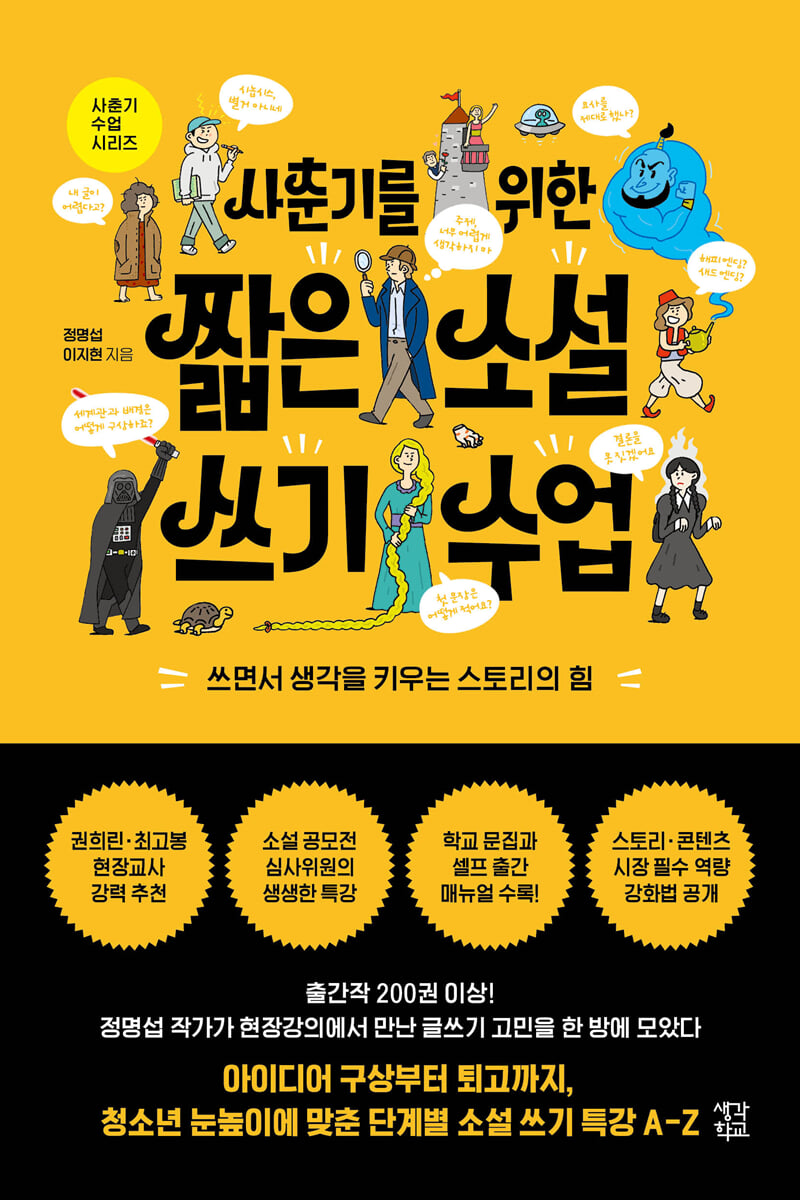
Short Story Writing Class for Teens
 |
Description
Book Introduction
Author Jeong Myeong-seop, a master of writing who has explored not only the published books but also the film and web novel markets, has returned with the adolescence class series, "Short Story Writing Class for Adolescents."
The author says that the key to successful content is storytelling ability, and that this ability can be developed through the practice of "writing short stories."
After four years of writing in obscurity, the author has published over 200 books and even served as a judge for short story contests. He wrote this book to share with young people the writing know-how he gained from wandering and failing with various characters and events in his writing.
Accordingly, the table of contents was compiled based on questions received from students during writing lectures given at schools across the country.
We also provide a step-by-step practical guide that can be read and followed by anyone who wants to create their own content in the future, even if they are not necessarily a writer.
Through this book, readers can learn the routine of writing a novel by following the series of steps applied to writing a novel, from idea generation to writing a synopsis, writing the first sentence, concluding, and revising. They can also learn novel writing tips unique to author Jeong Myeong-seop, such as the key to creating an attractive character is 'weakness', or that you should listen more when you receive a review saying 'the writing is difficult' rather than 'it is not boring'.
Furthermore, the appendix includes a 'self-publishing manual' by author Lee Ji-hyun, a current librarian and teacher, and a 'writing activity guidance method' for parents and teachers, providing tips on activities after writing.
The author says that the key to successful content is storytelling ability, and that this ability can be developed through the practice of "writing short stories."
After four years of writing in obscurity, the author has published over 200 books and even served as a judge for short story contests. He wrote this book to share with young people the writing know-how he gained from wandering and failing with various characters and events in his writing.
Accordingly, the table of contents was compiled based on questions received from students during writing lectures given at schools across the country.
We also provide a step-by-step practical guide that can be read and followed by anyone who wants to create their own content in the future, even if they are not necessarily a writer.
Through this book, readers can learn the routine of writing a novel by following the series of steps applied to writing a novel, from idea generation to writing a synopsis, writing the first sentence, concluding, and revising. They can also learn novel writing tips unique to author Jeong Myeong-seop, such as the key to creating an attractive character is 'weakness', or that you should listen more when you receive a review saying 'the writing is difficult' rather than 'it is not boring'.
Furthermore, the appendix includes a 'self-publishing manual' by author Lee Ji-hyun, a current librarian and teacher, and a 'writing activity guidance method' for parents and teachers, providing tips on activities after writing.
- You can preview some of the book's contents.
Preview
index
prolog
Ki: For students who are beginning to write novels
Q1.
Why is it a novel?
-People who are fascinated by stories
-Why a novel?
-Why I became a novelist
Q2.
Novels, how much do you know?
-What the heck is a novel?
-Novels divided by length
-Novels divided by genre
-Let's start writing a short story.
Q3.
How to become familiar with novel writing?
-Something more important than talent
-Getting to Know Novel Writing 1: Habits and Practice
-Getting to Know Novel Writing 2: Reading
Seung: What kind of story should I write?
Q4.
I can't think of any ideas or materials.
-The first step in writing: finding material
- A treasure trove of materials, news/articles
-Look at old articles and small advertisements too.
Q5.
What kind of character would you like to see appear?
-One well-raised character is worth ten full-length films.
-Let's make the main character like this.
-The Hidden Licorice of the Novel, the Villain
Q6.
How do you design the worldview and background?
-Is a worldview really necessary?
-The beginning of an attractive worldview
Q7.
What kind of incident would be interesting?
-This is the place where the incident happened
-Don't create incidents, find them!
- Genre-specific event rules
Q: How should I solve this?
Q8.
I have an idea, but I don't know where to start.
-Between idea and work, synopsis
-Synopsis, nothing special
Q9.
How do you write the first sentence?
-The first sentence that determines the first impression
-Escaping the trap of the first sentence
Q10.
I think it's awkward because something happened suddenly.
-Now the real work begins, the build-up
-When you feel lost at the beginning, use a cliché!
-Other ways to build up
Q11.
As long as it's fun, does it have to have a theme?
-Why did you write this article?
-Don't overthink the topic.
Q12.
I find it funny, but my friend doesn't really understand what I'm talking about.
-You think my writing is difficult?
-Mid-term check 1: Did I describe it correctly?
-Midterm Check 2: Did you use the lines and fingerprints well?
Q13.
Even after checking the ambassador and fingerprints, something about the writing feels off.
-If my novel still feels awkward, check the point of view.
-Two perspectives on one work, is that okay?
Conclusion: How should we conclude?
Q14.
I keep giving up while writing
-When you feel like giving up in the middle
- Fast-acting treatment 'must be finished'
Q15.
I can't come to a conclusion
-The beginning was grand, but what was the ending?
Happy ending? Sad ending? Before that, let's tie up the protagonist's narrative.
Q16.
What is a retirement?
-The first draft is trash
-Retire, try this
Q17.
How should I decide on the title?
-Name my writing
-Let's avoid names like this.
Appendix 1 I'm curious about the job of a writer!
Appendix 2: Publishing a book, do it this way!
Appendix 3: Instructions for Writing Books for Teachers AZ
Appendix 4: Ten Commandments of Writing from a Librarian
Ki: For students who are beginning to write novels
Q1.
Why is it a novel?
-People who are fascinated by stories
-Why a novel?
-Why I became a novelist
Q2.
Novels, how much do you know?
-What the heck is a novel?
-Novels divided by length
-Novels divided by genre
-Let's start writing a short story.
Q3.
How to become familiar with novel writing?
-Something more important than talent
-Getting to Know Novel Writing 1: Habits and Practice
-Getting to Know Novel Writing 2: Reading
Seung: What kind of story should I write?
Q4.
I can't think of any ideas or materials.
-The first step in writing: finding material
- A treasure trove of materials, news/articles
-Look at old articles and small advertisements too.
Q5.
What kind of character would you like to see appear?
-One well-raised character is worth ten full-length films.
-Let's make the main character like this.
-The Hidden Licorice of the Novel, the Villain
Q6.
How do you design the worldview and background?
-Is a worldview really necessary?
-The beginning of an attractive worldview
Q7.
What kind of incident would be interesting?
-This is the place where the incident happened
-Don't create incidents, find them!
- Genre-specific event rules
Q: How should I solve this?
Q8.
I have an idea, but I don't know where to start.
-Between idea and work, synopsis
-Synopsis, nothing special
Q9.
How do you write the first sentence?
-The first sentence that determines the first impression
-Escaping the trap of the first sentence
Q10.
I think it's awkward because something happened suddenly.
-Now the real work begins, the build-up
-When you feel lost at the beginning, use a cliché!
-Other ways to build up
Q11.
As long as it's fun, does it have to have a theme?
-Why did you write this article?
-Don't overthink the topic.
Q12.
I find it funny, but my friend doesn't really understand what I'm talking about.
-You think my writing is difficult?
-Mid-term check 1: Did I describe it correctly?
-Midterm Check 2: Did you use the lines and fingerprints well?
Q13.
Even after checking the ambassador and fingerprints, something about the writing feels off.
-If my novel still feels awkward, check the point of view.
-Two perspectives on one work, is that okay?
Conclusion: How should we conclude?
Q14.
I keep giving up while writing
-When you feel like giving up in the middle
- Fast-acting treatment 'must be finished'
Q15.
I can't come to a conclusion
-The beginning was grand, but what was the ending?
Happy ending? Sad ending? Before that, let's tie up the protagonist's narrative.
Q16.
What is a retirement?
-The first draft is trash
-Retire, try this
Q17.
How should I decide on the title?
-Name my writing
-Let's avoid names like this.
Appendix 1 I'm curious about the job of a writer!
Appendix 2: Publishing a book, do it this way!
Appendix 3: Instructions for Writing Books for Teachers AZ
Appendix 4: Ten Commandments of Writing from a Librarian
Detailed image

Into the book
Unfortunately, I only have one body and time is limited… .
So, in order to meet you through a book, I prepared a guide to writing for teenagers (novel writing) as a first step.
I wanted to convey the content as realistically as possible, so I organized the table of contents based on questions frequently asked by students during lectures.
I will share as much of the know-how and experience I have accumulated while writing novels through this book as possible, so please read it comfortably and enjoyably.
--- p.6
One thing to keep in mind is that the power to create and complete a narrative isn't just for novel writing.
To tell a story in various ways, including web novels and webtoons, you need to be able to write with a narrative.
Also, when planning a YouTube channel or shooting a short video, it must include a narrative.
--- p.19
If the protagonist isn't compelling, readers won't have any reason to read further.
Also, if the character who can be called the 'main character' of the narrative fails to capture the reader's interest, he or she will be buried in the flow of other characters and events.
If that happens, no matter how solid and interesting the story is, readers will not evaluate it favorably.
Because you can't tell who's leading the story.
--- p.59
A synopsis is like a light and a compass that we can rely on when we face such difficult situations.
When you feel confused or anxious, you can find peace and relaxation by looking back at the synopsis you wrote in advance.
Also, I need to write down the basic information and the outline of the novel I have in mind so that I don't waver in the latter half, whether it's a short story or a novel.
--- p.89
The most important thing when finishing a story is that the protagonist must achieve his goal, whether it is a happy ending or a sad ending.
(Omitted) The reason the protagonist goes on an adventure in the first place is because of the goal.
--- p.145
There's one more thing to look at while checking for typos and inscriptions.
This is the plausibility of the work.
When I write, I often develop the content without thinking.
Even if you write while considering various factors, it is not easy to write while grasping the overall flow.
There may have been parts written with the intention of establishing a connection, considering the ending or the twist effect, but while writing the novel, there probably wasn't time to think about whether the build-up process was natural or whether the connection was tight.
I'll check it when I retire.
This means that revision is not simply a process for correcting typos.
Rather than correcting typos or misspellings, it is more important to refine the flow of the narrative and the overall details.
So, in order to meet you through a book, I prepared a guide to writing for teenagers (novel writing) as a first step.
I wanted to convey the content as realistically as possible, so I organized the table of contents based on questions frequently asked by students during lectures.
I will share as much of the know-how and experience I have accumulated while writing novels through this book as possible, so please read it comfortably and enjoyably.
--- p.6
One thing to keep in mind is that the power to create and complete a narrative isn't just for novel writing.
To tell a story in various ways, including web novels and webtoons, you need to be able to write with a narrative.
Also, when planning a YouTube channel or shooting a short video, it must include a narrative.
--- p.19
If the protagonist isn't compelling, readers won't have any reason to read further.
Also, if the character who can be called the 'main character' of the narrative fails to capture the reader's interest, he or she will be buried in the flow of other characters and events.
If that happens, no matter how solid and interesting the story is, readers will not evaluate it favorably.
Because you can't tell who's leading the story.
--- p.59
A synopsis is like a light and a compass that we can rely on when we face such difficult situations.
When you feel confused or anxious, you can find peace and relaxation by looking back at the synopsis you wrote in advance.
Also, I need to write down the basic information and the outline of the novel I have in mind so that I don't waver in the latter half, whether it's a short story or a novel.
--- p.89
The most important thing when finishing a story is that the protagonist must achieve his goal, whether it is a happy ending or a sad ending.
(Omitted) The reason the protagonist goes on an adventure in the first place is because of the goal.
--- p.145
There's one more thing to look at while checking for typos and inscriptions.
This is the plausibility of the work.
When I write, I often develop the content without thinking.
Even if you write while considering various factors, it is not easy to write while grasping the overall flow.
There may have been parts written with the intention of establishing a connection, considering the ending or the twist effect, but while writing the novel, there probably wasn't time to think about whether the build-up process was natural or whether the connection was tight.
I'll check it when I retire.
This means that revision is not simply a process for correcting typos.
Rather than correcting typos or misspellings, it is more important to refine the flow of the narrative and the overall details.
--- p.153
Publisher's Review
Over 200 published works!
A veteran who crosses genres in publishing, film, and web novels.
Storytelling techniques taught by author Jeong Myeong-seop
Author Jeong Myeong-seop, a master writer who has explored not only the published books but also the film and web novel markets, has returned with the Adolescence Class series.
The Adolescence Class Series is a liberal arts series published by Saenggak School that contains knowledge that growing 1318 students need to learn and understand, such as 'vocabulary', 'grammar', and 'literacy'.
"Short Story Writing Class for Adolescence," written by author Jeong Myeong-seop, a veteran writer with over 200 published works and a judge for short story contests, and author Lee Ji-hyeon, a current librarian and yes24 reading education planning committee member, introduces "storytelling techniques," which are the foundation of all popular content these days, from videos to short posts on social media.
The author says that in a "society overflowing with stories" where people write their own stories through Brunch, Instagram, and blogs, the key condition for transforming one's writing into "readable writing" and "content that captivates others" is "a strong narrative (storytelling)."
Just as it is hard to breathe when asked to describe the founding process of Gojoseon, everyone can recall the general plot of the story when told of the story of Hwanung and Ungnyeo.
Moreover, the increasing number of books that teach history, world history, and economics through storytelling proves the power of stories and narratives.
“Isn’t literacy, vocabulary, and spelling ultimately for understanding and sharing texts?
“The one book I want to read to children who are about to embark on a journey of novel writing.”
-Kwon Hee-rin, librarian at Jangchung High School
The author suggests "writing short stories" as the fastest way to acquire all the basic skills covered in the previous series, such as literacy, vocabulary, and spelling, and further acquire the content composition skills, or storytelling skills, demanded in modern society.
Because the act of writing improves literacy on a completely different level than reading.
To write a novel, you need to ask yourself why you chose this topic and what kind of characters, events, and background are necessary for this story.
Through this, you can develop critical thinking, creativity, and imagination.
Moreover, writing a novel is a process of putting your thoughts into your writing and conveying them to others.
The experience of creating stories through one's own imagination and communicating with others through them will not only enhance storytelling skills but also help young people grow up to be healthier and more resilient.
The author says that he wrote this book to share with young people his own writing know-how, gained through wandering and failing with various characters and events in his writing, from a four-year period of obscurity to publishing over 200 books and serving as a judge for short story contests.
As the representative of the teachers' book club Booksuda, who recommends the book as "the golden roadmap for novel writing discovered by a writer after countless trials and errors," puts it, let's discover the storytelling techniques that only a "veteran" who has worked diligently and consistently in one field for a long time can know in "Short Novel Writing Class for Adolescents."
From idea conception to completion,
A Special Course on Novel Writing Tailored to Teens' Level AZ
Over the past several years, the author has consistently met students who enjoy expressing themselves through TikTok and social media, and who are familiar with such activities, in school writing classes and book talks.
The number of on-site writing lectures I have conducted so far is well over 100.
In this way, I organized the table of contents based on the vivid writing concerns and questions I heard from students while spending time with them through books and writing.
This book is a collection of concerns I've heard directly from the field, such as the concern of wanting to write but not having any ideas or material, what to do when you somehow manage to write but receive feedback from friends that your writing is "difficult" rather than "not fun," and what to do when you get lost in the middle of writing and feel stuck.
However, the reason why this book can be positioned as a "short story writing class for adolescents" rather than simply a collection of students' concerns Q&A is because it is not simply a list of questions and concerns, but is organized according to a series of flow from the beginning stages of novel writing to the final stage.
As a novel writing book, the book is composed of four chapters (introduction-development-turn-conclusion).
In the 'Gi' part, we introduce what a novel is, the benefits of writing a novel, and the preparatory activities needed before writing a novel.
From 'Seung' onwards, we will teach you practical writing techniques in earnest.
We introduce how to set up the main elements of a novel, 'characters, events, and background', starting from finding material.
The 'Before' part covers things to consider when developing a story, how to build up before an incident occurs, how to incorporate the theme into a story, and the golden ratio of dialogue and text to increase readability, as well as checking the point of view.
Finally, in 'Conclusion', we introduce the process of titling and the revision process, which is just as important as completing the piece.
Students who simply want to write their own piece can experience the entire writing routine, from idea generation to first sentence writing, conclusion, and final revision.
Additionally, students who have previously written but were not satisfied with the results or who have concerns about detailed writing techniques such as the novel's development method or increasing plausibility can learn how to improve their writing through author Jeong Myeong-seop's unique writing know-how and ways to prevent mistakes that beginners often make.
As I have spent a lot of time interacting with young people, my examples and word choices that are tailored to the children's level are also outstanding.
It is designed for modern students who are familiar with visualization and are exposed to a variety of genres, such as web novels.
By using the words 'character' rather than 'person' and 'worldview' rather than 'background', the reader can accept it more easily and immediately, and the hidden secrets of storytelling are explained through examples of works that are frequently mentioned among teenagers, such as 'Wednesday' and 'Harry Potter'.
As well as practical novel writing technique tips,
A detailed guide to writing without giving up on a single piece
“The biggest failure in writing is not writing boringly.
“I don’t write.”
It would be a big mistake to think that this book simply teaches writing techniques.
What the author has learned through trial and error in writing is not just technical tips.
I also learned the strength that comes from the perseverance to complete a single piece of work and the attitude of not giving up.
The author even reveals the mindset and attitude to deal with the 'fear' and 'doubt about one's own work' that one inevitably faces when engaging in the act of creation.
“Put aside your fear of failure for now.
They offer words of encouragement like, “Cross the line,” and they also prescribe “deadlines” to the “my writing is bad” syndrome, which is caused by the anxiety that my writing is not good.
At first glance, it may seem like encouragement or a solution that anyone can offer, but you will feel that the words of a writer who has braved the path of practice and practice more fiercely than anyone else have a deeper resonance and power than anything else.
Readers who read the author's anecdotes and attitude toward writing that appear here and there will be able to reflect not only on his writing skills but also on his own attitude toward his goals.
A book that teachers unanimously praise!
“A writing bible that will be helpful not only to students but also to teachers in the field!”
- Choi Go-bong, representative of the teachers' book reading group "Book Talk"
Unlike existing writing guides, this book also includes a manual for school teachers who want to encourage writing but are unsure of how to guide it.
“I’ve been thinking a lot about how I can help students who want to write poetry or novels and actually post on blogs and social media lately. But after encountering this book, which covers everything from practical writing tips to how to support book writing, I feel like I’ve found the path I need to take.
As recommended by a current teacher, “This is a practical book that will be helpful not only to students who are beginning to write, but also to teachers who are starting to teach reading to students in the field,” the appendix contains practical tips for teachers and parents in the field.
This book publishing manual, neatly organized by author Lee Ji-hyun, a current teacher-librarian and active leader of a school reading club, will serve as a valuable reference for teachers who want to go beyond writing and self-publish a book or create a class anthology.
In addition, we have organized publishing terms that are not easily known to those not working in the publishing industry, such as ISBN, deposit, and format, into an easy-to-understand format so that even readers who are new to publishing can easily understand and use them.
It also includes examples and checklists for school budget management for teachers in the field, making it a useful resource for teachers who want to run writing programs in their classrooms.
A veteran who crosses genres in publishing, film, and web novels.
Storytelling techniques taught by author Jeong Myeong-seop
Author Jeong Myeong-seop, a master writer who has explored not only the published books but also the film and web novel markets, has returned with the Adolescence Class series.
The Adolescence Class Series is a liberal arts series published by Saenggak School that contains knowledge that growing 1318 students need to learn and understand, such as 'vocabulary', 'grammar', and 'literacy'.
"Short Story Writing Class for Adolescence," written by author Jeong Myeong-seop, a veteran writer with over 200 published works and a judge for short story contests, and author Lee Ji-hyeon, a current librarian and yes24 reading education planning committee member, introduces "storytelling techniques," which are the foundation of all popular content these days, from videos to short posts on social media.
The author says that in a "society overflowing with stories" where people write their own stories through Brunch, Instagram, and blogs, the key condition for transforming one's writing into "readable writing" and "content that captivates others" is "a strong narrative (storytelling)."
Just as it is hard to breathe when asked to describe the founding process of Gojoseon, everyone can recall the general plot of the story when told of the story of Hwanung and Ungnyeo.
Moreover, the increasing number of books that teach history, world history, and economics through storytelling proves the power of stories and narratives.
“Isn’t literacy, vocabulary, and spelling ultimately for understanding and sharing texts?
“The one book I want to read to children who are about to embark on a journey of novel writing.”
-Kwon Hee-rin, librarian at Jangchung High School
The author suggests "writing short stories" as the fastest way to acquire all the basic skills covered in the previous series, such as literacy, vocabulary, and spelling, and further acquire the content composition skills, or storytelling skills, demanded in modern society.
Because the act of writing improves literacy on a completely different level than reading.
To write a novel, you need to ask yourself why you chose this topic and what kind of characters, events, and background are necessary for this story.
Through this, you can develop critical thinking, creativity, and imagination.
Moreover, writing a novel is a process of putting your thoughts into your writing and conveying them to others.
The experience of creating stories through one's own imagination and communicating with others through them will not only enhance storytelling skills but also help young people grow up to be healthier and more resilient.
The author says that he wrote this book to share with young people his own writing know-how, gained through wandering and failing with various characters and events in his writing, from a four-year period of obscurity to publishing over 200 books and serving as a judge for short story contests.
As the representative of the teachers' book club Booksuda, who recommends the book as "the golden roadmap for novel writing discovered by a writer after countless trials and errors," puts it, let's discover the storytelling techniques that only a "veteran" who has worked diligently and consistently in one field for a long time can know in "Short Novel Writing Class for Adolescents."
From idea conception to completion,
A Special Course on Novel Writing Tailored to Teens' Level AZ
Over the past several years, the author has consistently met students who enjoy expressing themselves through TikTok and social media, and who are familiar with such activities, in school writing classes and book talks.
The number of on-site writing lectures I have conducted so far is well over 100.
In this way, I organized the table of contents based on the vivid writing concerns and questions I heard from students while spending time with them through books and writing.
This book is a collection of concerns I've heard directly from the field, such as the concern of wanting to write but not having any ideas or material, what to do when you somehow manage to write but receive feedback from friends that your writing is "difficult" rather than "not fun," and what to do when you get lost in the middle of writing and feel stuck.
However, the reason why this book can be positioned as a "short story writing class for adolescents" rather than simply a collection of students' concerns Q&A is because it is not simply a list of questions and concerns, but is organized according to a series of flow from the beginning stages of novel writing to the final stage.
As a novel writing book, the book is composed of four chapters (introduction-development-turn-conclusion).
In the 'Gi' part, we introduce what a novel is, the benefits of writing a novel, and the preparatory activities needed before writing a novel.
From 'Seung' onwards, we will teach you practical writing techniques in earnest.
We introduce how to set up the main elements of a novel, 'characters, events, and background', starting from finding material.
The 'Before' part covers things to consider when developing a story, how to build up before an incident occurs, how to incorporate the theme into a story, and the golden ratio of dialogue and text to increase readability, as well as checking the point of view.
Finally, in 'Conclusion', we introduce the process of titling and the revision process, which is just as important as completing the piece.
Students who simply want to write their own piece can experience the entire writing routine, from idea generation to first sentence writing, conclusion, and final revision.
Additionally, students who have previously written but were not satisfied with the results or who have concerns about detailed writing techniques such as the novel's development method or increasing plausibility can learn how to improve their writing through author Jeong Myeong-seop's unique writing know-how and ways to prevent mistakes that beginners often make.
As I have spent a lot of time interacting with young people, my examples and word choices that are tailored to the children's level are also outstanding.
It is designed for modern students who are familiar with visualization and are exposed to a variety of genres, such as web novels.
By using the words 'character' rather than 'person' and 'worldview' rather than 'background', the reader can accept it more easily and immediately, and the hidden secrets of storytelling are explained through examples of works that are frequently mentioned among teenagers, such as 'Wednesday' and 'Harry Potter'.
As well as practical novel writing technique tips,
A detailed guide to writing without giving up on a single piece
“The biggest failure in writing is not writing boringly.
“I don’t write.”
It would be a big mistake to think that this book simply teaches writing techniques.
What the author has learned through trial and error in writing is not just technical tips.
I also learned the strength that comes from the perseverance to complete a single piece of work and the attitude of not giving up.
The author even reveals the mindset and attitude to deal with the 'fear' and 'doubt about one's own work' that one inevitably faces when engaging in the act of creation.
“Put aside your fear of failure for now.
They offer words of encouragement like, “Cross the line,” and they also prescribe “deadlines” to the “my writing is bad” syndrome, which is caused by the anxiety that my writing is not good.
At first glance, it may seem like encouragement or a solution that anyone can offer, but you will feel that the words of a writer who has braved the path of practice and practice more fiercely than anyone else have a deeper resonance and power than anything else.
Readers who read the author's anecdotes and attitude toward writing that appear here and there will be able to reflect not only on his writing skills but also on his own attitude toward his goals.
A book that teachers unanimously praise!
“A writing bible that will be helpful not only to students but also to teachers in the field!”
- Choi Go-bong, representative of the teachers' book reading group "Book Talk"
Unlike existing writing guides, this book also includes a manual for school teachers who want to encourage writing but are unsure of how to guide it.
“I’ve been thinking a lot about how I can help students who want to write poetry or novels and actually post on blogs and social media lately. But after encountering this book, which covers everything from practical writing tips to how to support book writing, I feel like I’ve found the path I need to take.
As recommended by a current teacher, “This is a practical book that will be helpful not only to students who are beginning to write, but also to teachers who are starting to teach reading to students in the field,” the appendix contains practical tips for teachers and parents in the field.
This book publishing manual, neatly organized by author Lee Ji-hyun, a current teacher-librarian and active leader of a school reading club, will serve as a valuable reference for teachers who want to go beyond writing and self-publish a book or create a class anthology.
In addition, we have organized publishing terms that are not easily known to those not working in the publishing industry, such as ISBN, deposit, and format, into an easy-to-understand format so that even readers who are new to publishing can easily understand and use them.
It also includes examples and checklists for school budget management for teachers in the field, making it a useful resource for teachers who want to run writing programs in their classrooms.
GOODS SPECIFICS
- Date of issue: January 18, 2024
- Page count, weight, size: 216 pages | 340g | 140*210*15mm
- ISBN13: 9791191360981
- ISBN10: 1191360989
You may also like
카테고리
korean


korean

![GQ KOREA Mark (Monthly): December [2025]](http://librairie.coreenne.fr/cdn/shop/files/8ef265dbbfbf186523ed75ba7319009d.jpg?v=1765340328&width=3840)


