

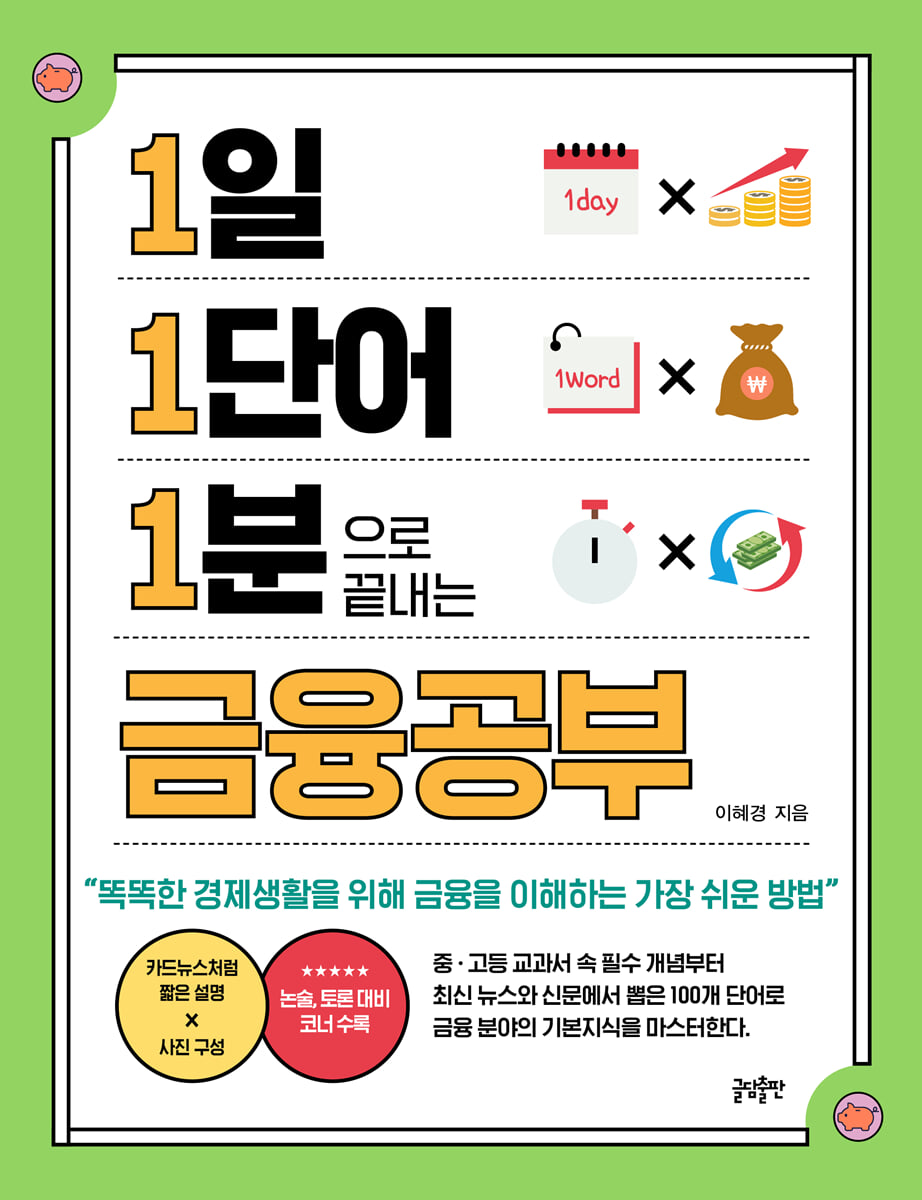
Financial Study: One Word a Day, One Minute
 |
Description
Book Introduction
Interest rates, exchange rates, stocks, open banking, fintech, blockchain, NFTs…
A 22-year veteran economics, finance, and securities expert reporter explains things in 100 words.
Everything You Need to Know About Finance for Teens!
Finance is a complex subject that makes even the mere thought of it a headache. Isn't it possible to study it in an easy and fun way? "One Word a Day, One Minute Financial Study" focuses on 100 words frequently appearing in middle and high school textbooks, the latest news, and newspapers, helping you quickly and easily master the fundamentals of finance.
From terms that are frequently used in daily life, such as deposits and savings, credit cards and check cards, and assets and liabilities, but whose concepts and differences are difficult to easily explain, to topics that are of high interest to teenagers, such as stocks, funds, subscription accounts, blockchain, and NFTs, interesting examples and visual materials are used to explain them in an easy-to-understand manner at the level of teenagers.
You can also find answers to everyday questions like, "What's the difference between investing and speculation?", "The unemployment rate is low, so why is it so hard to get a job?", "If the bank I used to work with fails, can I get my deposit back?", and "The ads say I can get a loan quickly and easily, so can I trust the loan sharks?"
Financial education in schools is still inadequate, and financial education at home is limited.
In this situation, young people are not able to build proper financial knowledge by randomly accepting the information overflowing through YouTube and social media.
Even this kind of misunderstood information often leads to poor investments or illegal loans, making financial education for youth urgently needed.
"Financial Studies in One Minute, One Word a Day" will help young people develop sound values about money and the economy by organizing the most fundamental knowledge for financial education, laying the foundation for a healthy economic life.
A 22-year veteran economics, finance, and securities expert reporter explains things in 100 words.
Everything You Need to Know About Finance for Teens!
Finance is a complex subject that makes even the mere thought of it a headache. Isn't it possible to study it in an easy and fun way? "One Word a Day, One Minute Financial Study" focuses on 100 words frequently appearing in middle and high school textbooks, the latest news, and newspapers, helping you quickly and easily master the fundamentals of finance.
From terms that are frequently used in daily life, such as deposits and savings, credit cards and check cards, and assets and liabilities, but whose concepts and differences are difficult to easily explain, to topics that are of high interest to teenagers, such as stocks, funds, subscription accounts, blockchain, and NFTs, interesting examples and visual materials are used to explain them in an easy-to-understand manner at the level of teenagers.
You can also find answers to everyday questions like, "What's the difference between investing and speculation?", "The unemployment rate is low, so why is it so hard to get a job?", "If the bank I used to work with fails, can I get my deposit back?", and "The ads say I can get a loan quickly and easily, so can I trust the loan sharks?"
Financial education in schools is still inadequate, and financial education at home is limited.
In this situation, young people are not able to build proper financial knowledge by randomly accepting the information overflowing through YouTube and social media.
Even this kind of misunderstood information often leads to poor investments or illegal loans, making financial education for youth urgently needed.
"Financial Studies in One Minute, One Word a Day" will help young people develop sound values about money and the economy by organizing the most fundamental knowledge for financial education, laying the foundation for a healthy economic life.
- You can preview some of the book's contents.
Preview
index
Chapter 1: Financial Concepts
001 Finance: Why can't the economy function properly when finance is unstable?
002 Interest Rates: Why does my mom buy me less chicken when interest rates rise?
003 Savings: Why does a country's economy grow when people save more?
004 Investment and Speculation: Should I invest if I risk losing my principal?
005 Credit and Credit Rating: Why is it important to repay your debts?
006 Assets and Liabilities: Why is it dangerous to have a lot of debt even if you have a lot of assets?
007 Trade: Why are there so many "Made in China" products in our country?
008 Currency: Are the numbers in your account, not cash, really money?
009 Credit Creation: Money Makes Money?
010 Credit Crunch: If you can't borrow money, will financial markets freeze?
011 Payment: Why is it so complicated when I'm just paying for the item?
012 Financial Markets: Where to Go to Trade Money?
013 Investment: How to invest well?
014 Accounting: Do companies and governments also keep household ledgers?
Reading the World Through Finance I: Even Financial Statements Get Makeup? - Creative Accounting
Chapter 2 Financial Products
015 Deposits and Savings: Turning Windmills with Savings?
016 Loans: Wouldn't it be great if you could get a large loan quickly?
017 Stocks: Can you buy the value of a company with money?
018 Fund: Is there a financial product that can make a mountain out of a little bit of dust?
019 Bonds: Can you lend money to anyone as long as they pay a high interest rate?
020 Derivatives: What happens when the desire to secure popular goods meets investment?
021 Insurance: How to prepare for unexpected accidents?
022 Credit Cards and Check Cards: Why Use a Card Even If You Have Cash?
023 Subscription Account: Is there an account that can be used to purchase an apartment?
024 Old-Age Pension: Why Does the Government Make It Mandatory to Join the National Pension?
Reading the World Through Finance II: Increasing Corporate Value Through Active Shareholders_Activist Investment
Chapter 3: History and Major Events of Finance
025 The Dawn of Finance: Why Did Jewish Moneylenders Get a Bad Image?
026 The Crusades: How the Crusaders Became Masters of Finance
027 Age of Exploration: Did Europe's love of pepper lead to the creation of banks?
028 Dutch Tulip Mania: Did tulips cause the first economic bubble in history?
029 Gold Standard: Was there a time when the value of currency was assessed by the price of gold?
030 Bretton Woods System: How Did the US Dollar Become the World's Key Player in Finance?
031 The Great Depression of 1929: Why did the 1929 US economic crisis spread to Europe?
032 Black Monday, 1987: Why did the term "Black Monday" come about?
033 1997 Economic Crisis: When was the biggest economic crisis since the founding of our country?
034 The 2002 Credit Card Crisis: Why Was the "Get Rich" Ad So Popular?
035 The Global Financial Crisis of 2007-2008: Why Did the Global Economy Fall into Crisis When the U.S. Real Estate Bubble Burst?
036 The COVID-19 Pandemic 2020-2022: Will a Sudden Epidemic Ruin the Economy?
Reading the World Through Finance III: Two Famous Swans in the Financial World: Black Swans and Green Swans
Chapter 4: Legends of the Financial World
037 The Rothschilds: The origins of financial capitalism that dominated the European financial world
038 John Pierpont Morgan: The ruthless giant of American finance
039 Benjamin Graham: The founder of value investing and Warren Buffett's mentor
040 Philip Fisher: A master of growth investing and Warren Buffett's investment mentor.
041 Warren Buffett: The world's fifth-richest man, a philanthropist, and a symbol of value investing.
042 Charles Thomas Munger: Warren Buffett's right-hand man and a wise billionaire investor
043 Peter Lynch: A legendary fund manager known for "discovering investment opportunities in everyday life."
044 André Kostolany: European investment legend known for the egg model and the walking dog theory.
045 John Templeton: A master bargain hunter and pioneer of overseas investment.
046 John Bogle: The founder of index funds, hailed as the "Saint of Wall Street."
047 George Soros: A legend in the hedge fund world, the greatest fund manager of the 20th century.
048 Ray Dalio: The hedge fund guru famous for his All Seasons Portfolio
049 Howard Marks: A Risk Management Philosopher Trusted Even by Investment Legends
Reading the World Through Finance IV: The Greatest Multi-Level Fraudster Who Disrupted the Financial Ecosystem - Bernard Madoff, the Ponzi Scammer
Chapter 5 Financial Indicators
050 Gross Domestic Product: How can we know the economic level of a country?
051 Composite Economic Index: Want to know the overall economic situation?
052 Exchange Rates: Is it better for the exchange rate to rise or fall?
053 Unemployment and Employment Rates: Why is it so hard to get a job when the unemployment rate is low?
054 Price Index: What is the most frequently encountered economic indicator in real life?
055 Consumer Sentiment Index and Business Survey Index: What will determine whether the economy will be good or bad going forward?
056 Stock Index: Can you tell the state of a country's economy by looking at the stock index?
057 Volatility Index: Is There an Index That Sounds a Risk Alert in the Stock Market?
058 Bank for International Settlements Capital Ratio: How do I know if the bank I'm dealing with is safe?
059 Economic Indicators in Everyday Life: Is there a way to understand economic conditions without complex indices?
Reading the World Through Finance V This is How Teenagers Learn Finance These Days_ From Teenager-Specific Financial Apps to Financial Education Programs
Chapter 6 Financial Institutions
060 Bank of Korea: Where do banks and governments borrow money?
061 Bank: Can I still be considered a bank even if I don't have an offline branch?
062 Securities Company: It wasn't just a company that helped with stock trading?
063 Asset Management Company: There's a company that invests my money for me?
064 Insurance Companies: The Financial Companies of Last Resort in an Emergency?
065 Mutual Finance and Comprehensive Finance: A Bank-Like Financial Company That's Not a Bank?
066 Savings Bank: Savings banks are not banks?
067 Venture Capital: Are there any financial firms that primarily invest in startups?
068 Specialized Financial Company for Goddesses: Do you know of a financial company that only does lending?
069 Loan shark: Is it easy to use a loan shark?
070 Financial Services Commission and Financial Supervisory Service: Is there a grim reaper who punishes financial companies that do wrong?
071 Deposit Insurance Corporation: Is there a guardian angel who will return my money when the bank fails?
072 Financial Settlement Center: How does money move between different banks?
073 Korea Exchange: What does the company that runs the stock market do?
074 Credit Rating Agencies: Is there a place that scores you on whether you're likely to repay your debt?
075 Financial Associations: What will happen when financial companies from various fields come together?
076 The International Bank for Reconstruction and Development and the International Monetary Fund: Where to Lenders for Cash-Strapped Countries?
Reading the World Through Finance Ⅵ Do you know a bank that supports the self-reliance of the poor? _ Microcredit
Chapter 7: Financial Theory and Financial Phenomena
077 Leverage Effect: Do you use leverage when investing?
078 Portfolio Theory: Is there a way to avoid losing your investment?
079 Efficient Market Hypothesis and Random Walk Hypothesis: Is It Possible to Predict Stock Prices?
080 Behavioral Economics Theory: Are People Making Rational Economic Decisions?
081 Dow Theory: Can I Know in Advance Whether My Stock Price Will Rise or Fall?
082 The Wimbledon Effect: Do We Only Do Good Things at Our Events?
083 Milestone Jinx: Is there a jinx in the stock market?
084 Bank Run: What if everyone withdraws money when bank finances are unstable?
Reading the World Through Finance VII: Putting Money in a Washing Machine and Running It?_ Money Laundering
Chapter 8 Financial Policy and Financial Systems
085 Financial Policy: Why Do Interest Rates Rise When Prices Rise?
086 Quantitative Easing and Tapering: Why Do Central Banks Inject Money into the Market When the Economy Is Bad?
087 Depositor Protection System: Can I get my deposits back if the bank I was dealing with fails?
088 Real-Name Financial System: Why can't I open a bank account in someone else's name?
089 Geumsan Separation: Why aren't there Samsung Bank or LG Bank?
090 Public Notice: How can I find information about a company that isn't in the news?
091 Electronic Signature Authentication: How do I prove my identity when conducting financial transactions online?
092 Open Banking: Check your accounts at multiple banks at once with just one banking app?
093 Year-end Tax Settlement: They even give you a refund for taxes you've already paid?
094 My Data: How can I find the financial product that's right for me?
Reading the World Through Finance Ⅷ Is Stock Investment for Youth Safe? _ Natural Economic Study vs. Uneasy Self-Control
Chapter 9: The Future of Finance
095 Fintech: What happens when IT meets financial services?
096 Virtual Assets: Is Bitcoin a Currency or Not?
097 Blockchain: Can the financial system survive without banks?
098 Robo-Advisor: An AI Butler Who Manages Your Assets?
099 NFT: Do Virtual Digital Assets Have Authenticity Certificates?
100 Piece Investment: How to become a building owner with just 5,000 won?
Reading the World Through Finance Ⅸ The Accelerating Digitalization of Finance and the Left Behind: The Digital Financial Divide
001 Finance: Why can't the economy function properly when finance is unstable?
002 Interest Rates: Why does my mom buy me less chicken when interest rates rise?
003 Savings: Why does a country's economy grow when people save more?
004 Investment and Speculation: Should I invest if I risk losing my principal?
005 Credit and Credit Rating: Why is it important to repay your debts?
006 Assets and Liabilities: Why is it dangerous to have a lot of debt even if you have a lot of assets?
007 Trade: Why are there so many "Made in China" products in our country?
008 Currency: Are the numbers in your account, not cash, really money?
009 Credit Creation: Money Makes Money?
010 Credit Crunch: If you can't borrow money, will financial markets freeze?
011 Payment: Why is it so complicated when I'm just paying for the item?
012 Financial Markets: Where to Go to Trade Money?
013 Investment: How to invest well?
014 Accounting: Do companies and governments also keep household ledgers?
Reading the World Through Finance I: Even Financial Statements Get Makeup? - Creative Accounting
Chapter 2 Financial Products
015 Deposits and Savings: Turning Windmills with Savings?
016 Loans: Wouldn't it be great if you could get a large loan quickly?
017 Stocks: Can you buy the value of a company with money?
018 Fund: Is there a financial product that can make a mountain out of a little bit of dust?
019 Bonds: Can you lend money to anyone as long as they pay a high interest rate?
020 Derivatives: What happens when the desire to secure popular goods meets investment?
021 Insurance: How to prepare for unexpected accidents?
022 Credit Cards and Check Cards: Why Use a Card Even If You Have Cash?
023 Subscription Account: Is there an account that can be used to purchase an apartment?
024 Old-Age Pension: Why Does the Government Make It Mandatory to Join the National Pension?
Reading the World Through Finance II: Increasing Corporate Value Through Active Shareholders_Activist Investment
Chapter 3: History and Major Events of Finance
025 The Dawn of Finance: Why Did Jewish Moneylenders Get a Bad Image?
026 The Crusades: How the Crusaders Became Masters of Finance
027 Age of Exploration: Did Europe's love of pepper lead to the creation of banks?
028 Dutch Tulip Mania: Did tulips cause the first economic bubble in history?
029 Gold Standard: Was there a time when the value of currency was assessed by the price of gold?
030 Bretton Woods System: How Did the US Dollar Become the World's Key Player in Finance?
031 The Great Depression of 1929: Why did the 1929 US economic crisis spread to Europe?
032 Black Monday, 1987: Why did the term "Black Monday" come about?
033 1997 Economic Crisis: When was the biggest economic crisis since the founding of our country?
034 The 2002 Credit Card Crisis: Why Was the "Get Rich" Ad So Popular?
035 The Global Financial Crisis of 2007-2008: Why Did the Global Economy Fall into Crisis When the U.S. Real Estate Bubble Burst?
036 The COVID-19 Pandemic 2020-2022: Will a Sudden Epidemic Ruin the Economy?
Reading the World Through Finance III: Two Famous Swans in the Financial World: Black Swans and Green Swans
Chapter 4: Legends of the Financial World
037 The Rothschilds: The origins of financial capitalism that dominated the European financial world
038 John Pierpont Morgan: The ruthless giant of American finance
039 Benjamin Graham: The founder of value investing and Warren Buffett's mentor
040 Philip Fisher: A master of growth investing and Warren Buffett's investment mentor.
041 Warren Buffett: The world's fifth-richest man, a philanthropist, and a symbol of value investing.
042 Charles Thomas Munger: Warren Buffett's right-hand man and a wise billionaire investor
043 Peter Lynch: A legendary fund manager known for "discovering investment opportunities in everyday life."
044 André Kostolany: European investment legend known for the egg model and the walking dog theory.
045 John Templeton: A master bargain hunter and pioneer of overseas investment.
046 John Bogle: The founder of index funds, hailed as the "Saint of Wall Street."
047 George Soros: A legend in the hedge fund world, the greatest fund manager of the 20th century.
048 Ray Dalio: The hedge fund guru famous for his All Seasons Portfolio
049 Howard Marks: A Risk Management Philosopher Trusted Even by Investment Legends
Reading the World Through Finance IV: The Greatest Multi-Level Fraudster Who Disrupted the Financial Ecosystem - Bernard Madoff, the Ponzi Scammer
Chapter 5 Financial Indicators
050 Gross Domestic Product: How can we know the economic level of a country?
051 Composite Economic Index: Want to know the overall economic situation?
052 Exchange Rates: Is it better for the exchange rate to rise or fall?
053 Unemployment and Employment Rates: Why is it so hard to get a job when the unemployment rate is low?
054 Price Index: What is the most frequently encountered economic indicator in real life?
055 Consumer Sentiment Index and Business Survey Index: What will determine whether the economy will be good or bad going forward?
056 Stock Index: Can you tell the state of a country's economy by looking at the stock index?
057 Volatility Index: Is There an Index That Sounds a Risk Alert in the Stock Market?
058 Bank for International Settlements Capital Ratio: How do I know if the bank I'm dealing with is safe?
059 Economic Indicators in Everyday Life: Is there a way to understand economic conditions without complex indices?
Reading the World Through Finance V This is How Teenagers Learn Finance These Days_ From Teenager-Specific Financial Apps to Financial Education Programs
Chapter 6 Financial Institutions
060 Bank of Korea: Where do banks and governments borrow money?
061 Bank: Can I still be considered a bank even if I don't have an offline branch?
062 Securities Company: It wasn't just a company that helped with stock trading?
063 Asset Management Company: There's a company that invests my money for me?
064 Insurance Companies: The Financial Companies of Last Resort in an Emergency?
065 Mutual Finance and Comprehensive Finance: A Bank-Like Financial Company That's Not a Bank?
066 Savings Bank: Savings banks are not banks?
067 Venture Capital: Are there any financial firms that primarily invest in startups?
068 Specialized Financial Company for Goddesses: Do you know of a financial company that only does lending?
069 Loan shark: Is it easy to use a loan shark?
070 Financial Services Commission and Financial Supervisory Service: Is there a grim reaper who punishes financial companies that do wrong?
071 Deposit Insurance Corporation: Is there a guardian angel who will return my money when the bank fails?
072 Financial Settlement Center: How does money move between different banks?
073 Korea Exchange: What does the company that runs the stock market do?
074 Credit Rating Agencies: Is there a place that scores you on whether you're likely to repay your debt?
075 Financial Associations: What will happen when financial companies from various fields come together?
076 The International Bank for Reconstruction and Development and the International Monetary Fund: Where to Lenders for Cash-Strapped Countries?
Reading the World Through Finance Ⅵ Do you know a bank that supports the self-reliance of the poor? _ Microcredit
Chapter 7: Financial Theory and Financial Phenomena
077 Leverage Effect: Do you use leverage when investing?
078 Portfolio Theory: Is there a way to avoid losing your investment?
079 Efficient Market Hypothesis and Random Walk Hypothesis: Is It Possible to Predict Stock Prices?
080 Behavioral Economics Theory: Are People Making Rational Economic Decisions?
081 Dow Theory: Can I Know in Advance Whether My Stock Price Will Rise or Fall?
082 The Wimbledon Effect: Do We Only Do Good Things at Our Events?
083 Milestone Jinx: Is there a jinx in the stock market?
084 Bank Run: What if everyone withdraws money when bank finances are unstable?
Reading the World Through Finance VII: Putting Money in a Washing Machine and Running It?_ Money Laundering
Chapter 8 Financial Policy and Financial Systems
085 Financial Policy: Why Do Interest Rates Rise When Prices Rise?
086 Quantitative Easing and Tapering: Why Do Central Banks Inject Money into the Market When the Economy Is Bad?
087 Depositor Protection System: Can I get my deposits back if the bank I was dealing with fails?
088 Real-Name Financial System: Why can't I open a bank account in someone else's name?
089 Geumsan Separation: Why aren't there Samsung Bank or LG Bank?
090 Public Notice: How can I find information about a company that isn't in the news?
091 Electronic Signature Authentication: How do I prove my identity when conducting financial transactions online?
092 Open Banking: Check your accounts at multiple banks at once with just one banking app?
093 Year-end Tax Settlement: They even give you a refund for taxes you've already paid?
094 My Data: How can I find the financial product that's right for me?
Reading the World Through Finance Ⅷ Is Stock Investment for Youth Safe? _ Natural Economic Study vs. Uneasy Self-Control
Chapter 9: The Future of Finance
095 Fintech: What happens when IT meets financial services?
096 Virtual Assets: Is Bitcoin a Currency or Not?
097 Blockchain: Can the financial system survive without banks?
098 Robo-Advisor: An AI Butler Who Manages Your Assets?
099 NFT: Do Virtual Digital Assets Have Authenticity Certificates?
100 Piece Investment: How to become a building owner with just 5,000 won?
Reading the World Through Finance Ⅸ The Accelerating Digitalization of Finance and the Left Behind: The Digital Financial Divide
Detailed image

Publisher's Review
“Why do teenagers have to study financial matters, which is a headache?”
A reporter with 22 years of experience in economics, finance, and securities explains things in an easy and fun way.
Financial Stories That Will Be the Foundation for a Smart Economic Life
It is said that the level of financial literacy among Korean youth has declined compared to 10 years ago.
According to the results of a survey conducted by the Youth Financial Education Council (YFCEC) on 717 second-year high school students, the average financial literacy score for students as of 2023 was 46.8 points, which is significantly lower than the failing score (60 points) set by the American financial education organization Jump Start.
Why did this result occur? First, financial education is not being implemented.
In a school education system that focuses on college entrance exams, financial education is inevitably put on the back burner, and most parents have never received proper financial education, so there are limits to providing education at home.
Second, the abundance of information available through social media and YouTube actually hinders proper financial education.
It is said that many teenagers who show a tendency toward overconfidence by randomly accepting unfiltered information jump into investing in stocks, funds, etc. without even a basic understanding of finance, or are deceived by illegal loan advertisements such as "easy ways to make money."
Until recently, talking about 'money' was considered impolite, and especially if young people were interested, they were scolded for 'not studying as they should and doing useless things.'
However, with the COVID-19 pandemic and the increased interest in finance and investment in recent years, it's becoming commonplace for everyone to ask about stock market conditions as a morning greeting, and the barrier to financial transactions has also become significantly lower for young people.
In this situation, financial education for youth has become a necessity rather than an option.
"Financial Studies in One Minute, One Word a Day" is a book written by an author who has been a journalist specializing in economics, finance, and securities for over 20 years, explaining the most basic financial concepts in an easy and fun way, as if he were explaining them to his nephew.
If you want to start studying finance but don't know where to start, start with this book.
“What is the difference between a deposit and a savings account?”
“If the bank fails, won’t I not be able to get my deposit back?”
“Wouldn’t it be great if we could just get a lot of loans quickly?”
An introductory financial book that not only answers your questions but also corrects misconceptions, helping you overcome financial illiteracy.
This book perfectly summarizes the basics of finance with 100 words selected from textbooks, the latest news, and newspapers.
We explained various cases in a story format tailored to the level of young people, and added abundant image materials such as graphs, diagrams, photos, and illustrations so that anyone can easily understand.
Chapter 1 examines essential financial concepts such as interest rates, savings, and currency, while Chapter 2 examines the characteristics of various financial products.
Chapter 3 examines the history of the development of finance and important financial events that occurred both domestically and internationally. Chapter 4 explores the legends of the financial world, including renowned financiers and investors.
Chapter 5 explains what various financial indicators often seen in the news mean, and Chapter 6 delves into the various types of financial institutions, each with its own distinct functions.
Chapter 7 examines financial theories and phenomena that may have seemed difficult, and Chapter 8 explores financial policies and systems and how they relate to our daily lives.
And in the final chapter, Chapter 9, we examine the latest issues surrounding finance, including fintech, virtual assets, and fragmented investment.
The core of financial education is establishing correct values about money and the economy.
The easiest, fastest, and most reliable financial guide for teenagers.
Alan Greenspan, former chairman of the U.S. Federal Reserve, said, “Illiteracy makes life inconvenient, but ‘financial illiteracy’ makes survival impossible.”
There was a time when working hard and saving little by little was the only virtue, but now, if you don't take an interest in finance and build up your knowledge, it will be difficult to narrow the widening wealth gap, and it can literally lead to a matter of 'survival.'
Finance isn't something you learn naturally as you become an adult.
It is knowledge that can only be acquired through study with interest.
Therefore, if you learn the basic concepts and sense of finance during your youth, it will be of great help when you start your full-fledged social life.
When it comes to studying finance, it's easy to think of only how to do well in stocks or manage one's finances, but the core of financial education for youth is to instill sound values about money and the economy and lay the foundation for a rational and healthy economic life.
This book will serve as a solid guide to providing proper financial education to youth.
A reporter with 22 years of experience in economics, finance, and securities explains things in an easy and fun way.
Financial Stories That Will Be the Foundation for a Smart Economic Life
It is said that the level of financial literacy among Korean youth has declined compared to 10 years ago.
According to the results of a survey conducted by the Youth Financial Education Council (YFCEC) on 717 second-year high school students, the average financial literacy score for students as of 2023 was 46.8 points, which is significantly lower than the failing score (60 points) set by the American financial education organization Jump Start.
Why did this result occur? First, financial education is not being implemented.
In a school education system that focuses on college entrance exams, financial education is inevitably put on the back burner, and most parents have never received proper financial education, so there are limits to providing education at home.
Second, the abundance of information available through social media and YouTube actually hinders proper financial education.
It is said that many teenagers who show a tendency toward overconfidence by randomly accepting unfiltered information jump into investing in stocks, funds, etc. without even a basic understanding of finance, or are deceived by illegal loan advertisements such as "easy ways to make money."
Until recently, talking about 'money' was considered impolite, and especially if young people were interested, they were scolded for 'not studying as they should and doing useless things.'
However, with the COVID-19 pandemic and the increased interest in finance and investment in recent years, it's becoming commonplace for everyone to ask about stock market conditions as a morning greeting, and the barrier to financial transactions has also become significantly lower for young people.
In this situation, financial education for youth has become a necessity rather than an option.
"Financial Studies in One Minute, One Word a Day" is a book written by an author who has been a journalist specializing in economics, finance, and securities for over 20 years, explaining the most basic financial concepts in an easy and fun way, as if he were explaining them to his nephew.
If you want to start studying finance but don't know where to start, start with this book.
“What is the difference between a deposit and a savings account?”
“If the bank fails, won’t I not be able to get my deposit back?”
“Wouldn’t it be great if we could just get a lot of loans quickly?”
An introductory financial book that not only answers your questions but also corrects misconceptions, helping you overcome financial illiteracy.
This book perfectly summarizes the basics of finance with 100 words selected from textbooks, the latest news, and newspapers.
We explained various cases in a story format tailored to the level of young people, and added abundant image materials such as graphs, diagrams, photos, and illustrations so that anyone can easily understand.
Chapter 1 examines essential financial concepts such as interest rates, savings, and currency, while Chapter 2 examines the characteristics of various financial products.
Chapter 3 examines the history of the development of finance and important financial events that occurred both domestically and internationally. Chapter 4 explores the legends of the financial world, including renowned financiers and investors.
Chapter 5 explains what various financial indicators often seen in the news mean, and Chapter 6 delves into the various types of financial institutions, each with its own distinct functions.
Chapter 7 examines financial theories and phenomena that may have seemed difficult, and Chapter 8 explores financial policies and systems and how they relate to our daily lives.
And in the final chapter, Chapter 9, we examine the latest issues surrounding finance, including fintech, virtual assets, and fragmented investment.
The core of financial education is establishing correct values about money and the economy.
The easiest, fastest, and most reliable financial guide for teenagers.
Alan Greenspan, former chairman of the U.S. Federal Reserve, said, “Illiteracy makes life inconvenient, but ‘financial illiteracy’ makes survival impossible.”
There was a time when working hard and saving little by little was the only virtue, but now, if you don't take an interest in finance and build up your knowledge, it will be difficult to narrow the widening wealth gap, and it can literally lead to a matter of 'survival.'
Finance isn't something you learn naturally as you become an adult.
It is knowledge that can only be acquired through study with interest.
Therefore, if you learn the basic concepts and sense of finance during your youth, it will be of great help when you start your full-fledged social life.
When it comes to studying finance, it's easy to think of only how to do well in stocks or manage one's finances, but the core of financial education for youth is to instill sound values about money and the economy and lay the foundation for a rational and healthy economic life.
This book will serve as a solid guide to providing proper financial education to youth.
GOODS SPECIFICS
- Date of issue: October 27, 2023
- Page count, weight, size: 256 pages | 536g | 170*225*15mm
- ISBN13: 9791191309508
- ISBN10: 1191309509
You may also like
카테고리
korean


korean

![GQ KOREA Mark (Monthly): December [2025]](http://librairie.coreenne.fr/cdn/shop/files/8ef265dbbfbf186523ed75ba7319009d.jpg?v=1765340328&width=3840)


