

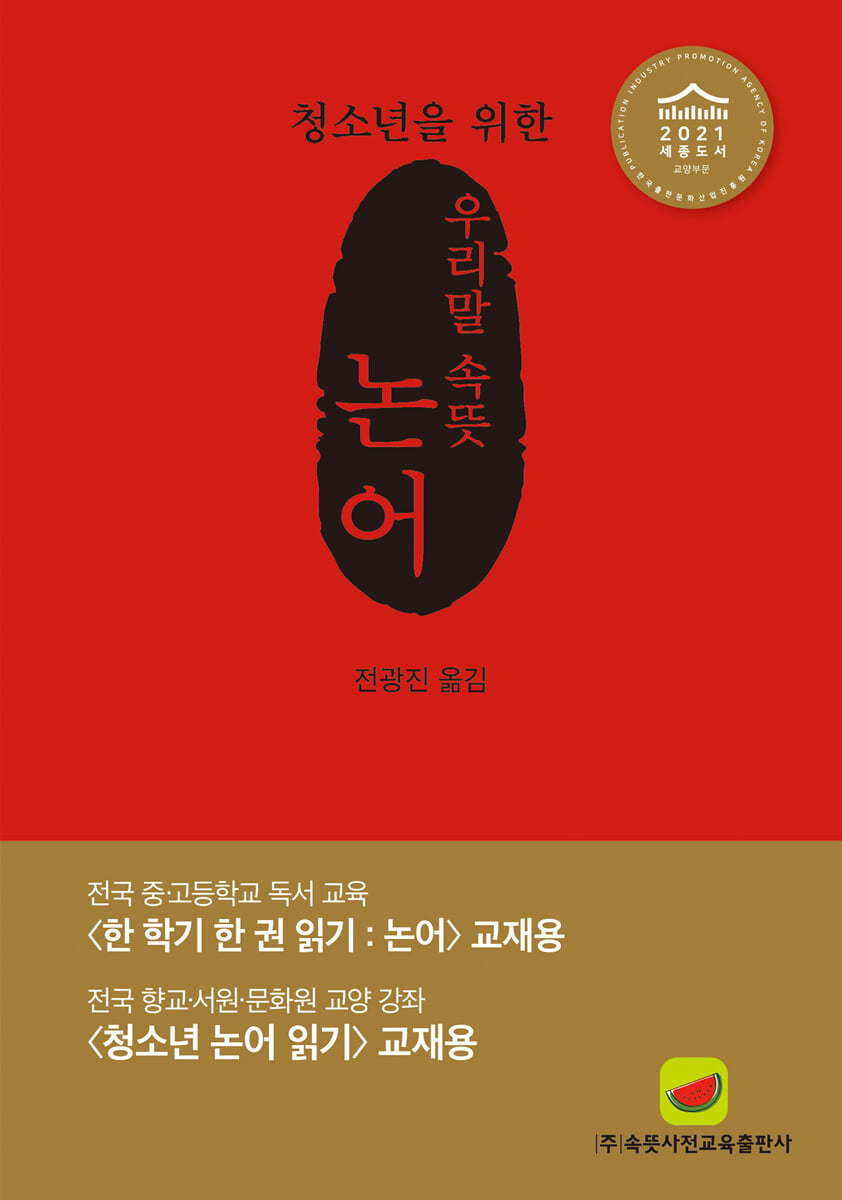
The Analects of Confucius, a Korean word with hidden meaning
 |
Description
Book Introduction
It was designed so that anyone, including middle and high school students and teenagers, who are encountering the Analects for the first time can read it easily.
You can read and understand the entire Analects without relying on the original text.
(▶Recommended as a textbook for ‘Reading One Book a Semester’ in middle and high schools, and as a textbook for ‘Reading the Analects for Youth’ in Hyanggyo, Seowon, and Cultural Centers nationwide) Although the Analects are a record of conversations between people from 2,500 years ago, all verbs were translated into present tense as much as possible to preserve a sense of reality.
In other words, by expressing 'did' as 'does', it was made to feel like it was happening right next to you.
You can read and understand the entire Analects without relying on the original text.
(▶Recommended as a textbook for ‘Reading One Book a Semester’ in middle and high schools, and as a textbook for ‘Reading the Analects for Youth’ in Hyanggyo, Seowon, and Cultural Centers nationwide) Although the Analects are a record of conversations between people from 2,500 years ago, all verbs were translated into present tense as much as possible to preserve a sense of reality.
In other words, by expressing 'did' as 'does', it was made to feel like it was happening right next to you.
- You can preview some of the book's contents.
Preview
Detailed image
Publisher's Review
The first attempt in the 400-year history of the Analects of Confucius translation!
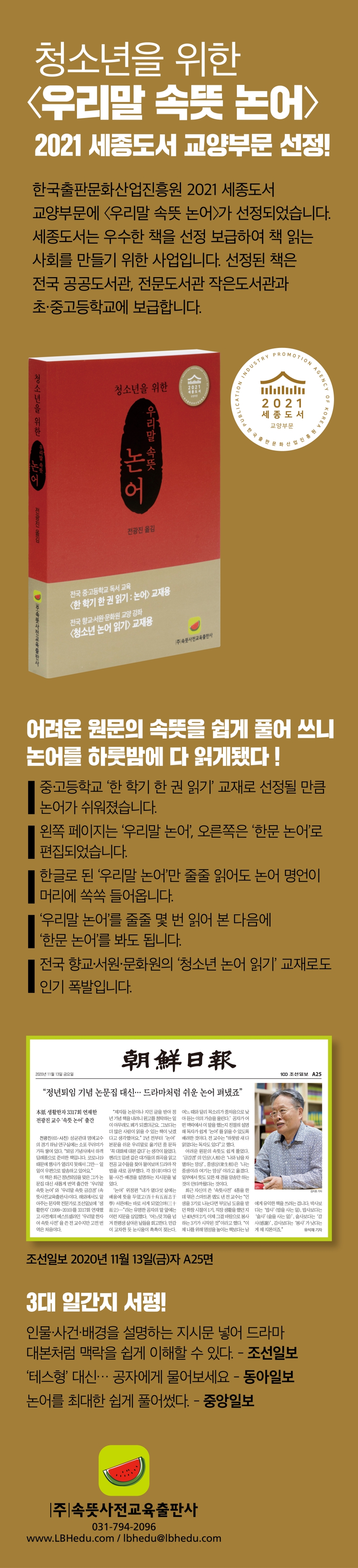
2021 Sejong Books Selected for the Culture Category!
The Analects, which are rumored to be difficult, were learned in just one or two days.
A length that can be read in Korean
It opened after 400 years.
If you read it once, you will become an intellectual.
If you read it 10 times, you will become an intellectual.
If you read it 100 times, you will become a leader.
The only Analects that even teenagers can read!
When the whole family reads together, the family comes alive.
1.
For young people who are encountering the Analects for the first time, it was translated into Korean as easily as possible.
- It was designed so that anyone, including middle and high school students and teenagers, who are encountering the Analects for the first time can read it easily.
You can read and understand the entire Analects without relying on the original text.
(Recommended as a textbook for the "One Book a Semester" program in middle and high schools, and as a textbook for the "Reading the Analects for Youth" program at Confucian schools, seowons, and cultural centers nationwide)
-Although the Analects are a record of conversations between people from 2,500 years ago, all verbs were translated into present tense as much as possible to preserve a sense of reality.
In other words, by expressing 'did' as 'does', it was made to feel like it was happening right next to you.
- We focused on accurately and easily translating the original text, and kept supplementary explanations as simple as possible.
We have tried to avoid excessive explanations becoming an obstacle to reading through and completing the book.
Because the reader's own thoughts and feelings are much more important than the commentator's opinion.
2.
It was written like a drama script to make it easy to understand the context.
-It's even more interesting if you imagine the 20 chapters and 498 chapters of the Analects as a dialogue record like a drama script.
The key to a drama is to get to know the characters first.
So, I have briefly summarized the main character, Confucius, the supporting characters, his disciples, his political enemies, and the kings who had relationships with Confucius.
If you read this part first, you can see the ‘forest’ of the Analects at a glance.
-Each chapter consists of dialogues and statements.
Each chapter is set up with instructions like a drama script.
Instructions that are not in the original text are enclosed in parentheses ( ) and colored differently to allow for easy identification.
It would be better if each of you imagined the assumed instructions differently.
-[ ] The part in parentheses is a reconstruction of expressions that were conventionally omitted in classical Chinese (古文, 文言文).
This is not in the original text, but it is necessary to read it together to easily understand the original text, so I did not distinguish it by color.
3.
It was made so that one can understand the entire text by reading only the translated Analects.
-The translated Korean must be independent of the original text.
In other words, you should be able to clearly understand what is being said just by reading the translated words.
Based on these principles, the Korean words translated are placed on the left page so that they can be accessed first.
If there are parts that are a bit difficult or not suitable for today's generation, feel free to skip them. This is not a book you can read once and put aside.
- By innovatively improving the traditional method of reading the Chinese original text first and then the Korean translation, a new method called ‘reading the Korean text first and then reading the Chinese text’ was opened.
First, read the Korean text on the left to understand its meaning, and then read the original Chinese text on the right, opening a new path to easily conquering the Analects.
- Even if you have not studied Chinese characters, you can read the Analects in Korean in one or two days by just reading the Analects on the left page.
This laid the foundation for ‘reading the Analects a hundred times’ (論讀百遍).
4.
For those who want to know more, the original text is placed in an easy-to-find format.
- The original text corresponding to the Korean translation is placed right next to it, making it easy to find and check immediately.
We added Korean phonetic transcriptions at the bottom of the original text to make it easier to read.
In the case of difficult or rarely used Chinese characters, a simple explanation is added to the right side to help you study Chinese characters.
-The original text of the Analects was notated using the Chinese punctuation method instead of the traditional hanging punctuation method.
Although the present tense helps us understand the grammatical structure and meaning of sentences, it can also be an obstacle to the accuracy of meaning, variety of expressions, and memorization.
-There were many readers of the Analects of Confucius during the Joseon Dynasty who read the original text over a hundred times to understand its meaning and memorize it in its entirety.
We have made various arrangements to help those who may still be passionate readers these days.
By introducing new line break arrangement and indentation methods, we have made it easier to understand and memorize the meaning structure of the original text.
summation
-The national translation of the Analects began in the 21st year of King Seonjo’s reign in Joseon (1588) with the “Analects of Confucius Eonhae.”
-Since then, about 300 translations and commentaries have been published up to the present day.
-Still, there is no book that can read the Analects in Korean in one or two days.
-So, I compiled a book that is easy to read while thinking about the inner meaning in Korean.
-Translated into easy language for young people who are new to the Analects.
Daily newspaper evaluation
-Include instructions explaining characters, events, and background, making it easy to understand the context, like a drama script. [Chosun Ilbo]
Ask Confucius instead of "Teshyung." [Dong-A Ilbo]
-The Analects were explained as simply as possible. [JoongAng Ilbo]
2021 Sejong Books Selected for the Culture Category!
The Analects, which are rumored to be difficult, were learned in just one or two days.
A length that can be read in Korean
It opened after 400 years.
If you read it once, you will become an intellectual.
If you read it 10 times, you will become an intellectual.
If you read it 100 times, you will become a leader.
The only Analects that even teenagers can read!
When the whole family reads together, the family comes alive.
1.
For young people who are encountering the Analects for the first time, it was translated into Korean as easily as possible.
- It was designed so that anyone, including middle and high school students and teenagers, who are encountering the Analects for the first time can read it easily.
You can read and understand the entire Analects without relying on the original text.
(Recommended as a textbook for the "One Book a Semester" program in middle and high schools, and as a textbook for the "Reading the Analects for Youth" program at Confucian schools, seowons, and cultural centers nationwide)
-Although the Analects are a record of conversations between people from 2,500 years ago, all verbs were translated into present tense as much as possible to preserve a sense of reality.
In other words, by expressing 'did' as 'does', it was made to feel like it was happening right next to you.
- We focused on accurately and easily translating the original text, and kept supplementary explanations as simple as possible.
We have tried to avoid excessive explanations becoming an obstacle to reading through and completing the book.
Because the reader's own thoughts and feelings are much more important than the commentator's opinion.
2.
It was written like a drama script to make it easy to understand the context.
-It's even more interesting if you imagine the 20 chapters and 498 chapters of the Analects as a dialogue record like a drama script.
The key to a drama is to get to know the characters first.
So, I have briefly summarized the main character, Confucius, the supporting characters, his disciples, his political enemies, and the kings who had relationships with Confucius.
If you read this part first, you can see the ‘forest’ of the Analects at a glance.
-Each chapter consists of dialogues and statements.
Each chapter is set up with instructions like a drama script.
Instructions that are not in the original text are enclosed in parentheses ( ) and colored differently to allow for easy identification.
It would be better if each of you imagined the assumed instructions differently.
-[ ] The part in parentheses is a reconstruction of expressions that were conventionally omitted in classical Chinese (古文, 文言文).
This is not in the original text, but it is necessary to read it together to easily understand the original text, so I did not distinguish it by color.
3.
It was made so that one can understand the entire text by reading only the translated Analects.
-The translated Korean must be independent of the original text.
In other words, you should be able to clearly understand what is being said just by reading the translated words.
Based on these principles, the Korean words translated are placed on the left page so that they can be accessed first.
If there are parts that are a bit difficult or not suitable for today's generation, feel free to skip them. This is not a book you can read once and put aside.
- By innovatively improving the traditional method of reading the Chinese original text first and then the Korean translation, a new method called ‘reading the Korean text first and then reading the Chinese text’ was opened.
First, read the Korean text on the left to understand its meaning, and then read the original Chinese text on the right, opening a new path to easily conquering the Analects.
- Even if you have not studied Chinese characters, you can read the Analects in Korean in one or two days by just reading the Analects on the left page.
This laid the foundation for ‘reading the Analects a hundred times’ (論讀百遍).
4.
For those who want to know more, the original text is placed in an easy-to-find format.
- The original text corresponding to the Korean translation is placed right next to it, making it easy to find and check immediately.
We added Korean phonetic transcriptions at the bottom of the original text to make it easier to read.
In the case of difficult or rarely used Chinese characters, a simple explanation is added to the right side to help you study Chinese characters.
-The original text of the Analects was notated using the Chinese punctuation method instead of the traditional hanging punctuation method.
Although the present tense helps us understand the grammatical structure and meaning of sentences, it can also be an obstacle to the accuracy of meaning, variety of expressions, and memorization.
-There were many readers of the Analects of Confucius during the Joseon Dynasty who read the original text over a hundred times to understand its meaning and memorize it in its entirety.
We have made various arrangements to help those who may still be passionate readers these days.
By introducing new line break arrangement and indentation methods, we have made it easier to understand and memorize the meaning structure of the original text.
summation
-The national translation of the Analects began in the 21st year of King Seonjo’s reign in Joseon (1588) with the “Analects of Confucius Eonhae.”
-Since then, about 300 translations and commentaries have been published up to the present day.
-Still, there is no book that can read the Analects in Korean in one or two days.
-So, I compiled a book that is easy to read while thinking about the inner meaning in Korean.
-Translated into easy language for young people who are new to the Analects.
Daily newspaper evaluation
-Include instructions explaining characters, events, and background, making it easy to understand the context, like a drama script. [Chosun Ilbo]
Ask Confucius instead of "Teshyung." [Dong-A Ilbo]
-The Analects were explained as simply as possible. [JoongAng Ilbo]
GOODS SPECIFICS
- Date of issue: May 2, 2023
- Page count, weight, size: 432 pages | 140*200*30mm
- ISBN13: 9788993858501
- ISBN10: 8993858500
You may also like
카테고리
korean


korean

![GQ KOREA Mark (Monthly): December [2025]](http://librairie.coreenne.fr/cdn/shop/files/8ef265dbbfbf186523ed75ba7319009d.jpg?v=1765340328&width=3840)


