

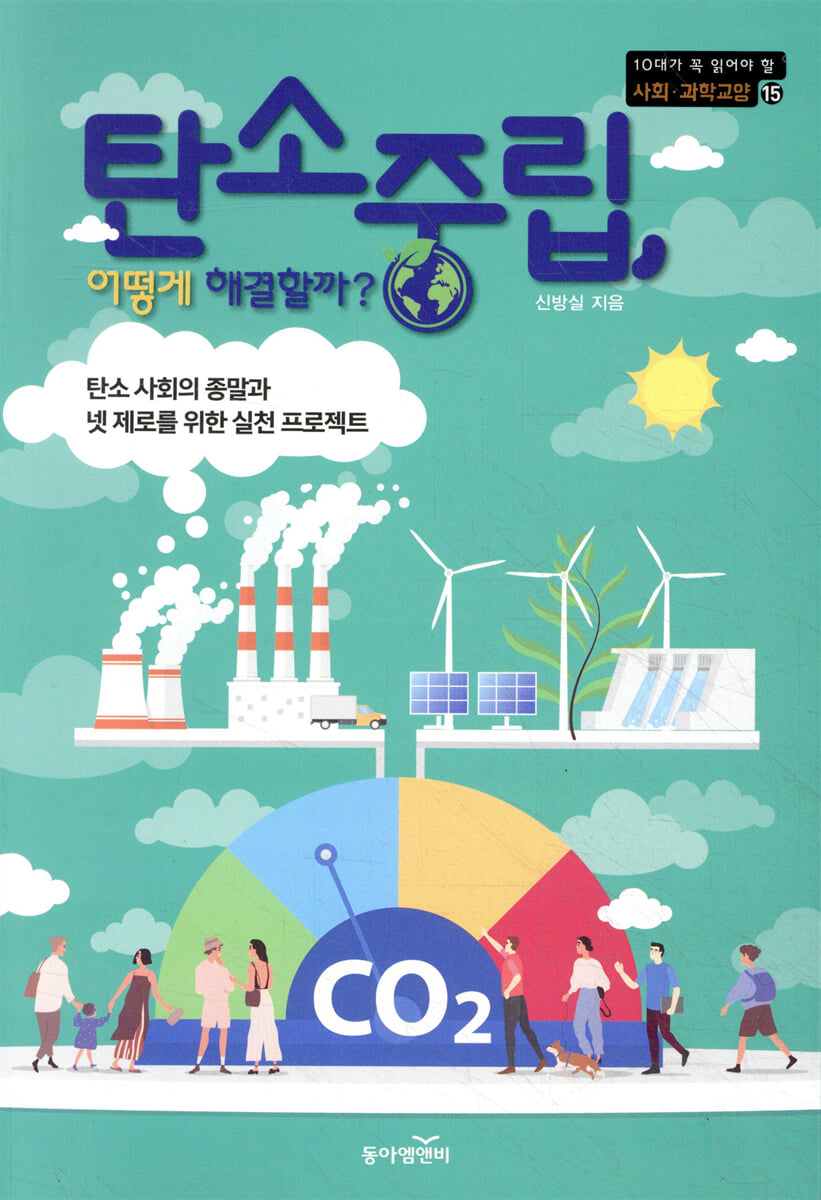
Carbon neutrality: How can we achieve it?
 |
Description
Book Introduction
Humanity's second challenge to escape climate disaster!
Coal (fossil fuel), which was the driving force of the 18th century industrial revolution, has become a pariah in the 21st century.
This is because it is considered the main culprit of carbon emissions. The IPCC recently announced that the scale of the climate system changes is unprecedented in millions to thousands of years.
It is a 'code red' (warning of a serious crisis) for humanity.
Even in December 1952, the fog in London, England was thick.
Smog, a combination of smoke and fog, covered the city so thickly that it was difficult to see even an inch ahead.
It was the beginning of the London smog incident.
On the Thames, a steamer rammed a moored ship, and a train and a car collided.
In London, more than 4,000 people died from respiratory problems.
Afterwards, there were about 8,000 deaths from chronic lung disease.
After this incident, Britain focused on improving air quality for over 60 years.
Britain enacted the Clean Air Act in 1956 following the London smog disaster.
This was a milestone in creating a legal framework for environmental protection.
The policies implemented to reduce air pollution since then have been unimaginably strong by domestic standards.
Rather than slowing climate change, humanity is accelerating it.
The climate crisis has now become a matter of human survival.
Climate change on Earth has become more serious, and carbon neutrality is a global trend.
Our country also declared carbon neutrality, aiming to reduce carbon emissions or absorb more of them to achieve zero emissions by 2050.
If carbon neutrality is achieved by 2050, fossil fuels, which emit large amounts of greenhouse gases, will disappear from our daily lives, and global greenhouse gas emissions will reach zero.
The Industrial Revolution also saw massive transitions and unemployment. As we enter a post-carbon era, the impact on workers in high-carbon occupations could be even greater.
In the era of climate disaster, a 'just transition' aims to ensure that both the process and the outcome of the transition are just for all.
This book presents practical challenges for humanity's second challenge to escape climate disaster, highlighting the severity of the climate crisis, the need for carbon neutrality, and how to achieve it.
Coal (fossil fuel), which was the driving force of the 18th century industrial revolution, has become a pariah in the 21st century.
This is because it is considered the main culprit of carbon emissions. The IPCC recently announced that the scale of the climate system changes is unprecedented in millions to thousands of years.
It is a 'code red' (warning of a serious crisis) for humanity.
Even in December 1952, the fog in London, England was thick.
Smog, a combination of smoke and fog, covered the city so thickly that it was difficult to see even an inch ahead.
It was the beginning of the London smog incident.
On the Thames, a steamer rammed a moored ship, and a train and a car collided.
In London, more than 4,000 people died from respiratory problems.
Afterwards, there were about 8,000 deaths from chronic lung disease.
After this incident, Britain focused on improving air quality for over 60 years.
Britain enacted the Clean Air Act in 1956 following the London smog disaster.
This was a milestone in creating a legal framework for environmental protection.
The policies implemented to reduce air pollution since then have been unimaginably strong by domestic standards.
Rather than slowing climate change, humanity is accelerating it.
The climate crisis has now become a matter of human survival.
Climate change on Earth has become more serious, and carbon neutrality is a global trend.
Our country also declared carbon neutrality, aiming to reduce carbon emissions or absorb more of them to achieve zero emissions by 2050.
If carbon neutrality is achieved by 2050, fossil fuels, which emit large amounts of greenhouse gases, will disappear from our daily lives, and global greenhouse gas emissions will reach zero.
The Industrial Revolution also saw massive transitions and unemployment. As we enter a post-carbon era, the impact on workers in high-carbon occupations could be even greater.
In the era of climate disaster, a 'just transition' aims to ensure that both the process and the outcome of the transition are just for all.
This book presents practical challenges for humanity's second challenge to escape climate disaster, highlighting the severity of the climate crisis, the need for carbon neutrality, and how to achieve it.
- You can preview some of the book's contents.
Preview
index
Introduction · 4
Part 1: The Decline of the Carbon Age · 10
Coal, the heart of the Industrial Revolution | The age of oil led by the United States | The murderous fog that enveloped the city, the shadow of the Industrial Revolution | Fossil fuels
An Inconvenient Truth: The Beginning of Environmental Regulation | From Ice Age to Interglacial, the Changing Climate | Is the Favorable Climate Over? The Emergence of the Anthropocene |
The incredible events that happened in just 10 minutes at the old station.
* Chew your thoughts carefully and organize them · 35
Part 2: The Truth and Warnings of the Climate Crisis · 36
Without greenhouse gases, the Earth would be a freezer | Arrhenius, who noticed the 'greenhouse effect' | A small ball launched from Hawaii | "Climate
"The crisis is human fault," warns IPCC | Earth more than 1℃ warmer than pre-industrial levels | "Reduce carbon": First mandatory treaty
'Kyoto Protocol' | 'Paris Agreement' that does not discriminate between developed and developing countries | Glasgow Climate Agreement, born six years after the Paris Agreement | Survival
Carbon neutrality: What is the global goal?
* Chew your thoughts carefully and organize them · 71
Part 3: Carbon Neutrality: How? · 72
What does carbon neutrality mean? | South Korea's carbon emissions report card | 1.
Electricity Sector: Coal-Fired Power Plants Lost | Coal-Fired Power Plants Left Behind
Investors, what are your true intentions? | Shinan, South Jeolla Province, transformed into an island of sun and wind | Europe, where governments are expanding renewable energy | 2.
hydrogen
Sector: The allure of hydrogen, an energy source twice as large as natural gas | Hydrogen instead of coal in steel mills! | Hydrogen's potential to unfold in the sky, sea, and land
The Future | Seize Hydrogen Energy! Accelerating the Transition to a Hydrogen Economy | 3.
Transportation: Smoke-free buses are gone, eco-friendly cars are the 'trend' | 4.
industry
Section: Carbon is Money, Carbon Tax on Fire | 5.
Carbon Removal: An Alternative for Hard-to-Abate Sectors? | 6.
Carbon absorption sector: carbon eating
Pay attention to the forest and tidal flats | 7.
Social Consensus: Acknowledging the Climate Crisis but Rejecting Electricity Rate Increases? | Is Nuclear Power Green? A Heated Debate
* Chew your thoughts carefully and organize them · 139
Part 4: A Just Transition in the Decarbonized Era · 140
Raising awareness of the climate crisis worldwide | Half of cumulative carbon dioxide emissions come from North America and Europe | Beyond precarious climate refugees and war refugees
The biggest cause of climate refugees is 'sea level rise' | Could we also become food refugees? | Disasters are the lot of the vulnerable? The 'injustice' of the climate crisis | Heat waves
Who is the biggest victim of carbon neutrality? | What is a just transition in the carbon neutral era? | “There are no jobs on a dead earth” | The just transition of coal-fired power plants
Transition | Youth Take to the Streets to Address the Climate Crisis | Climate Crisis Through the Eyes of Human Rights | A Rush of Climate Lawsuits, Changing Courts | This Is the Time
The future of the Earth depends on the liver, but there is hope.
* Chew your thoughts carefully and organize them · 189
Part 5: We Can Do It Too · 190
From a beautiful land to a disaster hell, Korean cooking | Why are we melting the Arctic ice? | Is there nothing we can do as an individual? | My
How many grams does a cow's footprint weigh? | Let's save the planet by eating vegetables instead of meat | The world is moving towards vegetarianism, but what about our country? | If you leave food behind, it's a waste of money.
Accelerating the Post-Crisis? | Keeping the Earth Healthy with Fair Consumption | Giant Garbage Patch Discovered in the North Pacific | Plastic Pushes Out Coal
As a key driver of change, demand carbon neutrality! Let's raise our voices like Thunberg! How to put this into practice in our daily lives.
* Chew your thoughts carefully and organize them · 233
Part 1: The Decline of the Carbon Age · 10
Coal, the heart of the Industrial Revolution | The age of oil led by the United States | The murderous fog that enveloped the city, the shadow of the Industrial Revolution | Fossil fuels
An Inconvenient Truth: The Beginning of Environmental Regulation | From Ice Age to Interglacial, the Changing Climate | Is the Favorable Climate Over? The Emergence of the Anthropocene |
The incredible events that happened in just 10 minutes at the old station.
* Chew your thoughts carefully and organize them · 35
Part 2: The Truth and Warnings of the Climate Crisis · 36
Without greenhouse gases, the Earth would be a freezer | Arrhenius, who noticed the 'greenhouse effect' | A small ball launched from Hawaii | "Climate
"The crisis is human fault," warns IPCC | Earth more than 1℃ warmer than pre-industrial levels | "Reduce carbon": First mandatory treaty
'Kyoto Protocol' | 'Paris Agreement' that does not discriminate between developed and developing countries | Glasgow Climate Agreement, born six years after the Paris Agreement | Survival
Carbon neutrality: What is the global goal?
* Chew your thoughts carefully and organize them · 71
Part 3: Carbon Neutrality: How? · 72
What does carbon neutrality mean? | South Korea's carbon emissions report card | 1.
Electricity Sector: Coal-Fired Power Plants Lost | Coal-Fired Power Plants Left Behind
Investors, what are your true intentions? | Shinan, South Jeolla Province, transformed into an island of sun and wind | Europe, where governments are expanding renewable energy | 2.
hydrogen
Sector: The allure of hydrogen, an energy source twice as large as natural gas | Hydrogen instead of coal in steel mills! | Hydrogen's potential to unfold in the sky, sea, and land
The Future | Seize Hydrogen Energy! Accelerating the Transition to a Hydrogen Economy | 3.
Transportation: Smoke-free buses are gone, eco-friendly cars are the 'trend' | 4.
industry
Section: Carbon is Money, Carbon Tax on Fire | 5.
Carbon Removal: An Alternative for Hard-to-Abate Sectors? | 6.
Carbon absorption sector: carbon eating
Pay attention to the forest and tidal flats | 7.
Social Consensus: Acknowledging the Climate Crisis but Rejecting Electricity Rate Increases? | Is Nuclear Power Green? A Heated Debate
* Chew your thoughts carefully and organize them · 139
Part 4: A Just Transition in the Decarbonized Era · 140
Raising awareness of the climate crisis worldwide | Half of cumulative carbon dioxide emissions come from North America and Europe | Beyond precarious climate refugees and war refugees
The biggest cause of climate refugees is 'sea level rise' | Could we also become food refugees? | Disasters are the lot of the vulnerable? The 'injustice' of the climate crisis | Heat waves
Who is the biggest victim of carbon neutrality? | What is a just transition in the carbon neutral era? | “There are no jobs on a dead earth” | The just transition of coal-fired power plants
Transition | Youth Take to the Streets to Address the Climate Crisis | Climate Crisis Through the Eyes of Human Rights | A Rush of Climate Lawsuits, Changing Courts | This Is the Time
The future of the Earth depends on the liver, but there is hope.
* Chew your thoughts carefully and organize them · 189
Part 5: We Can Do It Too · 190
From a beautiful land to a disaster hell, Korean cooking | Why are we melting the Arctic ice? | Is there nothing we can do as an individual? | My
How many grams does a cow's footprint weigh? | Let's save the planet by eating vegetables instead of meat | The world is moving towards vegetarianism, but what about our country? | If you leave food behind, it's a waste of money.
Accelerating the Post-Crisis? | Keeping the Earth Healthy with Fair Consumption | Giant Garbage Patch Discovered in the North Pacific | Plastic Pushes Out Coal
As a key driver of change, demand carbon neutrality! Let's raise our voices like Thunberg! How to put this into practice in our daily lives.
* Chew your thoughts carefully and organize them · 233
Into the book
As the industrial revolution increased economic wealth, the population began to grow explosively.
London, the capital of England, had a population of one million in 1801, at the beginning of the Industrial Revolution.
As populations became concentrated, large cities developed in Europe, including the UK.
With so many people flocking to the cities to make money, sanitation deteriorated and epidemics became widespread.
The black smoke pouring out from the factory often obscured the sky.
The factory's wastewater polluted the river.
(Omitted) City workers working in poor conditions died from illness from breathing polluted air.
He died without even knowing the cause.
---From "Part 1: The Declining Carbon Age"
London smog is considered one of the worst environmental disasters caused by mankind.
Similar substances are spewed into the air when a volcano erupts, but rarely has it claimed so many lives in such a short period of time.
The London smog brought the issue of environmental pollution caused by fossil fuels to the world's attention and had a huge impact.
Britain enacted the Clean Air Act in 1956, four years later.
---From "Part 1: The Declining Carbon Age"
The disaster caused by fossil fuels did not end here.
This is because the combustion of fossil fuels emits not only air pollutants but also greenhouse gases.
Carbon dioxide and methane are greenhouse gases that increase Earth's temperature and are the main culprits of climate change.
Ultimately, fossil fuels have a devastating impact on both the environment and the climate.
While atmospheric pollution causes immediate and visible damage, climate change occurs over very long periods of time and is therefore less easily perceived.
---From "Part 1: The Declining Carbon Age"
What is the primary reason we've moved from the stable Holocene to an era of climate instability? It's the dramatic increase in greenhouse gas emissions caused by industrialization, globalization, and population growth.
Unlike natural climate change, which occurs gradually, anthropogenic climate change occurs rapidly over a short period of time.
Human civilization has reached its peak, but we are more vulnerable to climate shocks than ever before.
So, have humans emitted enough greenhouse gases to change the climate?
---From "Part 1: The Declining Carbon Age"
Greenhouse gases play a role in maintaining the Earth's temperature at an appropriate level, but their amount has increased too much since the Industrial Revolution, becoming a problem.
In the past, it was released into the atmosphere through natural volcanic activity, but now fossil fuels such as coal and oil are the main sources of emissions.
The amount of carbon dioxide produced by human activities is estimated to be 100 times the amount emitted naturally.
By forcibly removing fossil fuels from the ground and burning them, a huge amount of carbon dioxide was released into the atmosphere in a short period of time.
---From "Part 2: The Truth and Warnings of the Climate Crisis"
The main culprit that has raised the Earth's temperature to this level is greenhouse gases emitted by humans.
It is an obvious fact that can no longer be avoided or denied.
When the 5th Assessment Report was released, the global carbon dioxide concentration was 391 ppm.
However, in the most recent 6th report, it increased to 410 ppm.
It first surpassed 400ppm, which was called the 'magic wall', in 2015, and then broke through 410ppm in 2019, four years later.
---From "Part 2: The Truth and Warnings of the Climate Crisis"
While the Kyoto Protocol focused on reducing greenhouse gas emissions, the Paris Agreement focused not only on reductions but also on climate change adaptation and mitigation, and support for developing countries.
Compared to 1997, when the Kyoto Protocol was adopted, climate change has accelerated to the point that talk of a "new normal" is already taking place in 2015.
As abnormal weather becomes the norm, adapting to climate change and mitigating its impacts has become more important than ever.
---From "Part 2: The Truth and Warnings of the Climate Crisis"
Our country has set a strong goal of achieving carbon neutrality by 2050.
First, greenhouse gas emissions must be reduced by 40% by 2030 compared to 2018.
The 'Basic Act on Carbon Neutrality and Green Growth', which contains these reduction goals, went into effect on March 25, 2022.
It was the fourteenth country in the world to enact a law on carbon neutrality.
---From "Part 3: Carbon Neutrality, How?"
This is why there are voices saying that we should reduce meat consumption and become vegetarian to prevent the climate crisis.
When cows burp and fart during the digestive process, methane is released.
Nitrous oxide is produced in cow dung.
Don't think about one or two cows raised in the countryside.
---From "Part 3: Carbon Neutrality, How?"
To achieve carbon neutrality by 2050, the most urgent task is to shift the focus of power generation to renewable energy.
These days, we can easily find wind turbines and solar panels around us.
Although renewable energy has increased, its share of total power generation still remains in the single digits at around 7%.
Renewable energy is still an expensive energy source in our country.
---From "Part 3: Carbon Neutrality, How?"
If the carbon tax bill passes the National Assembly, the top 100 companies by greenhouse gas emissions will bear the majority of the carbon tax.
By industry, the power generation and energy sectors are expected to bear the greatest burden.
The steel, petrochemical, cement, and oil refining sectors followed.
In particular, there are predictions that the carbon tax burden on Korea Electric Power Corporation (KEPCO) and power plants that produce electricity will increase, which will ultimately lead to an increase in electricity rates.
---From "Part 3: Carbon Neutrality, How?"
June 20th is World Refugee Day.
In the past, when people thought of refugees, they thought of war, but now the situation has changed.
As the climate crisis worsens, the term “climate refugee” is being heard more and more frequently.
For climate refugees, the climate crisis is not a future disaster, but a real threat to their survival.
The definition of a climate refugee is someone who has been forced to temporarily or permanently leave their home due to sudden or drastic climate change.
This includes both moving to another region within the country and moving abroad.
---From "Part 4: A Just Transition in the Decarbonized Era"
A just transition is based on the principle that the process and outcome of transitioning to a decarbonized world must be fair and just.
It all started with the worst soil contamination incident that was highlighted in the American media in August 1978.
The city of Love Canal, outside Niagara Falls, New York, has been severely polluted by illegal chemical dumping.
A state of emergency was declared in the city, which led to the creation of the Superfund, a law to manage hazardous industrial waste.
The idea is to tax the chemical industry and use the money to restore soil when it becomes polluted.
---From "Part 4: A Just Transition in the Decarbonized Era"
As we move beyond a climate crisis and head towards a climate catastrophe, the power of individuals may seem weak, but it is also individuals who can change this world.
When individual courageous words and actions come together, they become powerful and bring about enormous change.
What I must remember is that while I may not be able to shut down coal plants or stop oil drilling right away, if I consistently speak out and demand it, someone may change their mind and eventually lead to collective change.
London, the capital of England, had a population of one million in 1801, at the beginning of the Industrial Revolution.
As populations became concentrated, large cities developed in Europe, including the UK.
With so many people flocking to the cities to make money, sanitation deteriorated and epidemics became widespread.
The black smoke pouring out from the factory often obscured the sky.
The factory's wastewater polluted the river.
(Omitted) City workers working in poor conditions died from illness from breathing polluted air.
He died without even knowing the cause.
---From "Part 1: The Declining Carbon Age"
London smog is considered one of the worst environmental disasters caused by mankind.
Similar substances are spewed into the air when a volcano erupts, but rarely has it claimed so many lives in such a short period of time.
The London smog brought the issue of environmental pollution caused by fossil fuels to the world's attention and had a huge impact.
Britain enacted the Clean Air Act in 1956, four years later.
---From "Part 1: The Declining Carbon Age"
The disaster caused by fossil fuels did not end here.
This is because the combustion of fossil fuels emits not only air pollutants but also greenhouse gases.
Carbon dioxide and methane are greenhouse gases that increase Earth's temperature and are the main culprits of climate change.
Ultimately, fossil fuels have a devastating impact on both the environment and the climate.
While atmospheric pollution causes immediate and visible damage, climate change occurs over very long periods of time and is therefore less easily perceived.
---From "Part 1: The Declining Carbon Age"
What is the primary reason we've moved from the stable Holocene to an era of climate instability? It's the dramatic increase in greenhouse gas emissions caused by industrialization, globalization, and population growth.
Unlike natural climate change, which occurs gradually, anthropogenic climate change occurs rapidly over a short period of time.
Human civilization has reached its peak, but we are more vulnerable to climate shocks than ever before.
So, have humans emitted enough greenhouse gases to change the climate?
---From "Part 1: The Declining Carbon Age"
Greenhouse gases play a role in maintaining the Earth's temperature at an appropriate level, but their amount has increased too much since the Industrial Revolution, becoming a problem.
In the past, it was released into the atmosphere through natural volcanic activity, but now fossil fuels such as coal and oil are the main sources of emissions.
The amount of carbon dioxide produced by human activities is estimated to be 100 times the amount emitted naturally.
By forcibly removing fossil fuels from the ground and burning them, a huge amount of carbon dioxide was released into the atmosphere in a short period of time.
---From "Part 2: The Truth and Warnings of the Climate Crisis"
The main culprit that has raised the Earth's temperature to this level is greenhouse gases emitted by humans.
It is an obvious fact that can no longer be avoided or denied.
When the 5th Assessment Report was released, the global carbon dioxide concentration was 391 ppm.
However, in the most recent 6th report, it increased to 410 ppm.
It first surpassed 400ppm, which was called the 'magic wall', in 2015, and then broke through 410ppm in 2019, four years later.
---From "Part 2: The Truth and Warnings of the Climate Crisis"
While the Kyoto Protocol focused on reducing greenhouse gas emissions, the Paris Agreement focused not only on reductions but also on climate change adaptation and mitigation, and support for developing countries.
Compared to 1997, when the Kyoto Protocol was adopted, climate change has accelerated to the point that talk of a "new normal" is already taking place in 2015.
As abnormal weather becomes the norm, adapting to climate change and mitigating its impacts has become more important than ever.
---From "Part 2: The Truth and Warnings of the Climate Crisis"
Our country has set a strong goal of achieving carbon neutrality by 2050.
First, greenhouse gas emissions must be reduced by 40% by 2030 compared to 2018.
The 'Basic Act on Carbon Neutrality and Green Growth', which contains these reduction goals, went into effect on March 25, 2022.
It was the fourteenth country in the world to enact a law on carbon neutrality.
---From "Part 3: Carbon Neutrality, How?"
This is why there are voices saying that we should reduce meat consumption and become vegetarian to prevent the climate crisis.
When cows burp and fart during the digestive process, methane is released.
Nitrous oxide is produced in cow dung.
Don't think about one or two cows raised in the countryside.
---From "Part 3: Carbon Neutrality, How?"
To achieve carbon neutrality by 2050, the most urgent task is to shift the focus of power generation to renewable energy.
These days, we can easily find wind turbines and solar panels around us.
Although renewable energy has increased, its share of total power generation still remains in the single digits at around 7%.
Renewable energy is still an expensive energy source in our country.
---From "Part 3: Carbon Neutrality, How?"
If the carbon tax bill passes the National Assembly, the top 100 companies by greenhouse gas emissions will bear the majority of the carbon tax.
By industry, the power generation and energy sectors are expected to bear the greatest burden.
The steel, petrochemical, cement, and oil refining sectors followed.
In particular, there are predictions that the carbon tax burden on Korea Electric Power Corporation (KEPCO) and power plants that produce electricity will increase, which will ultimately lead to an increase in electricity rates.
---From "Part 3: Carbon Neutrality, How?"
June 20th is World Refugee Day.
In the past, when people thought of refugees, they thought of war, but now the situation has changed.
As the climate crisis worsens, the term “climate refugee” is being heard more and more frequently.
For climate refugees, the climate crisis is not a future disaster, but a real threat to their survival.
The definition of a climate refugee is someone who has been forced to temporarily or permanently leave their home due to sudden or drastic climate change.
This includes both moving to another region within the country and moving abroad.
---From "Part 4: A Just Transition in the Decarbonized Era"
A just transition is based on the principle that the process and outcome of transitioning to a decarbonized world must be fair and just.
It all started with the worst soil contamination incident that was highlighted in the American media in August 1978.
The city of Love Canal, outside Niagara Falls, New York, has been severely polluted by illegal chemical dumping.
A state of emergency was declared in the city, which led to the creation of the Superfund, a law to manage hazardous industrial waste.
The idea is to tax the chemical industry and use the money to restore soil when it becomes polluted.
---From "Part 4: A Just Transition in the Decarbonized Era"
As we move beyond a climate crisis and head towards a climate catastrophe, the power of individuals may seem weak, but it is also individuals who can change this world.
When individual courageous words and actions come together, they become powerful and bring about enormous change.
What I must remember is that while I may not be able to shut down coal plants or stop oil drilling right away, if I consistently speak out and demand it, someone may change their mind and eventually lead to collective change.
---From "Part 5 We Can Do It Too"
Publisher's Review
A Decarbonized Future Strategy for a Just Transition!
According to the 2050 Carbon Neutrality Scenario, a just transition is about "protecting vulnerable industries, classes, labor, and regions from climate impacts and energy and industrial structural transformations, and reducing inequality." To achieve this, a social dialogue involving all stakeholders must be conducted to ensure that no stakeholder is disadvantaged or marginalized.
In other words, for a successful transition to a decarbonized society, we must open the way for all citizens, regardless of class, occupation, or region, to participate fairly and actively.
These principles are crucial for achieving carbon neutrality because, in today's pluralistic democratic society, it is virtually impossible to expect social consensus and civic participation unless a fair transition is presupposed.
To find a specific direction for this, let's look at Germany's coal phase-out process.
In the 1990s, the German government, prioritizing climate change response and environmental innovation, pursued a coal phase-out policy to reorganize the industrial structure of the Ruhr region, a coal-based industrial region.
In this process, the government placed the utmost importance on the participation and agreement of various actors, including local governments, universities, residents, businesses, and labor.
Special efforts were made in employment policies to ensure that the total number of jobs in the region did not decrease due to job changes, etc.
Thanks to these efforts, in 2007 the federal government, state and local governments, and the coal industry reached a social agreement to close anthracite coal mines and end coal subsidies by 2018.
The Ruhr region, once a coal mining region, is now transforming into a hub of innovation, with over 100,000 people working to drive the development of new future industries and technologies.
Germany's transition away from coal is the product of nearly 60 years of aggressive policies.
Our country must also strive to develop systematic and consistent policies during the given period of time for carbon neutrality.
And, based on agreement among governments and stakeholders, the benefits and harms, conflicts and resistance arising from this new transition must be overcome and efforts must be made to open our hearts and minds to achieve carbon neutrality.
According to the 2050 Carbon Neutrality Scenario, a just transition is about "protecting vulnerable industries, classes, labor, and regions from climate impacts and energy and industrial structural transformations, and reducing inequality." To achieve this, a social dialogue involving all stakeholders must be conducted to ensure that no stakeholder is disadvantaged or marginalized.
In other words, for a successful transition to a decarbonized society, we must open the way for all citizens, regardless of class, occupation, or region, to participate fairly and actively.
These principles are crucial for achieving carbon neutrality because, in today's pluralistic democratic society, it is virtually impossible to expect social consensus and civic participation unless a fair transition is presupposed.
To find a specific direction for this, let's look at Germany's coal phase-out process.
In the 1990s, the German government, prioritizing climate change response and environmental innovation, pursued a coal phase-out policy to reorganize the industrial structure of the Ruhr region, a coal-based industrial region.
In this process, the government placed the utmost importance on the participation and agreement of various actors, including local governments, universities, residents, businesses, and labor.
Special efforts were made in employment policies to ensure that the total number of jobs in the region did not decrease due to job changes, etc.
Thanks to these efforts, in 2007 the federal government, state and local governments, and the coal industry reached a social agreement to close anthracite coal mines and end coal subsidies by 2018.
The Ruhr region, once a coal mining region, is now transforming into a hub of innovation, with over 100,000 people working to drive the development of new future industries and technologies.
Germany's transition away from coal is the product of nearly 60 years of aggressive policies.
Our country must also strive to develop systematic and consistent policies during the given period of time for carbon neutrality.
And, based on agreement among governments and stakeholders, the benefits and harms, conflicts and resistance arising from this new transition must be overcome and efforts must be made to open our hearts and minds to achieve carbon neutrality.
GOODS SPECIFICS
- Date of issue: January 5, 2023
- Page count, weight, size: 234 pages | 424g | 150*220*14mm
- ISBN13: 9791163636359
- ISBN10: 1163636355
You may also like
카테고리
korean


korean

![GQ KOREA Mark (Monthly): December [2025]](http://librairie.coreenne.fr/cdn/shop/files/8ef265dbbfbf186523ed75ba7319009d.jpg?v=1765340328&width=3840)


