

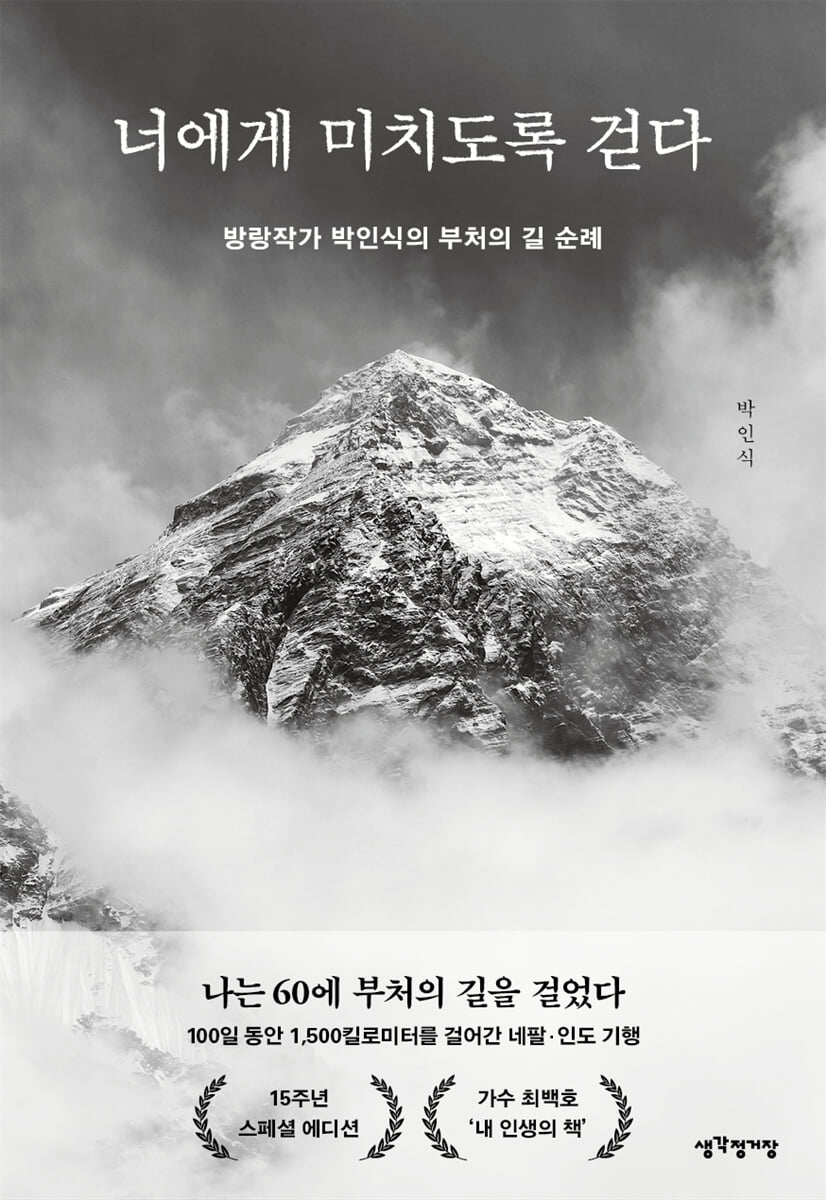
Walk crazy towards you
 |
Description
Book Introduction
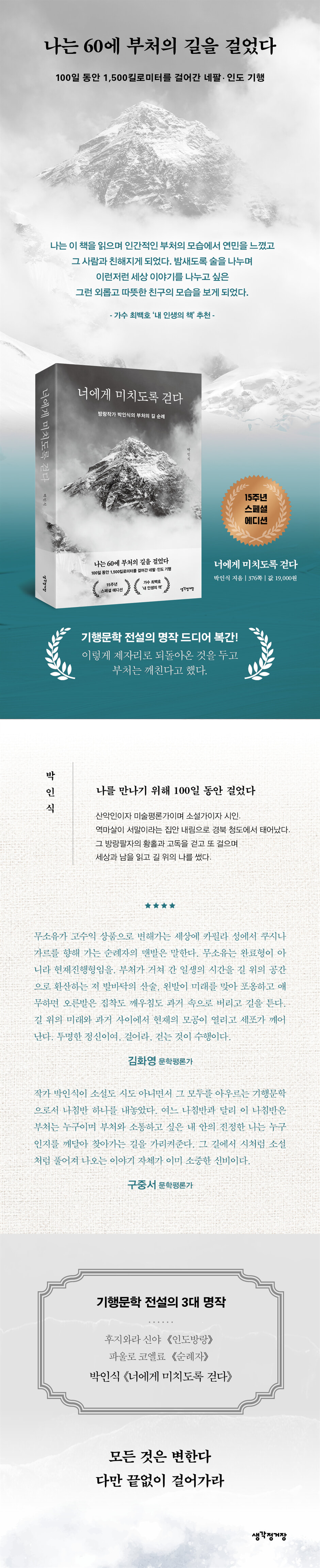
“I walked the path of Buddha at 60!”
A 1,500-kilometer, 100-day Nepal-India journey
★ Singer Choi Baek-ho recommends 'The Book of My Life'
★ 15th Anniversary Special Edition
A hidden masterpiece of Korean travel literature, "Walking Crazy for You" has been published in a special 15th anniversary edition.
On New Year's Day 2010, wandering writer Park In-sik and two companions flew to Kathmandu to go to Lumbini, Nepal, the birthplace of Buddha.
I set out on the road to follow the 'Buddha's Path' from Nepal to India, with only my own two feet.
This book, which has been called the 'essence of travelogues on Nepal and India' for the past 15 years, has served as a useful guide for those who are new to Buddhism as a 'guide for beginners in Buddhism'.
“If the West has the ‘Camino de Santiago’, the East has Park In-sik’s ‘Buddha’s Way Pilgrimage’!” I dare say.
The authors walk the entire 'Buddha's Path', including the four major Buddhist holy sites of Lumbini (the birthplace of the Buddha), Bodh Gaya (where he first attained enlightenment), Sarnath (where he first preached the Dharma), and Kushinagar (where he entered nirvana), as well as Kesarya where the Buddha met his first teacher and shaved his head, Vaishali, the city he loved most and the birthplace of the first nun, Patna, the site of the third Buddhist council, Nalanda, where the world's largest Buddhist university was located, and Rajgir, where the Buddha built the Bamboo Grove Monastery and where he preached the Diamond Sutra and other sutras during the Vulture Peak Assembly on its summit.
A 1,500-kilometer, 100-day Nepal-India journey
★ Singer Choi Baek-ho recommends 'The Book of My Life'
★ 15th Anniversary Special Edition
A hidden masterpiece of Korean travel literature, "Walking Crazy for You" has been published in a special 15th anniversary edition.
On New Year's Day 2010, wandering writer Park In-sik and two companions flew to Kathmandu to go to Lumbini, Nepal, the birthplace of Buddha.
I set out on the road to follow the 'Buddha's Path' from Nepal to India, with only my own two feet.
This book, which has been called the 'essence of travelogues on Nepal and India' for the past 15 years, has served as a useful guide for those who are new to Buddhism as a 'guide for beginners in Buddhism'.
“If the West has the ‘Camino de Santiago’, the East has Park In-sik’s ‘Buddha’s Way Pilgrimage’!” I dare say.
The authors walk the entire 'Buddha's Path', including the four major Buddhist holy sites of Lumbini (the birthplace of the Buddha), Bodh Gaya (where he first attained enlightenment), Sarnath (where he first preached the Dharma), and Kushinagar (where he entered nirvana), as well as Kesarya where the Buddha met his first teacher and shaved his head, Vaishali, the city he loved most and the birthplace of the first nun, Patna, the site of the third Buddhist council, Nalanda, where the world's largest Buddhist university was located, and Rajgir, where the Buddha built the Bamboo Grove Monastery and where he preached the Diamond Sutra and other sutras during the Vulture Peak Assembly on its summit.
- You can preview some of the book's contents.
Preview
index
The unfilial son cries
Applaud
fog
Leave the house
I first called your name there
The Rose of Sharon has bloomed
Two-pal-cheong-chun
After the frog, the crocodile
Hello, Rhinoceros
Misconceptions about elephants
When pink buckwheat flowers bloom
Portrait of a Peasant by Van Gogh
The briquette was broken
This is India
Park Gu-ra and Oh Mu-ja
Any problem?
wine tree
Will it be Yuma Hill, hiccup!
That mango tree was beautiful.
The market is a side dish
dung beetle
When you want to love like crazy
father and son
The lotus blooms
mother and son
A bowl of porridge, a spot in the shade of a tree
Five handcuffed sheep
Have we ever seen sheep?
What's your name?
Long night, short night
Old Maze
Ehi Bigku!
Walk alone
Infinitely transparent middle ground
Barefoot Tree
Review_ I walked a long way, but
The Buddha's Path, a Hundred-Day Journey
Applaud
fog
Leave the house
I first called your name there
The Rose of Sharon has bloomed
Two-pal-cheong-chun
After the frog, the crocodile
Hello, Rhinoceros
Misconceptions about elephants
When pink buckwheat flowers bloom
Portrait of a Peasant by Van Gogh
The briquette was broken
This is India
Park Gu-ra and Oh Mu-ja
Any problem?
wine tree
Will it be Yuma Hill, hiccup!
That mango tree was beautiful.
The market is a side dish
dung beetle
When you want to love like crazy
father and son
The lotus blooms
mother and son
A bowl of porridge, a spot in the shade of a tree
Five handcuffed sheep
Have we ever seen sheep?
What's your name?
Long night, short night
Old Maze
Ehi Bigku!
Walk alone
Infinitely transparent middle ground
Barefoot Tree
Review_ I walked a long way, but
The Buddha's Path, a Hundred-Day Journey
Detailed image
Into the book
That broadcast was truly terrifying to me.
“Nice to meet you, everyone.
Our Nepal is a very poor country.
So the plane was very old.
But don't worry.
Because the airplane is the world's best antique, the piloting skills are the best in the world.
We are bringing you safely even on planes abandoned by other countries.
thank you
“See you again.”
It's guts.
--- p.8 From “Applause”
The third leads to the ontological question of where we came from and where we are going.
You have to be careful here too.
If you give an ontological answer to the question as it is, you might end up with a philosophical debate with an old Indian for days.
In this case, you can answer specifically by saying something like, 'I came from Gaedongi's house and am on my way to Malddongi's house.'
Or you could just give a direction, like coming from the east and going west, or you could give a very vague answer like coming from where the wind blows and going to where the trees sway.
--- p.137 From "What's the problem?"
He went to her and hugged her tightly.
She held the bunch of beans in his arms and cooed as she held it out to me.
“Jjana Mita! Jjana Mita!”
These are delicious beans.
I told you, these beans are delicious!
I forgot a few eggs.
Raw beans are like that.
It's just bitter, but doesn't have the nutty flavor of peanuts.
Still, I have to tell you that it's delicious.
Otherwise his old daughter might get angry.
“It’s so delicious.
“Deredere Mitocha.”
She was delighted when I told her in Hindi that the beans were not just delicious, but 'very, very delicious'.
Wrinkles bloomed on the face that loved to be cute.
It was a beautiful, wrinkled flower.
--- p.234 From “Mother and Son”
“Are you trying to talk about acting?”
"ha ha ha.
I knew Mr. Park would come out like that.
But that's not it.
If you don't know and pass it by, you will see that coincidences of this level happen all the time in the world.
The same is true for Buddha.
Every time something great happened to him, a morning star appeared.
It is said that the morning star rose not only when he was enlightened but also when he was born, and that the morning star rose when he left home after seeing the eyes of a certain ascetic who shone like the morning star, and that the morning star rose when Dona Brahmin finished distributing the Buddha's relics.
So, many people misunderstand that seeing the morning star means that Buddha suddenly attained enlightenment.
But that's not the truth.
The moment of enlightenment simply coincided with the world waking up to the morning star.
The situation is the same now.
Mr. Park, if you don't mind, may I ask you something?"
--- p.269 From “Have we ever seen sheep?”
A long line of stretchers with corpses waiting for their turn to be burned.
The body at the front is placed on a stretcher and dipped three times in the waters of the Ganges River.
And it is placed on a pile of firewood.
The head of the household, who had shaved all his hair like a monk, lights a fire and circles the body several times.
All guests must wear white clothes.
The person holding the spark is like a white candle that has been lit with flame.
The makeup workers are also usually dressed in white.
Death is white here.
“Nice to meet you, everyone.
Our Nepal is a very poor country.
So the plane was very old.
But don't worry.
Because the airplane is the world's best antique, the piloting skills are the best in the world.
We are bringing you safely even on planes abandoned by other countries.
thank you
“See you again.”
It's guts.
--- p.8 From “Applause”
The third leads to the ontological question of where we came from and where we are going.
You have to be careful here too.
If you give an ontological answer to the question as it is, you might end up with a philosophical debate with an old Indian for days.
In this case, you can answer specifically by saying something like, 'I came from Gaedongi's house and am on my way to Malddongi's house.'
Or you could just give a direction, like coming from the east and going west, or you could give a very vague answer like coming from where the wind blows and going to where the trees sway.
--- p.137 From "What's the problem?"
He went to her and hugged her tightly.
She held the bunch of beans in his arms and cooed as she held it out to me.
“Jjana Mita! Jjana Mita!”
These are delicious beans.
I told you, these beans are delicious!
I forgot a few eggs.
Raw beans are like that.
It's just bitter, but doesn't have the nutty flavor of peanuts.
Still, I have to tell you that it's delicious.
Otherwise his old daughter might get angry.
“It’s so delicious.
“Deredere Mitocha.”
She was delighted when I told her in Hindi that the beans were not just delicious, but 'very, very delicious'.
Wrinkles bloomed on the face that loved to be cute.
It was a beautiful, wrinkled flower.
--- p.234 From “Mother and Son”
“Are you trying to talk about acting?”
"ha ha ha.
I knew Mr. Park would come out like that.
But that's not it.
If you don't know and pass it by, you will see that coincidences of this level happen all the time in the world.
The same is true for Buddha.
Every time something great happened to him, a morning star appeared.
It is said that the morning star rose not only when he was enlightened but also when he was born, and that the morning star rose when he left home after seeing the eyes of a certain ascetic who shone like the morning star, and that the morning star rose when Dona Brahmin finished distributing the Buddha's relics.
So, many people misunderstand that seeing the morning star means that Buddha suddenly attained enlightenment.
But that's not the truth.
The moment of enlightenment simply coincided with the world waking up to the morning star.
The situation is the same now.
Mr. Park, if you don't mind, may I ask you something?"
--- p.269 From “Have we ever seen sheep?”
A long line of stretchers with corpses waiting for their turn to be burned.
The body at the front is placed on a stretcher and dipped three times in the waters of the Ganges River.
And it is placed on a pile of firewood.
The head of the household, who had shaved all his hair like a monk, lights a fire and circles the body several times.
All guests must wear white clothes.
The person holding the spark is like a white candle that has been lit with flame.
The makeup workers are also usually dressed in white.
Death is white here.
--- p.324 From "Mom, Sister, Let's Live by the River"
Publisher's Review
A legendary masterpiece of travel literature finally republished.
“Buddha said that returning to one’s original place is enlightenment.”
The 'Buddha's Path' that the author walked features temples from many Buddhist countries around the world, and is visited by many pilgrims and visitors.
But most people are just travelers who use public transportation such as buses and trains.
But this book is a record of a pilgrimage.
The actual appearance of a Buddhist holy site that has existed for over 2,500 years and the vivid lives of local residents are combined with the gaze seen through the eyes of the body and the gaze seen through the eyes of the mind, creating a deep longing.
“The fog was giving birth to a river.
The river water poured out of the fog and rushed through the rapids.
At that rapid, the Ganges River was freely weeping, pouring out its long-held tears.”
_From the text 'After the Frog, the Crocodile'
A journey filled with India's history, culture, and religious mythology.
This book is not a simple travel essay recording a journey.
The story of the people he met while walking for 100 days is interwoven with the author's own life story, unraveling Buddhist metaphors. Within this, the life of Buddha and the spirit of Buddhism are introduced, making it accessible and easy to understand even for those unfamiliar with Buddhism.
For example, to facilitate the long walking journey, he hired a luggage rickshaw to accompany two locals, and named this rickshaw after the horse 'Kantaka' used by the Buddha when he left the Kapilavastu Palace after deciding to become a monk.
Author Park In-sik traveled through remote villages in Nepal, met with the Tamang and Tharu tribes, and walked through Bihar, India, where the poorest untouchables live.
Most of the Buddha's paths in India were in the state of Bihar.
The journey, which begins in Lumbini, the birthplace of Buddha, allows visitors to visit Kapilavastu, where the Buddha, the son of King Suddhodana, stayed in different places each season, and to reflect on the meaning of the early death of his mother, Mayadevi. By tracing the life of the Buddha, they can also glimpse a part of Indian history.
The mythical story of King Mahanama of Kapilavastu, who showed his wit and traded his life to prevent the extinction of the Sakya clan when the Kosala kingdom invaded, and the culture of cremation and bathing in the Ganges River become even more interesting when viewed through the author's eyes.
-You walked for 100 days to meet me
“Buddha is dead.
The disciples wept bitterly.
They were like young birds that had lost their mother.
Then the dead Buddha put both feet out of the coffin.
I was barefoot.
It becomes his bare feet.
“I walk along the ‘bare ground’ that those bare feet walked on.”
The first sentence of this book begins like this:
The Buddha's bare feet can be seen as symbolizing a humble life or non-possession.
The author walks a long way, seeking to meet a human Buddha and attain enlightenment on bare ground.
Perhaps enlightenment is something you gain along the way while walking.
But the answer is not asceticism, but the middle way.
The author interprets enlightenment as a universal human experience, not as a religious truth.
Ultimately, this book, which is closer to a “journey to find myself,” has become so well-known by word of mouth as “a book that makes it easy to understand the Buddha’s actions and Buddhist teachings,” that it records in detail the process of walking barefoot through the land from the Buddha’s birth to enlightenment, the first dharma transmission, and the moment of nirvana.
-A touching story about the poor people I met on the Buddha's path.
Our first meeting took place in Lumbini.
An Austrian woman, who was a former model, decided to follow the 'Way of Buddha'.
The scene where they barely manage to persuade each other and say goodbye in the fog is like a scene from a movie.
Passing through the Gobiens villages of Nepal, he walks with a sixteen-year-old girl named Minuka, named after a goddess, meets people waiting for rhinos in a village where rhinos have appeared, and is also harassed by overly friendly people who promise to help with anything.
In Golaghat, you meet a woman named Kkotpila and eat potato lunch boxes in a field of pink buckwheat flowers, and hear why there are many children named 'Papad', meaning 'child of the buckwheat field'. In Vaishali in Amrapali, where beauty enough to start a war fed a country, you pass by a mango grove said to have been dedicated to Buddha, and you try to sneak in to the 'Holi Festival' where people throw dazzlingly colored paints, but get scolded by the head monk of the temple where you are staying.
On the way to Nalanda via the small town of Hilsa, he meets girls diligently rolling cow dung to make fuel called 'gohara' and witnesses the spectacle of gohara towers being built like primitive stupas. In the village of Dharampur, he witnesses the utmost devotion of Upendra, who quit his government job to return home to care for his mother who is over 100 years old, and obtains well water, the 'tears of God', as precious drinking water.
While tasting the porridge Roy made, he recalls the story of Sujata offering the porridge to Buddha, and while meeting Achilles and sharing a drink with him, he suddenly hears the good news that his wife has given birth to a son.
In Varanasi, which Mark Twain called "a city older than tradition and legend," you see the ghats, steps leading down to the Ganges River that hold special meaning to Hindus, lining the riverbank, and you walk the 300-kilometer country road from Sarnath to Kushinagar, where Buddha attained nirvana, and you exclaim that it is the most beautiful road of your trip.
Finally, we conclude the 'Buddha's Path Pilgrimage' by feeling the heart of Buddha as he headed to his hometown of Kapilavastu for nirvana.
The Buddha's last teaching is this:
“Everything changes.
“Just keep working hard without end.”
“Buddha said that returning to one’s original place is enlightenment.”
The 'Buddha's Path' that the author walked features temples from many Buddhist countries around the world, and is visited by many pilgrims and visitors.
But most people are just travelers who use public transportation such as buses and trains.
But this book is a record of a pilgrimage.
The actual appearance of a Buddhist holy site that has existed for over 2,500 years and the vivid lives of local residents are combined with the gaze seen through the eyes of the body and the gaze seen through the eyes of the mind, creating a deep longing.
“The fog was giving birth to a river.
The river water poured out of the fog and rushed through the rapids.
At that rapid, the Ganges River was freely weeping, pouring out its long-held tears.”
_From the text 'After the Frog, the Crocodile'
A journey filled with India's history, culture, and religious mythology.
This book is not a simple travel essay recording a journey.
The story of the people he met while walking for 100 days is interwoven with the author's own life story, unraveling Buddhist metaphors. Within this, the life of Buddha and the spirit of Buddhism are introduced, making it accessible and easy to understand even for those unfamiliar with Buddhism.
For example, to facilitate the long walking journey, he hired a luggage rickshaw to accompany two locals, and named this rickshaw after the horse 'Kantaka' used by the Buddha when he left the Kapilavastu Palace after deciding to become a monk.
Author Park In-sik traveled through remote villages in Nepal, met with the Tamang and Tharu tribes, and walked through Bihar, India, where the poorest untouchables live.
Most of the Buddha's paths in India were in the state of Bihar.
The journey, which begins in Lumbini, the birthplace of Buddha, allows visitors to visit Kapilavastu, where the Buddha, the son of King Suddhodana, stayed in different places each season, and to reflect on the meaning of the early death of his mother, Mayadevi. By tracing the life of the Buddha, they can also glimpse a part of Indian history.
The mythical story of King Mahanama of Kapilavastu, who showed his wit and traded his life to prevent the extinction of the Sakya clan when the Kosala kingdom invaded, and the culture of cremation and bathing in the Ganges River become even more interesting when viewed through the author's eyes.
-You walked for 100 days to meet me
“Buddha is dead.
The disciples wept bitterly.
They were like young birds that had lost their mother.
Then the dead Buddha put both feet out of the coffin.
I was barefoot.
It becomes his bare feet.
“I walk along the ‘bare ground’ that those bare feet walked on.”
The first sentence of this book begins like this:
The Buddha's bare feet can be seen as symbolizing a humble life or non-possession.
The author walks a long way, seeking to meet a human Buddha and attain enlightenment on bare ground.
Perhaps enlightenment is something you gain along the way while walking.
But the answer is not asceticism, but the middle way.
The author interprets enlightenment as a universal human experience, not as a religious truth.
Ultimately, this book, which is closer to a “journey to find myself,” has become so well-known by word of mouth as “a book that makes it easy to understand the Buddha’s actions and Buddhist teachings,” that it records in detail the process of walking barefoot through the land from the Buddha’s birth to enlightenment, the first dharma transmission, and the moment of nirvana.
-A touching story about the poor people I met on the Buddha's path.
Our first meeting took place in Lumbini.
An Austrian woman, who was a former model, decided to follow the 'Way of Buddha'.
The scene where they barely manage to persuade each other and say goodbye in the fog is like a scene from a movie.
Passing through the Gobiens villages of Nepal, he walks with a sixteen-year-old girl named Minuka, named after a goddess, meets people waiting for rhinos in a village where rhinos have appeared, and is also harassed by overly friendly people who promise to help with anything.
In Golaghat, you meet a woman named Kkotpila and eat potato lunch boxes in a field of pink buckwheat flowers, and hear why there are many children named 'Papad', meaning 'child of the buckwheat field'. In Vaishali in Amrapali, where beauty enough to start a war fed a country, you pass by a mango grove said to have been dedicated to Buddha, and you try to sneak in to the 'Holi Festival' where people throw dazzlingly colored paints, but get scolded by the head monk of the temple where you are staying.
On the way to Nalanda via the small town of Hilsa, he meets girls diligently rolling cow dung to make fuel called 'gohara' and witnesses the spectacle of gohara towers being built like primitive stupas. In the village of Dharampur, he witnesses the utmost devotion of Upendra, who quit his government job to return home to care for his mother who is over 100 years old, and obtains well water, the 'tears of God', as precious drinking water.
While tasting the porridge Roy made, he recalls the story of Sujata offering the porridge to Buddha, and while meeting Achilles and sharing a drink with him, he suddenly hears the good news that his wife has given birth to a son.
In Varanasi, which Mark Twain called "a city older than tradition and legend," you see the ghats, steps leading down to the Ganges River that hold special meaning to Hindus, lining the riverbank, and you walk the 300-kilometer country road from Sarnath to Kushinagar, where Buddha attained nirvana, and you exclaim that it is the most beautiful road of your trip.
Finally, we conclude the 'Buddha's Path Pilgrimage' by feeling the heart of Buddha as he headed to his hometown of Kapilavastu for nirvana.
The Buddha's last teaching is this:
“Everything changes.
“Just keep working hard without end.”
GOODS SPECIFICS
- Date of issue: September 5, 2025
- Page count, weight, size: 376 pages | 526g | 148*215*25mm
- ISBN13: 9791164848027
You may also like
카테고리
korean


korean

![GQ KOREA Mark (Monthly): December [2025]](http://librairie.coreenne.fr/cdn/shop/files/8ef265dbbfbf186523ed75ba7319009d.jpg?v=1765340328&width=3840)


