

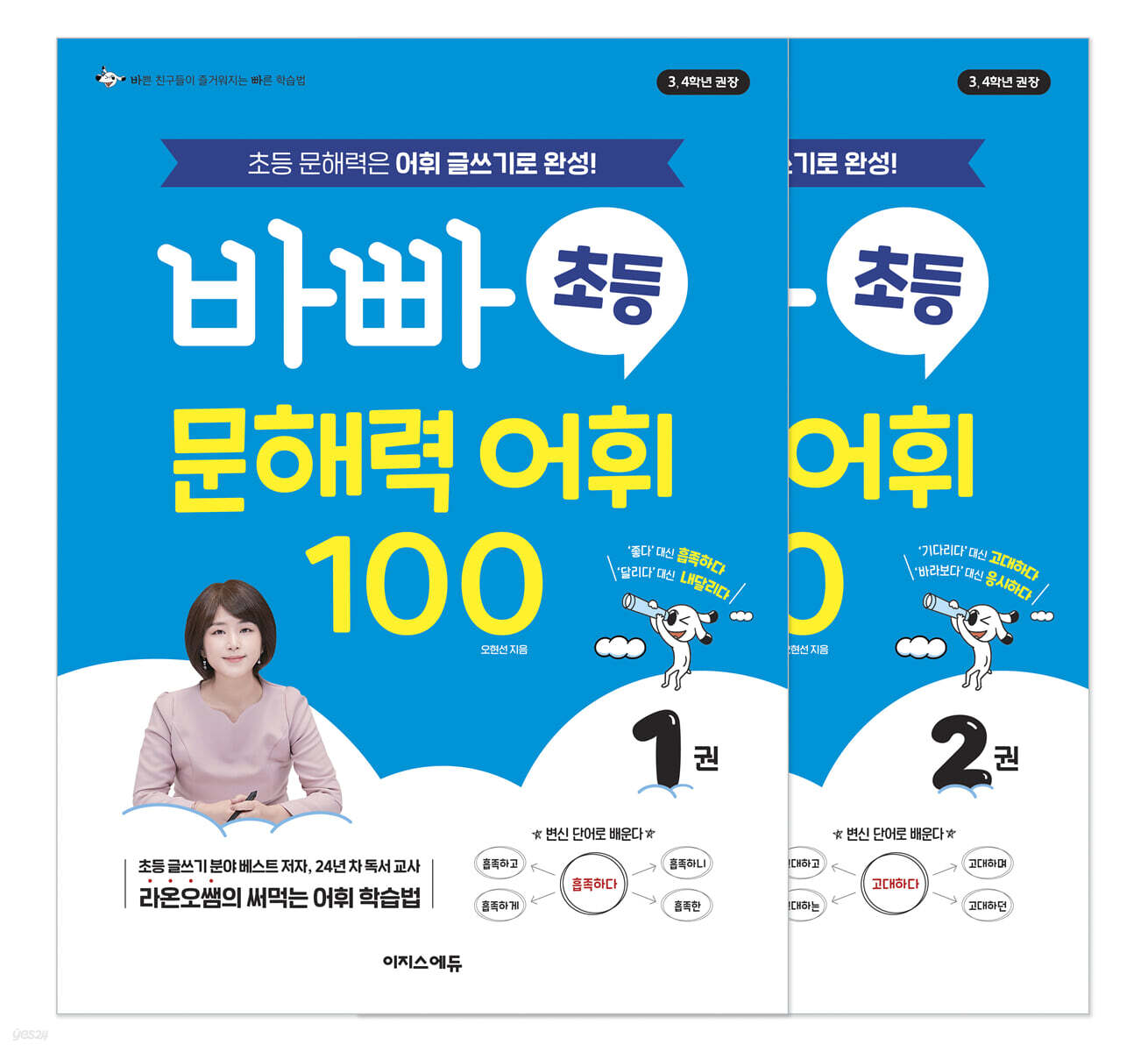
Busy Elementary Literacy Vocabulary 100 Sets
 |
Description
Book Introduction
Elementary literacy depends on the quantity and quality of vocabulary! A vocabulary + writing book that builds your own useful vocabulary. A set of 'Busy Elementary Literacy Vocabulary 100' has been released, which uses 100 basic vocabulary words that elementary school students need to know. This is a vocabulary and writing textbook that condenses the know-how of teacher Oh Hyeon-seon, a reading teacher with 24 years of experience and a best-selling author in the field of elementary school writing. The vocabulary in this book is 100 words selected from the elementary basic vocabulary selected by the National Institute of the Korean Language to enrich expressive power. For example, it is easy to express positive emotions with just one word, such as 'good'. However, if you study with this book, you can develop the ability to express your feelings more accurately and delicately, such as 'I am satisfied.' This book also includes three question activities that go beyond simple vocabulary learning and help you express the vocabulary in actual writing. By writing about your own experiences in response to these three questions, you can improve not only your vocabulary but also your writing skills. Let's learn essential elementary vocabulary and express it in writing with the 'Busy Elementary Literacy Vocabulary 100' set to perfect elementary literacy. |
- You can preview some of the book's contents.
Preview
index
Busy Elementary Literacy Vocabulary 100 Volume 1
First yard | Words expressing movement
01 Equip
02 Procrastinate
03 Meddling
04 Compete
05 Take a walk
06 Be hungry
07 I am moved
08 Sunset
09 Ignore
10 Move
11. Be patient
12 Allow
13. Be active
14 Run
15 Urge
* First yard review
Second yard | A word expressing a state or quality
16 Clumsy
17 Be humble
18 poor
19 Manly
20 It's sad
21 Boring
22 Neglect
23. Cool down
24 unfamiliar
25 Satisfied
26 Difficult
27 Abound
28 It's going smoothly
29 It's abundant
30 brilliant
* Review of the second yard
Third Yard | Words that represent the names of everything in the world
31 packages
32 tricks
33 Sense
34 The next day
Around 35
36 years old
37 Alley
38 Wall
39 Mountain
40 days of life
* Third yard review
Fourth Courtyard | Words that clarify the meaning
41 Finally
42 Very
43 Never
44 Barely
45 Inadvertently
46 absorbedly
47 As you wish
48 carefully
49 Hanchang
50 immediately
* Review of the fourth yard
Busy Elementary Literacy Vocabulary 100 Volume 2
First yard | Words expressing movement
01 Get excited
02 Stare
03 Exercise
04 Thin
05 Hesitate
06 Crowded
07 Encourage
08 Look forward to it
09 Predict
10. Estimate
11 Rebellion
12. Become an enemy
13 Seongida
14 Stay
15. Coveted
* First yard review
Second yard | A word expressing a state or quality
16 Coincidentally
17 Bold
18 Skilled
19 Solemn
20. It's strange
21 Reckless
22 Frugal
23 Rude
24 Cool
25 Desperate
26 Strong
27 Easy
28 Smart
29 Fair
30 rare
* Review of the second yard
Third Yard | Words that represent the names of everything in the world
31 Life
32 Diet
33 Opposite
34 The following year
35 letters
36 tropical nights
37 Conflict
38 peers
39 Predicament
40 Strengths
* Third yard review
Fourth Courtyard | Words that clarify the meaning
41 Only
42 Vaguely
43 Suddenly
44 Gearyi
45 It should be
46 Willingly
47 Day by day
48 Absolutely
49 Please
50 quite
* Review of the fourth yard
First yard | Words expressing movement
01 Equip
02 Procrastinate
03 Meddling
04 Compete
05 Take a walk
06 Be hungry
07 I am moved
08 Sunset
09 Ignore
10 Move
11. Be patient
12 Allow
13. Be active
14 Run
15 Urge
* First yard review
Second yard | A word expressing a state or quality
16 Clumsy
17 Be humble
18 poor
19 Manly
20 It's sad
21 Boring
22 Neglect
23. Cool down
24 unfamiliar
25 Satisfied
26 Difficult
27 Abound
28 It's going smoothly
29 It's abundant
30 brilliant
* Review of the second yard
Third Yard | Words that represent the names of everything in the world
31 packages
32 tricks
33 Sense
34 The next day
Around 35
36 years old
37 Alley
38 Wall
39 Mountain
40 days of life
* Third yard review
Fourth Courtyard | Words that clarify the meaning
41 Finally
42 Very
43 Never
44 Barely
45 Inadvertently
46 absorbedly
47 As you wish
48 carefully
49 Hanchang
50 immediately
* Review of the fourth yard
Busy Elementary Literacy Vocabulary 100 Volume 2
First yard | Words expressing movement
01 Get excited
02 Stare
03 Exercise
04 Thin
05 Hesitate
06 Crowded
07 Encourage
08 Look forward to it
09 Predict
10. Estimate
11 Rebellion
12. Become an enemy
13 Seongida
14 Stay
15. Coveted
* First yard review
Second yard | A word expressing a state or quality
16 Coincidentally
17 Bold
18 Skilled
19 Solemn
20. It's strange
21 Reckless
22 Frugal
23 Rude
24 Cool
25 Desperate
26 Strong
27 Easy
28 Smart
29 Fair
30 rare
* Review of the second yard
Third Yard | Words that represent the names of everything in the world
31 Life
32 Diet
33 Opposite
34 The following year
35 letters
36 tropical nights
37 Conflict
38 peers
39 Predicament
40 Strengths
* Third yard review
Fourth Courtyard | Words that clarify the meaning
41 Only
42 Vaguely
43 Suddenly
44 Gearyi
45 It should be
46 Willingly
47 Day by day
48 Absolutely
49 Please
50 quite
* Review of the fourth yard
Detailed image

Publisher's Review
Elementary literacy is completed through vocabulary writing!
Busy Elementary Literacy Vocabulary 100
The power to understand textbooks, vocabulary
A significant portion of elementary school textbooks consists of text explaining concepts.
The first thing you need to properly understand these texts is vocabulary.
Studying is bound to be difficult if you can't read and understand the vocabulary used in the explanations, as well as the learning terms.
How to Build Vocabulary = Consistent Conversation and Reading + Studying Vocabulary Materials
The problem is that it is not easy to build vocabulary.
Vocabulary is part of our language skills, which develop from birth through conversations with our parents.
Additionally, reading is an important factor in building vocabulary.
However, it is not easy for elementary school students these days to consistently maintain these two things.
In this situation, the most realistic way is to learn essential vocabulary using textbooks.
If conversations with parents or reading are 'implicit learning' that naturally acquires vocabulary, learning through vocabulary textbooks can be said to be 'explicit learning' that clearly teaches vocabulary.
This explicit learning should be followed by rapid vocabulary growth.
Expressive power changes! - "Satisfied" instead of "good," "run" instead of "run"
This book covers vocabulary that will broaden your thinking and enrich your writing.
For example, the word 'satisfied' expresses my state of mind more accurately than the commonly used word 'good'.
Also, 'run' conveys a more vivid sense of power than 'run'.
In this way, your ability to express yourself in speech and writing greatly depends on how well you know your vocabulary.
This book also teaches you the various conjugations of these words, helping you use them correctly in different situations.
It even contains abstract nouns that you absolutely need to study!
There are concrete nouns and abstract nouns.
Abstract nouns are difficult to learn without studying them separately because they represent things that cannot be seen or touched.
For example, only after learning the meaning of words like 'season', 'life', and 'tunchi' can you properly understand the text in which they are used, and also be able to express your own thoughts using those words.
Through this book, you will learn abstract nouns whose meaning you knew but did not know exactly.
Create your real 'vocabulary' by writing vocabulary!
To effectively acquire vocabulary, you need to know the context in which the vocabulary is actually used and learn how to use it naturally within that context.
You cannot properly learn vocabulary by simply reading its meaning over and over again.
Additionally, you need to know the various conjugations of vocabulary so that you can use it naturally and without awkwardness.
The most important thing is to actually use the vocabulary.
When using vocabulary, you can make it truly 'your vocabulary' by recalling your own experiences and expressing them in writing.
Help your children learn vocabulary and even write without pressure with Volumes 1 and 2 of "Busy Elementary Literacy Vocabulary 100."
By the end of this book, your vocabulary will have grown significantly.
Please don't forget to include conversation and reading in your daily life!
Busy Elementary Literacy Vocabulary 100
The power to understand textbooks, vocabulary
A significant portion of elementary school textbooks consists of text explaining concepts.
The first thing you need to properly understand these texts is vocabulary.
Studying is bound to be difficult if you can't read and understand the vocabulary used in the explanations, as well as the learning terms.
How to Build Vocabulary = Consistent Conversation and Reading + Studying Vocabulary Materials
The problem is that it is not easy to build vocabulary.
Vocabulary is part of our language skills, which develop from birth through conversations with our parents.
Additionally, reading is an important factor in building vocabulary.
However, it is not easy for elementary school students these days to consistently maintain these two things.
In this situation, the most realistic way is to learn essential vocabulary using textbooks.
If conversations with parents or reading are 'implicit learning' that naturally acquires vocabulary, learning through vocabulary textbooks can be said to be 'explicit learning' that clearly teaches vocabulary.
This explicit learning should be followed by rapid vocabulary growth.
Expressive power changes! - "Satisfied" instead of "good," "run" instead of "run"
This book covers vocabulary that will broaden your thinking and enrich your writing.
For example, the word 'satisfied' expresses my state of mind more accurately than the commonly used word 'good'.
Also, 'run' conveys a more vivid sense of power than 'run'.
In this way, your ability to express yourself in speech and writing greatly depends on how well you know your vocabulary.
This book also teaches you the various conjugations of these words, helping you use them correctly in different situations.
It even contains abstract nouns that you absolutely need to study!
There are concrete nouns and abstract nouns.
Abstract nouns are difficult to learn without studying them separately because they represent things that cannot be seen or touched.
For example, only after learning the meaning of words like 'season', 'life', and 'tunchi' can you properly understand the text in which they are used, and also be able to express your own thoughts using those words.
Through this book, you will learn abstract nouns whose meaning you knew but did not know exactly.
Create your real 'vocabulary' by writing vocabulary!
To effectively acquire vocabulary, you need to know the context in which the vocabulary is actually used and learn how to use it naturally within that context.
You cannot properly learn vocabulary by simply reading its meaning over and over again.
Additionally, you need to know the various conjugations of vocabulary so that you can use it naturally and without awkwardness.
The most important thing is to actually use the vocabulary.
When using vocabulary, you can make it truly 'your vocabulary' by recalling your own experiences and expressing them in writing.
Help your children learn vocabulary and even write without pressure with Volumes 1 and 2 of "Busy Elementary Literacy Vocabulary 100."
By the end of this book, your vocabulary will have grown significantly.
Please don't forget to include conversation and reading in your daily life!
GOODS SPECIFICS
- Date of issue: November 22, 2024
- Page count, weight, size: 272 pages | 210*280*50mm
- ISBN13: 9791163036517
- KC Certification: Certification Type: Conformity Confirmation
You may also like
카테고리
korean


korean

![GQ KOREA Mark (Monthly): December [2025]](http://librairie.coreenne.fr/cdn/shop/files/8ef265dbbfbf186523ed75ba7319009d.jpg?v=1765340328&width=3840)


