

Become a regular at Mirabeau Cafe
 |
Description
Book Introduction
Blue sky and red land, dazzling sun, streets filled with emotion, culture and art,
All of this leads to relaxation and healing,
Feeling at home in the nature and people of Namdo and Provence
The author has a special connection with the southern part of our country and Provence, France.
At the age of 31, after completing her studies abroad, she was appointed as an assistant professor in the Department of Sociology at Chonnam National University and lived in Gwangju for three years. Starting in 2018, she stayed in Aix-en-Provence for three to four months at a time for five years to participate in research projects with her husband.
During his stay in both places, the author felt true rest and healing.
Above all, I felt a deep sense of closeness in my heart because of the warm embrace of the land and nature, and the caring and compassionate people.
Just like home.
Although the South and Provence are geographically distant and have different languages and histories, the two regions the author experienced have many similarities.
Both boast beautiful scenery with mountains and seas, are rich in food, and have produced many writers and painters.
However, as it is a village at the end of the earth far from the capitals of Seoul and Paris, it has a famous place of exile and prison.
It has a sad history.
In this book, the author tells the story by comparing the two regions through themes of nature, religion, art, people, food, and history, incorporating his vivid experiences and feelings into words and pictures.
This book is divided into five parts.
Part 1 begins with the red land we first encountered in Haenam and Provence, and tells of the natural landscapes of Haenam's Dosolam and Dalmago Island, and Provence's Mount Sainte-Victoire and the Cassis coastal cliffs. Part 2 introduces temples and cathedrals with long histories in the southern provinces and Provence.
You can see Daeheungsa Temple, Mihwangsa Temple, Baekryeonsa Temple, and Muwisa Temple in Namdo, and the Avignon Papal Palace, Moustiers-Saint-Marie Cathedral, and Saint-Marie-de-La-Mer Cathedral in Provence.
Both regions are home to many outstanding artists, and in Part 3, we can see painters Heo Ryeon and Yun Du-seo, Cézanne and Van Gogh, and writers Yun Seon-do and Kim Yun-sik, Alphonse Daudet and Marcel Pagnol.
Similarities can be found even within the different artistic histories and traditions of the two regions.
Part 4 examines people's personalities and food.
The people of the two regions may look very different on the outside, but they have warm hearts.
You can also compare the local flavors of southern cuisine with Mediterranean cuisine, which you can enjoy first with your eyes.
Part 5 explores the darker side of history, a time of sorrow and suffering intertwined in the southern provinces and Provence, far from the capital.
All of this leads to relaxation and healing,
Feeling at home in the nature and people of Namdo and Provence
The author has a special connection with the southern part of our country and Provence, France.
At the age of 31, after completing her studies abroad, she was appointed as an assistant professor in the Department of Sociology at Chonnam National University and lived in Gwangju for three years. Starting in 2018, she stayed in Aix-en-Provence for three to four months at a time for five years to participate in research projects with her husband.
During his stay in both places, the author felt true rest and healing.
Above all, I felt a deep sense of closeness in my heart because of the warm embrace of the land and nature, and the caring and compassionate people.
Just like home.
Although the South and Provence are geographically distant and have different languages and histories, the two regions the author experienced have many similarities.
Both boast beautiful scenery with mountains and seas, are rich in food, and have produced many writers and painters.
However, as it is a village at the end of the earth far from the capitals of Seoul and Paris, it has a famous place of exile and prison.
It has a sad history.
In this book, the author tells the story by comparing the two regions through themes of nature, religion, art, people, food, and history, incorporating his vivid experiences and feelings into words and pictures.
This book is divided into five parts.
Part 1 begins with the red land we first encountered in Haenam and Provence, and tells of the natural landscapes of Haenam's Dosolam and Dalmago Island, and Provence's Mount Sainte-Victoire and the Cassis coastal cliffs. Part 2 introduces temples and cathedrals with long histories in the southern provinces and Provence.
You can see Daeheungsa Temple, Mihwangsa Temple, Baekryeonsa Temple, and Muwisa Temple in Namdo, and the Avignon Papal Palace, Moustiers-Saint-Marie Cathedral, and Saint-Marie-de-La-Mer Cathedral in Provence.
Both regions are home to many outstanding artists, and in Part 3, we can see painters Heo Ryeon and Yun Du-seo, Cézanne and Van Gogh, and writers Yun Seon-do and Kim Yun-sik, Alphonse Daudet and Marcel Pagnol.
Similarities can be found even within the different artistic histories and traditions of the two regions.
Part 4 examines people's personalities and food.
The people of the two regions may look very different on the outside, but they have warm hearts.
You can also compare the local flavors of southern cuisine with Mediterranean cuisine, which you can enjoy first with your eyes.
Part 5 explores the darker side of history, a time of sorrow and suffering intertwined in the southern provinces and Provence, far from the capital.
- You can preview some of the book's contents.
Preview
index
Prologue: The Relationship Between Namdo and Aix-en-Provence
Part 1: Red Earth, Blue Sea, White Stone Mountain
Chapter 1: Namdo, like a red, fragrant, and noble flower
Red Haenam Land | Yuseonggwan, reminiscent of an old country house | Azaleas on the way up to Dosol Am | Dalmagodo, the ancient path of ascetics | Silky Sand Beach, Myeongsa Shipri in Wando
Chapter 2: Aix-en-Provence, dazzling sun and blue sky
A great place to walk | Geometrically shaped street trees | Becoming a regular at the Mirabeau Café | Sainte-Victoire, the mountain behind Aix | Cassis, where you want to dive in
Part 2: Old Comfort and Peace, Temples and Cathedrals
Chapter 1: Emptying and Refilling Your Mind: A Southern Temple
Thinking of Old Friends at Daeheungsa Temple | Pyochungsa Temple, an unexpected space dedicated to Seosan Daesa, the leader of the monk army | Iljiam Temple, a historical site where Choui, Dasan, Chusa, and Sochi met | Baekryeonsa Temple, along a beautiful camellia forest path | Mihwangsa Temple, a 108-step climb that lets go of your worries | Muwisa Temple, a place that brings to mind your mother who never had any desires
Chapter 2: The Magnificent and Magnificent Cathedrals of Provence
Avignon, the papal capital that replaced Rome | Aigues-Mortes, the historic Crusader town | The majestic Mass of the Aix cathedrals | Lavender fields and star-studded villages | The small and cozy Moustiers-Saint-Marie and the Verdon Gorge | Sainte-Marie-de-la-Mer, a church of saints built by the sea | The olive tree, a symbol of Provence
Part 3: Artists Who Loved the Nature and Language of Their Hometown
Chapter 1: Artists from the Southern Province Who Became Friends with Nature
Sochi Heo Ryeon's landscape painting depicts the hometown of the heart; Sochi's ink peonies depict the desires of the times; Gongjae Yun Du-seo, a nobleman painter who sought to return to the basics; Gosan Yun Seon-do, a critical intellectual who created a utopia on Bogildo Island; Yeongrang Kim Yun-sik, a poet who sang of his hometown in his dialect
Chapter 2: Artists Who Loved Provence
Paul Cézanne, a painter who insisted on his own style | Van Gogh, who expressed his dreams and aspirations in his own way | Van Gogh, who dreamed of an artists' community but was confined to a mental hospital | Alphonse Daudet, a dialect writer who longed for what was lost |
Marcel Pagnol, "Marcel's Summer," a portrait of his childhood
Part 4: The People of Land's End Village: Stirring Hearts and Captivating Tastes
Chapter 1: The love of Namdo that calls out to even passersby
People who find healing in their spiritual home | A Jeolla-do resident enjoying the life of green potatoes and sweet potatoes | A disciple living in a remote house in a village at the end of the land | Fermented skate, a local flavor of Jeolla-do that stirs both the senses of smell and taste | Myeongyudang's spring vegetable table and mother's grilled hairtail | The first 'tip' of the year, green tea, and "Dongdasong"
Chapter 2: The Unique and Warm-hearted People of Provence
A proud and uninhibited Exua | A couple who turned their remote home into a hub for Korean studies | A Marseillesian who loves the southern region | Fresh vegetables and fruits at the morning market | Caprese salad, carpaccio, bouillabaisse | French home cooking enjoyed at Professor Michel's villa | 'Tip' Cafe Gourmand, Te Gourmand
Part 5: A Flower of Healing and Hope Blooming in a Painful History
Chapter 1: Beautiful Rivers and Mountains Embracing a Sacred History
A place of exile turned into a land of healing | Le Panier, Marseille, a tourist destination, leaving behind its painful history | Aix, which resisted industrialization and preserved its old appearance
Chapter 2: Hope Rising from Sad Exile and Prison
The Stranger in Sa-ui-jae, Jeong Yak-yong | Jeong Yak-yong's Self-Discovery in Exile | The Count of Monte Cristo's Revenge on If Island | Camus's Homecoming in Lourmarin
Epilogue: Meeting Myself in a Familiar Land
Acknowledgements
References
Part 1: Red Earth, Blue Sea, White Stone Mountain
Chapter 1: Namdo, like a red, fragrant, and noble flower
Red Haenam Land | Yuseonggwan, reminiscent of an old country house | Azaleas on the way up to Dosol Am | Dalmagodo, the ancient path of ascetics | Silky Sand Beach, Myeongsa Shipri in Wando
Chapter 2: Aix-en-Provence, dazzling sun and blue sky
A great place to walk | Geometrically shaped street trees | Becoming a regular at the Mirabeau Café | Sainte-Victoire, the mountain behind Aix | Cassis, where you want to dive in
Part 2: Old Comfort and Peace, Temples and Cathedrals
Chapter 1: Emptying and Refilling Your Mind: A Southern Temple
Thinking of Old Friends at Daeheungsa Temple | Pyochungsa Temple, an unexpected space dedicated to Seosan Daesa, the leader of the monk army | Iljiam Temple, a historical site where Choui, Dasan, Chusa, and Sochi met | Baekryeonsa Temple, along a beautiful camellia forest path | Mihwangsa Temple, a 108-step climb that lets go of your worries | Muwisa Temple, a place that brings to mind your mother who never had any desires
Chapter 2: The Magnificent and Magnificent Cathedrals of Provence
Avignon, the papal capital that replaced Rome | Aigues-Mortes, the historic Crusader town | The majestic Mass of the Aix cathedrals | Lavender fields and star-studded villages | The small and cozy Moustiers-Saint-Marie and the Verdon Gorge | Sainte-Marie-de-la-Mer, a church of saints built by the sea | The olive tree, a symbol of Provence
Part 3: Artists Who Loved the Nature and Language of Their Hometown
Chapter 1: Artists from the Southern Province Who Became Friends with Nature
Sochi Heo Ryeon's landscape painting depicts the hometown of the heart; Sochi's ink peonies depict the desires of the times; Gongjae Yun Du-seo, a nobleman painter who sought to return to the basics; Gosan Yun Seon-do, a critical intellectual who created a utopia on Bogildo Island; Yeongrang Kim Yun-sik, a poet who sang of his hometown in his dialect
Chapter 2: Artists Who Loved Provence
Paul Cézanne, a painter who insisted on his own style | Van Gogh, who expressed his dreams and aspirations in his own way | Van Gogh, who dreamed of an artists' community but was confined to a mental hospital | Alphonse Daudet, a dialect writer who longed for what was lost |
Marcel Pagnol, "Marcel's Summer," a portrait of his childhood
Part 4: The People of Land's End Village: Stirring Hearts and Captivating Tastes
Chapter 1: The love of Namdo that calls out to even passersby
People who find healing in their spiritual home | A Jeolla-do resident enjoying the life of green potatoes and sweet potatoes | A disciple living in a remote house in a village at the end of the land | Fermented skate, a local flavor of Jeolla-do that stirs both the senses of smell and taste | Myeongyudang's spring vegetable table and mother's grilled hairtail | The first 'tip' of the year, green tea, and "Dongdasong"
Chapter 2: The Unique and Warm-hearted People of Provence
A proud and uninhibited Exua | A couple who turned their remote home into a hub for Korean studies | A Marseillesian who loves the southern region | Fresh vegetables and fruits at the morning market | Caprese salad, carpaccio, bouillabaisse | French home cooking enjoyed at Professor Michel's villa | 'Tip' Cafe Gourmand, Te Gourmand
Part 5: A Flower of Healing and Hope Blooming in a Painful History
Chapter 1: Beautiful Rivers and Mountains Embracing a Sacred History
A place of exile turned into a land of healing | Le Panier, Marseille, a tourist destination, leaving behind its painful history | Aix, which resisted industrialization and preserved its old appearance
Chapter 2: Hope Rising from Sad Exile and Prison
The Stranger in Sa-ui-jae, Jeong Yak-yong | Jeong Yak-yong's Self-Discovery in Exile | The Count of Monte Cristo's Revenge on If Island | Camus's Homecoming in Lourmarin
Epilogue: Meeting Myself in a Familiar Land
Acknowledgements
References
Detailed image
.jpg)
Into the book
“De Cafe Americano, double water!”
At the Grillon Café in Aix-en-Provence (or simply 'Aix' for short), I always order like this, holding up the menu to shield my face from the sunlight.
… One day, a waiter came and said, “De Cafe Americano, double water?” and told me what I wanted to order.
Then he lifted the menu and held it to my forehead, smiling.
'No, this waiter remembers me.
I laughed too, saying, 'You know I'm a regular at that cafe?'
Everyone was enjoying the sun with their faces exposed, but I was the only one who had my face covered by the menu.
I can't believe I have a regular cafe in the far south of France.
--- From "Prologue: The Relationship Between Namdo and Aix-en-Provence"
If Haenam is famous for the Yuseonggwan and Daeheungsa Temple's Yeonrigeun, X is famous for its geometrically shaped street trees.
In particular, the geometric shapes of the street trees that have not yet sprouted leaves are quite unique.
Most of them stand in an upside-down S shape facing the sky.
In France, they seem to prune the branches of street trees that are overwintering in this way.
The same goes for the trees on the Rue Mirabeau, the trees on the way to the Carcassonne sports grounds, the trees in the Jourdan Park on the way to school, and the trees at the University of Aix-Marseille.
--- From "Geometrically Shaped Street Trees"
Thinking about Mihwangsa Temple, which is perched on a mountaintop but is said to have originated from the sea, two cathedrals in Provence came to mind.
One is the Basilica of Sainte-Marie de Moustiers, located on top of a rocky mountain, and the other is the Basilica of Sainte-Marie-de-la-Mer, located on the seashore south of Arles.
Because the names were confusing, the former was called 'St. Marie Cathedral on the Top of the Mountain' and the latter 'St. Marie Cathedral by the Sea'.
The 'Saint Marie Church on the Top of the Mountain' requires climbing over 200 steps, just like Mihwangsa Temple, which requires climbing 108 steps.
On the other hand, the 'Saint Marie Church on the Seaside' has a similar origin to Mihwangsa Temple, which has a legend that it was built by saints who came by boat carrying Buddhist scriptures, Buddhist statues, and stone coffins.
--- From "The Lavender Fields and the Star-studded Village"
When I told Kim Ji-woo of the open tea house Myeongyu-dang in advance that I wanted to visit, he immediately suggested that we have lunch together and have soybean paste stew.
It was truly amazing to receive such hospitality.
When you see strangers or foreigners, you are bound to feel wary, but she shared her space and treated others to food without any hesitation.
They say you can even sleep there if you want.
Isn't this truly a wonderful hospitality?
--- From "A Southerner Enjoying the Life of a Green Potato"
“We need to look at it both anthropologically and sociologically.”
He said that while the people of Exoana and Marseille are similar in that they have bright personalities thanks to the good weather and hot sun, sociologically they are very different.
While Exua is comprised of intellectuals, educators, and bureaucrats from the upper-middle class, the people of Marseille are comprised of many workers, and their inclinations differ according to these class characteristics.
If Exua is individualistic, the people of Marseille are more communal and tend to live by sharing even small things and helping each other.
And while the Exuas are cool and calculating, the Marseille people are more passionate and easily swayed by emotions, and they often fall into conflict, but they still live together in solidarity and harmony.
That was a really interesting observation and seemed to be correct.
At the Grillon Café in Aix-en-Provence (or simply 'Aix' for short), I always order like this, holding up the menu to shield my face from the sunlight.
… One day, a waiter came and said, “De Cafe Americano, double water?” and told me what I wanted to order.
Then he lifted the menu and held it to my forehead, smiling.
'No, this waiter remembers me.
I laughed too, saying, 'You know I'm a regular at that cafe?'
Everyone was enjoying the sun with their faces exposed, but I was the only one who had my face covered by the menu.
I can't believe I have a regular cafe in the far south of France.
--- From "Prologue: The Relationship Between Namdo and Aix-en-Provence"
If Haenam is famous for the Yuseonggwan and Daeheungsa Temple's Yeonrigeun, X is famous for its geometrically shaped street trees.
In particular, the geometric shapes of the street trees that have not yet sprouted leaves are quite unique.
Most of them stand in an upside-down S shape facing the sky.
In France, they seem to prune the branches of street trees that are overwintering in this way.
The same goes for the trees on the Rue Mirabeau, the trees on the way to the Carcassonne sports grounds, the trees in the Jourdan Park on the way to school, and the trees at the University of Aix-Marseille.
--- From "Geometrically Shaped Street Trees"
Thinking about Mihwangsa Temple, which is perched on a mountaintop but is said to have originated from the sea, two cathedrals in Provence came to mind.
One is the Basilica of Sainte-Marie de Moustiers, located on top of a rocky mountain, and the other is the Basilica of Sainte-Marie-de-la-Mer, located on the seashore south of Arles.
Because the names were confusing, the former was called 'St. Marie Cathedral on the Top of the Mountain' and the latter 'St. Marie Cathedral by the Sea'.
The 'Saint Marie Church on the Top of the Mountain' requires climbing over 200 steps, just like Mihwangsa Temple, which requires climbing 108 steps.
On the other hand, the 'Saint Marie Church on the Seaside' has a similar origin to Mihwangsa Temple, which has a legend that it was built by saints who came by boat carrying Buddhist scriptures, Buddhist statues, and stone coffins.
--- From "The Lavender Fields and the Star-studded Village"
When I told Kim Ji-woo of the open tea house Myeongyu-dang in advance that I wanted to visit, he immediately suggested that we have lunch together and have soybean paste stew.
It was truly amazing to receive such hospitality.
When you see strangers or foreigners, you are bound to feel wary, but she shared her space and treated others to food without any hesitation.
They say you can even sleep there if you want.
Isn't this truly a wonderful hospitality?
--- From "A Southerner Enjoying the Life of a Green Potato"
“We need to look at it both anthropologically and sociologically.”
He said that while the people of Exoana and Marseille are similar in that they have bright personalities thanks to the good weather and hot sun, sociologically they are very different.
While Exua is comprised of intellectuals, educators, and bureaucrats from the upper-middle class, the people of Marseille are comprised of many workers, and their inclinations differ according to these class characteristics.
If Exua is individualistic, the people of Marseille are more communal and tend to live by sharing even small things and helping each other.
And while the Exuas are cool and calculating, the Marseille people are more passionate and easily swayed by emotions, and they often fall into conflict, but they still live together in solidarity and harmony.
That was a really interesting observation and seemed to be correct.
--- From "Marseilles people who love the South"
Publisher's Review
Two regions separated by the Indian Ocean, the southernmost part of France and Aix-en-Provence, share similarities? Compared to the southernmost part, historically a place of exile, lagging behind in industrialization, and culturally steeped in indigenous flavors and human warmth, Aix is a vibrant, cultural city, home to a wealthy aristocracy, boasting a splendid and distinctive appearance. Even its people and cuisine mirror this aesthetic.
It is puzzling that Namdo and X, which seem to have no similar history or culture, are so similar.
What do they look like?
The author spent several years in each region, experiencing contrasting yet similar experiences in nature, religion, art, people, food, and history.
As we follow the author's story that crosses over two regions, we feel the long rocky mountain of Dalmago in the southern provinces reaching Mount Sainte-Victoire in Aix, the Mihwangsa Temple, which is said to have come from the sea, reaching the Sainte-Marie-de-La-Mer Church located on the seaside, and we imagine the literature of Alphonse Daudet through Yeongrang Kim Yun-sik, who wrote in dialect.
Isn't this an unfamiliar, yet fascinating and fun experience? The author doesn't just make this comparison based on feelings; he researches and references various sources to verify that it's not a false claim.
The author became a regular at a cafe in X, and while concentrating on reading a book amidst the chatter of people around him, he felt the unfamiliarity and newness of a foreign land approaching the comfort of home.
But what made me feel at home in a foreign land was, above all, the warm hearts of the people.
The author asked himself why the two regions felt like home and what home is.
Through that question, I sought to find answers about my roots and fundamental identity.
In the process, I came to realize the dream I had cherished since childhood.
Hometown no longer feels like a distant memory, a memory that the author recalls intimately, but rather like the energy of the future that pushes and guides the primal dreams that make me who I am.
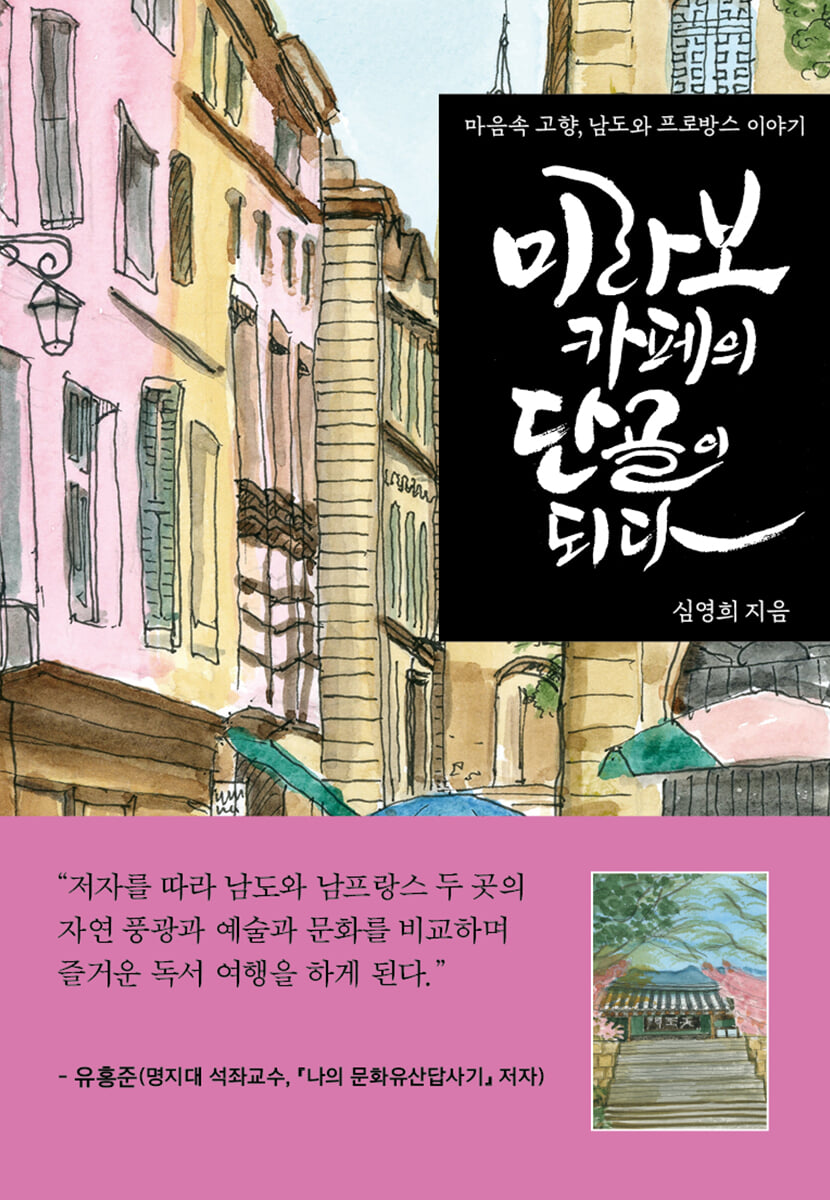
The author also drew the illustrations in this book.
As I drew each picture, I felt like I was back in the South and Provence, and I remembered the joy I felt there.
I rediscovered myself and felt free.
In this book, you can enjoy a unique journey by comparing the two regions that have become the author's spiritual home.
It is puzzling that Namdo and X, which seem to have no similar history or culture, are so similar.
What do they look like?
The author spent several years in each region, experiencing contrasting yet similar experiences in nature, religion, art, people, food, and history.
As we follow the author's story that crosses over two regions, we feel the long rocky mountain of Dalmago in the southern provinces reaching Mount Sainte-Victoire in Aix, the Mihwangsa Temple, which is said to have come from the sea, reaching the Sainte-Marie-de-La-Mer Church located on the seaside, and we imagine the literature of Alphonse Daudet through Yeongrang Kim Yun-sik, who wrote in dialect.
Isn't this an unfamiliar, yet fascinating and fun experience? The author doesn't just make this comparison based on feelings; he researches and references various sources to verify that it's not a false claim.
The author became a regular at a cafe in X, and while concentrating on reading a book amidst the chatter of people around him, he felt the unfamiliarity and newness of a foreign land approaching the comfort of home.
But what made me feel at home in a foreign land was, above all, the warm hearts of the people.
The author asked himself why the two regions felt like home and what home is.
Through that question, I sought to find answers about my roots and fundamental identity.
In the process, I came to realize the dream I had cherished since childhood.
Hometown no longer feels like a distant memory, a memory that the author recalls intimately, but rather like the energy of the future that pushes and guides the primal dreams that make me who I am.
The author also drew the illustrations in this book.
As I drew each picture, I felt like I was back in the South and Provence, and I remembered the joy I felt there.
I rediscovered myself and felt free.
In this book, you can enjoy a unique journey by comparing the two regions that have become the author's spiritual home.
GOODS SPECIFICS
- Date of issue: February 21, 2025
- Page count, weight, size: 288 pages | 398g | 130*188*20mm
- ISBN13: 9791198159090
- ISBN10: 119815909X
You may also like
카테고리
korean


korean

![GQ KOREA Mark (Monthly): December [2025]](http://librairie.coreenne.fr/cdn/shop/files/8ef265dbbfbf186523ed75ba7319009d.jpg?v=1765340328&width=3840)


