

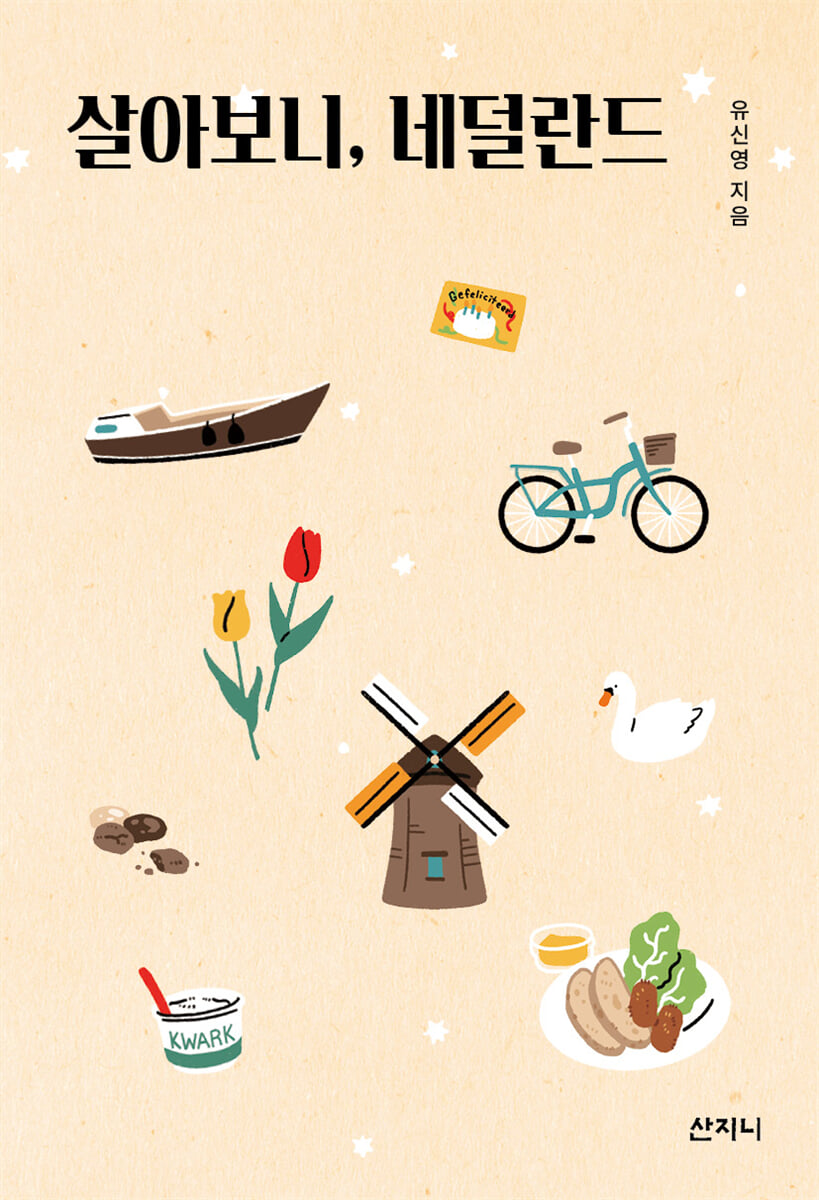
Living in the Netherlands
 |
Description
Book Introduction
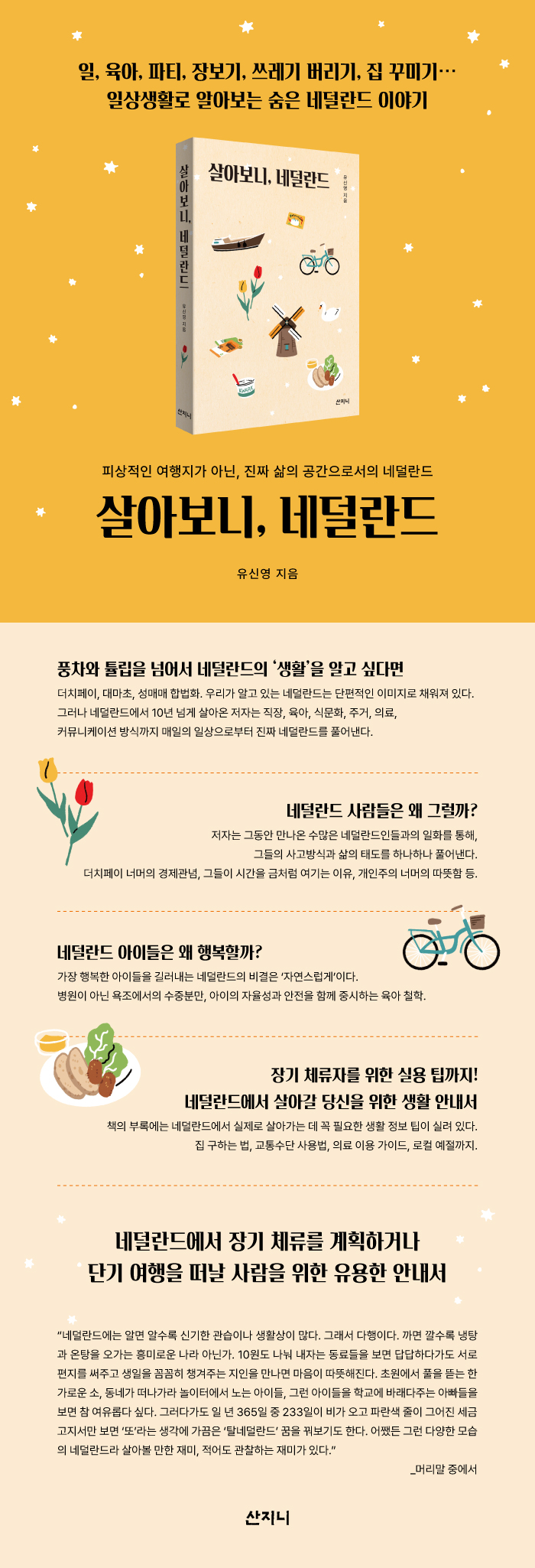
Beyond fragmentary images such as tulips, windmills, legalized prostitution, and marijuana,
Work, childcare, parties, grocery shopping, taking out the trash, decorating the house, etc.
Real Dutch stories from everyday life
The real Netherlands, not as a tourist destination but as a living space
The Netherlands ranked third in the ranking of preferred countries for overseas travel in December 2023.
Koreans' interest in the Netherlands is growing day by day, but most of us only have a superficial understanding of the Netherlands.
Instead of looking at the Netherlands through keywords like splitting the bill, windmills, tulips, marijuana, and legalized prostitution, what if we looked at it through keywords closely related to daily life, such as taxes, childcare, work, and housing?
We will get to know the real Netherlands.
The author, who has lived in the Netherlands since 2012, has included in the book stories about Dutch customs, food culture, childcare culture, and housing culture that only a resident can tell.
Introducing the Netherlands, but without unconditionally praising or criticizing the country.
Understand the differences between the Netherlands and Korea and highlight those differences from your own perspective.
Therefore, the author's writing helps readers experience the abstract Netherlands more realistically, and also provides living and travel tips for those planning to live in the Netherlands for a short or long term.
Work, childcare, parties, grocery shopping, taking out the trash, decorating the house, etc.
Real Dutch stories from everyday life
The real Netherlands, not as a tourist destination but as a living space
The Netherlands ranked third in the ranking of preferred countries for overseas travel in December 2023.
Koreans' interest in the Netherlands is growing day by day, but most of us only have a superficial understanding of the Netherlands.
Instead of looking at the Netherlands through keywords like splitting the bill, windmills, tulips, marijuana, and legalized prostitution, what if we looked at it through keywords closely related to daily life, such as taxes, childcare, work, and housing?
We will get to know the real Netherlands.
The author, who has lived in the Netherlands since 2012, has included in the book stories about Dutch customs, food culture, childcare culture, and housing culture that only a resident can tell.
Introducing the Netherlands, but without unconditionally praising or criticizing the country.
Understand the differences between the Netherlands and Korea and highlight those differences from your own perspective.
Therefore, the author's writing helps readers experience the abstract Netherlands more realistically, and also provides living and travel tips for those planning to live in the Netherlands for a short or long term.
- You can preview some of the book's contents.
Preview
index
preface
Chapter 1 Why do Dutch people do that?
A country that doesn't serve food at weddings
How to live well without expectations
Birthdays like a religion
You don't have to try so hard
Why is time gold?
What can I ask you to do for me?
A country that holds a meeting to decide on the meeting content
How the Dutch survive the winter
Chapter 2: Unique Dutch Variations
Three Colors Netherlands
Flowers, money, and aesthetics in the Netherlands
A garbage truck with a runny nose following it
The day when Dutch people dance shoulder dance
Santa Claus writes poetry
A swan built a nest in front of the house.
What our trading ancestors left behind in Amsterdam
Chapter 3: Why are Dutch children happy?
Free Dutch babies born naturalistically
Professional childcare services that come to your home
Taking parental leave in the Netherlands
Any bread with margarine on it is perfect for baby food
It's different for every child (so don't compare)
Dutch daycare center sends a photo
Dutch baby products made with my own money
A school without homework for 8 years
Children who have been working since they were 13 years old
Chapter 4: Living at Home in the Netherlands
Nine Houses I've Lived In in Amsterdam
Living in a Dutch nursing home for a month
Experience with eco-friendly housing in the Netherlands
A country house built as if heading straight into the ground
Dutch interior design that's too good to keep to yourself
Chapter 5: Dutch food that you will fall in love with after eating it
Dutch food that goes well with kimchi
Visual terror, Dutch croquette
Soul food for a rainy day
200-year-old mini pancake stall
Cinnamon-scented morning buns
Dutch-style Jajangmyeon restaurant
Kwak instead of whipped cream
Interesting eating habits of the Dutch people
Chapter 6: A Trip to the Netherlands, Beyond Drugs and Sex
Freedom of Amsterdam
A healing road trip along the flat land
A travelogue of Brabant, facing south
Belyuve rides a bike to see Van Gogh and the heather flowers
Friesland, another Netherlands in the Netherlands
Appendix - Dutch Life Tips from My Sister
Americas
Chapter 1 Why do Dutch people do that?
A country that doesn't serve food at weddings
How to live well without expectations
Birthdays like a religion
You don't have to try so hard
Why is time gold?
What can I ask you to do for me?
A country that holds a meeting to decide on the meeting content
How the Dutch survive the winter
Chapter 2: Unique Dutch Variations
Three Colors Netherlands
Flowers, money, and aesthetics in the Netherlands
A garbage truck with a runny nose following it
The day when Dutch people dance shoulder dance
Santa Claus writes poetry
A swan built a nest in front of the house.
What our trading ancestors left behind in Amsterdam
Chapter 3: Why are Dutch children happy?
Free Dutch babies born naturalistically
Professional childcare services that come to your home
Taking parental leave in the Netherlands
Any bread with margarine on it is perfect for baby food
It's different for every child (so don't compare)
Dutch daycare center sends a photo
Dutch baby products made with my own money
A school without homework for 8 years
Children who have been working since they were 13 years old
Chapter 4: Living at Home in the Netherlands
Nine Houses I've Lived In in Amsterdam
Living in a Dutch nursing home for a month
Experience with eco-friendly housing in the Netherlands
A country house built as if heading straight into the ground
Dutch interior design that's too good to keep to yourself
Chapter 5: Dutch food that you will fall in love with after eating it
Dutch food that goes well with kimchi
Visual terror, Dutch croquette
Soul food for a rainy day
200-year-old mini pancake stall
Cinnamon-scented morning buns
Dutch-style Jajangmyeon restaurant
Kwak instead of whipped cream
Interesting eating habits of the Dutch people
Chapter 6: A Trip to the Netherlands, Beyond Drugs and Sex
Freedom of Amsterdam
A healing road trip along the flat land
A travelogue of Brabant, facing south
Belyuve rides a bike to see Van Gogh and the heather flowers
Friesland, another Netherlands in the Netherlands
Appendix - Dutch Life Tips from My Sister
Americas
Detailed image
Into the book
This book is the result of an in-depth exploration of little-known parts of the Netherlands, seen through my personal perspective as a person living there.
It was only after spending more time in the Netherlands that I discovered the fascinating country it is today, beyond my fragmented understanding.
--- p.7
Now that I think about it, it was strange.
I never thought about how much the phrase "Please take care of me", which we often use as a greeting, comes from our emotions.
It is also difficult to translate into English or Dutch.
I thought that in the Netherlands, giving someone a gift, no matter how small, and saying "please take care of me" would be seen as really strange.
Isn't that flattery? Well, in a rationalist society, if an individual does well, it's good, and it's not something that others will ask for or acknowledge.
--- p.41
Life is precious everywhere.
The love for children in the Netherlands is as deep as that in our country.
But just as our three meals are different from theirs, the way we love is very different.
Having been pregnant, given birth, and raised a baby in the Netherlands, and having learned both Korean and Dutch parenting methods, I can't help but talk about these fascinating, and sometimes frustrating, cultural differences.
--- p.83
The Dutch education system was truly amazing.
It's different from our country, but it's refreshing to know that a country can be safe, happy, and wealthy without having to study much.
I really feel the truth about what they say: studying isn't everything.
I think if Dutch children are happy, it's because there's nothing they have to force themselves to do.
It seems like a bonus happiness for growing children to eat chocolate sprinkled on bread for breakfast and lunch.
--- p.127
The minimalism of Dutch food culture is often jaw-dropping.
Warm food (Warme maaltijd) is eaten only once a day.
Warm foods include cooked foods, meats and vegetables.
That means the other two meals of the day are not like that.
The rest I eat with yogurt or a slice of cheese on bread.
There are no vegetables either.
That doesn't mean I eat a lot of bread.
--- p.183
If you cross the embankment like that, you will soon reach Leewarden.
It's a small city, so it's best to just walk around and explore wherever your feet take you.
As I wandered through the alleys of the city center, away from the usual clothing stores and shops, I came across the quiet, cozy, and interesting Leuwarden.
The library, which was converted from a prison, and the atelier located right next to it were impressive.
It's a special building that makes you wonder why a prison could be so beautiful, and the addition of art gives it a somewhat experimental feel.
It was only after spending more time in the Netherlands that I discovered the fascinating country it is today, beyond my fragmented understanding.
--- p.7
Now that I think about it, it was strange.
I never thought about how much the phrase "Please take care of me", which we often use as a greeting, comes from our emotions.
It is also difficult to translate into English or Dutch.
I thought that in the Netherlands, giving someone a gift, no matter how small, and saying "please take care of me" would be seen as really strange.
Isn't that flattery? Well, in a rationalist society, if an individual does well, it's good, and it's not something that others will ask for or acknowledge.
--- p.41
Life is precious everywhere.
The love for children in the Netherlands is as deep as that in our country.
But just as our three meals are different from theirs, the way we love is very different.
Having been pregnant, given birth, and raised a baby in the Netherlands, and having learned both Korean and Dutch parenting methods, I can't help but talk about these fascinating, and sometimes frustrating, cultural differences.
--- p.83
The Dutch education system was truly amazing.
It's different from our country, but it's refreshing to know that a country can be safe, happy, and wealthy without having to study much.
I really feel the truth about what they say: studying isn't everything.
I think if Dutch children are happy, it's because there's nothing they have to force themselves to do.
It seems like a bonus happiness for growing children to eat chocolate sprinkled on bread for breakfast and lunch.
--- p.127
The minimalism of Dutch food culture is often jaw-dropping.
Warm food (Warme maaltijd) is eaten only once a day.
Warm foods include cooked foods, meats and vegetables.
That means the other two meals of the day are not like that.
The rest I eat with yogurt or a slice of cheese on bread.
There are no vegetables either.
That doesn't mean I eat a lot of bread.
--- p.183
If you cross the embankment like that, you will soon reach Leewarden.
It's a small city, so it's best to just walk around and explore wherever your feet take you.
As I wandered through the alleys of the city center, away from the usual clothing stores and shops, I came across the quiet, cozy, and interesting Leuwarden.
The library, which was converted from a prison, and the atelier located right next to it were impressive.
It's a special building that makes you wonder why a prison could be so beautiful, and the addition of art gives it a somewhat experimental feel.
--- p.244
Publisher's Review
▶ Why do Dutch people do that?
The author says that the Dutch people are difficult to define in one word.
As a country famous for splitting the bill, it's frustrating to see coworkers splitting even the 10 won bill, but it's heartwarming to see them record birthdays on the calendar and meticulously celebrate them.
They are staunch individualists, but they are also seen rushing to help someone who falls on the street.
There is also a strict schedule-making culture where you have to ask at least two weeks in advance if you want to have a cup of coffee or a beer together, so the Korean greeting of "let's grab a meal" is taboo.
The author talked to the Dutch people, who are difficult to understand but have much to learn, and looked deeply into their culture.
Why do the Dutch value time like gold?
How was individualism reflected in their consumption patterns, etc.
Each and every Dutch person the author met provided a window into understanding the Dutch way of life.
And that window gave me new perspective and insight.
▶ A country where childbirth and childcare are as natural as possible.
Both Korea and the Netherlands have deep love for their children.
But the way of that love is very different.
The author experienced pregnancy, childbirth, and parenting in the Netherlands, a country said to have the happiest children in the world.
For the author, who grew up in Korea, Dutch parenting and the way children grow up there were very unfamiliar and sometimes even frustrating.
There is a strong aversion to artificial things, so water births in the bathtub at home are recommended, and there are no prenatal tests (amniotic fluid volume, size of the baby's head relative to the size of the pelvis, etc.) like in Korea.
It is an approach that focuses on treating problems when they arise rather than preventing them.
However, there are many free services available from professional organizations and experts who can help you whenever you need it.
There are many free services available to new parents, including a doctor visiting the home after giving birth to provide medical care or a midwife checking the mother and baby.
Comparing and experiencing the Korean and Dutch ways, the author looked back on his own upbringing and asked himself what kind of parent he wanted to be in the future.
Concerns about pregnancy, childbirth, and childcare broadened my values about life.
▶ Which telecommunications company is best to use in the Netherlands?
Living in an unfamiliar country is no easy task.
The process of adapting to a new environment can be exciting at times, but it also comes with many challenges.
Right now, you have to sign a contract for a house to live in, and you have to learn everything from buying groceries to using public transportation.
If you want to live with people who have different cultures and customs, you also need to know etiquette.
"Living in the Netherlands" includes practical life tips in the appendix to help readers who plan to live or travel in the Netherlands for a long or short period of time.
When signing a contract for a house, you should keep in mind that you can find a good house through a website like Punda and then view it in person up to twice before making a decision, and you do not need to pay money to an agent (real estate agent) when signing the contract.
Also, because this is a country that is serious about giving priority to traffic at roundabouts and intersections, you should be well aware of the local rules before driving.
In addition, the author has written in detail, from the perspective of a Dutch resident, essential and useful tips such as what to do if you get sick in the Netherlands, what to bring from Korea, and what to bring as gifts for returning home.
The author says that the Dutch people are difficult to define in one word.
As a country famous for splitting the bill, it's frustrating to see coworkers splitting even the 10 won bill, but it's heartwarming to see them record birthdays on the calendar and meticulously celebrate them.
They are staunch individualists, but they are also seen rushing to help someone who falls on the street.
There is also a strict schedule-making culture where you have to ask at least two weeks in advance if you want to have a cup of coffee or a beer together, so the Korean greeting of "let's grab a meal" is taboo.
The author talked to the Dutch people, who are difficult to understand but have much to learn, and looked deeply into their culture.
Why do the Dutch value time like gold?
How was individualism reflected in their consumption patterns, etc.
Each and every Dutch person the author met provided a window into understanding the Dutch way of life.
And that window gave me new perspective and insight.
▶ A country where childbirth and childcare are as natural as possible.
Both Korea and the Netherlands have deep love for their children.
But the way of that love is very different.
The author experienced pregnancy, childbirth, and parenting in the Netherlands, a country said to have the happiest children in the world.
For the author, who grew up in Korea, Dutch parenting and the way children grow up there were very unfamiliar and sometimes even frustrating.
There is a strong aversion to artificial things, so water births in the bathtub at home are recommended, and there are no prenatal tests (amniotic fluid volume, size of the baby's head relative to the size of the pelvis, etc.) like in Korea.
It is an approach that focuses on treating problems when they arise rather than preventing them.
However, there are many free services available from professional organizations and experts who can help you whenever you need it.
There are many free services available to new parents, including a doctor visiting the home after giving birth to provide medical care or a midwife checking the mother and baby.
Comparing and experiencing the Korean and Dutch ways, the author looked back on his own upbringing and asked himself what kind of parent he wanted to be in the future.
Concerns about pregnancy, childbirth, and childcare broadened my values about life.
▶ Which telecommunications company is best to use in the Netherlands?
Living in an unfamiliar country is no easy task.
The process of adapting to a new environment can be exciting at times, but it also comes with many challenges.
Right now, you have to sign a contract for a house to live in, and you have to learn everything from buying groceries to using public transportation.
If you want to live with people who have different cultures and customs, you also need to know etiquette.
"Living in the Netherlands" includes practical life tips in the appendix to help readers who plan to live or travel in the Netherlands for a long or short period of time.
When signing a contract for a house, you should keep in mind that you can find a good house through a website like Punda and then view it in person up to twice before making a decision, and you do not need to pay money to an agent (real estate agent) when signing the contract.
Also, because this is a country that is serious about giving priority to traffic at roundabouts and intersections, you should be well aware of the local rules before driving.
In addition, the author has written in detail, from the perspective of a Dutch resident, essential and useful tips such as what to do if you get sick in the Netherlands, what to bring from Korea, and what to bring as gifts for returning home.
GOODS SPECIFICS
- Date of issue: February 17, 2025
- Page count, weight, size: 272 pages | 140*205*16mm
- ISBN13: 9791168614178
You may also like
카테고리
korean


korean

![ELLE 엘르 스페셜 에디션 A형 : 12월 [2025]](http://librairie.coreenne.fr/cdn/shop/files/b8e27a3de6c9538896439686c6b0e8fb.jpg?v=1766436872&width=3840)


