

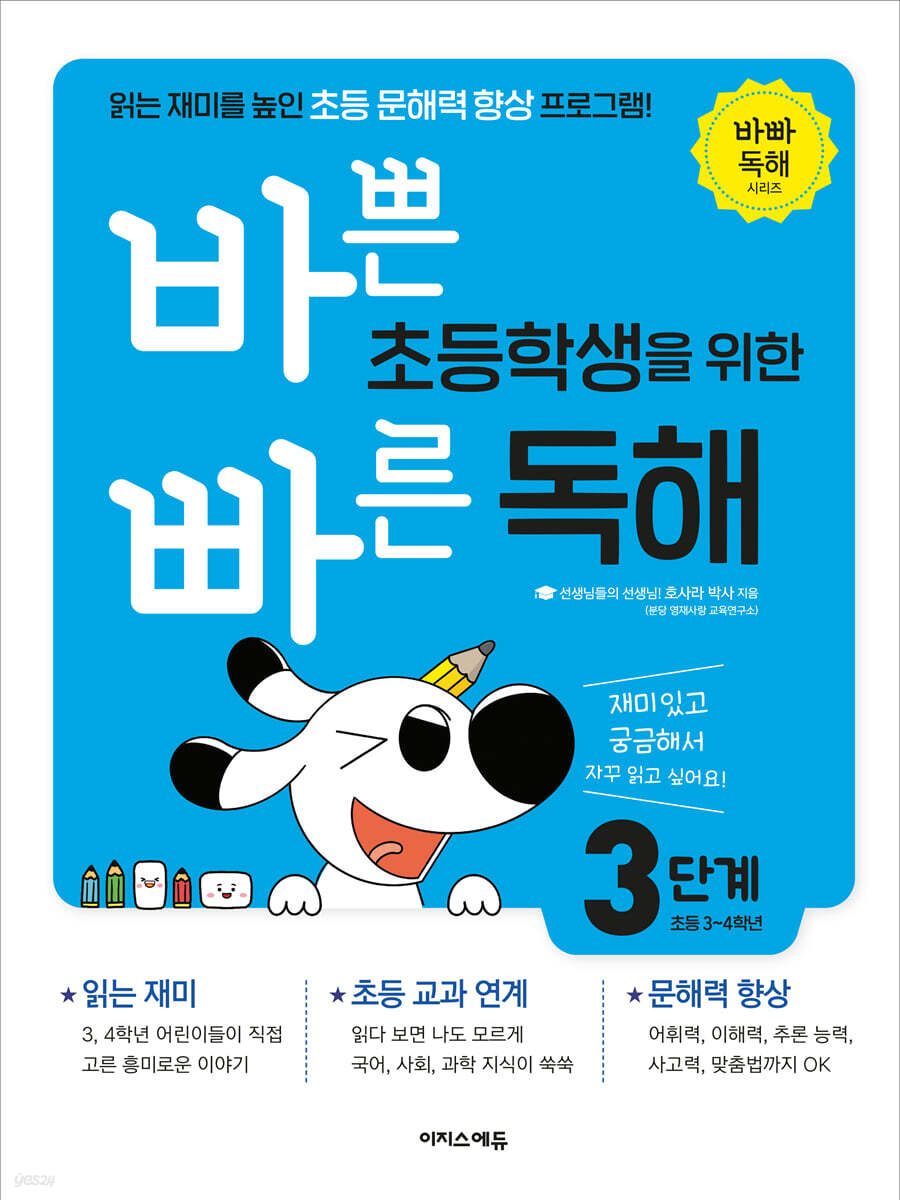
3 Steps to Quick Reading for Busy Elementary Students
 |
Description
Book Introduction
An elementary literacy program that enhances the fun of reading! “It’s fun and I’m curious, so I want to keep reading!” Bundang Youngjae Love Education Research Institute's teaching secrets revealed! Dr. Hosara, who has been teaching children for 16 years, has released the 3-level "Rapid Reading for Busy Elementary School Students" (hereafter, "Busy Reading"), a literacy improvement program that maximizes the enjoyment of reading. This book contains a selection of interesting stories that third and fourth graders at the institute would like to read, and all the stories and problems in this book are directly linked to elementary school textbooks, helping them do well in schoolwork. Let's meet 'Busy Reading', a fun reading book that will help you build literacy and knowledge of Korean, social studies, and science subjects without you even realizing it while reading! |
- You can preview some of the book's contents.
Preview
index
First yard.
Talmud
01 The Money Bag Found Again ①
02 The Rediscovered Money Bag ②
03 Kindness that Saved a Life ①
04 Kindness that Saved a Life ②
05 Three Treasures ①
06 Three Treasures ②
07 Mysterious Will ①
08 Mysterious Will ②
★ First Yard Review
Second yard.
Curriculum Science
09 There's a secret in the handle?
10 Taste it with your front legs?
11 Even if you split a magnet, it will still be a magnet?
12 Only women and bears?
13 Why does a horse have only one toe?
14 Do plants have different preferred soils?
15 Kim is not a gas?
16 Are there any sounds that cannot be heard?
★ Second Yard Review
Third yard.
Lifestyle
17 Ramen, I'll eat well
18 I apologize
19 The Golden Kingdom
20 Finding the meaning of confusing words
21 A lump of shit that fell from the sky
Find the 22nd sentence
23 Looking at the butterflies fluttering through the window
24 I had my first concert
★ Third Yard Review
Fourth yard.
Social Studies
25 Walking on the sky?
26 Was there an astronomical observatory during the Silla Dynasty?
27 You made paper out of grass?
28 There are non-square stamps?
29 There's a hotel made of ice?
30 Santa in the middle of summer?
31 You're paying for tuition with grain?
32 Why is a rainbow beautiful?
★Fourth Yard Review
Talmud
01 The Money Bag Found Again ①
02 The Rediscovered Money Bag ②
03 Kindness that Saved a Life ①
04 Kindness that Saved a Life ②
05 Three Treasures ①
06 Three Treasures ②
07 Mysterious Will ①
08 Mysterious Will ②
★ First Yard Review
Second yard.
Curriculum Science
09 There's a secret in the handle?
10 Taste it with your front legs?
11 Even if you split a magnet, it will still be a magnet?
12 Only women and bears?
13 Why does a horse have only one toe?
14 Do plants have different preferred soils?
15 Kim is not a gas?
16 Are there any sounds that cannot be heard?
★ Second Yard Review
Third yard.
Lifestyle
17 Ramen, I'll eat well
18 I apologize
19 The Golden Kingdom
20 Finding the meaning of confusing words
21 A lump of shit that fell from the sky
Find the 22nd sentence
23 Looking at the butterflies fluttering through the window
24 I had my first concert
★ Third Yard Review
Fourth yard.
Social Studies
25 Walking on the sky?
26 Was there an astronomical observatory during the Silla Dynasty?
27 You made paper out of grass?
28 There are non-square stamps?
29 There's a hotel made of ice?
30 Santa in the middle of summer?
31 You're paying for tuition with grain?
32 Why is a rainbow beautiful?
★Fourth Yard Review
Detailed image

Publisher's Review
3 Steps to Quick Reading for Busy Elementary Students
An elementary literacy program that enhances the enjoyment of reading.
“It’s a fun and intriguing book that makes you want to keep reading!”
■ 3rd and 4th grade textbook texts have become even more difficult!
Many parents received the 3rd and 4th grade textbooks and were surprised by the sudden increase in difficulty.
The most noticeable change is the length of the text, followed by the level of vocabulary.
Now, even if you read the 'letters' of a fingerprint, there will be many times when you will not understand the meaning.
‘Reading comprehension’, this is why these three words are so important.
■ The foundation of all study! 'Reading Comprehension'
Reading comprehension is the ability to read text and understand its meaning.
To achieve high performance on school assessments that require students to present and solve problem situations in writing, 'reading comprehension' is essential.
Reading comprehension is not developed by simply reading a text, but by actively checking how much the content of the text matches what you remember and understand.
The process at this time should be differentiated according to the students' developmental stage.
■ A book that perfectly meets the 3rd and 4th year Korean language reading achievement standards!
What curriculum is appropriate for third and fourth graders? Among the elementary Korean language achievement standards set by the Ministry of Education, the following are key reading comprehension achievements that should not be overlooked in third and fourth grades.
Reading
1) Identify the central idea of the paragraph and text.
2) Summarize the main content by considering the type of writing.
3) Guess the meaning of words or omitted content in the text.
4) Read the text and distinguish between facts and opinions.
<grammar>
1) Understand the relationship between words and their meanings.
2) Understand and use basic sentence structures.
<literature>
1) Appreciate the work by paying attention to sensory expressions such as sight and hearing.
2) Understand the work by paying attention to the characters (who), events (what, why, how), and background (when, where).
3) Understand the flow of the story and imagine and express what will follow.
'Busy Reading' is a program based on the above achievement standards.
Children begin by reading the text aloud, then identify the main idea, examine the details, and then organize the content through a repeated process.
In particular, you can develop your reading comprehension skills more actively by inferring the content that will fill in the blanks in the text.
■ Interesting stories chosen by 3rd and 4th graders!
But even the best book is useless if it just sits on a bookshelf, right? This book was created by Dr. Hosara, who has worked closely with children at the Bundang Youngjae Love Institute for 16 years. She opened third- and fourth-grade textbooks, selected related topics, and compiled a list. She then shared the stories with third- and fourth-grade students at the institute, selecting only those that truly resonated with her.
■ Problems that anyone can easily improve their reading comprehension skills at home!
Busy Reading is a fun reading book for all children.
The problems in this book are a selection of activities that can be easily accomplished at home, based on 16 years of teaching at the institute.
Even parents with no experience teaching reading can become great teachers with this book!
■ Let’s also develop ‘literacy’!
Recently, ‘literacy’ has been receiving attention.
Literacy is a concept that goes beyond reading comprehension and includes the ability to express thoughts in language.
As we delve deeper into the world of writing, we gain a better understanding and begin to think of our own.
So, in this book, I included friends that children can identify with.
If you immerse yourself in the text by putting yourself in the shoes of your peers, 'Sarang-i, Faith, Hope, and Oddball', and the cute animal friends, 'Busy Dog and Busy Cat', you can also develop your 'literacy' skills.
■ Background knowledge of elementary school subjects is acquired automatically!
This book is composed of 'Talmud, Science Textbook, Life Literature, and Social Studies Textbook.'
Since we've included material related to the subjects of 'Korean,' 'Social Studies,' and 'Science,' just reading this book will help you with your schoolwork right away!
I sincerely hope that our children will enjoy reading and develop their reading comprehension skills and background knowledge of various subjects with the 'Busy Reading' book!
■ Scientific learning design and utilization of 'Busy Reading'
Be sure to start this book by reading it out loud! No matter how many workbooks you solve, if you don't start with careful reading, your reading comprehension will remain stagnant.
On the other hand, reading out loud allows you to imagine the content and organize it in your head.
Step 1 | Vocabulary: Let's start with the meaning of words!
Fill in the blanks and organize the meaning of the words easily.
If you read a text without knowing the meaning of the words, you will misunderstand the content.
Therefore, before solving the problem, it is important to first know the meaning of the key words in the text.
Step 2 | Comprehension: Mark O and understand the content in detail.
'Who, what, how, when, why?' Think about the main idea of the text you read.
Step 3 | Inference Skills: Let's guess what's in the blank!
Look at the flow before and after and guess what should go in the blank.
Step 4 | Thinking: Developing the ability to step back and think.
Develop your ability to think objectively by considering the relationship between the characters' minds, situations, and content.
If you express your thoughts about the text like the busy dog and busy cat in the dialogue in the problem, you can even develop your 'literacy' skills.
Step 5 | Organizing: Develop the habit of organizing in four steps.
Develop the habit of remembering the structure of the text you read while recalling the main idea.
If you can summarize the content of the text you read in four steps, you're 90% done with your reading comprehension!
Step 6 | Spelling: Develop your grammar skills too!
Learn various spelling and spacing rules from the text you read.
You will also gain confidence in writing and performance assessments!
■ Parents, please help me like this!
1) When reading this book, it's more fun if you divide it into one line for the children, one line for the parents, or one line for the characters!
2) Spelling is a difficult subject even for adults, so don't scold them if they make mistakes! For struggling children, encourage them to find hints in the text and then try to write it out!
■ Study room teacher, use it like this!
This book is composed of 4 sections (32 lessons), each section consisting of 8 lessons + review pages.
From Monday to Thursday, solve two problems a day, and on Friday, solve the review page and then organize the incorrect problems by section.
You can complete this book in four weeks.
■ Recommended as an after-school textbook for elementary school students and as a supplementary textbook for learning loss!
This book was selected as an after-school textbook for elementary schools in the Daejeon area.
As the COVID-19 pandemic continues, the number of school days has decreased, leading to learning gaps for many children.
This book is composed of a selection of activities that enhance children's sense of accomplishment, making it suitable as a supplementary textbook for elementary school students who lack Korean reading and literacy skills.
An elementary literacy program that enhances the enjoyment of reading.
“It’s a fun and intriguing book that makes you want to keep reading!”
■ 3rd and 4th grade textbook texts have become even more difficult!
Many parents received the 3rd and 4th grade textbooks and were surprised by the sudden increase in difficulty.
The most noticeable change is the length of the text, followed by the level of vocabulary.
Now, even if you read the 'letters' of a fingerprint, there will be many times when you will not understand the meaning.
‘Reading comprehension’, this is why these three words are so important.
■ The foundation of all study! 'Reading Comprehension'
Reading comprehension is the ability to read text and understand its meaning.
To achieve high performance on school assessments that require students to present and solve problem situations in writing, 'reading comprehension' is essential.
Reading comprehension is not developed by simply reading a text, but by actively checking how much the content of the text matches what you remember and understand.
The process at this time should be differentiated according to the students' developmental stage.
■ A book that perfectly meets the 3rd and 4th year Korean language reading achievement standards!
What curriculum is appropriate for third and fourth graders? Among the elementary Korean language achievement standards set by the Ministry of Education, the following are key reading comprehension achievements that should not be overlooked in third and fourth grades.
Reading
1) Identify the central idea of the paragraph and text.
2) Summarize the main content by considering the type of writing.
3) Guess the meaning of words or omitted content in the text.
4) Read the text and distinguish between facts and opinions.
<grammar>
1) Understand the relationship between words and their meanings.
2) Understand and use basic sentence structures.
<literature>
1) Appreciate the work by paying attention to sensory expressions such as sight and hearing.
2) Understand the work by paying attention to the characters (who), events (what, why, how), and background (when, where).
3) Understand the flow of the story and imagine and express what will follow.
'Busy Reading' is a program based on the above achievement standards.
Children begin by reading the text aloud, then identify the main idea, examine the details, and then organize the content through a repeated process.
In particular, you can develop your reading comprehension skills more actively by inferring the content that will fill in the blanks in the text.
■ Interesting stories chosen by 3rd and 4th graders!
But even the best book is useless if it just sits on a bookshelf, right? This book was created by Dr. Hosara, who has worked closely with children at the Bundang Youngjae Love Institute for 16 years. She opened third- and fourth-grade textbooks, selected related topics, and compiled a list. She then shared the stories with third- and fourth-grade students at the institute, selecting only those that truly resonated with her.
■ Problems that anyone can easily improve their reading comprehension skills at home!
Busy Reading is a fun reading book for all children.
The problems in this book are a selection of activities that can be easily accomplished at home, based on 16 years of teaching at the institute.
Even parents with no experience teaching reading can become great teachers with this book!
■ Let’s also develop ‘literacy’!
Recently, ‘literacy’ has been receiving attention.
Literacy is a concept that goes beyond reading comprehension and includes the ability to express thoughts in language.
As we delve deeper into the world of writing, we gain a better understanding and begin to think of our own.
So, in this book, I included friends that children can identify with.
If you immerse yourself in the text by putting yourself in the shoes of your peers, 'Sarang-i, Faith, Hope, and Oddball', and the cute animal friends, 'Busy Dog and Busy Cat', you can also develop your 'literacy' skills.
■ Background knowledge of elementary school subjects is acquired automatically!
This book is composed of 'Talmud, Science Textbook, Life Literature, and Social Studies Textbook.'
Since we've included material related to the subjects of 'Korean,' 'Social Studies,' and 'Science,' just reading this book will help you with your schoolwork right away!
I sincerely hope that our children will enjoy reading and develop their reading comprehension skills and background knowledge of various subjects with the 'Busy Reading' book!
■ Scientific learning design and utilization of 'Busy Reading'
Be sure to start this book by reading it out loud! No matter how many workbooks you solve, if you don't start with careful reading, your reading comprehension will remain stagnant.
On the other hand, reading out loud allows you to imagine the content and organize it in your head.
Step 1 | Vocabulary: Let's start with the meaning of words!
Fill in the blanks and organize the meaning of the words easily.
If you read a text without knowing the meaning of the words, you will misunderstand the content.
Therefore, before solving the problem, it is important to first know the meaning of the key words in the text.
Step 2 | Comprehension: Mark O and understand the content in detail.
'Who, what, how, when, why?' Think about the main idea of the text you read.
Step 3 | Inference Skills: Let's guess what's in the blank!
Look at the flow before and after and guess what should go in the blank.
Step 4 | Thinking: Developing the ability to step back and think.
Develop your ability to think objectively by considering the relationship between the characters' minds, situations, and content.
If you express your thoughts about the text like the busy dog and busy cat in the dialogue in the problem, you can even develop your 'literacy' skills.
Step 5 | Organizing: Develop the habit of organizing in four steps.
Develop the habit of remembering the structure of the text you read while recalling the main idea.
If you can summarize the content of the text you read in four steps, you're 90% done with your reading comprehension!
Step 6 | Spelling: Develop your grammar skills too!
Learn various spelling and spacing rules from the text you read.
You will also gain confidence in writing and performance assessments!
■ Parents, please help me like this!
1) When reading this book, it's more fun if you divide it into one line for the children, one line for the parents, or one line for the characters!
2) Spelling is a difficult subject even for adults, so don't scold them if they make mistakes! For struggling children, encourage them to find hints in the text and then try to write it out!
■ Study room teacher, use it like this!
This book is composed of 4 sections (32 lessons), each section consisting of 8 lessons + review pages.
From Monday to Thursday, solve two problems a day, and on Friday, solve the review page and then organize the incorrect problems by section.
You can complete this book in four weeks.
■ Recommended as an after-school textbook for elementary school students and as a supplementary textbook for learning loss!
This book was selected as an after-school textbook for elementary schools in the Daejeon area.
As the COVID-19 pandemic continues, the number of school days has decreased, leading to learning gaps for many children.
This book is composed of a selection of activities that enhance children's sense of accomplishment, making it suitable as a supplementary textbook for elementary school students who lack Korean reading and literacy skills.
GOODS SPECIFICS
- Publication date: November 20, 2021
- Page count, weight, size: 128 pages | 412g | 210*281*20mm
- ISBN13: 9791163033097
- Reference book for grades: 3rd grade elementary school
- Reference book usage semester: Common semester
You may also like
카테고리
korean


korean

![GQ KOREA Mark (Monthly): December [2025]](http://librairie.coreenne.fr/cdn/shop/files/8ef265dbbfbf186523ed75ba7319009d.jpg?v=1765340328&width=3840)


