

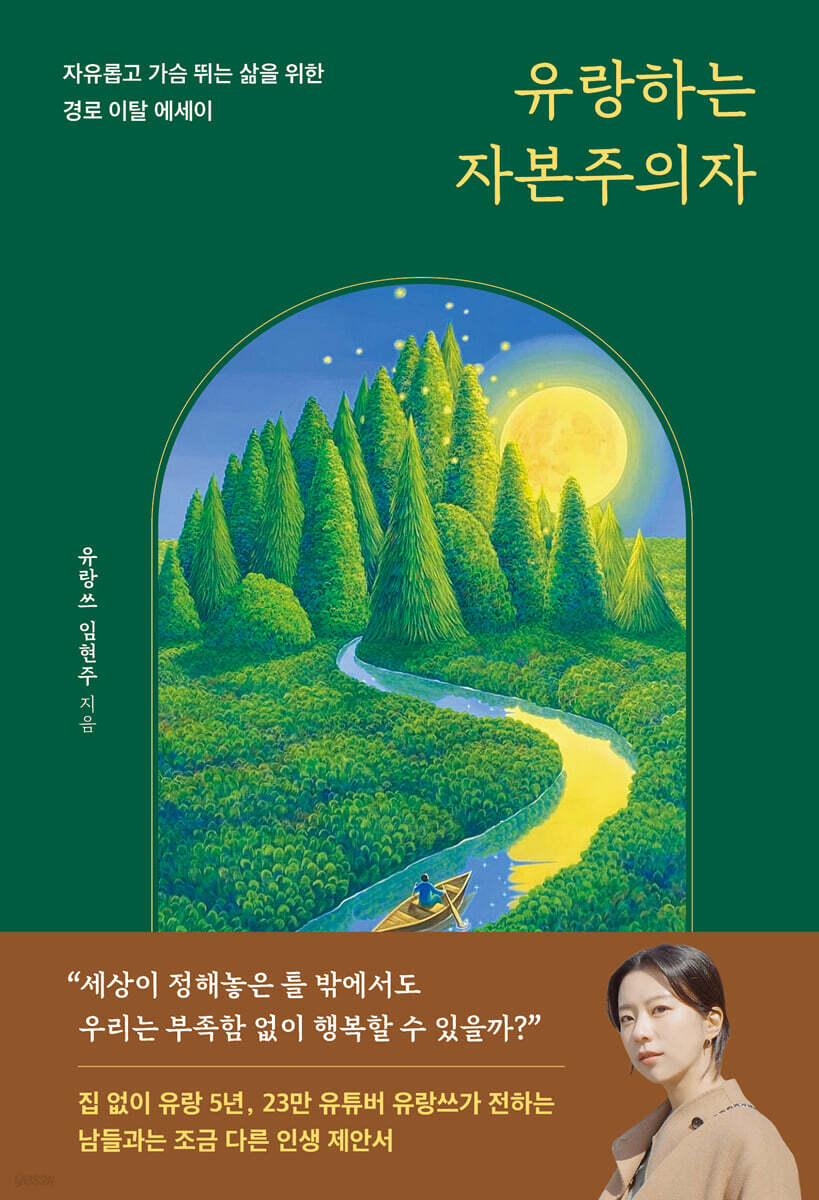
wandering capitalist
 |
Description
Book Introduction
“Even outside the framework set by the world
Can we be happy without lacking anything?
Five years of wandering without a home or job,
A life proposal a little different from others, delivered by YouTuber Yurangsu with 230,000 subscribers.
After one year of marriage, he sold his new home and all his belongings and left.
A newlywed couple, an elementary school teacher and a corporate employee.
Throw away the life cycle set by the world
Leaving only what fits in a 13 kilogram backpack
Throw yourself into the world as a naked baby.
“At thirty, when I could neither live nor die, I left.”
After five years of wandering without a home, I became the complete decision maker of my life.
The first essay by Lim Hyeon-ju, a 30-something couple who traveled the world for five years investing in stocks without a home and who runs the travel YouTube channel Yurangs with 230,000 subscribers and is also a writer, has been published by Nol.
The author worked as a teacher for nine years before embarking on her world travels, and her husband was a human resources manager for a large corporation.
One day, in the first year of their marriage, when they should have been happy, the author was lost in thought after her husband went to bed.
Concluding that the reason she's unhappy with her current life is because she's doing too many things she shouldn't be doing, she decides to start by shedding jobs that feel like clothes that are at least two sizes too small.
A person whose intrinsic motivation has never overcome extrinsic motivation.
That was the author's life until he was thirty.
I studied hard because I was told I had to go to a good university, and I chose teachers' college because I was told that being a teacher was the best thing for a woman.
During my nine years as a teacher, I wandered around without knowing why I was suffering.
Around the age of 30, I realized that for 'adult happiness', eliminating pain was more important than doing enjoyable things, so I quit teaching.
If you quit something you don't want to do, what will you have to give up in return?
The apartment, which was a symbol of living as much as others, and the furnishings that filled the space caught my eye.
After realizing that I had been mistakenly believing that my possessions were me, I started to empty out the things I had bought with money earned from doing things I didn't want to do.
Less than a year after getting married, he sold all his possessions, including his home, furniture, and household items, and put the money into a stock account and left.
I traveled and lived in 60 cities over 5 years.
When profits were good, they stayed in Europe or the Anglo-American region, and when profits were lacking, they stayed in Southeast Asia.
Two years ago, a video titled "Economic Freedom" containing their story achieved 3 million views through algorithms and received attention as it was re-examined in various media outlets such as news, magazines, and radio.
The couple, who had sharply defied Korean society's norms by giving up on their dream of owning a home, living off of investment income rather than labor, and not planning on having children in the future, received both fervent hate comments and cheers.
The freedom to love life again, leaving behind boredom and fear.
I thought that if I went off course, it would be a cliff.
But off the path, there was life, not a cliff.
My life up until now, following what was good in the eyes of others and what was right from the perspective of the majority, was like a life of going with the flow like a dead fish.
I thought I would fall endlessly without a decent job and business card, but in the empty space left behind, only 'my naked self' remained.
The author experiments with his tastes and inclinations without reserve, and is reborn as a fish swimming fiercely against the current.
The belief that today's peaches must be eaten today, and that happiness cannot be postponed like savings for the future, shows that life is full of possibilities without having to endure painful events.
Can we be happy without lacking anything?
Five years of wandering without a home or job,
A life proposal a little different from others, delivered by YouTuber Yurangsu with 230,000 subscribers.
After one year of marriage, he sold his new home and all his belongings and left.
A newlywed couple, an elementary school teacher and a corporate employee.
Throw away the life cycle set by the world
Leaving only what fits in a 13 kilogram backpack
Throw yourself into the world as a naked baby.
“At thirty, when I could neither live nor die, I left.”
After five years of wandering without a home, I became the complete decision maker of my life.
The first essay by Lim Hyeon-ju, a 30-something couple who traveled the world for five years investing in stocks without a home and who runs the travel YouTube channel Yurangs with 230,000 subscribers and is also a writer, has been published by Nol.
The author worked as a teacher for nine years before embarking on her world travels, and her husband was a human resources manager for a large corporation.
One day, in the first year of their marriage, when they should have been happy, the author was lost in thought after her husband went to bed.
Concluding that the reason she's unhappy with her current life is because she's doing too many things she shouldn't be doing, she decides to start by shedding jobs that feel like clothes that are at least two sizes too small.
A person whose intrinsic motivation has never overcome extrinsic motivation.
That was the author's life until he was thirty.
I studied hard because I was told I had to go to a good university, and I chose teachers' college because I was told that being a teacher was the best thing for a woman.
During my nine years as a teacher, I wandered around without knowing why I was suffering.
Around the age of 30, I realized that for 'adult happiness', eliminating pain was more important than doing enjoyable things, so I quit teaching.
If you quit something you don't want to do, what will you have to give up in return?
The apartment, which was a symbol of living as much as others, and the furnishings that filled the space caught my eye.
After realizing that I had been mistakenly believing that my possessions were me, I started to empty out the things I had bought with money earned from doing things I didn't want to do.
Less than a year after getting married, he sold all his possessions, including his home, furniture, and household items, and put the money into a stock account and left.
I traveled and lived in 60 cities over 5 years.
When profits were good, they stayed in Europe or the Anglo-American region, and when profits were lacking, they stayed in Southeast Asia.
Two years ago, a video titled "Economic Freedom" containing their story achieved 3 million views through algorithms and received attention as it was re-examined in various media outlets such as news, magazines, and radio.
The couple, who had sharply defied Korean society's norms by giving up on their dream of owning a home, living off of investment income rather than labor, and not planning on having children in the future, received both fervent hate comments and cheers.
The freedom to love life again, leaving behind boredom and fear.
I thought that if I went off course, it would be a cliff.
But off the path, there was life, not a cliff.
My life up until now, following what was good in the eyes of others and what was right from the perspective of the majority, was like a life of going with the flow like a dead fish.
I thought I would fall endlessly without a decent job and business card, but in the empty space left behind, only 'my naked self' remained.
The author experiments with his tastes and inclinations without reserve, and is reborn as a fish swimming fiercely against the current.
The belief that today's peaches must be eaten today, and that happiness cannot be postponed like savings for the future, shows that life is full of possibilities without having to endure painful events.
- You can preview some of the book's contents.
Preview
index
1.
Only dead fish drift with the current.
Adult happiness
An elementary school teacher with nine years of experience resigns.
The more you empty yourself, the more things fill you up
economic freedom
Have you ever cried because you were happy?
It's okay if you don't have a dream
Immersion conquers fear
To you who are still searching for ‘quitting your job’
Triangle kimbap, bulgogi pizza, and tears
You have gone off course
Why I gave up on the Camino de Santiago
Las Vegas sunshine
If today were the last day of my life
Chapter 2.
The joys and sorrows of making a living
I'm glad it's my fault
Happiness doesn't come from consumption.
Where desire is delayed
The easiest era to make money since Dangun
The history of others, the history of the nation
I was the ugly duckling
Why we call our accommodations home
To love something is
Take out happiness and eat it
Chapter 3.
How to live with others
Even hikikomori need to travel
"You made it!"
The more I am loved, the more confident I become in loving myself.
The relationship between a married couple is a battle of attrition
I picked you
The magic phrase "That could be it"
My eternal X-axis
What Happens When You Shed Your Persona
Chapter 4.
This life is 'real'
Even a dollar pizza is sweet
The moment when dreams become reality
How did I end up here?
A life of moving where your heart leads you
It can't get any better than this
Space creates people
You can't live forever just traveling.
A person with taste
The utopia I want to live in
The bluebird was inside me
Only dead fish drift with the current.
Adult happiness
An elementary school teacher with nine years of experience resigns.
The more you empty yourself, the more things fill you up
economic freedom
Have you ever cried because you were happy?
It's okay if you don't have a dream
Immersion conquers fear
To you who are still searching for ‘quitting your job’
Triangle kimbap, bulgogi pizza, and tears
You have gone off course
Why I gave up on the Camino de Santiago
Las Vegas sunshine
If today were the last day of my life
Chapter 2.
The joys and sorrows of making a living
I'm glad it's my fault
Happiness doesn't come from consumption.
Where desire is delayed
The easiest era to make money since Dangun
The history of others, the history of the nation
I was the ugly duckling
Why we call our accommodations home
To love something is
Take out happiness and eat it
Chapter 3.
How to live with others
Even hikikomori need to travel
"You made it!"
The more I am loved, the more confident I become in loving myself.
The relationship between a married couple is a battle of attrition
I picked you
The magic phrase "That could be it"
My eternal X-axis
What Happens When You Shed Your Persona
Chapter 4.
This life is 'real'
Even a dollar pizza is sweet
The moment when dreams become reality
How did I end up here?
A life of moving where your heart leads you
It can't get any better than this
Space creates people
You can't live forever just traveling.
A person with taste
The utopia I want to live in
The bluebird was inside me
Detailed image

Into the book
Some might say that giving up halfway is the only sure way to failure.
I also know that giving up your career can seem like a complete failure.
But I wanted to prove that the saying that those who give up never become winners is wrong.
I wanted to throw a small pebble at society's cold-hearted view of 'giving up' and its lenient view of 'not giving up.'
Sometimes, I want to tell people who are struggling like me right now that it takes courage to give up at the right time.
---From "Adult Happiness"
Perhaps I, too, may have mistakenly thought that the things surrounding me, as seen in others' eyes, represented who I was, rather than my own 'uniqueness' or 'living true to myself.'
In a society where the desire for expensive items, the need for more and better things, is recognized, wasn't my vanity, the vanity of possessing them, forcing me to do things I didn't want to do, eating away at me? How many of the items in this house I live in are truly my own, chosen solely for me? (Omitted)
From that day on, my husband and I got rid of the belongings that filled our new home one by one.
I listed my refrigerator, washing machine, and air conditioner, which I had purchased less than a year ago, on a second-hand goods website for about half their purchase price. Luckily, I found a buyer who wanted to buy all the large appliances at once, so I was able to get rid of the large items quickly.
I shared the miscellaneous items that were difficult to sell on their own by posting on local cafes or selling them for cheap, in units of 1,000 or 2,000 won. It was a moment when I personally experienced the saying that things are expensive when you buy them, but become worthless when you sell them.
(syncopation)
In Buddhism, hair is considered to symbolize the secular world and its various afflictions, so monks shave their heads to focus on their practice.
In Buddhism, hair symbolizes the things surrounding me.
As I disposed of my belongings one by one, I peeled away all the layers of the shell that surrounded me and was left with only the seed of my 'whole self'. I felt an inexplicable sense of exhilaration and a small hope welled up in my heart.
---From "Things that are filled the more they are emptied"
Perhaps I knew it from the time I was a young twenty-year-old private tutor teaching rich kids.
The fact that I wouldn't be able to live the free life I wanted with just my part-time job wages or monthly salary.
Was that why?
While my friends were putting the money they earned from tutoring or part-time jobs into bank deposits, I always chose to subscribe to aggressive investment products.
The product I signed up for at the time was a high-return, high-risk fund. That fund, which was my first investment in life, ended in a magical loss, with 5 million won becoming 2 million won in just 6 months.
A 60 percent loss was enough of an investment failure to make family and friends laugh at it for years.
Losing 3 million won as a student was quite a large sum, but strangely enough, I didn't mind.
It was a huge twist that a frugal college student who would feel bad about losing even a mere ten thousand won in everyday life didn't feel bad or upset about losing three million won in stocks.
It was a reckless time when I would say "It's your fault" rather than "It's my fault" for everything, but I never regretted my choice to invest rather than save, nor did I feel any resentment toward the bank employee who recommended the fund.
On the contrary, this failure served as a lesson and only increased my desire to make a profit next time.
Even if I lose money now, my determination to make meaningful profits someday continued even after I entered the workforce.
---From "Economic Freedom"
“Only dead fish go with the current.”
This is a sentence that British author Malcolm Muggeridge often quoted.
Just as a dead fish floats with the waves, my life up until now has been one of simply following where people go.
As I come out of the water against the current, I finally realize that I am truly alive.
It's like becoming a fish that swims on its own toward where it wants to go, rather than being guided by the waves.
I also know that giving up your career can seem like a complete failure.
But I wanted to prove that the saying that those who give up never become winners is wrong.
I wanted to throw a small pebble at society's cold-hearted view of 'giving up' and its lenient view of 'not giving up.'
Sometimes, I want to tell people who are struggling like me right now that it takes courage to give up at the right time.
---From "Adult Happiness"
Perhaps I, too, may have mistakenly thought that the things surrounding me, as seen in others' eyes, represented who I was, rather than my own 'uniqueness' or 'living true to myself.'
In a society where the desire for expensive items, the need for more and better things, is recognized, wasn't my vanity, the vanity of possessing them, forcing me to do things I didn't want to do, eating away at me? How many of the items in this house I live in are truly my own, chosen solely for me? (Omitted)
From that day on, my husband and I got rid of the belongings that filled our new home one by one.
I listed my refrigerator, washing machine, and air conditioner, which I had purchased less than a year ago, on a second-hand goods website for about half their purchase price. Luckily, I found a buyer who wanted to buy all the large appliances at once, so I was able to get rid of the large items quickly.
I shared the miscellaneous items that were difficult to sell on their own by posting on local cafes or selling them for cheap, in units of 1,000 or 2,000 won. It was a moment when I personally experienced the saying that things are expensive when you buy them, but become worthless when you sell them.
(syncopation)
In Buddhism, hair is considered to symbolize the secular world and its various afflictions, so monks shave their heads to focus on their practice.
In Buddhism, hair symbolizes the things surrounding me.
As I disposed of my belongings one by one, I peeled away all the layers of the shell that surrounded me and was left with only the seed of my 'whole self'. I felt an inexplicable sense of exhilaration and a small hope welled up in my heart.
---From "Things that are filled the more they are emptied"
Perhaps I knew it from the time I was a young twenty-year-old private tutor teaching rich kids.
The fact that I wouldn't be able to live the free life I wanted with just my part-time job wages or monthly salary.
Was that why?
While my friends were putting the money they earned from tutoring or part-time jobs into bank deposits, I always chose to subscribe to aggressive investment products.
The product I signed up for at the time was a high-return, high-risk fund. That fund, which was my first investment in life, ended in a magical loss, with 5 million won becoming 2 million won in just 6 months.
A 60 percent loss was enough of an investment failure to make family and friends laugh at it for years.
Losing 3 million won as a student was quite a large sum, but strangely enough, I didn't mind.
It was a huge twist that a frugal college student who would feel bad about losing even a mere ten thousand won in everyday life didn't feel bad or upset about losing three million won in stocks.
It was a reckless time when I would say "It's your fault" rather than "It's my fault" for everything, but I never regretted my choice to invest rather than save, nor did I feel any resentment toward the bank employee who recommended the fund.
On the contrary, this failure served as a lesson and only increased my desire to make a profit next time.
Even if I lose money now, my determination to make meaningful profits someday continued even after I entered the workforce.
---From "Economic Freedom"
“Only dead fish go with the current.”
This is a sentence that British author Malcolm Muggeridge often quoted.
Just as a dead fish floats with the waves, my life up until now has been one of simply following where people go.
As I come out of the water against the current, I finally realize that I am truly alive.
It's like becoming a fish that swims on its own toward where it wants to go, rather than being guided by the waves.
---From "It's Okay Not to Have a Dream"
Publisher's Review
“Some people said it was gambling, but I believed it.
“I am happy when I devote my time and soul entirely to myself.”
"The Wandering Capitalist" contains an experiment in life that is only possible under capitalism, and that only capitalism can provide.
The author lived off of investment returns rather than labor, and spent a long period of hiatus and exploration trying to figure out what he was good at.
And I realized that when I devote my soul and time entirely to myself, I can live a richer life, or a happier life even if I don't earn more.
The goal these couple set for themselves, giving up a steady salary, was not early retirement from work forever.
It was a seemingly impossible goal: to happily pursue a career that suited me and create more wealth through it.
People often say that you can't have everything you want.
If you want to achieve your dreams, you have to give up some income, and if you want to achieve something, you have to give up some freedom in the process of achieving it, right?
But to the author, that proposition came as a question.
I thought the answer came from only going one way, so I set out to find a descriptive answer on my own, rather than a multiple choice one.
Retirement gave me freedom of time.
And selling the house gave me some capital.
Traveling requires time and money, but it doesn't require a fixed home.
The author believes that thanks to this, he now has the freedom to take on the challenges he wants to pursue.
Life is a journey that you create according to your choices.
After leaving, I realized that the trip was more of a concentrated version of capitalism than a romantic one.
Travel was about buying time with money, and every moment was an economic choice.
The author ultimately concludes that money is 'mind'.
Money should be spent according to one's deepest desires rather than external factors, and there is an essence to life that does not change regardless of income.
So, regardless of whether I was financially well off or not, I quit my painful job, bought the food I really wanted to eat, and didn't spend money to please other people's opinions.
In the author's view, the first habit we need to develop in modern society is to be able to intelligently judge whether a certain consumption makes us happy or empty.
Happiness develops little by little, like climbing stairs day by day.
Giving yourself meaning in your achievements
It took the author nearly ten years of contemplation to leave teaching, which he considered a lifelong career, but the feeling he had when he quit was surprisingly 'excited.'
The excitement of finally being able to try something new rather than something boring.
The author reminisces about the days when he quit his job and had nothing else to do, so he wrote on his blog every day, and recalls the pure sense of accomplishment and self-efficacy that such pointless writing gave him.
And then he realizes what emotions he needed while he was dissatisfied with his work life.
That feeling was 'the feeling of taking on new challenges and improving little by little every day.'
The human brain is delicate, and performing the same level of intensity mission every day does not release dopamine.
Dopamine is secreted only when you can find different meaning in each challenge that changes little by little each day.
"The Wandering Capitalist" says that happiness is not a state of "complete satisfaction," but rather a feeling of renewed fulfillment each day, and shows how to apply that attitude to life.
Although Yurangseu delivered a colorful world from Yeongdeok and Gunsan some months, Malaysia some months, and Bacalar, Mexico some months, YouTube had a negative profit for three years.
However, I have never closed or taken a break from a channel that was not generating revenue.
When asked if they are happier now, when everything is on track, compared to the uncertain times when things were uncertain, they answer like this.
I remember that even back then, when I was struggling to climb the stairs without being able to see even an inch ahead of me, happiness definitely existed, and that happiness was by no means small or shabby compared to now.
The life depicted in "The Wandering Capitalist" may seem unconventional on the surface, but the important thing is that this journey, which involves choosing to constantly challenge oneself despite the uncertainty, reveals the essence of life.
The meaning of life does not come from conditions or reputations that require others' approval to be recognized, but from personal accomplishments that release healthy dopamine in the brain.
"The Wandering Capitalist" calmly tells us that anyone can be happy because they determine their own standards of happiness, and that living differently from others doesn't mean you'll perish, but rather, you can live better.
“I thought if I went off course it would be a cliff.
But off the beaten path, there was real life.”
We live in a world where studying, getting a job, getting married, buying a home, and raising children are no longer the right answers for everyone.
The number of people in their 20s taking the painting technician exam has doubled over the past four years, and by 2022, more than half of all entrepreneurs were in their 20s or 30s.
Teenagers who drop out of high school are beginning to divide into two groups: those with top grades who focus on the college entrance exam and those who prepare to start their own business by accumulating capital through delivery services.
The author shows through his own life experiments that there is no single right answer in life, but that anything can be the right answer.
There are as many correct answers as there are people alive in the world.
We often forget that more than we think in life, it's a choice.
If you know that every moment of your life is made up of choices, if you have the courage to explore your naked self and break free from the world's standards, you can make the answers you choose yourselves, rather than the answers dictated by society, the right answer.
Life is beautiful when you change the direction of your life yourself instead of leaving the steering wheel to others.
Freedom wasn't just about having more money and time, it was about having the autonomy to do what you wanted.
"The Wandering Capitalist" is an essay filled with the hope that everyone will live a life driven by internal motivation rather than being driven by external motives, and that everyone will live by taking the initiative rather than choosing the future by making no choices out of inertia.
“I am happy when I devote my time and soul entirely to myself.”
"The Wandering Capitalist" contains an experiment in life that is only possible under capitalism, and that only capitalism can provide.
The author lived off of investment returns rather than labor, and spent a long period of hiatus and exploration trying to figure out what he was good at.
And I realized that when I devote my soul and time entirely to myself, I can live a richer life, or a happier life even if I don't earn more.
The goal these couple set for themselves, giving up a steady salary, was not early retirement from work forever.
It was a seemingly impossible goal: to happily pursue a career that suited me and create more wealth through it.
People often say that you can't have everything you want.
If you want to achieve your dreams, you have to give up some income, and if you want to achieve something, you have to give up some freedom in the process of achieving it, right?
But to the author, that proposition came as a question.
I thought the answer came from only going one way, so I set out to find a descriptive answer on my own, rather than a multiple choice one.
Retirement gave me freedom of time.
And selling the house gave me some capital.
Traveling requires time and money, but it doesn't require a fixed home.
The author believes that thanks to this, he now has the freedom to take on the challenges he wants to pursue.
Life is a journey that you create according to your choices.
After leaving, I realized that the trip was more of a concentrated version of capitalism than a romantic one.
Travel was about buying time with money, and every moment was an economic choice.
The author ultimately concludes that money is 'mind'.
Money should be spent according to one's deepest desires rather than external factors, and there is an essence to life that does not change regardless of income.
So, regardless of whether I was financially well off or not, I quit my painful job, bought the food I really wanted to eat, and didn't spend money to please other people's opinions.
In the author's view, the first habit we need to develop in modern society is to be able to intelligently judge whether a certain consumption makes us happy or empty.
Happiness develops little by little, like climbing stairs day by day.
Giving yourself meaning in your achievements
It took the author nearly ten years of contemplation to leave teaching, which he considered a lifelong career, but the feeling he had when he quit was surprisingly 'excited.'
The excitement of finally being able to try something new rather than something boring.
The author reminisces about the days when he quit his job and had nothing else to do, so he wrote on his blog every day, and recalls the pure sense of accomplishment and self-efficacy that such pointless writing gave him.
And then he realizes what emotions he needed while he was dissatisfied with his work life.
That feeling was 'the feeling of taking on new challenges and improving little by little every day.'
The human brain is delicate, and performing the same level of intensity mission every day does not release dopamine.
Dopamine is secreted only when you can find different meaning in each challenge that changes little by little each day.
"The Wandering Capitalist" says that happiness is not a state of "complete satisfaction," but rather a feeling of renewed fulfillment each day, and shows how to apply that attitude to life.
Although Yurangseu delivered a colorful world from Yeongdeok and Gunsan some months, Malaysia some months, and Bacalar, Mexico some months, YouTube had a negative profit for three years.
However, I have never closed or taken a break from a channel that was not generating revenue.
When asked if they are happier now, when everything is on track, compared to the uncertain times when things were uncertain, they answer like this.
I remember that even back then, when I was struggling to climb the stairs without being able to see even an inch ahead of me, happiness definitely existed, and that happiness was by no means small or shabby compared to now.
The life depicted in "The Wandering Capitalist" may seem unconventional on the surface, but the important thing is that this journey, which involves choosing to constantly challenge oneself despite the uncertainty, reveals the essence of life.
The meaning of life does not come from conditions or reputations that require others' approval to be recognized, but from personal accomplishments that release healthy dopamine in the brain.
"The Wandering Capitalist" calmly tells us that anyone can be happy because they determine their own standards of happiness, and that living differently from others doesn't mean you'll perish, but rather, you can live better.
“I thought if I went off course it would be a cliff.
But off the beaten path, there was real life.”
We live in a world where studying, getting a job, getting married, buying a home, and raising children are no longer the right answers for everyone.
The number of people in their 20s taking the painting technician exam has doubled over the past four years, and by 2022, more than half of all entrepreneurs were in their 20s or 30s.
Teenagers who drop out of high school are beginning to divide into two groups: those with top grades who focus on the college entrance exam and those who prepare to start their own business by accumulating capital through delivery services.
The author shows through his own life experiments that there is no single right answer in life, but that anything can be the right answer.
There are as many correct answers as there are people alive in the world.
We often forget that more than we think in life, it's a choice.
If you know that every moment of your life is made up of choices, if you have the courage to explore your naked self and break free from the world's standards, you can make the answers you choose yourselves, rather than the answers dictated by society, the right answer.
Life is beautiful when you change the direction of your life yourself instead of leaving the steering wheel to others.
Freedom wasn't just about having more money and time, it was about having the autonomy to do what you wanted.
"The Wandering Capitalist" is an essay filled with the hope that everyone will live a life driven by internal motivation rather than being driven by external motives, and that everyone will live by taking the initiative rather than choosing the future by making no choices out of inertia.
GOODS SPECIFICS
- Date of issue: October 23, 2024
- Page count, weight, size: 256 pages | 478g | 140*205*20mm
- ISBN13: 9791130648675
- ISBN10: 1130648672
You may also like
카테고리
korean


korean

![GQ KOREA Mark (Monthly): December [2025]](http://librairie.coreenne.fr/cdn/shop/files/8ef265dbbfbf186523ed75ba7319009d.jpg?v=1765340328&width=3840)


