

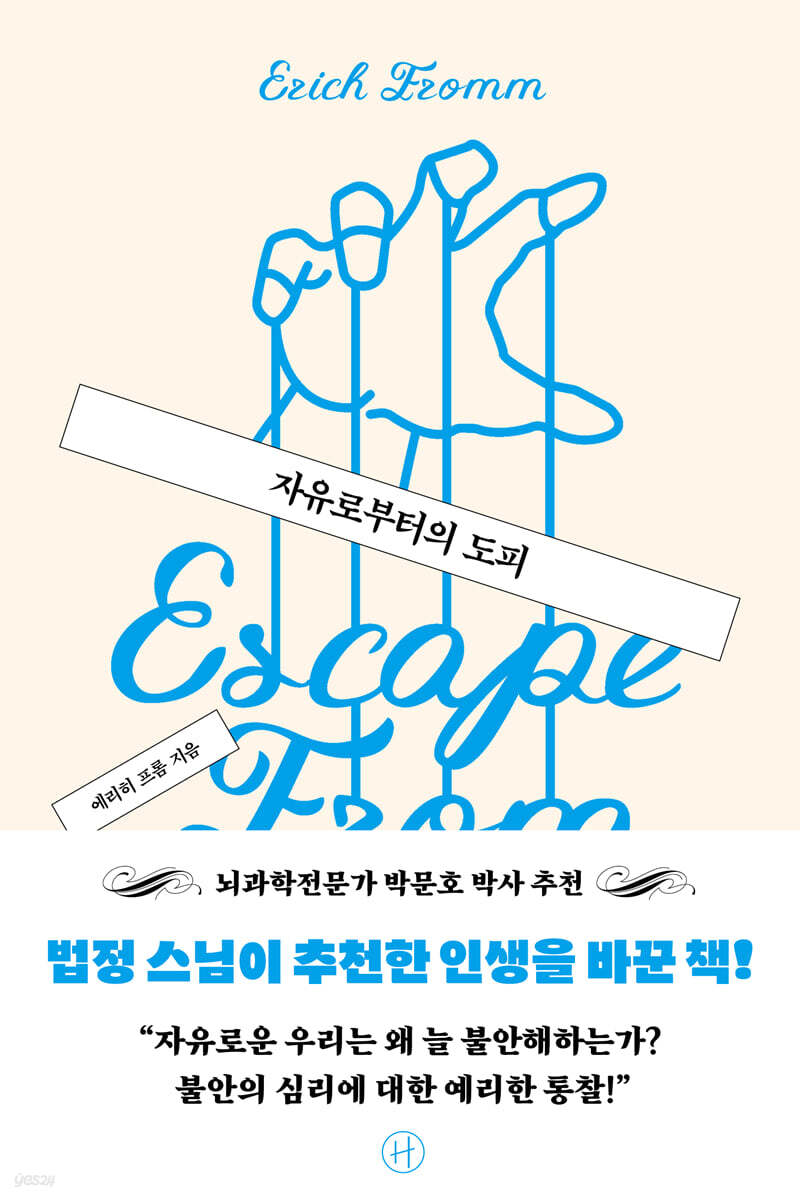
Escape from freedom
 |
Description
Book Introduction
A book that has risen from a classic of its time to a modern classic!
Meet Erich Fromm's masterpiece, which illuminates the mechanisms of self-loss, anxiety, and escape.
If humanity cannot assume the responsibility inherent in freedom, it will resort to authoritarianism.
This is the central idea of Erich Fromm's masterpiece, "Escape from Freedom," considered one of the most outstanding thinkers of our time.
This book is as timely today as it was when it was published in 1941.
No book has ever offered such profound insight into the nature of modern freedom, which isolates and renders individuals powerless, and the causes of the rise of authoritarian regimes.
In this book, Fromm, drawing on the insights of psychoanalysis, analyzes the ills of modern civilization, which are evidenced by its flight from freedom and willing submission to totalitarian rule.
Meet Erich Fromm's masterpiece, which illuminates the mechanisms of self-loss, anxiety, and escape.
If humanity cannot assume the responsibility inherent in freedom, it will resort to authoritarianism.
This is the central idea of Erich Fromm's masterpiece, "Escape from Freedom," considered one of the most outstanding thinkers of our time.
This book is as timely today as it was when it was published in 1941.
No book has ever offered such profound insight into the nature of modern freedom, which isolates and renders individuals powerless, and the causes of the rise of authoritarian regimes.
In this book, Fromm, drawing on the insights of psychoanalysis, analyzes the ills of modern civilization, which are evidenced by its flight from freedom and willing submission to totalitarian rule.
- You can preview some of the book's contents.
Preview
index
Preface to the 1965 edition
Preface to the first edition
Chapter 1 Freedom—A Psychological Problem?
Chapter 2: The Emergence of the Individual and the Polysemy of Freedom
Chapter 3: Freedom in the Reformation Era
1.
Medieval setting and Renaissance
2.
Reformation era
Chapter 4: Two Aspects of Freedom from a Modern Perspective
Chapter 5: The Mechanism of Escape
1.
authoritarianism
2.
destructiveness
3.
automaton-like compliance
Chapter 6: The Psychology of Nazism
Chapter 7 Freedom and Democracy
1.
The illusion of individuality
2.
Freedom and spontaneity
Appendix: Personality and Social Processes
main
Translator's Note
Search
Preface to the first edition
Chapter 1 Freedom—A Psychological Problem?
Chapter 2: The Emergence of the Individual and the Polysemy of Freedom
Chapter 3: Freedom in the Reformation Era
1.
Medieval setting and Renaissance
2.
Reformation era
Chapter 4: Two Aspects of Freedom from a Modern Perspective
Chapter 5: The Mechanism of Escape
1.
authoritarianism
2.
destructiveness
3.
automaton-like compliance
Chapter 6: The Psychology of Nazism
Chapter 7 Freedom and Democracy
1.
The illusion of individuality
2.
Freedom and spontaneity
Appendix: Personality and Social Processes
main
Translator's Note
Search
Detailed image

Publisher's Review
Escape from Freedom: A Precise and Fluent Translation, Now in a New Design
Erich Fromm, a philosopher and psychologist who is beloved by countless readers for his works such as To Have or to Be and The Art of Loving, has been translated accurately and fluently into English by translator Seok-hee Kim.
As is widely known, "Escape from Freedom" is Erich Fromm's masterpiece, published in over 30 countries and selling over 5 million copies worldwide.
The first official Korean-language contracted edition, the translation of 『Escape from Freedom』 by Humanist Publishing, which was first published in July 2012, was praised for best capturing the voice and spirit of Erich Fromm and has become a steady seller in the humanities field.
This book is a re-cover edition of the previously published translation of "Escape from Freedom," with a new format and cover design. It aims to present a new version of this classic of our time, beloved for 80 years, to readers.
A powerful insight into the mental state of modern people
"Escape from Freedom" is a book that analyzes the phenomenon of human anxiety that arose from the collapse of medieval society.
Although medieval society was full of dangers, people felt protected and safe within it.
After hundreds of years of hard work, humans have succeeded in amassing material wealth they never dreamed of.
Humanity has built democratic societies throughout the world and has recently succeeded in defending itself against new attempts at totalitarianism.
However, what Erich Fromm, the author of “Escape from Freedom,” analyzes and shows is that modern people are still anxious.
Anxious humans are tempted to surrender their freedom to all sorts of tyrants, or to become small cogs in a machine, living in luxury, but becoming automatons rather than free beings.
Two roads
Freedom brought independence and rationality to modern people, but on the other hand, it isolated the individual and made him an anxious and helpless being.
In that world, everyone and everything was instrumentalized, and he became part of a machine he had created with his own hands.
He thinks, feels, and wants what he believes he should think, feel, and want.
In this very process he loses his own self, but all true security of a free individual must be based on that self.
To escape isolation, an individual must either escape the heavy burden of freedom and return to dependence and submission, or move toward the realization of positive freedom based on human independence and individuality.
By one of these paths he can advance to 'positive freedom', can relate naturally to the outside world, truly expressing his emotional, sensory and intellectual capacities in love and work, and thus become one again with humanity, nature and himself, without giving up the independence and originality of his individual self.
Another path open to him is to step back, to give up his freedom, and to try to overcome his loneliness by eliminating the gap that has arisen between his individual self and the world.
This second path does not reintegrate him with the world in the same way as before he was united as an 'individual'.
Because the separation between him and the world is something that can never be reversed.
This second way is the way out of an unbearable situation.
If that situation continues for a long time, it becomes impossible to survive, so you escape from it.
What characterizes this second path, therefore, is its obsessive nature.
Another characteristic is the complete abandonment of individuality and the true nature of the self.
Humans are no longer the masters of the world they created.
On the contrary, the world created by man became his master.
Approaching the question of freedom from a psychological perspective
The psychological position that Fromm takes is also called neo-Freudianism or left Freudianism.
Simply put, neo-Freudianism is sociologicalized Freudianism.
Freud assumed libido to be a fundamental drive rooted in biology and sexual desire, but neo-Freudianism overcomes Freud's pansexualism, which covers everything up as sexuality, by assuming that it is a drive or desire that is formed within social human relationships.
Through this overcoming, it was possible to fully utilize Freud's brilliant insight while also overcoming Freud's social reactionary nature.
What is the force that moves history?
According to Fromm, it is socio-economic conditions, ideology, and finally 'social character'.
The great appeal of this book lies in its new presentation of the concept of social character.
This is discussed in detail in the appendix, 'Personality and Social Process', but please note that it cites three giant thinkers: Marx, Max Weber, and Freud.
Needless to say, it was Marx who thought of socio-economic factors as the ultimate or especially powerful factor driving history, it was Weber who thought of ideological factors, and it was Freud who thought of the fundamental drives deep within human beings (from which the concepts of individuality and social character arise).
Fromm does not assert that any one of these is the decisive final factor.
But what Fromm particularly wanted to draw attention to was the role of social character in history, along with socio-economic factors and ideology.
Analyzing the Psychological Aspects of Freedom
The point of the problem is that since the Renaissance and the Reformation, the principle of freedom, which has liberated humans from traditional bondage, and the negative aspects that have left humans feeling lonely and helpless have been intertwined.
As a result, humans, unable to bear the burden of freedom, actively seek totalitarian ideologies like Nazism.
So, where freedom becomes a heavy burden, even in democratic societies, there exist psychological hotbeds of Nazism and fascism.
What Fromm is saying about the fate of modern man is something that even we, who live in a society that is neither sufficiently democratic nor sufficiently mechanistic, can fully understand.
In a society that is not sufficiently democratic, the 'democracy' imposed from above will become more uniform, and in a society that is not sufficiently mechanistic, the barely functioning machines will emit more unpleasant toxins.
The hypnotic state of modern people, especially promoted by the mass media, is a common phenomenon regardless of East or West.
Therefore, the question of whether freedom is given and whether freedom can be used meaningfully naturally becomes a major challenge.
Erich Fromm, a philosopher and psychologist who is beloved by countless readers for his works such as To Have or to Be and The Art of Loving, has been translated accurately and fluently into English by translator Seok-hee Kim.
As is widely known, "Escape from Freedom" is Erich Fromm's masterpiece, published in over 30 countries and selling over 5 million copies worldwide.
The first official Korean-language contracted edition, the translation of 『Escape from Freedom』 by Humanist Publishing, which was first published in July 2012, was praised for best capturing the voice and spirit of Erich Fromm and has become a steady seller in the humanities field.
This book is a re-cover edition of the previously published translation of "Escape from Freedom," with a new format and cover design. It aims to present a new version of this classic of our time, beloved for 80 years, to readers.
A powerful insight into the mental state of modern people
"Escape from Freedom" is a book that analyzes the phenomenon of human anxiety that arose from the collapse of medieval society.
Although medieval society was full of dangers, people felt protected and safe within it.
After hundreds of years of hard work, humans have succeeded in amassing material wealth they never dreamed of.
Humanity has built democratic societies throughout the world and has recently succeeded in defending itself against new attempts at totalitarianism.
However, what Erich Fromm, the author of “Escape from Freedom,” analyzes and shows is that modern people are still anxious.
Anxious humans are tempted to surrender their freedom to all sorts of tyrants, or to become small cogs in a machine, living in luxury, but becoming automatons rather than free beings.
Two roads
Freedom brought independence and rationality to modern people, but on the other hand, it isolated the individual and made him an anxious and helpless being.
In that world, everyone and everything was instrumentalized, and he became part of a machine he had created with his own hands.
He thinks, feels, and wants what he believes he should think, feel, and want.
In this very process he loses his own self, but all true security of a free individual must be based on that self.
To escape isolation, an individual must either escape the heavy burden of freedom and return to dependence and submission, or move toward the realization of positive freedom based on human independence and individuality.
By one of these paths he can advance to 'positive freedom', can relate naturally to the outside world, truly expressing his emotional, sensory and intellectual capacities in love and work, and thus become one again with humanity, nature and himself, without giving up the independence and originality of his individual self.
Another path open to him is to step back, to give up his freedom, and to try to overcome his loneliness by eliminating the gap that has arisen between his individual self and the world.
This second path does not reintegrate him with the world in the same way as before he was united as an 'individual'.
Because the separation between him and the world is something that can never be reversed.
This second way is the way out of an unbearable situation.
If that situation continues for a long time, it becomes impossible to survive, so you escape from it.
What characterizes this second path, therefore, is its obsessive nature.
Another characteristic is the complete abandonment of individuality and the true nature of the self.
Humans are no longer the masters of the world they created.
On the contrary, the world created by man became his master.
Approaching the question of freedom from a psychological perspective
The psychological position that Fromm takes is also called neo-Freudianism or left Freudianism.
Simply put, neo-Freudianism is sociologicalized Freudianism.
Freud assumed libido to be a fundamental drive rooted in biology and sexual desire, but neo-Freudianism overcomes Freud's pansexualism, which covers everything up as sexuality, by assuming that it is a drive or desire that is formed within social human relationships.
Through this overcoming, it was possible to fully utilize Freud's brilliant insight while also overcoming Freud's social reactionary nature.
What is the force that moves history?
According to Fromm, it is socio-economic conditions, ideology, and finally 'social character'.
The great appeal of this book lies in its new presentation of the concept of social character.
This is discussed in detail in the appendix, 'Personality and Social Process', but please note that it cites three giant thinkers: Marx, Max Weber, and Freud.
Needless to say, it was Marx who thought of socio-economic factors as the ultimate or especially powerful factor driving history, it was Weber who thought of ideological factors, and it was Freud who thought of the fundamental drives deep within human beings (from which the concepts of individuality and social character arise).
Fromm does not assert that any one of these is the decisive final factor.
But what Fromm particularly wanted to draw attention to was the role of social character in history, along with socio-economic factors and ideology.
Analyzing the Psychological Aspects of Freedom
The point of the problem is that since the Renaissance and the Reformation, the principle of freedom, which has liberated humans from traditional bondage, and the negative aspects that have left humans feeling lonely and helpless have been intertwined.
As a result, humans, unable to bear the burden of freedom, actively seek totalitarian ideologies like Nazism.
So, where freedom becomes a heavy burden, even in democratic societies, there exist psychological hotbeds of Nazism and fascism.
What Fromm is saying about the fate of modern man is something that even we, who live in a society that is neither sufficiently democratic nor sufficiently mechanistic, can fully understand.
In a society that is not sufficiently democratic, the 'democracy' imposed from above will become more uniform, and in a society that is not sufficiently mechanistic, the barely functioning machines will emit more unpleasant toxins.
The hypnotic state of modern people, especially promoted by the mass media, is a common phenomenon regardless of East or West.
Therefore, the question of whether freedom is given and whether freedom can be used meaningfully naturally becomes a major challenge.
GOODS SPECIFICS
- Date of issue: September 7, 2020
- Page count, weight, size: 348 pages | 438g | 140*210*30mm
- ISBN13: 9791160804751
- ISBN10: 1160804753
You may also like
카테고리
korean


korean

![ELLE 엘르 스페셜 에디션 A형 : 12월 [2025]](http://librairie.coreenne.fr/cdn/shop/files/b8e27a3de6c9538896439686c6b0e8fb.jpg?v=1766436872&width=3840)


