

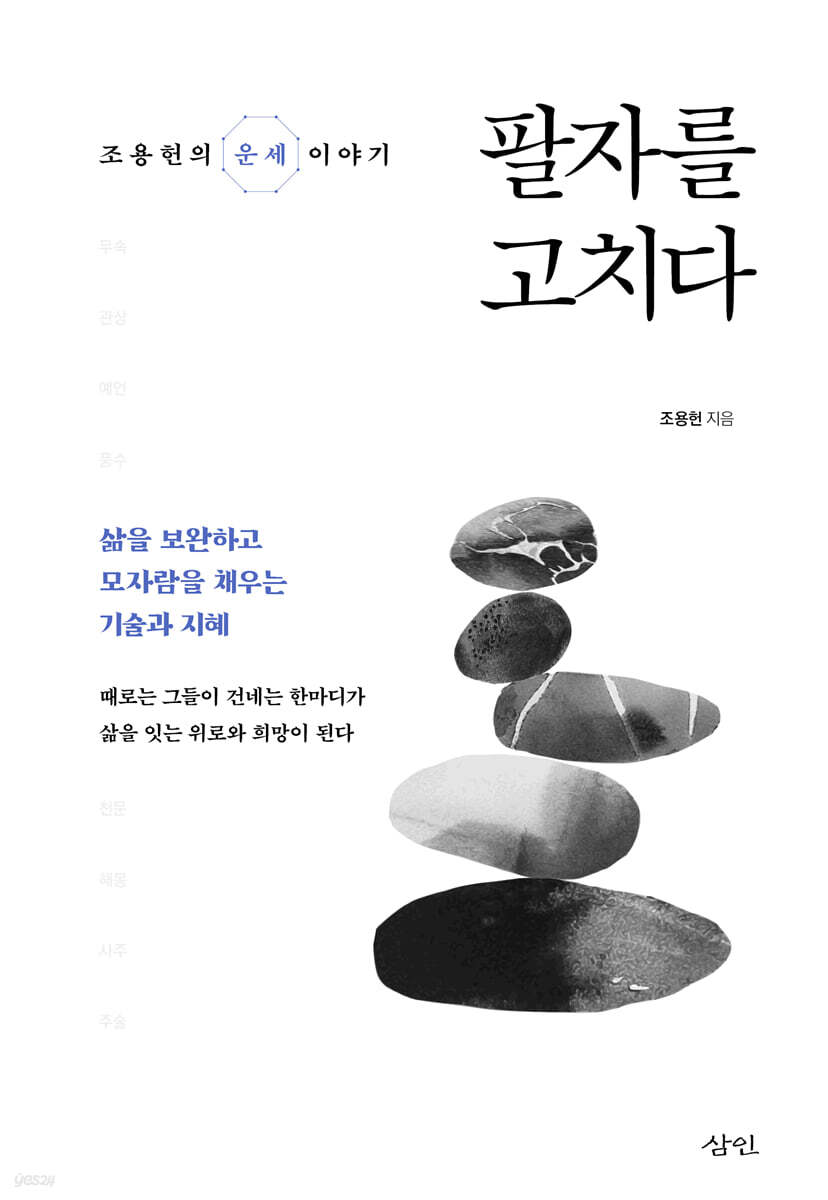
Change one's fortune
 |
Description
Book Introduction
Fortune telling, four pillars of destiny, astrology, tarot, physiognomy, compatibility, dream interpretation, shamanism, prophecy, sorcery, feng shui, Taoism, talismans…
A secret story of the world that I don't particularly believe in, but can't ignore.
Everything about "Superstition" explained from a public perspective by Kang Ho-dong, a scholar of Oriental medicine, Yong-heon Cho.
The 'new generation' of the past placed importance on 'blood type' as a standard for judging other people's personality and tendencies.
Asking and answering “What’s your blood type?” on a blind date or matchmaking was a kind of rite of passage, and neither the asker nor the answerer considered it rude.
Blood type was used as a tool to understand the reality of the uncertain situation of a stranger.
In the past few years, 'MBTI' has replaced 'blood type' in the past.
But it seems like MBTI is also gradually fading away.
Recently, there has been a growing trend of using tarot cards, fortune telling, physiognomy, constellations, and compatibility as tools to obtain hints about unclear situations and objects.
The shabby back alley fortune tellers, once known only through word of mouth, have infiltrated smart devices and are now attracting the MZ generation by offering cost-effective 'bokchae' (fortune telling).
The industry estimates the fortune-telling market size to be in the trillions.
So why is the most modern generation being drawn into a realm dismissed as "superstition"? Kang Ho-dong, a scholar of Oriental medicine, points to two reasons.
First, the fortune-telling market offers tailored answers to the small questions of everyday life that science and religion cannot answer.
The second reason is that the younger generation today is faced with the reality of each person living for themselves (in the absence of a social system, each individual finds their own way to survive).
Science is too dry and religion too distant to address the uncertain future and pressing realities we face.
I don't see any adults I can trust and follow.
Sometimes public systems become obstacles to realizing the fragmented needs and desires of individuals.
At this time, one cannot help but be interested in the immediate answers from the fortune-telling market that offer solutions like a pair of tongs.
Issues of reliability and effectiveness are secondary.
In a dead end situation, a word from a tarot reader can be a comfort and a source of hope.
『Changing Fortune: Jo Yong-heon's Fortune-telling Story』 is a book about traditional beliefs, or 'superstitions,' such as fortune-telling, shamanism, feng shui, prophecy, physiognomy, dream interpretation, compatibility, sorcery, and talismans.
It clearly addresses such issues as how Taoist priests make prophecies, how shamans' fortune-telling methods work, whether physiognomy and palmistry actually determine a person's fate, whether our birth date and time are recorded in our horoscopes, whether there actually are good and bad fortunes that bring prosperity and ruin to families and individuals, and whether dreams truly foreshadow the future.
Some may criticize fortune telling as unscientific and irrational, but even such people would be reluctant to move into an apartment built on a torn-down cemetery.
Whether we know it or not, shamanism and superstition have permeated our perceptions and lives as we enjoy modern civilization, and inexplicable things happen in life.
This book explains why mysterious situations and phenomena occur and discusses how the public should approach 'superstitions'.
Not only will it satisfy your curiosity about the world beyond the realm of reality, but it will also provide insight into the perspectives and criteria by which wise and intelligent people view the world and judge phenomena.
A secret story of the world that I don't particularly believe in, but can't ignore.
Everything about "Superstition" explained from a public perspective by Kang Ho-dong, a scholar of Oriental medicine, Yong-heon Cho.
The 'new generation' of the past placed importance on 'blood type' as a standard for judging other people's personality and tendencies.
Asking and answering “What’s your blood type?” on a blind date or matchmaking was a kind of rite of passage, and neither the asker nor the answerer considered it rude.
Blood type was used as a tool to understand the reality of the uncertain situation of a stranger.
In the past few years, 'MBTI' has replaced 'blood type' in the past.
But it seems like MBTI is also gradually fading away.
Recently, there has been a growing trend of using tarot cards, fortune telling, physiognomy, constellations, and compatibility as tools to obtain hints about unclear situations and objects.
The shabby back alley fortune tellers, once known only through word of mouth, have infiltrated smart devices and are now attracting the MZ generation by offering cost-effective 'bokchae' (fortune telling).
The industry estimates the fortune-telling market size to be in the trillions.
So why is the most modern generation being drawn into a realm dismissed as "superstition"? Kang Ho-dong, a scholar of Oriental medicine, points to two reasons.
First, the fortune-telling market offers tailored answers to the small questions of everyday life that science and religion cannot answer.
The second reason is that the younger generation today is faced with the reality of each person living for themselves (in the absence of a social system, each individual finds their own way to survive).
Science is too dry and religion too distant to address the uncertain future and pressing realities we face.
I don't see any adults I can trust and follow.
Sometimes public systems become obstacles to realizing the fragmented needs and desires of individuals.
At this time, one cannot help but be interested in the immediate answers from the fortune-telling market that offer solutions like a pair of tongs.
Issues of reliability and effectiveness are secondary.
In a dead end situation, a word from a tarot reader can be a comfort and a source of hope.
『Changing Fortune: Jo Yong-heon's Fortune-telling Story』 is a book about traditional beliefs, or 'superstitions,' such as fortune-telling, shamanism, feng shui, prophecy, physiognomy, dream interpretation, compatibility, sorcery, and talismans.
It clearly addresses such issues as how Taoist priests make prophecies, how shamans' fortune-telling methods work, whether physiognomy and palmistry actually determine a person's fate, whether our birth date and time are recorded in our horoscopes, whether there actually are good and bad fortunes that bring prosperity and ruin to families and individuals, and whether dreams truly foreshadow the future.
Some may criticize fortune telling as unscientific and irrational, but even such people would be reluctant to move into an apartment built on a torn-down cemetery.
Whether we know it or not, shamanism and superstition have permeated our perceptions and lives as we enjoy modern civilization, and inexplicable things happen in life.
This book explains why mysterious situations and phenomena occur and discusses how the public should approach 'superstitions'.
Not only will it satisfy your curiosity about the world beyond the realm of reality, but it will also provide insight into the perspectives and criteria by which wise and intelligent people view the world and judge phenomena.
- You can preview some of the book's contents.
Preview
index
Author's Note
Chapter 1 Prophecy and the Taoist Theory
|The Taoist and the Prophecy|
How does a Taoist see into the future?
: How to predict the future
How did Zhuge Liang summon the southeast wind at the Battle of Red Cliffs? How did the ancients predict the future: Rules and causality? Predicting the future by relying on the unconscious.
|The identity of the Taoist priest|
How are Taoist priests made?
: About Taoists, fortune tellers, and shamans
Western futurists and Eastern Taoists? The path to becoming a "superstitious practitioner"? What's the difference between fortune tellers and shamans?
|Prophecy and Do-Cham|
The future of the Republic of Korea as envisioned by Taoist priest Kang Jeung-san
: Predicting the power of Korea's medical system and the Korean Wave
Is the Bing crisis a signal that will completely change the world? Is South Korea's current situation equipped with the solution to the Bing crisis, as suggested by Jeungsan? The solution to save the world lies in South Korea.
|The Taoist Theory and the Later Heavenly Creation|
Innate and Acquired Ages
: A Taoist who predicted changes in the world situation due to climate change
The waters of the North are draining away, flowing into the southern sky. Will Japan really sink? The pre-heavenly era is ending, and the post-heavenly era is beginning.
|Politics and Taoism|
The origin of modern and contemporary Korean Taoist priests
: Baekunhak, a name that has continued from the Daewongun era to the present day
Kim Jong-pil met a Taoist priest just before the May 16 military coup. He was the eldest son of Heungseon Daewongun, and was embroiled in conflict with Queen Myeongseong.
|Overcoming the Taoist Crisis|
Save those around you with supernatural powers and virtue
: Taoist priest Jo Gap-hwan's response to natural disasters and chaos
Foreseeing the Korean War and Saving His Grandson? "If he does it, it's right."? Cho Gap-hwan's Response to the Korean War
Chapter 2: Feng Shui and Geomancy
|Feng Shui|
The directive affects human destiny.
: Conditions for a good site
Was feng shui a means of survival? Does geography shape history? Does geography create auspicious sites? What are the cultural conditions? The final condition for auspicious sites is virtue.
|The energy of the land|
The healing spring in Lourdes, France
: Feng Shui as understood by Westerners
Nostradamus's hometown and the Alpine peaks? Are there turtles in the Lourdes sanctuary in France? The Monte Carlo Casino, a gathering place of desire where people flock to drink whale milk.
|The land hidden by Taoist priests|
The land of Sipseungji, where one can escape chaos and save one's life
: Land features make people live
Why are people from the North particularly interested in Taoism and feng shui? Where is the ten-sung site? The conditions for the ten-sung site
|Ancestral Grave|
Who is using the grave site so carelessly!
: People who have benefited from the ancestral graves
What kind of being is a Ji-gwan? The story of Kim Gap-sun, who rose from a slave to a high-ranking official. The best way to enjoy a good site is through good deeds.
Chapter 3 The World of Shamanism
|Ghosts and Shamans|
How does a shaman's precognitive power work?
: President Lee Bo-tong and President Pil-bo as told by the Shinmyeonggye
Why is Yeongam Agricultural Cooperative's rapeseed oil so famous? Whether you become a fortune teller or a Taoist priest depends on the behavior of the being you receive. In any endeavor, a true professional is someone who possesses a knack for the divine.
|Spells and Talismans|
The mysterious ability to block evil
: summon ghosts, cast out ghosts
What is sorcery? A spell or a talisman to persuade the gods? What is a talisman? The Cheokjudonghaebi, a tsunami prevention device that protects against damage from the Samcheok tsunami.
|Yin-Yang and the Five Elements|
Why did you pray while pouring purified water?
: The power of water
What is the theory of yin-yang and the five elements? Water floats a boat, but it can also capsize it. Purifying water at the top of a mountain.
|Totemism and Physiognomy|
A person's fate engraved on his face
: Why ancient people worshipped the 12 zodiac gods
Master Park involved in Samsung's talent recruitment? A combination of animal worship and Jupiter's orbital cycle, the zodiac? Animal physiognomy
|Dreams and Dream Interpretation|
Why does dreaming of pigs bring wealth?
: A message from a world beyond reason
What nightmare did Reverend Sun Myung Moon have? What kind of dream is it? Why dreams about pigs are a sign of wealth.
Chapter 4: How to Change Your Fortune
|Internal energy|
Studying to make me stronger
: How to be resolute in the face of life's challenges
Is "malicious comments" a modern-day grim reaper? Sometimes, isolate yourself from the world? The inner strength to bide your time? I swallowed it, and it was poison.
|Stages of Life|
Early study abroad and early childhood education ruin people.
: What happens when you don't follow the right path in life
Innate or Acquired? The Problems of Early Study Abroad? The Misfortunes of Childhood Education
|Successor Education|
Why rich people don't pass on their wealth for three generations
: True leaders are made, not born.
What's the difference between first- and second-generation entrepreneurs? Can true leadership be achieved without pain and trials? The challenges of nurturing successors.
|How to change your fortune|
Small daily practices that create good fortune
: Every action you take now is a brick in the building of the house of the future.
Will you surrender to fate or resist it? 6 ways to change your destiny? How to attract good luck.
|Yoga and Barefoot Walking|
Exercises and postures to clear blocked blood vessels
: Ancient physical training to maintain health and gain energy
The world of yoga, with 5,000 years of accumulated experience? Yoga poses that open the 21 meridians in the brain? Ordinary people's breath stops in their throats, while the true practitioner's breath reaches all the way to their heels.
Chapter 5: Ancient Wisdom for Bringing Good Fortune
|Wealth luck|
Here's how to make money come in
: The message of money
Why is "Liberty" engraved on the dollar coin? Charity, gimay, and bribery? A stern warning from money, a cure-all? Why do successful businesses fail after relocating?
|The relationship between wealth and official fortune|
Should I go to law school or medical school?
: The relationship between wealth and official position
Why can't a politician from a management background succeed? If you don't have the fortune to become a manager, why not become one? Even if you have an abundance of money, if you can't manage it, you're destined for nothing.
|Human Relationships|
To win people, sometimes you have to lose and sometimes you have to suffer losses.
: How to build and maintain good relationships
If you try to win, you lose. If you give, you gain. If you want to gain more, don't be afraid of loss. If you give, you will definitely get something back.
|After retirement|
The cow floating down the river lives and the horse dies.
: There is a different way to live the second half of life.
My Three-Stage Theory of Life? Biological Costs and Social Costs? The Law of Cattle Living and Horses Dying
|Attitude toward fate and death|
Pause, enlightenment, and death
: The mindset to enjoy the blessing of dying well
A stop sign in life? Death reveals his life? The attitude of those who accept their fate toward life.
Chapter 1 Prophecy and the Taoist Theory
|The Taoist and the Prophecy|
How does a Taoist see into the future?
: How to predict the future
How did Zhuge Liang summon the southeast wind at the Battle of Red Cliffs? How did the ancients predict the future: Rules and causality? Predicting the future by relying on the unconscious.
|The identity of the Taoist priest|
How are Taoist priests made?
: About Taoists, fortune tellers, and shamans
Western futurists and Eastern Taoists? The path to becoming a "superstitious practitioner"? What's the difference between fortune tellers and shamans?
|Prophecy and Do-Cham|
The future of the Republic of Korea as envisioned by Taoist priest Kang Jeung-san
: Predicting the power of Korea's medical system and the Korean Wave
Is the Bing crisis a signal that will completely change the world? Is South Korea's current situation equipped with the solution to the Bing crisis, as suggested by Jeungsan? The solution to save the world lies in South Korea.
|The Taoist Theory and the Later Heavenly Creation|
Innate and Acquired Ages
: A Taoist who predicted changes in the world situation due to climate change
The waters of the North are draining away, flowing into the southern sky. Will Japan really sink? The pre-heavenly era is ending, and the post-heavenly era is beginning.
|Politics and Taoism|
The origin of modern and contemporary Korean Taoist priests
: Baekunhak, a name that has continued from the Daewongun era to the present day
Kim Jong-pil met a Taoist priest just before the May 16 military coup. He was the eldest son of Heungseon Daewongun, and was embroiled in conflict with Queen Myeongseong.
|Overcoming the Taoist Crisis|
Save those around you with supernatural powers and virtue
: Taoist priest Jo Gap-hwan's response to natural disasters and chaos
Foreseeing the Korean War and Saving His Grandson? "If he does it, it's right."? Cho Gap-hwan's Response to the Korean War
Chapter 2: Feng Shui and Geomancy
|Feng Shui|
The directive affects human destiny.
: Conditions for a good site
Was feng shui a means of survival? Does geography shape history? Does geography create auspicious sites? What are the cultural conditions? The final condition for auspicious sites is virtue.
|The energy of the land|
The healing spring in Lourdes, France
: Feng Shui as understood by Westerners
Nostradamus's hometown and the Alpine peaks? Are there turtles in the Lourdes sanctuary in France? The Monte Carlo Casino, a gathering place of desire where people flock to drink whale milk.
|The land hidden by Taoist priests|
The land of Sipseungji, where one can escape chaos and save one's life
: Land features make people live
Why are people from the North particularly interested in Taoism and feng shui? Where is the ten-sung site? The conditions for the ten-sung site
|Ancestral Grave|
Who is using the grave site so carelessly!
: People who have benefited from the ancestral graves
What kind of being is a Ji-gwan? The story of Kim Gap-sun, who rose from a slave to a high-ranking official. The best way to enjoy a good site is through good deeds.
Chapter 3 The World of Shamanism
|Ghosts and Shamans|
How does a shaman's precognitive power work?
: President Lee Bo-tong and President Pil-bo as told by the Shinmyeonggye
Why is Yeongam Agricultural Cooperative's rapeseed oil so famous? Whether you become a fortune teller or a Taoist priest depends on the behavior of the being you receive. In any endeavor, a true professional is someone who possesses a knack for the divine.
|Spells and Talismans|
The mysterious ability to block evil
: summon ghosts, cast out ghosts
What is sorcery? A spell or a talisman to persuade the gods? What is a talisman? The Cheokjudonghaebi, a tsunami prevention device that protects against damage from the Samcheok tsunami.
|Yin-Yang and the Five Elements|
Why did you pray while pouring purified water?
: The power of water
What is the theory of yin-yang and the five elements? Water floats a boat, but it can also capsize it. Purifying water at the top of a mountain.
|Totemism and Physiognomy|
A person's fate engraved on his face
: Why ancient people worshipped the 12 zodiac gods
Master Park involved in Samsung's talent recruitment? A combination of animal worship and Jupiter's orbital cycle, the zodiac? Animal physiognomy
|Dreams and Dream Interpretation|
Why does dreaming of pigs bring wealth?
: A message from a world beyond reason
What nightmare did Reverend Sun Myung Moon have? What kind of dream is it? Why dreams about pigs are a sign of wealth.
Chapter 4: How to Change Your Fortune
|Internal energy|
Studying to make me stronger
: How to be resolute in the face of life's challenges
Is "malicious comments" a modern-day grim reaper? Sometimes, isolate yourself from the world? The inner strength to bide your time? I swallowed it, and it was poison.
|Stages of Life|
Early study abroad and early childhood education ruin people.
: What happens when you don't follow the right path in life
Innate or Acquired? The Problems of Early Study Abroad? The Misfortunes of Childhood Education
|Successor Education|
Why rich people don't pass on their wealth for three generations
: True leaders are made, not born.
What's the difference between first- and second-generation entrepreneurs? Can true leadership be achieved without pain and trials? The challenges of nurturing successors.
|How to change your fortune|
Small daily practices that create good fortune
: Every action you take now is a brick in the building of the house of the future.
Will you surrender to fate or resist it? 6 ways to change your destiny? How to attract good luck.
|Yoga and Barefoot Walking|
Exercises and postures to clear blocked blood vessels
: Ancient physical training to maintain health and gain energy
The world of yoga, with 5,000 years of accumulated experience? Yoga poses that open the 21 meridians in the brain? Ordinary people's breath stops in their throats, while the true practitioner's breath reaches all the way to their heels.
Chapter 5: Ancient Wisdom for Bringing Good Fortune
|Wealth luck|
Here's how to make money come in
: The message of money
Why is "Liberty" engraved on the dollar coin? Charity, gimay, and bribery? A stern warning from money, a cure-all? Why do successful businesses fail after relocating?
|The relationship between wealth and official fortune|
Should I go to law school or medical school?
: The relationship between wealth and official position
Why can't a politician from a management background succeed? If you don't have the fortune to become a manager, why not become one? Even if you have an abundance of money, if you can't manage it, you're destined for nothing.
|Human Relationships|
To win people, sometimes you have to lose and sometimes you have to suffer losses.
: How to build and maintain good relationships
If you try to win, you lose. If you give, you gain. If you want to gain more, don't be afraid of loss. If you give, you will definitely get something back.
|After retirement|
The cow floating down the river lives and the horse dies.
: There is a different way to live the second half of life.
My Three-Stage Theory of Life? Biological Costs and Social Costs? The Law of Cattle Living and Horses Dying
|Attitude toward fate and death|
Pause, enlightenment, and death
: The mindset to enjoy the blessing of dying well
A stop sign in life? Death reveals his life? The attitude of those who accept their fate toward life.
Detailed image

Into the book
If I'm struggling right now with money problems, relationship issues, and tangled relationships, who will comfort and support me? Who will throw me even a shred of hope when I'm pushed to the edge of a precipice? At this point, a tarot reader with a shabby sign in a back alley might be able to offer me solace and hope, preventing my life from ending.
--- From the author's note
Many readers may have thought that Zhuge Liang had supernatural powers when he saw the scene in the Battle of Red Cliffs where he summoned the southeast wind.
But in fact, it was not Gongmyeong who summoned the southeast wind, but rather he was observing the flow of nature and guarding the passage of time.
--- From "How do Taoists foresee the future?: How to predict the future"
The reason Zhuge Liang was able to control the southeast wind was not because of his prayers or supernatural powers, but because of his statistics.
He turned the tide of the war based on statistics accumulated over a long period of time by intelligent beings who carefully observed nature.
To put it in modern terms, it was like having big data.
--- From "How do Taoists foresee the future?: How to predict the future"
One way to predict the future is through the human unconscious.
For example, among the Korean first birthday party customs, there is a practice of having a child pick up one of the items placed on the table. This is also a method of predicting the future that utilizes the unconscious.
It is by no means something to be ignored or dismissed as a coincidence that a young child, not knowing what the object in front of him is for, reaches for a specific object.
The more recently born a life form is, the more closely connected it is to the primordial realm of life, untouched by the taint of civilization.
If someone of a certain age were to do a stone grab, wouldn't they all end up with money?
--- From "How do Taoists foresee the future?: How to predict the future"
When Western white people predict the future, it becomes 'futurology', and when Korean natives make prophecies, it becomes 'superstition'.
The self-deprecation is too much.
What a foolish thing to do! Appropriate self-criticism can be considered humility and an openness to external advice, but to ignore that fundamental premise and proceed with it is another name for ignorance.
--- From "How Are Taoists Made?: About Taoists, Fortune Tellers, and Shamans"
Therefore, if you want to know your fortune throughout your life, the right answer is to seek out a fortune teller, and if you want to know about an immediate problem that is difficult to solve, the right answer is to seek out a shaman.
If a fortune teller is a life mentor who constantly gives advice, a shaman can be said to be a tutor who scratches the cool spots.
--- From "How Are Taoists Made?: About Taoists, Fortune Tellers, and Shamans"
The opening of the post-heavenly world heralds a change of era, while also warning that everything we have been accustomed to and taken for granted will become unfamiliar.
Even without the prophecies of the great monks and Taoists, we have already entered that era and are living in it.
Now, the only question that lies before us is how to live in this era of ‘post-heavenly opening.’
--- From "The Pre-Heavenly and Post-Heavenly Era: A Taoist Predictor of the World Situation Due to Climate Change"
It is not unrelated to survival that the theoretical foundation of feng shui theory was established at the end of China's Warring States Period.
As people went through the chaotic times of the Spring and Autumn Period and the Warring States Period, they began to value the concept of feng shui as a supplement that could help them survive even a little.
--- From "Orders Affect Human Fate: Conditions for a Good Site"
Although they don't openly say that they follow feng shui, most companies today consult the advice of geomancers and feng shui experts when building their offices or factories.
A large company whose name is difficult to reveal has built its headquarters building along Cheonggyecheon Stream, and has chosen a site in the shape of a sacred turtle drinking water called Yeonggu Eumsu-hyeong (靈龜飮水形).
In fact, this building not only has what appear to be turtle feet installed at the four corners of the building, but also cleverly installed a sculpture that appears to be a turtle's head.
--- From "Orders Affect Human Fate: Conditions for a Good Site"
There are stages to reception.
When a ghost enters your body and takes up residence, you become a shaman.
If it doesn't enter the body but stays around like a screen and gives inspiration on the difficult path of life, then it is a guardian spirit.
In Christian terms, it's like a guardian angel.
How can we overcome the countless crises we face through our own strength alone? It's the invisible undercurrent at work.
--- From the author's note
Many readers may have thought that Zhuge Liang had supernatural powers when he saw the scene in the Battle of Red Cliffs where he summoned the southeast wind.
But in fact, it was not Gongmyeong who summoned the southeast wind, but rather he was observing the flow of nature and guarding the passage of time.
--- From "How do Taoists foresee the future?: How to predict the future"
The reason Zhuge Liang was able to control the southeast wind was not because of his prayers or supernatural powers, but because of his statistics.
He turned the tide of the war based on statistics accumulated over a long period of time by intelligent beings who carefully observed nature.
To put it in modern terms, it was like having big data.
--- From "How do Taoists foresee the future?: How to predict the future"
One way to predict the future is through the human unconscious.
For example, among the Korean first birthday party customs, there is a practice of having a child pick up one of the items placed on the table. This is also a method of predicting the future that utilizes the unconscious.
It is by no means something to be ignored or dismissed as a coincidence that a young child, not knowing what the object in front of him is for, reaches for a specific object.
The more recently born a life form is, the more closely connected it is to the primordial realm of life, untouched by the taint of civilization.
If someone of a certain age were to do a stone grab, wouldn't they all end up with money?
--- From "How do Taoists foresee the future?: How to predict the future"
When Western white people predict the future, it becomes 'futurology', and when Korean natives make prophecies, it becomes 'superstition'.
The self-deprecation is too much.
What a foolish thing to do! Appropriate self-criticism can be considered humility and an openness to external advice, but to ignore that fundamental premise and proceed with it is another name for ignorance.
--- From "How Are Taoists Made?: About Taoists, Fortune Tellers, and Shamans"
Therefore, if you want to know your fortune throughout your life, the right answer is to seek out a fortune teller, and if you want to know about an immediate problem that is difficult to solve, the right answer is to seek out a shaman.
If a fortune teller is a life mentor who constantly gives advice, a shaman can be said to be a tutor who scratches the cool spots.
--- From "How Are Taoists Made?: About Taoists, Fortune Tellers, and Shamans"
The opening of the post-heavenly world heralds a change of era, while also warning that everything we have been accustomed to and taken for granted will become unfamiliar.
Even without the prophecies of the great monks and Taoists, we have already entered that era and are living in it.
Now, the only question that lies before us is how to live in this era of ‘post-heavenly opening.’
--- From "The Pre-Heavenly and Post-Heavenly Era: A Taoist Predictor of the World Situation Due to Climate Change"
It is not unrelated to survival that the theoretical foundation of feng shui theory was established at the end of China's Warring States Period.
As people went through the chaotic times of the Spring and Autumn Period and the Warring States Period, they began to value the concept of feng shui as a supplement that could help them survive even a little.
--- From "Orders Affect Human Fate: Conditions for a Good Site"
Although they don't openly say that they follow feng shui, most companies today consult the advice of geomancers and feng shui experts when building their offices or factories.
A large company whose name is difficult to reveal has built its headquarters building along Cheonggyecheon Stream, and has chosen a site in the shape of a sacred turtle drinking water called Yeonggu Eumsu-hyeong (靈龜飮水形).
In fact, this building not only has what appear to be turtle feet installed at the four corners of the building, but also cleverly installed a sculpture that appears to be a turtle's head.
--- From "Orders Affect Human Fate: Conditions for a Good Site"
There are stages to reception.
When a ghost enters your body and takes up residence, you become a shaman.
If it doesn't enter the body but stays around like a screen and gives inspiration on the difficult path of life, then it is a guardian spirit.
In Christian terms, it's like a guardian angel.
How can we overcome the countless crises we face through our own strength alone? It's the invisible undercurrent at work.
--- From "How does a shaman's precognitive power work?: President Lee Bo and President Pil Bo as told by the world of the gods"
Publisher's Review
Priests, shamans, Taoists, fortune tellers, physiognomists, fortune tellers, and ghosts
Uncover the identities of unscientific and irrational beings that run counter to scientific civilization!
During the Joseon Dynasty, there was a government position called Myeonghak Gwakgyo.
It was mainly held by the middle class, the middle class between the yangban and the commoners, and although it was not a high position at the 6th rank, it was an important position among important positions that dealt with the secret affairs of the royal family.
They were deeply involved in royal marriages, not only choosing the dates for major national events, but also determining the marriage partners of princes and princesses through physiognomy and fortune telling, so the balance of power was partly in their hands.
In fact, there were quite a few cases where famous professors intervened in rebellions.
While the royal physician could open a private practice after retirement, the famous professor and doctor who knew all the secrets of the royal family had to live as if he did not exist in the world after retirement.
During the Goryeo Dynasty, there was a goldsmith.
Although his position was low, he was a royal official and received a higher salary than general officials.
Their role was to recite spells to drive away illness and ward off bad luck.
Since the dawn of humankind, faith and religion have been the most powerful forces.
Even in the Middle Ages, when politics and religion were somewhat separated, after the era of the ecumenical society (=the ecumenical society) in which the priest who presided over the sacrificial rites was the political leader, shamans (sorcerers) and monks (priests) played an important political role as advisors to emperors and kings, and even in the West, the power of the pope surpassed that of the emperor for a long time.
What about today, when religious intervention in politics is legally prohibited in most civilized nations, except those with Islam and Hinduism as their state religions? Religion and faith still wield their power as key variables, shaping the course of political power.
This is not to say that a religious force can simply influence public opinion by pushing forward with its 'numbers'.
Not only have unscientific and irrational 'beliefs' deeply permeated the daily lives of modern people, but the percentage of those who believe in such beliefs is significantly higher among groups closer to political power, such as politicians, public officials, and legal professionals.
This phenomenon reveals that many people (especially those in power) consciously accept or have a sensory experience of the fact that some invisible force is at work in determining world affairs.
Even atheists who believe in science do not deliberately break taboos and avoid places with ominous history and energies.
The act of supporting our side and uniting our hearts to achieve our goal also stems from the recognition that there exists a power that transcends reality.
The remaining question is this:
So, do the actions and beliefs we call "superstition" actually have any real effect? Do things that defy science and rational thought actually occur? If "superstition" is merely an illusion, a fraud, and a temporary temptation, why have humans embraced it for so long? This book, "Changing Your Fortune: Jo Yong-heon's Fortune-telling Stories," clearly answers these questions.
“There is undoubtedly an unknown force that influences human fortune and misfortune, and how we approach this force can greatly change our fate and destiny!”
Ancient techniques and wisdom that supplemented life and secured life by filling in what was lacking.
Superstitions are the result of observations and experiences accumulated by mankind over tens of thousands of years!
In books containing secret records and prophecies such as 『Jeonggamnok』 and 『Gyeokamyurok』, there is a story about a special place called ‘Sipseungjiji (十勝之地)’.
From the perspective of geomancy, the ten victory points refer to ten places where one can survive even in times of chaos and disaster.
In fact, it is said that some of the residents who lived in these villages lived in such peace that they did not even know that the Korean War had broken out.
The Ten Victory Pilgrimage was a self-help plan devised by the common people to survive when they received no protection from the state or public authority in times of disaster such as war, epidemics, and natural disasters.
It was not a land that was just roughly mapped and mapped out based on the shape of the land, but a land discovered by Taoist priests and wandering commoners who traveled all over the Korean peninsula in search of a way to live.
The term ‘feng shui’ in geomancy theory is an abbreviation of ‘jangpungdeuksu’.
It means 'blocking the wind and getting water'.
Since time immemorial, humans have wanted a place to live where they can escape attacks from wild beasts and cold dew, and where water is readily available.
The starting point of Feng Shui was to provide the minimum means to live comfortably and sustain life in a harsh natural environment.
The fact that the theoretical foundation of feng shui was established during the Spring and Autumn Period and the Warring States Period (770 BC - 221 BC), the most turbulent period in Chinese history, shows that this idea was not a theory based on empty dreams, but rather a practical knowledge and technology directly related to human life.
Just like feng shui, the beliefs and practices that most people today call "superstitions", such as fortune telling, physiognomy, palmistry, compatibility, fortune telling (a method of predicting future fortunes), astrology, and dream interpretation, are also the result of the accumulated experience of mankind over a long period of time when they were at the crossroads of life and death.
It is based on statistics spanning hundreds of thousands to tens of thousands of years, obtained through careful observation of certain phenomena.
People born at this time are likely to be born with this kind of fate… A person’s personality and abilities are determined by their appearance, and thus the appearance of their face affects their fortune… When a person with a strong fire energy meets someone with water energy, their passion subsides but they become more cautious… People with this kind of palm generally enjoy this level of health and wealth… etc. The long-standing knowledge of people who have analyzed and investigated the various causes that led to certain results is the body that makes up ‘superstition.’
Of course, the situation is a little different in the case of a shaman possessed by a ghost such as an ancestral god or a child god.
Shamans do not use their experience or studies to predict good or bad fortune, but rather borrow the power of ghosts.
What a strange thing to say? Yet, in the realm of religion and faith, bizarre events are witnessed everywhere, and miracles occur frequently.
The scriptures of popular monotheistic religions speak of "demonic possession," and some Catholic priests perform exorcisms.
Ancient philosophers also believed that humans pass through the physical stage and reach the spiritual stage, and funeral rites to comfort the souls of the deceased have become a very common cultural practice.
Believe it or not, the spiritual world still maintains its domain in modern scientific civilization and influences the thoughts and actions of modern people.
Traditional beliefs are not foolish customs that are habitually followed without question or inquiry.
It is the sum total of long-standing wisdom for adapting to or actively responding to the laws of nature and the way the natural order of life and the world operates.
Accepting it or not is a matter of personal freedom, but exploring the world that our ancestors relied on for guidance and wisdom before science became widespread and popularized is a valuable endeavor in its own right.
Knowing your destiny makes life easier and more advantageous!
A Guide to Superstitions That Will Cut Out Bad Luck and Improve Your Life
In ancient India, there was a conflict between the ideas that human destiny was already predetermined and those that it was not.
Then, the two opinions reached an agreement, which became the '7/3 theory'.
In Chinese characters, it is expressed as 'luck, seven skills, three'.
I believe that 70 percent of it is down to luck, and the rest is down to talent and effort.
The author of this book, Cho Yong-heon, is more extreme and advocates the '9/1 theory'.
Innate character and temperament account for 90 percent, while education and effort account for only 10 percent.
Why do I make this argument? Because I believe that only by knowing one's own destiny can one formulate a proper life plan.
People who have been unable to tolerate clutter or chaos around them since childhood are likely born with a destiny that is good at organizing everything.
However, whether you become a sanitation worker, an employee of a cleaning service company, or the CEO of a cleaning company depends on 10 percent of your effort.
It is right for people who do not have good fortune in their horoscope to enter public office.
Even if you don't have good luck with money and can't become rich, you can at least avoid being involved in financial corruption, become an honest public official, and gain the respect of those around you.
If a person who is unlucky becomes excessively greedy, the result will not be good.
A person who knows his or her own destiny can make specific plans for how to live the best life possible within the boundaries of his or her innate destiny.
That is a wise way to live.
There are many people who have respectable jobs and enjoy social status, yet live unhappy lives.
Because it did not go according to the horoscope.
Even if you have had the desire to go to medical school since childhood, it is against the natural order to go to medical school just because you are concerned about your college entrance exam score.
The ancient Roman philosopher Seneca said:
“If you resist fate, you will be dragged along; if you submit to fate, you will be carried along.”
This book deals with several incidents in which superstitious beliefs and practices were realized in reality.
There are stories that have been passed down orally, and there are also actual cases that the author personally witnessed and experienced.
The plain truth is that even at this very moment, surreal and mysterious events are occurring frequently, and it is not uncommon for fervent desires to achieve certain goals to become reality.
However, with great power comes corresponding responsibility.
Those who abuse their 'power' to trample on others and satisfy their greed will surely pay the price.
How can we properly internalize the wisdom of traditional faith? This book by Jo Yong-heon provides the best guidance.
Uncover the identities of unscientific and irrational beings that run counter to scientific civilization!
During the Joseon Dynasty, there was a government position called Myeonghak Gwakgyo.
It was mainly held by the middle class, the middle class between the yangban and the commoners, and although it was not a high position at the 6th rank, it was an important position among important positions that dealt with the secret affairs of the royal family.
They were deeply involved in royal marriages, not only choosing the dates for major national events, but also determining the marriage partners of princes and princesses through physiognomy and fortune telling, so the balance of power was partly in their hands.
In fact, there were quite a few cases where famous professors intervened in rebellions.
While the royal physician could open a private practice after retirement, the famous professor and doctor who knew all the secrets of the royal family had to live as if he did not exist in the world after retirement.
During the Goryeo Dynasty, there was a goldsmith.
Although his position was low, he was a royal official and received a higher salary than general officials.
Their role was to recite spells to drive away illness and ward off bad luck.
Since the dawn of humankind, faith and religion have been the most powerful forces.
Even in the Middle Ages, when politics and religion were somewhat separated, after the era of the ecumenical society (=the ecumenical society) in which the priest who presided over the sacrificial rites was the political leader, shamans (sorcerers) and monks (priests) played an important political role as advisors to emperors and kings, and even in the West, the power of the pope surpassed that of the emperor for a long time.
What about today, when religious intervention in politics is legally prohibited in most civilized nations, except those with Islam and Hinduism as their state religions? Religion and faith still wield their power as key variables, shaping the course of political power.
This is not to say that a religious force can simply influence public opinion by pushing forward with its 'numbers'.
Not only have unscientific and irrational 'beliefs' deeply permeated the daily lives of modern people, but the percentage of those who believe in such beliefs is significantly higher among groups closer to political power, such as politicians, public officials, and legal professionals.
This phenomenon reveals that many people (especially those in power) consciously accept or have a sensory experience of the fact that some invisible force is at work in determining world affairs.
Even atheists who believe in science do not deliberately break taboos and avoid places with ominous history and energies.
The act of supporting our side and uniting our hearts to achieve our goal also stems from the recognition that there exists a power that transcends reality.
The remaining question is this:
So, do the actions and beliefs we call "superstition" actually have any real effect? Do things that defy science and rational thought actually occur? If "superstition" is merely an illusion, a fraud, and a temporary temptation, why have humans embraced it for so long? This book, "Changing Your Fortune: Jo Yong-heon's Fortune-telling Stories," clearly answers these questions.
“There is undoubtedly an unknown force that influences human fortune and misfortune, and how we approach this force can greatly change our fate and destiny!”
Ancient techniques and wisdom that supplemented life and secured life by filling in what was lacking.
Superstitions are the result of observations and experiences accumulated by mankind over tens of thousands of years!
In books containing secret records and prophecies such as 『Jeonggamnok』 and 『Gyeokamyurok』, there is a story about a special place called ‘Sipseungjiji (十勝之地)’.
From the perspective of geomancy, the ten victory points refer to ten places where one can survive even in times of chaos and disaster.
In fact, it is said that some of the residents who lived in these villages lived in such peace that they did not even know that the Korean War had broken out.
The Ten Victory Pilgrimage was a self-help plan devised by the common people to survive when they received no protection from the state or public authority in times of disaster such as war, epidemics, and natural disasters.
It was not a land that was just roughly mapped and mapped out based on the shape of the land, but a land discovered by Taoist priests and wandering commoners who traveled all over the Korean peninsula in search of a way to live.
The term ‘feng shui’ in geomancy theory is an abbreviation of ‘jangpungdeuksu’.
It means 'blocking the wind and getting water'.
Since time immemorial, humans have wanted a place to live where they can escape attacks from wild beasts and cold dew, and where water is readily available.
The starting point of Feng Shui was to provide the minimum means to live comfortably and sustain life in a harsh natural environment.
The fact that the theoretical foundation of feng shui was established during the Spring and Autumn Period and the Warring States Period (770 BC - 221 BC), the most turbulent period in Chinese history, shows that this idea was not a theory based on empty dreams, but rather a practical knowledge and technology directly related to human life.
Just like feng shui, the beliefs and practices that most people today call "superstitions", such as fortune telling, physiognomy, palmistry, compatibility, fortune telling (a method of predicting future fortunes), astrology, and dream interpretation, are also the result of the accumulated experience of mankind over a long period of time when they were at the crossroads of life and death.
It is based on statistics spanning hundreds of thousands to tens of thousands of years, obtained through careful observation of certain phenomena.
People born at this time are likely to be born with this kind of fate… A person’s personality and abilities are determined by their appearance, and thus the appearance of their face affects their fortune… When a person with a strong fire energy meets someone with water energy, their passion subsides but they become more cautious… People with this kind of palm generally enjoy this level of health and wealth… etc. The long-standing knowledge of people who have analyzed and investigated the various causes that led to certain results is the body that makes up ‘superstition.’
Of course, the situation is a little different in the case of a shaman possessed by a ghost such as an ancestral god or a child god.
Shamans do not use their experience or studies to predict good or bad fortune, but rather borrow the power of ghosts.
What a strange thing to say? Yet, in the realm of religion and faith, bizarre events are witnessed everywhere, and miracles occur frequently.
The scriptures of popular monotheistic religions speak of "demonic possession," and some Catholic priests perform exorcisms.
Ancient philosophers also believed that humans pass through the physical stage and reach the spiritual stage, and funeral rites to comfort the souls of the deceased have become a very common cultural practice.
Believe it or not, the spiritual world still maintains its domain in modern scientific civilization and influences the thoughts and actions of modern people.
Traditional beliefs are not foolish customs that are habitually followed without question or inquiry.
It is the sum total of long-standing wisdom for adapting to or actively responding to the laws of nature and the way the natural order of life and the world operates.
Accepting it or not is a matter of personal freedom, but exploring the world that our ancestors relied on for guidance and wisdom before science became widespread and popularized is a valuable endeavor in its own right.
Knowing your destiny makes life easier and more advantageous!
A Guide to Superstitions That Will Cut Out Bad Luck and Improve Your Life
In ancient India, there was a conflict between the ideas that human destiny was already predetermined and those that it was not.
Then, the two opinions reached an agreement, which became the '7/3 theory'.
In Chinese characters, it is expressed as 'luck, seven skills, three'.
I believe that 70 percent of it is down to luck, and the rest is down to talent and effort.
The author of this book, Cho Yong-heon, is more extreme and advocates the '9/1 theory'.
Innate character and temperament account for 90 percent, while education and effort account for only 10 percent.
Why do I make this argument? Because I believe that only by knowing one's own destiny can one formulate a proper life plan.
People who have been unable to tolerate clutter or chaos around them since childhood are likely born with a destiny that is good at organizing everything.
However, whether you become a sanitation worker, an employee of a cleaning service company, or the CEO of a cleaning company depends on 10 percent of your effort.
It is right for people who do not have good fortune in their horoscope to enter public office.
Even if you don't have good luck with money and can't become rich, you can at least avoid being involved in financial corruption, become an honest public official, and gain the respect of those around you.
If a person who is unlucky becomes excessively greedy, the result will not be good.
A person who knows his or her own destiny can make specific plans for how to live the best life possible within the boundaries of his or her innate destiny.
That is a wise way to live.
There are many people who have respectable jobs and enjoy social status, yet live unhappy lives.
Because it did not go according to the horoscope.
Even if you have had the desire to go to medical school since childhood, it is against the natural order to go to medical school just because you are concerned about your college entrance exam score.
The ancient Roman philosopher Seneca said:
“If you resist fate, you will be dragged along; if you submit to fate, you will be carried along.”
This book deals with several incidents in which superstitious beliefs and practices were realized in reality.
There are stories that have been passed down orally, and there are also actual cases that the author personally witnessed and experienced.
The plain truth is that even at this very moment, surreal and mysterious events are occurring frequently, and it is not uncommon for fervent desires to achieve certain goals to become reality.
However, with great power comes corresponding responsibility.
Those who abuse their 'power' to trample on others and satisfy their greed will surely pay the price.
How can we properly internalize the wisdom of traditional faith? This book by Jo Yong-heon provides the best guidance.
GOODS SPECIFICS
- Date of issue: September 5, 2025
- Page count, weight, size: 288 pages | 478g | 145*210*18mm
- ISBN13: 9788964362884
- ISBN10: 8964362888
You may also like
카테고리
korean


korean

![GQ KOREA Mark (Monthly): December [2025]](http://librairie.coreenne.fr/cdn/shop/files/8ef265dbbfbf186523ed75ba7319009d.jpg?v=1765340328&width=3840)


