

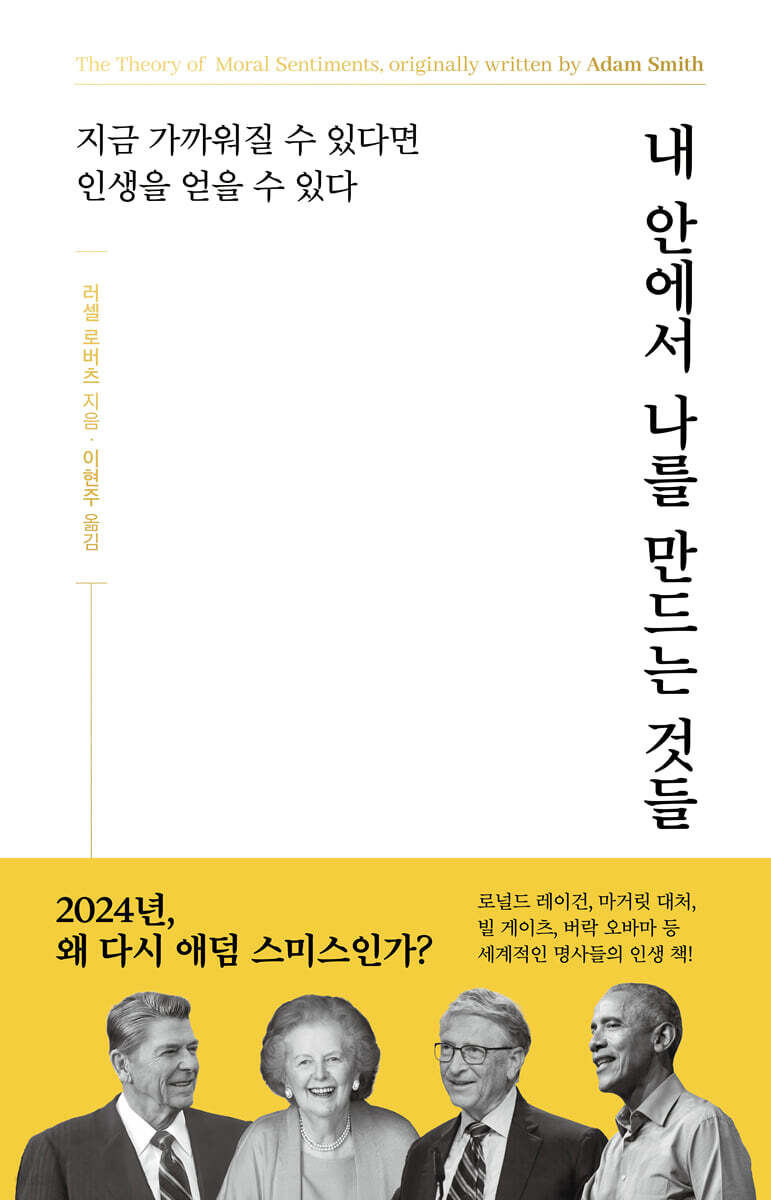
The things that make me who I am
 |
Description
Book Introduction
"What Makes Me": A Book That Changed the Lives of Hundreds of Thousands of Readers
Due to a surge of reader requests, a revised and expanded edition has been published to commemorate the 10th anniversary of the publication!
A masterpiece that Adam Smith, the 'father of capitalism', treasured more than 'The Wealth of Nations'!
"What Makes Me Within": A Translation of "The Theory of Moral Sentiments" into Everyday Language
"Easy, fun, yet substantial!" A bestseller, proven by hundreds of thousands of readers!
Adam Smith, author of The Wealth of Nations and known as the 'father of capitalism,' recognized early on the human nature of 'desiring to achieve a better life.'
The Theory of Moral Sentiments is a classic among classics, encompassing psychology, philosophy, and what is now called behavioral economics.
Throughout the book, Smith's rich insights into the pursuit of wealth and happiness, friendship, and virtue are evident.
Smith kindly provides readers with answers to two questions.
"What does it mean to live a happy and good life?" "How can we live such a life?"
He chose 'knowing yourself well' as the most important thing to create a better life and a better me.
And he has painstakingly included the brilliant answer to this question in his immortal masterpiece, The Theory of Moral Sentiments, which shines with insight into people and life.
This book is a reinterpretation of the core content of The Theory of Moral Sentiments, written 265 years ago, to fit the lives of modern people.
It contains the teachings of Adam Smith, who reveals the essence of various elements that create individuals and society, such as wealth, happiness, selfishness, altruism, justice, and relationships, and guides them in a good direction.
Hundreds of thousands of readers have raved about this book, saying it empowered them to create a new life that balances wealth, happiness, and relationships.
If you can properly instill in yourself the amazing values about humanity and life that Adam Smith preached through "What Makes Me", you will surely be able to live a life different from before.
Due to a surge of reader requests, a revised and expanded edition has been published to commemorate the 10th anniversary of the publication!
A masterpiece that Adam Smith, the 'father of capitalism', treasured more than 'The Wealth of Nations'!
"What Makes Me Within": A Translation of "The Theory of Moral Sentiments" into Everyday Language
"Easy, fun, yet substantial!" A bestseller, proven by hundreds of thousands of readers!
Adam Smith, author of The Wealth of Nations and known as the 'father of capitalism,' recognized early on the human nature of 'desiring to achieve a better life.'
The Theory of Moral Sentiments is a classic among classics, encompassing psychology, philosophy, and what is now called behavioral economics.
Throughout the book, Smith's rich insights into the pursuit of wealth and happiness, friendship, and virtue are evident.
Smith kindly provides readers with answers to two questions.
"What does it mean to live a happy and good life?" "How can we live such a life?"
He chose 'knowing yourself well' as the most important thing to create a better life and a better me.
And he has painstakingly included the brilliant answer to this question in his immortal masterpiece, The Theory of Moral Sentiments, which shines with insight into people and life.
This book is a reinterpretation of the core content of The Theory of Moral Sentiments, written 265 years ago, to fit the lives of modern people.
It contains the teachings of Adam Smith, who reveals the essence of various elements that create individuals and society, such as wealth, happiness, selfishness, altruism, justice, and relationships, and guides them in a good direction.
Hundreds of thousands of readers have raved about this book, saying it empowered them to create a new life that balances wealth, happiness, and relationships.
If you can properly instill in yourself the amazing values about humanity and life that Adam Smith preached through "What Makes Me", you will surely be able to live a life different from before.
- You can preview some of the book's contents.
Preview
index
Chapter 1: How Our Lives Can Change
Capitalism and Philosophy of Life
A hidden treasure I just discovered
An incredible journey that will change my life
∥Chapter 2∥ Time to ask myself questions
Little finger vs.
Tens of thousands of lives
There is someone who observes me fairly.
What I learned from Jean Valjean's song
What You See When You Admit a Mistake
Chapter 3: New Priorities for Happiness
What we desperately want in life
What makes a loved person different?
The Dangerous Trap of Praise
∥Chapter 4∥ Distinguishing between the real and the fake
The tragedy of narcissism
The conflicting feelings of two sisters
When I look in the mirror and I can't see myself
Nassim Taleb's Painful Advice
∥Chapter 5∥ What choices do successful people make?
The Real Reason People Pursue Wealth and Fame
Adam Smith's thoughts on money
Why We Obsess Over Celebrities
There is something else that truly connects
∥Chapter 6∥ How to Become a Loved Person
Where is the line between appropriate and inappropriate?
The magic of emotional regulation
Wall of Joy and Sorrow
∥Chapter 7∥ Commonalities of People Who Are Attractive
How to improve the quality of your life
Principles of justice in practice in life
What is true good deed?
Friendship is life's greatest tribute
∥Chapter 8∥ How to live well in an uncertain world
How is world order created?
Another 'invisible hand'
The greatest strength of human beings
Chapter 9: The Process of Creating a Good Society to Live In
The "Chessboard Fallacy" Everyone Should Remember
The power of innate healing
The right to follow one's own principles in everything
∥Chapter 10∥ Adam Smith's Warm Advice for Our Present
Differences between The Theory of Moral Sentiments and The Wealth of Nations
Relationships that change depending on the situation
To fully enjoy the benefits life has to offer
Capitalism and Philosophy of Life
A hidden treasure I just discovered
An incredible journey that will change my life
∥Chapter 2∥ Time to ask myself questions
Little finger vs.
Tens of thousands of lives
There is someone who observes me fairly.
What I learned from Jean Valjean's song
What You See When You Admit a Mistake
Chapter 3: New Priorities for Happiness
What we desperately want in life
What makes a loved person different?
The Dangerous Trap of Praise
∥Chapter 4∥ Distinguishing between the real and the fake
The tragedy of narcissism
The conflicting feelings of two sisters
When I look in the mirror and I can't see myself
Nassim Taleb's Painful Advice
∥Chapter 5∥ What choices do successful people make?
The Real Reason People Pursue Wealth and Fame
Adam Smith's thoughts on money
Why We Obsess Over Celebrities
There is something else that truly connects
∥Chapter 6∥ How to Become a Loved Person
Where is the line between appropriate and inappropriate?
The magic of emotional regulation
Wall of Joy and Sorrow
∥Chapter 7∥ Commonalities of People Who Are Attractive
How to improve the quality of your life
Principles of justice in practice in life
What is true good deed?
Friendship is life's greatest tribute
∥Chapter 8∥ How to live well in an uncertain world
How is world order created?
Another 'invisible hand'
The greatest strength of human beings
Chapter 9: The Process of Creating a Good Society to Live In
The "Chessboard Fallacy" Everyone Should Remember
The power of innate healing
The right to follow one's own principles in everything
∥Chapter 10∥ Adam Smith's Warm Advice for Our Present
Differences between The Theory of Moral Sentiments and The Wealth of Nations
Relationships that change depending on the situation
To fully enjoy the benefits life has to offer
Detailed image

Into the book
If I learned something about myself from Smith, you can learn something about yourself from Smith too.
So I can treat you the way you want me to, and you can know how to treat me the same way.
Above all, Adam Smith wanted to find out what makes people happy and what gives meaning to their lives.
And I can say with certainty that these are not abstract ideas, but rather useful things necessary for living in the world.
--- p.23~24
How can humans, so immoral and selfish, often behave so generously and noblely? It's an undeniable instinct that humans are far more influenced by what concerns them than by what concerns others.
But why, despite this, do we sacrifice our own interests for the benefit of others?
--- p.45
Why, he asked, are we not blindly immoral and selfish, even though our humanity is so weak? Smith answered that the reason lies in the impartial observer.
An impartial observer is an imaginary human figure, and according to Smith, human behavior is shaped by interactions with this impartial observer.
An impartial observer is a fair and objective person who engages in conversation with us and determines whether our actions are moral.
That is, when we have to judge whether an action is moral or right, we talk to this character.
--- p.46
How happy would I be if I knew I was loved and worthy of being loved? Conversely, how unhappy would I be if I knew I was hated and deserved to be hated? Smith also applies the impartial observer's perspective to why people avoid immoral acts.
That is, people's actions are judged by the judgment of objective observers.
Smith says we feel truly happy when people around us, observing our actions or our true selves, tell us, "You deserve to be loved."
--- p.68
Self-deception is a fatal weakness of human beings.
Half of the confusion that humans experience in life comes from this self-deception.
If only humans could see themselves from the perspective of others, they would not fall into the blind spot of self-deception.
If we continue to allow self-deception to continue, we will eventually become unable to tolerate our false selves.
--- p.96
We already have all the tools to satisfy our lives.
You don't have to conquer the Italian peninsula to enjoy life's basic pleasures.
Therefore, we must maintain our inner humanity and suppress the vile rat in our hearts.
Life is not a race, but a long journey to be savored and enjoyed.
Ambition, the persistent desire to have more, can consume us.
--- p.130
To accurately express the concept of matching emotional intensities, Smith used music as an analogy, saying that a semitone is lowered to create a harmony.
To soothe your emotions and harmonize with those around you, you need to lower your voice by a semitone from the original note.
--- p.184
As a better way to become a lovable person, Smith recommended living a virtuous life.
Virtue—what exactly does this ambiguous word mean? Smith's concept of virtue encompasses multiple meanings.
Among them, the three things he emphasized most were prudence, justice, and good deeds.
A person who possesses this becomes a lovable being and receives respect and praise from those around him.
In other words, these three are the qualifications necessary to become a loved person.
--- p.205
Maybe the best way to make the world a better place is simply to be the best husband, the best mother, the best neighbor.
Or maybe it's becoming a great company employee, manager, or businessman.
Sometimes people tend to dismiss their jobs as selfish.
Seeing a job as just a means to make money.
On the other hand, there is a misconception that only actions such as donating to charity, volunteering, or donating blood are altruistic.
But doing your own work well also helps others and contributes greatly to making the world a better place.
Why do people completely forget this fact?
--- p.237~238
Humans really have many flaws.
Not only do we not know ourselves well, we constantly make mistakes.
Among the many actions we do intentionally, there are many that are bad.
We are cruel, we exploit the weak, and we deceive the ignorant for our own gain.
But fortunately, at the same time, we also know how to fix it all.
The method is very easy.
All we have to do is discourage bad behavior and encourage good behavior.
--- p.272
"The Theory of Moral Sentiments" is a book about relationships with those closest to us, people with whom we can actively empathize, such as family, friends, and close neighbors.
In short, it deals with how other people perceive us in close relationships and how we relate to them.
This book is not intended for people who are completely unfamiliar with the subject.
This is a book about people we meet so often that we see them every day.
This book tells us how our relationships with those around us shape our emotions and behavior.
So I can treat you the way you want me to, and you can know how to treat me the same way.
Above all, Adam Smith wanted to find out what makes people happy and what gives meaning to their lives.
And I can say with certainty that these are not abstract ideas, but rather useful things necessary for living in the world.
--- p.23~24
How can humans, so immoral and selfish, often behave so generously and noblely? It's an undeniable instinct that humans are far more influenced by what concerns them than by what concerns others.
But why, despite this, do we sacrifice our own interests for the benefit of others?
--- p.45
Why, he asked, are we not blindly immoral and selfish, even though our humanity is so weak? Smith answered that the reason lies in the impartial observer.
An impartial observer is an imaginary human figure, and according to Smith, human behavior is shaped by interactions with this impartial observer.
An impartial observer is a fair and objective person who engages in conversation with us and determines whether our actions are moral.
That is, when we have to judge whether an action is moral or right, we talk to this character.
--- p.46
How happy would I be if I knew I was loved and worthy of being loved? Conversely, how unhappy would I be if I knew I was hated and deserved to be hated? Smith also applies the impartial observer's perspective to why people avoid immoral acts.
That is, people's actions are judged by the judgment of objective observers.
Smith says we feel truly happy when people around us, observing our actions or our true selves, tell us, "You deserve to be loved."
--- p.68
Self-deception is a fatal weakness of human beings.
Half of the confusion that humans experience in life comes from this self-deception.
If only humans could see themselves from the perspective of others, they would not fall into the blind spot of self-deception.
If we continue to allow self-deception to continue, we will eventually become unable to tolerate our false selves.
--- p.96
We already have all the tools to satisfy our lives.
You don't have to conquer the Italian peninsula to enjoy life's basic pleasures.
Therefore, we must maintain our inner humanity and suppress the vile rat in our hearts.
Life is not a race, but a long journey to be savored and enjoyed.
Ambition, the persistent desire to have more, can consume us.
--- p.130
To accurately express the concept of matching emotional intensities, Smith used music as an analogy, saying that a semitone is lowered to create a harmony.
To soothe your emotions and harmonize with those around you, you need to lower your voice by a semitone from the original note.
--- p.184
As a better way to become a lovable person, Smith recommended living a virtuous life.
Virtue—what exactly does this ambiguous word mean? Smith's concept of virtue encompasses multiple meanings.
Among them, the three things he emphasized most were prudence, justice, and good deeds.
A person who possesses this becomes a lovable being and receives respect and praise from those around him.
In other words, these three are the qualifications necessary to become a loved person.
--- p.205
Maybe the best way to make the world a better place is simply to be the best husband, the best mother, the best neighbor.
Or maybe it's becoming a great company employee, manager, or businessman.
Sometimes people tend to dismiss their jobs as selfish.
Seeing a job as just a means to make money.
On the other hand, there is a misconception that only actions such as donating to charity, volunteering, or donating blood are altruistic.
But doing your own work well also helps others and contributes greatly to making the world a better place.
Why do people completely forget this fact?
--- p.237~238
Humans really have many flaws.
Not only do we not know ourselves well, we constantly make mistakes.
Among the many actions we do intentionally, there are many that are bad.
We are cruel, we exploit the weak, and we deceive the ignorant for our own gain.
But fortunately, at the same time, we also know how to fix it all.
The method is very easy.
All we have to do is discourage bad behavior and encourage good behavior.
--- p.272
"The Theory of Moral Sentiments" is a book about relationships with those closest to us, people with whom we can actively empathize, such as family, friends, and close neighbors.
In short, it deals with how other people perceive us in close relationships and how we relate to them.
This book is not intended for people who are completely unfamiliar with the subject.
This is a book about people we meet so often that we see them every day.
This book tells us how our relationships with those around us shape our emotions and behavior.
--- p.299
Publisher's Review
What makes me me?
Is it me or something else?
This is a question about myself and no one else, and the answer is not easy.
Could it be that external factors, not me, are shaping me? My job, where I live, my car, my bank balance—perhaps I'm being shaped by something outside of myself?
Why is this question important? Because there's one thing we all want in life:
‘I am doing well’, that is the desire to achieve a better life.
So how do we create a truly "well-off me"? What grandiose claims did Adam Smith, author of "The Wealth of Nations" and known as the "Father of Capitalism," make?
Adam Smith seems to have recognized this true nature of human beings early on.
He emphasized that in order to live a better life and become a better person, one must know oneself.
And he has carefully included a brilliant answer to this question in a book called “The Theory of Moral Sentiments.”
It is an immortal masterpiece that shines with his insight into people and life.
This hidden masterpiece has been rediscovered and rewritten in an accessible book by Russell Roberts, a former Stanford University professor and bestselling author.
This book, "Things That Make Me Who I Am," reinterprets a classic written 265 years ago to fit the lives of modern people around the world.
This is a general education book that allows you to read the core content of the original work, “The Theory of Moral Sentiments,” with friendly commentary and interesting examples.
Above all, 『Things That Make Me Who I Am』 was written in an easy and comfortable way to relieve the weight of old classics.
However, the core and essence of the original work have been preserved so that you can still feel the same depth and emotion.
This book is exactly the 'life preview' and 'life lesson' we need most right now.
The most complete life lesson on finding balance between wealth, happiness, and relationships.
Adam Smith's Timeless Treasures of Advice
Adam Smith loved this book so much that he wanted the following inscription on his tombstone: "Here lies the author of 'The Theory of Moral Sentiments'."
Unlike 『The Wealth of Nations』, it was revised six times throughout his life, and he was a moral philosopher before being an economist.
Adam Smith saw through the greed of people who wanted not only a better life for themselves but also a better world.
He thought this greed of people was positive.
So, I wanted to find an answer that would satisfy our desire for life.
Because no matter how difficult the situation, we dream of a better life, a better world.
"What Makes Me" reveals the essence of various elements that make up individuals and society, such as wealth, happiness, selfishness, altruism, justice, and relationships, and contains Adam Smith's teachings that guide them in a good direction.
These teachings make us think again, nod our heads, and be humble.
The greatness of great classics constantly puts us to shame.
This book gives me precious time to get closer to myself.
If we can become closer to ourselves and no one else through that time, then anyone can gain a better life.
Wouldn't this be enough reason to put down your smartphone for a while and indulge in the old scent of classics?
We live in a precarious time where the logic that "money is everything" seems to be becoming increasingly true.
Fortunately, human life is not so easy that it can be easily overcome by wealth.
Because our lives are much more sophisticated and delicate, and filled with countless values.
So from now on, let's pay close attention to the precious values that make us who we are.
“Things That Make Me What I Am” will help you in your efforts.
If I plant those values deep within me, no matter what difficulties I face, my center will never waver.
Furthermore, you will be able to take a big step towards a better life than now.
Is it me or something else?
This is a question about myself and no one else, and the answer is not easy.
Could it be that external factors, not me, are shaping me? My job, where I live, my car, my bank balance—perhaps I'm being shaped by something outside of myself?
Why is this question important? Because there's one thing we all want in life:
‘I am doing well’, that is the desire to achieve a better life.
So how do we create a truly "well-off me"? What grandiose claims did Adam Smith, author of "The Wealth of Nations" and known as the "Father of Capitalism," make?
Adam Smith seems to have recognized this true nature of human beings early on.
He emphasized that in order to live a better life and become a better person, one must know oneself.
And he has carefully included a brilliant answer to this question in a book called “The Theory of Moral Sentiments.”
It is an immortal masterpiece that shines with his insight into people and life.
This hidden masterpiece has been rediscovered and rewritten in an accessible book by Russell Roberts, a former Stanford University professor and bestselling author.
This book, "Things That Make Me Who I Am," reinterprets a classic written 265 years ago to fit the lives of modern people around the world.
This is a general education book that allows you to read the core content of the original work, “The Theory of Moral Sentiments,” with friendly commentary and interesting examples.
Above all, 『Things That Make Me Who I Am』 was written in an easy and comfortable way to relieve the weight of old classics.
However, the core and essence of the original work have been preserved so that you can still feel the same depth and emotion.
This book is exactly the 'life preview' and 'life lesson' we need most right now.
The most complete life lesson on finding balance between wealth, happiness, and relationships.
Adam Smith's Timeless Treasures of Advice
Adam Smith loved this book so much that he wanted the following inscription on his tombstone: "Here lies the author of 'The Theory of Moral Sentiments'."
Unlike 『The Wealth of Nations』, it was revised six times throughout his life, and he was a moral philosopher before being an economist.
Adam Smith saw through the greed of people who wanted not only a better life for themselves but also a better world.
He thought this greed of people was positive.
So, I wanted to find an answer that would satisfy our desire for life.
Because no matter how difficult the situation, we dream of a better life, a better world.
"What Makes Me" reveals the essence of various elements that make up individuals and society, such as wealth, happiness, selfishness, altruism, justice, and relationships, and contains Adam Smith's teachings that guide them in a good direction.
These teachings make us think again, nod our heads, and be humble.
The greatness of great classics constantly puts us to shame.
This book gives me precious time to get closer to myself.
If we can become closer to ourselves and no one else through that time, then anyone can gain a better life.
Wouldn't this be enough reason to put down your smartphone for a while and indulge in the old scent of classics?
We live in a precarious time where the logic that "money is everything" seems to be becoming increasingly true.
Fortunately, human life is not so easy that it can be easily overcome by wealth.
Because our lives are much more sophisticated and delicate, and filled with countless values.
So from now on, let's pay close attention to the precious values that make us who we are.
“Things That Make Me What I Am” will help you in your efforts.
If I plant those values deep within me, no matter what difficulties I face, my center will never waver.
Furthermore, you will be able to take a big step towards a better life than now.
GOODS SPECIFICS
- Date of issue: August 27, 2024
- Page count, weight, size: 312 pages | 482g | 135*210*30mm
- ISBN13: 9788933872406
- ISBN10: 893387240X
You may also like
카테고리
korean


korean

![GQ KOREA Mark (Monthly): December [2025]](http://librairie.coreenne.fr/cdn/shop/files/8ef265dbbfbf186523ed75ba7319009d.jpg?v=1765340328&width=3840)


