

The man who mistook his wife for a hat
 |
Description
Book Introduction
The Great Doctors of Our Time Become Stars
Oliver Sacks's masterpiece, which presents a new and warm perspective on humanity.
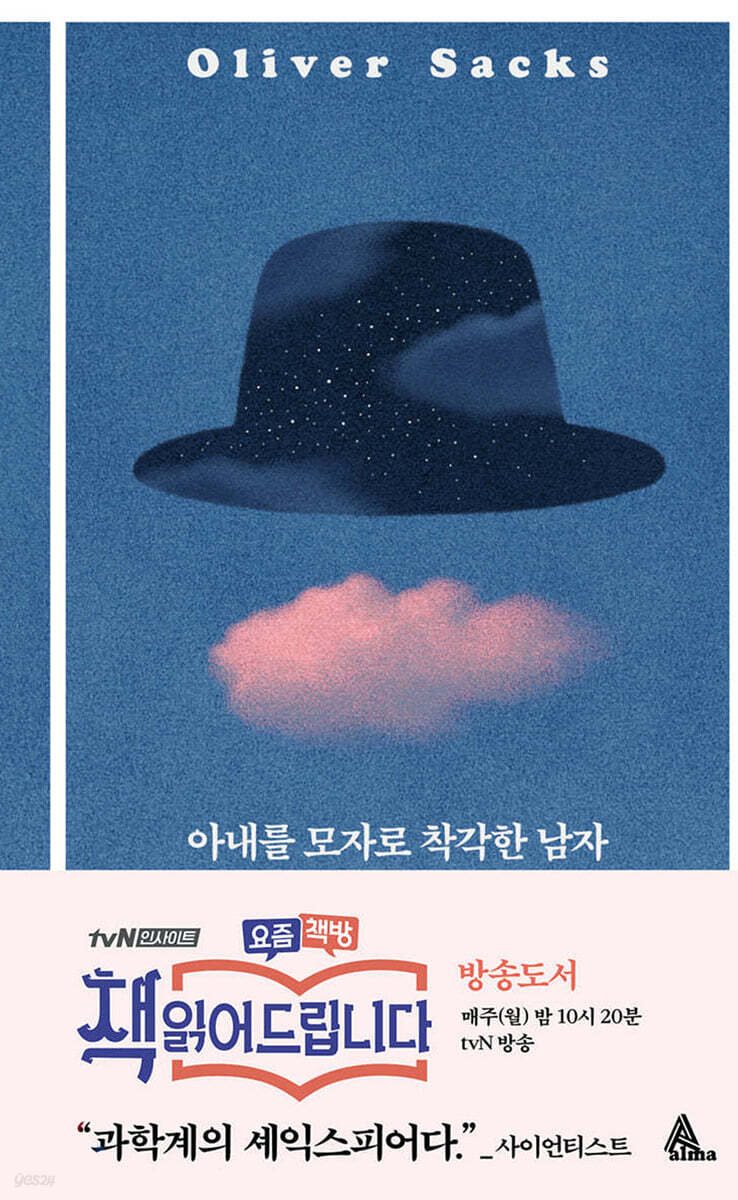
Meet the illustrations of Lee Jeong-ho, winner of the 2016 World Illustration Awards.
Oliver Sacks, one of the most influential neuroscientists and bestselling authors of our time.
The revised edition of "The Man Who Mistook His Wife for a Hat," a masterpiece that has been widely loved by readers around the world for over 30 years since its publication in the UK in 1985 and is also widely known to Korean readers, has been published.
From mild cases that cause inconvenience in daily life to those suffering from severe mental illnesses that completely isolate them from reality… Oliver Sacks's unique clinical records of people "a little different from us," meticulously observed and warmly written, are recognized as having transformed modern medicine's understanding of the human brain and are recognized as having the highest medical and literary value.
To mark the first anniversary of Oliver Sacks's passing, 'Alma' has prepared a revised edition with meticulously refined text and design.
So that the voice of the author, who had a vision that was more advanced than anyone else, can be fully conveyed to today's readers.
Oliver Sacks's masterpiece, which presents a new and warm perspective on humanity.
Meet the illustrations of Lee Jeong-ho, winner of the 2016 World Illustration Awards.
Oliver Sacks, one of the most influential neuroscientists and bestselling authors of our time.
The revised edition of "The Man Who Mistook His Wife for a Hat," a masterpiece that has been widely loved by readers around the world for over 30 years since its publication in the UK in 1985 and is also widely known to Korean readers, has been published.
From mild cases that cause inconvenience in daily life to those suffering from severe mental illnesses that completely isolate them from reality… Oliver Sacks's unique clinical records of people "a little different from us," meticulously observed and warmly written, are recognized as having transformed modern medicine's understanding of the human brain and are recognized as having the highest medical and literary value.
To mark the first anniversary of Oliver Sacks's passing, 'Alma' has prepared a revised edition with meticulously refined text and design.
So that the voice of the author, who had a vision that was more advanced than anyone else, can be fully conveyed to today's readers.
- You can preview some of the book's contents.
Preview
index
Introduction
Part 1 Loss
The man who mistook his wife for a hat
The Lost Sailor
Christina without a body
Man who fell out of bed
Madeline's Hand
hallucination
Horizontally
Right!
President's speech
Part 2 Excess
Joke Tick Ray
Cupid's disease
The question of identity
Yes, Father, yes, Nurse
A woman suffering from Tourette syndrome
Part 3 implementation
recall
An irresistible longing
The road to India
The dog inside me
murder
Hildegard's Welcome
Part 4: The World of Simplicity
Poet Rebecca
Living Dictionary
twin brothers
Artist with autism
Translator's Note
References
Chapter-by-chapter references
Part 1 Loss
The man who mistook his wife for a hat
The Lost Sailor
Christina without a body
Man who fell out of bed
Madeline's Hand
hallucination
Horizontally
Right!
President's speech
Part 2 Excess
Joke Tick Ray
Cupid's disease
The question of identity
Yes, Father, yes, Nurse
A woman suffering from Tourette syndrome
Part 3 implementation
recall
An irresistible longing
The road to India
The dog inside me
murder
Hildegard's Welcome
Part 4: The World of Simplicity
Poet Rebecca
Living Dictionary
twin brothers
Artist with autism
Translator's Note
References
Chapter-by-chapter references
Into the book
Part 1 Loss
Luria said that although Zazetsky had completely lost the ability to play, his "vivid imagination" was not impaired in the least.
Both Zazetzki and Mr. P were living in the same world.
But the most unfortunate difference between the two is that, as Ruriya said, Zazetsky 'did not succumb to that hellish situation and fought tenaciously to regain his lost abilities', while Mr. P did not.
He didn't even know what he had lost.
No, I didn't even know that I had lost something.
But which of the two is more tragic? Which of the two is in a more hellish situation? The one who knows the situation, or the one who knows nothing? --- p.39
This or that harsh ordeal is that you cannot receive sympathy or help from anyone.
She is disabled, but it is not obvious on the outside.
She is neither blind nor paralyzed.
There are no outwardly visible disabilities.
Therefore, they are often treated as liars or fools.
In our society, anyone with a hidden, unseen sensory impairment is treated the same way. --- p.98
Part 2 Excess
At this point we encounter a strange world.
It is a world where our common sense is turned upside down.
A world where a pathological state can be a happy state, and a normal state can be a pathological state.
A world where excitement can be both bondage and attachment.
A world where truth exists not in a waking state, but in a state of dazed intoxication.
This is the world of Cupid and Dionysus. --- p.189
Part 3 implementation
Mrs. C must have known this feeling too.
She also knew that she felt extreme happiness while having a seizure.
To her, it was the door, or the key, to a normal mental state, a state of perfect health.
That is why she felt that illness was the way to health and that getting sick was the way to being cured.
As her stroke progressed, Mrs. C became depressed and fearful.
She said.
“The door is closed.
“Everything was forgotten again.”
What she said was true.
By mid-April, the sights, music, and emotions of my childhood had suddenly vanished.
What she heard and saw was undoubtedly a true 'recollection'.
It wasn't a fantasy.
Because, as Penfield clearly showed, such seizures are a firm grasp of some reality, a reality experienced in the past, and a reproduction of it.
It's not a fantasy.
It is a fragment of a past experience that actually occurred in an individual's life.
(…)
It is for this very reason that we must assume that even if the 'door' is physiologically closed, the patient's experience itself is not forgotten, but remains a strong and lasting impression, felt as a meaningful experience with a healing effect. --- p.250
But it wasn't his heightened sense of smell that really changed his world.
“I had a dream that I was a dog.
It was a dream of smell.
And now when I woke up, it was a world filled with smells.
“All my other senses were more enhanced than before, but nothing compared to my sense of smell.”
And with all this came a chilling fervor, a strange nostalgia for a lost world, a world half lost and half remembered.
(…)
“I went to the hospital and sniffed around like a dog.
By sniffing around like that, I could immediately recognize the twenty patients there even before I saw them with my own eyes.
Everyone had their own unique facial scent.
Well, let's call it olfactory phrenology.
Anyway, the smell is much more vivid and suggestive than the appearance of a person's face.”
He could also sense people's emotions by smell.
Whether they are afraid, satisfied, and even whether they are male or female… just like a dog.
He could even distinguish streets and shops by smell.
He could navigate the streets of New York without getting lost, simply by smell. --- p.272
Part 4: The World of Simplicity
Rebecca embodied two very different forms of thought and mentality: the 'paradigmatic' and the 'narrative' (Bruner's term).
Both are natural elements inherent in the growing human mind, but of the two, the 'storytelling' comes first and is also psychologically important.
Children love stories and want to hear them.
Even when they do not yet have the ability to understand general concepts or legends, they are able to understand complex content presented in the form of a story.
It is the 'narrative' or 'symbolic' power that teaches children what the world is like.
Because specific realities are expressed through symbols or stories.
The power of 'narrative' becomes powerful when abstract thinking is no longer of any help.
Children understand the Bible before they understand Euclid.
This is not because the Bible is simpler (perhaps quite the opposite), but because it takes the form of a story expressed in symbols.
Thinking about it this way, it could be said that 19-year-old Rebecca was just like her grandmother said: childish.
But although he was 'like a child', he was not a child.
Because they are adults in terms of age.
(The term 'mental retardation' means that the child's condition persists, and the term 'mentally defective' means that the adult is defective.
There is a profound truth and falsehood mixed in these concepts.)
Not limited to Rebecca, in the case of a "mental defect" capable of inner growth, emotional, narrative, and symbolic abilities can be significantly developed.
So you can develop your talent as a poet like Rebecca did, or your talent as a painter like Jose.
On the other hand, abilities that are clearly lacking from the beginning, such as paradigmatic abilities and conceptual abilities, cannot be developed no matter how hard you study, and even if they are developed, there are limits to their development.
Luria said that although Zazetsky had completely lost the ability to play, his "vivid imagination" was not impaired in the least.
Both Zazetzki and Mr. P were living in the same world.
But the most unfortunate difference between the two is that, as Ruriya said, Zazetsky 'did not succumb to that hellish situation and fought tenaciously to regain his lost abilities', while Mr. P did not.
He didn't even know what he had lost.
No, I didn't even know that I had lost something.
But which of the two is more tragic? Which of the two is in a more hellish situation? The one who knows the situation, or the one who knows nothing? --- p.39
This or that harsh ordeal is that you cannot receive sympathy or help from anyone.
She is disabled, but it is not obvious on the outside.
She is neither blind nor paralyzed.
There are no outwardly visible disabilities.
Therefore, they are often treated as liars or fools.
In our society, anyone with a hidden, unseen sensory impairment is treated the same way. --- p.98
Part 2 Excess
At this point we encounter a strange world.
It is a world where our common sense is turned upside down.
A world where a pathological state can be a happy state, and a normal state can be a pathological state.
A world where excitement can be both bondage and attachment.
A world where truth exists not in a waking state, but in a state of dazed intoxication.
This is the world of Cupid and Dionysus. --- p.189
Part 3 implementation
Mrs. C must have known this feeling too.
She also knew that she felt extreme happiness while having a seizure.
To her, it was the door, or the key, to a normal mental state, a state of perfect health.
That is why she felt that illness was the way to health and that getting sick was the way to being cured.
As her stroke progressed, Mrs. C became depressed and fearful.
She said.
“The door is closed.
“Everything was forgotten again.”
What she said was true.
By mid-April, the sights, music, and emotions of my childhood had suddenly vanished.
What she heard and saw was undoubtedly a true 'recollection'.
It wasn't a fantasy.
Because, as Penfield clearly showed, such seizures are a firm grasp of some reality, a reality experienced in the past, and a reproduction of it.
It's not a fantasy.
It is a fragment of a past experience that actually occurred in an individual's life.
(…)
It is for this very reason that we must assume that even if the 'door' is physiologically closed, the patient's experience itself is not forgotten, but remains a strong and lasting impression, felt as a meaningful experience with a healing effect. --- p.250
But it wasn't his heightened sense of smell that really changed his world.
“I had a dream that I was a dog.
It was a dream of smell.
And now when I woke up, it was a world filled with smells.
“All my other senses were more enhanced than before, but nothing compared to my sense of smell.”
And with all this came a chilling fervor, a strange nostalgia for a lost world, a world half lost and half remembered.
(…)
“I went to the hospital and sniffed around like a dog.
By sniffing around like that, I could immediately recognize the twenty patients there even before I saw them with my own eyes.
Everyone had their own unique facial scent.
Well, let's call it olfactory phrenology.
Anyway, the smell is much more vivid and suggestive than the appearance of a person's face.”
He could also sense people's emotions by smell.
Whether they are afraid, satisfied, and even whether they are male or female… just like a dog.
He could even distinguish streets and shops by smell.
He could navigate the streets of New York without getting lost, simply by smell. --- p.272
Part 4: The World of Simplicity
Rebecca embodied two very different forms of thought and mentality: the 'paradigmatic' and the 'narrative' (Bruner's term).
Both are natural elements inherent in the growing human mind, but of the two, the 'storytelling' comes first and is also psychologically important.
Children love stories and want to hear them.
Even when they do not yet have the ability to understand general concepts or legends, they are able to understand complex content presented in the form of a story.
It is the 'narrative' or 'symbolic' power that teaches children what the world is like.
Because specific realities are expressed through symbols or stories.
The power of 'narrative' becomes powerful when abstract thinking is no longer of any help.
Children understand the Bible before they understand Euclid.
This is not because the Bible is simpler (perhaps quite the opposite), but because it takes the form of a story expressed in symbols.
Thinking about it this way, it could be said that 19-year-old Rebecca was just like her grandmother said: childish.
But although he was 'like a child', he was not a child.
Because they are adults in terms of age.
(The term 'mental retardation' means that the child's condition persists, and the term 'mentally defective' means that the adult is defective.
There is a profound truth and falsehood mixed in these concepts.)
Not limited to Rebecca, in the case of a "mental defect" capable of inner growth, emotional, narrative, and symbolic abilities can be significantly developed.
So you can develop your talent as a poet like Rebecca did, or your talent as a painter like Jose.
On the other hand, abilities that are clearly lacking from the beginning, such as paradigmatic abilities and conceptual abilities, cannot be developed no matter how hard you study, and even if they are developed, there are limits to their development.
--- p.304
Publisher's Review
Changing the perception of brain dysfunction and advancing modern brain medicine research to the next level,
A monumental work that has provided endless inspiration and expansion of thought to countless artists.
Oliver Sacks's works, including "The Man Who Mistook His Wife for a Hat," are all highly regarded literary works that deal with the highly specialized field of neurological disorders, and have been loved by readers for their unique excitement.
In addition, it has become a mother for the continuous creation of various genres of art, such as being adapted into a play and performed on stage by world-renowned director Peter Brook in France.
It is perhaps no surprise that artists from a wide range of fields, including poetry, fiction, dance, painting, film, theatre, and opera, have cited Oliver Sacks's work as inspiration.
Even today, American universities use his writings as textbooks not only in neurology but also in literature, ethics, and philosophy.
This book consists of 24 stories in 4 parts.
Parts 1 and 2 focus primarily on deficits and excesses in brain function (particularly the right hemisphere), while Parts 3 and 4 tell stories about phenomenal manifestations such as paroxysmal flashbacks, altered perceptions, and extraordinary mental qualities found in people with intellectual disabilities.
Additionally, a 'backstory' section is inserted into each episode, adding the author's experiences with other patients with the same symptoms.
This book's unique narrative style, which records the clinical records of patients with neurological diseases whose causes are unknown and whose treatment is unknown, had a major impact not only on the medical community but also on society as a whole.
Patients who seek growth and adaptation even in the midst of extreme confusion and awaken their hidden abilities.
The author captures their appearance with the professional insight of a neurologist, warm humanism, and a gaze full of love and trust for human dignity.
In an age where we need concern, understanding, and consideration for our neighbors,
A reminder of why you should read Oliver Sacks' books.
Even the smallest brain injury can affect the functioning of the entire body and completely change your life.
A neighbor who makes others uncomfortable with their eccentric personality and impulsive behavior may actually be someone who needs attention and consideration.
We didn't know this fact before Oliver Sacks.
Oliver Sacks's books raise the level of social awareness by conveying specialized knowledge to the general public in an easily understandable manner and creating a sense of empathy.
Anyone who has read "The Man Who Mistook His Wife for a Hat" has probably had the experience of opening the book with interest and curiosity, and then closing it with a sense of comfort and emotion.
In fact, The Man Who Mistook His Wife for a Hat is a book about 'what we don't know'.
'Fear of the unknown' is an instinctive human emotion, and sometimes that fear erupts into violence and hatred.
Especially for modern people who struggle to live a full life, it is not easy to try to understand people who behave differently from us or who make us uncomfortable with their unusual attitudes.
Oliver Sacks's book shows us an example of 'warm intelligence', making us think about how we can live together as best we can without giving up on others.
It offers new hope to lonely modern people who are gradually becoming divided and eventually becoming isolated.
In memory of the great teacher who left us in 2015 at the age of eighty-two.
We present a revised edition of his masterpiece, The Man Who Mistook His Wife for a Hat.
Alma Publishing honors Oliver Sacks, whose very existence was a great gift to humanity, and is reimagining his major works with contemporary designs and concepts to keep alive the spark of hope he brought.
In particular, a more cautious approach was required in the case of Oliver Sacks' masterpiece, The Man Who Mistook His Wife for a Hat.
We corrected sensitive expressions about people with intellectual disabilities and terminology that needed to be unified with other works.
Additionally, author Lee Jeong-ho, who won the highest honor at the 2016 World Illustration Awards hosted by the Society of Illustrators (AOI) for his picture book “Promenade,” drew new illustrations to match the theme of each chapter.
This revised edition, with its emotional yet mystical illustrations and meticulously refined sentences, will offer a "re-reading experience" for existing readers who love Oliver Sacks' books.
Media Review
“Dr. Oliver Sacks's most fascinating book.
His compelling story is a wondrous metaphor for modern medicine and modern man.”_New York Magazine
“The power and brilliance of a genius author, full of insight, compassion, and emotion.” —The New York Times Book Review
“The author presents a masterful work of fantastically detailed description.” —The Washington Post
“Wise and full of compassion.
“The author’s highly literary spirit is imbued with a deep faith in humanity.” —Chicago Sun-Times
“This book is a story told by a traveler who has returned from the field.
“An exploration of our own past experiences, something we have been longing to hear about.”_The Times
“Oliver Sacks, the most humane doctor who loved humanity, confronts him as a human being before he becomes a giant in the medical field.”_Dong-A Ilbo_
“The reason Oliver Sacks is supported and respected is not simply because he is a world-renowned best-selling author or a renowned doctor.
“It may be because he has dedicated his entire life to the service of weak beings who are considered insignificant and even incompetent.”_Chosun Ilbo
"Awakening to human dignity through novel-like clinical cases! This book demonstrates that even the most difficult topics can be loved by readers when presented through human stories." _The Hankyoreh
“Visuo-sensitivity disorder, tone-sensitivity disorder, retrograde amnesia, neurosyphilis, loss of sense of location, Tourette syndrome… The author tells the story of meeting patients with neurological disorders, and their miraculous lives in a moving way.”_Korea Ilbo
A monumental work that has provided endless inspiration and expansion of thought to countless artists.
Oliver Sacks's works, including "The Man Who Mistook His Wife for a Hat," are all highly regarded literary works that deal with the highly specialized field of neurological disorders, and have been loved by readers for their unique excitement.
In addition, it has become a mother for the continuous creation of various genres of art, such as being adapted into a play and performed on stage by world-renowned director Peter Brook in France.
It is perhaps no surprise that artists from a wide range of fields, including poetry, fiction, dance, painting, film, theatre, and opera, have cited Oliver Sacks's work as inspiration.
Even today, American universities use his writings as textbooks not only in neurology but also in literature, ethics, and philosophy.
This book consists of 24 stories in 4 parts.
Parts 1 and 2 focus primarily on deficits and excesses in brain function (particularly the right hemisphere), while Parts 3 and 4 tell stories about phenomenal manifestations such as paroxysmal flashbacks, altered perceptions, and extraordinary mental qualities found in people with intellectual disabilities.
Additionally, a 'backstory' section is inserted into each episode, adding the author's experiences with other patients with the same symptoms.
This book's unique narrative style, which records the clinical records of patients with neurological diseases whose causes are unknown and whose treatment is unknown, had a major impact not only on the medical community but also on society as a whole.
Patients who seek growth and adaptation even in the midst of extreme confusion and awaken their hidden abilities.
The author captures their appearance with the professional insight of a neurologist, warm humanism, and a gaze full of love and trust for human dignity.
In an age where we need concern, understanding, and consideration for our neighbors,
A reminder of why you should read Oliver Sacks' books.
Even the smallest brain injury can affect the functioning of the entire body and completely change your life.
A neighbor who makes others uncomfortable with their eccentric personality and impulsive behavior may actually be someone who needs attention and consideration.
We didn't know this fact before Oliver Sacks.
Oliver Sacks's books raise the level of social awareness by conveying specialized knowledge to the general public in an easily understandable manner and creating a sense of empathy.
Anyone who has read "The Man Who Mistook His Wife for a Hat" has probably had the experience of opening the book with interest and curiosity, and then closing it with a sense of comfort and emotion.
In fact, The Man Who Mistook His Wife for a Hat is a book about 'what we don't know'.
'Fear of the unknown' is an instinctive human emotion, and sometimes that fear erupts into violence and hatred.
Especially for modern people who struggle to live a full life, it is not easy to try to understand people who behave differently from us or who make us uncomfortable with their unusual attitudes.
Oliver Sacks's book shows us an example of 'warm intelligence', making us think about how we can live together as best we can without giving up on others.
It offers new hope to lonely modern people who are gradually becoming divided and eventually becoming isolated.
In memory of the great teacher who left us in 2015 at the age of eighty-two.
We present a revised edition of his masterpiece, The Man Who Mistook His Wife for a Hat.
Alma Publishing honors Oliver Sacks, whose very existence was a great gift to humanity, and is reimagining his major works with contemporary designs and concepts to keep alive the spark of hope he brought.
In particular, a more cautious approach was required in the case of Oliver Sacks' masterpiece, The Man Who Mistook His Wife for a Hat.
We corrected sensitive expressions about people with intellectual disabilities and terminology that needed to be unified with other works.
Additionally, author Lee Jeong-ho, who won the highest honor at the 2016 World Illustration Awards hosted by the Society of Illustrators (AOI) for his picture book “Promenade,” drew new illustrations to match the theme of each chapter.
This revised edition, with its emotional yet mystical illustrations and meticulously refined sentences, will offer a "re-reading experience" for existing readers who love Oliver Sacks' books.
Media Review
“Dr. Oliver Sacks's most fascinating book.
His compelling story is a wondrous metaphor for modern medicine and modern man.”_New York Magazine
“The power and brilliance of a genius author, full of insight, compassion, and emotion.” —The New York Times Book Review
“The author presents a masterful work of fantastically detailed description.” —The Washington Post
“Wise and full of compassion.
“The author’s highly literary spirit is imbued with a deep faith in humanity.” —Chicago Sun-Times
“This book is a story told by a traveler who has returned from the field.
“An exploration of our own past experiences, something we have been longing to hear about.”_The Times
“Oliver Sacks, the most humane doctor who loved humanity, confronts him as a human being before he becomes a giant in the medical field.”_Dong-A Ilbo_
“The reason Oliver Sacks is supported and respected is not simply because he is a world-renowned best-selling author or a renowned doctor.
“It may be because he has dedicated his entire life to the service of weak beings who are considered insignificant and even incompetent.”_Chosun Ilbo
"Awakening to human dignity through novel-like clinical cases! This book demonstrates that even the most difficult topics can be loved by readers when presented through human stories." _The Hankyoreh
“Visuo-sensitivity disorder, tone-sensitivity disorder, retrograde amnesia, neurosyphilis, loss of sense of location, Tourette syndrome… The author tells the story of meeting patients with neurological disorders, and their miraculous lives in a moving way.”_Korea Ilbo
GOODS SPECIFICS
- Date of issue: August 18, 2016
- Page count, weight, size: 396 pages | 632g | 140*225*30mm
- ISBN13: 9791159920257
- ISBN10: 1159920257
You may also like
카테고리
korean


korean

![ELLE 엘르 스페셜 에디션 A형 : 12월 [2025]](http://librairie.coreenne.fr/cdn/shop/files/b8e27a3de6c9538896439686c6b0e8fb.jpg?v=1766436872&width=3840)


