

There are things you can only see in the dark.
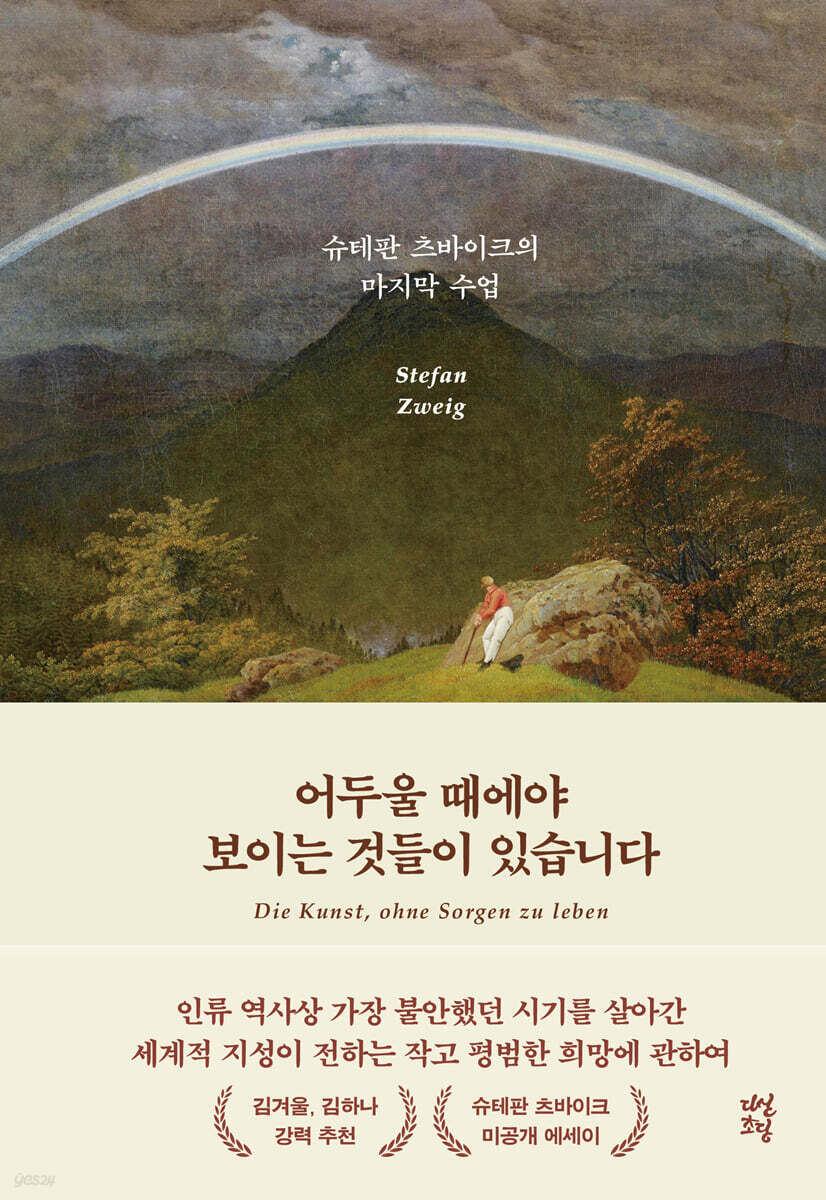 |
Description
Book Introduction
“I like his work better than Dostoevsky’s.” (Sigmund Freud)
“I have all of his works.” (Albert Einstein)
The last "unpublished" essay by the writer Stefan Zweig before he took his own life.
Unpublished essays by Stefan Zweig, who was known as 'the world's most widely read writer' during his time, have been published.
Stefan Zweig, who is familiar to us as the author of "The World of Yesterday" and the writer who inspired the film "The Grand Budapest Hotel," was one of the greatest intellectuals of his time, selling over 60 million copies of his books and providing great inspiration and inspiration to world-renowned scholars such as Albert Einstein, Sigmund Freud, Rainer Maria Rilke, and Bruno Walter.
His last essay, "Some Things Are Only Seen in the Dark," is a record of Stefan Zweig's time in exile in Brazil to escape Nazi Germany, and contains stories that have never been made public before.
Despite being written during one of the darkest and most barbaric times in history, the World War II, this essay is full of hope for humanity, gives us the courage to live, and is even humorous.
“I have all of his works.” (Albert Einstein)
The last "unpublished" essay by the writer Stefan Zweig before he took his own life.
Unpublished essays by Stefan Zweig, who was known as 'the world's most widely read writer' during his time, have been published.
Stefan Zweig, who is familiar to us as the author of "The World of Yesterday" and the writer who inspired the film "The Grand Budapest Hotel," was one of the greatest intellectuals of his time, selling over 60 million copies of his books and providing great inspiration and inspiration to world-renowned scholars such as Albert Einstein, Sigmund Freud, Rainer Maria Rilke, and Bruno Walter.
His last essay, "Some Things Are Only Seen in the Dark," is a record of Stefan Zweig's time in exile in Brazil to escape Nazi Germany, and contains stories that have never been made public before.
Despite being written during one of the darkest and most barbaric times in history, the World War II, this essay is full of hope for humanity, gives us the courage to live, and is even humorous.
- You can preview some of the book's contents.
Preview
index
The art of living without worry
All you need is courage!
What is money to me?
Fisherman on the Seine
Timeless lesson
Eulogy for Alfonso Hernández Catá
Great silence
In these dark times
Hartrod and Hitler
Reviews
source
All you need is courage!
What is money to me?
Fisherman on the Seine
Timeless lesson
Eulogy for Alfonso Hernández Catá
Great silence
In these dark times
Hartrod and Hitler
Reviews
source
Detailed image
.jpg)
Into the book
I often think of Anton.
I am always grateful because there are very few people who have helped me so much.
Sometimes, when I have petty and foolish worries about money, I think of this man who never wants more than he needs for a single day, and so he can always live comfortably and peacefully.
I saw him several times in shabby clothes.
He was always cheerful and peaceful.
Every time that happened, I thought.
If everyone learned this secret of mutual trust, there would be no need for police, courts, prisons, or money.
--- p.22
I know it's never easy to reach out to someone whose soul has been wounded by the shame of defeat or humiliation, but this experience taught me to obey without hesitation the first impulse to help someone.
--- p.33
I am not the master of money, and I don't want money to be the master of my life.
Through that experience, I learned an indelible lesson.
Our true security lies not in what we possess, but in who we are and what we become.
--- p.44
So if at the end of the first year of the war it seemed as if we had stopped caring about it, it was not because we were inhumane, but because we were human beings with small hearts.
Our hearts are too small to handle more than a certain amount of unhappiness.
--- p.57
The work that started like that didn't end even after 30 minutes, an hour, an hour and a half.
He didn't say anything to me.
He completely forgot I was even there, and I was both shocked and touched by that sight.
He was completely unaware that his invited guest was watching him from behind, and he didn't even know whether it was day or night, and he forgot the time and place.
He gazed only at his own work and at the higher, truer form that existed unseen beyond it, the form he sought to achieve.
--- p.74
Silence, impenetrable silence, endless silence, terrible silence.
I hear that silence day and night.
It fills my ears and soul with an indescribable horror.
It is more unbearable than any noise, more terrible than thunder, the wail of a siren, or the sound of an explosion.
It's more nerve-wracking and sadder than screaming or sobbing.
Every moment I realize that millions of people are oppressed in this silence.
--- p.101
So let's do it together.
Let us fulfill this duty, each for our own country, each in our own language, each with our own works and lives.
Only when we trust ourselves and each other in these dark times will we be able to fulfill our duties with honor.
I am always grateful because there are very few people who have helped me so much.
Sometimes, when I have petty and foolish worries about money, I think of this man who never wants more than he needs for a single day, and so he can always live comfortably and peacefully.
I saw him several times in shabby clothes.
He was always cheerful and peaceful.
Every time that happened, I thought.
If everyone learned this secret of mutual trust, there would be no need for police, courts, prisons, or money.
--- p.22
I know it's never easy to reach out to someone whose soul has been wounded by the shame of defeat or humiliation, but this experience taught me to obey without hesitation the first impulse to help someone.
--- p.33
I am not the master of money, and I don't want money to be the master of my life.
Through that experience, I learned an indelible lesson.
Our true security lies not in what we possess, but in who we are and what we become.
--- p.44
So if at the end of the first year of the war it seemed as if we had stopped caring about it, it was not because we were inhumane, but because we were human beings with small hearts.
Our hearts are too small to handle more than a certain amount of unhappiness.
--- p.57
The work that started like that didn't end even after 30 minutes, an hour, an hour and a half.
He didn't say anything to me.
He completely forgot I was even there, and I was both shocked and touched by that sight.
He was completely unaware that his invited guest was watching him from behind, and he didn't even know whether it was day or night, and he forgot the time and place.
He gazed only at his own work and at the higher, truer form that existed unseen beyond it, the form he sought to achieve.
--- p.74
Silence, impenetrable silence, endless silence, terrible silence.
I hear that silence day and night.
It fills my ears and soul with an indescribable horror.
It is more unbearable than any noise, more terrible than thunder, the wail of a siren, or the sound of an explosion.
It's more nerve-wracking and sadder than screaming or sobbing.
Every moment I realize that millions of people are oppressed in this silence.
--- p.101
So let's do it together.
Let us fulfill this duty, each for our own country, each in our own language, each with our own works and lives.
Only when we trust ourselves and each other in these dark times will we be able to fulfill our duties with honor.
--- p.117
Publisher's Review
“To see how brightly the eternal stars shine, you must first go dark.”
Just as stars cannot be seen in bright daylight, there are things that can only be seen when it gets dark.
If you are going through dark times right now, there is definitely a light that can only be found in that world.
"Some Things Are Only Seen in the Dark" is a passionate confession of conscience and a remnant of hope from a European intellectual who was frustrated after experiencing World War I and then witnessing World War II.
Even during dark times, his writings, which tenaciously searched for human dignity and freedom, seem to support us.
For us, who are under more stress than previous generations due to low birth rates, Hell Joseon, the climate crisis, and economic recession, this short but powerful essay offers the courage and inspiration to continue living, and a faint but clear hope.
★ A writer loved by Einstein and Freud ★
★ Stefan Zweig's Last Unpublished Essay ★
★ Highly recommended by Kim Gyul-wool and Kim Ha-na! ★
“The most widely read author in the world of his time”
Einstein, Freud, Thomas Mann, etc.
Unpublished Essays by Stefan Zweig, the World's Beloved Author
Freud said that he liked his work better than Dostoevsky's.
Einstein confessed that he owned all of his works.
Stefan Zweig, who sold over 60 million copies of his books at the time and gained fame as 'the world's most read author'.
He went into exile in Brazil during the height of World War II, where he suffered from severe depression and took his own life shortly thereafter.
"Some Things Are Only Seen in the Dark" is a collection of previously unpublished essays documenting the last two years of his life, compiled from writings discovered by renowned German editor Volker Michels and Zweig scholar Klaus Gräbner.
Zweig's world was completely destroyed by the two world wars.
I lost my hometown, my friends, and even my language.
I was deeply frustrated every time I learned about people's miserable reality through newspapers, letters, and phone calls.
He said this to a fellow writer he met while living in exile in Brazil:
“How can I breathe, sleep, and eat, knowing that the most senseless destruction is taking place and that countless innocent people are being dragged away?” These were his words in early 1942, shortly before he committed suicide.
Decades later, nine of his writings, which had been completely forgotten, were brought to light.
People were surprised.
According to editor Volker Michels, it was “the most beautiful and moving” of Zweig’s writings.
Even in the midst of the bleak reality of horrific violence and the mental anguish of extreme exhaustion, his writings were bright and warm, as if they were radiating light of their own, and they touched people's hearts.
Zweig never gave up hope for humanity until the day he died.
Stefan Zweig's book, "Some Things Are Seen Only in the Dark," a record of hope written during one of history's darkest times, captures his warmest and wisest everyday life.
“One word from us, one kind gesture from us
“It could have given me the strength to overcome misfortune and pain.”
A final appeal to humanity before taking his own life
Anton, whom I met by chance while walking, is a man with no money, no home, and no job, but who lives freely and is respected by everyone in the village.
Zweig says that when he sometimes has petty and foolish worries about money, he thinks of Anton, who always lived a carefree and easy life, never wanting more than he needed for a single day.
If people lived like Anton, “there would be no need for police, courts, prisons, or money.
He says that if everyone lived like this young man, who only received what was needed and helped as much as he could, the social problems that are rampant with absurdity might be solved.
Meanwhile, he recalls his high school days when he was unable to offer any words of comfort to a friend who was spiritually wounded, and confesses, “It wasn’t a lack of empathy, indifference, or bad intentions that led me to abandon him,” but “I think it was a lack of courage.”
So, he writes, “I learned that I must obey without hesitation the first impulse that comes to me to help someone.”
He captures these fleeting moments of everyday life, confesses, reflects, and realizes.
His daily life may seem trivial, but it continues without being swept away by the maelstrom of war.
Even amidst inhumane acts and brutal tales, he never loses his warmth for humanity.
He tries to live the trivial daily life given to him 'uprightly'.
We live believing that “one word, one kind gesture” can make a human being human.
So his daily life is a gentle comfort to us.
It seems to gently pat me on the back, telling me to keep living, to not lose sight of my daily life even in dark times.
On the historic day when Louis XVI was executed in the Place de la Concorde, fishermen were “fishing as usual” in the nearby Seine River.
Zweig argues that it is not because they “lack empathy, but because there is so much going on in such a ‘historical era,’” and that “it is not a lack of good will, but a lack of the strength to cope.”
And he leaves behind a beautiful quote: “Our hearts are too small to bear more than a certain amount of unhappiness.”
The first half of "Some Things You Can See Only in the Dark" is a record of everyday life.
These are the words left behind while walking a dog, reminiscing about childhood, watching an opera, and remembering a friend.
Even though we were living through the terrible times of World War II, daily life continued.
The same goes for our daily lives.
Even in the most brutal times, life goes on.
So how should we live? Perhaps this book holds clues to how to navigate everyday life.
Meanwhile, the latter half of this book is different from the previous ones.
Stefan Zweig, an Austrian intellectual, felt “terrible shame” for thinking and speaking German.
Still, he did not forget what he had to do.
In three essays, “The Great Silence,” “In These Dark Times,” and “Hartrod and Hitler,” he vividly describes the atrocities committed by the Nazis against humanity.
Through his writings, we indirectly experience the violence that occurred during World War II.
But these writings do not stop at mere confessions and accusations.
Behind sharp criticism, there is always realistic advice and warm comfort.
Because I stand on the side of those who are suffering deeply.
He further encourages the world's citizens not to hesitate to continue to speak out.
“So let’s do it together.
“For each country, each language, each with their own works and lives.” In this way, “Some Things Can Be Seen Only in the Dark” is the definitive edition of Stefan Zweig’s essays, containing both warm hope that can be drawn from everyday life and an earnest appeal to the world.
“I never thought I would read such a short book so slowly and repeatedly.”
Kim Gyul-wool and Kim Ha-na are highly recommended!
The book is compelling simply for its inclusion of Stefan Zweig's previously unpublished essays and the two years leading up to his suicide.
But all the authors who read this book first and recommended it focus on the warmth it contains.
Author Kim Gyul-wool says it exists “for those who still believe that there is light in dark times.”
According to him, the book's duty is to light "a small fire in people's hearts in the form of a book."
Meanwhile, author Kim Ha-na also recommends the book, saying it is “a very precious flint for us who are still living in dark and difficult times,” and that it is “warm and humorous.”
We all struggle for different reasons.
Just getting through each day safely is overwhelming.
This book is the last essay left by a great writer, and it is also a warm hand extended by humans to humans.
It's not a very long book, but it's enough to read and think about, feeling the warmth contained in each page.
If you are frustrated with a regrettable past, a helpless present, and an uncertain future, I recommend this essay by Stefan Zweig.
There are things that can only be seen in the dark, like the stars shining in the sky.
You will definitely move towards a brighter place.
Just as stars cannot be seen in bright daylight, there are things that can only be seen when it gets dark.
If you are going through dark times right now, there is definitely a light that can only be found in that world.
"Some Things Are Only Seen in the Dark" is a passionate confession of conscience and a remnant of hope from a European intellectual who was frustrated after experiencing World War I and then witnessing World War II.
Even during dark times, his writings, which tenaciously searched for human dignity and freedom, seem to support us.
For us, who are under more stress than previous generations due to low birth rates, Hell Joseon, the climate crisis, and economic recession, this short but powerful essay offers the courage and inspiration to continue living, and a faint but clear hope.
★ A writer loved by Einstein and Freud ★
★ Stefan Zweig's Last Unpublished Essay ★
★ Highly recommended by Kim Gyul-wool and Kim Ha-na! ★
“The most widely read author in the world of his time”
Einstein, Freud, Thomas Mann, etc.
Unpublished Essays by Stefan Zweig, the World's Beloved Author
Freud said that he liked his work better than Dostoevsky's.
Einstein confessed that he owned all of his works.
Stefan Zweig, who sold over 60 million copies of his books at the time and gained fame as 'the world's most read author'.
He went into exile in Brazil during the height of World War II, where he suffered from severe depression and took his own life shortly thereafter.
"Some Things Are Only Seen in the Dark" is a collection of previously unpublished essays documenting the last two years of his life, compiled from writings discovered by renowned German editor Volker Michels and Zweig scholar Klaus Gräbner.
Zweig's world was completely destroyed by the two world wars.
I lost my hometown, my friends, and even my language.
I was deeply frustrated every time I learned about people's miserable reality through newspapers, letters, and phone calls.
He said this to a fellow writer he met while living in exile in Brazil:
“How can I breathe, sleep, and eat, knowing that the most senseless destruction is taking place and that countless innocent people are being dragged away?” These were his words in early 1942, shortly before he committed suicide.
Decades later, nine of his writings, which had been completely forgotten, were brought to light.
People were surprised.
According to editor Volker Michels, it was “the most beautiful and moving” of Zweig’s writings.
Even in the midst of the bleak reality of horrific violence and the mental anguish of extreme exhaustion, his writings were bright and warm, as if they were radiating light of their own, and they touched people's hearts.
Zweig never gave up hope for humanity until the day he died.
Stefan Zweig's book, "Some Things Are Seen Only in the Dark," a record of hope written during one of history's darkest times, captures his warmest and wisest everyday life.
“One word from us, one kind gesture from us
“It could have given me the strength to overcome misfortune and pain.”
A final appeal to humanity before taking his own life
Anton, whom I met by chance while walking, is a man with no money, no home, and no job, but who lives freely and is respected by everyone in the village.
Zweig says that when he sometimes has petty and foolish worries about money, he thinks of Anton, who always lived a carefree and easy life, never wanting more than he needed for a single day.
If people lived like Anton, “there would be no need for police, courts, prisons, or money.
He says that if everyone lived like this young man, who only received what was needed and helped as much as he could, the social problems that are rampant with absurdity might be solved.
Meanwhile, he recalls his high school days when he was unable to offer any words of comfort to a friend who was spiritually wounded, and confesses, “It wasn’t a lack of empathy, indifference, or bad intentions that led me to abandon him,” but “I think it was a lack of courage.”
So, he writes, “I learned that I must obey without hesitation the first impulse that comes to me to help someone.”
He captures these fleeting moments of everyday life, confesses, reflects, and realizes.
His daily life may seem trivial, but it continues without being swept away by the maelstrom of war.
Even amidst inhumane acts and brutal tales, he never loses his warmth for humanity.
He tries to live the trivial daily life given to him 'uprightly'.
We live believing that “one word, one kind gesture” can make a human being human.
So his daily life is a gentle comfort to us.
It seems to gently pat me on the back, telling me to keep living, to not lose sight of my daily life even in dark times.
On the historic day when Louis XVI was executed in the Place de la Concorde, fishermen were “fishing as usual” in the nearby Seine River.
Zweig argues that it is not because they “lack empathy, but because there is so much going on in such a ‘historical era,’” and that “it is not a lack of good will, but a lack of the strength to cope.”
And he leaves behind a beautiful quote: “Our hearts are too small to bear more than a certain amount of unhappiness.”
The first half of "Some Things You Can See Only in the Dark" is a record of everyday life.
These are the words left behind while walking a dog, reminiscing about childhood, watching an opera, and remembering a friend.
Even though we were living through the terrible times of World War II, daily life continued.
The same goes for our daily lives.
Even in the most brutal times, life goes on.
So how should we live? Perhaps this book holds clues to how to navigate everyday life.
Meanwhile, the latter half of this book is different from the previous ones.
Stefan Zweig, an Austrian intellectual, felt “terrible shame” for thinking and speaking German.
Still, he did not forget what he had to do.
In three essays, “The Great Silence,” “In These Dark Times,” and “Hartrod and Hitler,” he vividly describes the atrocities committed by the Nazis against humanity.
Through his writings, we indirectly experience the violence that occurred during World War II.
But these writings do not stop at mere confessions and accusations.
Behind sharp criticism, there is always realistic advice and warm comfort.
Because I stand on the side of those who are suffering deeply.
He further encourages the world's citizens not to hesitate to continue to speak out.
“So let’s do it together.
“For each country, each language, each with their own works and lives.” In this way, “Some Things Can Be Seen Only in the Dark” is the definitive edition of Stefan Zweig’s essays, containing both warm hope that can be drawn from everyday life and an earnest appeal to the world.
“I never thought I would read such a short book so slowly and repeatedly.”
Kim Gyul-wool and Kim Ha-na are highly recommended!
The book is compelling simply for its inclusion of Stefan Zweig's previously unpublished essays and the two years leading up to his suicide.
But all the authors who read this book first and recommended it focus on the warmth it contains.
Author Kim Gyul-wool says it exists “for those who still believe that there is light in dark times.”
According to him, the book's duty is to light "a small fire in people's hearts in the form of a book."
Meanwhile, author Kim Ha-na also recommends the book, saying it is “a very precious flint for us who are still living in dark and difficult times,” and that it is “warm and humorous.”
We all struggle for different reasons.
Just getting through each day safely is overwhelming.
This book is the last essay left by a great writer, and it is also a warm hand extended by humans to humans.
It's not a very long book, but it's enough to read and think about, feeling the warmth contained in each page.
If you are frustrated with a regrettable past, a helpless present, and an uncertain future, I recommend this essay by Stefan Zweig.
There are things that can only be seen in the dark, like the stars shining in the sky.
You will definitely move towards a brighter place.
GOODS SPECIFICS
- Date of issue: November 1, 2024
- Format: Hardcover book binding method guide
- Page count, weight, size: 148 pages | 298g | 132*192*15mm
- ISBN13: 9791130657462
- ISBN10: 1130657469
You may also like
카테고리
korean


korean

![ELLE 엘르 스페셜 에디션 A형 : 12월 [2025]](http://librairie.coreenne.fr/cdn/shop/files/b8e27a3de6c9538896439686c6b0e8fb.jpg?v=1766436872&width=3840)


