

Minimal Three Kingdoms
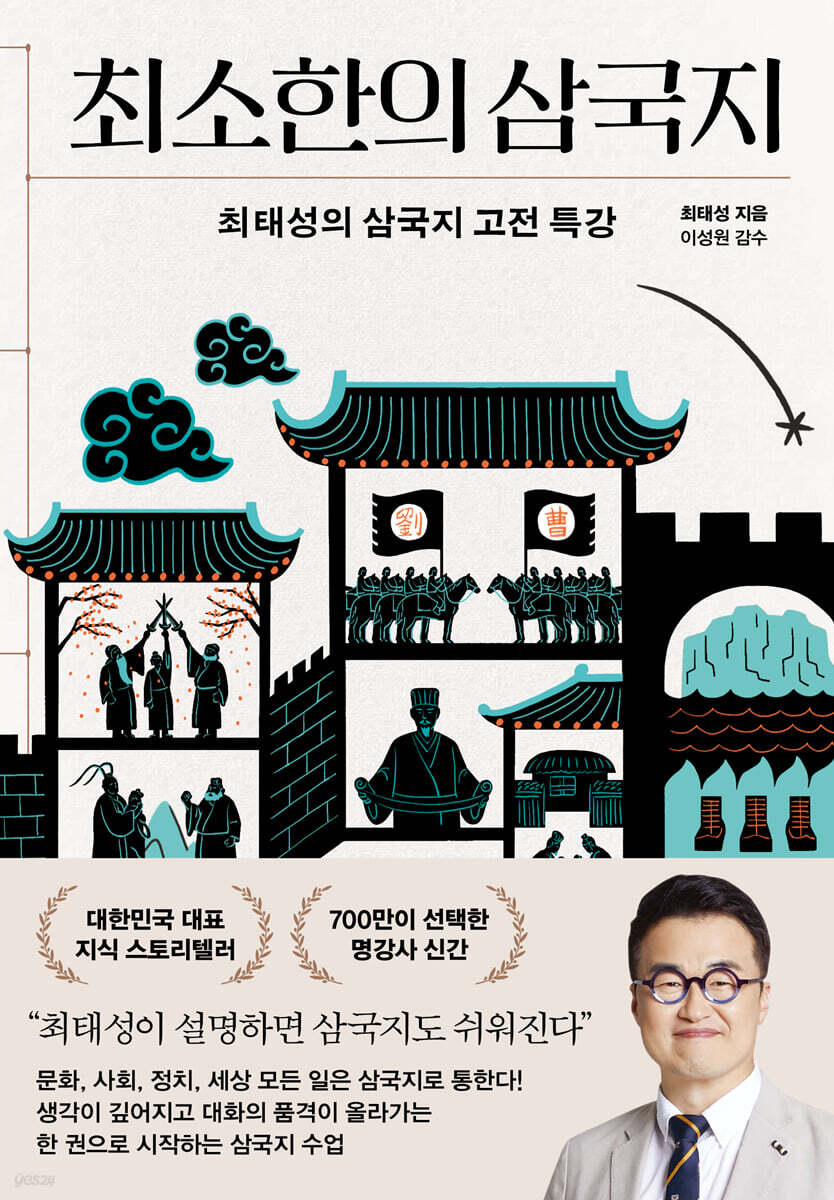 |
Description
Book Introduction
- A word from MD
-
Choi Tae-seong's friendly commentary on the Three KingdomsAn excellent commentary on the Romance of the Three Kingdoms.
The title is 'Minimum Romance of the Three Kingdoms', but you can fully understand the Romance of the Three Kingdoms with just this one book.
The lives of various heroes who each chose their own path in a chaotic world are explained in an easily understandable way using Choi Tae-seong's characteristically clear writing style.
December 2, 2025. Min-gyu Son, Humanities PD
★★★ Korea's Leading Knowledge Storyteller ★★★
★★★ New book by a famous lecturer chosen by 7 million people ★★★
“If Choi Tae-seong explains, the Three Kingdoms becomes easier!”
Deepening thoughts and improving the quality of conversation
Choi Tae-seong's special lecture on the Romance of the Three Kingdoms
An introductory book to the Romance of the Three Kingdoms, a must-read book in one volume.
Choi Tae-seong, a renowned lecturer with 7 million cumulative students, has stepped forward to share the wisdom and insights contained in the greatest classics of the East in an easy and enjoyable way.
For those who hesitated to start because of the vast volume and numerous characters, we have compiled only the essential events and characters that anyone needs to know into one volume, creating the "Minimum Romance of the Three Kingdoms" that anyone can understand in one sitting.
The author's secret to organizing the complex Romance of the Three Kingdoms into a clear and concise narrative is the Three Great Battles.
The story flows around the three largest wars in the Romance of the Three Kingdoms.
By following the process leading up to each war and the situation after the war, you can see at a glance the power structure of the three main characters of the Romance of the Three Kingdoms: Liu Bei, Cao Cao, and Sun Quan, and naturally understand the strategies and worldly skills that the world's heroes used to seize hegemony.
The author's unique, vivid storytelling style, combined with the absence of unfamiliar Chinese characters, will allow even those new to the Romance of the Three Kingdoms, or those who gave up halfway through, to become immersed in the exciting story of the Three Kingdoms.
《Minimum Romance of the Three Kingdoms》, which summarizes only the essential points while not missing the fun and lessons of the original Romance of the Three Kingdoms, is the shortest yet most profound way to read the Romance of the Three Kingdoms.
Let's delve into a classic lecture led by Korea's leading knowledge storyteller, Choi Tae-seong, that will deepen your thoughts and elevate the quality of your conversations.
★★★ New book by a famous lecturer chosen by 7 million people ★★★
“If Choi Tae-seong explains, the Three Kingdoms becomes easier!”
Deepening thoughts and improving the quality of conversation
Choi Tae-seong's special lecture on the Romance of the Three Kingdoms
An introductory book to the Romance of the Three Kingdoms, a must-read book in one volume.
Choi Tae-seong, a renowned lecturer with 7 million cumulative students, has stepped forward to share the wisdom and insights contained in the greatest classics of the East in an easy and enjoyable way.
For those who hesitated to start because of the vast volume and numerous characters, we have compiled only the essential events and characters that anyone needs to know into one volume, creating the "Minimum Romance of the Three Kingdoms" that anyone can understand in one sitting.
The author's secret to organizing the complex Romance of the Three Kingdoms into a clear and concise narrative is the Three Great Battles.
The story flows around the three largest wars in the Romance of the Three Kingdoms.
By following the process leading up to each war and the situation after the war, you can see at a glance the power structure of the three main characters of the Romance of the Three Kingdoms: Liu Bei, Cao Cao, and Sun Quan, and naturally understand the strategies and worldly skills that the world's heroes used to seize hegemony.
The author's unique, vivid storytelling style, combined with the absence of unfamiliar Chinese characters, will allow even those new to the Romance of the Three Kingdoms, or those who gave up halfway through, to become immersed in the exciting story of the Three Kingdoms.
《Minimum Romance of the Three Kingdoms》, which summarizes only the essential points while not missing the fun and lessons of the original Romance of the Three Kingdoms, is the shortest yet most profound way to read the Romance of the Three Kingdoms.
Let's delve into a classic lecture led by Korea's leading knowledge storyteller, Choi Tae-seong, that will deepen your thoughts and elevate the quality of your conversations.
- You can preview some of the book's contents.
Preview
index
|Preface| Wisdom and Insight for Today, Drawn from the Classics
Before entering
Chapter 1: The Rise of Heroes and Clashing Ambition: From the Peach Garden Oath to the Battle of Guandu
The Falling Han Dynasty and the Meeting of the Three Brothers
The emergence of Cao Cao, another protagonist of Romance of the Three Kingdoms
Warlords flocking to Luoyang
Dong Zhuo's death and the world divided
Cao Cao expanding his power and Liu Bei taking his first steps
Lu Bu's betrayal and Liu Bei's escape
Cao Cao turned a crisis into an opportunity
The dragon that escaped the cage and returned to the sea
The Battle of Guandu that decided the master of the Central Plains
Chapter 2: The World Divided into Three: From the Three Kingdoms to the Battle of Red Cliffs
Jiangdong, inherited by Sun Quan, and Jingzhou, which embraced Liu Bei
Zhuge Liang, the reclining dragon who will bring the world to you
Cao Cao, having pacified the north, heads south.
Liu Bei and Sun Quan join forces against Cao Cao
Chains of schemes being filled underwater
Burning Yangtze River, Battle of Red Cliffs
Chapter 3: The End of the Unrestrained: From the Battle of Jingzhou to the Battle of Yiling
The new owner of Hyungju, the land of opportunity
The division of the world into three parts realized by the occupation of Ikju
The Great Clash Between Cao Cao and Liu Bei: The Battle of Hanzhong
Sun Quan's betrayal and Guan Yu's death
The departure of heroes who fought for the world
The Collapse of the Alliance, the Battle of Yiling
Chapter 4: The Great Undertaking of Unifying the World Completed: From Zhuge Liang's Northern Expedition to the Unification of the Three Kingdoms
Zhuge Liang's declaration of war for the Northern Expedition
The first Northern Expedition failed due to repeated defeats.
The dream of the dragon at sunset in Ojangwon
Before entering
Chapter 1: The Rise of Heroes and Clashing Ambition: From the Peach Garden Oath to the Battle of Guandu
The Falling Han Dynasty and the Meeting of the Three Brothers
The emergence of Cao Cao, another protagonist of Romance of the Three Kingdoms
Warlords flocking to Luoyang
Dong Zhuo's death and the world divided
Cao Cao expanding his power and Liu Bei taking his first steps
Lu Bu's betrayal and Liu Bei's escape
Cao Cao turned a crisis into an opportunity
The dragon that escaped the cage and returned to the sea
The Battle of Guandu that decided the master of the Central Plains
Chapter 2: The World Divided into Three: From the Three Kingdoms to the Battle of Red Cliffs
Jiangdong, inherited by Sun Quan, and Jingzhou, which embraced Liu Bei
Zhuge Liang, the reclining dragon who will bring the world to you
Cao Cao, having pacified the north, heads south.
Liu Bei and Sun Quan join forces against Cao Cao
Chains of schemes being filled underwater
Burning Yangtze River, Battle of Red Cliffs
Chapter 3: The End of the Unrestrained: From the Battle of Jingzhou to the Battle of Yiling
The new owner of Hyungju, the land of opportunity
The division of the world into three parts realized by the occupation of Ikju
The Great Clash Between Cao Cao and Liu Bei: The Battle of Hanzhong
Sun Quan's betrayal and Guan Yu's death
The departure of heroes who fought for the world
The Collapse of the Alliance, the Battle of Yiling
Chapter 4: The Great Undertaking of Unifying the World Completed: From Zhuge Liang's Northern Expedition to the Unification of the Three Kingdoms
Zhuge Liang's declaration of war for the Northern Expedition
The first Northern Expedition failed due to repeated defeats.
The dream of the dragon at sunset in Ojangwon
Detailed image

Into the book
“Although we were not born on the same day and at the same time, we wish to die on the same day and at the same time. If I betray righteousness and forget kindness, please look upon my heart and kill me together!” This is the famous oath of brotherhood in the peach orchard, the Peach Garden Oath.
The three of them thus became sworn brothers.
Liu Bei, who was a descendant of the Han imperial family and had legitimacy, took the first position, Guan Yu, who had military power, took the second position, and Zhang Fei, who had economic power, took the third position.
Isn't it quite admirable that people who aren't related by blood swear to live and die together based on trust? In an era where the idea of "each for himself" is a hot topic, the oath of the Peach Garden even sounds romantic.
But even in modern times, when companies join forces to achieve a great goal or cause, we say that they have made a peach garden oath.
Perhaps, even though times have changed, it may still be more effective to trust others and live faithfully, rather than each person taking responsibility for themselves.
I think the idea that we can go farther together than when we are alone is something that has been true since the past.
Even if you're not sworn brothers, if you have a relationship where you can trust each other, it can be a great asset in life.
--- From "The Collapsing Han Nation and the Meeting of the Three Brothers"
It is against this backdrop that the Romance of the Three Kingdoms unfolds as a battle between many heroes.
(…) Because the power of the central government was so weak, it was easy for someone like Dong Zhuo to escape from the central government’s control and lead his own army to increase his power.
Then, when a suitable cause or opportunity arose, they fought each other to take land and expand their territory.
There was a king, but he was greedy and wanted to increase his power and seize real power.
This phenomenon of many people taking up positions in various parts of the country and competing for power is called 'Gungunghalgeo'.
'Gunung' means 'many heroes' and 'Halgeo' means 'to divide the country'.
After Dong Zhuo's death, the chaotic period in which regional heroes such as Cao Cao, Yuan Shu, and Yuan Shao began to compete with each other with full-fledged ambitions is called the 'Era of the Rise of Warlords.'
The already weakened Han Dynasty ended up splitting into various regional powers.
--- From "A World Without a Master, an Era of Warlords"
Zhuge Liang's plan was to first divide the world into three parts in order to unify it.
Until then, Liu Bei had only thought about fighting for the Han imperial family.
To Liu Bei, Cao Cao and Sun Quan were targets of overthrow.
It was either a fight with them, victory or defeat.
However, Zhuge Liang tells him to yield the north to Cao Cao and the east to Sun Quan.
Instead of fighting them right away, we should first take over Jing Province and Yi Province, and then form an alliance with Sun Quan to fight Cao Cao.
(…) This is the famous division of the world into three.
At this time, Liu Bei had no power whatsoever.
Zhuge Liang presented a vision to Liu Bei and drew up a roadmap.
In fact, later on, the Three Kingdoms period began with Cao Cao's Wei state in the Central Plains, Sun Quan's Wu state in the Jiangdong region, and Liu Bei's Shu state in the Yi Province.
At this time, Zhuge Liang had already drawn the picture.
--- From "Zhuge Liang, the Lying Dragon Who Will Bring the World"
The fire spread quickly, carried by the southeast wind.
The dark sky became bright as day in the flames.
Cao Cao's soldiers were in chaos.
The ships were connected by chains, so the fire spread quickly from ship to ship, and since all the ships were tied together, there was nowhere to escape.
Meanwhile, the Huang Gai's ships, laden with oil and firewood, began to collide here and there, engulfing everything from the river to the land camp in flames.
The Yangtze River around Red Cliffs burned like one giant flame.
In this way, 800,000 Cao Cao's troops were killed at Red Cliffs.
For this one victory, the Zhou army has been preparing operations with great care.
The fire attack plan devised by Zhou Yu and Zhuge Liang, Huang Gai's false surrender, Pang Tong's plan to link the ships with iron chains, and the wind changing direction as Zhuge Liang predicted.
All these strategies came together to drive Cao Cao, the greatest king of the world, into a corner.
Cao Cao barely managed to escape with his remaining soldiers.
However, even those numbers were gradually reduced in the pursuit by Sun Quan's generals, including Lu Meng, Gan Ning, and Ling Tong.
It was a complete defeat.
--- From "The Burning Yangtze River, the Battle of Red Cliffs"
The interests of Liu Bei and Sun Quan regarding Jing Province were intricately intertwined.
In order to divide the world into three parts and create a state of balance where each side checks the other, Liu Bei absolutely had to secure a base during this opportunity.
Sun Quan also had defeated his ministers who opposed the fight against Cao Cao and had mobilized troops and supplies for this war, so he could not give up Jing Province in this way.
It was a situation where neither of them could easily back down.
However, if both sides had strongly asserted their dominance and used definitive language such as, "We cannot give it to you because it is our land," then war would have broken out.
If war breaks out, the balance will be broken.
In this situation where he could neither give up nor fight, the card Zhuge Liang played was 'I will borrow it'.
This land was supposed to belong to Sun Quan, but we would use it temporarily for various reasons and then return it to Sun Quan once we secured another base.
Sun Quan also found the war with Liu Bei burdensome, so Zhuge Liang gave him Jing Province temporarily, but gave him the excuse that he would return it someday.
'Borrowing' was a diplomatic term that guaranteed the interests of both parties without breaking the alliance.
This, although precarious, maintained the alliance, and gave Zhuge Liang time to gain control of Jing Province and rebuild his power.
--- From "Land of Opportunity, the New Owner of Hyungju"
If we view the Romance of the Three Kingdoms as a story about moderation, then the epic tale of these heroes can ultimately be seen as a confrontation between those who are temperate and those who are not.
In the Battle of Guandu, Cao Cao and Yuan Shao were like that, in the Battle of Red Cliffs, Sun Quan and Liu Bei were like that, and in the Battle of Yiling, Sun Quan and Liu Bei were like that.
All who practice moderation have won.
Other heroes like Yuan Shu, Guan Yu, and Zhang Fei also lost their lives when they were unable to restrain themselves.
No matter how powerful a force you command or how high you are in life, the moment you lose self-control, your downfall begins.
Isn't this the core message conveyed by the Romance of the Three Kingdoms?
Of course, a life of moderation is not easy.
It might sound like an idealistic story to live your whole life training and discipline your mind.
But even if you don't succeed every time, you need to make a conscious effort.
I need to regularly reflect on whether my life is well-balanced and not excessive, and if anything is excessive, I need to limit or adjust it so that I can make appropriate decisions for the situation and the time.
The importance of moderation becomes even more evident when we recall what Liu Bei lost by making poor decisions that left him unable to govern himself.
--- From "The Collapse of the Alliance, the Battle of Yiling"
Zhuge Liang said that now that the south has been pacified, it is time to advance north, saying that this is “a way to repay the previous emperor and be loyal to Your Majesty.”
So, Zhuge Liang's request was to give him an order, and if he fails, to punish him.
Liu Shan, who received Zhuge Liang's resignation, ordered the northern expedition as he wished.
Realistically speaking, the war with Wei was a disadvantageous battle for Shu.
Not only the number of troops, but also the population and supplies needed to maintain the troops were far less than those of the Wei Dynasty.
However, Zhuge Liang sets out to realize his dream of unifying the world and reestablishing the Han Dynasty.
This was to show that although Liu Bei had passed away, his will had not disappeared.
The three of them thus became sworn brothers.
Liu Bei, who was a descendant of the Han imperial family and had legitimacy, took the first position, Guan Yu, who had military power, took the second position, and Zhang Fei, who had economic power, took the third position.
Isn't it quite admirable that people who aren't related by blood swear to live and die together based on trust? In an era where the idea of "each for himself" is a hot topic, the oath of the Peach Garden even sounds romantic.
But even in modern times, when companies join forces to achieve a great goal or cause, we say that they have made a peach garden oath.
Perhaps, even though times have changed, it may still be more effective to trust others and live faithfully, rather than each person taking responsibility for themselves.
I think the idea that we can go farther together than when we are alone is something that has been true since the past.
Even if you're not sworn brothers, if you have a relationship where you can trust each other, it can be a great asset in life.
--- From "The Collapsing Han Nation and the Meeting of the Three Brothers"
It is against this backdrop that the Romance of the Three Kingdoms unfolds as a battle between many heroes.
(…) Because the power of the central government was so weak, it was easy for someone like Dong Zhuo to escape from the central government’s control and lead his own army to increase his power.
Then, when a suitable cause or opportunity arose, they fought each other to take land and expand their territory.
There was a king, but he was greedy and wanted to increase his power and seize real power.
This phenomenon of many people taking up positions in various parts of the country and competing for power is called 'Gungunghalgeo'.
'Gunung' means 'many heroes' and 'Halgeo' means 'to divide the country'.
After Dong Zhuo's death, the chaotic period in which regional heroes such as Cao Cao, Yuan Shu, and Yuan Shao began to compete with each other with full-fledged ambitions is called the 'Era of the Rise of Warlords.'
The already weakened Han Dynasty ended up splitting into various regional powers.
--- From "A World Without a Master, an Era of Warlords"
Zhuge Liang's plan was to first divide the world into three parts in order to unify it.
Until then, Liu Bei had only thought about fighting for the Han imperial family.
To Liu Bei, Cao Cao and Sun Quan were targets of overthrow.
It was either a fight with them, victory or defeat.
However, Zhuge Liang tells him to yield the north to Cao Cao and the east to Sun Quan.
Instead of fighting them right away, we should first take over Jing Province and Yi Province, and then form an alliance with Sun Quan to fight Cao Cao.
(…) This is the famous division of the world into three.
At this time, Liu Bei had no power whatsoever.
Zhuge Liang presented a vision to Liu Bei and drew up a roadmap.
In fact, later on, the Three Kingdoms period began with Cao Cao's Wei state in the Central Plains, Sun Quan's Wu state in the Jiangdong region, and Liu Bei's Shu state in the Yi Province.
At this time, Zhuge Liang had already drawn the picture.
--- From "Zhuge Liang, the Lying Dragon Who Will Bring the World"
The fire spread quickly, carried by the southeast wind.
The dark sky became bright as day in the flames.
Cao Cao's soldiers were in chaos.
The ships were connected by chains, so the fire spread quickly from ship to ship, and since all the ships were tied together, there was nowhere to escape.
Meanwhile, the Huang Gai's ships, laden with oil and firewood, began to collide here and there, engulfing everything from the river to the land camp in flames.
The Yangtze River around Red Cliffs burned like one giant flame.
In this way, 800,000 Cao Cao's troops were killed at Red Cliffs.
For this one victory, the Zhou army has been preparing operations with great care.
The fire attack plan devised by Zhou Yu and Zhuge Liang, Huang Gai's false surrender, Pang Tong's plan to link the ships with iron chains, and the wind changing direction as Zhuge Liang predicted.
All these strategies came together to drive Cao Cao, the greatest king of the world, into a corner.
Cao Cao barely managed to escape with his remaining soldiers.
However, even those numbers were gradually reduced in the pursuit by Sun Quan's generals, including Lu Meng, Gan Ning, and Ling Tong.
It was a complete defeat.
--- From "The Burning Yangtze River, the Battle of Red Cliffs"
The interests of Liu Bei and Sun Quan regarding Jing Province were intricately intertwined.
In order to divide the world into three parts and create a state of balance where each side checks the other, Liu Bei absolutely had to secure a base during this opportunity.
Sun Quan also had defeated his ministers who opposed the fight against Cao Cao and had mobilized troops and supplies for this war, so he could not give up Jing Province in this way.
It was a situation where neither of them could easily back down.
However, if both sides had strongly asserted their dominance and used definitive language such as, "We cannot give it to you because it is our land," then war would have broken out.
If war breaks out, the balance will be broken.
In this situation where he could neither give up nor fight, the card Zhuge Liang played was 'I will borrow it'.
This land was supposed to belong to Sun Quan, but we would use it temporarily for various reasons and then return it to Sun Quan once we secured another base.
Sun Quan also found the war with Liu Bei burdensome, so Zhuge Liang gave him Jing Province temporarily, but gave him the excuse that he would return it someday.
'Borrowing' was a diplomatic term that guaranteed the interests of both parties without breaking the alliance.
This, although precarious, maintained the alliance, and gave Zhuge Liang time to gain control of Jing Province and rebuild his power.
--- From "Land of Opportunity, the New Owner of Hyungju"
If we view the Romance of the Three Kingdoms as a story about moderation, then the epic tale of these heroes can ultimately be seen as a confrontation between those who are temperate and those who are not.
In the Battle of Guandu, Cao Cao and Yuan Shao were like that, in the Battle of Red Cliffs, Sun Quan and Liu Bei were like that, and in the Battle of Yiling, Sun Quan and Liu Bei were like that.
All who practice moderation have won.
Other heroes like Yuan Shu, Guan Yu, and Zhang Fei also lost their lives when they were unable to restrain themselves.
No matter how powerful a force you command or how high you are in life, the moment you lose self-control, your downfall begins.
Isn't this the core message conveyed by the Romance of the Three Kingdoms?
Of course, a life of moderation is not easy.
It might sound like an idealistic story to live your whole life training and discipline your mind.
But even if you don't succeed every time, you need to make a conscious effort.
I need to regularly reflect on whether my life is well-balanced and not excessive, and if anything is excessive, I need to limit or adjust it so that I can make appropriate decisions for the situation and the time.
The importance of moderation becomes even more evident when we recall what Liu Bei lost by making poor decisions that left him unable to govern himself.
--- From "The Collapse of the Alliance, the Battle of Yiling"
Zhuge Liang said that now that the south has been pacified, it is time to advance north, saying that this is “a way to repay the previous emperor and be loyal to Your Majesty.”
So, Zhuge Liang's request was to give him an order, and if he fails, to punish him.
Liu Shan, who received Zhuge Liang's resignation, ordered the northern expedition as he wished.
Realistically speaking, the war with Wei was a disadvantageous battle for Shu.
Not only the number of troops, but also the population and supplies needed to maintain the troops were far less than those of the Wei Dynasty.
However, Zhuge Liang sets out to realize his dream of unifying the world and reestablishing the Han Dynasty.
This was to show that although Liu Bei had passed away, his will had not disappeared.
--- From "Zhuge Liang's Declaration of Inauguration for the Northern Expedition"
Publisher's Review
For all readers who want to read the Romance of the Three Kingdoms easily and accurately
Big Star Teacher Choi Tae-seong's special lecture on the Three Kingdoms, a liberal arts course you can read once and use for a lifetime!
“National team throws down the gauntlet”, “Appeared after much persuasion from the production team”, “Like a fish in water after advancing to the US”… .
These expressions, frequently cited across all walks of life, regardless of field, including culture, society, and politics, have something in common.
All of these words originate from the Romance of the Three Kingdoms.
In addition, idioms such as ‘Gye-reuk’ and ‘Baek-mi’ and new words such as ‘Bang-gu-seok Yeo-po’ are also based on the Three Kingdoms.
In this way, if you look closely, the Romance of the Three Kingdoms is permeating every aspect of our daily lives.
Because it has been read as a required book for 2,000 years and has become a part of general knowledge.
However, it is also true that some people are reluctant to try it because of the preconceived notion that it is difficult and complicated.
Author Choi Tae-seong, who has been reading the Three Kingdoms since childhood as a Three Kingdoms kid, says that it would be a great shame to miss out on the Three Kingdoms because of such preconceptions.
Just as we gain the wisdom we need today from history, we can also gain insights for life from classics that have been loved for a long time.
The author, who believed that a book suitable for beginners was needed, drew on his experience in extracting essential knowledge from vast historical sources to write "Minimum Romance of the Three Kingdoms," carefully selecting the core of the Romance of the Three Kingdoms.
This book explains the historical background and the psychology of the characters in a friendly way so that the content can be easily understood even without prior knowledge. It also explains Chinese characters, which can be a barrier to entry when reading classics, in familiar modern language so that people of all ages can read it with enjoyment.
Idioms and idioms derived from the Romance of the Three Kingdoms were also pointed out, and their meanings and usage methods were not missed.
《Minimal Romance of the Three Kingdoms》, which compiles the greatest classics of the East without a single complex or difficult word, will serve as a friendly and accurate guide to the world of the Three Kingdoms.
“If you remember just three events, you can understand the complex Three Kingdoms in no time!”
From the Peach Garden Oath to the unification of the Three Kingdoms...
A minimal Three Kingdoms story that captures the flow of a grand heroic epic.
The work commonly referred to as the “Romance of the Three Kingdoms” in Korea is “Romance of the Three Kingdoms” written by Luo Guanzhong.
This is a historical novel that covers the 100 years from the end of the 2nd century to the end of the 3rd century, when the Later Han Dynasty collapsed and was divided into the Three Kingdoms, and then the Chinese mainland was reunified by the Western Jin Dynasty.
In this epic, Liu Bei, Cao Cao, and Sun Quan, who divided the world into three kingdoms, engage in a fierce battle to unify the continent, and over 1,000 characters and numerous events appear surrounding them.
The author, who was struggling to find a way to condense the story, which spanned dozens of volumes, to its core while maintaining the original's fun, chose the three major wars of the Romance of the Three Kingdoms as the story's axis.
The three largest battles in the Romance of the Three Kingdoms, the Battle of Guandu, the Battle of Red Cliffs, and the Battle of Yiling, are not only filled with famous scenes that are still used as content today, but also because the transfer of power was determined by the outcome of these wars.
Accordingly, the book is composed of a total of four chapters.
Chapter 1 covers the story from the Peach Garden Oath of Liu Bei, Guan Yu, and Zhang Fei to the Battle of Guandu, which made Cao Cao famous; Chapter 2 covers the story of Liu Bei obtaining Zhuge Liang after much effort, to the Battle of Red Cliffs, where he allied with Sun Quan to fight Cao Cao; Chapter 3 covers the story of the division of the world into three parts, to the Battle of Yiling, where Liu Bei lost his sworn brother Guan Yu and attacked Sun Quan; and Chapter 4 covers the story from Zhuge Liang's Northern Expedition to the unification of the Three Kingdoms.
By unfolding the story around the three great wars, you can grasp the flow of the Three Kingdoms, which was difficult to grasp in context, and minimize the confusion that comes from complex events and character relationships, allowing you to immerse yourself in a fateful battle with peace of mind.
It only contains the essentials, but doesn't miss any details.
To aid understanding and enhance visual enjoyment, 38 visual aids, including various maps and weapon illustrations, have been included.
With "Minimal Romance of the Three Kingdoms," which compresses the core while maintaining the flow, completely conquering the Three Kingdoms is not difficult.
“If I were a character in the Romance of the Three Kingdoms, who would I choose to be like?”
A first step toward exploring the wisdom and insights contained in the greatest classics of the East.
Why is Romance of the Three Kingdoms still considered one of the best guides to life today? Because it goes beyond simply telling the story of past heroes.
There is a saying that goes, “Don’t discuss life with someone who hasn’t read the Romance of the Three Kingdoms, and don’t associate with someone who has read it more than three times,” showing that the Romance of the Three Kingdoms contains wisdom that sees through the world.
This is because in this drama, where heroes with great ambitions rise up to save a country in chaos and fight for their own desires and justifications, we can glimpse all types of relationships, conflicts, and choices.
It contains countless successes, failures, and wisdom of life.
Therefore, reading the Romance of the Three Kingdoms is not just reading a classic, but learning about human nature and life strategies.
The author proposes 'moderation' as a new perspective on reading the Romance of the Three Kingdoms.
The Romance of the Three Kingdoms is nothing but a battle between those who are moderate and those who are not.
Even the greatest heroes fall the moment they lose self-control, and ultimately victory belongs to those who know how to control themselves.
So, through this book, the author recommends that we reconsider ‘moderation.’
As the story progresses in an interesting way, it naturally leads readers to reflect on how to govern themselves and examine their attitude towards life.
The Romance of the Three Kingdoms is a story of heroes fighting for control of the world, but it has the charm of allowing us to discover ourselves in the heroes' appearances.
It makes us identify with the various heroes, such as the cool-headed Cao Cao, the tolerant Liu Bei, the patient Sun Quan, and the wise Zhuge Liang, and ask, “If I were a character in the Romance of the Three Kingdoms, who would I choose?”
《Minimum Three Kingdoms》 also helps readers ask and answer questions themselves, thereby gaining their own life strategies and wisdom.
Let's take the first step toward exploring the wisdom and insight of the classics with this fascinating and in-depth book that explores the choices and life stories of the characters in the Romance of the Three Kingdoms.
Big Star Teacher Choi Tae-seong's special lecture on the Three Kingdoms, a liberal arts course you can read once and use for a lifetime!
“National team throws down the gauntlet”, “Appeared after much persuasion from the production team”, “Like a fish in water after advancing to the US”… .
These expressions, frequently cited across all walks of life, regardless of field, including culture, society, and politics, have something in common.
All of these words originate from the Romance of the Three Kingdoms.
In addition, idioms such as ‘Gye-reuk’ and ‘Baek-mi’ and new words such as ‘Bang-gu-seok Yeo-po’ are also based on the Three Kingdoms.
In this way, if you look closely, the Romance of the Three Kingdoms is permeating every aspect of our daily lives.
Because it has been read as a required book for 2,000 years and has become a part of general knowledge.
However, it is also true that some people are reluctant to try it because of the preconceived notion that it is difficult and complicated.
Author Choi Tae-seong, who has been reading the Three Kingdoms since childhood as a Three Kingdoms kid, says that it would be a great shame to miss out on the Three Kingdoms because of such preconceptions.
Just as we gain the wisdom we need today from history, we can also gain insights for life from classics that have been loved for a long time.
The author, who believed that a book suitable for beginners was needed, drew on his experience in extracting essential knowledge from vast historical sources to write "Minimum Romance of the Three Kingdoms," carefully selecting the core of the Romance of the Three Kingdoms.
This book explains the historical background and the psychology of the characters in a friendly way so that the content can be easily understood even without prior knowledge. It also explains Chinese characters, which can be a barrier to entry when reading classics, in familiar modern language so that people of all ages can read it with enjoyment.
Idioms and idioms derived from the Romance of the Three Kingdoms were also pointed out, and their meanings and usage methods were not missed.
《Minimal Romance of the Three Kingdoms》, which compiles the greatest classics of the East without a single complex or difficult word, will serve as a friendly and accurate guide to the world of the Three Kingdoms.
“If you remember just three events, you can understand the complex Three Kingdoms in no time!”
From the Peach Garden Oath to the unification of the Three Kingdoms...
A minimal Three Kingdoms story that captures the flow of a grand heroic epic.
The work commonly referred to as the “Romance of the Three Kingdoms” in Korea is “Romance of the Three Kingdoms” written by Luo Guanzhong.
This is a historical novel that covers the 100 years from the end of the 2nd century to the end of the 3rd century, when the Later Han Dynasty collapsed and was divided into the Three Kingdoms, and then the Chinese mainland was reunified by the Western Jin Dynasty.
In this epic, Liu Bei, Cao Cao, and Sun Quan, who divided the world into three kingdoms, engage in a fierce battle to unify the continent, and over 1,000 characters and numerous events appear surrounding them.
The author, who was struggling to find a way to condense the story, which spanned dozens of volumes, to its core while maintaining the original's fun, chose the three major wars of the Romance of the Three Kingdoms as the story's axis.
The three largest battles in the Romance of the Three Kingdoms, the Battle of Guandu, the Battle of Red Cliffs, and the Battle of Yiling, are not only filled with famous scenes that are still used as content today, but also because the transfer of power was determined by the outcome of these wars.
Accordingly, the book is composed of a total of four chapters.
Chapter 1 covers the story from the Peach Garden Oath of Liu Bei, Guan Yu, and Zhang Fei to the Battle of Guandu, which made Cao Cao famous; Chapter 2 covers the story of Liu Bei obtaining Zhuge Liang after much effort, to the Battle of Red Cliffs, where he allied with Sun Quan to fight Cao Cao; Chapter 3 covers the story of the division of the world into three parts, to the Battle of Yiling, where Liu Bei lost his sworn brother Guan Yu and attacked Sun Quan; and Chapter 4 covers the story from Zhuge Liang's Northern Expedition to the unification of the Three Kingdoms.
By unfolding the story around the three great wars, you can grasp the flow of the Three Kingdoms, which was difficult to grasp in context, and minimize the confusion that comes from complex events and character relationships, allowing you to immerse yourself in a fateful battle with peace of mind.
It only contains the essentials, but doesn't miss any details.
To aid understanding and enhance visual enjoyment, 38 visual aids, including various maps and weapon illustrations, have been included.
With "Minimal Romance of the Three Kingdoms," which compresses the core while maintaining the flow, completely conquering the Three Kingdoms is not difficult.
“If I were a character in the Romance of the Three Kingdoms, who would I choose to be like?”
A first step toward exploring the wisdom and insights contained in the greatest classics of the East.
Why is Romance of the Three Kingdoms still considered one of the best guides to life today? Because it goes beyond simply telling the story of past heroes.
There is a saying that goes, “Don’t discuss life with someone who hasn’t read the Romance of the Three Kingdoms, and don’t associate with someone who has read it more than three times,” showing that the Romance of the Three Kingdoms contains wisdom that sees through the world.
This is because in this drama, where heroes with great ambitions rise up to save a country in chaos and fight for their own desires and justifications, we can glimpse all types of relationships, conflicts, and choices.
It contains countless successes, failures, and wisdom of life.
Therefore, reading the Romance of the Three Kingdoms is not just reading a classic, but learning about human nature and life strategies.
The author proposes 'moderation' as a new perspective on reading the Romance of the Three Kingdoms.
The Romance of the Three Kingdoms is nothing but a battle between those who are moderate and those who are not.
Even the greatest heroes fall the moment they lose self-control, and ultimately victory belongs to those who know how to control themselves.
So, through this book, the author recommends that we reconsider ‘moderation.’
As the story progresses in an interesting way, it naturally leads readers to reflect on how to govern themselves and examine their attitude towards life.
The Romance of the Three Kingdoms is a story of heroes fighting for control of the world, but it has the charm of allowing us to discover ourselves in the heroes' appearances.
It makes us identify with the various heroes, such as the cool-headed Cao Cao, the tolerant Liu Bei, the patient Sun Quan, and the wise Zhuge Liang, and ask, “If I were a character in the Romance of the Three Kingdoms, who would I choose?”
《Minimum Three Kingdoms》 also helps readers ask and answer questions themselves, thereby gaining their own life strategies and wisdom.
Let's take the first step toward exploring the wisdom and insight of the classics with this fascinating and in-depth book that explores the choices and life stories of the characters in the Romance of the Three Kingdoms.
GOODS SPECIFICS
- Date of issue: November 18, 2025
- Page count, weight, size: 352 pages | 528g | 146*210*23mm
- ISBN13: 9791193401583
- ISBN10: 1193401585
You may also like
카테고리
korean


korean

![GQ KOREA Mark (Monthly): December [2025]](http://librairie.coreenne.fr/cdn/shop/files/8ef265dbbfbf186523ed75ba7319009d.jpg?v=1765340328&width=3840)


