

Sentences from a scientist asking about the direction of life
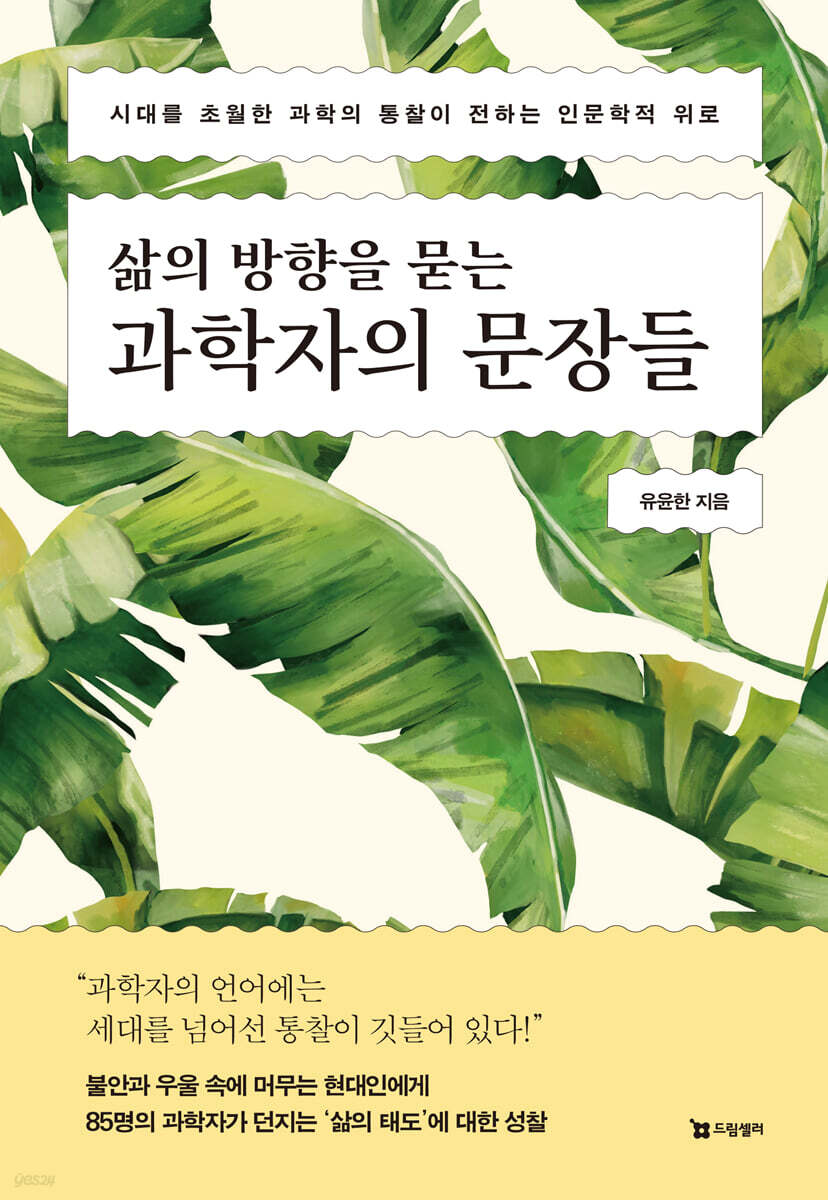 |
Description
Book Introduction
“In the sentence of a scientist asking about the direction of life,
“The practice of asking about the essence of life begins!”
Through the sentences of human intelligence such as Thales, Einstein, Carl Sagan, Stephen Hawking, and Jensen Huang
√ Curiosity about life direction and the world
√ Unwavering courage in the face of uncertainty and failure
√ Persistence and an attitude to tolerate boredom
√ A book that explores the value of exploration and immersion over success!
“Where does this attitude of constant questioning and inquiry come from?”
Enduring 'boredom' is not simply a matter of perseverance,
It is an attitude of believing that what I am doing at this moment has meaning!
With what mindset did the scientists walk that path?
Like Mendel, who observed peas in a monastery for eight years to discover genes, like Rosalind Franklin, who discovered the structure of DNA after countless failures, and like Madame Curie, who obtained 0.1 gram of radium after thousands of separation experiments, the words of scientists who silently endured countless failures and boredom contain timeless insights! The 180 sentences filled with the agony and determination of 85 scientists, including Thales, Einstein, Stephen Hawking, Carl Sagan, Lisa Su, and Jensen Huang, are a history of science and a record of courage and determination! In the era of the convergence of humanities and science, this "definitely written humanities essay" will be the most reliable compass to steady your mind and show you the way forward! Whenever the direction of your life wavers, open this book.
You will face a stronger 'me' than yesterday!
“The practice of asking about the essence of life begins!”
Through the sentences of human intelligence such as Thales, Einstein, Carl Sagan, Stephen Hawking, and Jensen Huang
√ Curiosity about life direction and the world
√ Unwavering courage in the face of uncertainty and failure
√ Persistence and an attitude to tolerate boredom
√ A book that explores the value of exploration and immersion over success!
“Where does this attitude of constant questioning and inquiry come from?”
Enduring 'boredom' is not simply a matter of perseverance,
It is an attitude of believing that what I am doing at this moment has meaning!
With what mindset did the scientists walk that path?
Like Mendel, who observed peas in a monastery for eight years to discover genes, like Rosalind Franklin, who discovered the structure of DNA after countless failures, and like Madame Curie, who obtained 0.1 gram of radium after thousands of separation experiments, the words of scientists who silently endured countless failures and boredom contain timeless insights! The 180 sentences filled with the agony and determination of 85 scientists, including Thales, Einstein, Stephen Hawking, Carl Sagan, Lisa Su, and Jensen Huang, are a history of science and a record of courage and determination! In the era of the convergence of humanities and science, this "definitely written humanities essay" will be the most reliable compass to steady your mind and show you the way forward! Whenever the direction of your life wavers, open this book.
You will face a stronger 'me' than yesterday!
- You can preview some of the book's contents.
Preview
index
To the readers of this book
Thales, Pythagoras, Democritus, Hippocrates, Aristotle, Archimedes, Eratosthenes, Hipparchus, Ptolemy, Hypatia, Theon, Nemesius, Firmicus Maternus, Ammonius Hermias, Severus Sebokht, Brahmagupta, the Venerable Vedas, Al-Khwarizmi, Zair ibn Hayyan, Nasir al-Din al-Tusi, Roger Bacon, Choi Mu-seon, Ulugh Beg, Paolo Toscanelli, Nicolaus Cusanus, Nicolaus Copernicus, Andrea Vesalius, Heo Jun, William Gilbert, Tycho Brahe, Galileo Galilei, Johannes Kepler, Evangelista Torricelli, Robert Boyle, Isaac Newton, Emilie du Châtelet, Benjamin Franklin, Carl von Linnaeus, Dorothea Erksleben, Henry Cavendish, Carl Friedrich Gauss, Michael Faraday, Charles Darwin, Gregor Mendel, Louis Pasteur, James Clerk Maxwell, Dmitri Mendeleev, Thomas Edison, Nikola Tesla, Max Planck, David Hilbert, Marie Curie, Ernest Rutherford, Lise Meitner, Albert Einstein, Alexander Fleming, Niels Bohr, Erwin Schrödinger, Edwin Hubble, Georges Lemaître, Enrico Fermi, Werner Heisenberg, Rachel Carson, Barbara McClintock, Grace Hopper, Alan Turing, Chien-Shiung Wu, Francis Crick, Richard Feynman, Rosalind Franklin, James Watson, Kazuo Inamori, Carl Sagan, Jane Goodall, Stephen Hawking, Bill Gates, Christopher Bishop Jensen Huang, Jennifer Doudna, Emmanuel Charpentier, Lisa Su, Elon Musk, Demis Hassabis, and Parisa Tabriz
Thales, Pythagoras, Democritus, Hippocrates, Aristotle, Archimedes, Eratosthenes, Hipparchus, Ptolemy, Hypatia, Theon, Nemesius, Firmicus Maternus, Ammonius Hermias, Severus Sebokht, Brahmagupta, the Venerable Vedas, Al-Khwarizmi, Zair ibn Hayyan, Nasir al-Din al-Tusi, Roger Bacon, Choi Mu-seon, Ulugh Beg, Paolo Toscanelli, Nicolaus Cusanus, Nicolaus Copernicus, Andrea Vesalius, Heo Jun, William Gilbert, Tycho Brahe, Galileo Galilei, Johannes Kepler, Evangelista Torricelli, Robert Boyle, Isaac Newton, Emilie du Châtelet, Benjamin Franklin, Carl von Linnaeus, Dorothea Erksleben, Henry Cavendish, Carl Friedrich Gauss, Michael Faraday, Charles Darwin, Gregor Mendel, Louis Pasteur, James Clerk Maxwell, Dmitri Mendeleev, Thomas Edison, Nikola Tesla, Max Planck, David Hilbert, Marie Curie, Ernest Rutherford, Lise Meitner, Albert Einstein, Alexander Fleming, Niels Bohr, Erwin Schrödinger, Edwin Hubble, Georges Lemaître, Enrico Fermi, Werner Heisenberg, Rachel Carson, Barbara McClintock, Grace Hopper, Alan Turing, Chien-Shiung Wu, Francis Crick, Richard Feynman, Rosalind Franklin, James Watson, Kazuo Inamori, Carl Sagan, Jane Goodall, Stephen Hawking, Bill Gates, Christopher Bishop Jensen Huang, Jennifer Doudna, Emmanuel Charpentier, Lisa Su, Elon Musk, Demis Hassabis, and Parisa Tabriz
Detailed image
.jpg)
Into the book
“Know thyself.”
This saying is often attributed to Socrates, but in fact it is one of the aphorisms inscribed on the temple of Delphi long before that.
This is a saying by one of the seven wise men of ancient times, most likely Thales.
When I look out the window in the morning, the scenery that unfolds is not much different from yesterday.
A similar distance, a tree that is always there… .
But sometimes it feels really strange.
For some reason, my perspective on them has changed.
Thales' claim that 'the origin of the world is water' is not simply natural philosophy.
It is a bold declaration from someone who has come to see the world we have long believed to be created by God in a completely different way.
Afterwards, the door was opened to a new idea that sought the origin of the world in primal matter rather than in God.
This is the beginning of natural philosophy.
To put Thales's "Know thyself" into practice, we must first look into our own hearts.
Depending on that gaze, your heart will change, and eventually a new world will open up around you.
We are what we are as we look at ourselves and acknowledge ourselves.
--- p.16
“Everything is made of numbers.”
Pythagoras, who was both a philosopher and a 'number maniac', tried to interpret everything in the world with numbers.
Did he know that the curves of a seashell reveal the Fibonacci sequence, that a snowflake, viewed through a magnifying glass, reveals a hexagon? Or that lightning strikes in a regular pattern, and that galaxies rotate in a ratio we instinctively find beautiful? In any case, Pythagoras discerned that numbers were evidence of the order hidden within all natural phenomena.
Even when strumming the lyre, an ancient stringed instrument, he would say, “Huh? The pitch changes depending on the length of the strings.” He even created the musical scale system that we learn today as ‘do-re-mi-fa-sol-la-ti-do.’
Even when we love, we are governed by numbers.
If your heartbeat is not beating fast in a regular pattern and certain hormones are not secreted to the right levels, then the love is fake.
In this way, numbers show all order more clearly.
So, the more chaotic the world becomes, the more we should focus on the numbers that reveal the invisible order within it.
Also, we must remember that experiences that seem meaningless at the moment may eventually form a pattern.
--- p.18
“Life is short, art is long.”
The 'art' Hippocrates spoke of does not only mean fine art or music.
Perhaps he really wanted to talk about medicine. Life is short, and there's not enough time to properly learn medicine.
This statement is also a confession that human understanding is limited and that there is no end to the world to learn about.
This is true not only of medicine, but also of science, literature, and philosophy.
The universe is vast, and the time given to one human is so short.
There is only one reason why we repeat experiments in the lab, revise sentences at our desks, and ask endless questions.
Even if it can't be perfect, I want to reach the end someday.
And even if we leave without achieving everything, we hope that the efforts we leave behind will be passed on to the next generation and become their starting point.
As Hippocrates said, life is short but art is long.
--- p.23
“Nature reveals her secret mysteries most frankly when she deviates from the familiar path.”
The deepest insights often come from surprising places that defy easy explanation.
Harvey discovered the secret of blood circulation outside the traditional teachings of Galen.
Kepler, mentioned earlier, also discovered elliptical orbits, which broke the stereotype that planets move in perfect circles, and also discovered the laws of planetary motion within them.
Even when philosophy is at its most powerful, it is in moments when it confronts the contradiction of what is familiar.
For example, philosophers constantly ask questions like, "If humans are free, why does society restrict their actions through laws? If God is omnipotent, why does evil exist?"
And by confronting two seemingly contradictory concepts simultaneously, he digs into the conflict without avoiding it.
We must become accustomed to the discomfort that contradiction and conflict bring.
Because in that discomfort, the existing order is shaken and new questions sprout.
It is precisely where familiar explanations fail that thinking can open up wider and deeper.
The ability to endure uncertainty is the beginning of true thinking.
--- p.79
“He who wastes an hour has not yet discovered the value of life.”
These are the words contained in a letter Darwin sent to his sister in 1836.
In his youth, Darwin went on long voyages, observing the plants, animals, winds, and seas of unfamiliar lands and leaving behind numerous records.
Darwin's "Origin of Species" was not just a scientific achievement, but the result of one man's long and precious time spent trying to understand the world.
It took him a full 23 years to complete this book after the Beagle voyage.
The 'one hour' that Darwin spoke of will vary depending on what you focus on and live for.
Sometimes, looking out the window in silence or quietly turning the pages of a book are also part of our lives.
Cherishing time means not wasting every moment of your life.
Just by going through our day and remembering where we were and what we felt each hour, we can hold on to life a little more firmly.
--- p.93
“Life is too complex to be thought of as arising by chance.
But this is the illusion we must overcome.”
Crick was wary of the belief that life was so sophisticated that it envisioned a designer.
He saw the gap between what can be explained in the language of science and what can easily be mystified by imagination.
Looking back at the history of countless mutations and natural selection that have occurred over billions of years, it reveals how order arises from chance.
By chance, a protein folds, by chance, a gene is expressed at the right time, and by chance, the structures that distinguish cells from each other are established.
All this is possible without any special design, so we must always be vigilant so as not to mistake wonder for mystery.
Science may not have all the answers, but when scientific explanations cease, myths and ignorance rule the world.
Ultimately, he traced back to how rationally explainable life is, to explain how amazing it is.
Science is the most human way we can understand the world rationally through questioning.
This saying is often attributed to Socrates, but in fact it is one of the aphorisms inscribed on the temple of Delphi long before that.
This is a saying by one of the seven wise men of ancient times, most likely Thales.
When I look out the window in the morning, the scenery that unfolds is not much different from yesterday.
A similar distance, a tree that is always there… .
But sometimes it feels really strange.
For some reason, my perspective on them has changed.
Thales' claim that 'the origin of the world is water' is not simply natural philosophy.
It is a bold declaration from someone who has come to see the world we have long believed to be created by God in a completely different way.
Afterwards, the door was opened to a new idea that sought the origin of the world in primal matter rather than in God.
This is the beginning of natural philosophy.
To put Thales's "Know thyself" into practice, we must first look into our own hearts.
Depending on that gaze, your heart will change, and eventually a new world will open up around you.
We are what we are as we look at ourselves and acknowledge ourselves.
--- p.16
“Everything is made of numbers.”
Pythagoras, who was both a philosopher and a 'number maniac', tried to interpret everything in the world with numbers.
Did he know that the curves of a seashell reveal the Fibonacci sequence, that a snowflake, viewed through a magnifying glass, reveals a hexagon? Or that lightning strikes in a regular pattern, and that galaxies rotate in a ratio we instinctively find beautiful? In any case, Pythagoras discerned that numbers were evidence of the order hidden within all natural phenomena.
Even when strumming the lyre, an ancient stringed instrument, he would say, “Huh? The pitch changes depending on the length of the strings.” He even created the musical scale system that we learn today as ‘do-re-mi-fa-sol-la-ti-do.’
Even when we love, we are governed by numbers.
If your heartbeat is not beating fast in a regular pattern and certain hormones are not secreted to the right levels, then the love is fake.
In this way, numbers show all order more clearly.
So, the more chaotic the world becomes, the more we should focus on the numbers that reveal the invisible order within it.
Also, we must remember that experiences that seem meaningless at the moment may eventually form a pattern.
--- p.18
“Life is short, art is long.”
The 'art' Hippocrates spoke of does not only mean fine art or music.
Perhaps he really wanted to talk about medicine. Life is short, and there's not enough time to properly learn medicine.
This statement is also a confession that human understanding is limited and that there is no end to the world to learn about.
This is true not only of medicine, but also of science, literature, and philosophy.
The universe is vast, and the time given to one human is so short.
There is only one reason why we repeat experiments in the lab, revise sentences at our desks, and ask endless questions.
Even if it can't be perfect, I want to reach the end someday.
And even if we leave without achieving everything, we hope that the efforts we leave behind will be passed on to the next generation and become their starting point.
As Hippocrates said, life is short but art is long.
--- p.23
“Nature reveals her secret mysteries most frankly when she deviates from the familiar path.”
The deepest insights often come from surprising places that defy easy explanation.
Harvey discovered the secret of blood circulation outside the traditional teachings of Galen.
Kepler, mentioned earlier, also discovered elliptical orbits, which broke the stereotype that planets move in perfect circles, and also discovered the laws of planetary motion within them.
Even when philosophy is at its most powerful, it is in moments when it confronts the contradiction of what is familiar.
For example, philosophers constantly ask questions like, "If humans are free, why does society restrict their actions through laws? If God is omnipotent, why does evil exist?"
And by confronting two seemingly contradictory concepts simultaneously, he digs into the conflict without avoiding it.
We must become accustomed to the discomfort that contradiction and conflict bring.
Because in that discomfort, the existing order is shaken and new questions sprout.
It is precisely where familiar explanations fail that thinking can open up wider and deeper.
The ability to endure uncertainty is the beginning of true thinking.
--- p.79
“He who wastes an hour has not yet discovered the value of life.”
These are the words contained in a letter Darwin sent to his sister in 1836.
In his youth, Darwin went on long voyages, observing the plants, animals, winds, and seas of unfamiliar lands and leaving behind numerous records.
Darwin's "Origin of Species" was not just a scientific achievement, but the result of one man's long and precious time spent trying to understand the world.
It took him a full 23 years to complete this book after the Beagle voyage.
The 'one hour' that Darwin spoke of will vary depending on what you focus on and live for.
Sometimes, looking out the window in silence or quietly turning the pages of a book are also part of our lives.
Cherishing time means not wasting every moment of your life.
Just by going through our day and remembering where we were and what we felt each hour, we can hold on to life a little more firmly.
--- p.93
“Life is too complex to be thought of as arising by chance.
But this is the illusion we must overcome.”
Crick was wary of the belief that life was so sophisticated that it envisioned a designer.
He saw the gap between what can be explained in the language of science and what can easily be mystified by imagination.
Looking back at the history of countless mutations and natural selection that have occurred over billions of years, it reveals how order arises from chance.
By chance, a protein folds, by chance, a gene is expressed at the right time, and by chance, the structures that distinguish cells from each other are established.
All this is possible without any special design, so we must always be vigilant so as not to mistake wonder for mystery.
Science may not have all the answers, but when scientific explanations cease, myths and ignorance rule the world.
Ultimately, he traced back to how rationally explainable life is, to explain how amazing it is.
Science is the most human way we can understand the world rationally through questioning.
--- p.155
Publisher's Review
The scientist's sentences that quietly touch the heart, "The practice of asking about the essence of life begins with the scientist's sentences that ask about the direction of life!"
Through the sentences of human intelligence such as Thales, Einstein, Carl Sagan, Stephen Hawking, and Jensen Huang
√ Curiosity about life direction and the world
√ Unwavering courage in the face of uncertainty and failure
√ Persistence and an attitude to tolerate boredom
√ A book that explores the value of exploration and immersion over success!
“Where does this attitude of constant questioning and inquiry come from?”
Enduring 'boredom' is not simply a matter of perseverance,
It is an attitude of believing that what I am doing at this moment has meaning!
With what mindset did the scientists walk that path?
Like Mendel, who observed peas in a monastery for eight years to discover genes, like Rosalind Franklin, who discovered the structure of DNA after countless failures, and like Madame Curie, who obtained 0.1g of radium after thousands of separation experiments, the words of scientists who silently endured countless failures and boredom contain timeless insights! The 180 sentences containing the agony and determination of 85 scientists, including Thales, Einstein, Stephen Hawking, Carl Sagan, Lisa Su, and Jensen Huang, are a history of science and a record of courage and determination! In the era of the convergence of humanities and science, this 'written humanities essay' will be the most reliable compass to steady your mind and show you the way forward!
Whenever your life's direction wavers, open this book.
You will face a stronger 'me' than yesterday!
About the attitude that holds the center of life
In today's rapidly changing society, even a moment of pause can make us feel like we're falling behind and being eliminated.
People suffer from constant comparisons between their daily lives and the happiness of others through social media.
The author sought to find answers for readers suffering from impatience, alienation, and depression in the silent journey of scientists.
We often think of science as simply a world of numbers and formulas, but the writings of great scientists are imbued with life's attitudes and wisdom.
Do you know that what scientists, who tried to understand the world through the language of numbers and experiments, ultimately left us was a reflection on the essence of life and a humane attitude?
《Sentences from Scientists Asking About the Direction of Life》 is a book that asks and answers about the direction of life by illuminating their ‘attitude to life’ and ‘human suffering’ through 180 sentences left by 85 scientists, from Thales of ancient times to Einstein, Marie Curie, Richard Feynman, Carl Sagan, Stephen Hawking, and current figures such as Jensen Huang, Elon Musk, Jennifer Doudna, and Lisa Su.
These are people who have endured the world's indifference, betrayal, and failure for a long time, exploring the ways of the world, enduring the "boredom" of thousands of experiments and records, and believing that what they do has meaning.
Mendel's persistence in discovering genes and Rosalind Franklin's determination in elucidating the structure of DNA are representative examples.
Their thinking goes beyond science and leads to philosophical questions such as, "How should we live?", "Why do we live?", and "What attitude should I have toward the world?"
Their writings reveal that true intelligence begins with the attitude of seeking to understand oneself before changing the world, and that it involves unwavering courage in the face of uncertainty and failure, curiosity about the world, and the tenacity and passion to seek truth.
This book does more than simply quote scientists.
We explore the context and background of those words, the lives of scientists, and the philosophical implications they contain, and explore how we can apply them to our lives today.
For example, Einstein's statement, "Imagination is more important than knowledge," is not mere rhetoric, but a declaration of creative thinking and an open mind, and Carl Sagan's statement, "We are made of stardust," is a humble realization that we are all connected.
In a world that changes rapidly, we always run for fear of falling behind.
But scientists rather endured boredom and found answers in slowness.
Even when experiments failed, I started again, and even when the path seemed uncertain, I didn't give up.
We live in an age where knowledge is accumulating rapidly, but thinking is becoming increasingly shallow.
As we seek more information but lose the leisure for self-reflection, we must learn the direction of life from the words of scientists and learn how to solidify ourselves through their attitudes.
Sentences from a scientist that I write by hand whenever my life's direction wavers!
"Sentences from a Scientist Asking About the Direction of Life" is a liberal arts essay that crosses the boundaries between science and humanities, reason and emotion, and moves from knowledge to attitude, from information to reflection.
Life is always uncertain and unpredictable.
So life always asks questions, and we wander in search of answers.
Sometimes we fail, make mistakes, and lose our way.
Whenever that happens, we can ask scientists for guidance.
“How did they rise again in the face of failure?”
“Where does this attitude of constant questioning and inquiry come from?”
Their words embody the tenacity, curiosity, and humility of a human being who, through countless trials and errors, strives to understand the world.
Because science is ultimately an intellectual adventure to understand the world and a human journey to understand oneself.
This book allows readers to re-echo such insights in their own words.
Throughout the book, there are spaces for handwriting the scientist's sentences. In this age of rapid information, the act of handwriting sentences allows us to regain the speed of thought we had forgotten.
Time to trace the scientist's sentences with your fingertips.
In that short act, we are once again asked about the direction and attitude towards life.
“What is my attitude towards life right now?”
Each and every line of the words left by first-class intellectuals comes to us living today as a weighty comfort and wisdom.
Moreover, the words of scientists deeply resonate in our daily lives, from study and work to interpersonal relationships and self-reflection.
We aim to help you find your own path through anxiety and uncertainty, guided by the insights of great scientists.
This will be an excellent humanities textbook for all readers who wish to find depth and direction in life through the insights of science.
Author's Note
Now is the time when science and technology move and lead the world.
Our lives are built on the work of scientists who know how to endure boredom and wait.
And from the cutting-edge technologies they create, world-leading companies are emerging.
Even the managers of these companies are filled with scientists and engineers, as described later in this book.
As we face this science-driven world, one question has always lingered in my mind.
"With what mindset did scientists walk this path? How can we learn from them how to endure boredom and build slowly?" Perhaps these questions served as the starting point for this book.
The advancement of science was not achieved solely by human reason.
There was passion, there was doubt, and sometimes there was loneliness and despair.
In other words, the joys and sorrows of life are fully expressed, and the words left behind by scientists in the process contain human suffering and timeless insights.
Through the sentences of human intelligence such as Thales, Einstein, Carl Sagan, Stephen Hawking, and Jensen Huang
√ Curiosity about life direction and the world
√ Unwavering courage in the face of uncertainty and failure
√ Persistence and an attitude to tolerate boredom
√ A book that explores the value of exploration and immersion over success!
“Where does this attitude of constant questioning and inquiry come from?”
Enduring 'boredom' is not simply a matter of perseverance,
It is an attitude of believing that what I am doing at this moment has meaning!
With what mindset did the scientists walk that path?
Like Mendel, who observed peas in a monastery for eight years to discover genes, like Rosalind Franklin, who discovered the structure of DNA after countless failures, and like Madame Curie, who obtained 0.1g of radium after thousands of separation experiments, the words of scientists who silently endured countless failures and boredom contain timeless insights! The 180 sentences containing the agony and determination of 85 scientists, including Thales, Einstein, Stephen Hawking, Carl Sagan, Lisa Su, and Jensen Huang, are a history of science and a record of courage and determination! In the era of the convergence of humanities and science, this 'written humanities essay' will be the most reliable compass to steady your mind and show you the way forward!
Whenever your life's direction wavers, open this book.
You will face a stronger 'me' than yesterday!
About the attitude that holds the center of life
In today's rapidly changing society, even a moment of pause can make us feel like we're falling behind and being eliminated.
People suffer from constant comparisons between their daily lives and the happiness of others through social media.
The author sought to find answers for readers suffering from impatience, alienation, and depression in the silent journey of scientists.
We often think of science as simply a world of numbers and formulas, but the writings of great scientists are imbued with life's attitudes and wisdom.
Do you know that what scientists, who tried to understand the world through the language of numbers and experiments, ultimately left us was a reflection on the essence of life and a humane attitude?
《Sentences from Scientists Asking About the Direction of Life》 is a book that asks and answers about the direction of life by illuminating their ‘attitude to life’ and ‘human suffering’ through 180 sentences left by 85 scientists, from Thales of ancient times to Einstein, Marie Curie, Richard Feynman, Carl Sagan, Stephen Hawking, and current figures such as Jensen Huang, Elon Musk, Jennifer Doudna, and Lisa Su.
These are people who have endured the world's indifference, betrayal, and failure for a long time, exploring the ways of the world, enduring the "boredom" of thousands of experiments and records, and believing that what they do has meaning.
Mendel's persistence in discovering genes and Rosalind Franklin's determination in elucidating the structure of DNA are representative examples.
Their thinking goes beyond science and leads to philosophical questions such as, "How should we live?", "Why do we live?", and "What attitude should I have toward the world?"
Their writings reveal that true intelligence begins with the attitude of seeking to understand oneself before changing the world, and that it involves unwavering courage in the face of uncertainty and failure, curiosity about the world, and the tenacity and passion to seek truth.
This book does more than simply quote scientists.
We explore the context and background of those words, the lives of scientists, and the philosophical implications they contain, and explore how we can apply them to our lives today.
For example, Einstein's statement, "Imagination is more important than knowledge," is not mere rhetoric, but a declaration of creative thinking and an open mind, and Carl Sagan's statement, "We are made of stardust," is a humble realization that we are all connected.
In a world that changes rapidly, we always run for fear of falling behind.
But scientists rather endured boredom and found answers in slowness.
Even when experiments failed, I started again, and even when the path seemed uncertain, I didn't give up.
We live in an age where knowledge is accumulating rapidly, but thinking is becoming increasingly shallow.
As we seek more information but lose the leisure for self-reflection, we must learn the direction of life from the words of scientists and learn how to solidify ourselves through their attitudes.
Sentences from a scientist that I write by hand whenever my life's direction wavers!
"Sentences from a Scientist Asking About the Direction of Life" is a liberal arts essay that crosses the boundaries between science and humanities, reason and emotion, and moves from knowledge to attitude, from information to reflection.
Life is always uncertain and unpredictable.
So life always asks questions, and we wander in search of answers.
Sometimes we fail, make mistakes, and lose our way.
Whenever that happens, we can ask scientists for guidance.
“How did they rise again in the face of failure?”
“Where does this attitude of constant questioning and inquiry come from?”
Their words embody the tenacity, curiosity, and humility of a human being who, through countless trials and errors, strives to understand the world.
Because science is ultimately an intellectual adventure to understand the world and a human journey to understand oneself.
This book allows readers to re-echo such insights in their own words.
Throughout the book, there are spaces for handwriting the scientist's sentences. In this age of rapid information, the act of handwriting sentences allows us to regain the speed of thought we had forgotten.
Time to trace the scientist's sentences with your fingertips.
In that short act, we are once again asked about the direction and attitude towards life.
“What is my attitude towards life right now?”
Each and every line of the words left by first-class intellectuals comes to us living today as a weighty comfort and wisdom.
Moreover, the words of scientists deeply resonate in our daily lives, from study and work to interpersonal relationships and self-reflection.
We aim to help you find your own path through anxiety and uncertainty, guided by the insights of great scientists.
This will be an excellent humanities textbook for all readers who wish to find depth and direction in life through the insights of science.
Author's Note
Now is the time when science and technology move and lead the world.
Our lives are built on the work of scientists who know how to endure boredom and wait.
And from the cutting-edge technologies they create, world-leading companies are emerging.
Even the managers of these companies are filled with scientists and engineers, as described later in this book.
As we face this science-driven world, one question has always lingered in my mind.
"With what mindset did scientists walk this path? How can we learn from them how to endure boredom and build slowly?" Perhaps these questions served as the starting point for this book.
The advancement of science was not achieved solely by human reason.
There was passion, there was doubt, and sometimes there was loneliness and despair.
In other words, the joys and sorrows of life are fully expressed, and the words left behind by scientists in the process contain human suffering and timeless insights.
GOODS SPECIFICS
- Date of issue: November 24, 2025
- Page count, weight, size: 204 pages | 286g | 145*210*13mm
- ISBN13: 9791192788487
- ISBN10: 1192788486
You may also like
카테고리
korean


korean

![ELLE 엘르 스페셜 에디션 A형 : 12월 [2025]](http://librairie.coreenne.fr/cdn/shop/files/b8e27a3de6c9538896439686c6b0e8fb.jpg?v=1766436872&width=3840)


