

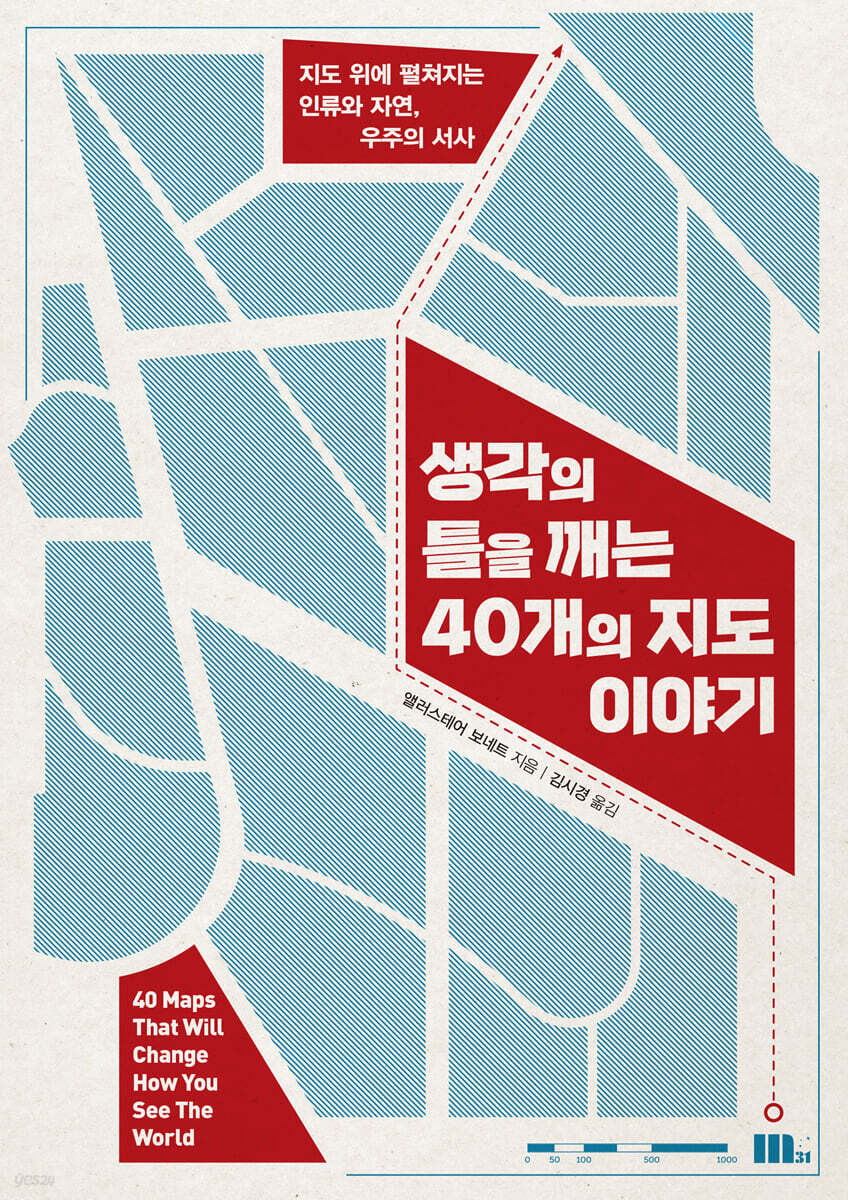
40 Map Stories That Will Break Your Mind
 |
Description
Book Introduction
The worldview of ancient people, the mysterious patterns drawn by nature and science, the vivid reality of the climate crisis, and the secrets of the universe gradually being revealed.
An exciting story unfolding through various maps!
A map is more than just a simple means of navigation that depicts geographical features; it is also a collection of information that contains an infinite number of stories in a concise format.
Through various production methods and forms, maps can contain countless pieces of information, secrets, and stories.
The author of this book selects 40 of these remarkable maps and presents a fascinating and comprehensive narrative spanning the past and present, humanity and nature, science and the universe.
From village maps dating back 9,000 years, to world maps as seen from around the world, to vibrant maps crafted by nature and science, to cutting-edge maps detailing the universe, this book is packed with information that will spark curiosity, spark lively discussion, and deepen our understanding of the interconnectedness of our world.
These maps, which vividly illustrate the footsteps of humanity, the secrets of the universe, and even the realities of a changing climate, are a stimulant that prompts a shift in mindset and an invitation to see the world from a new perspective.
An exciting story unfolding through various maps!
A map is more than just a simple means of navigation that depicts geographical features; it is also a collection of information that contains an infinite number of stories in a concise format.
Through various production methods and forms, maps can contain countless pieces of information, secrets, and stories.
The author of this book selects 40 of these remarkable maps and presents a fascinating and comprehensive narrative spanning the past and present, humanity and nature, science and the universe.
From village maps dating back 9,000 years, to world maps as seen from around the world, to vibrant maps crafted by nature and science, to cutting-edge maps detailing the universe, this book is packed with information that will spark curiosity, spark lively discussion, and deepen our understanding of the interconnectedness of our world.
These maps, which vividly illustrate the footsteps of humanity, the secrets of the universe, and even the realities of a changing climate, are a stimulant that prompts a shift in mindset and an invitation to see the world from a new perspective.
index
introduction
Map 1: A village map from 9,000 years ago
Map 2 The first modern map
Map 3 The oldest map depicting the British Zero
Map 4 When did China first discover the world?
Map 5: The World Turned Upside Down: The Ottoman Empire's Aim for the New World
Map 6 Aztecs Vs.
colonial power
Map 7: People of the World as Seen by Japanese People
Map 8 Navigational chart made of sticks and shells
Map 9 Scattered Tears, Into an Unfamiliar World
Map 10 If Africa Had Not Been Colonized
Map 11 Vast territories occupied by the Han Empire
Map 12 German Citizens Who Take Over the United States
Map 13 Who owns Alaska?
Map 14 A massive environmental project underway in Africa
Map 15: A New Map for the Emerging Superpowers
Map 16: All Head South! Bustling Antarctica
Map 17 China's High-Speed Revolution
Map 18 A transparently revealed 3D city
Map 19 Big Map for Big Data
Map 20: Google Maps Resembles a Chameleon
Map 21 Is a Women-Friendly City Just a Wish?
Map 22 The noise of cars and trucks dominating the city
Map 23 A map that captures the scent of a beach resort
Map 24 Love Game
Map 25 Wandering Ghosts: The Art of GPS
Map 26 The human brain is being mapped one piece at a time.
Map 27 Dancing Geography: Maps Drawn by Bees
Map 28 Wood Wide Web: How Trees and Fungi Help Each Other
Map 29 Earth's Forces: How Earthquakes Reveal Hidden Parts of the Planet
Map 30 Potato Planet: Gravity Map
Map 31 Vertical Extremes: From Challenger Deep to Lake Tilicho
Map 32 The Sea is One
Map 33 Sundaland: An Ancient Land Hidden Beneath the Sea
Map 34 Europe in a World Without Glaciers
Map 35: The Iberian Peninsula Heats Up: A Map of Extreme Heat
Map 36 Hidden Giant Lake
Map 37 New Maps of Mount Olympus and Mars
Map 38 Journey Across the Sun
Map 39 Lakes on Saturn's moon Titan
Map 40 Our New Space: The Laniakea Supercluster
References
Search
Map 1: A village map from 9,000 years ago
Map 2 The first modern map
Map 3 The oldest map depicting the British Zero
Map 4 When did China first discover the world?
Map 5: The World Turned Upside Down: The Ottoman Empire's Aim for the New World
Map 6 Aztecs Vs.
colonial power
Map 7: People of the World as Seen by Japanese People
Map 8 Navigational chart made of sticks and shells
Map 9 Scattered Tears, Into an Unfamiliar World
Map 10 If Africa Had Not Been Colonized
Map 11 Vast territories occupied by the Han Empire
Map 12 German Citizens Who Take Over the United States
Map 13 Who owns Alaska?
Map 14 A massive environmental project underway in Africa
Map 15: A New Map for the Emerging Superpowers
Map 16: All Head South! Bustling Antarctica
Map 17 China's High-Speed Revolution
Map 18 A transparently revealed 3D city
Map 19 Big Map for Big Data
Map 20: Google Maps Resembles a Chameleon
Map 21 Is a Women-Friendly City Just a Wish?
Map 22 The noise of cars and trucks dominating the city
Map 23 A map that captures the scent of a beach resort
Map 24 Love Game
Map 25 Wandering Ghosts: The Art of GPS
Map 26 The human brain is being mapped one piece at a time.
Map 27 Dancing Geography: Maps Drawn by Bees
Map 28 Wood Wide Web: How Trees and Fungi Help Each Other
Map 29 Earth's Forces: How Earthquakes Reveal Hidden Parts of the Planet
Map 30 Potato Planet: Gravity Map
Map 31 Vertical Extremes: From Challenger Deep to Lake Tilicho
Map 32 The Sea is One
Map 33 Sundaland: An Ancient Land Hidden Beneath the Sea
Map 34 Europe in a World Without Glaciers
Map 35: The Iberian Peninsula Heats Up: A Map of Extreme Heat
Map 36 Hidden Giant Lake
Map 37 New Maps of Mount Olympus and Mars
Map 38 Journey Across the Sun
Map 39 Lakes on Saturn's moon Titan
Map 40 Our New Space: The Laniakea Supercluster
References
Search
Detailed image

Into the book
Humans have been making maps for tens of thousands of years, but today we are entering a new era of mapmaking.
Now everyone with a smartphone is part of that change.
We live our lives constantly checking our own location and at the same time providing location information.
Maps are now everywhere.
It organizes information about what we do and who we are, and serves as a pulse gauge for our connected society.
--- p.5~6
Çatalhöyük is a difficult problem to solve.
Although over 9,000 years have passed, it is not just a pile of dust and stones, but raises many questions.
This is especially curious because it appears that there was no social hierarchy.
There are no residences of the powerful, no mansions that represent wealth, and no traces of kings and queens.
The houses are all pretty much the same.
This was a communal society where labor and food were shared.
There is no clear evidence of hierarchy.
--- p.13
People of various ethnic groups dressed in traditional attire are lined up in pairs, as if showing off.
A total of 40 types are listed, some with brief descriptions.
For example, it is written about Brazilian men and women:
'They don't live in houses, they prefer to live in caves.
They eat human flesh.' And he added this explanation:
'When a woman is about to give birth, the man experiences abdominal pain.
Women do not experience the pain of childbirth.'
--- p.58
Unlike common maps, which are generally widely shared and familiar to everyone, the stick chart of the Marshall Islands is not public domain.
Each map is unique and deeply personal, and some of the meanings contained in a map are known only to its creator.
Because it is the result of hundreds of years of accumulated experience over many generations.
This map summarizes a specific part of the vast ocean and serves as a reminder of the state of the ocean.
This is something that must be studied and memorized diligently before embarking on a dangerous voyage.
--- p.65
There is another story about the island located at the top left.
This is the Kingdom of 'Merina', which is now called Madagascar.
Merina was an independent kingdom from 1540 to 1897.
Queen Ranavalona III, the last monarch of the Merina Kingdom, ascended to the throne at the age of 22.
After the French invasion, she was driven to Réunion and later to Algeria, where she died at her home in 1917 at the age of 55.
Thus ended the dynasty of Madagascar, and the Merina Kingdom sank into memory.
--- p.81
But Russia's invasion of Ukraine in 2022 suggests another perspective.
One consequence of absorption and integration or territorial expansion into neighboring countries is a lack of awareness of the conquests that have taken place, and a consequently a strong sense of privilege.
This leads to a firm conviction that the lands adjacent to the country are not legitimate states but merely appendages of Russia.
For Russians who support Putin, the attempt to occupy Ukraine is not an invasion, but more like reclaiming lost land.
--- p.90
A project is underway to plant trees in a wide belt stretching about 6,500 kilometers (just under seven times the length of the United Kingdom) from Senegal to Djibouti to curb desertification and protect farmland.
The map shown above is quite simple, but considering the number of creatures that will benefit from it, it is arguably the most important map in this book.
On this map, the thick green line is the 'Green Wall' and the wide yellow band is the Sahel region.
The Sahel is a region between the Sahara Desert and the more humid lands to the south.
This map also shows how the green barrier was distributed among the first participating countries.
--- p.108
Some may see a vision of Asia's future in this map.
It does seem that way.
But if you look again, you can see that something else is going on.
The polar regions, long overlooked, are emerging as regions of economic potential.
The most remote places on Earth are within our range.
It's an uncomfortable moment.
The whole world is being stripped bare, and there is nothing left to be whole.
--- p.121
This Chinese railway map shows a kind of revolution, a realignment of world power.
Some countries move forward straight ahead, while others look back.
China is racing at high speed.
Many countries recognize this and are trying to catch up.
But countries like the UK and the US have yet to realise that they are on a slow track.
Now everyone with a smartphone is part of that change.
We live our lives constantly checking our own location and at the same time providing location information.
Maps are now everywhere.
It organizes information about what we do and who we are, and serves as a pulse gauge for our connected society.
--- p.5~6
Çatalhöyük is a difficult problem to solve.
Although over 9,000 years have passed, it is not just a pile of dust and stones, but raises many questions.
This is especially curious because it appears that there was no social hierarchy.
There are no residences of the powerful, no mansions that represent wealth, and no traces of kings and queens.
The houses are all pretty much the same.
This was a communal society where labor and food were shared.
There is no clear evidence of hierarchy.
--- p.13
People of various ethnic groups dressed in traditional attire are lined up in pairs, as if showing off.
A total of 40 types are listed, some with brief descriptions.
For example, it is written about Brazilian men and women:
'They don't live in houses, they prefer to live in caves.
They eat human flesh.' And he added this explanation:
'When a woman is about to give birth, the man experiences abdominal pain.
Women do not experience the pain of childbirth.'
--- p.58
Unlike common maps, which are generally widely shared and familiar to everyone, the stick chart of the Marshall Islands is not public domain.
Each map is unique and deeply personal, and some of the meanings contained in a map are known only to its creator.
Because it is the result of hundreds of years of accumulated experience over many generations.
This map summarizes a specific part of the vast ocean and serves as a reminder of the state of the ocean.
This is something that must be studied and memorized diligently before embarking on a dangerous voyage.
--- p.65
There is another story about the island located at the top left.
This is the Kingdom of 'Merina', which is now called Madagascar.
Merina was an independent kingdom from 1540 to 1897.
Queen Ranavalona III, the last monarch of the Merina Kingdom, ascended to the throne at the age of 22.
After the French invasion, she was driven to Réunion and later to Algeria, where she died at her home in 1917 at the age of 55.
Thus ended the dynasty of Madagascar, and the Merina Kingdom sank into memory.
--- p.81
But Russia's invasion of Ukraine in 2022 suggests another perspective.
One consequence of absorption and integration or territorial expansion into neighboring countries is a lack of awareness of the conquests that have taken place, and a consequently a strong sense of privilege.
This leads to a firm conviction that the lands adjacent to the country are not legitimate states but merely appendages of Russia.
For Russians who support Putin, the attempt to occupy Ukraine is not an invasion, but more like reclaiming lost land.
--- p.90
A project is underway to plant trees in a wide belt stretching about 6,500 kilometers (just under seven times the length of the United Kingdom) from Senegal to Djibouti to curb desertification and protect farmland.
The map shown above is quite simple, but considering the number of creatures that will benefit from it, it is arguably the most important map in this book.
On this map, the thick green line is the 'Green Wall' and the wide yellow band is the Sahel region.
The Sahel is a region between the Sahara Desert and the more humid lands to the south.
This map also shows how the green barrier was distributed among the first participating countries.
--- p.108
Some may see a vision of Asia's future in this map.
It does seem that way.
But if you look again, you can see that something else is going on.
The polar regions, long overlooked, are emerging as regions of economic potential.
The most remote places on Earth are within our range.
It's an uncomfortable moment.
The whole world is being stripped bare, and there is nothing left to be whole.
--- p.121
This Chinese railway map shows a kind of revolution, a realignment of world power.
Some countries move forward straight ahead, while others look back.
China is racing at high speed.
Many countries recognize this and are trying to catch up.
But countries like the UK and the US have yet to realise that they are on a slow track.
--- p.133
Publisher's Review
An engaging story unfolding smoothly based on 40 maps!
From the worldview of ancient people to the latest cosmic map,
A special map story that leads to a change in thinking
This book is full of interesting maps of all kinds.
For example, when looking at the murals of the Neolithic site of Çatalhöyük, a map of global internet usage, a map tracking the smells of a specific region, or a stick navigation chart of the Marshall Islands, one might wonder, "Are these really maps?"
This is because the 'map' that the author of this book refers to includes not only general maps but also 'maps that compress specific information.'
Moreover, the author fluently unravels fascinating stories related to each map, including direct information contained in each map, related history, personal experiences, often overlooked social issues, and shifting global power.
As we delve into the vast narrative surrounding maps—what their true intentions are, what arguments they imply, what messages they imply, and what future they hold—issues we'd previously overlooked become clearer, and things we took for granted can feel unfamiliar.
In other words, the maps in this book can be said to be an invitation to broaden one's perspective on the world and lead to a change in thinking.
Our relationship with space, the shift and shift of global hegemony, the reality of the climate crisis, etc.
A bundle of stories unfolds, one after another!
This book covers a wide range of topics, including history, humanity, society, science, nature, and the universe, and captures the reader's interest with its unpredictable plot development.
For example, while explaining the characteristics of Russian imperialism using a map showing the largest territory occupied by the Russian Empire (Map 11), the conversation shifts to the recent war in Ukraine.
The map showing ships traveling to and from Antarctica (Map 16) highlights the destruction of the ecosystem of the only remaining pristine region on Earth, while the map of noise in Mexico City (Map 22) highlights the need to reflect on our attitude of overlooking noise issues.
In addition, this book presents a variety of topics for reflection and discussion, such as the impact of colonial rule as seen in the Aztec Quetzalecazin Codex (Map 6) and Alkebulan (Map 10), the climate crisis vividly revealed in Sundaland submerged in the sea (Map 33), Europe after sea level rise (Map 34), and soil temperatures in the Iberian Peninsula (Map 35).
This book provides a good opportunity to carefully examine our worldview and framework of thought.
From the worldview of ancient people to the latest cosmic map,
A special map story that leads to a change in thinking
This book is full of interesting maps of all kinds.
For example, when looking at the murals of the Neolithic site of Çatalhöyük, a map of global internet usage, a map tracking the smells of a specific region, or a stick navigation chart of the Marshall Islands, one might wonder, "Are these really maps?"
This is because the 'map' that the author of this book refers to includes not only general maps but also 'maps that compress specific information.'
Moreover, the author fluently unravels fascinating stories related to each map, including direct information contained in each map, related history, personal experiences, often overlooked social issues, and shifting global power.
As we delve into the vast narrative surrounding maps—what their true intentions are, what arguments they imply, what messages they imply, and what future they hold—issues we'd previously overlooked become clearer, and things we took for granted can feel unfamiliar.
In other words, the maps in this book can be said to be an invitation to broaden one's perspective on the world and lead to a change in thinking.
Our relationship with space, the shift and shift of global hegemony, the reality of the climate crisis, etc.
A bundle of stories unfolds, one after another!
This book covers a wide range of topics, including history, humanity, society, science, nature, and the universe, and captures the reader's interest with its unpredictable plot development.
For example, while explaining the characteristics of Russian imperialism using a map showing the largest territory occupied by the Russian Empire (Map 11), the conversation shifts to the recent war in Ukraine.
The map showing ships traveling to and from Antarctica (Map 16) highlights the destruction of the ecosystem of the only remaining pristine region on Earth, while the map of noise in Mexico City (Map 22) highlights the need to reflect on our attitude of overlooking noise issues.
In addition, this book presents a variety of topics for reflection and discussion, such as the impact of colonial rule as seen in the Aztec Quetzalecazin Codex (Map 6) and Alkebulan (Map 10), the climate crisis vividly revealed in Sundaland submerged in the sea (Map 33), Europe after sea level rise (Map 34), and soil temperatures in the Iberian Peninsula (Map 35).
This book provides a good opportunity to carefully examine our worldview and framework of thought.
GOODS SPECIFICS
- Date of issue: November 10, 2025
- Page count, weight, size: 320 pages | 562g | 152*215*20mm
- ISBN13: 9791191095203
- ISBN10: 1191095207
You may also like
카테고리
korean


korean

![ELLE 엘르 스페셜 에디션 A형 : 12월 [2025]](http://librairie.coreenne.fr/cdn/shop/files/b8e27a3de6c9538896439686c6b0e8fb.jpg?v=1766436872&width=3840)


