

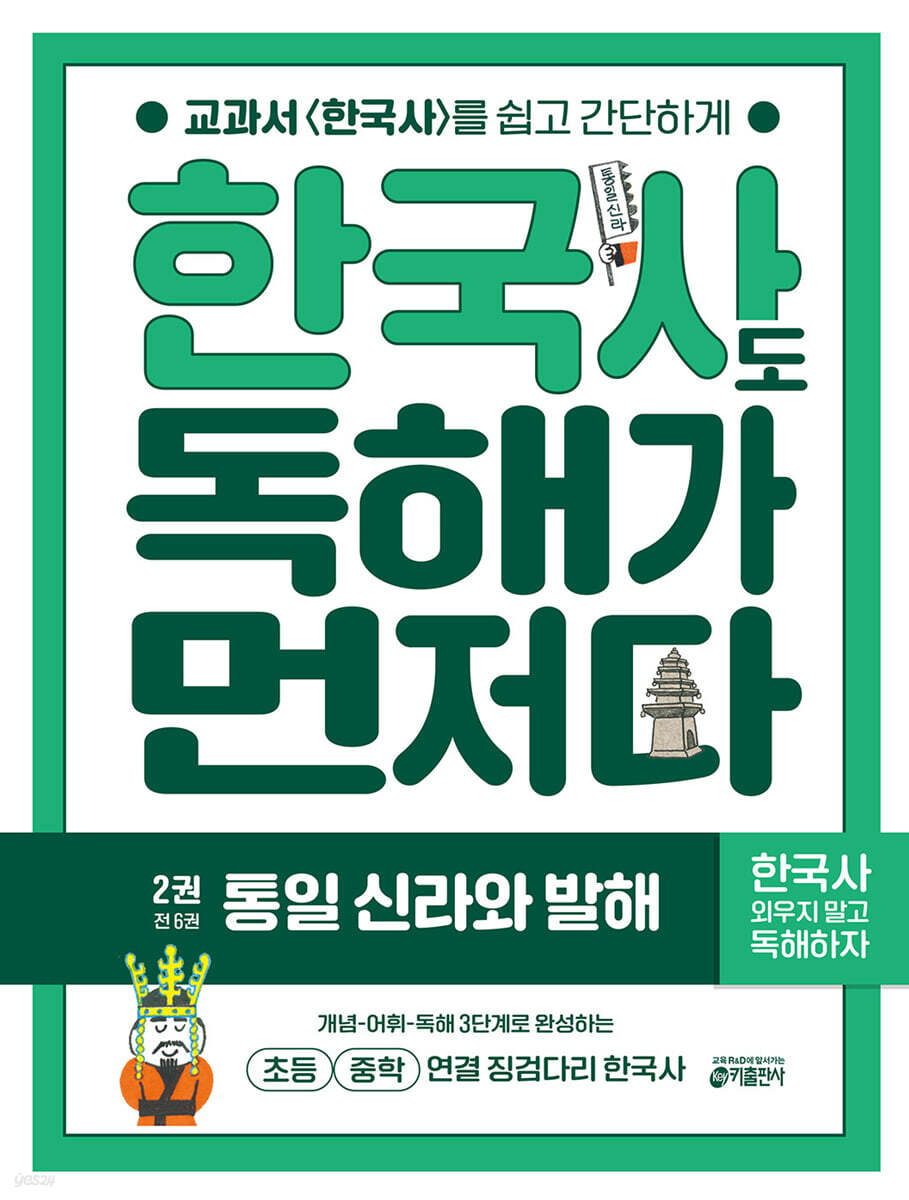
Korean History: Reading First, Volume 2: Unified Silla and Balhae
 |
Description
Book Introduction
『Reading Korean History Comes First』 is a Korean history reading program that makes studying Korean history easy and simple. · Grasp the concept and understand Korean history clearly! Complex historical concepts are presented in a pictorial format for easy viewing. · Get the flow and learn Korean history simply! By connecting events and grasping historical concepts, we were able to learn Korean history in a flow. · More detailed than elementary school textbooks and easier than middle school textbooks! We filled in the missing parts of elementary school textbooks and explained difficult terms in middle school textbooks to make it easier to study the textbooks. |
- You can preview some of the book's contents.
Preview
index
Chapter 1: Silla's Unification of the Three Kingdoms and the Founding of Balhae
01 Goguryeo repelled the invasions of Sui and Tang.
02 (Meanwhile) Silla allied with Tang and destroyed Baekje.
03 (Continued) Silla also destroyed Goguryeo and unified the three kingdoms.
04 (After) Balhae, which succeeded Goguryeo, was established.
[Confirmation Learning] Concept Organization / Exploratory Reading
Chapter 2: Development and Change in Unified Silla and Balhae
01 Silla, which unified the three kingdoms, strengthened its royal authority.
02 (Meanwhile) Balhae also achieved development.
03 (But) Unified Silla fell into chaos.
04 (In it) the powerful clans grew and the Later Three Kingdoms period began.
[Confirmation Learning] Concept Organization / Exploratory Reading
Chapter 3: The Culture of Unified Silla and Balhae
01 Buddhism and Confucianism developed in Unified Silla.
02 Balhae fused various cultures.
03 Unified Silla and Balhae interacted with Tang, Japan, and the Western Regions.
[Confirmation Learning] Concept Organization / Exploratory Reading
Answer and explanation
01 Goguryeo repelled the invasions of Sui and Tang.
02 (Meanwhile) Silla allied with Tang and destroyed Baekje.
03 (Continued) Silla also destroyed Goguryeo and unified the three kingdoms.
04 (After) Balhae, which succeeded Goguryeo, was established.
[Confirmation Learning] Concept Organization / Exploratory Reading
Chapter 2: Development and Change in Unified Silla and Balhae
01 Silla, which unified the three kingdoms, strengthened its royal authority.
02 (Meanwhile) Balhae also achieved development.
03 (But) Unified Silla fell into chaos.
04 (In it) the powerful clans grew and the Later Three Kingdoms period began.
[Confirmation Learning] Concept Organization / Exploratory Reading
Chapter 3: The Culture of Unified Silla and Balhae
01 Buddhism and Confucianism developed in Unified Silla.
02 Balhae fused various cultures.
03 Unified Silla and Balhae interacted with Tang, Japan, and the Western Regions.
[Confirmation Learning] Concept Organization / Exploratory Reading
Answer and explanation
Detailed image

Publisher's Review
Why should I study Korean history through reading comprehension?
They say that Korean history is a subject that requires a lot of memorization.
However, in order to study history easily, properly, and enjoyably, you need to first learn important historical concepts and vocabulary, and then practice reading comprehension.
Reading practice isn't just for Korean language subjects.
Reading practice is essential for studying Korean history, which involves a lot of unfamiliar concepts and vocabulary.
Difficult Korean history becomes fun with the step-by-step reading practice of 『Reading Korean History Comes First』!
Why do we need to know the flow of Korean history?
History is the story of how people lived in the past.
The story continues on and on.
Historical events have backgrounds or causes, and new events and scenes unfold accordingly.
That's why it's important to understand the flow of history.
Korean history is not a subject to be memorized.
If you get the flow, you can remember the story in a series of steps.
With the easy-to-understand illustrations and explanations of 『Korean History: Reading First』, you can clearly remember the complex flow of Korean history!
Composition and Features
Complete and check in 3 steps: concept, vocabulary, and reading comprehension.
[Concept] Concepts in pictures
1) Understand the concept through a picture.
- You can grasp key concepts at a glance and memorize them in chunks of pictures.
[Vocabulary] Vocabulary in sentences
2) Summarize the concept in one sentence.
- You can learn the meaning of concept vocabulary and use it in sentences to understand it clearly.
- You can clearly understand the key concepts by summarizing them in one sentence.
[Reading] Reading comprehension: reading text and pictures together
3) Read the text while checking the key concepts.
- You can preview the key concepts covered in the text using paragraph summaries.
- By organizing the content scattered across several pages of the textbook into a single text, you can clearly understand the core concepts and grasp the structure of the text, allowing you to read effectively.
4) Look at the map and photos along with the text.
- Understand the chronological flow of history while reading the text, and understand the spatial context by looking at maps and photographs along with the text.
I can understand.
- You can remember historical facts in three dimensions by weaving them together like warp and weft.
5) Develop basic reading comprehension skills.
- Reading correctly: You can develop the ability to ‘factually understand’ by reading a given passage correctly and accurately understanding the content.
- Reading by connection: You can develop the ability to understand organic relationships, which is essential for reading history, by connecting the order in which events occurred or connecting people and events.
6) Develop in-depth reading skills.
- Detailed reading: Analytical reading that digs deep into the text and specifically understands the details of the text.
You can develop your ability to 'understand'.
- Deep Reading: By reading the text in connection with the ‘View’ text, you can develop the ability to ‘inferentially understand’ by drawing judgments based on the given information.
7) Summarize the structure.
- Organizing the structure (short answer): You can organize the content of the text in a structured diagram by filling in the appropriate vocabulary.
8) Learn how to write descriptively.
- Marking on a blank map (active, short answer): You can clearly remember important information by recalling historical map information in the text related to the learning content and marking it on a blank map.
- Descriptive writing (hint-based descriptive questions): By writing out what you have learned in accordance with the question's intent, you can develop the ability to logically describe knowledge and internalize the learning content.
We've provided some sentences as guides to help you approach descriptive writing more easily.
[Confirmation Learning] Concept organization through gathering and review + Exploratory reading that completes through writing
9) Gather and organize the concepts.
- Writing concept terms (short answer): By gathering the concepts studied in each chapter together like a chronology, you can intuitively remember the flow of history that can be confusing because it is divided and review important concepts.
10) Develop in-depth reading comprehension and descriptive writing skills through inquiry-type problems.
- Exploratory Reading: You can develop in-depth reading skills with added depth and density by examining important research topics in each chapter and reading based on related materials.
- Descriptive writing (keyword-based descriptive questions): This is a more advanced writing type than 'hint-based descriptive questions', where you write a description based on given keywords or sentence structures. This helps you build confidence in descriptive writing.
They say that Korean history is a subject that requires a lot of memorization.
However, in order to study history easily, properly, and enjoyably, you need to first learn important historical concepts and vocabulary, and then practice reading comprehension.
Reading practice isn't just for Korean language subjects.
Reading practice is essential for studying Korean history, which involves a lot of unfamiliar concepts and vocabulary.
Difficult Korean history becomes fun with the step-by-step reading practice of 『Reading Korean History Comes First』!
Why do we need to know the flow of Korean history?
History is the story of how people lived in the past.
The story continues on and on.
Historical events have backgrounds or causes, and new events and scenes unfold accordingly.
That's why it's important to understand the flow of history.
Korean history is not a subject to be memorized.
If you get the flow, you can remember the story in a series of steps.
With the easy-to-understand illustrations and explanations of 『Korean History: Reading First』, you can clearly remember the complex flow of Korean history!
Composition and Features
Complete and check in 3 steps: concept, vocabulary, and reading comprehension.
[Concept] Concepts in pictures
1) Understand the concept through a picture.
- You can grasp key concepts at a glance and memorize them in chunks of pictures.
[Vocabulary] Vocabulary in sentences
2) Summarize the concept in one sentence.
- You can learn the meaning of concept vocabulary and use it in sentences to understand it clearly.
- You can clearly understand the key concepts by summarizing them in one sentence.
[Reading] Reading comprehension: reading text and pictures together
3) Read the text while checking the key concepts.
- You can preview the key concepts covered in the text using paragraph summaries.
- By organizing the content scattered across several pages of the textbook into a single text, you can clearly understand the core concepts and grasp the structure of the text, allowing you to read effectively.
4) Look at the map and photos along with the text.
- Understand the chronological flow of history while reading the text, and understand the spatial context by looking at maps and photographs along with the text.
I can understand.
- You can remember historical facts in three dimensions by weaving them together like warp and weft.
5) Develop basic reading comprehension skills.
- Reading correctly: You can develop the ability to ‘factually understand’ by reading a given passage correctly and accurately understanding the content.
- Reading by connection: You can develop the ability to understand organic relationships, which is essential for reading history, by connecting the order in which events occurred or connecting people and events.
6) Develop in-depth reading skills.
- Detailed reading: Analytical reading that digs deep into the text and specifically understands the details of the text.
You can develop your ability to 'understand'.
- Deep Reading: By reading the text in connection with the ‘View’ text, you can develop the ability to ‘inferentially understand’ by drawing judgments based on the given information.
7) Summarize the structure.
- Organizing the structure (short answer): You can organize the content of the text in a structured diagram by filling in the appropriate vocabulary.
8) Learn how to write descriptively.
- Marking on a blank map (active, short answer): You can clearly remember important information by recalling historical map information in the text related to the learning content and marking it on a blank map.
- Descriptive writing (hint-based descriptive questions): By writing out what you have learned in accordance with the question's intent, you can develop the ability to logically describe knowledge and internalize the learning content.
We've provided some sentences as guides to help you approach descriptive writing more easily.
[Confirmation Learning] Concept organization through gathering and review + Exploratory reading that completes through writing
9) Gather and organize the concepts.
- Writing concept terms (short answer): By gathering the concepts studied in each chapter together like a chronology, you can intuitively remember the flow of history that can be confusing because it is divided and review important concepts.
10) Develop in-depth reading comprehension and descriptive writing skills through inquiry-type problems.
- Exploratory Reading: You can develop in-depth reading skills with added depth and density by examining important research topics in each chapter and reading based on related materials.
- Descriptive writing (keyword-based descriptive questions): This is a more advanced writing type than 'hint-based descriptive questions', where you write a description based on given keywords or sentence structures. This helps you build confidence in descriptive writing.
GOODS SPECIFICS
- Date of issue: November 20, 2024
- Page count, weight, size: 120 pages | 210*277*9mm
- ISBN13: 9791165264024
- ISBN10: 1165264021
- Reference book for use in grades: 5th and 6th grades
- Reference book usage semester: Common semester
- Reference book difficulty: Normal, Hard Reference book difficulty guide
- KC Certification: Certification Type: Conformity Confirmation
You may also like
카테고리
korean


korean

![GQ KOREA Mark (Monthly): December [2025]](http://librairie.coreenne.fr/cdn/shop/files/8ef265dbbfbf186523ed75ba7319009d.jpg?v=1765340328&width=3840)


