

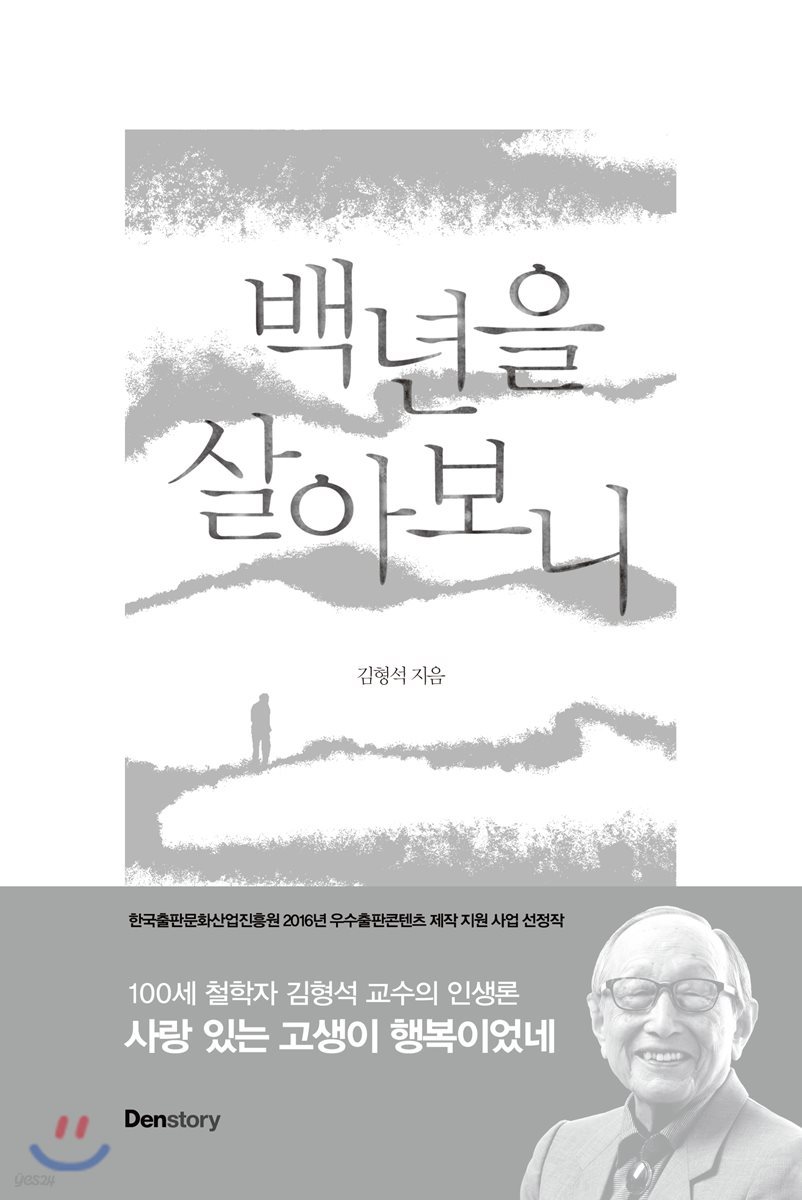
After living for a hundred years
 |
Description
Book Introduction
The 'godfather of Korean philosophy' looks at life from the hill of 90 We are now in the '100-year era'. As we enter an unprecedented era of 100-year lifespans in human history, we are more anxious and flustered than excited and happy. Why do we live, how and for what purpose should we live, what is happiness? I'm at a loss as to what kind of outlook on life and values I should have for the rest of my life. They say, "You have to experience life to understand it," but if we first borrow the wisdom of someone who has lived to be 100, wouldn't our future life become a little clearer and more fragrant? Professor Kim Hyung-seok, author of the 1960s mega-bestseller 『Dialogue of Eternity and Love』, a contemporary intellectual who awakens us with philosophical thoughts that permeate life, and an 'eternal active' who continues to write and lecture even at the age of 97, looks back on his own life and shares the secrets of life he has discovered with his juniors in a gentle and soft voice. It presents life wisdom that helps us wisely judge and deal with everyday problems, from problems that arise at home to challenges that everyone must face in social life, and even concerns about the meaning of life and death. The author says: 'Life is not about growing old, it's about maturing.' Looking back, it was a difficult process, but the hardships that came with love were happiness. And I confess. 'It took me 90 years to realize that.' |
- You can preview some of the book's contents.
Preview
index
prolog
1. There is no such thing as the same happiness_Theory of Happiness
Will I be happy if I succeed?
The relationship between personality level and wealth
Reasons for working
Is it good to live long?
Happiness comes from a grateful heart.
What remains when everything is gone
2. Love and suffering were joys_Marriage and family
The idea of marriage is changing.
The most vain loneliness in the world
Would I have been happier if I had remarried?
About divorce in the twilight years
Couples who fight hard don't divorce.
What Makes a Woman Beautiful
Raising children that doesn't go as planned
3. Neither fate nor vanity, but something else_Friendship and religion
Was friendship a providence to me?
My friend Ahn Byeong-wook
Is Religion Necessary for Modern People?
The many shades of gray between black and white
Does death have meaning?
The final choice is up to everyone.
4 What will you leave behind? Money, success, and fame
Why didn't he succeed?
Economically middle class, mentally upper class
If you write an autobiography
Three statues
What does 'hat' mean to me?
What should we live for?
5. Old age comes silently_Life in old age
The golden age of life is from 60 to 75 years old.
“What is the secret to longevity?”
Courage in youth, wisdom in old age
The joy of hobbies
Growing old is no one's fault
In old age, set an admirable example
Who should I go to?
“Thank you for your hardships and long life.”
1. There is no such thing as the same happiness_Theory of Happiness
Will I be happy if I succeed?
The relationship between personality level and wealth
Reasons for working
Is it good to live long?
Happiness comes from a grateful heart.
What remains when everything is gone
2. Love and suffering were joys_Marriage and family
The idea of marriage is changing.
The most vain loneliness in the world
Would I have been happier if I had remarried?
About divorce in the twilight years
Couples who fight hard don't divorce.
What Makes a Woman Beautiful
Raising children that doesn't go as planned
3. Neither fate nor vanity, but something else_Friendship and religion
Was friendship a providence to me?
My friend Ahn Byeong-wook
Is Religion Necessary for Modern People?
The many shades of gray between black and white
Does death have meaning?
The final choice is up to everyone.
4 What will you leave behind? Money, success, and fame
Why didn't he succeed?
Economically middle class, mentally upper class
If you write an autobiography
Three statues
What does 'hat' mean to me?
What should we live for?
5. Old age comes silently_Life in old age
The golden age of life is from 60 to 75 years old.
“What is the secret to longevity?”
Courage in youth, wisdom in old age
The joy of hobbies
Growing old is no one's fault
In old age, set an admirable example
Who should I go to?
“Thank you for your hardships and long life.”
Publisher's Review
The Life Philosophy of 97-Year-Old Philosopher Professor Kim Hyung-seok: Suffering with Love is Happiness
There are times when you learn things you didn't know when you were twenty when you turned thirty.
Once you turn forty, life looks different.
If we were to live to be a hundred years old, what patterns would life depict for us? If we knew this wisdom in advance, wouldn't our lives become a little more fragrant? Professor Kim Hyung-seok, a contemporary intellectual who awakens us with philosophical reflections that permeate life, and a 97-year-old, ever-active professor, reflects on his own life and shares the secrets of life he's discovered, in a gentle and soothing voice, with his younger colleagues, anxious and flustered as we enter the "100-year era."
And says:
They say that suffering with love is the greatest happiness.
It took me over 90 years to realize that… … .
What is happiness after living for a hundred years?
“Everything else is something that some people want and some people don’t.
But everyone wants happiness.”
These are the words of the philosopher Aristotle.
It's a story that makes you nod your head in agreement.
But if you ask what happiness is, there is no single answer.
Because happiness is everyone's subjective judgment.
In Part 1, “On Happiness,” the author presents a profound reflection on happiness.
Most people think, 'If you are successful, you will be happy.'
Especially as we get older, we tend to think that 'successful people are happy.'
However, the ‘functional relationship between success and happiness’ that the author draws is different.
A life in which one fully realizes the talents and potential given to him is happy and successful.
However, a person who has not fully utilized his or her given abilities and potential cannot be recognized as successful.
Therefore, there is no failure for those who work hard, but there is no success for those who are lazy.
The author's answer to the question of 'the functional relationship between wealth and happiness' is more clear.
The author always advises his family and students, “Those who remain economically middle class but mentally belong to the upper class are happy and contribute to society.”
Of course, this is the result of the author's own experiences of seeing and hearing things around him.
So, how much wealth should a person have to live with?
The principle is to have wealth commensurate with one's character.
If your personality growth is 70, you should possess 70 worth of wealth.
If you inherit 90% of your wealth from your ancestors, you will suffer a loss of character due to the 20% of your wealth that is too much for you, and you will experience the pain and unhappiness of carrying a burden that you should not have to bear.
After living for a hundred years, I realized that life is neither fate nor futility, but providence.
Part 3 is about friendship and religion.
The author published a book titled “Neither Fate nor Vanity” in the 1960s, and at the time, the idea was that life was neither fate nor vanity.
But now, after so many years, I confess that there was one more thing than the other.
It is 'providence'.
This realization came from incidents of friendship through friends.
This book contains many stories about the author's beautiful friends.
They are Young-gil, my first friend in life, Elder Kim Gwang-yoon, my friend from elementary school, and Heo Gap and Park Chi-won from middle school, high school, and college.
But more than anything, the most precious relationships in the author's life were two friends he met while living in society: Professor Kim Tae-gil of Seoul National University and Professor Ahn Byeong-uk of Soongsil University.
These two, known as the 'Three Musketeers of Philosophy', had a 'blessed relationship' of loving competition for half a century.
The author confesses that these two friends were the ones who taught him and helped him the most, after Dosan Ahn Chang-ho and Inchon Kim Seong-su.
One day, around the time he was in his mid-80s, Professor Ahn suggested, “Before we get any older, the three of us should meet four times a year.”
Professor Kim Tae-gil's answer was a rejection.
The reason was, “All three of us are in our mid-80s, so if one of us has to leave first, how difficult will it be for the person left behind after everyone else has left?”
In the end, they stayed together from afar, and the author was left alone.
After sending off his two friends, the author says, "I didn't feel like I was living my life." He became even more lonely.
'After living for a hundred years,' the golden age of life is between 60 and 75 years old.
Part 5 is about life in old age.
When does old age begin?
It is usually said to be from the age of 65.
But the author and his close friends have long since abandoned such ideas.
Because those who make an effort have personally experienced that mental and human growth is possible until the age of 75.
Professor Kim Tae-gil published a book on “Korean Values” at the age of 76, and Professor Ahn Byeong-uk continued his work until he was 89.
The author admits, "I was immature in every way before I turned 60."
As the author approaches 100, the question he receives most frequently is, "What is the secret to health and longevity?"
He was in such poor health that even his family gave up on him until he was 20.
It wasn't until I was 50 that I finally found myself in normal health.
So, I lived carefully without overworking myself or overdoing anything physically, and that may have become a habit and become a secret to longevity.
Since I turned 50, I have been going to the pool about three times a week and have been exercising by walking for about 50 minutes a day.
However, the author believes that 'work' has maintained his health.
For the author, health is essential for work.
Even if we look at the cases of Kant and Schweitzer, people who worked a lot also maintained their health.
We have the right to live happily even in old age, and we also have the duty to be respected by our juniors and descendants.
Growing old is no one's fault, but the older you get, the more you should set an admirable example.
In old age, wisdom is needed more than anything else, and that wisdom means setting an example of how to live when you are old.
The old philosopher says that there is no greater self-cultivation than the character that allows one to treat others with respect even when treated poorly, and the culture that allows one to treat everyone with nobility.
A lonely yet beautiful life story you've never heard before
The author, who was widely loved for his essays and award-winning collections in the 1960s and 1970s, became distant from the public after the 1980s, focusing on philosophy and religion books.
Then, when he was in his 90s, he made a splendid return to the world of reading.
The author says about this, “I felt comforted that my long life was not in vain.”
The author's life was hard and lonely, but honest and beautiful.
A representative example is the story of when my wife was ill for over 20 years.
It was two or three years after the author's wife became ill.
My friend, Professor C, came to visit and said he wanted to talk to me in a discreet and helpful way.
Professor C's wife saw the author outside two or three times, and said in one word that he smelled like a widower.
After that, the author became interested in how he dressed and always reflected on himself to keep a smile and a gentle demeanor.
I came to think that it was not good if I could not give gratitude and joy to others because I was having a hard time.
The author's trademark today, a gentle smile that can be seen anywhere at any time, is the result of such efforts.
"
For the author, ill health and poverty were the burdens of life, and it was a series of hardships until he put down those heavy burdens.
We also had to bear the heavy burden of history, including the Japanese colonial period and the Korean War.
But I don't think my life was unhappy or a meaningless struggle.
Because it was all a struggle with love.
There are times when you learn things you didn't know when you were twenty when you turned thirty.
Once you turn forty, life looks different.
If we were to live to be a hundred years old, what patterns would life depict for us? If we knew this wisdom in advance, wouldn't our lives become a little more fragrant? Professor Kim Hyung-seok, a contemporary intellectual who awakens us with philosophical reflections that permeate life, and a 97-year-old, ever-active professor, reflects on his own life and shares the secrets of life he's discovered, in a gentle and soothing voice, with his younger colleagues, anxious and flustered as we enter the "100-year era."
And says:
They say that suffering with love is the greatest happiness.
It took me over 90 years to realize that… … .
What is happiness after living for a hundred years?
“Everything else is something that some people want and some people don’t.
But everyone wants happiness.”
These are the words of the philosopher Aristotle.
It's a story that makes you nod your head in agreement.
But if you ask what happiness is, there is no single answer.
Because happiness is everyone's subjective judgment.
In Part 1, “On Happiness,” the author presents a profound reflection on happiness.
Most people think, 'If you are successful, you will be happy.'
Especially as we get older, we tend to think that 'successful people are happy.'
However, the ‘functional relationship between success and happiness’ that the author draws is different.
A life in which one fully realizes the talents and potential given to him is happy and successful.
However, a person who has not fully utilized his or her given abilities and potential cannot be recognized as successful.
Therefore, there is no failure for those who work hard, but there is no success for those who are lazy.
The author's answer to the question of 'the functional relationship between wealth and happiness' is more clear.
The author always advises his family and students, “Those who remain economically middle class but mentally belong to the upper class are happy and contribute to society.”
Of course, this is the result of the author's own experiences of seeing and hearing things around him.
So, how much wealth should a person have to live with?
The principle is to have wealth commensurate with one's character.
If your personality growth is 70, you should possess 70 worth of wealth.
If you inherit 90% of your wealth from your ancestors, you will suffer a loss of character due to the 20% of your wealth that is too much for you, and you will experience the pain and unhappiness of carrying a burden that you should not have to bear.
After living for a hundred years, I realized that life is neither fate nor futility, but providence.
Part 3 is about friendship and religion.
The author published a book titled “Neither Fate nor Vanity” in the 1960s, and at the time, the idea was that life was neither fate nor vanity.
But now, after so many years, I confess that there was one more thing than the other.
It is 'providence'.
This realization came from incidents of friendship through friends.
This book contains many stories about the author's beautiful friends.
They are Young-gil, my first friend in life, Elder Kim Gwang-yoon, my friend from elementary school, and Heo Gap and Park Chi-won from middle school, high school, and college.
But more than anything, the most precious relationships in the author's life were two friends he met while living in society: Professor Kim Tae-gil of Seoul National University and Professor Ahn Byeong-uk of Soongsil University.
These two, known as the 'Three Musketeers of Philosophy', had a 'blessed relationship' of loving competition for half a century.
The author confesses that these two friends were the ones who taught him and helped him the most, after Dosan Ahn Chang-ho and Inchon Kim Seong-su.
One day, around the time he was in his mid-80s, Professor Ahn suggested, “Before we get any older, the three of us should meet four times a year.”
Professor Kim Tae-gil's answer was a rejection.
The reason was, “All three of us are in our mid-80s, so if one of us has to leave first, how difficult will it be for the person left behind after everyone else has left?”
In the end, they stayed together from afar, and the author was left alone.
After sending off his two friends, the author says, "I didn't feel like I was living my life." He became even more lonely.
'After living for a hundred years,' the golden age of life is between 60 and 75 years old.
Part 5 is about life in old age.
When does old age begin?
It is usually said to be from the age of 65.
But the author and his close friends have long since abandoned such ideas.
Because those who make an effort have personally experienced that mental and human growth is possible until the age of 75.
Professor Kim Tae-gil published a book on “Korean Values” at the age of 76, and Professor Ahn Byeong-uk continued his work until he was 89.
The author admits, "I was immature in every way before I turned 60."
As the author approaches 100, the question he receives most frequently is, "What is the secret to health and longevity?"
He was in such poor health that even his family gave up on him until he was 20.
It wasn't until I was 50 that I finally found myself in normal health.
So, I lived carefully without overworking myself or overdoing anything physically, and that may have become a habit and become a secret to longevity.
Since I turned 50, I have been going to the pool about three times a week and have been exercising by walking for about 50 minutes a day.
However, the author believes that 'work' has maintained his health.
For the author, health is essential for work.
Even if we look at the cases of Kant and Schweitzer, people who worked a lot also maintained their health.
We have the right to live happily even in old age, and we also have the duty to be respected by our juniors and descendants.
Growing old is no one's fault, but the older you get, the more you should set an admirable example.
In old age, wisdom is needed more than anything else, and that wisdom means setting an example of how to live when you are old.
The old philosopher says that there is no greater self-cultivation than the character that allows one to treat others with respect even when treated poorly, and the culture that allows one to treat everyone with nobility.
A lonely yet beautiful life story you've never heard before
The author, who was widely loved for his essays and award-winning collections in the 1960s and 1970s, became distant from the public after the 1980s, focusing on philosophy and religion books.
Then, when he was in his 90s, he made a splendid return to the world of reading.
The author says about this, “I felt comforted that my long life was not in vain.”
The author's life was hard and lonely, but honest and beautiful.
A representative example is the story of when my wife was ill for over 20 years.
It was two or three years after the author's wife became ill.
My friend, Professor C, came to visit and said he wanted to talk to me in a discreet and helpful way.
Professor C's wife saw the author outside two or three times, and said in one word that he smelled like a widower.
After that, the author became interested in how he dressed and always reflected on himself to keep a smile and a gentle demeanor.
I came to think that it was not good if I could not give gratitude and joy to others because I was having a hard time.
The author's trademark today, a gentle smile that can be seen anywhere at any time, is the result of such efforts.
"
For the author, ill health and poverty were the burdens of life, and it was a series of hardships until he put down those heavy burdens.
We also had to bear the heavy burden of history, including the Japanese colonial period and the Korean War.
But I don't think my life was unhappy or a meaningless struggle.
Because it was all a struggle with love.
GOODS SPECIFICS
- Date of issue: August 1, 2016
- Page count, weight, size: 300 pages | 406g | 140*210*20mm
- ISBN13: 9791185716435
- ISBN10: 1185716432
You may also like
카테고리
korean


korean

![GQ KOREA Mark (Monthly): December [2025]](http://librairie.coreenne.fr/cdn/shop/files/8ef265dbbfbf186523ed75ba7319009d.jpg?v=1765340328&width=3840)


