

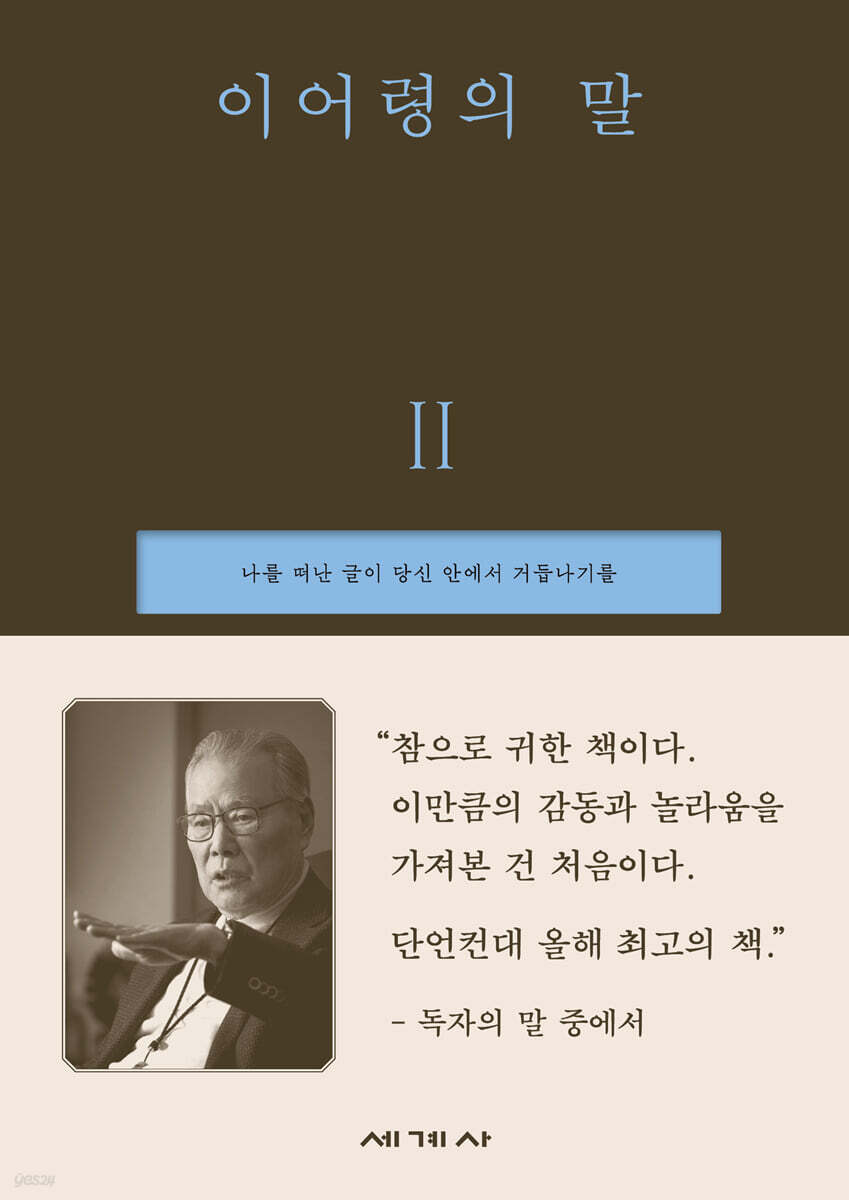
Lee Eo-ryeong's words 2
 |
Description
Book Introduction
Lee Eo-ryeong's words, the second story
May the words that left me be reborn in you
A thousand words, sentences that squeeze through the cracks of thought, and a crystallization of eons of time.
The second volume of "Lee Eo-ryeong's Words," a selection of the "essence of words" from hundreds of works by Lee Eo-ryeong, a leading intellectual of our time, has been published.
Volume 2 contains new famous quotes, including unpublished lectures that were not included in Volume 1.
Before he died, he said, “I hope that through this one book, future readers can easily understand the intellectual explorations I have been on throughout my life,” and he wanted to leave behind a book that would be like a beacon of light for future generations who might be lost and wandering in the world he has left behind.
『Lee Eo-ryeong's Words』 is Lee Eo-ryeong's last work and intellectual legacy, completed after years of planning and editing in accordance with his will.
As Kang In-sook, who is in charge of the Lee Eo-ryeong Memorial Foundation, hinted in the preface to Volume 1, Volume 2 of 『Lee Eo-ryeong's Words』 was planned from early on.
It is because there are so many sentences that awaken our minds and touch our hearts that it is difficult to compile Lee Eo-ryeong's 88-year history into a single volume.
In particular, in Volume 2 of 『Lee Eo-ryeong's Words』, sentences were selected from works published after his death in 2022.
“I talk a lot during my lifetime.
For me, that's breathing.
Lee Eo-ryeong, who said, “If intellectuals don’t breathe, they will die,” left behind words of life, like breathing, until his last moments.
If Volume 1 of 『Lee Eo-ryeong's Words』 suggested the direction toward 'creation', which he had emphasized throughout his life, Volume 2 delves deeply into the gap between life, which constitutes everyday life, and death, which is the fate of human beings, focusing on 'life', which Lee Eo-ryeong had considered as his hope for the future.
May the words that left me be reborn in you
A thousand words, sentences that squeeze through the cracks of thought, and a crystallization of eons of time.
The second volume of "Lee Eo-ryeong's Words," a selection of the "essence of words" from hundreds of works by Lee Eo-ryeong, a leading intellectual of our time, has been published.
Volume 2 contains new famous quotes, including unpublished lectures that were not included in Volume 1.
Before he died, he said, “I hope that through this one book, future readers can easily understand the intellectual explorations I have been on throughout my life,” and he wanted to leave behind a book that would be like a beacon of light for future generations who might be lost and wandering in the world he has left behind.
『Lee Eo-ryeong's Words』 is Lee Eo-ryeong's last work and intellectual legacy, completed after years of planning and editing in accordance with his will.
As Kang In-sook, who is in charge of the Lee Eo-ryeong Memorial Foundation, hinted in the preface to Volume 1, Volume 2 of 『Lee Eo-ryeong's Words』 was planned from early on.
It is because there are so many sentences that awaken our minds and touch our hearts that it is difficult to compile Lee Eo-ryeong's 88-year history into a single volume.
In particular, in Volume 2 of 『Lee Eo-ryeong's Words』, sentences were selected from works published after his death in 2022.
“I talk a lot during my lifetime.
For me, that's breathing.
Lee Eo-ryeong, who said, “If intellectuals don’t breathe, they will die,” left behind words of life, like breathing, until his last moments.
If Volume 1 of 『Lee Eo-ryeong's Words』 suggested the direction toward 'creation', which he had emphasized throughout his life, Volume 2 delves deeply into the gap between life, which constitutes everyday life, and death, which is the fate of human beings, focusing on 'life', which Lee Eo-ryeong had considered as his hope for the future.
- You can preview some of the book's contents.
Preview
index
Chapter 10: Emotions: The Human Condition
Chapter 11: Intellect: The Intellectual in Front of a Blank Page
Chapter 12 Nature: The Song of the Seasons
Chapter 13 Culture: The Core of Results
Chapter 14: Material: The Landscape of Modern Man
Chapter 15: The Spirit: The Light of Finding Your Own Life
Chapter 16: Everyday Life: A Story Without End
Chapter 17 Imagination: Nothing and Nothingness
Chapter 18 Life: Between the Womb and the Grave
index
List of works
Chapter 11: Intellect: The Intellectual in Front of a Blank Page
Chapter 12 Nature: The Song of the Seasons
Chapter 13 Culture: The Core of Results
Chapter 14: Material: The Landscape of Modern Man
Chapter 15: The Spirit: The Light of Finding Your Own Life
Chapter 16: Everyday Life: A Story Without End
Chapter 17 Imagination: Nothing and Nothingness
Chapter 18 Life: Between the Womb and the Grave
index
List of works
Detailed image

Into the book
No man is a perfect island.
I am not an island alone.
No matter how much we try to isolate ourselves, humans are connected to each other.
It's not an island.
I am part of the continent.
No matter how small a piece of sand or dirt is, it is connected to a vast continent.
(…) When someone dies, it means that the sand and soil within my continent are swept away into the sea.
His suffering is not unrelated to mine, and his life flows from the same spring as mine.
--- p.15
Think with your head.
Let go of your own thoughts, why do you want to borrow someone else's?
Just changing these habits can change the world.
You are all geniuses, and you all hold truly precious jewels in your hearts.
Don't forget this.
Besides, how could I have survived until now without it?
--- p.38
When a single leaf sways, we feel our life.
I think of the rhythm of life, so blue and so fresh.
Even on gloomy and sad days, looking at the new green leaves sprouting makes my heart ache with the desire to live.
--- p.95
A single millstone cannot do its job.
When two stones rub against each other, hard grains become soft powder.
Generations also imitate the law of the millstone.
The older generation is a fixed millstone, and the younger generation is another millstone that is constantly turning and moving on top of it.
In that friction, culture becomes fine powder that we can eat.
--- p.150
The crisis of modern man arises not when he works, but when he stops working.
It is the time when one returns to oneself.
When it's time to leave work, we are released from our chairs and paperwork at work.
The things that held us back, the things that commanded us endlessly, will stop.
Machines, all tools, automatically and quickly recover their objectivity when not in use.
That is why shields and swords are only weapons when fighting, and in times of peace, they are decorations on the wall, like sculptures.
However, even when human work is over, human beings do not immediately regain their humanity from instrumental existence.
When most people are away from work, they drink, hang out at nightclubs, or loiter in dark alleys.
Because they are afraid of meeting their own ego.
--- p.169
Among animals, humans are born the most immature.
Other animals walk and find food on their own as soon as they are born.
However, humans can barely stand up and learn to walk after a year of being born.
It takes at least three years for a child to leave their parents and learn to use a spoon and toilet independently.
We were born into this world and for three years we could not live without our parents' eyes for even a moment.
Therefore, even if it is not an ethics of filial piety, it is considered natural to repay the love of parents who have provided absolute help for three years with three years of mourning.
Even from today's commercial perspective, where everything is calculated as a 'give and take' transaction, this logic would be reasonable.
--- p.202
A duck floating on water does not know the depth of the water.
Those who only float on the surface of life do not know the depth of life.
Only an animal that knows how to fall into water knows the depth of water, and only a human being who has experienced frustration in life knows the depth of life.
--- p.264
Creation is (so) lonely, unnoticed, and always having to be alone.
Don't be afraid of isolation.
Even if everyone laughs at you, if it is the path of creation and the future path chosen by your passion, you must boldly jump into it.
Isn't this life one and only? (…) Each and every one of you is unique.
Same face, same height.
There is no one on this planet with the same voice.
You are all complete beings.
--- p.284
The most important things in a human life are birth and death.
What could possibly have more meaning than the beginning of life and the end of that life?
Yet we cannot remember our birth and cannot speak of our own death.
I am not an island alone.
No matter how much we try to isolate ourselves, humans are connected to each other.
It's not an island.
I am part of the continent.
No matter how small a piece of sand or dirt is, it is connected to a vast continent.
(…) When someone dies, it means that the sand and soil within my continent are swept away into the sea.
His suffering is not unrelated to mine, and his life flows from the same spring as mine.
--- p.15
Think with your head.
Let go of your own thoughts, why do you want to borrow someone else's?
Just changing these habits can change the world.
You are all geniuses, and you all hold truly precious jewels in your hearts.
Don't forget this.
Besides, how could I have survived until now without it?
--- p.38
When a single leaf sways, we feel our life.
I think of the rhythm of life, so blue and so fresh.
Even on gloomy and sad days, looking at the new green leaves sprouting makes my heart ache with the desire to live.
--- p.95
A single millstone cannot do its job.
When two stones rub against each other, hard grains become soft powder.
Generations also imitate the law of the millstone.
The older generation is a fixed millstone, and the younger generation is another millstone that is constantly turning and moving on top of it.
In that friction, culture becomes fine powder that we can eat.
--- p.150
The crisis of modern man arises not when he works, but when he stops working.
It is the time when one returns to oneself.
When it's time to leave work, we are released from our chairs and paperwork at work.
The things that held us back, the things that commanded us endlessly, will stop.
Machines, all tools, automatically and quickly recover their objectivity when not in use.
That is why shields and swords are only weapons when fighting, and in times of peace, they are decorations on the wall, like sculptures.
However, even when human work is over, human beings do not immediately regain their humanity from instrumental existence.
When most people are away from work, they drink, hang out at nightclubs, or loiter in dark alleys.
Because they are afraid of meeting their own ego.
--- p.169
Among animals, humans are born the most immature.
Other animals walk and find food on their own as soon as they are born.
However, humans can barely stand up and learn to walk after a year of being born.
It takes at least three years for a child to leave their parents and learn to use a spoon and toilet independently.
We were born into this world and for three years we could not live without our parents' eyes for even a moment.
Therefore, even if it is not an ethics of filial piety, it is considered natural to repay the love of parents who have provided absolute help for three years with three years of mourning.
Even from today's commercial perspective, where everything is calculated as a 'give and take' transaction, this logic would be reasonable.
--- p.202
A duck floating on water does not know the depth of the water.
Those who only float on the surface of life do not know the depth of life.
Only an animal that knows how to fall into water knows the depth of water, and only a human being who has experienced frustration in life knows the depth of life.
--- p.264
Creation is (so) lonely, unnoticed, and always having to be alone.
Don't be afraid of isolation.
Even if everyone laughs at you, if it is the path of creation and the future path chosen by your passion, you must boldly jump into it.
Isn't this life one and only? (…) Each and every one of you is unique.
Same face, same height.
There is no one on this planet with the same voice.
You are all complete beings.
--- p.284
The most important things in a human life are birth and death.
What could possibly have more meaning than the beginning of life and the end of that life?
Yet we cannot remember our birth and cannot speak of our own death.
--- p.311
Publisher's Review
A perspective on life, insight that penetrates existence, and an attitude toward death.
Emotion and intellect, nature and culture, material and spiritual, daily life and imagination…
Speak of life
If Volume 1 of "The Words of Lee Eo-ryeong" was the culmination of an intellectual journey, Volume 2 shows how the breath of that journey continues in our lives today.
The themes of Volume 2, ‘Emotion, Intellect, Nature, Culture, Material, Spirit, Daily Life, and Imagination’, are the basic elements of life that constitute us and surround us at the same time.
Emotions are the first response to being alive, and intellect is the power to understand and interpret the world.
Nature is the foundation of life, and culture is the trajectory of that life.
Matter is the reality that sustains life, and spirit is its direction.
Daily life is the repetitive rhythm of life, and imagination is the wing that takes us beyond it.
And all of these elements ultimately converge into ‘life.’
Lee Eo-ryeong considered ‘life’ to be the most important value during his lifetime.
It has also been said that life itself is a 'purpose'.
In today's age of despair and fear, driven by climate crisis, war, and artificial intelligence, the value of life, which must never be abandoned, is the only force that preserves human dignity.
A scholar who has spent his life studying our language and writing, an administrator who broke down the barriers between nations through the 1988 Olympics, and an adult of our time who has shared in the hardships of every social crisis and found solutions.
We encourage you to join us on our journey to ‘life,’ which Lee Eo-ryeong has considered to be an important value throughout his life.
“Please forget what I said.”
The meaning of Lee Eo-ryeong's words left for posterity
I finally came face to face with myself through Lee Eo-ryeong's words.
Lee Eo-ryeong never gave up reading and writing until the last moment of his life.
He asked what is absolutely necessary for human survival and left the answer in a book.
The nine keywords, from emotion to life, are also where Lee Eo-ryeong's thoughts stayed until the end.
Lee Eo-ryeong left behind more words than anyone else in his entire life.
The young writer who suddenly appeared and turned the existing literary world upside down has, over the past 80 years, written countless critiques, plays, essays, novels, and poetry, covering all fields, shaking up our stereotypes and stimulating our thinking.
But he actually asked that his words be forgotten while he was alive.
“You have to empty the bowl before you can fill it with new water.
So, after you listen to what I've said so far,
You must erase it and fill your heart with your own thoughts.
Please forget what I said.
This is what I want to ask, paradoxically.”
The reason he wanted to leave 『Lee Eo-ryeong's Words』 to future generations was not to ask people to remember his words.
I hoped that the writings I had written to myself my entire life would now leave me and be reborn as independent lives within each of us.
『Lee Eo-ryeong's Words』 is not a simple collection of sayings.
It is an intellectual and emotional journey that awakens your thoughts and fills your inner self through Lee Eo-ryeong's words.
And when we reach the end of that path, we will finally be able to face ourselves.
Emotion and intellect, nature and culture, material and spiritual, daily life and imagination…
Speak of life
If Volume 1 of "The Words of Lee Eo-ryeong" was the culmination of an intellectual journey, Volume 2 shows how the breath of that journey continues in our lives today.
The themes of Volume 2, ‘Emotion, Intellect, Nature, Culture, Material, Spirit, Daily Life, and Imagination’, are the basic elements of life that constitute us and surround us at the same time.
Emotions are the first response to being alive, and intellect is the power to understand and interpret the world.
Nature is the foundation of life, and culture is the trajectory of that life.
Matter is the reality that sustains life, and spirit is its direction.
Daily life is the repetitive rhythm of life, and imagination is the wing that takes us beyond it.
And all of these elements ultimately converge into ‘life.’
Lee Eo-ryeong considered ‘life’ to be the most important value during his lifetime.
It has also been said that life itself is a 'purpose'.
In today's age of despair and fear, driven by climate crisis, war, and artificial intelligence, the value of life, which must never be abandoned, is the only force that preserves human dignity.
A scholar who has spent his life studying our language and writing, an administrator who broke down the barriers between nations through the 1988 Olympics, and an adult of our time who has shared in the hardships of every social crisis and found solutions.
We encourage you to join us on our journey to ‘life,’ which Lee Eo-ryeong has considered to be an important value throughout his life.
“Please forget what I said.”
The meaning of Lee Eo-ryeong's words left for posterity
I finally came face to face with myself through Lee Eo-ryeong's words.
Lee Eo-ryeong never gave up reading and writing until the last moment of his life.
He asked what is absolutely necessary for human survival and left the answer in a book.
The nine keywords, from emotion to life, are also where Lee Eo-ryeong's thoughts stayed until the end.
Lee Eo-ryeong left behind more words than anyone else in his entire life.
The young writer who suddenly appeared and turned the existing literary world upside down has, over the past 80 years, written countless critiques, plays, essays, novels, and poetry, covering all fields, shaking up our stereotypes and stimulating our thinking.
But he actually asked that his words be forgotten while he was alive.
“You have to empty the bowl before you can fill it with new water.
So, after you listen to what I've said so far,
You must erase it and fill your heart with your own thoughts.
Please forget what I said.
This is what I want to ask, paradoxically.”
The reason he wanted to leave 『Lee Eo-ryeong's Words』 to future generations was not to ask people to remember his words.
I hoped that the writings I had written to myself my entire life would now leave me and be reborn as independent lives within each of us.
『Lee Eo-ryeong's Words』 is not a simple collection of sayings.
It is an intellectual and emotional journey that awakens your thoughts and fills your inner self through Lee Eo-ryeong's words.
And when we reach the end of that path, we will finally be able to face ourselves.
GOODS SPECIFICS
- Date of issue: July 27, 2025
- Format: Hardcover book binding method guide
- Page count, weight, size: 372 pages | 135*195*30mm
- ISBN13: 9788933803561
- ISBN10: 8933803564
You may also like
카테고리
korean


korean

![GQ KOREA Mark (Monthly): December [2025]](http://librairie.coreenne.fr/cdn/shop/files/8ef265dbbfbf186523ed75ba7319009d.jpg?v=1765340328&width=3840)


