

Latin class
 |
Description
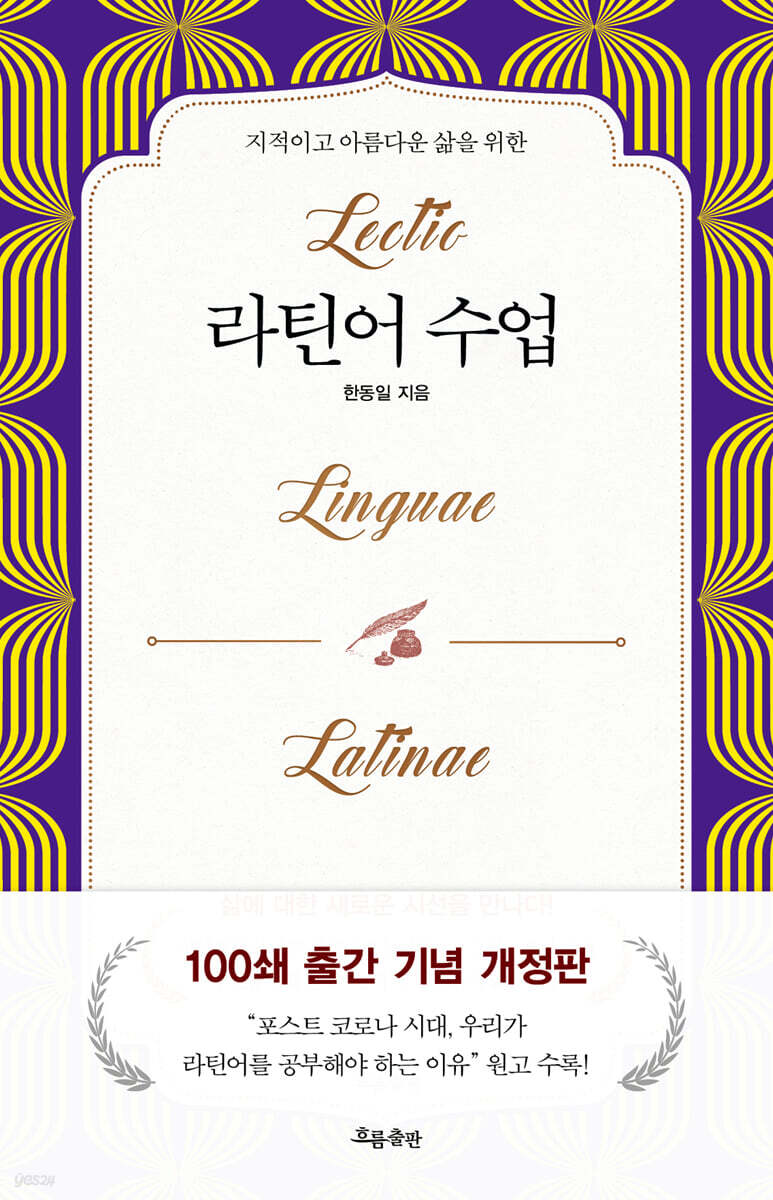
Book Introduction
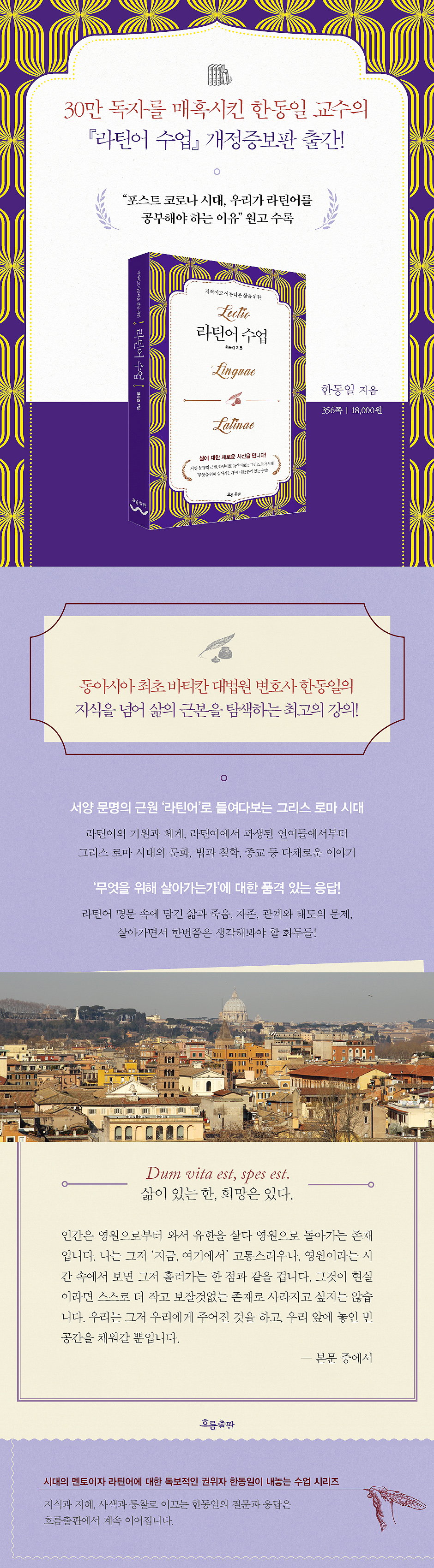
Han Dong-il, the first East Asian lawyer to serve on the Vatican Supreme Court
The ultimate lecture that goes beyond knowledge and explores the fundamentals of life!
[Revised and Expanded Edition] Released in 2023.
Manuscript included: "Why We Should Study Latin in the Post-COVID Era"
“Through the writings of ‘Latin Lessons,’ readers learn about life and learning.
The author's writing touches the hearts of people tired of everyday life.
In an era where studying to beat others is gaining popularity, the author says that the goal of studying should be to become a different person from yesterday, and thus to share it with others.” - Kyunghyang Shinmun
The best-selling book "Latin Lessons," which was published in 2017 and received widespread attention, including being selected as Book of the Year and Author of the Year by the media and bookstores, is back in a revised and expanded edition in 2023.
This newly redesigned book includes the manuscript “Why We Should Study Latin in the Post-Corona Era,” which contains Han Dong-il’s reflections on the world through the COVID-19 pandemic.
This book is a transcript of a lecture given at Sogang University by Han Dong-il, the first Korean and East Asian lawyer to be admitted to the Rota Romana, the Vatican's Supreme Court.
It covers the Latin system, the European languages derived from Latin, the culture, social systems, laws, and religions of the Greco-Roman era, and even the story of present-day Italy.
In addition, author Han Dong-il talks about various aspects of life, including his experiences studying abroad, the difficulties of studying, reflections on strengths and weaknesses, and relationship problems.
The ultimate lecture that goes beyond knowledge and explores the fundamentals of life!
[Revised and Expanded Edition] Released in 2023.
Manuscript included: "Why We Should Study Latin in the Post-COVID Era"
“Through the writings of ‘Latin Lessons,’ readers learn about life and learning.
The author's writing touches the hearts of people tired of everyday life.
In an era where studying to beat others is gaining popularity, the author says that the goal of studying should be to become a different person from yesterday, and thus to share it with others.” - Kyunghyang Shinmun
The best-selling book "Latin Lessons," which was published in 2017 and received widespread attention, including being selected as Book of the Year and Author of the Year by the media and bookstores, is back in a revised and expanded edition in 2023.
This newly redesigned book includes the manuscript “Why We Should Study Latin in the Post-Corona Era,” which contains Han Dong-il’s reflections on the world through the COVID-19 pandemic.
This book is a transcript of a lecture given at Sogang University by Han Dong-il, the first Korean and East Asian lawyer to be admitted to the Rota Romana, the Vatican's Supreme Court.
It covers the Latin system, the European languages derived from Latin, the culture, social systems, laws, and religions of the Greco-Roman era, and even the story of present-day Italy.
In addition, author Han Dong-il talks about various aspects of life, including his experiences studying abroad, the difficulties of studying, reflections on strengths and weaknesses, and relationship problems.
- You can preview some of the book's contents.
Preview
index
introduction
Before we begin classes, why we should study Latin in the post-COVID era.
Lectio 1 The Great Childhood Within Me (Magna puerilitas que est in me)
Lectio 2 The first class is cancelled (Prima schola alba est)
Lectio 3 De Elegantiis Linguae Latinae
Lectio 4 We learn not for school but for life (Non scholae sed vitae discimus)
Lectio 5 Disadvantages and Meritum
Lectio 6 Summa cum laude pro se quisque (Each for himself)
Lectio 7 I am a working man who studies (Ego sum operarius studens)
Lectio 8 Render to Caesar the things that are Caesar's, and to God the things that are God's (Quae sunt Caesaris Caesari et quae sunt Dei Deo)
Lectio 9 Even if there is no God (Etsi Deus non daretur)
Lectio10 I give because you give (Do ut Des)
Lectio 11 Time is the best judge (Tempus est optimus iudex)
Lectio 12 All animals are depressed after sex (Post coitum omne animal triste est)
Lectio 13 If you are well, then it is well.
I am well (Si vales bene est, ego valeo)
Lectio 14 Today for me, tomorrow for you (Hodie mihi, Cras tibi)
Lectio 15 Carpe Diem
Lectio 16 Roman Insults (Improperia Romanorum)
Lectio 17 The Age of the Romans (Aetates Romanorum)
Lectio 18 Roman Food (Cibi Romanorum)
Lectio 19 Roman Games (Ludi Romanorum)
Lectio 20 See as much as you know (Tantum videmus quantum scimus)
Lectio 21 I desire, therefore I am (Desidero ergo sum)
Lectio 22 Are you Korean? (Coreanus esne?)
Lectio 23 Today, tomorrow, and the day after that, I must continue on my way (Verumtamen oportet me hodie et cras et sequenti die ambulare)
Lectio 24 Obey the truth! (Oboedire Veritati!)
Lectio 25 Everyone only hurts and eventually dies (Vulnerant omnes, ultima necat)
Lectio 26 Love and do what you want (Dilige et fac quod vis)
Lectio 27 This too shall pass! (Hoc quoque transibit!)
Lectio 28 As long as there is life, there is hope (Dum vita est, spes est)
Acknowledgments: Remembering the Latin Classes That Built the "Bookshelf of Life" - Letters from Students
Before we begin classes, why we should study Latin in the post-COVID era.
Lectio 1 The Great Childhood Within Me (Magna puerilitas que est in me)
Lectio 2 The first class is cancelled (Prima schola alba est)
Lectio 3 De Elegantiis Linguae Latinae
Lectio 4 We learn not for school but for life (Non scholae sed vitae discimus)
Lectio 5 Disadvantages and Meritum
Lectio 6 Summa cum laude pro se quisque (Each for himself)
Lectio 7 I am a working man who studies (Ego sum operarius studens)
Lectio 8 Render to Caesar the things that are Caesar's, and to God the things that are God's (Quae sunt Caesaris Caesari et quae sunt Dei Deo)
Lectio 9 Even if there is no God (Etsi Deus non daretur)
Lectio10 I give because you give (Do ut Des)
Lectio 11 Time is the best judge (Tempus est optimus iudex)
Lectio 12 All animals are depressed after sex (Post coitum omne animal triste est)
Lectio 13 If you are well, then it is well.
I am well (Si vales bene est, ego valeo)
Lectio 14 Today for me, tomorrow for you (Hodie mihi, Cras tibi)
Lectio 15 Carpe Diem
Lectio 16 Roman Insults (Improperia Romanorum)
Lectio 17 The Age of the Romans (Aetates Romanorum)
Lectio 18 Roman Food (Cibi Romanorum)
Lectio 19 Roman Games (Ludi Romanorum)
Lectio 20 See as much as you know (Tantum videmus quantum scimus)
Lectio 21 I desire, therefore I am (Desidero ergo sum)
Lectio 22 Are you Korean? (Coreanus esne?)
Lectio 23 Today, tomorrow, and the day after that, I must continue on my way (Verumtamen oportet me hodie et cras et sequenti die ambulare)
Lectio 24 Obey the truth! (Oboedire Veritati!)
Lectio 25 Everyone only hurts and eventually dies (Vulnerant omnes, ultima necat)
Lectio 26 Love and do what you want (Dilige et fac quod vis)
Lectio 27 This too shall pass! (Hoc quoque transibit!)
Lectio 28 As long as there is life, there is hope (Dum vita est, spes est)
Acknowledgments: Remembering the Latin Classes That Built the "Bookshelf of Life" - Letters from Students
Detailed image
Into the book
Even if we trace the origin of the Latin word 'nebula', meaning 'haze', we have to look back a long time.
It is the same when we see the energy blooming like a spring breeze in our hearts.
Remembering that the word 'Ajirangi' was formed over eons of time, we should not give up easily and look at our hearts like that from time to time.
--- From "The first class is cancelled"
What I want to say is that even if others' objective evaluations do not say that I am 'summa cum laude (top student),' we must study with the sense of 'summa cum laude.'
Even if we don't humble ourselves, the world will try to make us feel small and worthless in many ways.
If, in the midst of all this, we treat ourselves as worthless, who will respect us? We are already "summa cum laude"—to ourselves and to something else.
--- From "Summa Cum Laude" for Each One
There is a Latin word called 'beatitudo'.
It is a word meaning 'happiness' and is a compound word of the verb 'beo' and the noun 'attitudo'.
Here, 'beo' means 'to make blessed, to make happy' and 'atitudo' means 'attitude, posture, or state of mind'.
In other words, the word 'beatitudo' also means 'you can bring good fortune depending on your attitude or state of mind.'
There are several Latin words for happiness, but this one stands out because it suggests that happiness can be achieved through a person's state of mind.
--- From "Time is the best judge"
Humans are beings who are remembered through others.
My mother became a coffin, a memory for me, and she made me look forward to my death.
Tomorrow, I too will become a coffin, a memory for someone, and I will face my own death.
Humans are beings who, by dying, pass on memories to others, saying, “Today is me, tomorrow is you.”
Now, let's think about one more thing there.
The scent my parents left behind still lives within me, but it is my responsibility to create what comes next.
I must use those memories as a foundation to create the fragrance of my life.
--- From "Today is for me, tomorrow is for you"
Each bird flies through the sky with its own unique flight method and wing beat.
Even though people are the same age, they do not all do the same things or go in the same direction.
Each and every one of us has our own gait and our own wings.
I have to go my own way, and the important thing at this time is to 'move on from yesterday's self.'
And I'm still figuring out the speed of my steps and my gestures, which I don't know exactly yet.
--- From "The Age of the Romans"
Hoc quoque transibit!
Maybe Quoque Transibit!
This too shall pass!
It may seem like the pain and despair we have now will last forever, but that is not the case.
There is an end somewhere.
We want the period to be put right now, but unfortunately, we don't know when that will be.
But one thing is certain: it will end someday.
Everything passes.
So, let's postpone today's despair, the desire to give up or run away right now, the endless anger until tomorrow.
Then, at some point, you will realize that the moments and things that tormented you are passing, that they have passed.
It is the same when we see the energy blooming like a spring breeze in our hearts.
Remembering that the word 'Ajirangi' was formed over eons of time, we should not give up easily and look at our hearts like that from time to time.
--- From "The first class is cancelled"
What I want to say is that even if others' objective evaluations do not say that I am 'summa cum laude (top student),' we must study with the sense of 'summa cum laude.'
Even if we don't humble ourselves, the world will try to make us feel small and worthless in many ways.
If, in the midst of all this, we treat ourselves as worthless, who will respect us? We are already "summa cum laude"—to ourselves and to something else.
--- From "Summa Cum Laude" for Each One
There is a Latin word called 'beatitudo'.
It is a word meaning 'happiness' and is a compound word of the verb 'beo' and the noun 'attitudo'.
Here, 'beo' means 'to make blessed, to make happy' and 'atitudo' means 'attitude, posture, or state of mind'.
In other words, the word 'beatitudo' also means 'you can bring good fortune depending on your attitude or state of mind.'
There are several Latin words for happiness, but this one stands out because it suggests that happiness can be achieved through a person's state of mind.
--- From "Time is the best judge"
Humans are beings who are remembered through others.
My mother became a coffin, a memory for me, and she made me look forward to my death.
Tomorrow, I too will become a coffin, a memory for someone, and I will face my own death.
Humans are beings who, by dying, pass on memories to others, saying, “Today is me, tomorrow is you.”
Now, let's think about one more thing there.
The scent my parents left behind still lives within me, but it is my responsibility to create what comes next.
I must use those memories as a foundation to create the fragrance of my life.
--- From "Today is for me, tomorrow is for you"
Each bird flies through the sky with its own unique flight method and wing beat.
Even though people are the same age, they do not all do the same things or go in the same direction.
Each and every one of us has our own gait and our own wings.
I have to go my own way, and the important thing at this time is to 'move on from yesterday's self.'
And I'm still figuring out the speed of my steps and my gestures, which I don't know exactly yet.
--- From "The Age of the Romans"
Hoc quoque transibit!
Maybe Quoque Transibit!
This too shall pass!
It may seem like the pain and despair we have now will last forever, but that is not the case.
There is an end somewhere.
We want the period to be put right now, but unfortunately, we don't know when that will be.
But one thing is certain: it will end someday.
Everything passes.
So, let's postpone today's despair, the desire to give up or run away right now, the endless anger until tomorrow.
Then, at some point, you will realize that the moments and things that tormented you are passing, that they have passed.
--- From "This Too Shall Pass!"
Publisher's Review
Latin classes that go beyond knowledge and build the foundations of life.
A dignified response to the question, 'What do we live for?'
This book, which has captivated countless readers since its publication in early summer 2017, is a transcription of Han Dong-il's Latin lectures given at Sogang University.
At the time, the author's lectures spread through word of mouth and were attended not only by Sogang University students, but also by students from Yonsei University, Ewha Womans University, and local schools outside of the Sinchon university district, as well as the general public. This was covered in the media at the time as a "hot lecture," drawing even more attention.
The author's background as the first Korean and first Asian lawyer to serve on the Vatican's Supreme Court, the Rota Romana, has become a hot topic, but there is another reason why the author's lectures have become popular.
This class allowed students to learn not only the system of the Latin language and European languages derived from Latin, but also hear colorful stories about the food, entertainment, social systems, laws, and religion of the Greco-Roman era.
Additionally, the class included topics relevant to our lives, such as the author's experiences while studying abroad, the people he met, the frustrations and difficulties he encountered while studying, the relationship problems he could not avoid in life, and reflections on his own strengths and weaknesses.
Students who took the author's lectures, which were like comprehensive liberal arts classes, say that the class allowed them to meet themselves, broaden their perspective on the world, deepen their thinking, and even became a turning point in their lives.
The origin of Western civilization, ‘Latin’
A Look into the Greco-Roman Era
In this book, the author tells an interesting story about the social, cultural, and religious aspects of the Latin and Greco-Roman eras.
The stories of the Greco-Roman era told by the author do not remain in the past, but are still relevant to the present day.
For example, consider the Latin phrase 'Do ut Des' introduced in the book. This phrase means 'I give to you as you give' and is a legal concept derived from Roman law's bond contracts.
Through these words, the author unfolds the story from the four diagrams that formed the basis of contracts under Roman law in the past to European secularism and reciprocity.
Furthermore, it explains why this concept is not something of the past but remains relevant today in today's international society, where the principle of reciprocity is under threat.
Another example is the Latin word 'iuvenis', which means young man, which refers to those between the ages of 20 and 25. The reason the age range for youth in Roman law was so long was to ensure a smooth supply of soldiers to fill the army.
The author argues that this has served a positive function in relieving Europeans of their obsession with age.
In fact, the author adds that the Italian friends he met while studying abroad in Rome told him, "You are still young," even to a 70-year-old man, and says that we too need to reflect on our thoughts and attitudes toward age.
To build a solid life
A class that makes roots grow
One of the author's students, who took the author's class, said that in his twenties, when he was still a young man who had not yet blossomed, he learned the 'roots' rather than the 'flowers' in this class.
This is because the author's classes do not stop at simply imparting knowledge, but are connected to our 'lives'.
He explains that the Latin phrase 'Hodie Migi Kras Tibi', engraved on a Roman cemetery, means 'Today for me, tomorrow for you', and through it, he unravels memories of his late mother, reminding us that 'death' will someday be ours, and raising the question that life and death are not far apart.
He also talks calmly about the difficulties he faced in classes that mixed Italian, English, and Latin while studying abroad, the frustration he experienced while studying, and the days when he despaired over things not going his way after returning to Korea, but he cannot help but speak of hope, but the resonance is by no means light.
His story ultimately becomes a starting point for us to think about ourselves and ask ourselves, 'What kind of person should I be, how should I live, and what attitude should I have toward life?'
Learn attitude and direction in life
At the end of the book, there are handwritten letters the author received from his students at the end of class and letters sent by his students to commemorate the book's publication.
There is something they all have in common.
The midterm assignment is 'De mea vita', which is to be submitted on one A4 page, and to write 'about my life'.
The disciples say that through this assignment, they were able to face themselves for the first time, understand their past selves, acknowledge their present selves, and dream of their future selves.
He further said that through the class he was able to reflect on his attitude and direction toward life.
The letters sent by the students express their hope that many readers will find comfort and strength through this book, just as they found comfort and strength through their classes.
A dignified response to the question, 'What do we live for?'
This book, which has captivated countless readers since its publication in early summer 2017, is a transcription of Han Dong-il's Latin lectures given at Sogang University.
At the time, the author's lectures spread through word of mouth and were attended not only by Sogang University students, but also by students from Yonsei University, Ewha Womans University, and local schools outside of the Sinchon university district, as well as the general public. This was covered in the media at the time as a "hot lecture," drawing even more attention.
The author's background as the first Korean and first Asian lawyer to serve on the Vatican's Supreme Court, the Rota Romana, has become a hot topic, but there is another reason why the author's lectures have become popular.
This class allowed students to learn not only the system of the Latin language and European languages derived from Latin, but also hear colorful stories about the food, entertainment, social systems, laws, and religion of the Greco-Roman era.
Additionally, the class included topics relevant to our lives, such as the author's experiences while studying abroad, the people he met, the frustrations and difficulties he encountered while studying, the relationship problems he could not avoid in life, and reflections on his own strengths and weaknesses.
Students who took the author's lectures, which were like comprehensive liberal arts classes, say that the class allowed them to meet themselves, broaden their perspective on the world, deepen their thinking, and even became a turning point in their lives.
The origin of Western civilization, ‘Latin’
A Look into the Greco-Roman Era
In this book, the author tells an interesting story about the social, cultural, and religious aspects of the Latin and Greco-Roman eras.
The stories of the Greco-Roman era told by the author do not remain in the past, but are still relevant to the present day.
For example, consider the Latin phrase 'Do ut Des' introduced in the book. This phrase means 'I give to you as you give' and is a legal concept derived from Roman law's bond contracts.
Through these words, the author unfolds the story from the four diagrams that formed the basis of contracts under Roman law in the past to European secularism and reciprocity.
Furthermore, it explains why this concept is not something of the past but remains relevant today in today's international society, where the principle of reciprocity is under threat.
Another example is the Latin word 'iuvenis', which means young man, which refers to those between the ages of 20 and 25. The reason the age range for youth in Roman law was so long was to ensure a smooth supply of soldiers to fill the army.
The author argues that this has served a positive function in relieving Europeans of their obsession with age.
In fact, the author adds that the Italian friends he met while studying abroad in Rome told him, "You are still young," even to a 70-year-old man, and says that we too need to reflect on our thoughts and attitudes toward age.
To build a solid life
A class that makes roots grow
One of the author's students, who took the author's class, said that in his twenties, when he was still a young man who had not yet blossomed, he learned the 'roots' rather than the 'flowers' in this class.
This is because the author's classes do not stop at simply imparting knowledge, but are connected to our 'lives'.
He explains that the Latin phrase 'Hodie Migi Kras Tibi', engraved on a Roman cemetery, means 'Today for me, tomorrow for you', and through it, he unravels memories of his late mother, reminding us that 'death' will someday be ours, and raising the question that life and death are not far apart.
He also talks calmly about the difficulties he faced in classes that mixed Italian, English, and Latin while studying abroad, the frustration he experienced while studying, and the days when he despaired over things not going his way after returning to Korea, but he cannot help but speak of hope, but the resonance is by no means light.
His story ultimately becomes a starting point for us to think about ourselves and ask ourselves, 'What kind of person should I be, how should I live, and what attitude should I have toward life?'
Learn attitude and direction in life
At the end of the book, there are handwritten letters the author received from his students at the end of class and letters sent by his students to commemorate the book's publication.
There is something they all have in common.
The midterm assignment is 'De mea vita', which is to be submitted on one A4 page, and to write 'about my life'.
The disciples say that through this assignment, they were able to face themselves for the first time, understand their past selves, acknowledge their present selves, and dream of their future selves.
He further said that through the class he was able to reflect on his attitude and direction toward life.
The letters sent by the students express their hope that many readers will find comfort and strength through this book, just as they found comfort and strength through their classes.
GOODS SPECIFICS
- Date of issue: August 15, 2023
- Page count, weight, size: 356 pages | 614g | 145*225*20mm
- ISBN13: 9788965965879
- ISBN10: 896596587X
You may also like
카테고리
korean


korean

![ELLE 엘르 스페셜 에디션 A형 : 12월 [2025]](http://librairie.coreenne.fr/cdn/shop/files/b8e27a3de6c9538896439686c6b0e8fb.jpg?v=1766436872&width=3840)


