

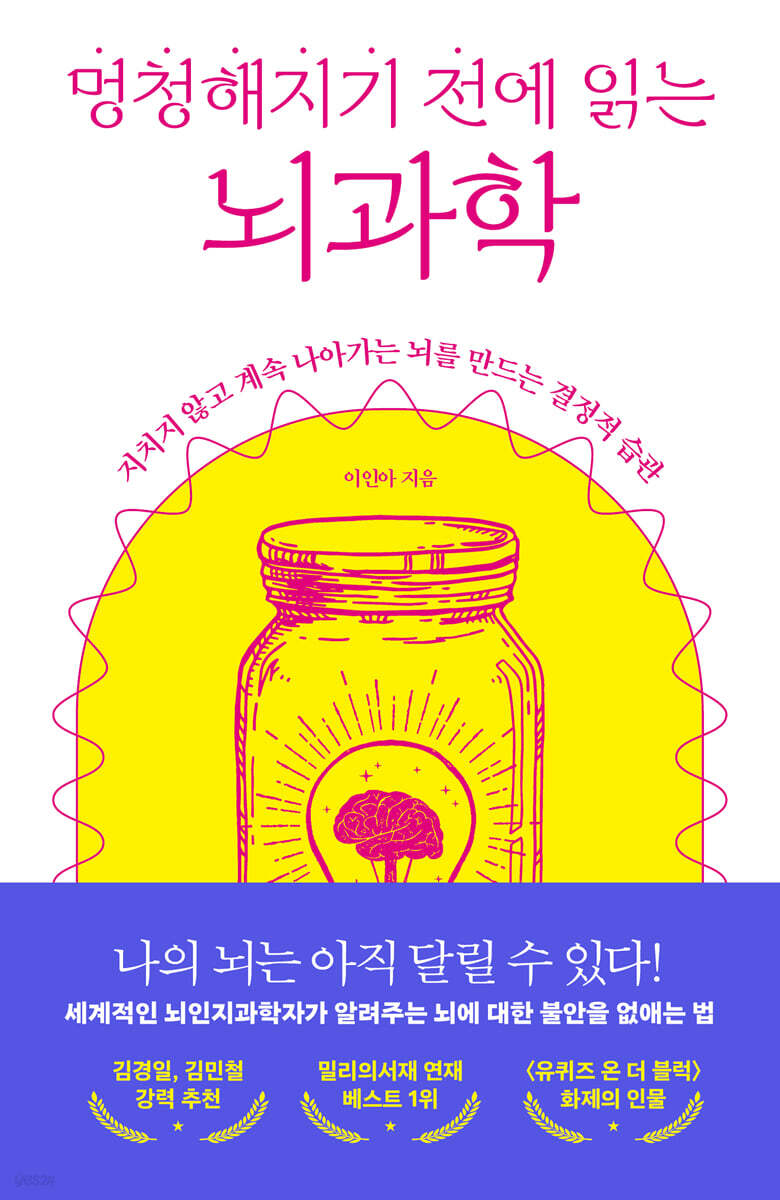
Brain Science to Read Before You Go Dumb
 |
Description
Book Introduction
My brain can still run!
How to Eliminate Brain Anxiety from a World-Renowned Neuroscientist
The question, "Why isn't my concentration and memory as good as before?" continues throughout life, regardless of age.
Life is full of things to learn and achieve, and at each opportunity, you can't help but feel your own limitations.
But those who know the truth hidden in the brain have a different way of dealing with it.
The brain is a system built to keep trying and changing.
Just by getting rid of the misconceptions you've had about the brain and discovering its positive possibilities, your current unnecessary anxiety will disappear.
Professor Lee In-ah, who is at the forefront of brain cognitive science research, is delving into the mysteries of 'memory and forgetting' and will guide you into 'the world of the brain's infinite possibilities.'
From now on, let's start incorporating brain-friendly habits into our lives one by one.
Through those small changes, you will find yourself breaking free from the lethargy of everyday life and taking control of your life.
How to Eliminate Brain Anxiety from a World-Renowned Neuroscientist
The question, "Why isn't my concentration and memory as good as before?" continues throughout life, regardless of age.
Life is full of things to learn and achieve, and at each opportunity, you can't help but feel your own limitations.
But those who know the truth hidden in the brain have a different way of dealing with it.
The brain is a system built to keep trying and changing.
Just by getting rid of the misconceptions you've had about the brain and discovering its positive possibilities, your current unnecessary anxiety will disappear.
Professor Lee In-ah, who is at the forefront of brain cognitive science research, is delving into the mysteries of 'memory and forgetting' and will guide you into 'the world of the brain's infinite possibilities.'
From now on, let's start incorporating brain-friendly habits into our lives one by one.
Through those small changes, you will find yourself breaking free from the lethargy of everyday life and taking control of your life.
- You can preview some of the book's contents.
Preview
index
Prologue _ The Brain, In Search of the Closest and Most Unfamiliar Universe
1. I misunderstand the brain.
: What We Don't Know About the Brain
You never learn, do you? - To make what you learn your own
Are Young and Old Brains Different? - Misconceptions About Learning and Age
What is the power of long-term concentration? - Passive concentration and true concentration
On Seeing the World Correctly - An Open Look at the Brain
2.
My brain changes as much as I do.
: Habits that unlock your brain's potential
Memory is for the future, not the past - recall for imagination.
Moving Your Body Changes Everything - Create a Movement List
Creating order in chaos: Storytelling
The Balance You Need Before Burnout Strikes: Balancing Your Learning System
The Effects of Silent Time - Using Default Mode
On the possibilities that curiosity creates - Staying curious
3.
The power you gain by understanding and moving forward with your brain
: Strategies to enhance the brain's responsiveness
Am I a good positionalist? - Learning to move the center of gravity.
How to Fail Right, Not Just Fail - Effective Trial and Error
Exercises for Improving Organizing Skills - Creating Structures in Your Head
Emotional context changes everything - Making a good emotional soup
Learning how to learn requires learning - making good use of tools
The little things that make me who I am - Breaking down my routine
4.
For a brain that is not shaken by any anxiety
: A life centered on the brain
It is I who create experiences and memories - Truman's era
Become a Cognitive Marathoner - Pace Control Practice
The bottom line is to trust your experiential feelings - reducing memory outsourcing.
Am I ready for a change in work? - Finding the essence of work
How to navigate life on a map - The importance of maps
People with many detours - having multiple alternatives
1. I misunderstand the brain.
: What We Don't Know About the Brain
You never learn, do you? - To make what you learn your own
Are Young and Old Brains Different? - Misconceptions About Learning and Age
What is the power of long-term concentration? - Passive concentration and true concentration
On Seeing the World Correctly - An Open Look at the Brain
2.
My brain changes as much as I do.
: Habits that unlock your brain's potential
Memory is for the future, not the past - recall for imagination.
Moving Your Body Changes Everything - Create a Movement List
Creating order in chaos: Storytelling
The Balance You Need Before Burnout Strikes: Balancing Your Learning System
The Effects of Silent Time - Using Default Mode
On the possibilities that curiosity creates - Staying curious
3.
The power you gain by understanding and moving forward with your brain
: Strategies to enhance the brain's responsiveness
Am I a good positionalist? - Learning to move the center of gravity.
How to Fail Right, Not Just Fail - Effective Trial and Error
Exercises for Improving Organizing Skills - Creating Structures in Your Head
Emotional context changes everything - Making a good emotional soup
Learning how to learn requires learning - making good use of tools
The little things that make me who I am - Breaking down my routine
4.
For a brain that is not shaken by any anxiety
: A life centered on the brain
It is I who create experiences and memories - Truman's era
Become a Cognitive Marathoner - Pace Control Practice
The bottom line is to trust your experiential feelings - reducing memory outsourcing.
Am I ready for a change in work? - Finding the essence of work
How to navigate life on a map - The importance of maps
People with many detours - having multiple alternatives
Detailed image

Into the book
The brain's ability to change, its plasticity, is truly remarkable.
The famous "London Taxi Driver Study," which showed that driving a car by memorizing London's streets led to an enlarged hippocampus, as well as research showing that other brain regions actively take over the functions of damaged areas during stroke recovery, demonstrate the brain's remarkable plasticity, allowing it to change like a chameleon.
The research on older nuns and the brain changes that occur during regular meditation, as described in this book, are also based on the principle of plasticity.
--- p.10
All of this 'retrieving my experiential memories' of everyday life is a shortcut to building an adaptive brain that can respond to unpredictable changes.
The brain's natural learning doesn't happen at a desk.
Rather, it would be good to remember that in the world, we encounter various stimuli, people, environments, and events, and through the process of utilizing and responding to our own experiences, we naturally and ultimately come to a complete form.
--- p.24
As we age, individual differences in the brain's cognitive abilities become more severe, making it difficult to say roughly what level of brain performance will be at a certain age.
(…) Just as some of the elderly people you meet at the gym can lift heavy plates that even young people find difficult to lift, while others break out in a sweat after lifting only a few light dumbbells, our bodies, including our brains, can perform very differently as we age depending on the type of training we have received.
--- p.32
If "place + time + object + value" were simply stored as one, like taking a photograph, it would seem unlikely that the contents would be misassembled and retrieved, much like pulling a photo from an album. But why does our brain's episodic memory system operate in such a way that it's so prone to error? Perhaps it's because our brain, when imagining and creating something new, builds upon a combination of things we already know from experience.
Perhaps that's why the hippocampus, which creates combinations of memories, is also mobilized when we imagine.
--- p.68
Speaking by moving only the lips and vocal cords is considered movement, and typing or touching with the fingers is also considered movement, but it is more likely that learning will be best experienced through large-scale movements of the body moving through space than through these small movements.
The reason has to do with the principles of how the brain operates its energy.
That is, the greater the body's movements, and the more elaborate and organized the movements, the more energy is required, but the brain is extremely reluctant to spend energy on unnecessary things.
--- p.76
The rapid depletion of energy when using the hippocampal system is similar to how the battery on your smartphone quickly dies when you watch videos or take a lot of pictures with the camera.
Conversely, activities like reading an e-book don't drain your smartphone's battery very much, similar to how our brain's procedural learning system works unconsciously and without using energy.
For those who must intensively utilize narrative learning systems for their work or tasks, replenishing energy through so-called recharging is crucial to consistently perform those tasks or tasks well without burnout.
Park Wan-seo and Hermann Hesse chose gardening as a means of recharging.
--- p.100
Most people probably think that this busy state is when our brains work most efficiently.
(…) However, brain science research strongly suggests that the human brain needs adequate rest.
I believe that even when resting, especially when doing nothing, and being in a state of blankness, allowing the mind to wander freely like a leaf blowing in the wind, is essential for maintaining the human nature of the brain.
The famous "London Taxi Driver Study," which showed that driving a car by memorizing London's streets led to an enlarged hippocampus, as well as research showing that other brain regions actively take over the functions of damaged areas during stroke recovery, demonstrate the brain's remarkable plasticity, allowing it to change like a chameleon.
The research on older nuns and the brain changes that occur during regular meditation, as described in this book, are also based on the principle of plasticity.
--- p.10
All of this 'retrieving my experiential memories' of everyday life is a shortcut to building an adaptive brain that can respond to unpredictable changes.
The brain's natural learning doesn't happen at a desk.
Rather, it would be good to remember that in the world, we encounter various stimuli, people, environments, and events, and through the process of utilizing and responding to our own experiences, we naturally and ultimately come to a complete form.
--- p.24
As we age, individual differences in the brain's cognitive abilities become more severe, making it difficult to say roughly what level of brain performance will be at a certain age.
(…) Just as some of the elderly people you meet at the gym can lift heavy plates that even young people find difficult to lift, while others break out in a sweat after lifting only a few light dumbbells, our bodies, including our brains, can perform very differently as we age depending on the type of training we have received.
--- p.32
If "place + time + object + value" were simply stored as one, like taking a photograph, it would seem unlikely that the contents would be misassembled and retrieved, much like pulling a photo from an album. But why does our brain's episodic memory system operate in such a way that it's so prone to error? Perhaps it's because our brain, when imagining and creating something new, builds upon a combination of things we already know from experience.
Perhaps that's why the hippocampus, which creates combinations of memories, is also mobilized when we imagine.
--- p.68
Speaking by moving only the lips and vocal cords is considered movement, and typing or touching with the fingers is also considered movement, but it is more likely that learning will be best experienced through large-scale movements of the body moving through space than through these small movements.
The reason has to do with the principles of how the brain operates its energy.
That is, the greater the body's movements, and the more elaborate and organized the movements, the more energy is required, but the brain is extremely reluctant to spend energy on unnecessary things.
--- p.76
The rapid depletion of energy when using the hippocampal system is similar to how the battery on your smartphone quickly dies when you watch videos or take a lot of pictures with the camera.
Conversely, activities like reading an e-book don't drain your smartphone's battery very much, similar to how our brain's procedural learning system works unconsciously and without using energy.
For those who must intensively utilize narrative learning systems for their work or tasks, replenishing energy through so-called recharging is crucial to consistently perform those tasks or tasks well without burnout.
Park Wan-seo and Hermann Hesse chose gardening as a means of recharging.
--- p.100
Most people probably think that this busy state is when our brains work most efficiently.
(…) However, brain science research strongly suggests that the human brain needs adequate rest.
I believe that even when resting, especially when doing nothing, and being in a state of blankness, allowing the mind to wander freely like a leaf blowing in the wind, is essential for maintaining the human nature of the brain.
--- p.107
Publisher's Review
★ “To take control of your life, you must keep your brain alive and breathing.”
★Milli's Library Best Series #1!
★A Guide to Brain Utilization from Professor In-Ah Lee, a World-Renowned Brain and Cognitive Scientist
The anxiety we all feel as if we're becoming dumber
“Why does my mind seem to be getting worse?” “Is my brain rotting away?” When we feel that our concentration and memory are not what they used to be, we are suddenly struck by fear.
I'm worried that I'll become stupid like this.
Everyone who is going through this kind of worry at some point in their life can say, "This is my story."
Life is full of things to learn and achieve, and at each opportunity, you can't help but feel your own limitations.
Moreover, in these days when AI is increasingly taking care of many things for us, anxiety is growing as much as comfort.
But how much do you truly know about the hidden potential within your brain? Are you delaying efforts to change, presuming it's too late or preconceived notions that change is difficult?
The brain is a system designed to constantly change.
"Brain Science Before You Go Dumb" examines the unnecessary anxieties we've had about the brain and guides us through crucial methods for creating a brain that continues to move forward without tiring.
Professor Lee In-ah, the author of this book, is a world-renowned brain cognitive scientist who is intensively exploring the mysteries of 'memory and forgetting.'
One thing he has learned for sure during his 30 years of research is that, unlike the rest of the human body, the brain can develop infinitely.
The brain is a system designed to constantly change.
As the master of my brain, I can show infinite possibilities depending on how much new change I try.
It doesn't matter if the changes are minor.
The important thing is to feel yourself changing little by little and to gain experience of change.
In neuroscience, the saying "Use it or lose it" is considered an unwritten rule.
It starts with knowing that the brain changes as much as I use it.
Expanding the Brain's Potential and Practical Responses
Part 1 first examines some common misconceptions about the brain and learning.
We'll clear up some of the misconceptions we've had, including what's most important to internalize what you've learned, whether learning ability actually declines with age, and the difference between passive concentration and true concentration.
In parts 2 and 3, we will discover the hidden potential of the brain and guide you through ways to increase your brain power by 200%.
Part 2 contains habits that unlock the brain's potential, such as recall for imagination, movement, storytelling, balancing learning systems, and using default mode. Part 3 contains strategies that are practically helpful in daily life and work, such as shifting focus, efficient trial and error, improving organizational skills, understanding emotional context, and using learning tools.
Finally, in Part 4, we talk about what it means to live a life centered in the brain, free from anxiety about the future.
We explore why it is we who create experiences and memories, how to become a cognitive marathoner, what is important to prepare for changes in work, and how to become a person with many detours.
Things to check to regain control of your life
In fact, the reason why improvements in things like concentration and memory feel slow is because we forget about true motivation under the pretext of our busy daily lives.
The brain never wastes energy.
My brain knows what I need most.
So, it is important to look back on your daily life and check it frequently.
Are you constantly putting off important changes, or are you wasting your time on other stimuli to avoid reality?
From now on, let's begin the journey to move our stagnant daily lives and take back control of our lives.
★Milli's Library Best Series #1!
★A Guide to Brain Utilization from Professor In-Ah Lee, a World-Renowned Brain and Cognitive Scientist
The anxiety we all feel as if we're becoming dumber
“Why does my mind seem to be getting worse?” “Is my brain rotting away?” When we feel that our concentration and memory are not what they used to be, we are suddenly struck by fear.
I'm worried that I'll become stupid like this.
Everyone who is going through this kind of worry at some point in their life can say, "This is my story."
Life is full of things to learn and achieve, and at each opportunity, you can't help but feel your own limitations.
Moreover, in these days when AI is increasingly taking care of many things for us, anxiety is growing as much as comfort.
But how much do you truly know about the hidden potential within your brain? Are you delaying efforts to change, presuming it's too late or preconceived notions that change is difficult?
The brain is a system designed to constantly change.
"Brain Science Before You Go Dumb" examines the unnecessary anxieties we've had about the brain and guides us through crucial methods for creating a brain that continues to move forward without tiring.
Professor Lee In-ah, the author of this book, is a world-renowned brain cognitive scientist who is intensively exploring the mysteries of 'memory and forgetting.'
One thing he has learned for sure during his 30 years of research is that, unlike the rest of the human body, the brain can develop infinitely.
The brain is a system designed to constantly change.
As the master of my brain, I can show infinite possibilities depending on how much new change I try.
It doesn't matter if the changes are minor.
The important thing is to feel yourself changing little by little and to gain experience of change.
In neuroscience, the saying "Use it or lose it" is considered an unwritten rule.
It starts with knowing that the brain changes as much as I use it.
Expanding the Brain's Potential and Practical Responses
Part 1 first examines some common misconceptions about the brain and learning.
We'll clear up some of the misconceptions we've had, including what's most important to internalize what you've learned, whether learning ability actually declines with age, and the difference between passive concentration and true concentration.
In parts 2 and 3, we will discover the hidden potential of the brain and guide you through ways to increase your brain power by 200%.
Part 2 contains habits that unlock the brain's potential, such as recall for imagination, movement, storytelling, balancing learning systems, and using default mode. Part 3 contains strategies that are practically helpful in daily life and work, such as shifting focus, efficient trial and error, improving organizational skills, understanding emotional context, and using learning tools.
Finally, in Part 4, we talk about what it means to live a life centered in the brain, free from anxiety about the future.
We explore why it is we who create experiences and memories, how to become a cognitive marathoner, what is important to prepare for changes in work, and how to become a person with many detours.
Things to check to regain control of your life
In fact, the reason why improvements in things like concentration and memory feel slow is because we forget about true motivation under the pretext of our busy daily lives.
The brain never wastes energy.
My brain knows what I need most.
So, it is important to look back on your daily life and check it frequently.
Are you constantly putting off important changes, or are you wasting your time on other stimuli to avoid reality?
From now on, let's begin the journey to move our stagnant daily lives and take back control of our lives.
GOODS SPECIFICS
- Date of issue: November 12, 2025
- Page count, weight, size: 264 pages | 318g | 130*200*17mm
- ISBN13: 9791169085458
- ISBN10: 1169085458
You may also like
카테고리
korean


korean

![ELLE 엘르 스페셜 에디션 A형 : 12월 [2025]](http://librairie.coreenne.fr/cdn/shop/files/b8e27a3de6c9538896439686c6b0e8fb.jpg?v=1766436872&width=3840)


