

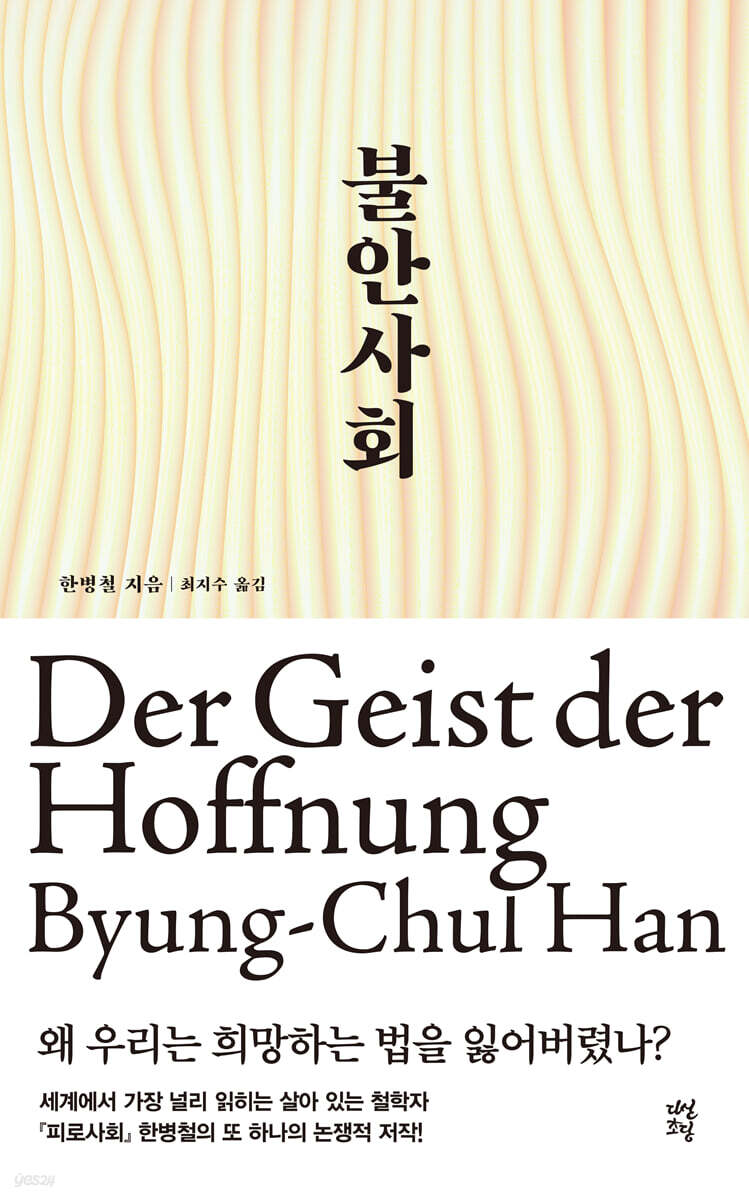
Anxious society
 |
Description
Book Introduction
From a fatigued society to an anxious society…
Philosopher Han Byung-chul, who diagnoses the wounds of the times,
Emphasizing the power of empathy and solidarity in an age of anxiety!
“Why have we lost our ability to hope?”
Another controversial work by the world-renowned bestselling author and philosopher Han Byung-chul, whose book "The Fatigued Society" created a sensation in Korea 10 years ago.
He says, “Each era has its own major disease,” and in his latest work, “Anxiety Society,” he diagnoses the disease of this era as “anxiety,” sounding the alarm about the broken solidarity and widespread hatred in a society consumed by anxiety.
In our modern society, where anxiety is systematically used, we have lost the ability to hope.
This book emphasizes that what is needed in the lives of modern people, who are mired in deep uncertainty and profound helplessness, is 'hope.'
A life consumed by anxiety, unable to envision the future, and mired in past trauma, is nothing more than a life of survival.
Anxiety about failure, anxiety about being left out, anxiety about being eliminated… We constantly whip ourselves and run just to survive.
The problem is anxiety that spreads like a disease.
A society where dialogue, listening, empathy, and reconciliation collapse due to the looming sense of unknown threat is no different from a prison.
Philosopher Han Byung-chul, who diagnoses the wounds of the times,
Emphasizing the power of empathy and solidarity in an age of anxiety!
“Why have we lost our ability to hope?”
Another controversial work by the world-renowned bestselling author and philosopher Han Byung-chul, whose book "The Fatigued Society" created a sensation in Korea 10 years ago.
He says, “Each era has its own major disease,” and in his latest work, “Anxiety Society,” he diagnoses the disease of this era as “anxiety,” sounding the alarm about the broken solidarity and widespread hatred in a society consumed by anxiety.
In our modern society, where anxiety is systematically used, we have lost the ability to hope.
This book emphasizes that what is needed in the lives of modern people, who are mired in deep uncertainty and profound helplessness, is 'hope.'
A life consumed by anxiety, unable to envision the future, and mired in past trauma, is nothing more than a life of survival.
Anxiety about failure, anxiety about being left out, anxiety about being eliminated… We constantly whip ourselves and run just to survive.
The problem is anxiety that spreads like a disease.
A society where dialogue, listening, empathy, and reconciliation collapse due to the looming sense of unknown threat is no different from a prison.
- You can preview some of the book's contents.
Preview
index
Translator's Preface
Entering
Hope and Action
Hope and awareness
Hope as a Form of Life
Americas
index
Entering
Hope and Action
Hope and awareness
Hope as a Form of Life
Americas
index
Detailed image

Into the book
There are times in our lives when we reach the depths of despair.
When I don't have the strength to get back up, only with the 'spirit of hope' can I open my eyes from the depths of despair and feel that I am still alive.
When all the hardships of love have dissipated and disappeared, and I once again grasp the soil in my hands at the bottom that has become quiet, I realize that I have my own 'Bohemia by the Sea' that no one can conquer.
I believe that the hope of Havel and Celan's "nevertheless"—the hope that possesses the vitality that makes existence possible—is the spirit that our times must pursue.
--- From the "Translator's Preface"
Anxiety is a great tool of control.
Because it makes the masses obedient and vulnerable to intimidation.
In an anxious atmosphere, you cannot freely express your opinions.
This stems from anxiety about oppression.
Hate speech and so-called hush-hush attacks that openly incite anxiety hinder the free expression of opinions.
Even today, we have anxiety about reason.
It seems like I'm losing the courage to think.
Reason enables access to something 'completely different'.
But in an atmosphere of anxiety, the same things circulate.
Conformism is becoming widespread.
Anxiety blocks access to the 'other'.
This is because other things do not follow the logic of efficiency and productivity, which corresponds to the logic of 'the same thing'.
Hopeful thinking is different from optimistic thinking.
Because, unlike hope, there is nothing negative about optimism.
Optimistic thinking has no doubts or despair.
Complete positivity is the essence of optimism.
Optimism is a way of thinking that firmly believes that things will turn out well.
So, time is closed for the optimist.
The optimist does not see the future as closed, as a space of possibility.
In other words, nothing new happens to the optimist.
Nothing can surprise an optimist.
For them, the future is a 'manageable object'.
However, the actual future time exists within ‘impossibility of processing.’
Optimists don't focus on distant, intangible things.
This is because they do not want to think about the unexpected or the unpredictable.
The widespread anxiety today is not actually caused by any permanent catastrophe.
We suffer from widespread anxiety, linked to structural reasons, and therefore unable to trace its causes to specific events.
The neoliberal system is a system of insecurity.
It separated people from each other and made them their own entrepreneurs.
Total competition and the growing obsession with performance erode community.
Narcissistic isolation breeds loneliness and anxiety.
Even our relationship with ourselves becomes increasingly filled with anxiety.
Anxiety about failure, anxiety about not being able to meet your own needs, anxiety about not being able to keep up or being left behind.
But paradoxically, this widespread anxiety increases productivity.
--- From "Entering"
It cannot be said that animals have no linguistic ability at all.
However, the language used by animals has a completely different temporal structure from that of human language.
They have no concept of an empathetic future.
But hope exists in the future.
Animals communicate by sending signals that carry meaning.
But animals cannot make promises.
Also, animal language is not narrative.
So animals cannot tell narrative stories.
Animals can express their 'wants' sufficiently, but hope is narratively structured and therefore cannot be expressed by animals.
Epic stories presuppose a consciousness of time.
However, animals are not capable of developing the concept of tomorrow.
Because the concept of tomorrow has a narrative character.
Therefore, animals have no access to this narrative future.
Unlike nighttime dreams, which do not transcend the personal dimension, daytime dreams possess utopian potential and political dimensions.
Only in daytime dreams can beauty, sublimity, and transformation appear.
There is no utopian vision or utopian movement in the dreams of the night.
Night dreams hate to act.
Revolutionaries dream of day.
Revolutionaries dream forward, and they dream together.
The dream of making the world a better place is a daytime dream born from intense hope.
There is no place for hope in the dreams of the night.
Most of the dreams at night are dreams of wishes and anxiety.
According to Freud, the function of night dreams is to process traumatic experiences from the past.
There is no future dimension in the dreams of the night.
--- From "Hope and Action"
Without Eros, we are trapped in the hell of sameness.
Deleuze asked a profound question.
“If ‘friend’ becomes a condition for thinking (…), what does ‘friend’ mean? Isn’t it a lover, or rather a lover? Doesn’t that friend bring back into thought the vivid relationship with the other that was considered excluded from pure thinking?” Artificial intelligence has neither friends nor lovers, and therefore cannot think.
There is no Eros for artificial intelligence.
Because artificial intelligence has no desire for others.
--- From "Hope and Awareness"
The Dasein that Heidegger speaks of is either caught up in ‘everydayness’ or ‘anxious about being able to exist.’
Elevated or heightened moods are not essential aspects of present existence.
Heidegger continues to assert the burdensome nature of Dasein.
He even attributes hope to the burdensome nature of things.
But hope lifts our spirits and relieves us of the burden of existence.
Hope relieves or lightens the burden of existence.
From such hope comes the movement and dynamism that enables us to transcend 'being thrown' and 'guilt.'
The Dasein that Heidegger speaks of is a being that cannot be free from guilt.
There can be no grace for such a being.
But hope knows how to receive grace.
Heidegger also misinterprets the temporality of hope as a ‘mode of already being.’
Hope is characterized as a 'state of being that is not yet'.
Heidegger does not know about the future as 'Avenir'.
When I don't have the strength to get back up, only with the 'spirit of hope' can I open my eyes from the depths of despair and feel that I am still alive.
When all the hardships of love have dissipated and disappeared, and I once again grasp the soil in my hands at the bottom that has become quiet, I realize that I have my own 'Bohemia by the Sea' that no one can conquer.
I believe that the hope of Havel and Celan's "nevertheless"—the hope that possesses the vitality that makes existence possible—is the spirit that our times must pursue.
--- From the "Translator's Preface"
Anxiety is a great tool of control.
Because it makes the masses obedient and vulnerable to intimidation.
In an anxious atmosphere, you cannot freely express your opinions.
This stems from anxiety about oppression.
Hate speech and so-called hush-hush attacks that openly incite anxiety hinder the free expression of opinions.
Even today, we have anxiety about reason.
It seems like I'm losing the courage to think.
Reason enables access to something 'completely different'.
But in an atmosphere of anxiety, the same things circulate.
Conformism is becoming widespread.
Anxiety blocks access to the 'other'.
This is because other things do not follow the logic of efficiency and productivity, which corresponds to the logic of 'the same thing'.
Hopeful thinking is different from optimistic thinking.
Because, unlike hope, there is nothing negative about optimism.
Optimistic thinking has no doubts or despair.
Complete positivity is the essence of optimism.
Optimism is a way of thinking that firmly believes that things will turn out well.
So, time is closed for the optimist.
The optimist does not see the future as closed, as a space of possibility.
In other words, nothing new happens to the optimist.
Nothing can surprise an optimist.
For them, the future is a 'manageable object'.
However, the actual future time exists within ‘impossibility of processing.’
Optimists don't focus on distant, intangible things.
This is because they do not want to think about the unexpected or the unpredictable.
The widespread anxiety today is not actually caused by any permanent catastrophe.
We suffer from widespread anxiety, linked to structural reasons, and therefore unable to trace its causes to specific events.
The neoliberal system is a system of insecurity.
It separated people from each other and made them their own entrepreneurs.
Total competition and the growing obsession with performance erode community.
Narcissistic isolation breeds loneliness and anxiety.
Even our relationship with ourselves becomes increasingly filled with anxiety.
Anxiety about failure, anxiety about not being able to meet your own needs, anxiety about not being able to keep up or being left behind.
But paradoxically, this widespread anxiety increases productivity.
--- From "Entering"
It cannot be said that animals have no linguistic ability at all.
However, the language used by animals has a completely different temporal structure from that of human language.
They have no concept of an empathetic future.
But hope exists in the future.
Animals communicate by sending signals that carry meaning.
But animals cannot make promises.
Also, animal language is not narrative.
So animals cannot tell narrative stories.
Animals can express their 'wants' sufficiently, but hope is narratively structured and therefore cannot be expressed by animals.
Epic stories presuppose a consciousness of time.
However, animals are not capable of developing the concept of tomorrow.
Because the concept of tomorrow has a narrative character.
Therefore, animals have no access to this narrative future.
Unlike nighttime dreams, which do not transcend the personal dimension, daytime dreams possess utopian potential and political dimensions.
Only in daytime dreams can beauty, sublimity, and transformation appear.
There is no utopian vision or utopian movement in the dreams of the night.
Night dreams hate to act.
Revolutionaries dream of day.
Revolutionaries dream forward, and they dream together.
The dream of making the world a better place is a daytime dream born from intense hope.
There is no place for hope in the dreams of the night.
Most of the dreams at night are dreams of wishes and anxiety.
According to Freud, the function of night dreams is to process traumatic experiences from the past.
There is no future dimension in the dreams of the night.
--- From "Hope and Action"
Without Eros, we are trapped in the hell of sameness.
Deleuze asked a profound question.
“If ‘friend’ becomes a condition for thinking (…), what does ‘friend’ mean? Isn’t it a lover, or rather a lover? Doesn’t that friend bring back into thought the vivid relationship with the other that was considered excluded from pure thinking?” Artificial intelligence has neither friends nor lovers, and therefore cannot think.
There is no Eros for artificial intelligence.
Because artificial intelligence has no desire for others.
--- From "Hope and Awareness"
The Dasein that Heidegger speaks of is either caught up in ‘everydayness’ or ‘anxious about being able to exist.’
Elevated or heightened moods are not essential aspects of present existence.
Heidegger continues to assert the burdensome nature of Dasein.
He even attributes hope to the burdensome nature of things.
But hope lifts our spirits and relieves us of the burden of existence.
Hope relieves or lightens the burden of existence.
From such hope comes the movement and dynamism that enables us to transcend 'being thrown' and 'guilt.'
The Dasein that Heidegger speaks of is a being that cannot be free from guilt.
There can be no grace for such a being.
But hope knows how to receive grace.
Heidegger also misinterprets the temporality of hope as a ‘mode of already being.’
Hope is characterized as a 'state of being that is not yet'.
Heidegger does not know about the future as 'Avenir'.
--- From "Hope as a Form of Life"
Publisher's Review
There is no future, no solidarity, and a deep sense of apathy.
A scathing critique of the present age, "The Anxious Society," has been published!
“Why have we lost our ability to hope?”
From the macroeconomic anxieties caused by pandemics, war, and the climate crisis to the everyday anxieties caused by unemployment, poverty in old age, and rising prices, our society is truly facing multiple crises.
In a life that seems to be a tightrope walk from one disaster to the next, the fear of uncertainty and a deep sense of helplessness are felt simultaneously.
In his new book, “Anxiety Society,” Byung-Chul Han, a world-renowned bestselling author and philosopher, diagnoses the disease of this era as “anxiety,” and starkly criticizes the lives of modern people who have been robbed of their future and self due to rampant anxiety.
Of course, it is a legitimate anxiety to sense and worry about the dangers that may arise in the future.
The problem is anxiety that is 'rampant' like a disease.
Any action that is intended to stimulate anxiety can never be considered future-oriented.
A society where dialogue, listening, empathy, and reconciliation collapse due to the looming sense of unknown threat is no different from a prison.
Anxiety alone cannot adequately prepare us for any problems or dangers that may arise in the future.
Overseas readers who first encountered this book were enthusiastic about its message, saying, “It’s simply the best,” “He always offers excellent reflections on our society and spirit,” and “This book takes readers beyond the horizon that cuts across the history of philosophy and literature.”
Anxiety about failure, anxiety about being left out, anxiety about being eliminated… We are all constantly whipping ourselves and running forward just to survive.
“What keeps us anxious!”
In a society where people are gasping for breath,
A Look at the Anxiety That Makes Us Sick
The anxiety that has consumed us is growing stronger as time passes.
In the midst of uncertainty and the inability to envision a stable future, people are rushing to invest in stocks and buying houses with what is called "soul-pulling."
At work, we exert ourselves physically and mentally to achieve better results, and we even cling to insincere relationships for the sake of the future.
The situation has worsened after experiencing an unprecedented pandemic.
The distrust that the state or system can help us in times of disaster, such as war or climate crisis, is making our society more individualistic.
People are growing weary of the constant sacrifices and vague emergency systems for a future shrouded in fog, and amidst this, solidarity and empathy are powerlessly collapsing amidst increasing competition and the obsession with performance.
The fear of failure, of not being able to keep up or being left behind, robs us of our sense of self.
In this regard, Han Byeong-cheol closely examines in “Anxiety Society” what makes us constantly anxious and what impact anxiety has on society.
Today's anxiety is not actually caused by a permanent catastrophe, but by a system of anxiety.
This system separates people from each other and forces them to exist as individuals.
The constant competition and obsession with performance breaks solidarity and isolates individuals.
There is no freedom where anxiety reigns.
Because anxiety and freedom are mutually exclusive.
Anxiety turns the entire society into a prison, a concentration camp.
Anxiety doesn't set milestones, it only puts up warning signs.
That is why, in an anxious society, people always glance sideways at the bleak future with anxious eyes.
There seems to be no hope anywhere.
People live their lives walking a tightrope from one crisis to the next, from one disaster to the next, from one problem to the next.
A gloomy and exhausting future
The only solution to avoid repetition
"The deeper the despair, the more intense the hope. That is the dialectic of hope."
How should we live in an anxious society? The author argues that "hope" is the only solution.
The hope the author speaks of is completely different from optimism.
Unlike hope, which is the spirit of trying to move forward even in despair, optimism has no negative aspects.
Hope is 'moving forward'.
In this present age, where there is no future, solidarity has disappeared, and we have fallen into deep apathy, what we need is ‘hope.’
But unfortunately, modern people have no positive memories of 'hope'.
Since ancient times, hope has been thought to blind us to reality, create meaningless illusions, and distance us from real life.
Even hope was sometimes equated with escape, with rejecting the present life we must live on.
However, in this book, Han Byung-chul questions existing ideas about hope.
"So then, what exactly is 'life itself' or 'life in itself,' which hope so-called 'avoids,' even 'betrays?' Is it a life where one merely consumes nutrients, where one merely needs the nutrients necessary for survival? Is 'life in itself,' where one somehow manages to survive without 'concepts' or 'meaning,' truly a life worth contemplating, a life worth yearning for?"
- 『Anxious Society』, p. 45
In 『Anxiety Society』, hope is discussed through a variety of quotes, including from philosophers Spinoza, Wittgenstein, Erich Fromm, and Heidegger, as well as writers Ingeborg Bachmann, Vaclav Havel, and Achim von Arnim.
Through this book, he will help us approach the true nature of hope by thoroughly dissecting it, which has been perceived critically so far.
Because social and personal anxiety can be healed by properly understanding hope.
In times of uncertainty, if we turn away from solidarity, empathy, and hope, we will never overcome the crisis and move forward.
This is why we must teach and learn the spirit of hope instead of the fear of anxiety.
A scathing critique of the present age, "The Anxious Society," has been published!
“Why have we lost our ability to hope?”
From the macroeconomic anxieties caused by pandemics, war, and the climate crisis to the everyday anxieties caused by unemployment, poverty in old age, and rising prices, our society is truly facing multiple crises.
In a life that seems to be a tightrope walk from one disaster to the next, the fear of uncertainty and a deep sense of helplessness are felt simultaneously.
In his new book, “Anxiety Society,” Byung-Chul Han, a world-renowned bestselling author and philosopher, diagnoses the disease of this era as “anxiety,” and starkly criticizes the lives of modern people who have been robbed of their future and self due to rampant anxiety.
Of course, it is a legitimate anxiety to sense and worry about the dangers that may arise in the future.
The problem is anxiety that is 'rampant' like a disease.
Any action that is intended to stimulate anxiety can never be considered future-oriented.
A society where dialogue, listening, empathy, and reconciliation collapse due to the looming sense of unknown threat is no different from a prison.
Anxiety alone cannot adequately prepare us for any problems or dangers that may arise in the future.
Overseas readers who first encountered this book were enthusiastic about its message, saying, “It’s simply the best,” “He always offers excellent reflections on our society and spirit,” and “This book takes readers beyond the horizon that cuts across the history of philosophy and literature.”
Anxiety about failure, anxiety about being left out, anxiety about being eliminated… We are all constantly whipping ourselves and running forward just to survive.
“What keeps us anxious!”
In a society where people are gasping for breath,
A Look at the Anxiety That Makes Us Sick
The anxiety that has consumed us is growing stronger as time passes.
In the midst of uncertainty and the inability to envision a stable future, people are rushing to invest in stocks and buying houses with what is called "soul-pulling."
At work, we exert ourselves physically and mentally to achieve better results, and we even cling to insincere relationships for the sake of the future.
The situation has worsened after experiencing an unprecedented pandemic.
The distrust that the state or system can help us in times of disaster, such as war or climate crisis, is making our society more individualistic.
People are growing weary of the constant sacrifices and vague emergency systems for a future shrouded in fog, and amidst this, solidarity and empathy are powerlessly collapsing amidst increasing competition and the obsession with performance.
The fear of failure, of not being able to keep up or being left behind, robs us of our sense of self.
In this regard, Han Byeong-cheol closely examines in “Anxiety Society” what makes us constantly anxious and what impact anxiety has on society.
Today's anxiety is not actually caused by a permanent catastrophe, but by a system of anxiety.
This system separates people from each other and forces them to exist as individuals.
The constant competition and obsession with performance breaks solidarity and isolates individuals.
There is no freedom where anxiety reigns.
Because anxiety and freedom are mutually exclusive.
Anxiety turns the entire society into a prison, a concentration camp.
Anxiety doesn't set milestones, it only puts up warning signs.
That is why, in an anxious society, people always glance sideways at the bleak future with anxious eyes.
There seems to be no hope anywhere.
People live their lives walking a tightrope from one crisis to the next, from one disaster to the next, from one problem to the next.
A gloomy and exhausting future
The only solution to avoid repetition
"The deeper the despair, the more intense the hope. That is the dialectic of hope."
How should we live in an anxious society? The author argues that "hope" is the only solution.
The hope the author speaks of is completely different from optimism.
Unlike hope, which is the spirit of trying to move forward even in despair, optimism has no negative aspects.
Hope is 'moving forward'.
In this present age, where there is no future, solidarity has disappeared, and we have fallen into deep apathy, what we need is ‘hope.’
But unfortunately, modern people have no positive memories of 'hope'.
Since ancient times, hope has been thought to blind us to reality, create meaningless illusions, and distance us from real life.
Even hope was sometimes equated with escape, with rejecting the present life we must live on.
However, in this book, Han Byung-chul questions existing ideas about hope.
"So then, what exactly is 'life itself' or 'life in itself,' which hope so-called 'avoids,' even 'betrays?' Is it a life where one merely consumes nutrients, where one merely needs the nutrients necessary for survival? Is 'life in itself,' where one somehow manages to survive without 'concepts' or 'meaning,' truly a life worth contemplating, a life worth yearning for?"
- 『Anxious Society』, p. 45
In 『Anxiety Society』, hope is discussed through a variety of quotes, including from philosophers Spinoza, Wittgenstein, Erich Fromm, and Heidegger, as well as writers Ingeborg Bachmann, Vaclav Havel, and Achim von Arnim.
Through this book, he will help us approach the true nature of hope by thoroughly dissecting it, which has been perceived critically so far.
Because social and personal anxiety can be healed by properly understanding hope.
In times of uncertainty, if we turn away from solidarity, empathy, and hope, we will never overcome the crisis and move forward.
This is why we must teach and learn the spirit of hope instead of the fear of anxiety.
GOODS SPECIFICS
- Date of issue: November 28, 2024
- Page count, weight, size: 172 pages | 125*200*20mm
- ISBN13: 9791130658643
- ISBN10: 1130658643
You may also like
카테고리
korean


korean

![ELLE 엘르 스페셜 에디션 A형 : 12월 [2025]](http://librairie.coreenne.fr/cdn/shop/files/b8e27a3de6c9538896439686c6b0e8fb.jpg?v=1766436872&width=3840)


