

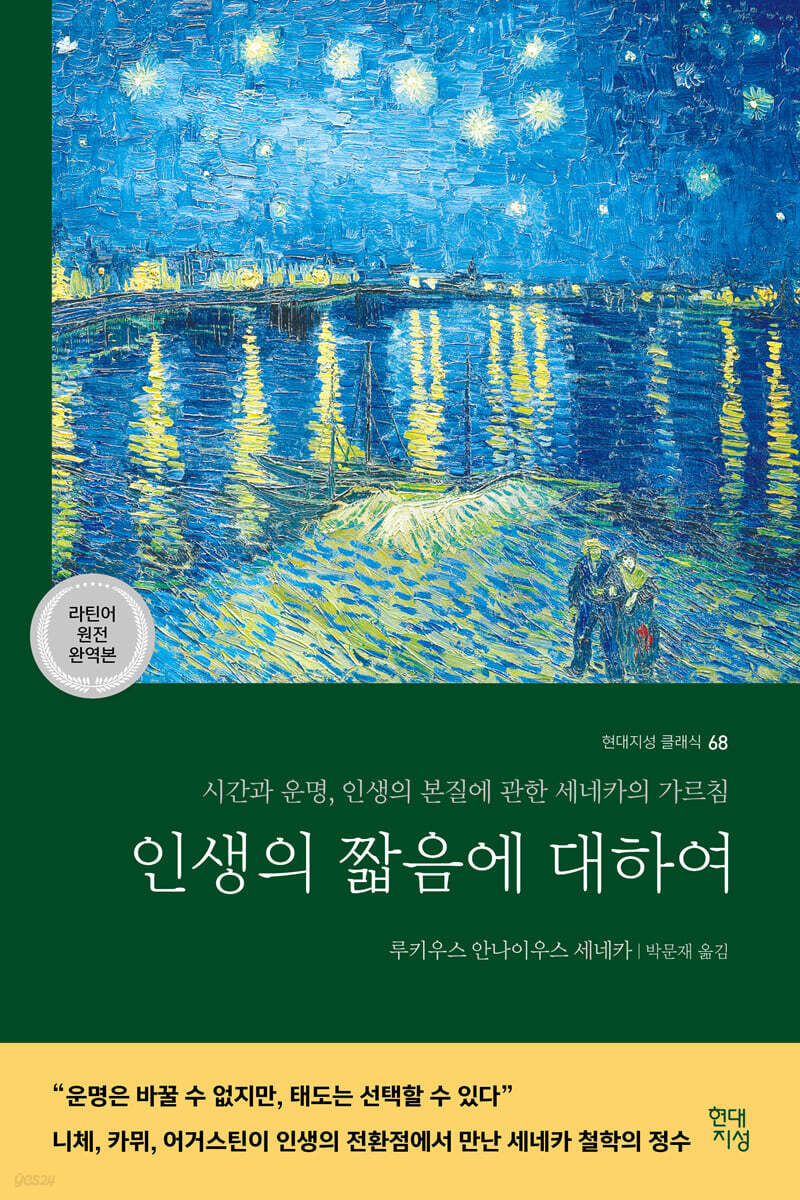
On the brevity of life
 |
Description
Book Introduction
★ In this era of empty but busy living, Seneca's words help us live more deeply.
★ The essence of Seneca's philosophy that Nietzsche, Camus, and Augustine encountered at a turning point in their lives
★ Includes 283 in-depth commentaries and detailed footnotes.
“It’s not that there’s no time, it’s that there’s no life.”
Do you feel like you don't have enough time?
Are you always busy, have a lot to do, and the days just fly by?
Seneca asked this question 2000 years ago.
And he gives a shocking diagnosis.
“Life is long enough.
The problem is that we are not living properly.”
In other words, life is not short, we just live it for a short time.
On the Brevity of Life is not just a classic.
This book is the most incisive philosophical self-help book for those who have lost track of time.
Seneca asks those who have never had an hour to live for themselves because they are so busy chasing wealth, success, busy schedules, and other people's expectations.
“Whose life are you living now?”
Many people exhaust themselves and focus only on other people's business, without actually reflecting on and judging themselves.
They sacrifice the present for the sake of their expectations of the future, and this is the greatest loss in life.
Seneca says that people waste time as if they were going to live forever, forgetting that they are destined to die.
In the end, if you don't live your own life proactively, even if you live a long life, it's no different from dying young like a child.
On the other hand, the wise man does not feel that he has no time.
They are meticulous about time, using it fully for themselves and filling every moment with meaning.
For the wise man, past, present, and future all exist as now, and he lives a wide and deep life that encompasses all of time.
Seneca encourages his readers to live in the present moment, to let go of all distractions, to pursue wisdom alone, and to enjoy true freedom.
Seneca says:
A person who is driven by desire, addicted to achievement, and obsessed with fame ends up as someone who has 'never lived until he dies.'
But he shows another possibility.
Real time begins inside, not outside.
When we explore wisdom, immerse ourselves in the present, and keep our own time, we can no longer be 'time-chased' but 'time-masters.'
This book asks busy modern people the true meaning of life and awakens the wisdom to properly utilize their time and one life.
Seneca's insights still have a powerful force, even 2,000 years later, to make us reflect on our lives and times.
The Modern Intellect Classics series introduces all 14 of Seneca's essays as numbers 67 and 68.
Completely translated from the original Latin, this respectful translation combines philosophical depth with a modern context, allowing anyone to savor the essence of the classics.
A classic is not an old book, but an insight that still works today.
Seneca's sentences will become a balm for your heart that you can read whenever you feel like your inner self is crumbling.
★ The essence of Seneca's philosophy that Nietzsche, Camus, and Augustine encountered at a turning point in their lives
★ Includes 283 in-depth commentaries and detailed footnotes.
“It’s not that there’s no time, it’s that there’s no life.”
Do you feel like you don't have enough time?
Are you always busy, have a lot to do, and the days just fly by?
Seneca asked this question 2000 years ago.
And he gives a shocking diagnosis.
“Life is long enough.
The problem is that we are not living properly.”
In other words, life is not short, we just live it for a short time.
On the Brevity of Life is not just a classic.
This book is the most incisive philosophical self-help book for those who have lost track of time.
Seneca asks those who have never had an hour to live for themselves because they are so busy chasing wealth, success, busy schedules, and other people's expectations.
“Whose life are you living now?”
Many people exhaust themselves and focus only on other people's business, without actually reflecting on and judging themselves.
They sacrifice the present for the sake of their expectations of the future, and this is the greatest loss in life.
Seneca says that people waste time as if they were going to live forever, forgetting that they are destined to die.
In the end, if you don't live your own life proactively, even if you live a long life, it's no different from dying young like a child.
On the other hand, the wise man does not feel that he has no time.
They are meticulous about time, using it fully for themselves and filling every moment with meaning.
For the wise man, past, present, and future all exist as now, and he lives a wide and deep life that encompasses all of time.
Seneca encourages his readers to live in the present moment, to let go of all distractions, to pursue wisdom alone, and to enjoy true freedom.
Seneca says:
A person who is driven by desire, addicted to achievement, and obsessed with fame ends up as someone who has 'never lived until he dies.'
But he shows another possibility.
Real time begins inside, not outside.
When we explore wisdom, immerse ourselves in the present, and keep our own time, we can no longer be 'time-chased' but 'time-masters.'
This book asks busy modern people the true meaning of life and awakens the wisdom to properly utilize their time and one life.
Seneca's insights still have a powerful force, even 2,000 years later, to make us reflect on our lives and times.
The Modern Intellect Classics series introduces all 14 of Seneca's essays as numbers 67 and 68.
Completely translated from the original Latin, this respectful translation combines philosophical depth with a modern context, allowing anyone to savor the essence of the classics.
A classic is not an old book, but an insight that still works today.
Seneca's sentences will become a balm for your heart that you can read whenever you feel like your inner self is crumbling.
- You can preview some of the book's contents.
Preview
index
Part 1 | On the Brevity of Life
Part 2 | On a Happy Life
Part 3 | On Seclusion
Part 4 | On Providence
Part 5 | Comfort to Marcia
Part 6 | Comfort for Mother Helvia
Book 7 | A Consolation to Polybius
Commentary | Park Moon-jae
Seneca Chronology
Part 2 | On a Happy Life
Part 3 | On Seclusion
Part 4 | On Providence
Part 5 | Comfort to Marcia
Part 6 | Comfort for Mother Helvia
Book 7 | A Consolation to Polybius
Commentary | Park Moon-jae
Seneca Chronology
Detailed image

Into the book
Isn't it too late to begin living only when life is nearing its end? To postpone the beginning of a proper life until fifty or sixty, and even then, at an age when it's uncertain how many will survive, isn't that the most foolish mistake a person, facing the inevitability of death, can easily fall into? You will find even the most powerful people unconsciously yearning for and praising the life of seclusion.
--- From "Part 1 | On the Shortness of Life"
I swear that even if you live a thousand years, your life will be shortened to a very short period of time.
Because time spent committing evil is time wasted.
Time naturally passes quickly, but if you plan and use it well, you can increase it.
Yet time flies away from you because you don't try to catch it or slow its flow, but just let it pass by as if you could fill it up at any time.
…Who is more foolish than those who boast of their cleverness and cleverness? They rush about, busying themselves with every task, hoping to live a better life.
In the end, you're trying to build your life by wasting it.
They plan their lives with a distant future in mind, but that is the greatest loss in life.
When we procrastinate, we lose every day that comes our way, and the present is sacrificed for the future.
The greatest obstacle in life is the expectation of the future, the sacrifice of today for tomorrow.
--- From "Part 1 | On the Shortness of Life"
Only those who spend time pursuing wisdom are truly leisurely, and only they live well.
Not only do they guard their lives well, but they also make every passing moment their own and add to it.
The founders of the sacred teachings are luminous teachers who were born for us and paved the way for us.
No era is closed to us, and we can enter any era.
If we, with a great heart, seek to transcend the narrow limitations created by human weakness, a vast expanse of time opens up for us to enjoy.
…
Therefore, the life of a wise man is not bound to any one period, but freely embraces all times.
Only the wise transcend the flow of time and possess every moment completely.
He treasures the past as memories, lives the present without waste, and is prepared to welcome the future.
For him, the past, present, and future all exist as now.
Thus, the wise man gathers all of time and lives a wide and deep life.
--- From "Part 1 | On the Shortness of Life"
Wisdom is to follow the laws and examples of nature without departing from the nature of things.
Therefore, following one's own nature is a happy life, and to achieve this happy life, one must do the following, and there is no other way.
First, you must have the right mindset and maintain that right state consistently.
Next, the spirit must be strong and energetic, able to endure well, respond appropriately to any situation, and take good care of one's body and surroundings, but without going overboard and maintaining balance.
Finally, we must carefully examine the other things that make up life, but we must not become attached to any of them, and we must use the gifts that fate has given us, but we must not become dependent on them.
Even without me saying more, you know that when we let go of what excites and frightens us, lasting peace and freedom come.
Our rough nature comes from weakness, and when we let go of this weakness, we find that instead of petty and fleeting pleasures, we are replaced by a great and unshakable joy, and with it a great soul, peaceful, harmonious, and gentle.
--- From "Part 2 | On a Happy Life"
Among the many famous quotes left by my friend Demetrius, there are some that still ring in my ears as if I had just heard them.
He said this:
“I don’t think there is anyone more unfortunate than the person who has never experienced adversity.” This is because such a person has never had the precious opportunity to test himself.
He may have had everything go smoothly just as he wanted, or even without wanting it, but in fact he received a bad evaluation from the gods.
--- From "Part 4 | On Providence"
Death is liberation from all sorrow and pain.
Once we cross the border of death, no misfortune in this world can touch us.
Death returns us to the peaceful state we were in before birth.
Therefore, if one has pity on the dead, he should also have pity on those who are not yet born.
Death is neither good nor bad.
Because only being alive can be good or bad.
Death, which is nothingness itself and returns everything to nothingness, does not leave us under the dominion of fate.
Because good and bad always arise around some entity.
Fate cannot control what nature sends back, and what does not exist cannot be unhappy.
Your son has now escaped the confines of a world where he was a slave to fate and entered into a great and eternal peace.
There is no poverty there, no worry about property.
There is no constant attack by desire, which seizes the soul with pleasure as bait, nor is there any envy of others' happiness or one's own happiness.
--- From "Part 5 | Consolation to Marcia"
We are born under conditions that allow us to live happily if we just accept our innate conditions.
Nature has made it so that we don't need anything grand to live happily.
Each person can make themselves happy.
External things are not important and do not have much influence in determining happiness or unhappiness.
A wise man is neither excited by good luck nor discouraged by bad luck.
Because the wise man always strives to make much of his happiness depend on himself, and to make all his pleasures come from himself.
--- From "Part 1 | On the Shortness of Life"
I swear that even if you live a thousand years, your life will be shortened to a very short period of time.
Because time spent committing evil is time wasted.
Time naturally passes quickly, but if you plan and use it well, you can increase it.
Yet time flies away from you because you don't try to catch it or slow its flow, but just let it pass by as if you could fill it up at any time.
…Who is more foolish than those who boast of their cleverness and cleverness? They rush about, busying themselves with every task, hoping to live a better life.
In the end, you're trying to build your life by wasting it.
They plan their lives with a distant future in mind, but that is the greatest loss in life.
When we procrastinate, we lose every day that comes our way, and the present is sacrificed for the future.
The greatest obstacle in life is the expectation of the future, the sacrifice of today for tomorrow.
--- From "Part 1 | On the Shortness of Life"
Only those who spend time pursuing wisdom are truly leisurely, and only they live well.
Not only do they guard their lives well, but they also make every passing moment their own and add to it.
The founders of the sacred teachings are luminous teachers who were born for us and paved the way for us.
No era is closed to us, and we can enter any era.
If we, with a great heart, seek to transcend the narrow limitations created by human weakness, a vast expanse of time opens up for us to enjoy.
…
Therefore, the life of a wise man is not bound to any one period, but freely embraces all times.
Only the wise transcend the flow of time and possess every moment completely.
He treasures the past as memories, lives the present without waste, and is prepared to welcome the future.
For him, the past, present, and future all exist as now.
Thus, the wise man gathers all of time and lives a wide and deep life.
--- From "Part 1 | On the Shortness of Life"
Wisdom is to follow the laws and examples of nature without departing from the nature of things.
Therefore, following one's own nature is a happy life, and to achieve this happy life, one must do the following, and there is no other way.
First, you must have the right mindset and maintain that right state consistently.
Next, the spirit must be strong and energetic, able to endure well, respond appropriately to any situation, and take good care of one's body and surroundings, but without going overboard and maintaining balance.
Finally, we must carefully examine the other things that make up life, but we must not become attached to any of them, and we must use the gifts that fate has given us, but we must not become dependent on them.
Even without me saying more, you know that when we let go of what excites and frightens us, lasting peace and freedom come.
Our rough nature comes from weakness, and when we let go of this weakness, we find that instead of petty and fleeting pleasures, we are replaced by a great and unshakable joy, and with it a great soul, peaceful, harmonious, and gentle.
--- From "Part 2 | On a Happy Life"
Among the many famous quotes left by my friend Demetrius, there are some that still ring in my ears as if I had just heard them.
He said this:
“I don’t think there is anyone more unfortunate than the person who has never experienced adversity.” This is because such a person has never had the precious opportunity to test himself.
He may have had everything go smoothly just as he wanted, or even without wanting it, but in fact he received a bad evaluation from the gods.
--- From "Part 4 | On Providence"
Death is liberation from all sorrow and pain.
Once we cross the border of death, no misfortune in this world can touch us.
Death returns us to the peaceful state we were in before birth.
Therefore, if one has pity on the dead, he should also have pity on those who are not yet born.
Death is neither good nor bad.
Because only being alive can be good or bad.
Death, which is nothingness itself and returns everything to nothingness, does not leave us under the dominion of fate.
Because good and bad always arise around some entity.
Fate cannot control what nature sends back, and what does not exist cannot be unhappy.
Your son has now escaped the confines of a world where he was a slave to fate and entered into a great and eternal peace.
There is no poverty there, no worry about property.
There is no constant attack by desire, which seizes the soul with pleasure as bait, nor is there any envy of others' happiness or one's own happiness.
--- From "Part 5 | Consolation to Marcia"
We are born under conditions that allow us to live happily if we just accept our innate conditions.
Nature has made it so that we don't need anything grand to live happily.
Each person can make themselves happy.
External things are not important and do not have much influence in determining happiness or unhappiness.
A wise man is neither excited by good luck nor discouraged by bad luck.
Because the wise man always strives to make much of his happiness depend on himself, and to make all his pleasures come from himself.
--- From "Part 6 | Comfort to Mother Helvia"
Publisher's Review
I live with the words that I am busy
A prescription for your empty heart
We are always busy.
We live our lives squeezing ourselves into a constant stream of meetings, appointments, message notifications, and work.
But when you stop and think about it, you realize that your mind is empty and you have very little time for yourself.
Saying I'm busy has become a habit, but my life is missing in it.
Seneca rebukes us that this is the real reason why life is so short.
According to him, people are unusually sensitive to their possessions, but incredibly indifferent to time.
We waste our time on the demands of others without any reward, and our days are consumed by useless worries, pleasures, ambitions, and vain expectations.
And yet, they always say, “There’s not enough time.”
But the lack is not a result of real conditions, but rather of incorrect use of time.
Seneca points out that the real problem is not that 'life is short', but that 'we are living someone else's life'.
Swayed by the desires and gazes of others, compelled to make demands that cannot be refused, and never able to make time for oneself, life ultimately flows by in vain.
Without even being able to ask the question, 'What are we living for?', one day we suddenly reach the end of time.
In this book, Seneca says, 'Only the wise can own time.'
It is about interacting with the great minds of the past and reclaiming ownership of time.
He makes every moment of life his own, not letting time pass by but reconstructing it with accumulated wisdom.
The past is a memory of reflection, the future is a blueprint for preparation, and the present is lived as the most fulfilling subjective life.
In philosophical silence he truly lives in time.
“On the Shortness of Life” is not just an ancient lesson.
For modern people who are losing time, this is a technique book to 'get my life back' and an inner reset button.
It's not that we don't have enough time, we just don't look back and see who and what we are giving our time to.
This book begins with that very question.
And, he says, this very moment could be the real beginning of your life.
Why I couldn't live my time
"On the Shortness of Life" overwhelms the reader from the very beginning with a single sentence.
“Life is not short.
We just make it short.”
This sentence is not just a warning.
It is a warning bell to us who live busy lives but do not truly own our lives.
In this essay, Seneca urges us to shift from a life of 'spending' time to a life of 'living' time.
I'm not simply saying slow down.
It fundamentally questions the balance between work and rest, worldliness and philosophy, busyness and immersion.
This letter, which he sent to Paulinus, is a letter from an intellectual who had resigned from a high public office and gone into 'philosophical seclusion'.
Seneca sees seclusion not as passive avoidance, but as the most courageous choice to face oneself.
It is similar to what today's terms 'work-life balance' and 'ritual routine' are aiming for.
Rest is not just a simple rest, but a time to return to the essence of life and an inner training that centers me.
"On the Happy Life" is Seneca's direct response to the criticism that "rich philosophers are hypocrites."
He asserts that even philosophers can have wealth, and that material wealth does not harm freedom if it does not bind the mind.
For modern people who are struggling within the frame of a binary choice between 'earning money or being satisfied with earning less,' Seneca advises them to maintain a 'philosophical sense of balance' between the strictness of Stoicism and the flexibility of reality.
His insight that we can simultaneously pursue moderation and freedom, comfort and autonomy, remains powerful for those of us who waver between minimalism and YOLO.
"On Withdrawal" is a work in which Seneca, who left politics during the tyranny of Nero, reinterprets the philosophical meaning of "withdrawal."
He views seclusion not as a defeat but as a mature choice, and talks about how silence and distance can bring us closer to the essence of life.
Meanwhile, 『On Providence』 and the three comforting poems suggest an attitude toward fate and loss.
He conveys the central principle of Stoic philosophy, which accepts even suffering and sorrow as part of the cosmic order, and emphasizes the power of 'interpreting and accepting' human suffering, rather than being insensitive or cynical to it.
Seneca's writings shine even brighter for those who seek to grasp the "why" of life, rather than those who ask the "how" of life.
And the seven essays in this book are a guide to a philosophical journey that answers that question.
His sentences still speak to us today.
“Time is yours.
The question is, who are we handing it over to?”
To live deeply, even with little:
How to Own Life Fully, According to Seneca
Modern Intellect Classics introduces the complete translation of all 14 of Seneca's essays in two volumes.
The sophisticated nuances of the original Latin text have been preserved, but meticulously refined to allow readers to savor its essence.
Seneca viewed philosophy as the 'art of living', and that this art lies in how one views and uses time.
This book goes beyond simply advising you to "save time," and talks about how to "make time truly yours."
Here are the philosophical turning points this book raises.
1.
From a life of letting time pass by to a life of 'living' time
This book isn't just about time management; it's about helping you regain control of your life itself.
It's about cutting out unnecessary schedules, breaking free from other people's expectations, and shifting my life to spending my time 'for myself.'
Break free from the 'busy but empty life' and learn the skills to focus on what you truly want.
2.
The Power of Not Being Swayed by Anxiety: Building an "Inner Safe Zone"
Seneca says that happiness is determined by our inner attitude, not external conditions.
From a life driven by money, fame, and success, to a life of contentment with modest possessions! For those seeking to regain their rhythm, this book offers a balanced approach between moderation and immersion.
Instead of having more, you can design a life that is less anxious.
3.
Strength to Endure Hurt: Strengthening Resilience
If no one can avoid suffering, we must change our relationship with suffering.
Seneca says:
“Pain isn’t something to be eliminated, but rather something to be made manageable.” Instead of collapsing in the face of disappointment, loss, or injustice, learn to manage your emotions through philosophical distancing and the skills to protect yourself.
This book can help you build emotional resilience.
A prescription for your empty heart
We are always busy.
We live our lives squeezing ourselves into a constant stream of meetings, appointments, message notifications, and work.
But when you stop and think about it, you realize that your mind is empty and you have very little time for yourself.
Saying I'm busy has become a habit, but my life is missing in it.
Seneca rebukes us that this is the real reason why life is so short.
According to him, people are unusually sensitive to their possessions, but incredibly indifferent to time.
We waste our time on the demands of others without any reward, and our days are consumed by useless worries, pleasures, ambitions, and vain expectations.
And yet, they always say, “There’s not enough time.”
But the lack is not a result of real conditions, but rather of incorrect use of time.
Seneca points out that the real problem is not that 'life is short', but that 'we are living someone else's life'.
Swayed by the desires and gazes of others, compelled to make demands that cannot be refused, and never able to make time for oneself, life ultimately flows by in vain.
Without even being able to ask the question, 'What are we living for?', one day we suddenly reach the end of time.
In this book, Seneca says, 'Only the wise can own time.'
It is about interacting with the great minds of the past and reclaiming ownership of time.
He makes every moment of life his own, not letting time pass by but reconstructing it with accumulated wisdom.
The past is a memory of reflection, the future is a blueprint for preparation, and the present is lived as the most fulfilling subjective life.
In philosophical silence he truly lives in time.
“On the Shortness of Life” is not just an ancient lesson.
For modern people who are losing time, this is a technique book to 'get my life back' and an inner reset button.
It's not that we don't have enough time, we just don't look back and see who and what we are giving our time to.
This book begins with that very question.
And, he says, this very moment could be the real beginning of your life.
Why I couldn't live my time
"On the Shortness of Life" overwhelms the reader from the very beginning with a single sentence.
“Life is not short.
We just make it short.”
This sentence is not just a warning.
It is a warning bell to us who live busy lives but do not truly own our lives.
In this essay, Seneca urges us to shift from a life of 'spending' time to a life of 'living' time.
I'm not simply saying slow down.
It fundamentally questions the balance between work and rest, worldliness and philosophy, busyness and immersion.
This letter, which he sent to Paulinus, is a letter from an intellectual who had resigned from a high public office and gone into 'philosophical seclusion'.
Seneca sees seclusion not as passive avoidance, but as the most courageous choice to face oneself.
It is similar to what today's terms 'work-life balance' and 'ritual routine' are aiming for.
Rest is not just a simple rest, but a time to return to the essence of life and an inner training that centers me.
"On the Happy Life" is Seneca's direct response to the criticism that "rich philosophers are hypocrites."
He asserts that even philosophers can have wealth, and that material wealth does not harm freedom if it does not bind the mind.
For modern people who are struggling within the frame of a binary choice between 'earning money or being satisfied with earning less,' Seneca advises them to maintain a 'philosophical sense of balance' between the strictness of Stoicism and the flexibility of reality.
His insight that we can simultaneously pursue moderation and freedom, comfort and autonomy, remains powerful for those of us who waver between minimalism and YOLO.
"On Withdrawal" is a work in which Seneca, who left politics during the tyranny of Nero, reinterprets the philosophical meaning of "withdrawal."
He views seclusion not as a defeat but as a mature choice, and talks about how silence and distance can bring us closer to the essence of life.
Meanwhile, 『On Providence』 and the three comforting poems suggest an attitude toward fate and loss.
He conveys the central principle of Stoic philosophy, which accepts even suffering and sorrow as part of the cosmic order, and emphasizes the power of 'interpreting and accepting' human suffering, rather than being insensitive or cynical to it.
Seneca's writings shine even brighter for those who seek to grasp the "why" of life, rather than those who ask the "how" of life.
And the seven essays in this book are a guide to a philosophical journey that answers that question.
His sentences still speak to us today.
“Time is yours.
The question is, who are we handing it over to?”
To live deeply, even with little:
How to Own Life Fully, According to Seneca
Modern Intellect Classics introduces the complete translation of all 14 of Seneca's essays in two volumes.
The sophisticated nuances of the original Latin text have been preserved, but meticulously refined to allow readers to savor its essence.
Seneca viewed philosophy as the 'art of living', and that this art lies in how one views and uses time.
This book goes beyond simply advising you to "save time," and talks about how to "make time truly yours."
Here are the philosophical turning points this book raises.
1.
From a life of letting time pass by to a life of 'living' time
This book isn't just about time management; it's about helping you regain control of your life itself.
It's about cutting out unnecessary schedules, breaking free from other people's expectations, and shifting my life to spending my time 'for myself.'
Break free from the 'busy but empty life' and learn the skills to focus on what you truly want.
2.
The Power of Not Being Swayed by Anxiety: Building an "Inner Safe Zone"
Seneca says that happiness is determined by our inner attitude, not external conditions.
From a life driven by money, fame, and success, to a life of contentment with modest possessions! For those seeking to regain their rhythm, this book offers a balanced approach between moderation and immersion.
Instead of having more, you can design a life that is less anxious.
3.
Strength to Endure Hurt: Strengthening Resilience
If no one can avoid suffering, we must change our relationship with suffering.
Seneca says:
“Pain isn’t something to be eliminated, but rather something to be made manageable.” Instead of collapsing in the face of disappointment, loss, or injustice, learn to manage your emotions through philosophical distancing and the skills to protect yourself.
This book can help you build emotional resilience.
GOODS SPECIFICS
- Date of issue: August 1, 2025
- Page count, weight, size: 336 pages | 150*225*30mm
- ISBN13: 9791139725636
- ISBN10: 1139725637
You may also like
카테고리
korean


korean

![ELLE 엘르 스페셜 에디션 A형 : 12월 [2025]](http://librairie.coreenne.fr/cdn/shop/files/b8e27a3de6c9538896439686c6b0e8fb.jpg?v=1766436872&width=3840)


