

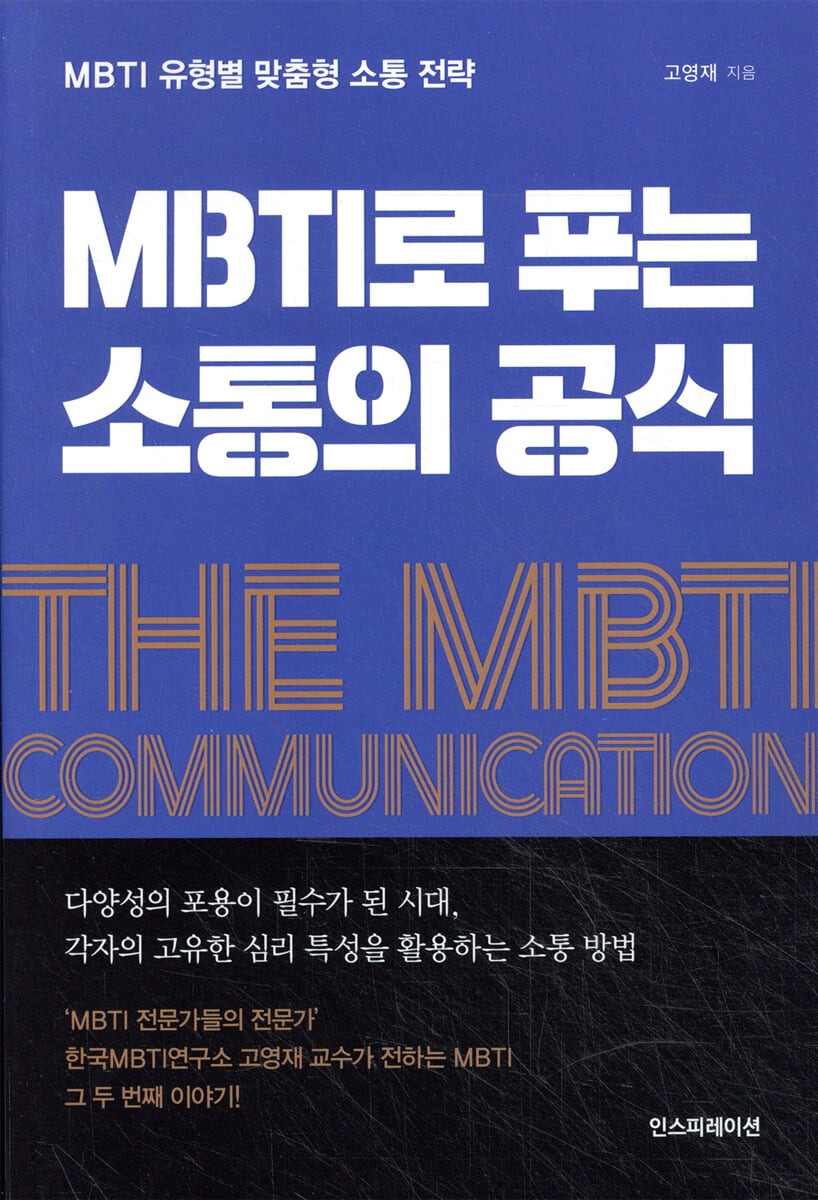
The formula for communication as explained by MBTI
 |
Description
Book Introduction
In an era where embracing diversity has become essential,
Communication methods that utilize each person's unique psychological characteristics
MBTI Experts' Experts
MBTI as told by Professor Youngjae Ko of the Korea MBTI Research Institute
That second story!
Why do I only see differences between you and me?
Now, with MBTI, we can turn differences into respect.
Let's start some real communication!
Bestseller "The MBTI You Knew Wasn't the Real MBTI"
Author Ko Young-jae tells us
How to Use MBTI for Understanding and Respect
Attempts to classify people into several types have been around for a very long time.
Hippocrates (B.), the pioneer of Western medicine
C. 460~377) classified human temperaments into four types: sanguine, melancholic, choleric, and phlegmatic.
The Enneagram divides human personality into nine types.
In addition, various psychological tests such as DISC and Birkman classify human types based on specific criteria.
So why have these attempts continued? Because they greatly contribute to understanding the abstract and complex nature of human psychology.
Finding and understanding your own psychological uniqueness is not an easy task.
Perhaps, even if we spend a lifetime exploring, we will never fully understand ourselves.
People who have pondered and studied these topics for a long time have discovered patterns in human psychology and left them as a legacy.
The same goes for MBTI.
I use the MBTI simply because it helps me understand and respect myself and others when I divide people into 16 types.
When used properly, it can be a valuable tool for discovering your true self and achieving inner growth that suits you. The core purpose of the MBTI isn't to categorize people into 16 types, but to help you find ways to respect each individual. Proper use of the MBTI can be a tremendous help in loving and respecting yourself and others.
Communication methods that utilize each person's unique psychological characteristics
MBTI Experts' Experts
MBTI as told by Professor Youngjae Ko of the Korea MBTI Research Institute
That second story!
Why do I only see differences between you and me?
Now, with MBTI, we can turn differences into respect.
Let's start some real communication!
Bestseller "The MBTI You Knew Wasn't the Real MBTI"
Author Ko Young-jae tells us
How to Use MBTI for Understanding and Respect
Attempts to classify people into several types have been around for a very long time.
Hippocrates (B.), the pioneer of Western medicine
C. 460~377) classified human temperaments into four types: sanguine, melancholic, choleric, and phlegmatic.
The Enneagram divides human personality into nine types.
In addition, various psychological tests such as DISC and Birkman classify human types based on specific criteria.
So why have these attempts continued? Because they greatly contribute to understanding the abstract and complex nature of human psychology.
Finding and understanding your own psychological uniqueness is not an easy task.
Perhaps, even if we spend a lifetime exploring, we will never fully understand ourselves.
People who have pondered and studied these topics for a long time have discovered patterns in human psychology and left them as a legacy.
The same goes for MBTI.
I use the MBTI simply because it helps me understand and respect myself and others when I divide people into 16 types.
When used properly, it can be a valuable tool for discovering your true self and achieving inner growth that suits you. The core purpose of the MBTI isn't to categorize people into 16 types, but to help you find ways to respect each individual. Proper use of the MBTI can be a tremendous help in loving and respecting yourself and others.
- You can preview some of the book's contents.
Preview
index
About this book
Prologue - Many people believe the "distorted MBTI" is the "real MBTI."
PART 1: Understanding MBTI
Chapter 1. MBTI is so unfair now!
Chapter 2.
Distinguishing between 'MBTI abuse' and 'MBTI problems'
Chapter 3. MBTI User Manual
PART 2: Communicating with MBTI
Chapter 4. 3 Things to Remember When Using MBTI in Communication
Chapter 5.
ESTJ - A person who proactively solves practical problems
Chapter 6.
People who enjoy challenges and experiences - ESTP
Chapter 7.
Very meticulous and careful person - ISTJ
Chapter 8.
Observant and Independent - ISTP
Chapter 9.
People who seek harmony and cooperation - ESFJ
Chapter 10.
ESFP - A sociable person who enjoys a variety of experiences
Chapter 11.
Dedicated, Honest, and Attentive - ISFJ
Chapter 12.
Humble and warm person - ISFP
Chapter 13.
People who seek to benefit humanity - ENFJ
Chapter 14.
The Human Brainstormer - ENFP
Chapter 15.
INFJ - A believer who delves deeply into the human mind
Chapter 16.
A warm person who values meaning - INFP
Chapter 17.
Enterprising people who solve problems innovatively - ENTJ
Chapter 18.
Logical Brainstormer - ENTP
Chapter 19.
INTJ - an intelligent and independent person who focuses on the world of ideas
Chapter 20.
The Creative Analyst - INTP
Epilogue - Towards 'Respect', the Deepest Realm of Love
Prologue - Many people believe the "distorted MBTI" is the "real MBTI."
PART 1: Understanding MBTI
Chapter 1. MBTI is so unfair now!
Chapter 2.
Distinguishing between 'MBTI abuse' and 'MBTI problems'
Chapter 3. MBTI User Manual
PART 2: Communicating with MBTI
Chapter 4. 3 Things to Remember When Using MBTI in Communication
Chapter 5.
ESTJ - A person who proactively solves practical problems
Chapter 6.
People who enjoy challenges and experiences - ESTP
Chapter 7.
Very meticulous and careful person - ISTJ
Chapter 8.
Observant and Independent - ISTP
Chapter 9.
People who seek harmony and cooperation - ESFJ
Chapter 10.
ESFP - A sociable person who enjoys a variety of experiences
Chapter 11.
Dedicated, Honest, and Attentive - ISFJ
Chapter 12.
Humble and warm person - ISFP
Chapter 13.
People who seek to benefit humanity - ENFJ
Chapter 14.
The Human Brainstormer - ENFP
Chapter 15.
INFJ - A believer who delves deeply into the human mind
Chapter 16.
A warm person who values meaning - INFP
Chapter 17.
Enterprising people who solve problems innovatively - ENTJ
Chapter 18.
Logical Brainstormer - ENTP
Chapter 19.
INTJ - an intelligent and independent person who focuses on the world of ideas
Chapter 20.
The Creative Analyst - INTP
Epilogue - Towards 'Respect', the Deepest Realm of Love
Into the book
The purpose of this book is no different. Properly understanding and utilizing the MBTI will significantly deepen your self-esteem.
Because people are most capable and happy when they live as themselves.
I hope that by using the MBTI correctly, you will come to respect and love yourself more deeply.
I hope your own flower blooms.
And I sincerely hope that based on that experience, you will come to deeply respect someone you love.
If this book can serve as a meaningful 'stepping stone' in that process, I could not ask for more.
--- p.22
MBTI is not a diagnostic test.
Factors requiring diagnosis, such as depression, mental disorders, IQ, stress, morality, and competence, cannot be measured. Because the MBTI measures only an individual's "psychological uniqueness," it has no elements of assessment or diagnosis.
This also means that not all areas should be interpreted as a single entity using MBTI.
In particular, we must be very careful not to generalize insincere attitudes or personality problems into MBTI type problems.
Even people with the same personality type can show very big differences in character and attitude.
This means that there may be ENTJs with healthy personalities, and there may be ENTJs with poor personalities.
All the various rankings floating around the internet, such as "Bad Personality Rankings," "Mental Age Rankings," and "Depression-Prone Rankings," based on MBTI type, are simply misinformation created for entertainment purposes. Rankings based solely on MBTI type are already beyond the scope of the MBTI's intended purpose.
The same goes for using MBTI in hiring.
I've seen ads that say, "We don't want the ○○○○ type," but that's a very wrong approach.
This is because competencies are a combination of various factors, such as values, interests, aptitudes, personality types, attitudes, self-esteem, belief systems, emotional levels, and experiences.
If everyone had the same type as Steve Jobs and demonstrated the same capabilities as Steve Jobs, success in this world would be determined solely by MBTI type.
Even if you think about it logically, it doesn't make sense.
It is clear that personality types provide very crucial information about a person.
But people cannot be explained by personality types alone.
This is because various factors such as values, attitude, and personality come together to determine a person's unique characteristics.
Even people with the same personality type have different personalities and abilities.
However, throughout all of these processes, they have common characteristics due to their psychological structure.
Therefore, we must be careful not to make the mistake of lumping everything together and interpreting it as a personality type. It's important to remember that the MBTI is a "non-diagnostic" test. It only measures unique personality traits, not "evaluative factors" like a person's personality, attitude, or mental health issues.
--- p.52
Many people hurt their loved ones.
We say we love our children, our lovers, and our spouses, but often times we actually make it harder for them.
Why is that? Because we try to cherish the object of our love in our own way, lacking any understanding of it.
If you don't know what the object of your love truly wants and what state it is in, your love may not be love but rather possession and domination.
No matter how hard you love, if you are ignorant about the object of your love, that love can make the other person suffer and feel pain.
To reach the level of 'respect', which can be said to be the deepest level of love, 'understanding' of the object of love is necessary.
It is absurd to talk about respect without understanding.
Because respect means accepting the other person's existence as it is.
Rather than criticizing someone by saying, "Why on earth are you born that way?", we experience respect when we acknowledge, "That's just your way of being." The MBTI provides concrete guidance for understanding another person's "way of being."
The statement that "personality types are different" presupposes that "each person has a way of being that makes them most comfortable and respected."
People who are respected for their 'way of being' can grow in psychological stability.
Just as a plant grows naturally when treated with respect and appropriate cultivation methods, let's not forget that the MBTI is a tool designed to help us understand and respect each other.
Because people are most capable and happy when they live as themselves.
I hope that by using the MBTI correctly, you will come to respect and love yourself more deeply.
I hope your own flower blooms.
And I sincerely hope that based on that experience, you will come to deeply respect someone you love.
If this book can serve as a meaningful 'stepping stone' in that process, I could not ask for more.
--- p.22
MBTI is not a diagnostic test.
Factors requiring diagnosis, such as depression, mental disorders, IQ, stress, morality, and competence, cannot be measured. Because the MBTI measures only an individual's "psychological uniqueness," it has no elements of assessment or diagnosis.
This also means that not all areas should be interpreted as a single entity using MBTI.
In particular, we must be very careful not to generalize insincere attitudes or personality problems into MBTI type problems.
Even people with the same personality type can show very big differences in character and attitude.
This means that there may be ENTJs with healthy personalities, and there may be ENTJs with poor personalities.
All the various rankings floating around the internet, such as "Bad Personality Rankings," "Mental Age Rankings," and "Depression-Prone Rankings," based on MBTI type, are simply misinformation created for entertainment purposes. Rankings based solely on MBTI type are already beyond the scope of the MBTI's intended purpose.
The same goes for using MBTI in hiring.
I've seen ads that say, "We don't want the ○○○○ type," but that's a very wrong approach.
This is because competencies are a combination of various factors, such as values, interests, aptitudes, personality types, attitudes, self-esteem, belief systems, emotional levels, and experiences.
If everyone had the same type as Steve Jobs and demonstrated the same capabilities as Steve Jobs, success in this world would be determined solely by MBTI type.
Even if you think about it logically, it doesn't make sense.
It is clear that personality types provide very crucial information about a person.
But people cannot be explained by personality types alone.
This is because various factors such as values, attitude, and personality come together to determine a person's unique characteristics.
Even people with the same personality type have different personalities and abilities.
However, throughout all of these processes, they have common characteristics due to their psychological structure.
Therefore, we must be careful not to make the mistake of lumping everything together and interpreting it as a personality type. It's important to remember that the MBTI is a "non-diagnostic" test. It only measures unique personality traits, not "evaluative factors" like a person's personality, attitude, or mental health issues.
--- p.52
Many people hurt their loved ones.
We say we love our children, our lovers, and our spouses, but often times we actually make it harder for them.
Why is that? Because we try to cherish the object of our love in our own way, lacking any understanding of it.
If you don't know what the object of your love truly wants and what state it is in, your love may not be love but rather possession and domination.
No matter how hard you love, if you are ignorant about the object of your love, that love can make the other person suffer and feel pain.
To reach the level of 'respect', which can be said to be the deepest level of love, 'understanding' of the object of love is necessary.
It is absurd to talk about respect without understanding.
Because respect means accepting the other person's existence as it is.
Rather than criticizing someone by saying, "Why on earth are you born that way?", we experience respect when we acknowledge, "That's just your way of being." The MBTI provides concrete guidance for understanding another person's "way of being."
The statement that "personality types are different" presupposes that "each person has a way of being that makes them most comfortable and respected."
People who are respected for their 'way of being' can grow in psychological stability.
Just as a plant grows naturally when treated with respect and appropriate cultivation methods, let's not forget that the MBTI is a tool designed to help us understand and respect each other.
--- p.497
GOODS SPECIFICS
- Date of issue: February 27, 2025
- Page count, weight, size: 498 pages | 852g | 152*225*27mm
- ISBN13: 9791188929047
- ISBN10: 1188929046
You may also like
카테고리
korean


korean

![ELLE 엘르 스페셜 에디션 A형 : 12월 [2025]](http://librairie.coreenne.fr/cdn/shop/files/b8e27a3de6c9538896439686c6b0e8fb.jpg?v=1766436872&width=3840)


