

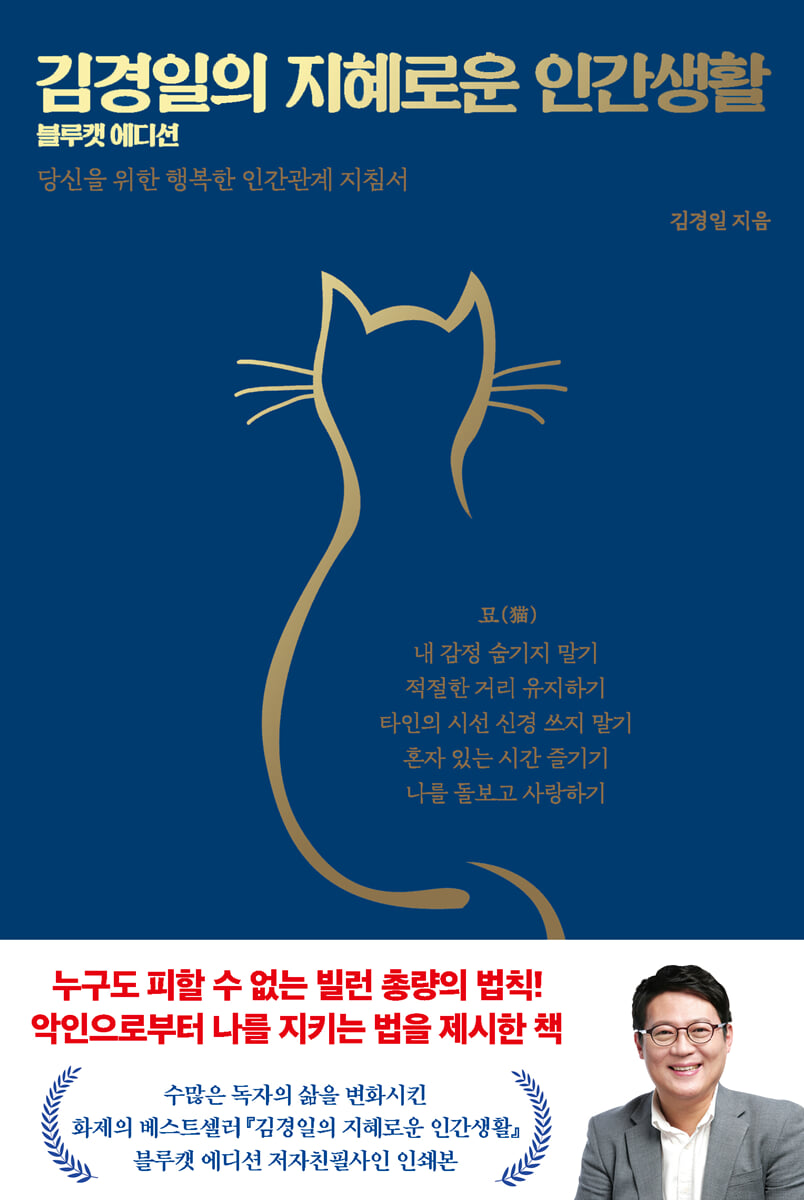
Kim Kyung-il's Wise Human Life (Blue Cat Edition)
 |
Description
Book Introduction
A hot bestseller that solved countless readers' relationship problems.
The Blue Cat Edition (revised edition) of "Kim Kyung-il's Wise Human Life" has been published.
Professor Kim Kyung-il, a leading cognitive psychologist in Korea, has returned with the Blue Cat edition of his book, "Kim Kyung-il's Wise Human Life."
This book sharply examines "human relationships," the topic that Professor Kim Kyung-il receives the most questions about in his lectures, and presents, through sixteen lectures, methods for maintaining appropriate relationships without stress.
Based on cognitive psychology, it examines the relationship between 'others and myself' and is structured to provide Professor Kim Kyung-il's clear insights into human relationships.
Have you ever heard the saying, "The Law of Villain Quantity"? Villains who torment and trouble us exist everywhere, at school, at work, and around us.
As society becomes more complex and relationships between people become more complex, concerns about human relationships are bound to increase.
This book contains 'how to protect myself' from villains that I encounter in any relationship.
Through 『Kim Kyung-il's Wise Human Life』, you will be able to regain your peaceful daily life and begin to live a confident life through proper relationships.
The Blue Cat Edition (revised edition) of "Kim Kyung-il's Wise Human Life" has been published.
Professor Kim Kyung-il, a leading cognitive psychologist in Korea, has returned with the Blue Cat edition of his book, "Kim Kyung-il's Wise Human Life."
This book sharply examines "human relationships," the topic that Professor Kim Kyung-il receives the most questions about in his lectures, and presents, through sixteen lectures, methods for maintaining appropriate relationships without stress.
Based on cognitive psychology, it examines the relationship between 'others and myself' and is structured to provide Professor Kim Kyung-il's clear insights into human relationships.
Have you ever heard the saying, "The Law of Villain Quantity"? Villains who torment and trouble us exist everywhere, at school, at work, and around us.
As society becomes more complex and relationships between people become more complex, concerns about human relationships are bound to increase.
This book contains 'how to protect myself' from villains that I encounter in any relationship.
Through 『Kim Kyung-il's Wise Human Life』, you will be able to regain your peaceful daily life and begin to live a confident life through proper relationships.
- You can preview some of the book's contents.
Preview
index
Prologue - Circumstances Matter More Than Ability
Part 1: How to Deal with Others - How to Become Mentally Stronger and Wise, Without Being Swayed by Emotions
Lesson 1: How to Deal Wisely with Emotional People
Lesson 2: Sensitive People vs.
dull person
3. The psychology of a person who repeats others' words
What a person who is completely wrapped up in the pretense of the top 4 needs
Lesson 5: People with different perspectives are helpful to me.
Part 2: Standing as Your Whole Self - Focusing on Yourself Frees You from Interpersonal Relationships
Lecture 1: What is Happiness?
Lesson 2: What's More Important Than Other People's Approval
Lesson 3: How to Build Confidence Easily
Small steps to advance to the semifinals first
Lesson 5: How to Recognize Someone Who Is Truly Ignoring You
6. Physical strength and brain function are linked.
Part 3: Going the Extra Step - How to Add Positive Energy to Your Life
Lesson 1: Can an Introvert Be Successful?
2nd Lecture: The Secret of Successful People Anywhere
3 Ways to Communicate Effectively Without Heeding the Old Man's Cries
It's natural not to want to think about the semifinals.
Lesson 5: The Psychology Behind Quick Judgments and Decisions
Epilogue _ Others, Me, and Work as Life
Part 1: How to Deal with Others - How to Become Mentally Stronger and Wise, Without Being Swayed by Emotions
Lesson 1: How to Deal Wisely with Emotional People
Lesson 2: Sensitive People vs.
dull person
3. The psychology of a person who repeats others' words
What a person who is completely wrapped up in the pretense of the top 4 needs
Lesson 5: People with different perspectives are helpful to me.
Part 2: Standing as Your Whole Self - Focusing on Yourself Frees You from Interpersonal Relationships
Lecture 1: What is Happiness?
Lesson 2: What's More Important Than Other People's Approval
Lesson 3: How to Build Confidence Easily
Small steps to advance to the semifinals first
Lesson 5: How to Recognize Someone Who Is Truly Ignoring You
6. Physical strength and brain function are linked.
Part 3: Going the Extra Step - How to Add Positive Energy to Your Life
Lesson 1: Can an Introvert Be Successful?
2nd Lecture: The Secret of Successful People Anywhere
3 Ways to Communicate Effectively Without Heeding the Old Man's Cries
It's natural not to want to think about the semifinals.
Lesson 5: The Psychology Behind Quick Judgments and Decisions
Epilogue _ Others, Me, and Work as Life
Detailed image
Into the book
Creativity may seem like a constant, but it is a variable.
My creativity is not something I am born with, but rather something that depends on whether or not I can change the 'situation' that makes me think creatively.
The ability to get along well with others while maintaining an appropriate distance is not a matter of innate personality or temperament, but rather depends on the 'situation'.
This book talks about what can be changed between others and ourselves, and what cannot be changed.
We introduce numerous ways to change situations under the theme of 'Others, Me, and Life'.
This book may not be a powerful solution like Jeon Ga's "Treasure Sword," but I sincerely hope that it can help alleviate some of the pain you feel when you're stressed out and losing sleep because of people.
I hope I will no longer allow others to control me, and I will no longer be frustrated by things I cannot change.
---From the "Prologue"
I have 10 points on my heart scale, but my partner only has 2 points.
So what happens then?
I'd say something like 3 or 4 pointed things out, and the other person would get really excited and feel like they'd just been criticized like the biggest person on earth.
If the other person's heart has two scales, it means that the heart scale has not yet developed.
So the scale didn't increase.
So, should I wait until the other person's emotional scale matures? Or should I only talk to those whose hearts have matured? It would be nice if that were the only way, but the world doesn't work that way.
The 'normal assumptions' do not apply to people who have a narrow mind and explode with emotion at the slightest suggestion from me.
So how should we address this? If we carefully observe people with narrow mental scales, we find that they are surprisingly fine-tuned in certain areas.
They don't explode every time they talk.
So they might think to themselves, 'I may be a bit sensitive sometimes, but I'm generally a well-behaved person.'
Some areas have only two tick marks, while others have ten.
If you want to get along reasonably well with anyone, if you want to have a decent conversation with even emotional people, you need to investigate where the other person's tight-knit grid area is.
To communicate comfortably with people you work with, you need to put in this kind of effort and effort.
---From "How to Deal Wisely with Emotional People"
People who are good at repeating what others say will deliberately approach you and ask questions without offering their own opinions, such as, "What do you think about this? What should we do?"
When I buy something, they buy it too.
These are the people who constantly ask me what I think while telling me what other people think about it.
These are also 'people who want to be supported'.
They are very lonely and insecure people.
But is he coming to me? Is he coming to me regularly and asking questions? If so, I need to take a look at myself.
The fact that he keeps coming to me means that he feels a great sense of kinship with me.
It's because I'm so drawn to the thought, 'You and I are similar,' that it bothers and makes things difficult for me.
The cause of that homogeneity could be environment, appearance, a favorite baseball player, or a favorite singer.
What's interesting is that, surprisingly, the basis for homogeneity is not clear.
You should pay attention to that.
---From "The Psychology of a Person Who Repeats Other People's Words"
Wanting to be recognized means having others say to me, “Wow, that’s great.
That's cool.
I want you to say, "It's the best."
People who struggle for recognition are simply living hard to hear the admiration of others, and wanting to be recognized means that I need the admiration of others right now.
It's the same thing when I say I have to respect myself.
I need to be able to admire myself.
If I can't admire myself, no one else will.
How can I expect others to admire me if I don't admire myself? I'm not saying you should admire your own appearance.
How can I admire myself?
If your abilities increase, you can admire me.
It's an experience of growth through cultural activities unrelated to one's main job, such as becoming good at calligraphy that one couldn't do before, or learning to play the piano and being able to play a song.
Whether it's writing, music, art, or sports, experiencing accomplishments through a hobby is the easiest and best way to admire yourself.
---From "What's More Important Than Other People's Approval"
There is a term called trouble shooting.
When a problem occurs, it refers to the process of comprehensively diagnosing the cause of the problem and finding a solution.
The better the manual, the better the troubleshooting examples it contains.
It includes detailed and detailed information on frequently asked questions, common mistakes, and important product precautions.
So, when you have a problem with an electronic product, you can quickly solve the problem by just looking at the manual.
This book is not a theoretical book.
It is not a collection of essays that are a collection of fragments of thoughts.
It's a kind of troubleshooting.
Although it was written in simple terms, I put a lot of thought into each expression and checked each theoretical basis.
I believe that readers and those I meet at lectures will continue to ask many questions and want to hear answers to their concerns.
So, as a psychologist, I'll try to find answers to the best of my ability, and as a human being, I'll try to tell you honestly what I've experienced when dealing with similar problems.
This book is the first step.
My creativity is not something I am born with, but rather something that depends on whether or not I can change the 'situation' that makes me think creatively.
The ability to get along well with others while maintaining an appropriate distance is not a matter of innate personality or temperament, but rather depends on the 'situation'.
This book talks about what can be changed between others and ourselves, and what cannot be changed.
We introduce numerous ways to change situations under the theme of 'Others, Me, and Life'.
This book may not be a powerful solution like Jeon Ga's "Treasure Sword," but I sincerely hope that it can help alleviate some of the pain you feel when you're stressed out and losing sleep because of people.
I hope I will no longer allow others to control me, and I will no longer be frustrated by things I cannot change.
---From the "Prologue"
I have 10 points on my heart scale, but my partner only has 2 points.
So what happens then?
I'd say something like 3 or 4 pointed things out, and the other person would get really excited and feel like they'd just been criticized like the biggest person on earth.
If the other person's heart has two scales, it means that the heart scale has not yet developed.
So the scale didn't increase.
So, should I wait until the other person's emotional scale matures? Or should I only talk to those whose hearts have matured? It would be nice if that were the only way, but the world doesn't work that way.
The 'normal assumptions' do not apply to people who have a narrow mind and explode with emotion at the slightest suggestion from me.
So how should we address this? If we carefully observe people with narrow mental scales, we find that they are surprisingly fine-tuned in certain areas.
They don't explode every time they talk.
So they might think to themselves, 'I may be a bit sensitive sometimes, but I'm generally a well-behaved person.'
Some areas have only two tick marks, while others have ten.
If you want to get along reasonably well with anyone, if you want to have a decent conversation with even emotional people, you need to investigate where the other person's tight-knit grid area is.
To communicate comfortably with people you work with, you need to put in this kind of effort and effort.
---From "How to Deal Wisely with Emotional People"
People who are good at repeating what others say will deliberately approach you and ask questions without offering their own opinions, such as, "What do you think about this? What should we do?"
When I buy something, they buy it too.
These are the people who constantly ask me what I think while telling me what other people think about it.
These are also 'people who want to be supported'.
They are very lonely and insecure people.
But is he coming to me? Is he coming to me regularly and asking questions? If so, I need to take a look at myself.
The fact that he keeps coming to me means that he feels a great sense of kinship with me.
It's because I'm so drawn to the thought, 'You and I are similar,' that it bothers and makes things difficult for me.
The cause of that homogeneity could be environment, appearance, a favorite baseball player, or a favorite singer.
What's interesting is that, surprisingly, the basis for homogeneity is not clear.
You should pay attention to that.
---From "The Psychology of a Person Who Repeats Other People's Words"
Wanting to be recognized means having others say to me, “Wow, that’s great.
That's cool.
I want you to say, "It's the best."
People who struggle for recognition are simply living hard to hear the admiration of others, and wanting to be recognized means that I need the admiration of others right now.
It's the same thing when I say I have to respect myself.
I need to be able to admire myself.
If I can't admire myself, no one else will.
How can I expect others to admire me if I don't admire myself? I'm not saying you should admire your own appearance.
How can I admire myself?
If your abilities increase, you can admire me.
It's an experience of growth through cultural activities unrelated to one's main job, such as becoming good at calligraphy that one couldn't do before, or learning to play the piano and being able to play a song.
Whether it's writing, music, art, or sports, experiencing accomplishments through a hobby is the easiest and best way to admire yourself.
---From "What's More Important Than Other People's Approval"
There is a term called trouble shooting.
When a problem occurs, it refers to the process of comprehensively diagnosing the cause of the problem and finding a solution.
The better the manual, the better the troubleshooting examples it contains.
It includes detailed and detailed information on frequently asked questions, common mistakes, and important product precautions.
So, when you have a problem with an electronic product, you can quickly solve the problem by just looking at the manual.
This book is not a theoretical book.
It is not a collection of essays that are a collection of fragments of thoughts.
It's a kind of troubleshooting.
Although it was written in simple terms, I put a lot of thought into each expression and checked each theoretical basis.
I believe that readers and those I meet at lectures will continue to ask many questions and want to hear answers to their concerns.
So, as a psychologist, I'll try to find answers to the best of my ability, and as a human being, I'll try to tell you honestly what I've experienced when dealing with similar problems.
This book is the first step.
---From the "Epilogue"
Publisher's Review
“I now understand why that person does that.”
“Now I can protect myself without being shaken by others.”
It brought fresh insight and change to many readers.
Professor Kim Kyung-il, a leading cognitive psychologist in South Korea, shares the core principles of human relationships.
We live our lives interacting with countless people every day.
Good people comfort me and help me get back on track, but people who make things unbearable drain my energy and ruin my day.
Is there a way to avoid further hurt in difficult relationships and uncomfortable situations? This book contains sixteen lectures on human relationships for those who no longer want to suffer because of others.
Professor Kim Kyung-il, a leading cognitive psychologist in Korea, sharply examines 'human relationships,' the most frequently asked topic in his lectures, and explores ways to maintain appropriate relationships without stress.
Not only does it offer words of comfort to those struggling in painful interpersonal relationships, but it also examines the relationship between 'others and myself' based on cognitive psychology, penetrating the essence of human relationships and suggesting ways to solve problems.
I always care about what other people say
Looking back, a psychological prescription for you who is hurting alone
『Kim Kyung-il's Wise Human Life』 Blue Cat Edition published!
We all live in a 'flood of relationships'.
Relationships are definitely something that makes me happy.
A comfortable relationship with someone I like brings me small, frequent happiness.
But in the company, community, and social media I belong to, I am also connected to unwanted and uncomfortable people.
This connection cannot be easily broken, creating internal or external conflicts and leaving emotional scars.
Professor Kim Kyung-il, a leading cognitive psychologist in Korea, has returned with the book 『Kim Kyung-il's Wise Human Life』, which focuses on the topic of 'my relationship with others'.
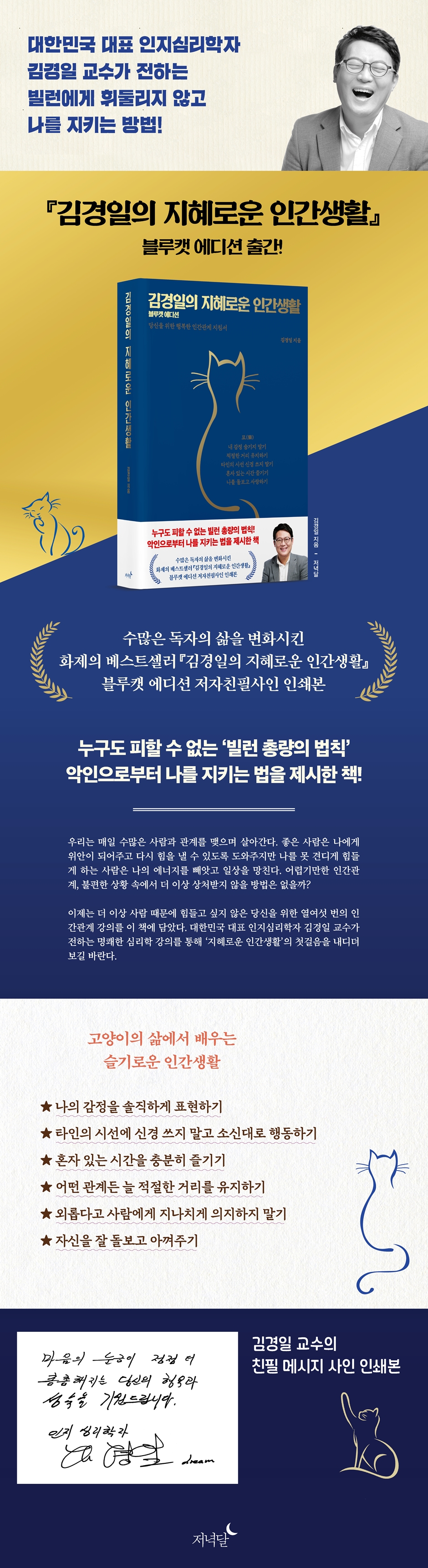
This edition is meant to teach you how to wisely protect yourself from the cat's life and strengthen your mind.
Wise Human Life Lessons from Cats
★ Expressing my feelings honestly
★ Act according to your convictions without worrying about what others think.
★ Enjoy your alone time
★ Always maintain an appropriate distance in any relationship
★ Don't rely too much on people because you're lonely.
★ Take good care of yourself and cherish yourself
The Law of Villain Amounts That No One Can Escape
How to stay healthy in uncomfortable relationships
Have you ever heard the saying, "The Law of Villain Quantity"? Villains who torment and cause us hardship exist everywhere, at school, at work, and around us.
As society becomes more complex and relationships between people become more complex, concerns about human relationships are bound to increase.
In any relationship, you must know how to 'protect yourself' from the villains you encounter.
The difficulties of interpersonal relationships are not only felt by the 2030 generation.
The 4050 generation also feels discomfort and fatigue in communication.
They confess that they have to be careful with every word they say when communicating with each other due to cultural conflicts, value conflicts, and generational conflicts.
In this day and age, the same words can be considered harassment and harm to some people.
Because the spirit of the times has changed and values have changed.
As society becomes increasingly complex and competitive, we live under various stresses.
Among these, stress arising from interpersonal relationships also plays a significant role.
Interpersonal relationship concerns are not just the concerns of those just starting out in society.
Because getting older and having more social experience doesn't mean you're free from the worries of interpersonal relationships.
For us, who operate not only in face-to-face organizations like schools and companies, but also in social media such as the Internet, relationships with others can be seen as a desperate effort for survival.
Those who live in modern society have no choice but to live in association with others, whether they like it or not, whether they will or not.
Now I want to be free from difficult human relationships.
The best human relations class for you!
This book is a kind of troubleshooting manual.
Just like 'troubleshooting', which comprehensively diagnoses the cause of a problem and finds a solution when a problem occurs, we select the most frequently asked interpersonal relationship concerns and specifically introduce how the situation arose, how to overcome the situation, and what to keep in mind in interpersonal relationships.
“This book is not a theoretical book.
It is not a collection of essays that are a collection of fragments of thoughts.
It's a kind of troubleshooting.
Although it was written in simple terms, I put a lot of thought into each expression and checked each theoretical basis.
I believe that readers and those I meet at lectures will continue to ask many questions and want to hear answers to their concerns.
So, as a psychologist, I'll try to find answers to the best of my ability, and as a human being, I'll be honest about my experiences with similar problems.
This book is the first step.”
-From the prologue
As a psychologist and a human being, Professor Kim Kyung-il's "Wise Human Life," written with outstanding empathy, is a book that best demonstrates the outstanding insight and wit of Professor Kim Kyung-il, a leading psychologist in Korea.
This book offers clear advice to those who have suffered in their relationships with others and experienced the breakdown of their daily lives. It will help them regain peace in their daily lives and begin to live confidently through proper relationships.
“Now I can protect myself without being shaken by others.”
It brought fresh insight and change to many readers.
Professor Kim Kyung-il, a leading cognitive psychologist in South Korea, shares the core principles of human relationships.
We live our lives interacting with countless people every day.
Good people comfort me and help me get back on track, but people who make things unbearable drain my energy and ruin my day.
Is there a way to avoid further hurt in difficult relationships and uncomfortable situations? This book contains sixteen lectures on human relationships for those who no longer want to suffer because of others.
Professor Kim Kyung-il, a leading cognitive psychologist in Korea, sharply examines 'human relationships,' the most frequently asked topic in his lectures, and explores ways to maintain appropriate relationships without stress.
Not only does it offer words of comfort to those struggling in painful interpersonal relationships, but it also examines the relationship between 'others and myself' based on cognitive psychology, penetrating the essence of human relationships and suggesting ways to solve problems.
I always care about what other people say
Looking back, a psychological prescription for you who is hurting alone
『Kim Kyung-il's Wise Human Life』 Blue Cat Edition published!
We all live in a 'flood of relationships'.
Relationships are definitely something that makes me happy.
A comfortable relationship with someone I like brings me small, frequent happiness.
But in the company, community, and social media I belong to, I am also connected to unwanted and uncomfortable people.
This connection cannot be easily broken, creating internal or external conflicts and leaving emotional scars.
Professor Kim Kyung-il, a leading cognitive psychologist in Korea, has returned with the book 『Kim Kyung-il's Wise Human Life』, which focuses on the topic of 'my relationship with others'.
This edition is meant to teach you how to wisely protect yourself from the cat's life and strengthen your mind.
Wise Human Life Lessons from Cats
★ Expressing my feelings honestly
★ Act according to your convictions without worrying about what others think.
★ Enjoy your alone time
★ Always maintain an appropriate distance in any relationship
★ Don't rely too much on people because you're lonely.
★ Take good care of yourself and cherish yourself
The Law of Villain Amounts That No One Can Escape
How to stay healthy in uncomfortable relationships
Have you ever heard the saying, "The Law of Villain Quantity"? Villains who torment and cause us hardship exist everywhere, at school, at work, and around us.
As society becomes more complex and relationships between people become more complex, concerns about human relationships are bound to increase.
In any relationship, you must know how to 'protect yourself' from the villains you encounter.
The difficulties of interpersonal relationships are not only felt by the 2030 generation.
The 4050 generation also feels discomfort and fatigue in communication.
They confess that they have to be careful with every word they say when communicating with each other due to cultural conflicts, value conflicts, and generational conflicts.
In this day and age, the same words can be considered harassment and harm to some people.
Because the spirit of the times has changed and values have changed.
As society becomes increasingly complex and competitive, we live under various stresses.
Among these, stress arising from interpersonal relationships also plays a significant role.
Interpersonal relationship concerns are not just the concerns of those just starting out in society.
Because getting older and having more social experience doesn't mean you're free from the worries of interpersonal relationships.
For us, who operate not only in face-to-face organizations like schools and companies, but also in social media such as the Internet, relationships with others can be seen as a desperate effort for survival.
Those who live in modern society have no choice but to live in association with others, whether they like it or not, whether they will or not.
Now I want to be free from difficult human relationships.
The best human relations class for you!
This book is a kind of troubleshooting manual.
Just like 'troubleshooting', which comprehensively diagnoses the cause of a problem and finds a solution when a problem occurs, we select the most frequently asked interpersonal relationship concerns and specifically introduce how the situation arose, how to overcome the situation, and what to keep in mind in interpersonal relationships.
“This book is not a theoretical book.
It is not a collection of essays that are a collection of fragments of thoughts.
It's a kind of troubleshooting.
Although it was written in simple terms, I put a lot of thought into each expression and checked each theoretical basis.
I believe that readers and those I meet at lectures will continue to ask many questions and want to hear answers to their concerns.
So, as a psychologist, I'll try to find answers to the best of my ability, and as a human being, I'll be honest about my experiences with similar problems.
This book is the first step.”
-From the prologue
As a psychologist and a human being, Professor Kim Kyung-il's "Wise Human Life," written with outstanding empathy, is a book that best demonstrates the outstanding insight and wit of Professor Kim Kyung-il, a leading psychologist in Korea.
This book offers clear advice to those who have suffered in their relationships with others and experienced the breakdown of their daily lives. It will help them regain peace in their daily lives and begin to live confidently through proper relationships.
GOODS SPECIFICS
- Date of issue: April 30, 2024
- Format: Hardcover book binding method guide
- Page count, weight, size: 280 pages | 438g | 130*194*26mm
- ISBN13: 9791189217266
- ISBN10: 1189217260
You may also like
카테고리
korean


korean

![ELLE 엘르 스페셜 에디션 A형 : 12월 [2025]](http://librairie.coreenne.fr/cdn/shop/files/b8e27a3de6c9538896439686c6b0e8fb.jpg?v=1766436872&width=3840)


