

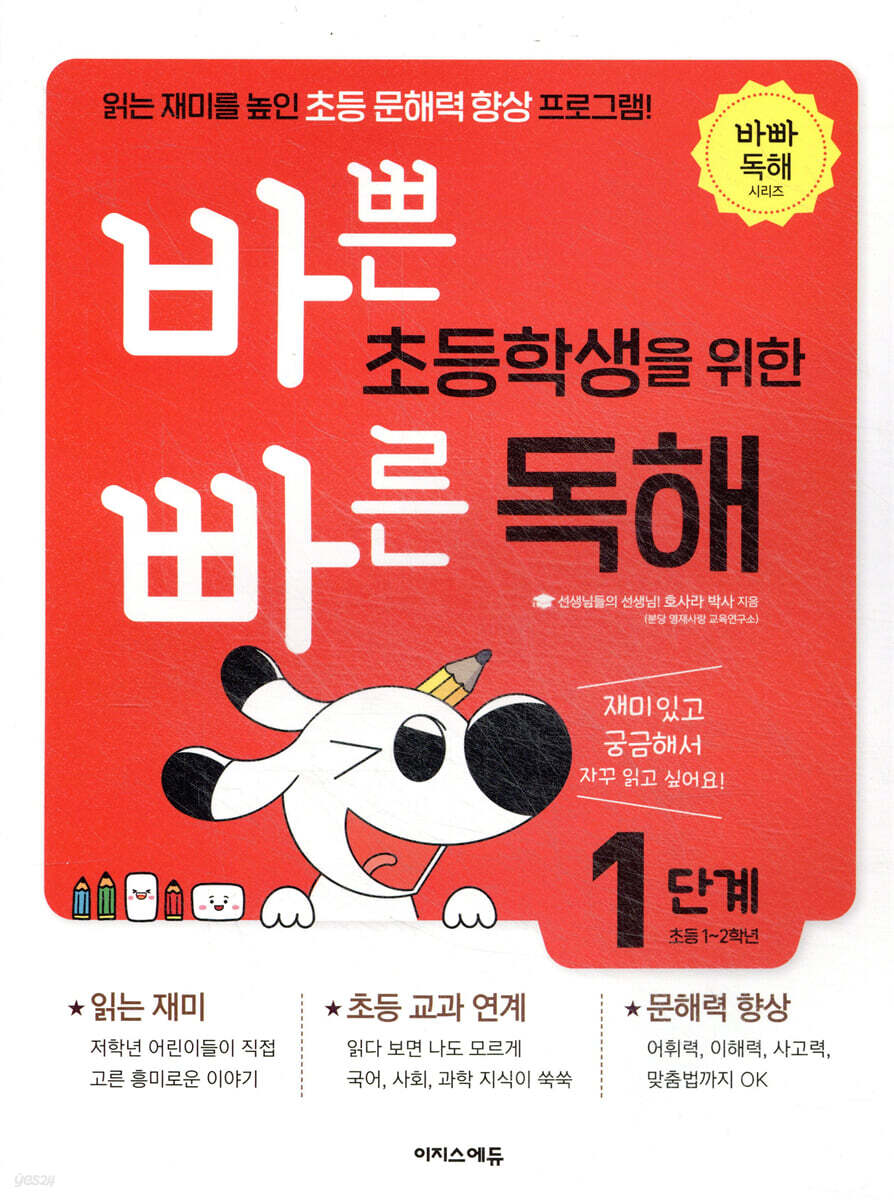
Quick Reading for Busy Elementary Students, Step 1
 |
Description
Book Introduction
An elementary literacy program that enhances the fun of reading! “It’s fun and I’m curious, so I want to keep reading!” Bundang Youngjae Love Education Research Institute's teaching secrets revealed! Dr. Hosara, who has been teaching children for 16 years, has released the first level of "Rapid Reading for Busy Elementary School Students" (hereafter, "Busy Reading"), a literacy improvement program that maximizes the enjoyment of reading. This book contains a selection of interesting stories that first and second graders at the institute would like to read, and all the stories and problems in this book are directly linked to elementary school textbooks, helping them do well in schoolwork. Let's meet 'Busy Reading', a fun reading book that will help you build literacy and knowledge of Korean, social studies, and science subjects without you even realizing it while reading! |
- You can preview some of the book's contents.
Preview
index
First yard.
Aesop's Fables
01 The Fox and the Crane ①
02 The Fox and the Crane ②
03 The Turtle Who Wants to Fly ①
04 The Turtle Who Wants to Fly ②
05 The Greedy Man and the Peanut ①
06 The Greedy Man and the Peanut ②
07 Ants and Pupa ①
08 Ants and Pupa ②
★ First Yard Review
Second yard.
scientific common sense
09 Should I be thankful to the booger?
10 Colorful Poops?
11 Polar bear fur isn't white?
12 Shooting stars aren't stars?
13 There's a dinosaur that ate rocks?
14 Are you confusing owls with owls?
15 You can't even move in the desert?
16 Fighter cells?
★ Second Yard Review
Third yard.
traditional fairy tales
17 Things Scarier Than a Tiger ①
18 Things Scarier Than a Tiger ②
19 The Rabbit's Trial ①
20 The Rabbit's Trial ②
21 Wild Strawberries and the Strange Son ①
22 Wild Strawberries and the Strange Son ②
23 The radish exchanged for the calf ①
24 The radish swapped with the calf ②
★ Third Yard Review
Fourth yard.
Social common sense
25 Homey is a world-class star?
26 They say that if you laugh, good fortune will come?
27 If you catch the tail, you win?
28 The sandwich wasn't food?
29 You ground the beans with a stone?
30 Ganggangsullae protected the country?
31 There's a polar bear swim competition?
32 What if you see a whale washed up on the waves?
★Fourth Yard Review
Aesop's Fables
01 The Fox and the Crane ①
02 The Fox and the Crane ②
03 The Turtle Who Wants to Fly ①
04 The Turtle Who Wants to Fly ②
05 The Greedy Man and the Peanut ①
06 The Greedy Man and the Peanut ②
07 Ants and Pupa ①
08 Ants and Pupa ②
★ First Yard Review
Second yard.
scientific common sense
09 Should I be thankful to the booger?
10 Colorful Poops?
11 Polar bear fur isn't white?
12 Shooting stars aren't stars?
13 There's a dinosaur that ate rocks?
14 Are you confusing owls with owls?
15 You can't even move in the desert?
16 Fighter cells?
★ Second Yard Review
Third yard.
traditional fairy tales
17 Things Scarier Than a Tiger ①
18 Things Scarier Than a Tiger ②
19 The Rabbit's Trial ①
20 The Rabbit's Trial ②
21 Wild Strawberries and the Strange Son ①
22 Wild Strawberries and the Strange Son ②
23 The radish exchanged for the calf ①
24 The radish swapped with the calf ②
★ Third Yard Review
Fourth yard.
Social common sense
25 Homey is a world-class star?
26 They say that if you laugh, good fortune will come?
27 If you catch the tail, you win?
28 The sandwich wasn't food?
29 You ground the beans with a stone?
30 Ganggangsullae protected the country?
31 There's a polar bear swim competition?
32 What if you see a whale washed up on the waves?
★Fourth Yard Review
Detailed image

Publisher's Review
Quick Reading for Busy Elementary Students: Level 1
An elementary literacy program that enhances the enjoyment of reading.
“It’s a fun and intriguing book that makes you want to keep reading!”
■ When you reach second grade, the level of textbook writing improves significantly!
Many parents spend first grade feeling relieved when their children tell them that schoolwork is easy.
Then, when you become a second grader, you become embarrassed.
This is because difficult words like ‘haegeoreum’ and ‘hungnyeon’ appear in Korean language textbooks, and even the texts in math textbooks are getting longer.
At this time, children who have had a rich reading experience are able to overcome the difficulties of learning.
But even if we know that 'reading is power,' our worries and curiosities do not disappear.
How much and how should children read? Is there no solution for children who hate reading? Just because they read a lot as children doesn't mean they'll excel academically. And as children advance in grades, is there anything else they shouldn't miss besides reading?
■ The foundation of all study! 'Reading Comprehension'
It is ‘reading comprehension’.
'Reading comprehension' is literally the ability to read text and understand its meaning.
To achieve high performance on school assessments that require students to present and solve problem situations in writing, 'reading comprehension' is essential.
Reading comprehension is developed through repeated processes of understanding words, sentences, and paragraphs, rather than simply reading text.
The process at this time should be differentiated according to the students' developmental stage.
■ A book that perfectly meets the achievement standards for 1st and 2nd grade Korean language reading!
So, what curriculum would be appropriate for first and second graders? The Korean language reading achievement standards for first and second graders are as follows:
1) Read letters, words, and sentences out loud.
2) Read sentences and texts with appropriate spacing.
3) Read the text and check the main content.
4) Read the text and guess the character's situation and feelings.
5) Have an interest in reading and enjoy reading books.
'Busy Reading' is a program based on the above achievement standards.
Children begin by reading the text aloud, then repeatedly identify the main idea and try to guess the character's situation and feelings.
■ Interesting stories chosen by 1st and 2nd graders!
But, just like the saying goes, “Even beads need to be strung to be valuable,” no matter how good the content is, it is useless if children don’t read it, right?
This book was written by Dr. Hosara, who has been closely teaching children at the Bundang Youngjae Love Research Institute for 16 years, while pondering, “Is there a reading book that children can read with a smile?”
The destination of 'excellent reading comprehension' is not a place that can be reached by force, but a place that children must reach on their own, with excitement.
The 'Busy Reading' program selects the most interesting stories for lower grades, then shows them to first and second graders at the lab, selecting only the stories that really caught their interest and curiosity.
Additionally, the text was composed in a way that would maintain the concentration of first and second graders.
■ Problems that anyone can easily improve their reading comprehension skills at home!
Busy Reading is a fun reading book for all children.
The problems in this book are a selection of activities that can be easily accomplished at home, based on 16 years of teaching at the institute.
Even parents with no experience teaching reading can become great teachers with this book!
■ Let’s also develop ‘literacy’!
Recently, ‘literacy’ has been receiving attention.
Literacy is the ability to read, understand, and express text.
So, unlike other reading books that ask you to choose the correct answer from the options, this book features speakers such as 'busy dog' and 'busy cat' in the choices.
It's about reinforcing expressiveness by reconstructing fingerprints into dialogue.
If children put themselves in these situations and express their own thoughts about the text, they can also develop literacy skills.
■ Background knowledge of elementary school subjects is acquired automatically!
The first section of 'Busy Reading' consists of 'Aesop's Fables', the second section is 'Science Common Sense', the third section is 'Traditional Fairy Tales', and the fourth section is 'Social Common Sense'.
All the stories and problems in this book are 100% closely linked to elementary school textbooks.
As you read about a variety of topics, you will naturally build up background knowledge in Korean, social studies, and science, which will help you with your schoolwork!
I sincerely hope that our children will enjoy reading and develop their reading comprehension skills and background knowledge of various subjects with the 'Busy Reading' book!
■ Scientific learning design and utilization of 'Busy Reading'
Be sure to start this book by reading it out loud! No matter how many workbooks you solve, if you don't start with careful reading, your reading comprehension will remain stagnant.
On the other hand, reading out loud allows you to imagine the content and organize it in your head.
Step 1 | Vocabulary: Let's start with the meaning of words!
Fill in the blanks and organize the meaning of the words easily.
If you read a text without knowing the meaning of the words, you will misunderstand the content.
Therefore, before solving the problem, it is important to first know the meaning of the key words in the text.
Step 2 | Comprehension: Mark O and understand the content in detail.
'Who, what, how, when, why?' Think about the main idea of the text you read.
Step 3 | Thinking: Developing the ability to step back and think.
Develop your ability to think objectively by considering the relationship between the characters' minds, situations, and content.
If you express your thoughts about the text like the busy dog and busy cat in the dialogue in the problem, you can even develop your 'literacy' skills.
Step 4 | Organizing: Develop the habit of organizing in four steps.
Develop the habit of remembering the structure of the text you read while recalling the main idea.
If you can summarize the content of the text you read in four steps, you're 90% done with your reading comprehension!
Step 5 | Spacing and Spelling: A Bonus from This Book!
I have selected spelling and spacing mistakes that young children often make from the text I read.
Once you've solved all 5 problems, you'll feel confident taking the dictation test!
■ Parents, please help me like this!
1) When reading this book, it's more fun if you divide it into one line for the children, one line for the parents, or one line for the characters!
2) Spelling is a difficult subject even for adults, so don't scold them if they make mistakes! For struggling children, encourage them to find hints in the text and then try to write it out!
■ Study room teacher, use it like this!
This book is divided into 4 sections (32 lessons), and each section consists of '8 lessons + review pages'.
From Monday to Thursday, solve two problems per day. On Friday, solve the review page and then organize the incorrect problems by section.
If you follow this guide, you can complete this book in four weeks.
An elementary literacy program that enhances the enjoyment of reading.
“It’s a fun and intriguing book that makes you want to keep reading!”
■ When you reach second grade, the level of textbook writing improves significantly!
Many parents spend first grade feeling relieved when their children tell them that schoolwork is easy.
Then, when you become a second grader, you become embarrassed.
This is because difficult words like ‘haegeoreum’ and ‘hungnyeon’ appear in Korean language textbooks, and even the texts in math textbooks are getting longer.
At this time, children who have had a rich reading experience are able to overcome the difficulties of learning.
But even if we know that 'reading is power,' our worries and curiosities do not disappear.
How much and how should children read? Is there no solution for children who hate reading? Just because they read a lot as children doesn't mean they'll excel academically. And as children advance in grades, is there anything else they shouldn't miss besides reading?
■ The foundation of all study! 'Reading Comprehension'
It is ‘reading comprehension’.
'Reading comprehension' is literally the ability to read text and understand its meaning.
To achieve high performance on school assessments that require students to present and solve problem situations in writing, 'reading comprehension' is essential.
Reading comprehension is developed through repeated processes of understanding words, sentences, and paragraphs, rather than simply reading text.
The process at this time should be differentiated according to the students' developmental stage.
■ A book that perfectly meets the achievement standards for 1st and 2nd grade Korean language reading!
So, what curriculum would be appropriate for first and second graders? The Korean language reading achievement standards for first and second graders are as follows:
1) Read letters, words, and sentences out loud.
2) Read sentences and texts with appropriate spacing.
3) Read the text and check the main content.
4) Read the text and guess the character's situation and feelings.
5) Have an interest in reading and enjoy reading books.
'Busy Reading' is a program based on the above achievement standards.
Children begin by reading the text aloud, then repeatedly identify the main idea and try to guess the character's situation and feelings.
■ Interesting stories chosen by 1st and 2nd graders!
But, just like the saying goes, “Even beads need to be strung to be valuable,” no matter how good the content is, it is useless if children don’t read it, right?
This book was written by Dr. Hosara, who has been closely teaching children at the Bundang Youngjae Love Research Institute for 16 years, while pondering, “Is there a reading book that children can read with a smile?”
The destination of 'excellent reading comprehension' is not a place that can be reached by force, but a place that children must reach on their own, with excitement.
The 'Busy Reading' program selects the most interesting stories for lower grades, then shows them to first and second graders at the lab, selecting only the stories that really caught their interest and curiosity.
Additionally, the text was composed in a way that would maintain the concentration of first and second graders.
■ Problems that anyone can easily improve their reading comprehension skills at home!
Busy Reading is a fun reading book for all children.
The problems in this book are a selection of activities that can be easily accomplished at home, based on 16 years of teaching at the institute.
Even parents with no experience teaching reading can become great teachers with this book!
■ Let’s also develop ‘literacy’!
Recently, ‘literacy’ has been receiving attention.
Literacy is the ability to read, understand, and express text.
So, unlike other reading books that ask you to choose the correct answer from the options, this book features speakers such as 'busy dog' and 'busy cat' in the choices.
It's about reinforcing expressiveness by reconstructing fingerprints into dialogue.
If children put themselves in these situations and express their own thoughts about the text, they can also develop literacy skills.
■ Background knowledge of elementary school subjects is acquired automatically!
The first section of 'Busy Reading' consists of 'Aesop's Fables', the second section is 'Science Common Sense', the third section is 'Traditional Fairy Tales', and the fourth section is 'Social Common Sense'.
All the stories and problems in this book are 100% closely linked to elementary school textbooks.
As you read about a variety of topics, you will naturally build up background knowledge in Korean, social studies, and science, which will help you with your schoolwork!
I sincerely hope that our children will enjoy reading and develop their reading comprehension skills and background knowledge of various subjects with the 'Busy Reading' book!
■ Scientific learning design and utilization of 'Busy Reading'
Be sure to start this book by reading it out loud! No matter how many workbooks you solve, if you don't start with careful reading, your reading comprehension will remain stagnant.
On the other hand, reading out loud allows you to imagine the content and organize it in your head.
Step 1 | Vocabulary: Let's start with the meaning of words!
Fill in the blanks and organize the meaning of the words easily.
If you read a text without knowing the meaning of the words, you will misunderstand the content.
Therefore, before solving the problem, it is important to first know the meaning of the key words in the text.
Step 2 | Comprehension: Mark O and understand the content in detail.
'Who, what, how, when, why?' Think about the main idea of the text you read.
Step 3 | Thinking: Developing the ability to step back and think.
Develop your ability to think objectively by considering the relationship between the characters' minds, situations, and content.
If you express your thoughts about the text like the busy dog and busy cat in the dialogue in the problem, you can even develop your 'literacy' skills.
Step 4 | Organizing: Develop the habit of organizing in four steps.
Develop the habit of remembering the structure of the text you read while recalling the main idea.
If you can summarize the content of the text you read in four steps, you're 90% done with your reading comprehension!
Step 5 | Spacing and Spelling: A Bonus from This Book!
I have selected spelling and spacing mistakes that young children often make from the text I read.
Once you've solved all 5 problems, you'll feel confident taking the dictation test!
■ Parents, please help me like this!
1) When reading this book, it's more fun if you divide it into one line for the children, one line for the parents, or one line for the characters!
2) Spelling is a difficult subject even for adults, so don't scold them if they make mistakes! For struggling children, encourage them to find hints in the text and then try to write it out!
■ Study room teacher, use it like this!
This book is divided into 4 sections (32 lessons), and each section consists of '8 lessons + review pages'.
From Monday to Thursday, solve two problems per day. On Friday, solve the review page and then organize the incorrect problems by section.
If you follow this guide, you can complete this book in four weeks.
GOODS SPECIFICS
- Date of issue: August 25, 2021
- Page count, weight, size: 128 pages | 210*280*20mm
- ISBN13: 9791163032762
- ISBN10: 116303276X
- KC Certification: Certification Type: Confirming Certification Number: -
You may also like
카테고리
korean


korean

![GQ KOREA Mark (Monthly): December [2025]](http://librairie.coreenne.fr/cdn/shop/files/8ef265dbbfbf186523ed75ba7319009d.jpg?v=1765340328&width=3840)


