

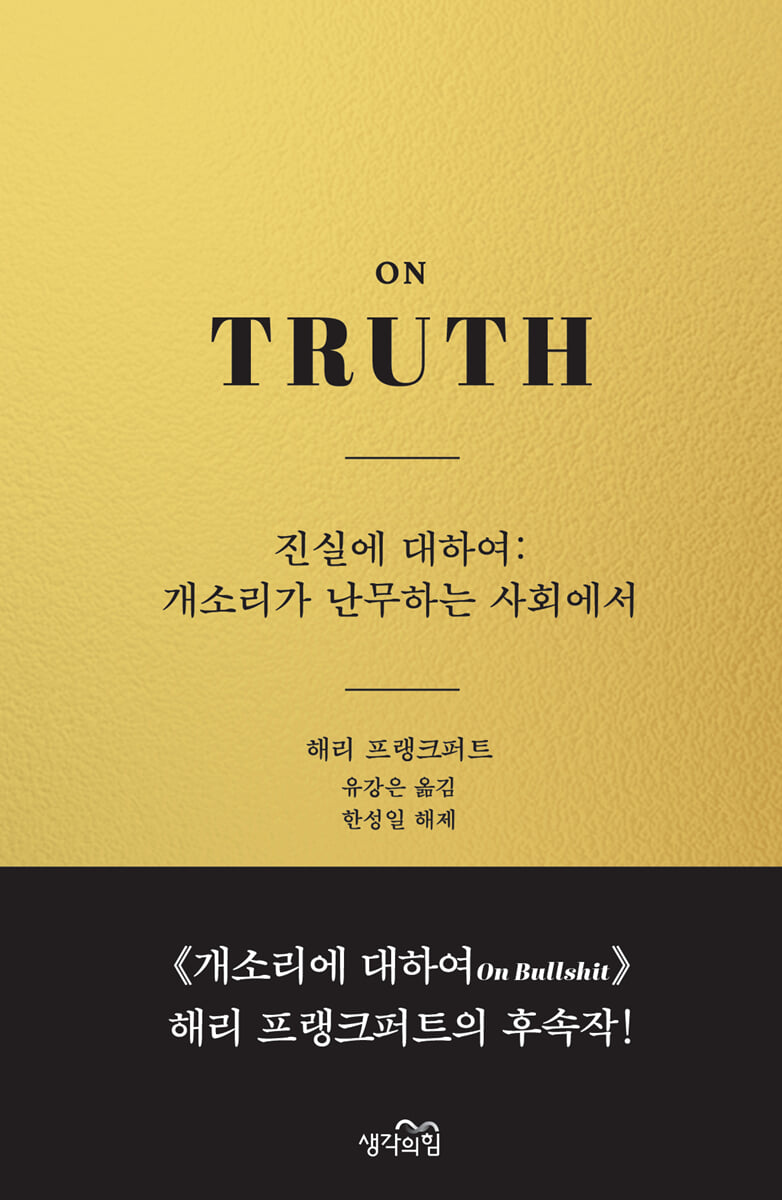
About the Truth: In a Society Where Bullshit Runs Wild
 |
Description
Book Introduction
The message of philosopher Harry Frankfort, who became a New York Times bestseller with his book “On Bullshit,” is once again reaching Korean society.
In his previous work, he characterized the nature of dog whining as 'indifference to the truth', but he did not sufficiently explain why this was so bad.
This work, "On Truth: In a Society Where Bullshit Runs Wild," focuses on this very point: the "value and importance of truth."
What good is truth, anyway? From posing the question to philosophical reflections on the solution, in this small but immaculately written book, Frankfort argues for the utility of truth.
Through his uniquely precise conceptual analysis, he proves from philosophical, ethical, and practical perspectives that neither humanity nor society can survive without truth.
Building on the wit and insight he displayed in his previous work, Frankfort invites us to take a fresh look at the truth.
From an age of bullshit to an age of truth, it leads us to think anew about truth as the foundation of survival and prosperity.
In his previous work, he characterized the nature of dog whining as 'indifference to the truth', but he did not sufficiently explain why this was so bad.
This work, "On Truth: In a Society Where Bullshit Runs Wild," focuses on this very point: the "value and importance of truth."
What good is truth, anyway? From posing the question to philosophical reflections on the solution, in this small but immaculately written book, Frankfort argues for the utility of truth.
Through his uniquely precise conceptual analysis, he proves from philosophical, ethical, and practical perspectives that neither humanity nor society can survive without truth.
Building on the wit and insight he displayed in his previous work, Frankfort invites us to take a fresh look at the truth.
From an age of bullshit to an age of truth, it leads us to think anew about truth as the foundation of survival and prosperity.
- You can preview some of the book's contents.
Preview
index
About the Truth: In a Society Full of Bullshit
Release | Han Seong-il (Professor of Philosophy, Seoul National University)
Translator's Note
Release | Han Seong-il (Professor of Philosophy, Seoul National University)
Translator's Note
Into the book
In other words, I haven't explained why the indifference to truth that I consider a hallmark of bullshit is so bad.
Of course, most people recognize that truth is extremely important and are willing to admit it to some extent.
On the other hand, few people are willing to take the time to consider what makes truth so important.
We all know that our society is constantly awash with lies, bullshit, and other falsehoods and deceptions—some intentional, some simply accidental.
But—at least so far—this burden has not seriously damaged our civilization.
Some might be content with this fact, saying that truth is not that important anyway, and that we have no reason to care much about it.
In my view, this attitude is nothing short of a pathetic mistake.
So here I propose—as a sort of sequel to, or rather an introductory exploration of, "On Bullshit"—to examine the practical and theoretical significance of truth.
Regardless of whether we generally recognize and act on that fact.
--- p.12~13
When we try to point out why truth is important to us, the first thing that comes to mind is perhaps a very ordinary thought, but one that is undoubtedly appropriate.
The truth is that often times, the idea is that there is a great deal of practical utility.
In my view, any society that is even minimally functional must recognize the utility of the ever-changing truth.
After all, if a society cares little for truth, how can it make informed judgments and decisions regarding the most appropriate disposition of public affairs? How can a society thrive, or even survive, if it lacks sufficient facts to successfully pursue its ambitions and to address its various problems thoughtfully and effectively?
--- p.21~22
In fact, we cannot live without truth.
Truth is needed not only to understand how to live well, but also to know how to survive.
Moreover, this fact cannot easily go unnoticed.
Therefore, we cannot help but recognize, at least implicitly, that truth is important to us.
So we also have to understand (at least implicitly) that truth is not some feature of belief that we can be indifferent to.
Indifference is not simply a matter of lazy recklessness.
It quickly becomes apparent that this is a fatal problem.
To the extent that we recognize the importance of truth, there is no reasonable way to restrain our desire for truth, or our efforts to obtain it, about many things.
--- p.40~41
Spinoza argues that, therefore, anyone who despises or is indifferent to truth must also despise or be indifferent to his own life.
Such a hostile or insensitive attitude toward oneself is extremely rare and difficult to maintain.
Thus, Spinoza concluded that almost everyone—everyone who values and cares about their own life—loves the truth, whether they know it or not.
As far as I know, Spinoza was generally right about this.
In fact, we all love the truth, whether we know it or not.
And as long as we recognize what it entails to deal effectively with life's problems, we cannot help but love the truth.
--- p.52
Without truth, we would have no opinions about the reality of things, or at best, they would be wrong.
Either way, we don't know what situation we're in now.
We are unaware of what is happening in the world around us or within us.
Any belief you have about these issues is a false belief.
False beliefs, of course, do not effectively help us deal with reality.
Perhaps, out of ignorance, we may temporarily be happy or, through self-deception, may be satisfied for a while, and in this way, we may temporarily avoid feeling particularly angry or anxious amidst all the difficulties that threaten us.
But ultimately, our ignorance and false beliefs are likely to make our situation worse.
--- p.62~63
Lies are designed to undermine our perception of reality.
So lies try to drive us crazy in a very real way.
As long as we believe a lie, our minds are occupied and dominated by the fictions, illusions, and illusions that the liar creates to deceive us.
What we accept as reality is a world that others cannot see, touch, or experience directly.
Therefore, people who believe lies become trapped in their own world.
It is a world that no one else can enter, and a world that even the person who lied does not truly belong to.
Thus, to the extent that the victim of a lie is deprived of the truth, he is cut off from the world of common experience and isolated in a realm of fantasy that others cannot find or follow.
--- p.82
We must first be clear about what it means to value and care about the truth—specifically, practically.
What does it actually mean to be interested in truth, as opposed to simply being interested in acquiring and utilizing a particular truth?
Of course, most people recognize that truth is extremely important and are willing to admit it to some extent.
On the other hand, few people are willing to take the time to consider what makes truth so important.
We all know that our society is constantly awash with lies, bullshit, and other falsehoods and deceptions—some intentional, some simply accidental.
But—at least so far—this burden has not seriously damaged our civilization.
Some might be content with this fact, saying that truth is not that important anyway, and that we have no reason to care much about it.
In my view, this attitude is nothing short of a pathetic mistake.
So here I propose—as a sort of sequel to, or rather an introductory exploration of, "On Bullshit"—to examine the practical and theoretical significance of truth.
Regardless of whether we generally recognize and act on that fact.
--- p.12~13
When we try to point out why truth is important to us, the first thing that comes to mind is perhaps a very ordinary thought, but one that is undoubtedly appropriate.
The truth is that often times, the idea is that there is a great deal of practical utility.
In my view, any society that is even minimally functional must recognize the utility of the ever-changing truth.
After all, if a society cares little for truth, how can it make informed judgments and decisions regarding the most appropriate disposition of public affairs? How can a society thrive, or even survive, if it lacks sufficient facts to successfully pursue its ambitions and to address its various problems thoughtfully and effectively?
--- p.21~22
In fact, we cannot live without truth.
Truth is needed not only to understand how to live well, but also to know how to survive.
Moreover, this fact cannot easily go unnoticed.
Therefore, we cannot help but recognize, at least implicitly, that truth is important to us.
So we also have to understand (at least implicitly) that truth is not some feature of belief that we can be indifferent to.
Indifference is not simply a matter of lazy recklessness.
It quickly becomes apparent that this is a fatal problem.
To the extent that we recognize the importance of truth, there is no reasonable way to restrain our desire for truth, or our efforts to obtain it, about many things.
--- p.40~41
Spinoza argues that, therefore, anyone who despises or is indifferent to truth must also despise or be indifferent to his own life.
Such a hostile or insensitive attitude toward oneself is extremely rare and difficult to maintain.
Thus, Spinoza concluded that almost everyone—everyone who values and cares about their own life—loves the truth, whether they know it or not.
As far as I know, Spinoza was generally right about this.
In fact, we all love the truth, whether we know it or not.
And as long as we recognize what it entails to deal effectively with life's problems, we cannot help but love the truth.
--- p.52
Without truth, we would have no opinions about the reality of things, or at best, they would be wrong.
Either way, we don't know what situation we're in now.
We are unaware of what is happening in the world around us or within us.
Any belief you have about these issues is a false belief.
False beliefs, of course, do not effectively help us deal with reality.
Perhaps, out of ignorance, we may temporarily be happy or, through self-deception, may be satisfied for a while, and in this way, we may temporarily avoid feeling particularly angry or anxious amidst all the difficulties that threaten us.
But ultimately, our ignorance and false beliefs are likely to make our situation worse.
--- p.62~63
Lies are designed to undermine our perception of reality.
So lies try to drive us crazy in a very real way.
As long as we believe a lie, our minds are occupied and dominated by the fictions, illusions, and illusions that the liar creates to deceive us.
What we accept as reality is a world that others cannot see, touch, or experience directly.
Therefore, people who believe lies become trapped in their own world.
It is a world that no one else can enter, and a world that even the person who lied does not truly belong to.
Thus, to the extent that the victim of a lie is deprived of the truth, he is cut off from the world of common experience and isolated in a realm of fantasy that others cannot find or follow.
--- p.82
We must first be clear about what it means to value and care about the truth—specifically, practically.
What does it actually mean to be interested in truth, as opposed to simply being interested in acquiring and utilizing a particular truth?
--- p.101
Publisher's Review
A short and provocative philosophical book, On Bullshit
Harry Frankfort's new work captivates the world
Philosopher Harry Frankfort, whose lucid analysis of bullshit and lies captivated readers around the world with his New York Times bestseller, On Bullshit, followed up the following year with a follow-up book he hoped would “address issues not covered in his previous work.”
The subject is none other than 'truth', and although the characteristic of bullshit was defined as 'indifference to the truth' in the previous work, the reason why this is so bad was not sufficiently explained.
Thus, 《On Truth: In a Society Full of Bullshit》 deals only with the value and importance of truth.
This book is not a simple sequel.
It is also the starting point of the reason that gave birth to the first introduced work, “On Dog Noise.”
Through his characteristically precise conceptual analysis, Frankfurt demonstrates from philosophical, ethical, and practical perspectives that neither humanity nor society can survive without truth.
In an age where bullshit still runs rampant, his message finds its way into Korean society once again.
Why is truth important?
Why should we value truth?
Our culture today is far more actively engaged in bullshit than in lukewarmly supporting the truth.
Some people don't even recognize 'true' and 'false' as meaningful categories.
Even those who claim to love the truth are left to doubt whether their words and actions are true.
In reality, most people only tell the truth when absolutely necessary, often believing that alternatives to the truth "sell" better.
And yet the world somehow goes on.
So where are we headed? Are we destroying ourselves by our quick and easy handling of facts? Or is this simply "okay" enough? What purpose does truth serve? From posing questions to philosophical reflections on solutions, in this compact yet impeccably written book, Frankfurt emphasizes the importance of truth.
His answer is essentially that truth “often has a great deal of practical utility” (p. 21), and he seeks to provide a clearer and more definitive understanding of the importance of truth by examining the connections between rationality, truthfulness, and reality to explain this.
The introduction by Professor Han Seong-il of the Department of Philosophy at Seoul National University, a world-renowned authority in analytic philosophy, provides a clear introduction to Frankfurt's arguments while also presenting expanded arguments, adding another layer of enjoyment to the Korean edition.
In an age of lies and deception,
A powerful declaration toward the restoration of truth
Building on the wit and insight he displayed in his previous work, Frankfort invites us to take a fresh look at the truth.
The 'truth' that we have been passing by without paying attention even though we have our eyes wide open.
Perhaps the truth is so obvious that it's easy to miss, but in fact, we may be yearning for the truth without even realizing it.
This short and powerful philosophical essay asks us today to revisit the value and meaning of truth.
And it goes beyond philosophical discussion to lead us to think anew about truth as the foundation of survival and prosperity.
From an age of bullshit to an age of truth, Frankfort's philosophy of "covering big philosophical ideas in a small book" once again illuminates our reality.
“We cannot live without truth.
“Truth is necessary not only to understand how to live well, but also to know how to survive.” (p. 40)
Harry Frankfort's new work captivates the world
Philosopher Harry Frankfort, whose lucid analysis of bullshit and lies captivated readers around the world with his New York Times bestseller, On Bullshit, followed up the following year with a follow-up book he hoped would “address issues not covered in his previous work.”
The subject is none other than 'truth', and although the characteristic of bullshit was defined as 'indifference to the truth' in the previous work, the reason why this is so bad was not sufficiently explained.
Thus, 《On Truth: In a Society Full of Bullshit》 deals only with the value and importance of truth.
This book is not a simple sequel.
It is also the starting point of the reason that gave birth to the first introduced work, “On Dog Noise.”
Through his characteristically precise conceptual analysis, Frankfurt demonstrates from philosophical, ethical, and practical perspectives that neither humanity nor society can survive without truth.
In an age where bullshit still runs rampant, his message finds its way into Korean society once again.
Why is truth important?
Why should we value truth?
Our culture today is far more actively engaged in bullshit than in lukewarmly supporting the truth.
Some people don't even recognize 'true' and 'false' as meaningful categories.
Even those who claim to love the truth are left to doubt whether their words and actions are true.
In reality, most people only tell the truth when absolutely necessary, often believing that alternatives to the truth "sell" better.
And yet the world somehow goes on.
So where are we headed? Are we destroying ourselves by our quick and easy handling of facts? Or is this simply "okay" enough? What purpose does truth serve? From posing questions to philosophical reflections on solutions, in this compact yet impeccably written book, Frankfurt emphasizes the importance of truth.
His answer is essentially that truth “often has a great deal of practical utility” (p. 21), and he seeks to provide a clearer and more definitive understanding of the importance of truth by examining the connections between rationality, truthfulness, and reality to explain this.
The introduction by Professor Han Seong-il of the Department of Philosophy at Seoul National University, a world-renowned authority in analytic philosophy, provides a clear introduction to Frankfurt's arguments while also presenting expanded arguments, adding another layer of enjoyment to the Korean edition.
In an age of lies and deception,
A powerful declaration toward the restoration of truth
Building on the wit and insight he displayed in his previous work, Frankfort invites us to take a fresh look at the truth.
The 'truth' that we have been passing by without paying attention even though we have our eyes wide open.
Perhaps the truth is so obvious that it's easy to miss, but in fact, we may be yearning for the truth without even realizing it.
This short and powerful philosophical essay asks us today to revisit the value and meaning of truth.
And it goes beyond philosophical discussion to lead us to think anew about truth as the foundation of survival and prosperity.
From an age of bullshit to an age of truth, Frankfort's philosophy of "covering big philosophical ideas in a small book" once again illuminates our reality.
“We cannot live without truth.
“Truth is necessary not only to understand how to live well, but also to know how to survive.” (p. 40)
GOODS SPECIFICS
- Date of issue: November 20, 2025
- Format: Hardcover book binding method guide
- Page count, weight, size: 156 pages | 156g | 107*159*12mm
- ISBN13: 9791194880318
- ISBN10: 1194880312
You may also like
카테고리
korean


korean

![ELLE 엘르 스페셜 에디션 A형 : 12월 [2025]](http://librairie.coreenne.fr/cdn/shop/files/b8e27a3de6c9538896439686c6b0e8fb.jpg?v=1766436872&width=3840)


