

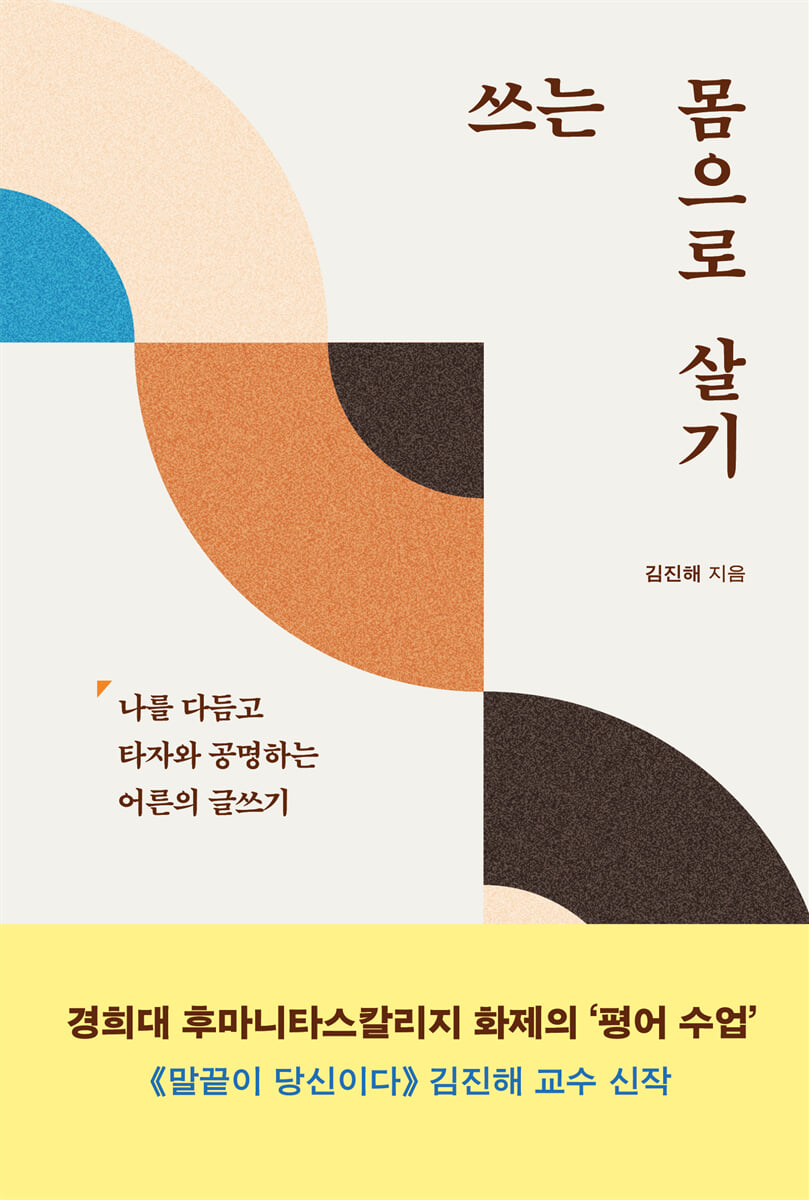
Living with a writing body
 |
Description
Book Introduction
Kyung Hee University's Humanities College's hotly contested "Squid Class"
Professor Kim Jin-hae's new work, "The End of Your Words is You"
"Writing isn't about pushing others away, it's about pulling them toward you."
Refining myself and resonating with others
Adult writing
Many writers secretly think of their readers as their 'enemy'.
There's a flood of writing courses and books out there teaching you how to effectively persuade others, and we're refining our logic to make our arguments and stories stick.
But language does not exist for me alone.
“Writing is not about subduing others, but rather a message of wanting to coexist with them” (p. 5).
Linguist Kim Jin-hae (professor at Kyunghee University's Humanities College), who has become a topic of conversation for his unique teaching method of using colloquial language in the classroom, says that writing is "not about pushing away the other person, but about pulling them toward me" (p. 5).
This new work, “Living with a Writing Body,” also focuses on writing as an “experience of two” that refines oneself and resonates with others.
As a linguist, I attempt a new approach to writing by exploring the nature of various languages through bodily sensations.
“Writing is not about pushing the other person away, but about pulling them toward you.
Even when you say, "You're wrong," you're ultimately saying, "So please, come with me."
This does not mean that we should turn a blind eye to the contradictions and conflicts of reality.
“I won’t give up on the idea of making friends.” _Page 5
So then, what is the ‘writing body’ at this time?
A body that possesses an eye that can see beyond fixed expressions and common sense to see what is "unspoken," a delicate sensibility that can put into words the order of the world around me and the traces of others, and the flexibility to willingly create a space for others in my writing.
At the same time, it is a body that does not stay on one piece of writing, but constantly reflects and flows into new writing.
The author says that 'good' writing is 'written with the body', not with the head.
Writing like this does not follow the world's rules of writing and formulaic techniques.
Language flows.
It is inevitably flexible.
Stuck and stagnant words make thoughts old.
Only the writing body pursues continuous writing.
The author, who has been exploring language and teaching writing for over 20 years, shares his reflective thoughts on writing and teaches us how to break down old words and enter a new world of words.
“Writing teaches you to be polite yet not servile, firm yet respectful, altruistic rather than selfish, face reality while dreaming of a world beyond it, and consider all variables while finding a way forward.
Writing can make you a better person.
So don't lose the courage to write." _Page 104
Professor Kim Jin-hae's new work, "The End of Your Words is You"
"Writing isn't about pushing others away, it's about pulling them toward you."
Refining myself and resonating with others
Adult writing
Many writers secretly think of their readers as their 'enemy'.
There's a flood of writing courses and books out there teaching you how to effectively persuade others, and we're refining our logic to make our arguments and stories stick.
But language does not exist for me alone.
“Writing is not about subduing others, but rather a message of wanting to coexist with them” (p. 5).
Linguist Kim Jin-hae (professor at Kyunghee University's Humanities College), who has become a topic of conversation for his unique teaching method of using colloquial language in the classroom, says that writing is "not about pushing away the other person, but about pulling them toward me" (p. 5).
This new work, “Living with a Writing Body,” also focuses on writing as an “experience of two” that refines oneself and resonates with others.
As a linguist, I attempt a new approach to writing by exploring the nature of various languages through bodily sensations.
“Writing is not about pushing the other person away, but about pulling them toward you.
Even when you say, "You're wrong," you're ultimately saying, "So please, come with me."
This does not mean that we should turn a blind eye to the contradictions and conflicts of reality.
“I won’t give up on the idea of making friends.” _Page 5
So then, what is the ‘writing body’ at this time?
A body that possesses an eye that can see beyond fixed expressions and common sense to see what is "unspoken," a delicate sensibility that can put into words the order of the world around me and the traces of others, and the flexibility to willingly create a space for others in my writing.
At the same time, it is a body that does not stay on one piece of writing, but constantly reflects and flows into new writing.
The author says that 'good' writing is 'written with the body', not with the head.
Writing like this does not follow the world's rules of writing and formulaic techniques.
Language flows.
It is inevitably flexible.
Stuck and stagnant words make thoughts old.
Only the writing body pursues continuous writing.
The author, who has been exploring language and teaching writing for over 20 years, shares his reflective thoughts on writing and teaches us how to break down old words and enter a new world of words.
“Writing teaches you to be polite yet not servile, firm yet respectful, altruistic rather than selfish, face reality while dreaming of a world beyond it, and consider all variables while finding a way forward.
Writing can make you a better person.
So don't lose the courage to write." _Page 104
- You can preview some of the book's contents.
Preview
index
Prologue: Writing with your body, not your head
Part 1 What sentence do you have?
Work that resonates with others
What the expression doesn't say
From concrete to abstract
'Bad' writing remains
What can be writing
The less clear the topic, the better.
Appendix: To better express the subject matter
Part 2: How to structure a good essay
The aesthetics of addition and subtraction
Engraving someone else's perspective on my body
Style, a style shaped by life
Translating experience into something unfamiliar
A single sentence that resonates with the world
Some scenes keep grabbing me
Finding the 'right' word
How to anchor my writing
Writing that starts with 'I don't want to write'
The text also needs some editing.
Appendix: For 'Human' Writing
Part 3: Let's write what wasn't said
Thickness of time
The power to imagine a scene
I saw it, but the reader didn't see it.
Into a new world of words
The freedom of being imperfect
Language that starts from me
Emotions are outside the skin
Appendix: To better convey my story to the readers
Part 4: Live as if you were writing, read as if you were living
Sensitivity engraved in the body
The joy of becoming someone else, the longing to give of myself
When the book passes through me
The discovery of repetition
Establishing the axis of life
In an equal and free space
Writing that invites heterogeneity
With the sense of 'another body'
Epilogue: If you want to write 'well'
Part 1 What sentence do you have?
Work that resonates with others
What the expression doesn't say
From concrete to abstract
'Bad' writing remains
What can be writing
The less clear the topic, the better.
Appendix: To better express the subject matter
Part 2: How to structure a good essay
The aesthetics of addition and subtraction
Engraving someone else's perspective on my body
Style, a style shaped by life
Translating experience into something unfamiliar
A single sentence that resonates with the world
Some scenes keep grabbing me
Finding the 'right' word
How to anchor my writing
Writing that starts with 'I don't want to write'
The text also needs some editing.
Appendix: For 'Human' Writing
Part 3: Let's write what wasn't said
Thickness of time
The power to imagine a scene
I saw it, but the reader didn't see it.
Into a new world of words
The freedom of being imperfect
Language that starts from me
Emotions are outside the skin
Appendix: To better convey my story to the readers
Part 4: Live as if you were writing, read as if you were living
Sensitivity engraved in the body
The joy of becoming someone else, the longing to give of myself
When the book passes through me
The discovery of repetition
Establishing the axis of life
In an equal and free space
Writing that invites heterogeneity
With the sense of 'another body'
Epilogue: If you want to write 'well'
Into the book
When writing, consider 'what I will choose' while also reviewing 'what I did not choose'.
Rather than just writing, 'the thoughts that come to my mind are always choices.
It is necessary to ask, 'Is there anything more hidden?'
When we distrust visible words, new words spring up.
--- p.25
I hope that your writing purpose will be 'pure'.
The purpose of writing should not be to vent these two emotions: pride and pity.
Getting closer to my truth.
To write my story honestly and frankly.
Writing is not about trying to become something else, but about becoming yourself, not someone else.
--- p.58
Writing does not seek universality.
The reason we write is because of the uniqueness of our lives and experiences.
To defend uniqueness.
But ethics makes the uniqueness of our experience seem like it's there.
I don't know about 'Mother's Love'.
I only know about my mother's 'Lee Ui-gi's Love'.
Just write that.
--- p.65
‘Writing’ is not about writing down your thoughts as they are.
Writing is about 'translating' thoughts.
--- p.105
A sense for writing is a sense for sentences.
How you see the world is important, but you also need to think about how to express the world and your thoughts in sentences.
The world is not the goal.
The purpose of the writing is.
The purpose is the sentence, not the effect of persuasion or instruction.
So, every piece of writing should have at least one unique sentence.
(Omitted) Writing is about extracting a good sentence from within myself.
--- p.120
Just like people, words cannot live alone, so they 'build' meaning by forming relationships with other words within a text.
Anyone can write if they believe that even the simplest and most ordinary words can have profound meaning depending on where they are placed.
Finding the right word is a matter of attitude, not a matter of saying there is one right answer somewhere.
--- p.134
'Why do I write?' There are many answers, but I believe I write to affirm life and existence.
To be surprised that I have many stories inside me, and to be surprised again that the twists and turns of my life are acceptable.
--- p.167
Isn't writing about realizing that there's something left unwritten after writing it, about finding and rewriting the 'unwritten things' and accepting that there's still something left unwritten? Isn't it about the fact that the phrase 'I wrote it all, I'm done' doesn't make sense at all?
A true letter is like a letter that is written again after it has been sent.
It seems like a matter of waiting for 'unwritten text'.
--- p.274
How can this be expressed in the word 'metaphor', which means 'to compare to something else'?
I think it would be more accurate to call it 'becoming another body'.
I think this is very important when writing.
The mystery of human existence lies in the fact that the more we try to become other bodies and the more we distance ourselves from ourselves, the better we come to know ourselves.
Rather than just writing, 'the thoughts that come to my mind are always choices.
It is necessary to ask, 'Is there anything more hidden?'
When we distrust visible words, new words spring up.
--- p.25
I hope that your writing purpose will be 'pure'.
The purpose of writing should not be to vent these two emotions: pride and pity.
Getting closer to my truth.
To write my story honestly and frankly.
Writing is not about trying to become something else, but about becoming yourself, not someone else.
--- p.58
Writing does not seek universality.
The reason we write is because of the uniqueness of our lives and experiences.
To defend uniqueness.
But ethics makes the uniqueness of our experience seem like it's there.
I don't know about 'Mother's Love'.
I only know about my mother's 'Lee Ui-gi's Love'.
Just write that.
--- p.65
‘Writing’ is not about writing down your thoughts as they are.
Writing is about 'translating' thoughts.
--- p.105
A sense for writing is a sense for sentences.
How you see the world is important, but you also need to think about how to express the world and your thoughts in sentences.
The world is not the goal.
The purpose of the writing is.
The purpose is the sentence, not the effect of persuasion or instruction.
So, every piece of writing should have at least one unique sentence.
(Omitted) Writing is about extracting a good sentence from within myself.
--- p.120
Just like people, words cannot live alone, so they 'build' meaning by forming relationships with other words within a text.
Anyone can write if they believe that even the simplest and most ordinary words can have profound meaning depending on where they are placed.
Finding the right word is a matter of attitude, not a matter of saying there is one right answer somewhere.
--- p.134
'Why do I write?' There are many answers, but I believe I write to affirm life and existence.
To be surprised that I have many stories inside me, and to be surprised again that the twists and turns of my life are acceptable.
--- p.167
Isn't writing about realizing that there's something left unwritten after writing it, about finding and rewriting the 'unwritten things' and accepting that there's still something left unwritten? Isn't it about the fact that the phrase 'I wrote it all, I'm done' doesn't make sense at all?
A true letter is like a letter that is written again after it has been sent.
It seems like a matter of waiting for 'unwritten text'.
--- p.274
How can this be expressed in the word 'metaphor', which means 'to compare to something else'?
I think it would be more accurate to call it 'becoming another body'.
I think this is very important when writing.
The mystery of human existence lies in the fact that the more we try to become other bodies and the more we distance ourselves from ourselves, the better we come to know ourselves.
--- p.309
Publisher's Review
“Only those who have engraved the perspective of others on their own bodies
“I can create a single sentence that will move your heart.”
On the method of 'writing with the body', not the head
This book is divided into four parts, which sequentially help you broaden your perspective on writing and develop a 'writing body.'
First, Part 1, 'What kind of sentences do you have?' contains basic preparations for becoming a writer.
For example, first of all, it talks about the importance of relaxing.
Just as you have to relax when doing Aikido to be able to receive the opponent's movements and show your own, the same goes for writing.
Writing that is full of force, with blood in your throat, and shouting is clichéd and noisy and does not reach the reader.
This opens with a discussion of what constitutes "good" writing, and explores various ways of thinking that can help you draw out topics and writing materials from your own life and create good sentences.
Part 2, 'How is a good piece of writing structured?', delves into the structure of writing and the expression of sentences.
It provides points to consider for each element of writing, such as point of view, style, description, expression of emotion, and sentence length, along with its own new definition.
For example, the author distinguishes between empathy and sympathy, defining empathy as becoming one with another because it “invites the other person’s perspective into my body” (p. 92), whereas empathy is maintaining a state of discord because it agrees with the other person’s feelings while maintaining my own position.
It is said that in order to write new sentences and articles that will move the reader's heart, one must overcome the natural instinct to protect oneself and willingly shed oneself and experience becoming someone else.
"Through whose eyes do you see this world? Are you only seeing it through your own eyes? You have to sit in someone else's shoes to know your own place.
Only such a person can create sentences from the perspective of an object.
“Just one sentence that will move your heart.” _Page 92
Part 3, "Let's Write What Hasn't Been Said," teaches us how to effectively understand and utilize techniques such as metaphor, metonymy, and personification, while delving deeper into the nature of language, including its irrationality and human-centered nature.
According to him, language cannot objectively and accurately reflect the world, and is therefore inevitably irrational.
For example, the metonymic expression 'to bake bread' is actually incorrect.
In fact, we only bake the dough, and only then do we get the bread.
The author argues that we should move beyond the illusion that language is objective, and emphasizes that anyone can reinterpret and recreate the world by relying on the free irrationality of language.
The final fourth part continues with a story of connecting with others and the world through letters, from the perspective that writing is always an act that transcends 'me'.
The joy of reading and writing is connected to “meeting the world through the bodies and perspectives of others” (p. 252), and writing is like increasing the number of pillars that support life, ultimately broadening and expanding me.
“A human person is a ‘beginning person.’
Of course, the writer is also a beginner.
A person who lives a life of action, not a life of observation.
(Omitted) It is a miracle that cannot be predicted, not a causal relationship or logic.
Because that is human ability.
Start something new without any purpose.
I wish someone like that would write.” _Page 245
“I talk about writing, but maybe I'm really talking about democracy.”
In an era where differences are not accepted,
Writing for a Flexible Attitude to Life
In November 2024, approximately 4,000 professors from 60 universities across the country issued a statement on the current situation.
Among them, the 'Kyunghee University Declaration on Current Affairs' written by Professor Kim Jin-hae caused the greatest stir.
Rather than following the grammar of a typical declaration (poster) that strongly questions social structures or external circumstances, this declaration began with a calm, reflective tone that confessed the vulnerability of 'myself'.
The first-person sentences extended to 'with you' and finally 'we'.
This declaration, which reflects the author's writing philosophy, caught the attention of many fellow citizens both on and off campus, and raised the question of what makes a good adult and a better community.
It was just a few days before former President Yoon Seok-yeol declared martial law.
“The world we live in is a collaborative creation of heterogeneous species meeting, entangling, and colliding, so why is it that writing is told to contain ‘a single, well-organized thought’?
“Wouldn’t that be okay?” _Page 294
The world we live in today is full of uncertainty.
In these unpredictable times, it's increasingly easy to want to protect what's ours and stick together, but perhaps what we need more than anything else is an attitude of "willingly inviting heterogeneity."
Just as a natural ecosystem is not maintained by a single species, but rather by various individuals forming relationships and coexisting while 'contaminating' each other.
For the author, this vast mechanism of symbiosis applies equally to natural ecosystems, human societies, and writing.
The author says that “good writing is writing in which disparate stories cooperate and coexist” (p. 298), and that the joy of writing lies in “realizing after writing that there is something left unwritten, accepting that even after finding and rewriting the ‘unwritten things,’ there are still things left unwritten, and that the phrase ‘I wrote everything’ does not make sense at all” (p. 274).
Ultimately, the author's thoughts on writing are centered around the soft possibility and diversity of "all can be correct, even though they are different," rather than the near-fictional unity and accuracy of "only one is correct."
This book promotes writing as a true adult communication method, and in an age obsessed with telling one's story, it provides a clue to an attitude of acceptance and coexistence that willingly humbles oneself and makes eye contact with others.
“Language (spoken and written) is not a mirror that reflects the world as it is.
Language does not objectively reflect the world.
That has never happened before.
Language provides a framework for understanding the world from a certain perspective.
(Omitted) Because I have the power to shape the world, I need to be conscious of how the world is being reconstructed through my writing.
“As language changes, so does our understanding of reality.” _Page 205
“I can create a single sentence that will move your heart.”
On the method of 'writing with the body', not the head
This book is divided into four parts, which sequentially help you broaden your perspective on writing and develop a 'writing body.'
First, Part 1, 'What kind of sentences do you have?' contains basic preparations for becoming a writer.
For example, first of all, it talks about the importance of relaxing.
Just as you have to relax when doing Aikido to be able to receive the opponent's movements and show your own, the same goes for writing.
Writing that is full of force, with blood in your throat, and shouting is clichéd and noisy and does not reach the reader.
This opens with a discussion of what constitutes "good" writing, and explores various ways of thinking that can help you draw out topics and writing materials from your own life and create good sentences.
Part 2, 'How is a good piece of writing structured?', delves into the structure of writing and the expression of sentences.
It provides points to consider for each element of writing, such as point of view, style, description, expression of emotion, and sentence length, along with its own new definition.
For example, the author distinguishes between empathy and sympathy, defining empathy as becoming one with another because it “invites the other person’s perspective into my body” (p. 92), whereas empathy is maintaining a state of discord because it agrees with the other person’s feelings while maintaining my own position.
It is said that in order to write new sentences and articles that will move the reader's heart, one must overcome the natural instinct to protect oneself and willingly shed oneself and experience becoming someone else.
"Through whose eyes do you see this world? Are you only seeing it through your own eyes? You have to sit in someone else's shoes to know your own place.
Only such a person can create sentences from the perspective of an object.
“Just one sentence that will move your heart.” _Page 92
Part 3, "Let's Write What Hasn't Been Said," teaches us how to effectively understand and utilize techniques such as metaphor, metonymy, and personification, while delving deeper into the nature of language, including its irrationality and human-centered nature.
According to him, language cannot objectively and accurately reflect the world, and is therefore inevitably irrational.
For example, the metonymic expression 'to bake bread' is actually incorrect.
In fact, we only bake the dough, and only then do we get the bread.
The author argues that we should move beyond the illusion that language is objective, and emphasizes that anyone can reinterpret and recreate the world by relying on the free irrationality of language.
The final fourth part continues with a story of connecting with others and the world through letters, from the perspective that writing is always an act that transcends 'me'.
The joy of reading and writing is connected to “meeting the world through the bodies and perspectives of others” (p. 252), and writing is like increasing the number of pillars that support life, ultimately broadening and expanding me.
“A human person is a ‘beginning person.’
Of course, the writer is also a beginner.
A person who lives a life of action, not a life of observation.
(Omitted) It is a miracle that cannot be predicted, not a causal relationship or logic.
Because that is human ability.
Start something new without any purpose.
I wish someone like that would write.” _Page 245
“I talk about writing, but maybe I'm really talking about democracy.”
In an era where differences are not accepted,
Writing for a Flexible Attitude to Life
In November 2024, approximately 4,000 professors from 60 universities across the country issued a statement on the current situation.
Among them, the 'Kyunghee University Declaration on Current Affairs' written by Professor Kim Jin-hae caused the greatest stir.
Rather than following the grammar of a typical declaration (poster) that strongly questions social structures or external circumstances, this declaration began with a calm, reflective tone that confessed the vulnerability of 'myself'.
The first-person sentences extended to 'with you' and finally 'we'.
This declaration, which reflects the author's writing philosophy, caught the attention of many fellow citizens both on and off campus, and raised the question of what makes a good adult and a better community.
It was just a few days before former President Yoon Seok-yeol declared martial law.
“The world we live in is a collaborative creation of heterogeneous species meeting, entangling, and colliding, so why is it that writing is told to contain ‘a single, well-organized thought’?
“Wouldn’t that be okay?” _Page 294
The world we live in today is full of uncertainty.
In these unpredictable times, it's increasingly easy to want to protect what's ours and stick together, but perhaps what we need more than anything else is an attitude of "willingly inviting heterogeneity."
Just as a natural ecosystem is not maintained by a single species, but rather by various individuals forming relationships and coexisting while 'contaminating' each other.
For the author, this vast mechanism of symbiosis applies equally to natural ecosystems, human societies, and writing.
The author says that “good writing is writing in which disparate stories cooperate and coexist” (p. 298), and that the joy of writing lies in “realizing after writing that there is something left unwritten, accepting that even after finding and rewriting the ‘unwritten things,’ there are still things left unwritten, and that the phrase ‘I wrote everything’ does not make sense at all” (p. 274).
Ultimately, the author's thoughts on writing are centered around the soft possibility and diversity of "all can be correct, even though they are different," rather than the near-fictional unity and accuracy of "only one is correct."
This book promotes writing as a true adult communication method, and in an age obsessed with telling one's story, it provides a clue to an attitude of acceptance and coexistence that willingly humbles oneself and makes eye contact with others.
“Language (spoken and written) is not a mirror that reflects the world as it is.
Language does not objectively reflect the world.
That has never happened before.
Language provides a framework for understanding the world from a certain perspective.
(Omitted) Because I have the power to shape the world, I need to be conscious of how the world is being reconstructed through my writing.
“As language changes, so does our understanding of reality.” _Page 205
GOODS SPECIFICS
- Date of issue: September 30, 2025
- Page count, weight, size: 320 pages | 388g | 135*200*20mm
- ISBN13: 9791172133245
You may also like
카테고리
korean


korean

![GQ KOREA Mark (Monthly): December [2025]](http://librairie.coreenne.fr/cdn/shop/files/8ef265dbbfbf186523ed75ba7319009d.jpg?v=1765340328&width=3840)


