

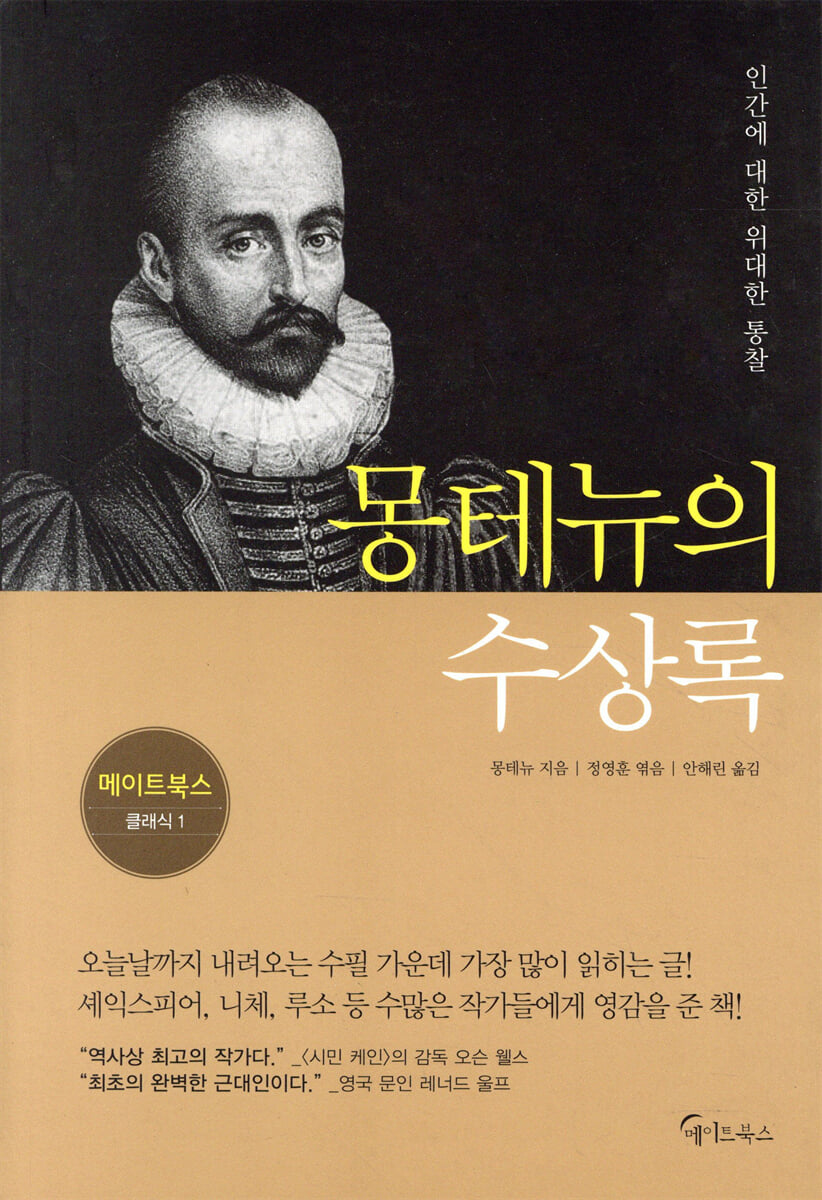
Montaigne's Essays
 |
Description
Book Introduction
Great insight into life, into humanity! The question, 'How should we live?' is not a philosophical conundrum. It is a very everyday question that everyone will inevitably encounter at some point, and perhaps one that will accompany them throughout their lives. But the worries about this are as vague as a small sailboat floating on a vast ocean. Let's listen to the advice of Montaigne, who, even after 500 years, has inspired the lives of many and served as a strong guide in lonely lives. This book contains Montaigne's insights into life and humanity. Montaigne, a French judge, created a unique literary form called the 'essay' to express his views on life after retirement. The book that he published containing his own reflections, opinions, and insights is 『Susangrok』. Originally, this 『Susangrok』 boasts a massive volume consisting of three volumes. I hope that readers will be able to more easily understand Montaigne's thoughts through this book, which has selected some of his most famous quotes and organized them by topic. With a weight that is neither light nor excessive, Montaigne confidently and calmly expresses his views on various topics of world affairs. As you read this book, ask yourself countless questions such as whether your judgment is correct, whether you are living properly now, and how you should live in the future. By thinking about the fundamental and yet fundamental aspects of life, it will be an opportunity to awaken consciousness, reflect on oneself, and learn about life in general. Montaigne, in particular, emphasizes, “Take care of yourself by your own standards, not by those of others.” When we learn how to be ourselves, our lives become richer. This book contains the wisdom of a human being who has lived life fiercely or fully. When you're going through the ups and downs of life, when you're struggling with an unknown lack, when you're afraid of what others think, read this book. You will find appropriate enlightenment and comfort at every turn of life. |
- You can preview some of the book's contents.
Preview
index
Author's Note _ The subject of this book is none other than myself!
Translator's Note: Montaigne's Great Reflections on Human Life and Death
Chapter 1: Accepting Old Age and Death
1.
I'm not afraid even when I hear the word death.
2.
Accept death calmly and peacefully
3.
Death awaits willingly everywhere
4.
Living life and dying at the same time
5.
There is nothing to be surprised about when death comes suddenly.
6.
Whether you live long or short, it's all the same in the face of death.
7.
No one dies without giving his time.
8.
I live with the word death constantly on my lips.
9.
Death does not deviate in the least from the principles of nature.
10.
Dying of old age is rare and unusual.
11.
I don't know where old age will take me.
12.
Avoid mental aging as much as possible.
13.
May death take its place in the comfort and pleasure of my life.
14.
Minimize the time spent aging rather than aging quickly
15.
Death may be the conclusion, but it is not the goal of life.
16.
I'd rather die on a horse than in bed.
17. I don't complain about the natural decline I experience.
Chapter 2: Enjoying the Present Moment
18.
When I dance, I just dance, and when I sleep, I just sleep.
19.
Be content with what you have and live faithfully in the present.
20.
Ignore the present and do not pursue an unknown future.
21.
The desire to forget sharpens memories.
22.
Accept that unhappiness is a part of being human.
23.
I never wished for my destiny to be great.
24.
It matters how I see it.
25.
I only make plans for a maximum of one year.
26.
What good is luck if you can't enjoy it?
27.
I enjoyed life twice as much as others.
Chapter 3: Knowing How to Be Your True Self
28.
I pour all my affection into my soul and myself.
29.
A country knows how to enjoy existence faithfully.
30.
I will live the rest of my life entirely for myself.
31.
Enjoy true freedom and solitude
32.
I believe I exist only within myself.
33.
I trust my judgment, not the judgment of others.
34.
I have never trusted anything but my own opinion.
35.
I am passionate and absorbed in only a few things.
36.
I only care about myself
37.
Rule yourself and have self-respect
38.
I won't sell myself cheap for fame.
39.
You don't enjoy false praise because you know me well.
40.
I don't give a shit about other people's criticism of me.
41.
The freedom I enjoy is unadorned and aloof.
Chapter 4: Always be vigilant and reflect on yourself.
42.
I am most wary of my own two eyes watching me
43.
I often doubt myself and am wary of myself.
44.
I always ask myself if I'm doing something wrong
45.
They apply the same standards to themselves as they apply to others.
46.
My conscience controls me more strongly.
47.
I learn that I am just an idiot.
48.
To live is to think
49.
I don't let anger take over and control me.
50.
I feel my emotions rather than hide them.
51.
The misfortunes of everyday life are never trivial.
52.
Don't live your life swayed by your mood every moment.
53.
Be honest when talking about yourself
Chapter 5: Acquire Knowledge and Make It Your Own
54.
Study to live well and die well
55.
It's not about knowing more, it's about knowing better.
56.
Do not blindly accept the opinions and knowledge of others.
57.
We must absorb the spirit, not the teachings, of the philosophers.
58.
The world is a mirror I must look into to know myself.
59.
Asserting that something is impossible is a rash assumption.
60.
When speaking the truth, speak simply.
61.
The best essential I've found on my life's journey is books.
62.
In debate, honest intentions must be maintained.
Translator's Note: Montaigne's Great Reflections on Human Life and Death
Chapter 1: Accepting Old Age and Death
1.
I'm not afraid even when I hear the word death.
2.
Accept death calmly and peacefully
3.
Death awaits willingly everywhere
4.
Living life and dying at the same time
5.
There is nothing to be surprised about when death comes suddenly.
6.
Whether you live long or short, it's all the same in the face of death.
7.
No one dies without giving his time.
8.
I live with the word death constantly on my lips.
9.
Death does not deviate in the least from the principles of nature.
10.
Dying of old age is rare and unusual.
11.
I don't know where old age will take me.
12.
Avoid mental aging as much as possible.
13.
May death take its place in the comfort and pleasure of my life.
14.
Minimize the time spent aging rather than aging quickly
15.
Death may be the conclusion, but it is not the goal of life.
16.
I'd rather die on a horse than in bed.
17. I don't complain about the natural decline I experience.
Chapter 2: Enjoying the Present Moment
18.
When I dance, I just dance, and when I sleep, I just sleep.
19.
Be content with what you have and live faithfully in the present.
20.
Ignore the present and do not pursue an unknown future.
21.
The desire to forget sharpens memories.
22.
Accept that unhappiness is a part of being human.
23.
I never wished for my destiny to be great.
24.
It matters how I see it.
25.
I only make plans for a maximum of one year.
26.
What good is luck if you can't enjoy it?
27.
I enjoyed life twice as much as others.
Chapter 3: Knowing How to Be Your True Self
28.
I pour all my affection into my soul and myself.
29.
A country knows how to enjoy existence faithfully.
30.
I will live the rest of my life entirely for myself.
31.
Enjoy true freedom and solitude
32.
I believe I exist only within myself.
33.
I trust my judgment, not the judgment of others.
34.
I have never trusted anything but my own opinion.
35.
I am passionate and absorbed in only a few things.
36.
I only care about myself
37.
Rule yourself and have self-respect
38.
I won't sell myself cheap for fame.
39.
You don't enjoy false praise because you know me well.
40.
I don't give a shit about other people's criticism of me.
41.
The freedom I enjoy is unadorned and aloof.
Chapter 4: Always be vigilant and reflect on yourself.
42.
I am most wary of my own two eyes watching me
43.
I often doubt myself and am wary of myself.
44.
I always ask myself if I'm doing something wrong
45.
They apply the same standards to themselves as they apply to others.
46.
My conscience controls me more strongly.
47.
I learn that I am just an idiot.
48.
To live is to think
49.
I don't let anger take over and control me.
50.
I feel my emotions rather than hide them.
51.
The misfortunes of everyday life are never trivial.
52.
Don't live your life swayed by your mood every moment.
53.
Be honest when talking about yourself
Chapter 5: Acquire Knowledge and Make It Your Own
54.
Study to live well and die well
55.
It's not about knowing more, it's about knowing better.
56.
Do not blindly accept the opinions and knowledge of others.
57.
We must absorb the spirit, not the teachings, of the philosophers.
58.
The world is a mirror I must look into to know myself.
59.
Asserting that something is impossible is a rash assumption.
60.
When speaking the truth, speak simply.
61.
The best essential I've found on my life's journey is books.
62.
In debate, honest intentions must be maintained.
Detailed image

Into the book
Let us imagine all the ways death approaches us at every moment.
When a horse stumbles, a tile falls, or a tiny pin pricks you, immediately remind yourself, “Yes, this could have been what death looked like.”
And let's make up our minds and work hard.
Even in moments of celebration and joy, let us always remember this verse and our circumstances, so as not to become too absorbed in our enjoyment.
Sometimes we get caught up in pleasure and forget to remember this phrase.
How many times have we been targeted and threatened with death?
So the Egyptians used to bring the dried skulls of the dead to warn people during large feasts like banquets.
We do not know where death awaits us.
So let us wait for death everywhere.
To think about death in advance is to think about freedom in advance.
Once you learn how to die, you will forget the fear of being helpless to death.
Knowing what death is frees us from all bondage and restraint.
Once you realize that being deprived of life is not harmful, then nothing is harmful in life.
--- pp.22-23
Even if it takes just an hour, if it's something I have to finish before I die, I feel like no matter how much time I make, there just isn't enough time.
One day, someone was going through my notebook and saw a list of things I wanted to happen after I die.
I told him the truth, that although I was only ten li from home, I had no guarantee of getting home safely, so I was in a hurry to write it while I was still healthy and energetic.
Because I constantly hold my thoughts and engrave them on myself, I am always prepared for what happens next.
So, even if death comes suddenly, there is nothing to be surprised about.
We must be ready and equipped to leave as we are at any time.
--- p.27
People say that no matter how splendid the swordsmanship is, it is bound to be defeated in the face of death, because the reality of death far surpasses imagination.
Let them say so.
It is certainly very beneficial to think about death in advance.
Isn't it already a significant accomplishment to have even thought of such a thing, without any change or excitement? Moreover, nature itself reaches out to us, offering us courage.
Because if death is sudden and violent, there is no room to fear it.
If death comes slowly, the more severe my illness becomes, the more I will despise life.
I know that it is harder to digest the resolution of death when I am healthy than when I am sick and suffering.
But when we no longer enjoy or pursue the charms of life, our fear of death decreases significantly.
I hope that the further I get from life and the closer I get to death, the more comfortable I become with the exchange between life and death.
--- pp.33-34
How absurd is it to await this, the rarest of deaths, the decline of vitality due to extreme old age? It's as if death by falling with a broken neck, suffocation in a shipwreck, or the Black Death or pleurisy were unnatural, and we only regard death from old age as natural, as if these events were unthinkable under ordinary circumstances.
Let us not flatter ourselves with these fine words, but let us call only the deaths that are general, common, and universal natural.
It is rare to die of old age.
This death, unique and unusual, is no more natural than any other death.
Death by labor is the last and most extreme way of dying, and it is a death that is not longed for because it is distant.
It is also a boundary we cannot cross, a limit that the laws of nature prohibit us from crossing.
But at the same time, living to old age is a rare privilege granted by nature.
It is a special favor of nature, granted exceptionally to one person every two or three centuries, and relieves him of all the hardships he may experience during his long life.
--- pp.38-39
The mind is so firmly attached to the body, yet it abandons me and constantly pursues the suffering of the body, making me wonder if it might be a traitor.
Flattering and persuading the spirit is useless.
this
In order to persuade the mind not to conspire with the body, he introduced it to Seneca and Catullus, and to the dances of noble ladies and the royal court.
But when his companion develops a stomachache, his mind wanders to him.
It seems like we are both suffering from the same problem.
In times like these, the mind's inherent abilities are not utilized and the body becomes exhausted.
If the body is not happy, the mind cannot feel happy either.
Our teachers were wrong.
They attributed the dazzling leaps of the soul to divine ecstasy, love, warlike fury, poetry, wine, and so on, without considering health.
The joy that once came from strong, vibrant, complete, and stable health can now be found in stillness and stability.
This fire of joy sheds a more intense and brilliant light upon our spirit than it ever did when we were most cheerful and passionately enthusiastic.
--- pp.44-45
Philosophy tells us to always keep death before our eyes and to think about it in advance.
And these foreknowledges and thoughts give us cautions and rules to keep us from hurting ourselves.
This is similar to the behavior of doctors who make us sick to test their medicine and techniques.
It is unjust to teach someone how to die when he does not know how to live, and to distort the end of his life.
If you knew how to live with dignity and peace, you would also know how to die.
Philosophers boast about themselves.
“I have devoted my entire life to studying death.”
But I think death is the conclusion, not the goal of life.
Death is the end and extreme of life, but that does not mean that death is the purpose of life.
Life should be its own purpose and goal, and it should be allowed to make its own decisions and conduct itself.
Knowledge of death is only part of understanding life.
This can be a light element of life, if it doesn't weigh down on the fear of death.
--- pp.53-54
Even when my body collapsed several times, it seemed like the warmth of my spirit was what lifted me up.
To that extent, my mind was cheerful, or calm and stable.
Also, when I had a fever for 4-5 months, my body was completely ruined, but my mind remained cheerful.
When the pain went away, weakness and depression didn't make me sad so much.
There are countless physical ailments whose names alone are frightening, but I am more afraid of the thousands of passions and mental disturbances I actually experience.
So I don't complain about the natural decline I'm experiencing.
And I don't regret that my life isn't as long and strong as an oak tree.
--- p.60
Nature reveals itself, so we just have to operate.
Nature exists in all classes and is revealed even from behind, as if there were no veil.
Do you know how to cultivate your own character? If so, you have done far more than the author of the book.
Do you know how to relax? If so, you have gained more than those who conquered cities and empires.
The greatest masterpiece of humankind is a life lived properly.
All other things, such as governing, amassing wealth, and making plans, are at best incidental and trivial scraps.
There are those in the world who criticize humans for always being preoccupied with the future, and who teach us to cling tightly to the present and settle on it, as if we have not grasped the past and have no intention of grasping the future.
If they dare to call the results of their natural inclinations error, they are committing the most common human error.
Because it instills in us the false idea that we need to correct our actions rather than our minds.
--- pp.66-67
If we would occasionally reflect on ourselves, if we would instead devote the time we spend observing others and grasping external things to exploring ourselves, we would quickly discover how fragile and imperfect we are as human beings.
Isn't our inability to be satisfied with anything, caught up in desires and fantasies, unable to properly choose what we need, proof of our imperfection? This is clearly demonstrated by the highest good, a concept philosophers have long debated.
The debate on this topic is ongoing and will likely continue forever without a consensus.
--- p.71
What we call 'happiness' is simply the absence of 'unhappiness'.
This is in line with the definition of happiness by the philosophical school that most praised pleasure (Epicurean school) as the absence of pain.
As Ennius said, “It is a very happy thing to have no misfortunes at all.” The greatest happiness a human being can hope for is the absence of misfortune.
The excitement and desire that some pleasures provide, that seem to give more than just health and painlessness, is active pleasure.
This active pleasure, so to speak, variable, sharp, and poignant, has only one aim.
It's about avoiding pain.
For example, passion for a woman ultimately leads to pain, which in turn leads to a burning desire.
And this active pleasure called passion demands only that its heat be filled, quenched, or relieved.
The same goes for other desires.
--- p.77
Wealth and poverty depend on the individual's mind.
Neither wealth, nor fame, nor health, possesses any beauty or pleasure beyond the meaning given to it by its possessor.
If you think you are happy, you are happy, and if you think you are unhappy, you are unhappy.
Self-confidence is what is essential and true.
Fate cannot make us happy or unhappy.
It simply gives our souls the materials and seeds to become stronger and to be able to direct and execute as they wish.
Self-will is the sole basis and sovereignty that determines happiness and unhappiness.
External achievements are given flavor and color through internal organization.
Just as when we wear clothes, our body heats up not because the clothes themselves are hot, but because we ourselves radiate heat.
Likewise, when you want to cool your body, you get the cold from within, not from outside.
--- pp.84-85
The wise say that young people should prepare for life and old people should enjoy life.
The biggest mistake they found in us was that our desires were constantly getting younger.
We are constantly starting to live again.
One foot is already in the grave, yet desires and needs continue to resurface. "At the moment of death, one cuts marble, but instead of thinking of erecting it on a grave, one builds a house." I only make plans for a year at most, and I always think about my own death.
I distance myself from every new hope and undertaking, bid farewell to every place I leave, and every day I move a little further away from what I have.
“It has been a long time since I lost or gained anything.
“There is more in store than there is in the road ahead.” --- pp.86-87
I have lived a life well lived for others.
Now, let's live the rest of our lives for ourselves.
Let all our thoughts and intentions be directed toward ourselves and our well-being.
Having your own private space is a huge undertaking, and it can be a bit overwhelming to juggle with other things.
But God has given us time to leave, so let us prepare.
Let's pack our bags and take a break from work.
And let us separate ourselves from others and break free from the violent bonds that bind us.
However strong the bondage, free from the sense of duty, you must now love this or that, but marry only yourself.
In other words, we must relate to everything, but not become so attached or clinging to it that we cannot separate ourselves from it without stripping away or tearing off a part of ourselves.
The greatest thing in the world is to know yourself.
It is time for us to leave society, as we have nothing to contribute to it.
Those who cannot lend something should not borrow it.
As your energy is waning, gather your remaining strength and use it only for yourself.
--- pp.101-102
For those who know how to reflect on themselves and fully immerse themselves in their thoughts, meditation is a complete and powerful practice.
I prefer to train my mind rather than fill it.
There is no task easier or more powerful than keeping your thoughts in line with your spirit.
For great people, 'living' means 'thinking', so they make this their vocation.
Moreover, there is nothing that can be devoted to more for a longer period of time than the contemplation of oneself, and this is a privilege given by nature.
Even things that are easier to do on a daily basis can't be done for that long.
Aristotle said, “Meditation is the work of the gods, and just as we find bliss through meditation, the gods find bliss through meditation.”
--- p.157
If we call creatures or phenomena beyond our comprehension "monsters" or "miracles," how many monsters and miracles constantly appear before our eyes? If we recall how much we groped in the dark to acquire the knowledge we know today, we will realize that the reason our possessions feel familiar is not knowledge, but habit.
“We have seen it so many times that we are sick of it, that no one now looks up to the splendid sky.” If things we already know were to appear before us for the first time, we would find them more surprising than anything else. “If these things were to appear before us for the first time, if they were to appear before us suddenly, we would say that we have never seen anything so wonderful and extraordinary.” When a person who has never seen a river sees a river for the first time, he thinks it is the great ocean.
And I think that as far as I know, that is the maximum that nature can create.
“Even a small river seems enormous to someone who has never seen a larger river.
“It is the same with trees and people, and in everything we consider the biggest thing we see to be enormous.”
When a horse stumbles, a tile falls, or a tiny pin pricks you, immediately remind yourself, “Yes, this could have been what death looked like.”
And let's make up our minds and work hard.
Even in moments of celebration and joy, let us always remember this verse and our circumstances, so as not to become too absorbed in our enjoyment.
Sometimes we get caught up in pleasure and forget to remember this phrase.
How many times have we been targeted and threatened with death?
So the Egyptians used to bring the dried skulls of the dead to warn people during large feasts like banquets.
We do not know where death awaits us.
So let us wait for death everywhere.
To think about death in advance is to think about freedom in advance.
Once you learn how to die, you will forget the fear of being helpless to death.
Knowing what death is frees us from all bondage and restraint.
Once you realize that being deprived of life is not harmful, then nothing is harmful in life.
--- pp.22-23
Even if it takes just an hour, if it's something I have to finish before I die, I feel like no matter how much time I make, there just isn't enough time.
One day, someone was going through my notebook and saw a list of things I wanted to happen after I die.
I told him the truth, that although I was only ten li from home, I had no guarantee of getting home safely, so I was in a hurry to write it while I was still healthy and energetic.
Because I constantly hold my thoughts and engrave them on myself, I am always prepared for what happens next.
So, even if death comes suddenly, there is nothing to be surprised about.
We must be ready and equipped to leave as we are at any time.
--- p.27
People say that no matter how splendid the swordsmanship is, it is bound to be defeated in the face of death, because the reality of death far surpasses imagination.
Let them say so.
It is certainly very beneficial to think about death in advance.
Isn't it already a significant accomplishment to have even thought of such a thing, without any change or excitement? Moreover, nature itself reaches out to us, offering us courage.
Because if death is sudden and violent, there is no room to fear it.
If death comes slowly, the more severe my illness becomes, the more I will despise life.
I know that it is harder to digest the resolution of death when I am healthy than when I am sick and suffering.
But when we no longer enjoy or pursue the charms of life, our fear of death decreases significantly.
I hope that the further I get from life and the closer I get to death, the more comfortable I become with the exchange between life and death.
--- pp.33-34
How absurd is it to await this, the rarest of deaths, the decline of vitality due to extreme old age? It's as if death by falling with a broken neck, suffocation in a shipwreck, or the Black Death or pleurisy were unnatural, and we only regard death from old age as natural, as if these events were unthinkable under ordinary circumstances.
Let us not flatter ourselves with these fine words, but let us call only the deaths that are general, common, and universal natural.
It is rare to die of old age.
This death, unique and unusual, is no more natural than any other death.
Death by labor is the last and most extreme way of dying, and it is a death that is not longed for because it is distant.
It is also a boundary we cannot cross, a limit that the laws of nature prohibit us from crossing.
But at the same time, living to old age is a rare privilege granted by nature.
It is a special favor of nature, granted exceptionally to one person every two or three centuries, and relieves him of all the hardships he may experience during his long life.
--- pp.38-39
The mind is so firmly attached to the body, yet it abandons me and constantly pursues the suffering of the body, making me wonder if it might be a traitor.
Flattering and persuading the spirit is useless.
this
In order to persuade the mind not to conspire with the body, he introduced it to Seneca and Catullus, and to the dances of noble ladies and the royal court.
But when his companion develops a stomachache, his mind wanders to him.
It seems like we are both suffering from the same problem.
In times like these, the mind's inherent abilities are not utilized and the body becomes exhausted.
If the body is not happy, the mind cannot feel happy either.
Our teachers were wrong.
They attributed the dazzling leaps of the soul to divine ecstasy, love, warlike fury, poetry, wine, and so on, without considering health.
The joy that once came from strong, vibrant, complete, and stable health can now be found in stillness and stability.
This fire of joy sheds a more intense and brilliant light upon our spirit than it ever did when we were most cheerful and passionately enthusiastic.
--- pp.44-45
Philosophy tells us to always keep death before our eyes and to think about it in advance.
And these foreknowledges and thoughts give us cautions and rules to keep us from hurting ourselves.
This is similar to the behavior of doctors who make us sick to test their medicine and techniques.
It is unjust to teach someone how to die when he does not know how to live, and to distort the end of his life.
If you knew how to live with dignity and peace, you would also know how to die.
Philosophers boast about themselves.
“I have devoted my entire life to studying death.”
But I think death is the conclusion, not the goal of life.
Death is the end and extreme of life, but that does not mean that death is the purpose of life.
Life should be its own purpose and goal, and it should be allowed to make its own decisions and conduct itself.
Knowledge of death is only part of understanding life.
This can be a light element of life, if it doesn't weigh down on the fear of death.
--- pp.53-54
Even when my body collapsed several times, it seemed like the warmth of my spirit was what lifted me up.
To that extent, my mind was cheerful, or calm and stable.
Also, when I had a fever for 4-5 months, my body was completely ruined, but my mind remained cheerful.
When the pain went away, weakness and depression didn't make me sad so much.
There are countless physical ailments whose names alone are frightening, but I am more afraid of the thousands of passions and mental disturbances I actually experience.
So I don't complain about the natural decline I'm experiencing.
And I don't regret that my life isn't as long and strong as an oak tree.
--- p.60
Nature reveals itself, so we just have to operate.
Nature exists in all classes and is revealed even from behind, as if there were no veil.
Do you know how to cultivate your own character? If so, you have done far more than the author of the book.
Do you know how to relax? If so, you have gained more than those who conquered cities and empires.
The greatest masterpiece of humankind is a life lived properly.
All other things, such as governing, amassing wealth, and making plans, are at best incidental and trivial scraps.
There are those in the world who criticize humans for always being preoccupied with the future, and who teach us to cling tightly to the present and settle on it, as if we have not grasped the past and have no intention of grasping the future.
If they dare to call the results of their natural inclinations error, they are committing the most common human error.
Because it instills in us the false idea that we need to correct our actions rather than our minds.
--- pp.66-67
If we would occasionally reflect on ourselves, if we would instead devote the time we spend observing others and grasping external things to exploring ourselves, we would quickly discover how fragile and imperfect we are as human beings.
Isn't our inability to be satisfied with anything, caught up in desires and fantasies, unable to properly choose what we need, proof of our imperfection? This is clearly demonstrated by the highest good, a concept philosophers have long debated.
The debate on this topic is ongoing and will likely continue forever without a consensus.
--- p.71
What we call 'happiness' is simply the absence of 'unhappiness'.
This is in line with the definition of happiness by the philosophical school that most praised pleasure (Epicurean school) as the absence of pain.
As Ennius said, “It is a very happy thing to have no misfortunes at all.” The greatest happiness a human being can hope for is the absence of misfortune.
The excitement and desire that some pleasures provide, that seem to give more than just health and painlessness, is active pleasure.
This active pleasure, so to speak, variable, sharp, and poignant, has only one aim.
It's about avoiding pain.
For example, passion for a woman ultimately leads to pain, which in turn leads to a burning desire.
And this active pleasure called passion demands only that its heat be filled, quenched, or relieved.
The same goes for other desires.
--- p.77
Wealth and poverty depend on the individual's mind.
Neither wealth, nor fame, nor health, possesses any beauty or pleasure beyond the meaning given to it by its possessor.
If you think you are happy, you are happy, and if you think you are unhappy, you are unhappy.
Self-confidence is what is essential and true.
Fate cannot make us happy or unhappy.
It simply gives our souls the materials and seeds to become stronger and to be able to direct and execute as they wish.
Self-will is the sole basis and sovereignty that determines happiness and unhappiness.
External achievements are given flavor and color through internal organization.
Just as when we wear clothes, our body heats up not because the clothes themselves are hot, but because we ourselves radiate heat.
Likewise, when you want to cool your body, you get the cold from within, not from outside.
--- pp.84-85
The wise say that young people should prepare for life and old people should enjoy life.
The biggest mistake they found in us was that our desires were constantly getting younger.
We are constantly starting to live again.
One foot is already in the grave, yet desires and needs continue to resurface. "At the moment of death, one cuts marble, but instead of thinking of erecting it on a grave, one builds a house." I only make plans for a year at most, and I always think about my own death.
I distance myself from every new hope and undertaking, bid farewell to every place I leave, and every day I move a little further away from what I have.
“It has been a long time since I lost or gained anything.
“There is more in store than there is in the road ahead.” --- pp.86-87
I have lived a life well lived for others.
Now, let's live the rest of our lives for ourselves.
Let all our thoughts and intentions be directed toward ourselves and our well-being.
Having your own private space is a huge undertaking, and it can be a bit overwhelming to juggle with other things.
But God has given us time to leave, so let us prepare.
Let's pack our bags and take a break from work.
And let us separate ourselves from others and break free from the violent bonds that bind us.
However strong the bondage, free from the sense of duty, you must now love this or that, but marry only yourself.
In other words, we must relate to everything, but not become so attached or clinging to it that we cannot separate ourselves from it without stripping away or tearing off a part of ourselves.
The greatest thing in the world is to know yourself.
It is time for us to leave society, as we have nothing to contribute to it.
Those who cannot lend something should not borrow it.
As your energy is waning, gather your remaining strength and use it only for yourself.
--- pp.101-102
For those who know how to reflect on themselves and fully immerse themselves in their thoughts, meditation is a complete and powerful practice.
I prefer to train my mind rather than fill it.
There is no task easier or more powerful than keeping your thoughts in line with your spirit.
For great people, 'living' means 'thinking', so they make this their vocation.
Moreover, there is nothing that can be devoted to more for a longer period of time than the contemplation of oneself, and this is a privilege given by nature.
Even things that are easier to do on a daily basis can't be done for that long.
Aristotle said, “Meditation is the work of the gods, and just as we find bliss through meditation, the gods find bliss through meditation.”
--- p.157
If we call creatures or phenomena beyond our comprehension "monsters" or "miracles," how many monsters and miracles constantly appear before our eyes? If we recall how much we groped in the dark to acquire the knowledge we know today, we will realize that the reason our possessions feel familiar is not knowledge, but habit.
“We have seen it so many times that we are sick of it, that no one now looks up to the splendid sky.” If things we already know were to appear before us for the first time, we would find them more surprising than anything else. “If these things were to appear before us for the first time, if they were to appear before us suddenly, we would say that we have never seen anything so wonderful and extraordinary.” When a person who has never seen a river sees a river for the first time, he thinks it is the great ocean.
And I think that as far as I know, that is the maximum that nature can create.
“Even a small river seems enormous to someone who has never seen a larger river.
“It is the same with trees and people, and in everything we consider the biggest thing we see to be enormous.”
--- pp.188-189
Publisher's Review
Montaigne's advice for a real life!
This book, which contains subjective yet universal concerns about life, is composed of five chapters and covers 62 in-depth concerns.
Chapter 1, “Willingly Accepting Old Age and Death,” reminds us of our destiny to live with both death and life at the same time.
Moreover, fear only grows bigger in our imagination, so I recommend that we live faithfully in the present rather than fearing death that we have not yet faced.
'Because if you are alive, you exist; if you are dead, you are absent.' Death is something beyond our control.
So what we can do is to live fully experiencing every aspect of the life that has been given to us.
Chapter 2, “Enjoying the Present Moment,” advises us to accept that both happy and unhappy moments are part of life.
Do you feel miserable because you have nothing? Do you feel unhappy because you have achieved nothing? Montaigne said, "Nothing is painful or difficult in itself," implying that only our own judgment is essential.
In other words, happiness comes from within, so let's focus on training our minds.
Chapter 3, “Knowing How to Be Your True Self,” tells us to fully enjoy our existence based on our own judgment, not the judgment of others.
It means not wasting yourself in pursuit of fame and wealth, but rather having self-respect and cherishing yourself.
Chapter 4, “Always be wary of and reflect on yourself,” advises not to be overconfident and to always reflect on yourself.
It means that you should apply the same strict standards to yourself that you use to judge others.
Montaigne also tells us to always watch ourselves with our own eyes, not with those of others, and to control ourselves so that we can go on the right path.
The final chapter, Chapter 5, “Acquire Knowledge and Make It Your Own,” emphasizes the depth of knowledge rather than the quantity of knowledge.
It's not how much you know, but how you know that matters.
So, rather than blindly accepting ‘other people’s knowledge,’ we must strive to make it our own through critical acceptance.
I am confident that readers' lives will become even more profound if they take the advice contained in this book to heart and understand Montaigne's thoughts.
This book, which contains subjective yet universal concerns about life, is composed of five chapters and covers 62 in-depth concerns.
Chapter 1, “Willingly Accepting Old Age and Death,” reminds us of our destiny to live with both death and life at the same time.
Moreover, fear only grows bigger in our imagination, so I recommend that we live faithfully in the present rather than fearing death that we have not yet faced.
'Because if you are alive, you exist; if you are dead, you are absent.' Death is something beyond our control.
So what we can do is to live fully experiencing every aspect of the life that has been given to us.
Chapter 2, “Enjoying the Present Moment,” advises us to accept that both happy and unhappy moments are part of life.
Do you feel miserable because you have nothing? Do you feel unhappy because you have achieved nothing? Montaigne said, "Nothing is painful or difficult in itself," implying that only our own judgment is essential.
In other words, happiness comes from within, so let's focus on training our minds.
Chapter 3, “Knowing How to Be Your True Self,” tells us to fully enjoy our existence based on our own judgment, not the judgment of others.
It means not wasting yourself in pursuit of fame and wealth, but rather having self-respect and cherishing yourself.
Chapter 4, “Always be wary of and reflect on yourself,” advises not to be overconfident and to always reflect on yourself.
It means that you should apply the same strict standards to yourself that you use to judge others.
Montaigne also tells us to always watch ourselves with our own eyes, not with those of others, and to control ourselves so that we can go on the right path.
The final chapter, Chapter 5, “Acquire Knowledge and Make It Your Own,” emphasizes the depth of knowledge rather than the quantity of knowledge.
It's not how much you know, but how you know that matters.
So, rather than blindly accepting ‘other people’s knowledge,’ we must strive to make it our own through critical acceptance.
I am confident that readers' lives will become even more profound if they take the advice contained in this book to heart and understand Montaigne's thoughts.
GOODS SPECIFICS
- Date of issue: February 15, 2019
- Page count, weight, size: 200 pages | 282g | 143*210*13mm
- ISBN13: 9791160022117
- ISBN10: 1160022119
You may also like
카테고리
korean


korean

![GQ KOREA Mark (Monthly): December [2025]](http://librairie.coreenne.fr/cdn/shop/files/8ef265dbbfbf186523ed75ba7319009d.jpg?v=1765340328&width=3840)


