

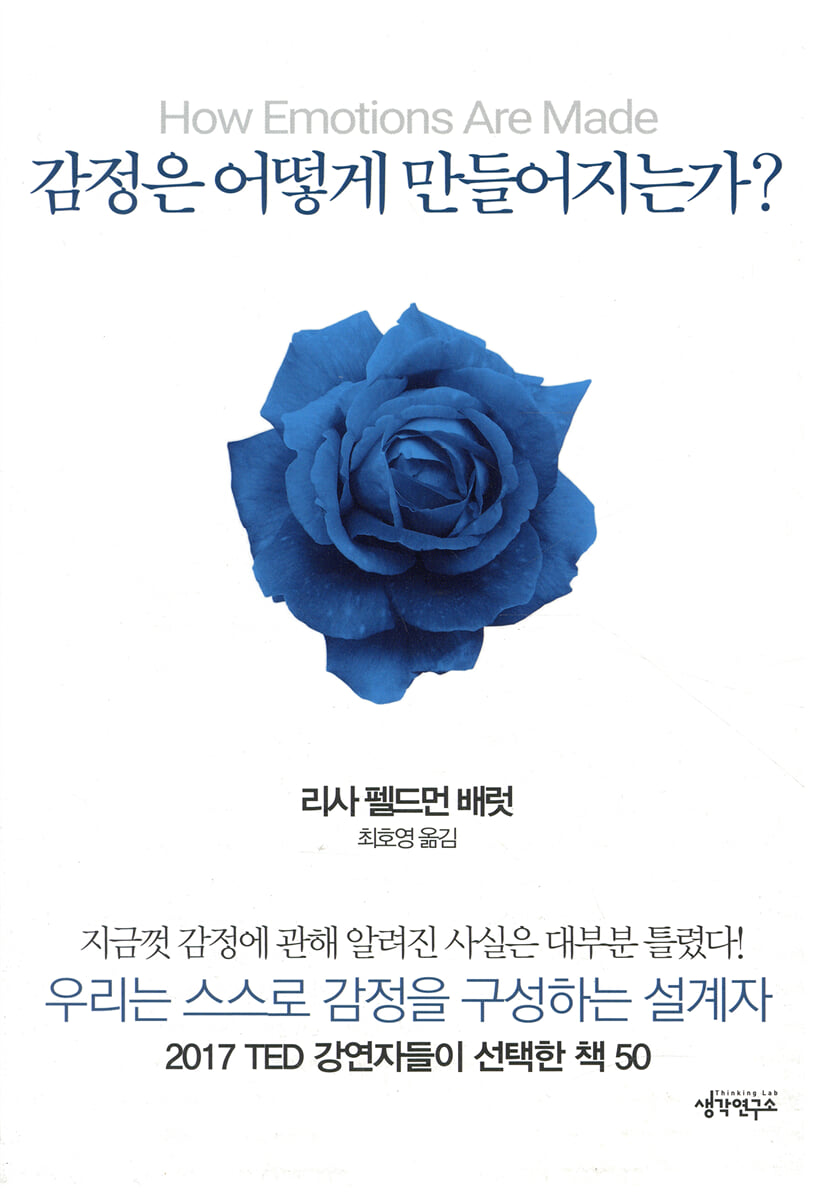
How are emotions created?
 |
Description
Book Introduction
“Why is my sadness different from yours?”
A world-renowned scholar in the fields of psychology and cognitive science
New facts about emotions you never knew before
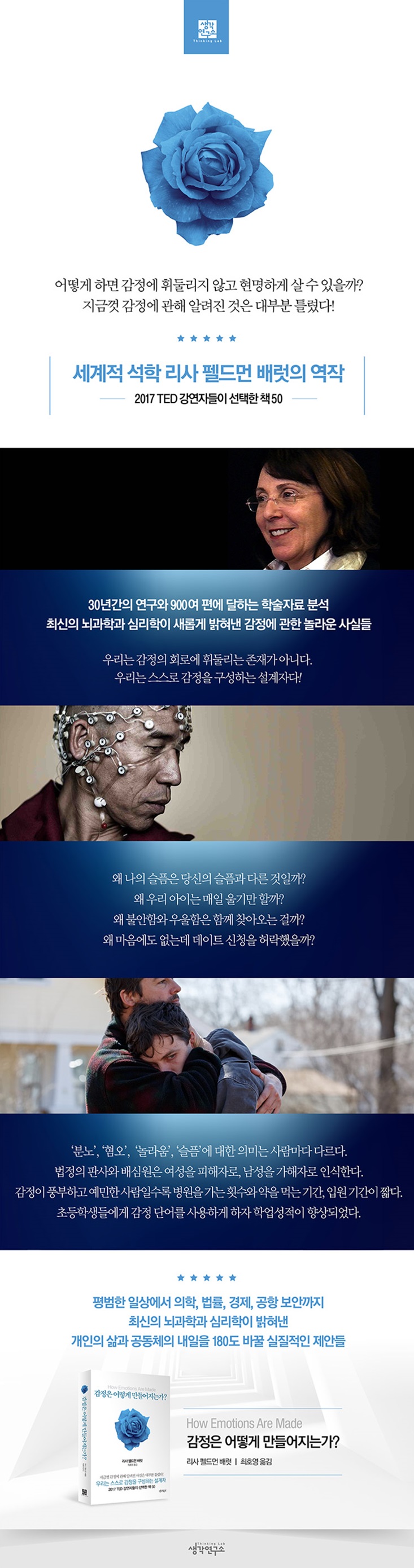
Are emotions universal, and are humans simply swayed by emotions that should be controlled by reason? Lisa Feldman Barrett, a world-renowned expert in psychology and cognitive science, presents research findings from the emerging science of emotions, the mind, and the brain that are not only shifting the paradigm of psychology but also profoundly impacting medicine, the legal system, parenting, meditation, and even airport security. She also presents ways to become true masters of our emotions.
It provides an interesting look at how we can improve our daily lives and social problems.
Professor Lisa Feldman Barrett presents a new theory of emotion: the constructed theory of emotion.
He visited the Himba people of Namibia, far from the Western cultural sphere, and conducted an experiment in which he presented photographs reproducing the six facial expressions of the basic emotion theory and asked them to categorize them by emotion.
As a result, subjects categorized facial movements as actions rather than emotions, such as a smiling face as "laughing" rather than "happy," and a face with wide eyes as "looking" rather than "fearful."
This suggests that there is no universal emotional fingerprint that can be found in all people, but rather that emotions are individual concepts and a set of population thoughts that can be expressed in various ways depending on culture and context.
The author argues that an individual's emotional experience is actively constructed by their actions, and that we are, in a very real sense, designers of our environments and designers of our emotions.
And the concept of emotion exists as a social reality through the collective orientation among people.
When we realize that we are social animals who influence each other's emotions, we can begin to change our tomorrows as masters of our emotions, starting from our ordinary daily lives.
By exploring the brain's mechanisms for constantly predicting and verifying based on past experiences, the book reveals how the brain confuses human free will and what errors it makes when inferring human psychology.
It also offers ways to become a true master of your emotions, drawing on the emerging science of emotions, mind, and brain research that is having a profound impact on medicine, the legal system, parenting, meditation, and even airport security.
A world-renowned scholar in the fields of psychology and cognitive science
New facts about emotions you never knew before
Are emotions universal, and are humans simply swayed by emotions that should be controlled by reason? Lisa Feldman Barrett, a world-renowned expert in psychology and cognitive science, presents research findings from the emerging science of emotions, the mind, and the brain that are not only shifting the paradigm of psychology but also profoundly impacting medicine, the legal system, parenting, meditation, and even airport security. She also presents ways to become true masters of our emotions.
It provides an interesting look at how we can improve our daily lives and social problems.
Professor Lisa Feldman Barrett presents a new theory of emotion: the constructed theory of emotion.
He visited the Himba people of Namibia, far from the Western cultural sphere, and conducted an experiment in which he presented photographs reproducing the six facial expressions of the basic emotion theory and asked them to categorize them by emotion.
As a result, subjects categorized facial movements as actions rather than emotions, such as a smiling face as "laughing" rather than "happy," and a face with wide eyes as "looking" rather than "fearful."
This suggests that there is no universal emotional fingerprint that can be found in all people, but rather that emotions are individual concepts and a set of population thoughts that can be expressed in various ways depending on culture and context.
The author argues that an individual's emotional experience is actively constructed by their actions, and that we are, in a very real sense, designers of our environments and designers of our emotions.
And the concept of emotion exists as a social reality through the collective orientation among people.
When we realize that we are social animals who influence each other's emotions, we can begin to change our tomorrows as masters of our emotions, starting from our ordinary daily lives.
By exploring the brain's mechanisms for constantly predicting and verifying based on past experiences, the book reveals how the brain confuses human free will and what errors it makes when inferring human psychology.
It also offers ways to become a true master of your emotions, drawing on the emerging science of emotions, mind, and brain research that is having a profound impact on medicine, the legal system, parenting, meditation, and even airport security.
- You can preview some of the book's contents.
Preview
index
Recommendation
Entering a 2,000-year-old family
Part 1 What do I feel now?
Chapter 1: Finding the Fingerprint of Emotions
Reading emotions through facial expressions
Reading emotions through the body's state
Analyzing the brain to read emotions
Diversity is the standard
Chapter 2: We Design Our Experiences
Why We Fall in Love in Dramatic Situations
Three Approaches to the Theory of Constructed Emotions
There are no two identical cookies in the world.
Emotions created from our experiences
Chapter 3: The Myth of Universal Emotions
Are happiness and smile the same concept?
Misunderstandings Caused by the Universal Expression Project
The emotions shown on the face are not everything.
Part 2 How are emotions structured?
Chapter 4: The Origin of Feelings
A flying baseball and a predictive brain
Imbalance of emotional and physical energy
A judge who convicted an innocent person
We feel what our brain feels
A rational economist who ruined the economy
You create your world too
Chapter 5: Statistics of Concepts and Words
The ability to create concepts based on context
Creative Statisticians
How do children learn anger?
Pizza Effect
The multiple senses of a man who found a snake
Chapter 6 How Does the Brain Create Emotions?
Baby's predictions are full of errors
The remembered present created by concepts and predictions
A control neural network that eliminates uncertainty and regulates emotions
Emotions are constructs of meaning
Chapter 7: Emotions are a Social Reality
Prerequisites for Civilization: Sharing and Symbols
That's what you and I feel together
We each have our own emotional dictionary.
Seven-color rainbow and six-color rainbow
How New Cultures Survive
Part 3: Emotions Move the World
Chapter 8: A New View of Human Nature
Culture increases the efficiency of evolution.
We're misunderstanding Darwin
Why we can't escape essentialism
Nature, God, and Evolution vs. Environment and Culture
Behaviorism that disrupted psychology
Today's experiences change tomorrow
Chapter 9: A Life Free from Emotions
Lifestyle habits to manage your body budget
Advice for those who struggle with expressing their emotions
Dismantle me and all my senses
Talking like a scientist and a bartender
Your perception is just a guess.
Chapter 10: The Brain's Faulty Predictions Are Ruining My Body
Why do anxiety and depression occur together?
Another name for emotion, stress
Why do I feel pain in my amputated arm?
Depression is not a mental illness.
How are anxiety and depression created?
Unpredictable people
A society plagued by drug addiction
Chapter 11: The Impact of Emotions on Law
Why does the law only punish cold-blooded criminals?
Contradictory judgments handed down to men and women
There is no brain for crime
How do you judge a criminal's conscience?
Jury bias and eyewitness memory distortion
Do fair and just judges exist?
Is emotional bullying guilty or innocent?
Five Tips for a Proper Legal System
Who is responsible for my actions?
Ultimately, even the courts are governed by the senses.
Chapter 12 Do animals get angry too?
Differences between human babies and monkey babies
Absence of goal-based concept formation
Do dogs understand human emotions?
The emotional makeup of dogs we didn't know about
Psychological inference errors about not moving
Reading the minds of animals
Part 4: The Relationship Between Emotions and the Mind
Chapter 13: The Mind Created by the Brain, the Mind Misunderstanding the Brain
A mind created from neural networks
Three modes set in the human mind
Break free from the bonds of certainty
We progress by asking better questions.
Acknowledgements
supplement
Glossary of Key Terms
annotation
References
Translator's Note
Entering a 2,000-year-old family
Part 1 What do I feel now?
Chapter 1: Finding the Fingerprint of Emotions
Reading emotions through facial expressions
Reading emotions through the body's state
Analyzing the brain to read emotions
Diversity is the standard
Chapter 2: We Design Our Experiences
Why We Fall in Love in Dramatic Situations
Three Approaches to the Theory of Constructed Emotions
There are no two identical cookies in the world.
Emotions created from our experiences
Chapter 3: The Myth of Universal Emotions
Are happiness and smile the same concept?
Misunderstandings Caused by the Universal Expression Project
The emotions shown on the face are not everything.
Part 2 How are emotions structured?
Chapter 4: The Origin of Feelings
A flying baseball and a predictive brain
Imbalance of emotional and physical energy
A judge who convicted an innocent person
We feel what our brain feels
A rational economist who ruined the economy
You create your world too
Chapter 5: Statistics of Concepts and Words
The ability to create concepts based on context
Creative Statisticians
How do children learn anger?
Pizza Effect
The multiple senses of a man who found a snake
Chapter 6 How Does the Brain Create Emotions?
Baby's predictions are full of errors
The remembered present created by concepts and predictions
A control neural network that eliminates uncertainty and regulates emotions
Emotions are constructs of meaning
Chapter 7: Emotions are a Social Reality
Prerequisites for Civilization: Sharing and Symbols
That's what you and I feel together
We each have our own emotional dictionary.
Seven-color rainbow and six-color rainbow
How New Cultures Survive
Part 3: Emotions Move the World
Chapter 8: A New View of Human Nature
Culture increases the efficiency of evolution.
We're misunderstanding Darwin
Why we can't escape essentialism
Nature, God, and Evolution vs. Environment and Culture
Behaviorism that disrupted psychology
Today's experiences change tomorrow
Chapter 9: A Life Free from Emotions
Lifestyle habits to manage your body budget
Advice for those who struggle with expressing their emotions
Dismantle me and all my senses
Talking like a scientist and a bartender
Your perception is just a guess.
Chapter 10: The Brain's Faulty Predictions Are Ruining My Body
Why do anxiety and depression occur together?
Another name for emotion, stress
Why do I feel pain in my amputated arm?
Depression is not a mental illness.
How are anxiety and depression created?
Unpredictable people
A society plagued by drug addiction
Chapter 11: The Impact of Emotions on Law
Why does the law only punish cold-blooded criminals?
Contradictory judgments handed down to men and women
There is no brain for crime
How do you judge a criminal's conscience?
Jury bias and eyewitness memory distortion
Do fair and just judges exist?
Is emotional bullying guilty or innocent?
Five Tips for a Proper Legal System
Who is responsible for my actions?
Ultimately, even the courts are governed by the senses.
Chapter 12 Do animals get angry too?
Differences between human babies and monkey babies
Absence of goal-based concept formation
Do dogs understand human emotions?
The emotional makeup of dogs we didn't know about
Psychological inference errors about not moving
Reading the minds of animals
Part 4: The Relationship Between Emotions and the Mind
Chapter 13: The Mind Created by the Brain, the Mind Misunderstanding the Brain
A mind created from neural networks
Three modes set in the human mind
Break free from the bonds of certainty
We progress by asking better questions.
Acknowledgements
supplement
Glossary of Key Terms
annotation
References
Translator's Note
Detailed image
Into the book
What are emotions, really? If we set aside the classical scientific view and simply look at the data, a fundamentally different explanation for emotions emerges.
In short, our emotions are not built-in, but rather built upon more fundamental elements.
Emotions are not universal and vary across cultures.
Emotions are not triggered.
In other words, we create emotions.
Emotions emerge from a combination of your physical characteristics, your flexible brain that develops in close connection with your environment, and the culture and upbringing that correspond to this environment.
---「From the introduction, ‘A Two Thousand Year Old Family’
Although all the people we tested used the same emotion words—like "angry," "sad," and "scared"—to describe their feelings, their meanings weren't always the same.
Some subjects used these words to make very subtle distinctions.
For example, they experienced sadness and fear as qualitatively different.
However, other subjects lumped together words like "sad," "scared," "anxious," and "depressed" to mean "feeling bad."
The same was true for pleasant emotions such as happiness, peace, and pride.
After testing more than 700 American subjects, we found that people vary greatly in how they categorize their emotional experiences.
---From Chapter 1, "Finding the Fingerprint of Emotions"
Simulation is the process by which your brain guesses what is happening in the world.
Every waking moment you are surrounded by a mess of vague information coming in through your eyes, ears, nose, and other sense organs.
At this point, your brain builds a hypothesis (simulation) based on your past experiences and compares this to the dissonance being transmitted through your senses.
In this way, your brain simulates the noise, assigning meaning to it, selecting what's important and ignoring the rest.
---「Chapter 2.
From 'We Design Our Experiences'
We have raised serious questions about the evidence for universal emotions.
These emotions only appear to be universal under certain conditions, namely when people are provided, intentionally or not, with only a very small amount of information about Western concepts of emotion.
And this observation, along with others like it, sets the stage for a new theory of emotions that you will now learn.
---「Chapter 3.
From "The Myth of Universal Emotions"
Simple pleasure and displeasure arise from an ongoing process within you called interoception.
Interoception is your brain's representation of all the sensations that arise from your internal organs and tissues, the hormones in your blood, your immune system, and so on.
Think about what is happening inside your body right now.
Your insides are constantly moving.
Blood sent from the heart flows powerfully through the veins and arteries.
The lungs are constantly filled with air and emptied.
Above, food is being digested.
Through these interoceptive activities, basic feelings such as pleasure and displeasure, calmness and sensitivity, and completely neutral feelings are produced.
---「Chapter 4.
From 'The Origin of Feeling'
A concept is not a fixed definition in your brain.
And concepts are not archetypes that correspond to the most typical or frequent cases.
Instead, your brain has many examples of things like cars, patterns of dots, sadness, etc., and then it instantly brings up similarities between the examples to suit your goals in a given situation.
For example, your usual goal for a vehicle is to use it for transportation, so any object that satisfies your goal is a vehicle, whether it's a car, a helicopter, or even a piece of plywood with four wheels attached.
---「Chapter 5.
From 'Statistics of Concepts and Words'
Let's say a child hears someone say the word "sad" in three different situations.
These three cases are represented piecemeal in this child's brain.
These cases are not specifically 'grouped together' anywhere.
In the fourth situation, the child sees another child crying in the classroom, and the teacher uses the word "sad."
In this child's brain, the previous three instances are constructed as predictions, along with other predictions that are statistically similar in some way to the current situation.
The set of predictions for these three cases is a concept created at this moment based on some purely mental similarities between the 'sadness' cases.
And again, the prediction that most closely resembles the current situation is this child's experience, or in this case, an emotional instance.
---「Chapter 6.
From "How Does the Brain Create Emotions?"
Evolution has endowed the human mind with the ability to create another kind of reality, one that is entirely dependent on the human observer.
We construct sound based on changes in air pressure.
We construct colors based on wavelengths of light.
We create cupcakes and muffins that are indistinguishable from each other except by name, based on a baked dough.
When two people agree that something is real, and give it a name, they create reality.
Every human being with a functioning brain has the potential to perform this little trick, and we use it all the time.
---「Chapter 7.
From 'Emotions are social realities'
As philosopher Thomas Kuhn said in his discussion of the structure of scientific revolutions, “To reject a paradigm without proposing a replacement is to reject science itself.” The resurgence of classical views in the 1960s ultimately consigned half a century of anti-essentialist research to the dustbin of history.
And when we consider how much time and money is wasted today searching for the true nature of emotions that don't even exist, we are all the poorer because of this forgetfulness.
---「Chapter 8.
From "A New View of Human Nature"
Emotional intelligence can be better defined in conceptual terms.
Let's say the only emotional concepts you know are "I feel really good" and "I feel terrible."
Then, every time you experience an emotion or perceive another person's emotion, you will only categorize it with this rough brush.
This kind of person cannot have high emotional intelligence.
On the other hand, if you could discern the nuances of what it means to feel great, and the 50 nuances of what it means to feel awful, your brain would have many more options for predicting, categorizing, and perceiving emotions.
So you'll be equipped with tools to cope more flexibly and effectively.
---「Chapter 9.
From “A Life Not Swayed by Emotions”
Inflammation in your brain is a very bad thing.
This affects your forecasts, especially your body budget management forecasts, and can lead to budget overdrafts.
Remember, your body's budget control circuits are so jammed that they are barely able to hear the corrective requests your body is sending you.
Inflammation moves the needle towards 'complete deadness'.
Your body's budgeting part will become insensitive to your circumstances and continue to overdraw your budget.
Then you may feel tired and uncomfortable.
A chronic budget deficit depletes your resources, wears out your body, and ultimately increases pro-inflammatory cytokines.
If that happens, you're really, really in trouble.
---「Chapter 10.
From 'The brain's wrong predictions are ruining my body'
The American legal system assumes that emotions are part of our so-called animal nature and, if not controlled by rational thought, can lead to foolish and even violent behavior.
Centuries ago, lawyers concluded that people sometimes commit murder when they are angry because they haven't yet "cooled down" and their anger explodes spontaneously.
Anger boils over and explodes, leaving a trail of destruction in its wake.
When you are angry, you are less responsible for your actions because you cannot bring your actions into line with the law.
This argument is called the "argument from excitement."
---「Chapter 11.
From 'The Influence of Emotions on Law'
The question, “When a dog growls, is it angry?” is the wrong question to ask.
Or at least it is an incomplete question.
This question assumes that in some objective sense the dog is either more or less angry.
But as you've learned, emotion categories don't have consistent biological fingerprints.
Emotions are always constructed from the perspective of several perceivers.
So the question, “Is Rowdy angry?” is actually two separate scientific questions.
“Is Rowdy angry from the boy’s perspective?”, “Is Rowdy angry from Rowdy’s own perspective?” ---「Chapter 12.
From "Do Animals Get Angry?"
Like most major paradigm shifts in science, this scientific revolution has the potential to fundamentally change our health, our laws, and who we are.
This is the potential to create a new reality.
If this book has brought you to the realization that you are the architect of your experience (and the experiences of those around you), then we are shaping this new reality together.
In short, our emotions are not built-in, but rather built upon more fundamental elements.
Emotions are not universal and vary across cultures.
Emotions are not triggered.
In other words, we create emotions.
Emotions emerge from a combination of your physical characteristics, your flexible brain that develops in close connection with your environment, and the culture and upbringing that correspond to this environment.
---「From the introduction, ‘A Two Thousand Year Old Family’
Although all the people we tested used the same emotion words—like "angry," "sad," and "scared"—to describe their feelings, their meanings weren't always the same.
Some subjects used these words to make very subtle distinctions.
For example, they experienced sadness and fear as qualitatively different.
However, other subjects lumped together words like "sad," "scared," "anxious," and "depressed" to mean "feeling bad."
The same was true for pleasant emotions such as happiness, peace, and pride.
After testing more than 700 American subjects, we found that people vary greatly in how they categorize their emotional experiences.
---From Chapter 1, "Finding the Fingerprint of Emotions"
Simulation is the process by which your brain guesses what is happening in the world.
Every waking moment you are surrounded by a mess of vague information coming in through your eyes, ears, nose, and other sense organs.
At this point, your brain builds a hypothesis (simulation) based on your past experiences and compares this to the dissonance being transmitted through your senses.
In this way, your brain simulates the noise, assigning meaning to it, selecting what's important and ignoring the rest.
---「Chapter 2.
From 'We Design Our Experiences'
We have raised serious questions about the evidence for universal emotions.
These emotions only appear to be universal under certain conditions, namely when people are provided, intentionally or not, with only a very small amount of information about Western concepts of emotion.
And this observation, along with others like it, sets the stage for a new theory of emotions that you will now learn.
---「Chapter 3.
From "The Myth of Universal Emotions"
Simple pleasure and displeasure arise from an ongoing process within you called interoception.
Interoception is your brain's representation of all the sensations that arise from your internal organs and tissues, the hormones in your blood, your immune system, and so on.
Think about what is happening inside your body right now.
Your insides are constantly moving.
Blood sent from the heart flows powerfully through the veins and arteries.
The lungs are constantly filled with air and emptied.
Above, food is being digested.
Through these interoceptive activities, basic feelings such as pleasure and displeasure, calmness and sensitivity, and completely neutral feelings are produced.
---「Chapter 4.
From 'The Origin of Feeling'
A concept is not a fixed definition in your brain.
And concepts are not archetypes that correspond to the most typical or frequent cases.
Instead, your brain has many examples of things like cars, patterns of dots, sadness, etc., and then it instantly brings up similarities between the examples to suit your goals in a given situation.
For example, your usual goal for a vehicle is to use it for transportation, so any object that satisfies your goal is a vehicle, whether it's a car, a helicopter, or even a piece of plywood with four wheels attached.
---「Chapter 5.
From 'Statistics of Concepts and Words'
Let's say a child hears someone say the word "sad" in three different situations.
These three cases are represented piecemeal in this child's brain.
These cases are not specifically 'grouped together' anywhere.
In the fourth situation, the child sees another child crying in the classroom, and the teacher uses the word "sad."
In this child's brain, the previous three instances are constructed as predictions, along with other predictions that are statistically similar in some way to the current situation.
The set of predictions for these three cases is a concept created at this moment based on some purely mental similarities between the 'sadness' cases.
And again, the prediction that most closely resembles the current situation is this child's experience, or in this case, an emotional instance.
---「Chapter 6.
From "How Does the Brain Create Emotions?"
Evolution has endowed the human mind with the ability to create another kind of reality, one that is entirely dependent on the human observer.
We construct sound based on changes in air pressure.
We construct colors based on wavelengths of light.
We create cupcakes and muffins that are indistinguishable from each other except by name, based on a baked dough.
When two people agree that something is real, and give it a name, they create reality.
Every human being with a functioning brain has the potential to perform this little trick, and we use it all the time.
---「Chapter 7.
From 'Emotions are social realities'
As philosopher Thomas Kuhn said in his discussion of the structure of scientific revolutions, “To reject a paradigm without proposing a replacement is to reject science itself.” The resurgence of classical views in the 1960s ultimately consigned half a century of anti-essentialist research to the dustbin of history.
And when we consider how much time and money is wasted today searching for the true nature of emotions that don't even exist, we are all the poorer because of this forgetfulness.
---「Chapter 8.
From "A New View of Human Nature"
Emotional intelligence can be better defined in conceptual terms.
Let's say the only emotional concepts you know are "I feel really good" and "I feel terrible."
Then, every time you experience an emotion or perceive another person's emotion, you will only categorize it with this rough brush.
This kind of person cannot have high emotional intelligence.
On the other hand, if you could discern the nuances of what it means to feel great, and the 50 nuances of what it means to feel awful, your brain would have many more options for predicting, categorizing, and perceiving emotions.
So you'll be equipped with tools to cope more flexibly and effectively.
---「Chapter 9.
From “A Life Not Swayed by Emotions”
Inflammation in your brain is a very bad thing.
This affects your forecasts, especially your body budget management forecasts, and can lead to budget overdrafts.
Remember, your body's budget control circuits are so jammed that they are barely able to hear the corrective requests your body is sending you.
Inflammation moves the needle towards 'complete deadness'.
Your body's budgeting part will become insensitive to your circumstances and continue to overdraw your budget.
Then you may feel tired and uncomfortable.
A chronic budget deficit depletes your resources, wears out your body, and ultimately increases pro-inflammatory cytokines.
If that happens, you're really, really in trouble.
---「Chapter 10.
From 'The brain's wrong predictions are ruining my body'
The American legal system assumes that emotions are part of our so-called animal nature and, if not controlled by rational thought, can lead to foolish and even violent behavior.
Centuries ago, lawyers concluded that people sometimes commit murder when they are angry because they haven't yet "cooled down" and their anger explodes spontaneously.
Anger boils over and explodes, leaving a trail of destruction in its wake.
When you are angry, you are less responsible for your actions because you cannot bring your actions into line with the law.
This argument is called the "argument from excitement."
---「Chapter 11.
From 'The Influence of Emotions on Law'
The question, “When a dog growls, is it angry?” is the wrong question to ask.
Or at least it is an incomplete question.
This question assumes that in some objective sense the dog is either more or less angry.
But as you've learned, emotion categories don't have consistent biological fingerprints.
Emotions are always constructed from the perspective of several perceivers.
So the question, “Is Rowdy angry?” is actually two separate scientific questions.
“Is Rowdy angry from the boy’s perspective?”, “Is Rowdy angry from Rowdy’s own perspective?” ---「Chapter 12.
From "Do Animals Get Angry?"
Like most major paradigm shifts in science, this scientific revolution has the potential to fundamentally change our health, our laws, and who we are.
This is the potential to create a new reality.
If this book has brought you to the realization that you are the architect of your experience (and the experiences of those around you), then we are shaping this new reality together.
---「Chapter 13.
From 'The Mind Created by the Brain, the Mind That Misunderstands the Brain'
From 'The Mind Created by the Brain, the Mind That Misunderstands the Brain'
Publisher's Review
“Most of what we know about emotions is wrong!”
A revolutionary theory of emotions, based on 30 years of research and analysis of over 900 academic papers.
Professor Lisa Feldman Barrett presents a new theory of emotion: the constructed theory of emotion.
He visited the Himba people of Namibia, far from the Western cultural sphere, and conducted an experiment in which he presented photographs reproducing the six facial expressions of the basic emotion theory and asked them to categorize them by emotion.
As a result, subjects categorized facial movements as actions rather than emotions, such as a smiling face as "laughing" rather than "happy," and a face with wide eyes as "looking" rather than "fearful."
This suggests that there is no universal emotional fingerprint that can be found across all people, but rather that emotions are individual concepts and a set of population thoughts that can be expressed in various ways depending on culture and context.
“We are the designers of our own emotions.”
The brain's mechanism of constantly predicting and verifying based on past experiences
We can only feel emotions when we understand the concept of emotions.
Here is an example that makes it easier to understand the process by which the concept of emotion is formed.
This is an examination of the process by which a newborn baby, with no prior experience, learns emotions.
When parents respond with “Are you angry?” or “Don’t be angry” when their children cry, spit out food, or hit someone because they feel bad, the children statistically learn the emotion of “anger” by associating their actions with their parents’ words.
That is, the concept of learning and creating emotions through the word 'anger' through various physical changes and contexts.
“Today’s experiences change tomorrow.”
From everyday life to medicine, law, economics, and airport security.
Practical suggestions for emotional resilience that will transform individual lives and the future of our communities.
The author argues that an individual's emotional experience is actively constructed by their actions, and that we are, in a very real sense, designers of our environments and designers of our emotions.
And the concept of emotion exists as a social reality through the collective orientation among people.
When we realize that we are social animals who influence each other's emotions, we can begin to change our tomorrows as masters of our emotions, starting from our ordinary daily lives.
By exploring the brain's mechanisms for constantly predicting and verifying based on past experiences, the book reveals how the brain confuses human free will and what errors it makes when inferring human psychology.
It also offers ways to become a true master of your emotions, drawing on the emerging science of emotions, mind, and brain research that is having a profound impact on medicine, the legal system, parenting, meditation, and even airport security.
A revolutionary theory of emotions, based on 30 years of research and analysis of over 900 academic papers.
Professor Lisa Feldman Barrett presents a new theory of emotion: the constructed theory of emotion.
He visited the Himba people of Namibia, far from the Western cultural sphere, and conducted an experiment in which he presented photographs reproducing the six facial expressions of the basic emotion theory and asked them to categorize them by emotion.
As a result, subjects categorized facial movements as actions rather than emotions, such as a smiling face as "laughing" rather than "happy," and a face with wide eyes as "looking" rather than "fearful."
This suggests that there is no universal emotional fingerprint that can be found across all people, but rather that emotions are individual concepts and a set of population thoughts that can be expressed in various ways depending on culture and context.
“We are the designers of our own emotions.”
The brain's mechanism of constantly predicting and verifying based on past experiences
We can only feel emotions when we understand the concept of emotions.
Here is an example that makes it easier to understand the process by which the concept of emotion is formed.
This is an examination of the process by which a newborn baby, with no prior experience, learns emotions.
When parents respond with “Are you angry?” or “Don’t be angry” when their children cry, spit out food, or hit someone because they feel bad, the children statistically learn the emotion of “anger” by associating their actions with their parents’ words.
That is, the concept of learning and creating emotions through the word 'anger' through various physical changes and contexts.
“Today’s experiences change tomorrow.”
From everyday life to medicine, law, economics, and airport security.
Practical suggestions for emotional resilience that will transform individual lives and the future of our communities.
The author argues that an individual's emotional experience is actively constructed by their actions, and that we are, in a very real sense, designers of our environments and designers of our emotions.
And the concept of emotion exists as a social reality through the collective orientation among people.
When we realize that we are social animals who influence each other's emotions, we can begin to change our tomorrows as masters of our emotions, starting from our ordinary daily lives.
By exploring the brain's mechanisms for constantly predicting and verifying based on past experiences, the book reveals how the brain confuses human free will and what errors it makes when inferring human psychology.
It also offers ways to become a true master of your emotions, drawing on the emerging science of emotions, mind, and brain research that is having a profound impact on medicine, the legal system, parenting, meditation, and even airport security.
GOODS SPECIFICS
- Date of publication: September 25, 2017
- Page count, weight, size: 320 pages | 844g | 150*220*30mm
- ISBN13: 9791188096428
- ISBN10: 1188096427
You may also like
카테고리
korean


korean

![ELLE 엘르 스페셜 에디션 A형 : 12월 [2025]](http://librairie.coreenne.fr/cdn/shop/files/b8e27a3de6c9538896439686c6b0e8fb.jpg?v=1766436872&width=3840)


