

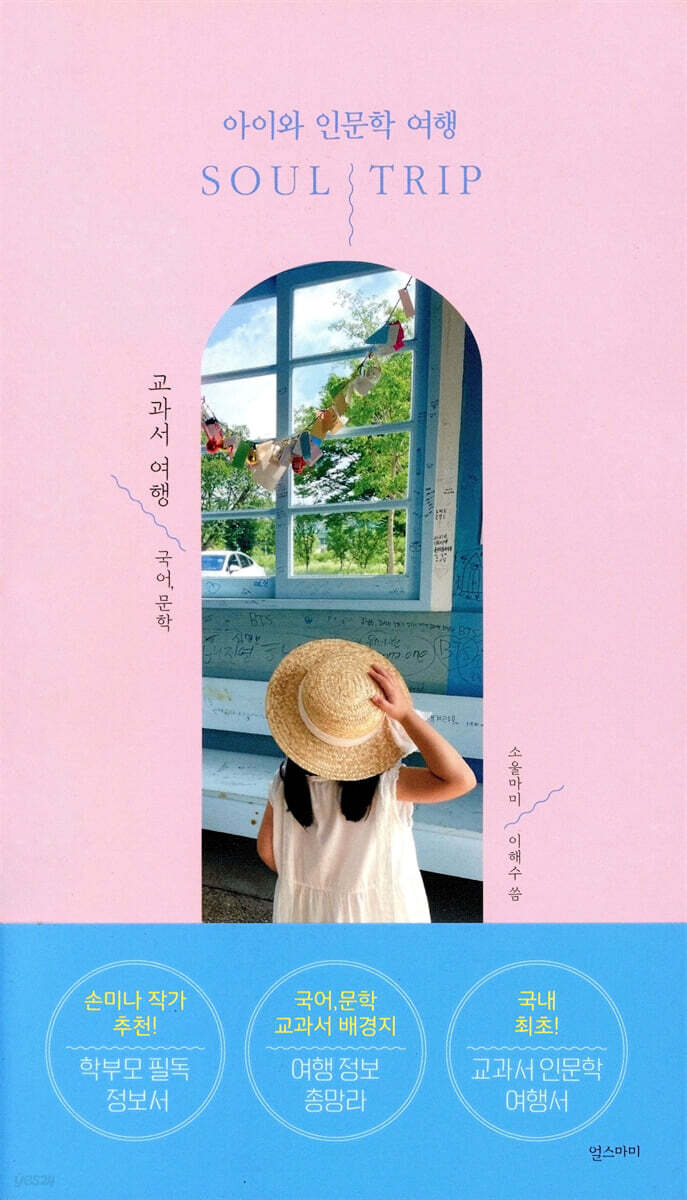
Soul Trip Textbook Travel: Korean Language, Literature
 |
Description
Book Introduction
Couldn't we experience the content in textbooks more vividly? Are there any experiential learning experiences that even mothers can find healing? The "Soul Trip - Textbook Journey" series began with these questions.
It follows the travel destinations in the textbook, but it also includes the author's humanistic insights, the stories behind the travel destinations, and the story of a mother who raised her child through travel.
『Soul Trip - Textbook Travel』 is a 'textbook humanities travel book' that combines three books: a humanities parenting book, a textbook travel guidebook, and a parenting essay.
Volume 1 of 『Soul Trip - Textbook Travel』 is about Korean language and literature.
First, 'Read to Your Child Before You Go' provides information that will help your child easily understand textbook works before leaving on a trip.
Then, in 'Textbook Spot', travel information about the backgrounds of textbook works is introduced, and in 'Soul Spot', humanistic thoughts are presented that can be shared while experiencing healing with children during travel.
This book allows children to travel through beautiful textbook backgrounds while simultaneously experiencing humanistic insights.
It follows the travel destinations in the textbook, but it also includes the author's humanistic insights, the stories behind the travel destinations, and the story of a mother who raised her child through travel.
『Soul Trip - Textbook Travel』 is a 'textbook humanities travel book' that combines three books: a humanities parenting book, a textbook travel guidebook, and a parenting essay.
Volume 1 of 『Soul Trip - Textbook Travel』 is about Korean language and literature.
First, 'Read to Your Child Before You Go' provides information that will help your child easily understand textbook works before leaving on a trip.
Then, in 'Textbook Spot', travel information about the backgrounds of textbook works is introduced, and in 'Soul Spot', humanistic thoughts are presented that can be shared while experiencing healing with children during travel.
This book allows children to travel through beautiful textbook backgrounds while simultaneously experiencing humanistic insights.
- You can preview some of the book's contents.
Preview
index
10 Reasons Why You Should Leave Your Child
Abundance, Hadong
Land (Park Kyung-ni) 27
#Land Stage 31
Seomjin River 1 (Kim Yong-taek) 33
#The most Seomjin River-like Seomjin River 36
Soul Spot...Space, Wall 38
Healing, Yangpyeong
Shower (Hwang Sun-won) 53
#Sonagi Village 57
#The scent of an old study 59
Soul Spot...White House on the Hill 61
Walking, Seoul
A Day in the Life of Novelist Gu Bo (Park Tae-won) 77
#Gubo's Route 81
Azalea (Kim So-wol) 83
#Jeongdong-gil School Street 85
Soul Spot...City Art Museum, Le Pool 89
Lonely, Namhae
Seopomanpil (Kim Manjung) 108
#Exiled Writers 112
Nanjung Ilgi (Yi Sun-sin), Song of the Sword (Kim Hoon) 114
#117 where the big star is locked
Soul Spot...Benny 119 in the Greenhouse
Yesterday, Gunsan
Christmas in August (Heo Jin-ho) 131
#ThatPhotoStudio132
#Crimson Letters Engraved in the Sea 135
Readymade Life (Chae Man-sik) 137
#Pretty Scars 139
Back, Gochang
At Seonunsa Temple (Choi Young-mi) 149
#ThatFlower,Flowerpot 151
Grandmother's Backyard Veranda (Seo Jeong-ju) 153
#The Aesthetics of Native Language 156
Soul Spot...Farmer's Village 158
Romance, Chuncheon
#First Gateway to Meeting Kim Yoo-jung 169
Bom Bom (Kim Yu-jeong) 171
#BomBom, Camellia Village 174
#Romance of a Simple Station 176
Soul Spot...Santorini 178
Emptiness, Cheongju
Chojeongri Letter (Bae Yu-an) 189
#WhereRabbitEyeGrandpaStayed 192
#Where Kings Rested 194
Abundance, Hadong
Land (Park Kyung-ni) 27
#Land Stage 31
Seomjin River 1 (Kim Yong-taek) 33
#The most Seomjin River-like Seomjin River 36
Soul Spot...Space, Wall 38
Healing, Yangpyeong
Shower (Hwang Sun-won) 53
#Sonagi Village 57
#The scent of an old study 59
Soul Spot...White House on the Hill 61
Walking, Seoul
A Day in the Life of Novelist Gu Bo (Park Tae-won) 77
#Gubo's Route 81
Azalea (Kim So-wol) 83
#Jeongdong-gil School Street 85
Soul Spot...City Art Museum, Le Pool 89
Lonely, Namhae
Seopomanpil (Kim Manjung) 108
#Exiled Writers 112
Nanjung Ilgi (Yi Sun-sin), Song of the Sword (Kim Hoon) 114
#117 where the big star is locked
Soul Spot...Benny 119 in the Greenhouse
Yesterday, Gunsan
Christmas in August (Heo Jin-ho) 131
#ThatPhotoStudio132
#Crimson Letters Engraved in the Sea 135
Readymade Life (Chae Man-sik) 137
#Pretty Scars 139
Back, Gochang
At Seonunsa Temple (Choi Young-mi) 149
#ThatFlower,Flowerpot 151
Grandmother's Backyard Veranda (Seo Jeong-ju) 153
#The Aesthetics of Native Language 156
Soul Spot...Farmer's Village 158
Romance, Chuncheon
#First Gateway to Meeting Kim Yoo-jung 169
Bom Bom (Kim Yu-jeong) 171
#BomBom, Camellia Village 174
#Romance of a Simple Station 176
Soul Spot...Santorini 178
Emptiness, Cheongju
Chojeongri Letter (Bae Yu-an) 189
#WhereRabbitEyeGrandpaStayed 192
#Where Kings Rested 194
Detailed image

Into the book
In psychology, it is said that "travel increases emotional intelligence."
By observing others expressing their emotions strongly, we can learn to interpret and understand their emotions.
As your overall understanding of emotions increases, you will naturally begin to think about how to regulate your own emotions and deal with the emotions of others, and your skills in this area will improve.
This is the part where you nod your head as to why children's EQ cannot help but rise through travel.
--- p.14
In this way, the child thought long and hard about the events he encountered during his travels and stayed in those memories.
And when I returned from my trip, it had grown by an inch without fail.
It was only then that I realized.
And I was able to speak with confidence.
Travel is the best humanities lesson, and you have to hold my hand and go, and the more you go, the better.
--- p.15
A place where you can walk along the Seomjin River while holding your child's hand, then sit comfortably on a bench and gaze at the river's waters.
A place where you can sit there, look towards Jeolla-do, and tell your child that over there is Jeolla-do, and this is Gyeongsang-do.
And if you turn your body and walk just a few steps, you will find yourself in a vast pine forest.
This is a precious spot where you can take in a 260-year-old pine tree, white sand beach, and Seomjin River at a glance.
--- p.38
"Mom, Hadong seems to have a lot of green."
That's right.
The greenery of Jirisan Mountain, the lush, lush rice fields of Pyeongsa-ri, and even the picturesque tea fields.
Hadong was a city of vitality.
Hadong, a city of rugged terrain and rich history, and the Seomjin River, which flows with many stories.
My child and I come here to recharge our vitality.
It returns with the power of the old as inspiration and muscle.
The rain cleared up on the morning of the day I left Hadong.
I saw a pale rainbow beyond the clean, private Jirisan Mountains.
I ran north, past the rainbow, along the Seomjin River.
It felt like Sarah Vaughan's "Over the rainbow" was flowing.
--- p.47
There, there was no need for the masks we wore in the city, the cell phones that rang out loud, or the watches we checked every 15 minutes.
I would just open my eyes, cook rice, mix side dishes with seasonal vegetables that the grandmother next door picked from her garden, and make stew.
In spring, I cherished the flowers blooming in the stream, and in summer, I filled the yard pool with water every day.
In the fall, I would go out to the rice paddy in front of my house and watch the farmers harvesting their crops, and in the winter, I would bury my feet under the blanket and roast sweet potatoes over the brazier.
It was a beautiful day, whether it was clear or not, whether it rained or not.
--- p.65
Serendipity.
It means an unexpected discovery, an unintended discovery, or a lucky discovery.
Yangpyeong, a pastoral village that served as the setting for one of the most pure and clear works in our literature.
Was it serendipity that a friend found a house in that beautiful town, and then entrusted it to me, who was prevented from entering the country due to COVID-19 and was suffering from burnout?
Whether it was coincidence or fate, the important thing is that serendipity comes when we need it most.
And it means going to the person who can boldly seize that moment.
--- p.70
The philosopher and poet Friedrich Nietzsche walked for one hour in the morning and three hours in the afternoon.
There were times when I walked for eight hours a day.
He, who continued this lifestyle for 10 years and wrote great works, said, "Only ideas conceived in walking have value."
The road is like a magic door that opens up thoughts.
This is especially true in a city like Seoul, where it is difficult to take your eyes off of it for even a moment, and even more so in the heart of Gyeongseong, which was once bustling with the wave of modernity.
--- p.78
Modern Joseon was divided into two parts based on the Gyeongseongbucheong (Seoul City Hall).
If you go towards Myeongdong, you will find many cafes and tea houses that have brought about the splendid modern culture (Mr. Gubo also writes while drinking tea (coffee) at the first tea house, Nakrangpara, located in Sogong-dong). If you go up along Deoksugung-gil, you will come across Jeongdong-gil, which was called ‘School Road.’
If you go up the hill with Jeongdong Church on your right, you will find the remains of Baejae High School, which Kim So-wol attended.
--- p.87
As soon as the door opens, I order a chicken panini and coffee and look around the brick house that was a Western restaurant 100 years ago.
I can almost hear the laughter of modern girls enjoying Western food and tea.
In this fast-paced era where hot spots appear and disappear overnight, enjoying these old-time restaurants that show off their value enriches our daily lives.
Owning the aura and story created over time.
It gives us the strength to work hard at something we love for a long time, to love someone for a long time, to laugh with our children every day without getting tired, and thus to affirm our own existence as it is.
It tells me that I can stay the way I am for a long time.
--- p.95
Yi Sun-sin, who was evaluated as a near-perfect general in the military, was also an outstanding leader.
He created an atmosphere where soldiers could demonstrate their abilities even on the battlefield where life and death were at stake, and he often showed his benevolence by paying back soldiers who stole from the people.
The soldiers also held Admiral Yi Sun-sin in awe, and even when supplies were extremely scarce, they rushed into the battlefield, saying, "It's worth a try if I'm with Yi Sun-sin."
Because of such soldiers, the Joseon navy was able to remain a legend.
Examining the insights of those who changed history provides a resonant guide for both children and parents.
--- p.117
This small, temporary station, which is approaching 100 years old, still stands beautifully, preserving the typical architectural style of small, temporary stations in rural areas at the time.
As I looked around the place with my child, I hoped that even though it had a painful history, it would stay there for a long time.
So that my child's child can also know and feel the past of his parents' parents' parents.
--- p.142
“The destination is not only in the destination.
"The laughter that blooms between the hands I hold, the sound of your words that scatter through the clouds, there is a destination in that time that I want to hold on to."
--- p.146
Love fades easily, despair suddenly strikes, and autumn approaches quickly.
The moment when a flower, which has sprouted with difficulty, raised its buds with great effort, blooms magnificently and is in full bloom, falls is a moment.
When I was living in the countryside due to burnout, I had a hydrangea that I treasured.
The feeling of loss when I picked it up on my morning walk, made lunch, and went out to find it withered.
The poet would have focused on the finiteness of nature and the parallel theory of human history.
Perhaps the flower the poet who wrote this poem at Seonunsa Temple saw wasn't a spring flower, but this one? This is the flower that paints Seonunsa Temple in autumn crimson.
--- p.152
Gochang in autumn was in the back alley.
One poet sang of the sorrow of falling flowers, and another sang of the warm embrace of his grandmother, a woman who had withered and wrinkled.
Those things that fall, turn around, and are in the back alley have an invisible force.
The fallen flowers wither away, carrying with them the warm memories of those glorious days.
My grandmother, who has lost her luster and has become wrinkled, showers me with love without even realizing that I am withering away.
I told the child that there was such power in the things in the back alley, and that there was nobility in sacrifice.
About the value that children will one day know, admire, and cherish.
--- p.163
When you go here, the romance of train travel that you longed for remains intact.
Memories of waiting for the train in a small waiting room, blowing on my frozen hands, memories of crossing the tracks at the train attendant's beckoning when the train passed, the harsh wind at the moment the train came in, the sea passing by outside the window, the taste of a particularly sweet cup of coffee, the strong movement of wheels I saw on my way to and from the restroom.
--- p.178
I sat with my child in the hot springs of Chojeong-ri, where Sejong had briefly rested from his fatigue.
Sejong may have been relying on his body there, but his brain and heart must have been working tirelessly.
It is the law that you must empty yourself to be filled.
I surrendered my mind to the warm energy of the hot springs that penetrated my lower body.
Cheongju, seen from there, was indeed clear and pure, worthy of being chosen by kings.
It would have been better to just stay like that and do nothing.
By observing others expressing their emotions strongly, we can learn to interpret and understand their emotions.
As your overall understanding of emotions increases, you will naturally begin to think about how to regulate your own emotions and deal with the emotions of others, and your skills in this area will improve.
This is the part where you nod your head as to why children's EQ cannot help but rise through travel.
--- p.14
In this way, the child thought long and hard about the events he encountered during his travels and stayed in those memories.
And when I returned from my trip, it had grown by an inch without fail.
It was only then that I realized.
And I was able to speak with confidence.
Travel is the best humanities lesson, and you have to hold my hand and go, and the more you go, the better.
--- p.15
A place where you can walk along the Seomjin River while holding your child's hand, then sit comfortably on a bench and gaze at the river's waters.
A place where you can sit there, look towards Jeolla-do, and tell your child that over there is Jeolla-do, and this is Gyeongsang-do.
And if you turn your body and walk just a few steps, you will find yourself in a vast pine forest.
This is a precious spot where you can take in a 260-year-old pine tree, white sand beach, and Seomjin River at a glance.
--- p.38
"Mom, Hadong seems to have a lot of green."
That's right.
The greenery of Jirisan Mountain, the lush, lush rice fields of Pyeongsa-ri, and even the picturesque tea fields.
Hadong was a city of vitality.
Hadong, a city of rugged terrain and rich history, and the Seomjin River, which flows with many stories.
My child and I come here to recharge our vitality.
It returns with the power of the old as inspiration and muscle.
The rain cleared up on the morning of the day I left Hadong.
I saw a pale rainbow beyond the clean, private Jirisan Mountains.
I ran north, past the rainbow, along the Seomjin River.
It felt like Sarah Vaughan's "Over the rainbow" was flowing.
--- p.47
There, there was no need for the masks we wore in the city, the cell phones that rang out loud, or the watches we checked every 15 minutes.
I would just open my eyes, cook rice, mix side dishes with seasonal vegetables that the grandmother next door picked from her garden, and make stew.
In spring, I cherished the flowers blooming in the stream, and in summer, I filled the yard pool with water every day.
In the fall, I would go out to the rice paddy in front of my house and watch the farmers harvesting their crops, and in the winter, I would bury my feet under the blanket and roast sweet potatoes over the brazier.
It was a beautiful day, whether it was clear or not, whether it rained or not.
--- p.65
Serendipity.
It means an unexpected discovery, an unintended discovery, or a lucky discovery.
Yangpyeong, a pastoral village that served as the setting for one of the most pure and clear works in our literature.
Was it serendipity that a friend found a house in that beautiful town, and then entrusted it to me, who was prevented from entering the country due to COVID-19 and was suffering from burnout?
Whether it was coincidence or fate, the important thing is that serendipity comes when we need it most.
And it means going to the person who can boldly seize that moment.
--- p.70
The philosopher and poet Friedrich Nietzsche walked for one hour in the morning and three hours in the afternoon.
There were times when I walked for eight hours a day.
He, who continued this lifestyle for 10 years and wrote great works, said, "Only ideas conceived in walking have value."
The road is like a magic door that opens up thoughts.
This is especially true in a city like Seoul, where it is difficult to take your eyes off of it for even a moment, and even more so in the heart of Gyeongseong, which was once bustling with the wave of modernity.
--- p.78
Modern Joseon was divided into two parts based on the Gyeongseongbucheong (Seoul City Hall).
If you go towards Myeongdong, you will find many cafes and tea houses that have brought about the splendid modern culture (Mr. Gubo also writes while drinking tea (coffee) at the first tea house, Nakrangpara, located in Sogong-dong). If you go up along Deoksugung-gil, you will come across Jeongdong-gil, which was called ‘School Road.’
If you go up the hill with Jeongdong Church on your right, you will find the remains of Baejae High School, which Kim So-wol attended.
--- p.87
As soon as the door opens, I order a chicken panini and coffee and look around the brick house that was a Western restaurant 100 years ago.
I can almost hear the laughter of modern girls enjoying Western food and tea.
In this fast-paced era where hot spots appear and disappear overnight, enjoying these old-time restaurants that show off their value enriches our daily lives.
Owning the aura and story created over time.
It gives us the strength to work hard at something we love for a long time, to love someone for a long time, to laugh with our children every day without getting tired, and thus to affirm our own existence as it is.
It tells me that I can stay the way I am for a long time.
--- p.95
Yi Sun-sin, who was evaluated as a near-perfect general in the military, was also an outstanding leader.
He created an atmosphere where soldiers could demonstrate their abilities even on the battlefield where life and death were at stake, and he often showed his benevolence by paying back soldiers who stole from the people.
The soldiers also held Admiral Yi Sun-sin in awe, and even when supplies were extremely scarce, they rushed into the battlefield, saying, "It's worth a try if I'm with Yi Sun-sin."
Because of such soldiers, the Joseon navy was able to remain a legend.
Examining the insights of those who changed history provides a resonant guide for both children and parents.
--- p.117
This small, temporary station, which is approaching 100 years old, still stands beautifully, preserving the typical architectural style of small, temporary stations in rural areas at the time.
As I looked around the place with my child, I hoped that even though it had a painful history, it would stay there for a long time.
So that my child's child can also know and feel the past of his parents' parents' parents.
--- p.142
“The destination is not only in the destination.
"The laughter that blooms between the hands I hold, the sound of your words that scatter through the clouds, there is a destination in that time that I want to hold on to."
--- p.146
Love fades easily, despair suddenly strikes, and autumn approaches quickly.
The moment when a flower, which has sprouted with difficulty, raised its buds with great effort, blooms magnificently and is in full bloom, falls is a moment.
When I was living in the countryside due to burnout, I had a hydrangea that I treasured.
The feeling of loss when I picked it up on my morning walk, made lunch, and went out to find it withered.
The poet would have focused on the finiteness of nature and the parallel theory of human history.
Perhaps the flower the poet who wrote this poem at Seonunsa Temple saw wasn't a spring flower, but this one? This is the flower that paints Seonunsa Temple in autumn crimson.
--- p.152
Gochang in autumn was in the back alley.
One poet sang of the sorrow of falling flowers, and another sang of the warm embrace of his grandmother, a woman who had withered and wrinkled.
Those things that fall, turn around, and are in the back alley have an invisible force.
The fallen flowers wither away, carrying with them the warm memories of those glorious days.
My grandmother, who has lost her luster and has become wrinkled, showers me with love without even realizing that I am withering away.
I told the child that there was such power in the things in the back alley, and that there was nobility in sacrifice.
About the value that children will one day know, admire, and cherish.
--- p.163
When you go here, the romance of train travel that you longed for remains intact.
Memories of waiting for the train in a small waiting room, blowing on my frozen hands, memories of crossing the tracks at the train attendant's beckoning when the train passed, the harsh wind at the moment the train came in, the sea passing by outside the window, the taste of a particularly sweet cup of coffee, the strong movement of wheels I saw on my way to and from the restroom.
--- p.178
I sat with my child in the hot springs of Chojeong-ri, where Sejong had briefly rested from his fatigue.
Sejong may have been relying on his body there, but his brain and heart must have been working tirelessly.
It is the law that you must empty yourself to be filled.
I surrendered my mind to the warm energy of the hot springs that penetrated my lower body.
Cheongju, seen from there, was indeed clear and pure, worthy of being chosen by kings.
It would have been better to just stay like that and do nothing.
--- p.199
Publisher's Review
A textbook trip can be this healing?
A humanities journey that follows the travel destinations in textbooks.
Humanities is a discipline that develops the muscles of children's minds.
Therefore, it is no exaggeration to say that the humanities that children encounter during childhood, when almost all of their character and brain development is determined, are essential and valuable even if the results are not immediately visible.
In psychology, it is said that "travel increases emotional intelligence."
By observing others expressing their emotions strongly, we can learn to interpret and understand their emotions.
They also say that travel is deeply related to increasing cultural intelligence.
The author, who has lived as a broadcast writer, author, writing tutor, and traveler, and who helped her child learn to read and write independently at the age of five and has read and traveled with her, is paying attention to this truth.
That is how the series 『Soul Trip: A Journey of Children and Humanities』 was born.
The first series is “Textbook Travel.”
Are experiential learning, typically educational trips, necessarily rigid and mandatory? Here, we present a journey that follows textbook destinations but with a story.
"Soul Trip - Textbook Travel" is a travel guidebook and educational book that not only explains textbook content in a way that even children can easily understand, but also skillfully reveals the humanistic insights hidden behind the textbook content and the stories hidden between the lines.
It is also a parenting essay that contains the author's honest experience of raising a child in the city while working hard and overcoming burnout through travel parenting and natural parenting.
Through this special journey, the author sends warm comfort and empathy to all parents in this era who are quietly walking the path of parenthood despite the difficulties of difficult economic times.
Soul Trip Textbook Travel Volume 1 Korean Language and Literature
A textbook that easily explains the contents of elementary, middle, and high school Korean language textbooks.
A travel guidebook introducing textbook spots across the country.
A humanities education book to read to your child while traveling
The first volume of the 『Soul Trip Textbook Travel』 series is about Korean language and literature.
It includes works from elementary, middle, and high school Korean language and literature textbooks, but the chapter “Read to Your Child Before You Leave” explains the works so that even young children can easily understand them.
After reading this chapter to your child, you can go on a trip.
The background of the textbook work is guided by <Textbook Spot>.
It is written in simple terms so that even mothers with no textbook knowledge can easily travel with their children and explain it to them.
It's okay if there are mothers who had a hard time with experiential learning at textbook spots.
You will experience true healing and rest at Soul Spot.
The “soul spot” chosen by the author is far from popular accommodations or cafes.
Rather, they are spaces that are close to nature and where thoughts blossom, such as spaces that have been stained by time, vintage places that were abandoned in the back and reborn, and places like a European farm.
This provides time to share humanistic thoughts with children.
During the vacation period, or even starting this weekend, let's take this book and go on a trip with our children.
Just as the works in textbooks are beautiful enough, you can give your child a slow, affectionate, and warm journey through the textbook.
A humanities journey that follows the travel destinations in textbooks.
Humanities is a discipline that develops the muscles of children's minds.
Therefore, it is no exaggeration to say that the humanities that children encounter during childhood, when almost all of their character and brain development is determined, are essential and valuable even if the results are not immediately visible.
In psychology, it is said that "travel increases emotional intelligence."
By observing others expressing their emotions strongly, we can learn to interpret and understand their emotions.
They also say that travel is deeply related to increasing cultural intelligence.
The author, who has lived as a broadcast writer, author, writing tutor, and traveler, and who helped her child learn to read and write independently at the age of five and has read and traveled with her, is paying attention to this truth.
That is how the series 『Soul Trip: A Journey of Children and Humanities』 was born.
The first series is “Textbook Travel.”
Are experiential learning, typically educational trips, necessarily rigid and mandatory? Here, we present a journey that follows textbook destinations but with a story.
"Soul Trip - Textbook Travel" is a travel guidebook and educational book that not only explains textbook content in a way that even children can easily understand, but also skillfully reveals the humanistic insights hidden behind the textbook content and the stories hidden between the lines.
It is also a parenting essay that contains the author's honest experience of raising a child in the city while working hard and overcoming burnout through travel parenting and natural parenting.
Through this special journey, the author sends warm comfort and empathy to all parents in this era who are quietly walking the path of parenthood despite the difficulties of difficult economic times.
Soul Trip Textbook Travel Volume 1 Korean Language and Literature
A textbook that easily explains the contents of elementary, middle, and high school Korean language textbooks.
A travel guidebook introducing textbook spots across the country.
A humanities education book to read to your child while traveling
The first volume of the 『Soul Trip Textbook Travel』 series is about Korean language and literature.
It includes works from elementary, middle, and high school Korean language and literature textbooks, but the chapter “Read to Your Child Before You Leave” explains the works so that even young children can easily understand them.
After reading this chapter to your child, you can go on a trip.
The background of the textbook work is guided by <Textbook Spot>.
It is written in simple terms so that even mothers with no textbook knowledge can easily travel with their children and explain it to them.
It's okay if there are mothers who had a hard time with experiential learning at textbook spots.
You will experience true healing and rest at Soul Spot.
The “soul spot” chosen by the author is far from popular accommodations or cafes.
Rather, they are spaces that are close to nature and where thoughts blossom, such as spaces that have been stained by time, vintage places that were abandoned in the back and reborn, and places like a European farm.
This provides time to share humanistic thoughts with children.
During the vacation period, or even starting this weekend, let's take this book and go on a trip with our children.
Just as the works in textbooks are beautiful enough, you can give your child a slow, affectionate, and warm journey through the textbook.
GOODS SPECIFICS
- Publication date: December 14, 2022
- Page count, weight, size: 206 pages | 298g | 125*217*13mm
- ISBN13: 9791198079312
- ISBN10: 1198079312
You may also like
카테고리
korean


korean

![GQ KOREA Mark (Monthly): December [2025]](http://librairie.coreenne.fr/cdn/shop/files/8ef265dbbfbf186523ed75ba7319009d.jpg?v=1765340328&width=3840)


