

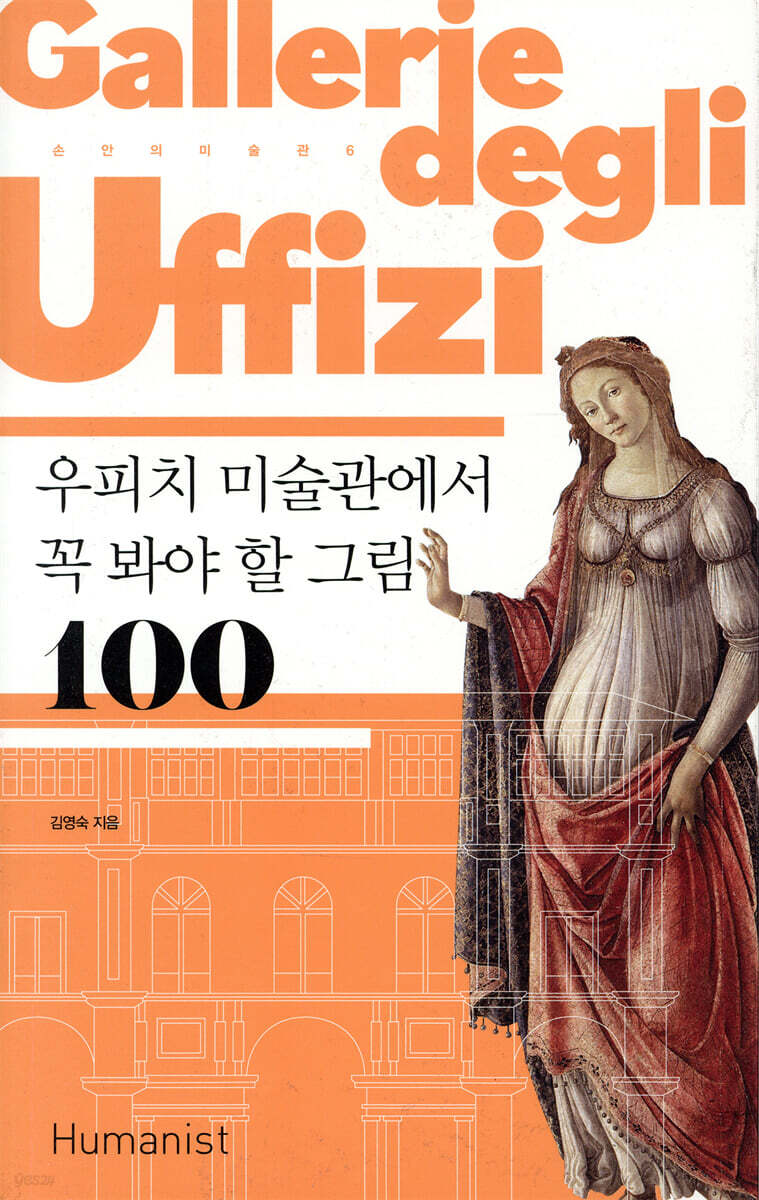
100 Must-See Paintings at the Uffizi Gallery
 |
Description
Book Introduction
Art Museum in Your Hand, Volume 6.
Kim Young-sook, the best art storyteller who has taught us how to read paintings in an exciting way through “Art Books That Make You Want to Go to an Art Museum” and “1 Page Art 365,” points out 100 “must-see paintings” for travelers who are pressed for time and cannot properly see the paintings.
In the hope that travelers can easily view the paintings in European art museums as if looking into the palm of their hand, we recommend works that are easily digestible.
The sixth place visited by the 'Museum in Your Hand' series, following the Louvre Museum, the Musée d'Orsay, the National Gallery, the Prado Museum, and the Vatican Museum, is the Uffizi Gallery in Florence, the 'City of Flowers.'
Uffizi means office, and it was built as a government office by Cosimo I de' Medici, the most powerful family in Florence.
The long, L-shaped building, connected to the Pitti Palace across the Arno River by the 800-meter-long Vasari Corridor, is a work of art in itself, filled with over 2,500 paintings, ancient documents, and sculptures, including numerous works of art from the Medici family's collection.
《100 Must-See Paintings at the Uffizi Gallery》 has selected and organized 100 of the most famous paintings that can only be seen at the Uffizi Gallery.
This book will be an essential guide for your Uffizi painting tour, and a small album to remember the place when you return to your daily life.
Kim Young-sook, the best art storyteller who has taught us how to read paintings in an exciting way through “Art Books That Make You Want to Go to an Art Museum” and “1 Page Art 365,” points out 100 “must-see paintings” for travelers who are pressed for time and cannot properly see the paintings.
In the hope that travelers can easily view the paintings in European art museums as if looking into the palm of their hand, we recommend works that are easily digestible.
The sixth place visited by the 'Museum in Your Hand' series, following the Louvre Museum, the Musée d'Orsay, the National Gallery, the Prado Museum, and the Vatican Museum, is the Uffizi Gallery in Florence, the 'City of Flowers.'
Uffizi means office, and it was built as a government office by Cosimo I de' Medici, the most powerful family in Florence.
The long, L-shaped building, connected to the Pitti Palace across the Arno River by the 800-meter-long Vasari Corridor, is a work of art in itself, filled with over 2,500 paintings, ancient documents, and sculptures, including numerous works of art from the Medici family's collection.
《100 Must-See Paintings at the Uffizi Gallery》 has selected and organized 100 of the most famous paintings that can only be seen at the Uffizi Gallery.
This book will be an essential guide for your Uffizi painting tour, and a small album to remember the place when you return to your daily life.
- You can preview some of the book's contents.
Preview
index
First, for those who want to go to European art museums
Things to know before visiting the Uffizi Gallery
Painting Gallery of the Uffizi Gallery
From the Middle Ages to the Renaissance
- Florence and the Renaissance
- Medici family
Florentine masters' "Crucifixion with Stories from the Passion to the Resurrection" and "Crucifixion with Eight Scenes of the Passion" by Bonaventura Berlinghieri.
Giovanni Cimabue's "Maesta of Santa Trinita", Duccio di Buoninsegna's "Maesta (Madonna of Rucellae)", and Giotto di Bondone's "Maesta"
Giovanni del Biondo, Altarpiece of St. John the Baptist
Simone Martini and Lippo Memmi, "Annunciation"
Ambrogio Lorenzetti, Presentation to the Temple
Lorenzo Monaco and Cosimo Rosselli, Adoration of the Magi; Gentile da Fabriano, Adoration of the Magi
Renaissance art
Masolino da Panicale or Pesello, "The Humility of the Virgin," Masaccio and Masolino da Panicale, "The Madonna and Child with Saint Anne," Masaccio, "The Madonna and Child"
Fra Angelico, Thebaide and the Coronation of the Virgin
Paolo Uccello, The Battle of San Romano
Domenico Veneziano, "Sacred Painting of Santa Lucia dei Magnoli"
Piero della Francesca, Portrait of the Duke and Duchess of Urbino
Fra Filippo Lippi, Madonna and Child with Two Angels, Madonna and Child with Saints
Antonio Pollaiuolo, "Hercules and Antaeus", "Hercules and the Hydra", Antonio Pollaiuolo and Piero Pollaiuolo, "Altarpiece of the Cardinal of Portugal"
Sandro Botticelli, Adoration of the Magi
Sandro Botticelli, Spring
Sandro Botticelli's The Birth of Venus
Sandro Botticelli, "Pallas and the Centaur" and "Man with a Medal"
Sandro Botticelli, Apelles in the Scheme
Hugo van der Gys, Portinari Altarpiece
Rogier van der Weyden, The Burial of Christ
Hans Memling, Portinari Altarpiece, Madonna Surrounded by Musical Angels
Albrecht Dürer, Adoration of the Magi
Lucas Cranach, Luther and His Wife, Adam and Eve
Andrea del Verrocchio and Leonardo da Vinci's "Baptism of Christ"
Leonardo da Vinci's Adoration of the Magi
Leonardo da Vinci's "Annunciation"
Perugino's "Madonna and Saints" and "Pieta"
Michelangelo, Doni Tondo with John the Baptist
Raphael Sanzio, Madonna and the Goldfinch
Raphael Sanzio, Portrait of Leo X
Andrea del Sarto, Madonna of the Harpies, Portrait of a Woman with a Sewing Kit, and Woman Reading Petrarch
Giovanni Bellini, Portrait of a Young Man and Sacred Allegory
Andrea Mantegna, The Ascension (Uffizi Triptych), The Adoration of the Magi (Uffizi Triptych), The Circumcision (Uffizi Triptych), Portrait of Carlo de' Medici, The Madonna and Child of the Rocks
16th century
Rosso Fiorentino, Madonna and Child with Four Saints and Cherubs Playing Musical Instruments
Rosso Fiorentino, Moses Rescuing the Daughters of Jethro
Jacopo da Pontormo, The Supper at Emmaus
Jacopo da Pontormo, Venus and Cupid, Madonna and Child with Two Saints, Portrait of Maria Salviati
Agnolo Bronzino, Portrait of Cosimo I de' Medici in Armour, Portrait of Eleonora of Toledo and Her Son, Portrait of Bia, Portrait of Lucrezia Panziattichi, Portrait of Bartolomeo Panziattichi
Parmigianino, Madonna and Saints (Madonna with Saint Zechariah)
Parmigianino's "Madonna of the Long Neck"
Sebastiano del Piombo, "The Death of Adonis" and "Portrait of a Lady"
Giorgio Vasari, The Forge of Vulcan
Titian Vecellio, Flora, Portrait of a Knight of Malta, Francesco Maria della Rovere, Eleonora Gonzaga della Rovere
Titian Vecellio, Venus of Urbino
Paolo Veronese, Father and Son, The Holy Family with Saints Catherine and John, and the Martyrdom of Saint Justina
Tintoretto's Leda and the Swan
The Master of Fontainebleau, Two Women Bathing
El Greco, The Apostles John and St. Francis
Federico Barozzi, Madonna for All, Portrait of a Young Girl, Self-Portrait
Lorenzo Lotto, Susanna and the Elder
Baroque art
Peter Paul Rubens, Victory, War, Portrait of Isabella Brandt, Self-Portrait
Gerrit Bergheide, "The Marketplace of Haarlem," Canaletto, "The Doge's Palace in Venice," Francesco Guardi, "View of a Village with a Bridge"
Gabriel Metsch, Woman Playing the Mandolin; Rembrandt Harmans van Rijn, Self-Portrait as a Young Man
Caravaggio's Young Bacchus
Caravaggio, The Sacrifice of Isaac and Medusa
Artemisia Gentileschi, Judith Beheading Holofernes
Figure annotations
Things to know before visiting the Uffizi Gallery
Painting Gallery of the Uffizi Gallery
From the Middle Ages to the Renaissance
- Florence and the Renaissance
- Medici family
Florentine masters' "Crucifixion with Stories from the Passion to the Resurrection" and "Crucifixion with Eight Scenes of the Passion" by Bonaventura Berlinghieri.
Giovanni Cimabue's "Maesta of Santa Trinita", Duccio di Buoninsegna's "Maesta (Madonna of Rucellae)", and Giotto di Bondone's "Maesta"
Giovanni del Biondo, Altarpiece of St. John the Baptist
Simone Martini and Lippo Memmi, "Annunciation"
Ambrogio Lorenzetti, Presentation to the Temple
Lorenzo Monaco and Cosimo Rosselli, Adoration of the Magi; Gentile da Fabriano, Adoration of the Magi
Renaissance art
Masolino da Panicale or Pesello, "The Humility of the Virgin," Masaccio and Masolino da Panicale, "The Madonna and Child with Saint Anne," Masaccio, "The Madonna and Child"
Fra Angelico, Thebaide and the Coronation of the Virgin
Paolo Uccello, The Battle of San Romano
Domenico Veneziano, "Sacred Painting of Santa Lucia dei Magnoli"
Piero della Francesca, Portrait of the Duke and Duchess of Urbino
Fra Filippo Lippi, Madonna and Child with Two Angels, Madonna and Child with Saints
Antonio Pollaiuolo, "Hercules and Antaeus", "Hercules and the Hydra", Antonio Pollaiuolo and Piero Pollaiuolo, "Altarpiece of the Cardinal of Portugal"
Sandro Botticelli, Adoration of the Magi
Sandro Botticelli, Spring
Sandro Botticelli's The Birth of Venus
Sandro Botticelli, "Pallas and the Centaur" and "Man with a Medal"
Sandro Botticelli, Apelles in the Scheme
Hugo van der Gys, Portinari Altarpiece
Rogier van der Weyden, The Burial of Christ
Hans Memling, Portinari Altarpiece, Madonna Surrounded by Musical Angels
Albrecht Dürer, Adoration of the Magi
Lucas Cranach, Luther and His Wife, Adam and Eve
Andrea del Verrocchio and Leonardo da Vinci's "Baptism of Christ"
Leonardo da Vinci's Adoration of the Magi
Leonardo da Vinci's "Annunciation"
Perugino's "Madonna and Saints" and "Pieta"
Michelangelo, Doni Tondo with John the Baptist
Raphael Sanzio, Madonna and the Goldfinch
Raphael Sanzio, Portrait of Leo X
Andrea del Sarto, Madonna of the Harpies, Portrait of a Woman with a Sewing Kit, and Woman Reading Petrarch
Giovanni Bellini, Portrait of a Young Man and Sacred Allegory
Andrea Mantegna, The Ascension (Uffizi Triptych), The Adoration of the Magi (Uffizi Triptych), The Circumcision (Uffizi Triptych), Portrait of Carlo de' Medici, The Madonna and Child of the Rocks
16th century
Rosso Fiorentino, Madonna and Child with Four Saints and Cherubs Playing Musical Instruments
Rosso Fiorentino, Moses Rescuing the Daughters of Jethro
Jacopo da Pontormo, The Supper at Emmaus
Jacopo da Pontormo, Venus and Cupid, Madonna and Child with Two Saints, Portrait of Maria Salviati
Agnolo Bronzino, Portrait of Cosimo I de' Medici in Armour, Portrait of Eleonora of Toledo and Her Son, Portrait of Bia, Portrait of Lucrezia Panziattichi, Portrait of Bartolomeo Panziattichi
Parmigianino, Madonna and Saints (Madonna with Saint Zechariah)
Parmigianino's "Madonna of the Long Neck"
Sebastiano del Piombo, "The Death of Adonis" and "Portrait of a Lady"
Giorgio Vasari, The Forge of Vulcan
Titian Vecellio, Flora, Portrait of a Knight of Malta, Francesco Maria della Rovere, Eleonora Gonzaga della Rovere
Titian Vecellio, Venus of Urbino
Paolo Veronese, Father and Son, The Holy Family with Saints Catherine and John, and the Martyrdom of Saint Justina
Tintoretto's Leda and the Swan
The Master of Fontainebleau, Two Women Bathing
El Greco, The Apostles John and St. Francis
Federico Barozzi, Madonna for All, Portrait of a Young Girl, Self-Portrait
Lorenzo Lotto, Susanna and the Elder
Baroque art
Peter Paul Rubens, Victory, War, Portrait of Isabella Brandt, Self-Portrait
Gerrit Bergheide, "The Marketplace of Haarlem," Canaletto, "The Doge's Palace in Venice," Francesco Guardi, "View of a Village with a Bridge"
Gabriel Metsch, Woman Playing the Mandolin; Rembrandt Harmans van Rijn, Self-Portrait as a Young Man
Caravaggio's Young Bacchus
Caravaggio, The Sacrifice of Isaac and Medusa
Artemisia Gentileschi, Judith Beheading Holofernes
Figure annotations
Detailed image

Publisher's Review
Patron of Renaissance masters
The Uffizi Gallery, the great legacy of the Medici family
Florence, which frequently appears as a backdrop in films such as “Between Calm and Passion,” “Perfume,” and “A Room with a View,” has many beautiful landmarks such as the Duomo, Ponte Vecchio, Santa Croce, and Piazzale Michelangelo.
But, above all, the place that truly shows the true face of Florence, the great city of art that brought the Renaissance to fruition in the 14th and 15th centuries, is the Uffizi Gallery.
The sixth place visited by the 'Museum in Your Hand' series, following the Louvre Museum, the Musée d'Orsay, the National Gallery, the Prado Museum, and the Vatican Museum, is the Uffizi Gallery in Florence, the 'City of Flowers.'
Uffizi means office, and it was built as a government office by Cosimo I de' Medici, the most powerful family in Florence.
The long, L-shaped building, connected to the Pitti Palace across the Arno River by the 800-meter-long Vasari Corridor, is a work of art in itself, filled with over 2,500 paintings, ancient documents, and sculptures, including numerous works of art from the Medici family's collection.
The Medici family, who led the revival of Renaissance culture, played an essential role in establishing today's Uffizi Gallery as a national art museum that Italy is proud of.
The Medici family, which enjoyed power in Florence and throughout Europe based on the capital accumulated through banking for generations, did not spare support for scholarship and the arts.
He founded the Platonic Academy and converted the Monastery of San Marco into a public library, where he gathered various rare books and ancient documents, contributing greatly to the development of the humanities.
He also directly and indirectly supported outstanding architects and artists of the time by mobilizing them for public and private projects.
Michelozzo, Brunelleschi, Fra Angelico, Filippo Lippi, Benozzo Gozzoli, and Donatello all benefited from this, and the Medici family also played a major role in the once-in-a-century genius artists flocking to Florence, including Michelangelo, Leonardo da Vinci, Perugino, and Sandro Botticelli.
The Uffizi Gallery, which began when Francesco I de' Medici stored his overflowing collection at the top of the Uffizi, was maintained in its current form by the donation of Anna Maria Luisa, the last descendant of the Medici family, on the condition that the collection not be taken out of Florence.
Thanks to this, Florence was able to establish itself as a tourist city loved by people all over the world, with the glorious status of a 'Renaissance city'.
The Uffizi Gallery, filled with the precious legacy of the Medici family, attracts nearly 2 million visitors every year, and admission to the gallery requires reservations and long lines.
《100 Must-See Paintings at the Uffizi Gallery》 has selected and organized 100 of the most famous paintings that can only be seen at the Uffizi Gallery.
This book will be an essential guide for your Uffizi Gallery tour, and a small album to remember your visit when you return to your daily life.
A Vivid History of Western Art Through Masterpieces by Geniuses and Masters
What paintings should I see at the Uffizi?
At the Uffizi Gallery, Florence's pride, you can see works by medieval masters, Renaissance genius painters who were active in Florence such as da Vinci, Michelangelo, and Raphael, and Baroque masters such as Rubens and Caravaggio.
《100 Must-See Paintings at the Uffizi Gallery》 is composed of four chapters, dividing the works of the Uffizi Gallery by period: 〈From the Middle Ages to the Renaissance〉, 〈Renaissance Art〉, 〈16th Century Art〉, and 〈Baroque Art〉.
It provides a simple, clear, yet engaging explanation of one or two or three works on a single page, and also concise information about the Uffizi Gallery, the significance of Renaissance culture that must be known, and the history of the Medici family.
In addition, we have included works that will be helpful when viewed alongside the conversations in the main text in the 'Picture Notes' section.
In the first chapter, “From the Middle Ages to the Renaissance,” we examine the changing landscape of painting, where medieval and Renaissance characteristics coexist, through works such as the painted crucifix called “Croce Dipinta,” Giovanni Cimabue’s “Maesta of Santa Trinita,” and Giotto di Bondone’s “Maesta.”
In particular, works that stand out in the international Gothic style, such as the Annunciation by Simone Martini and Lippo Memmi and the Adoration of the Magi by Lorenzo Monaco and Cosimo Rosselli, capture the attention of the viewer.
The second chapter, “Renaissance Art,” is the highlight of the Uffizi Gallery.
You can see Fra Angelico's "Coronation of the Virgin," shining in gold and ultramarine; Sandro Botticelli's "Spring" and "Birth of Venus," which express the glory of the Medici family with ideal human proportions and splendid composition; Raphael Sanzio's "Madonna and the Goldfinch," which became a representative image of the Virgin Mary; and Leonardo da Vinci's "Adoration of the Magi," which was left unfinished.
Works by artists active in Flanders and Germany, such as Hugo van der Huys's "Portinari Altarpiece," Albrecht Dürer's "Adoration of the Magi," and Lucas Cranach the Elder's "Luther and His Wife," are also notable.
In the third chapter, “16th Century Art,” you can appreciate works by Mannerist painters, such as Rosso Fiorentino’s “Madonna and Four Saints,” Jacopo da Pontormo’s “Supper at Emmaus,” Parmigianino’s “Madonna with the Long Neck,” and El Greco’s “John the Apostle and Saint Francis.”
The Mannerist style, which sought a different path from the aesthetics of the Renaissance era through elongated human figures and dazzling colors, is vivid.
The Venus of Urbino by Titian Vecellio, a masterpiece of the Uffizi Gallery, is also not to be missed.
The Venus of Urbino directly challenged the male viewer's gaze, and had a great influence on later artists, leading to works such as Goya's The Nude Maja, Ingres's La Grande Odalisque, and Manet's Olympia.
In the fourth chapter, “Baroque Art,” a feast of Baroque artists awaits, including Rubens, Caravaggio, and Artemisia Gentileschi.
You can experience the Baroque aesthetics that give psychological shock to the viewer with realistic aesthetics and dynamic screen composition through works such as “Triumph” and “War” by Peter Paul Rubens, who is considered a master of 17th-century Baroque art along with Caravaggio and Rembrandt; “The Sacrifice of Isaac” by Caravaggio, which is reminiscent of the climax of a play with its realistic sensibility and strong contrast; and “Judith Beheading Holofernes” by Artemisia Gentileschi, which depicts a woman resolutely carrying out her decision, unlike Caravaggio who depicted the same subject matter from an extremely male perspective.
《100 Must-See Paintings at the Uffizi Gallery》 carefully selects the must-see paintings at the Uffizi Gallery and guides readers on a journey through the Uffizi with refreshing illustrations and brief, detailed explanations.
For those reminiscing about their visit to the Uffizi Gallery, or for those eagerly anticipating their next visit, this book will be an invaluable guide.
* The revised edition of “100 Must-See Paintings at the Uffizi Gallery” offers even greater enjoyment of viewing the paintings with clearer picture quality and a more sophisticated layout than the previous edition.
We have also increased the font size of the image captions and simplified the content to greatly improve readability.
The figure annotations have also been refined to help you understand the figures more easily.
The Uffizi Gallery, the great legacy of the Medici family
Florence, which frequently appears as a backdrop in films such as “Between Calm and Passion,” “Perfume,” and “A Room with a View,” has many beautiful landmarks such as the Duomo, Ponte Vecchio, Santa Croce, and Piazzale Michelangelo.
But, above all, the place that truly shows the true face of Florence, the great city of art that brought the Renaissance to fruition in the 14th and 15th centuries, is the Uffizi Gallery.
The sixth place visited by the 'Museum in Your Hand' series, following the Louvre Museum, the Musée d'Orsay, the National Gallery, the Prado Museum, and the Vatican Museum, is the Uffizi Gallery in Florence, the 'City of Flowers.'
Uffizi means office, and it was built as a government office by Cosimo I de' Medici, the most powerful family in Florence.
The long, L-shaped building, connected to the Pitti Palace across the Arno River by the 800-meter-long Vasari Corridor, is a work of art in itself, filled with over 2,500 paintings, ancient documents, and sculptures, including numerous works of art from the Medici family's collection.
The Medici family, who led the revival of Renaissance culture, played an essential role in establishing today's Uffizi Gallery as a national art museum that Italy is proud of.
The Medici family, which enjoyed power in Florence and throughout Europe based on the capital accumulated through banking for generations, did not spare support for scholarship and the arts.
He founded the Platonic Academy and converted the Monastery of San Marco into a public library, where he gathered various rare books and ancient documents, contributing greatly to the development of the humanities.
He also directly and indirectly supported outstanding architects and artists of the time by mobilizing them for public and private projects.
Michelozzo, Brunelleschi, Fra Angelico, Filippo Lippi, Benozzo Gozzoli, and Donatello all benefited from this, and the Medici family also played a major role in the once-in-a-century genius artists flocking to Florence, including Michelangelo, Leonardo da Vinci, Perugino, and Sandro Botticelli.
The Uffizi Gallery, which began when Francesco I de' Medici stored his overflowing collection at the top of the Uffizi, was maintained in its current form by the donation of Anna Maria Luisa, the last descendant of the Medici family, on the condition that the collection not be taken out of Florence.
Thanks to this, Florence was able to establish itself as a tourist city loved by people all over the world, with the glorious status of a 'Renaissance city'.
The Uffizi Gallery, filled with the precious legacy of the Medici family, attracts nearly 2 million visitors every year, and admission to the gallery requires reservations and long lines.
《100 Must-See Paintings at the Uffizi Gallery》 has selected and organized 100 of the most famous paintings that can only be seen at the Uffizi Gallery.
This book will be an essential guide for your Uffizi Gallery tour, and a small album to remember your visit when you return to your daily life.
A Vivid History of Western Art Through Masterpieces by Geniuses and Masters
What paintings should I see at the Uffizi?
At the Uffizi Gallery, Florence's pride, you can see works by medieval masters, Renaissance genius painters who were active in Florence such as da Vinci, Michelangelo, and Raphael, and Baroque masters such as Rubens and Caravaggio.
《100 Must-See Paintings at the Uffizi Gallery》 is composed of four chapters, dividing the works of the Uffizi Gallery by period: 〈From the Middle Ages to the Renaissance〉, 〈Renaissance Art〉, 〈16th Century Art〉, and 〈Baroque Art〉.
It provides a simple, clear, yet engaging explanation of one or two or three works on a single page, and also concise information about the Uffizi Gallery, the significance of Renaissance culture that must be known, and the history of the Medici family.
In addition, we have included works that will be helpful when viewed alongside the conversations in the main text in the 'Picture Notes' section.
In the first chapter, “From the Middle Ages to the Renaissance,” we examine the changing landscape of painting, where medieval and Renaissance characteristics coexist, through works such as the painted crucifix called “Croce Dipinta,” Giovanni Cimabue’s “Maesta of Santa Trinita,” and Giotto di Bondone’s “Maesta.”
In particular, works that stand out in the international Gothic style, such as the Annunciation by Simone Martini and Lippo Memmi and the Adoration of the Magi by Lorenzo Monaco and Cosimo Rosselli, capture the attention of the viewer.
The second chapter, “Renaissance Art,” is the highlight of the Uffizi Gallery.
You can see Fra Angelico's "Coronation of the Virgin," shining in gold and ultramarine; Sandro Botticelli's "Spring" and "Birth of Venus," which express the glory of the Medici family with ideal human proportions and splendid composition; Raphael Sanzio's "Madonna and the Goldfinch," which became a representative image of the Virgin Mary; and Leonardo da Vinci's "Adoration of the Magi," which was left unfinished.
Works by artists active in Flanders and Germany, such as Hugo van der Huys's "Portinari Altarpiece," Albrecht Dürer's "Adoration of the Magi," and Lucas Cranach the Elder's "Luther and His Wife," are also notable.
In the third chapter, “16th Century Art,” you can appreciate works by Mannerist painters, such as Rosso Fiorentino’s “Madonna and Four Saints,” Jacopo da Pontormo’s “Supper at Emmaus,” Parmigianino’s “Madonna with the Long Neck,” and El Greco’s “John the Apostle and Saint Francis.”
The Mannerist style, which sought a different path from the aesthetics of the Renaissance era through elongated human figures and dazzling colors, is vivid.
The Venus of Urbino by Titian Vecellio, a masterpiece of the Uffizi Gallery, is also not to be missed.
The Venus of Urbino directly challenged the male viewer's gaze, and had a great influence on later artists, leading to works such as Goya's The Nude Maja, Ingres's La Grande Odalisque, and Manet's Olympia.
In the fourth chapter, “Baroque Art,” a feast of Baroque artists awaits, including Rubens, Caravaggio, and Artemisia Gentileschi.
You can experience the Baroque aesthetics that give psychological shock to the viewer with realistic aesthetics and dynamic screen composition through works such as “Triumph” and “War” by Peter Paul Rubens, who is considered a master of 17th-century Baroque art along with Caravaggio and Rembrandt; “The Sacrifice of Isaac” by Caravaggio, which is reminiscent of the climax of a play with its realistic sensibility and strong contrast; and “Judith Beheading Holofernes” by Artemisia Gentileschi, which depicts a woman resolutely carrying out her decision, unlike Caravaggio who depicted the same subject matter from an extremely male perspective.
《100 Must-See Paintings at the Uffizi Gallery》 carefully selects the must-see paintings at the Uffizi Gallery and guides readers on a journey through the Uffizi with refreshing illustrations and brief, detailed explanations.
For those reminiscing about their visit to the Uffizi Gallery, or for those eagerly anticipating their next visit, this book will be an invaluable guide.
* The revised edition of “100 Must-See Paintings at the Uffizi Gallery” offers even greater enjoyment of viewing the paintings with clearer picture quality and a more sophisticated layout than the previous edition.
We have also increased the font size of the image captions and simplified the content to greatly improve readability.
The figure annotations have also been refined to help you understand the figures more easily.
GOODS SPECIFICS
- Date of issue: April 11, 2022
- Page count, weight, size: 212 pages | 376g | 140*220*12mm
- ISBN13: 9791160808247
- ISBN10: 1160808244
You may also like
카테고리
korean


korean

![GQ KOREA Mark (Monthly): December [2025]](http://librairie.coreenne.fr/cdn/shop/files/8ef265dbbfbf186523ed75ba7319009d.jpg?v=1765340328&width=3840)


