

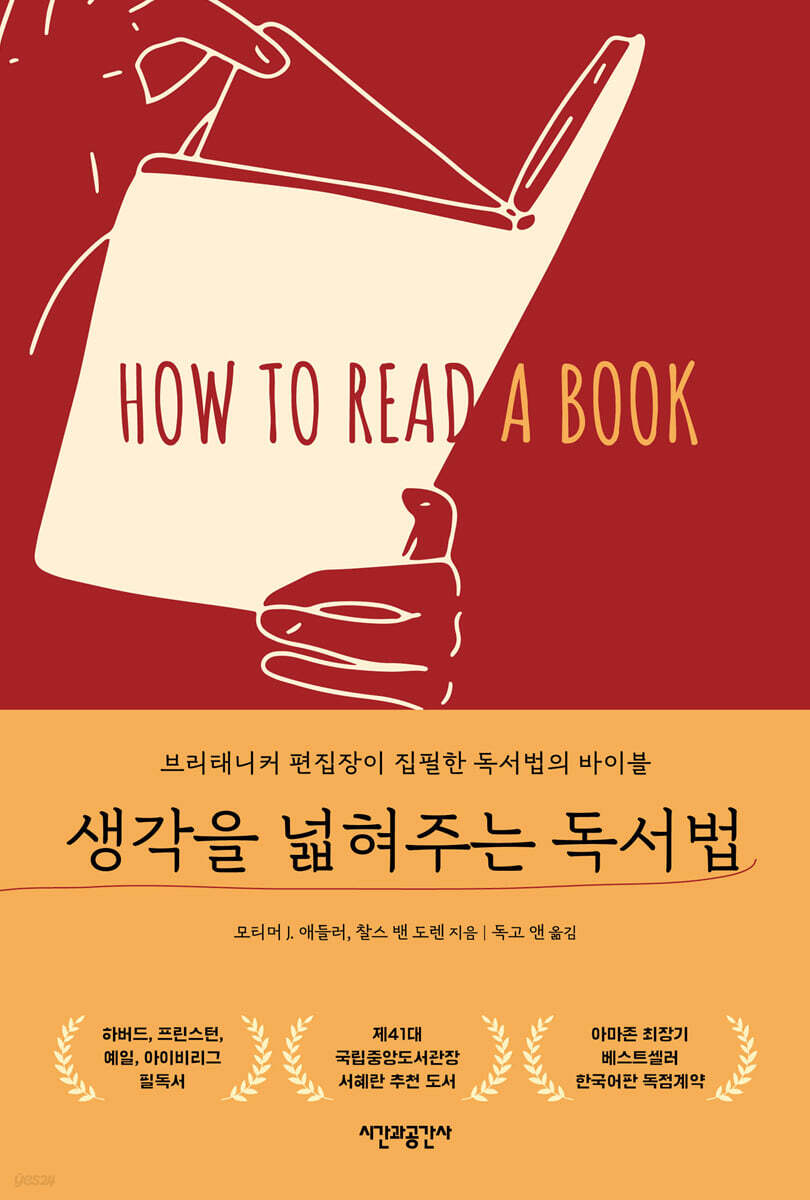
Reading methods that broaden your thinking
 |
Description
Book Introduction
“Since the publication of this book, no other reading method book has surpassed it!”
“A book is not truly read until it has been judged and critiqued!”
Exclusive Korean version of Amazon's longest-running bestseller!
A must-read for Harvard, Princeton, Stanford, and Yale universities!
A global bestseller translated into over 30 countries around the world!
Highly recommended by Professor Seo Hye-ran, the 41st Director of the National Library of Korea!
Nowadays, with the Internet so developed that most knowledge can be obtained through a simple search, there are almost no people who cannot read books.
There are just some people who can't read properly.
So why should we read? In "Reading to Expand Your Mind," first published in 1940 and reissued in 1972 to reflect the changing times, the authors provide a detailed and clear explanation of the various levels of reading, from basic reading (Level 1), to observation (Level 2), analytical reading (Level 3), and finally, integrated reading (Level 4).
The reading method suggested by the authors, who are former editors of the Britannica, goes far beyond the reading methods we think we know. They show us how to judge a book by its cover and table of contents, how to build basic reading skills that form the basis of understanding, and then move on to examining, analyzing, and integrating reading, using various book examples.
The authors also introduce various reading techniques that are most effective for reading each genre, such as practical books, literature, novels, comedies, and poetry, history, science, mathematics, philosophy, and social sciences, and help readers grow mentally and in life through integrated reading, the ultimate goal of reading.
Reading books using Syntopicon is especially helpful for beginners because it makes it easier to get started, stimulates other interests, and has an educational effect.
The appendix suggests a list of 137 recommended books composed of world-class classics, and provides reading practice questions and tests for each reading level that can be used to measure reading skills, comprehension, and speed, encouraging you to go beyond reading books and instead self-reflect.
If you actively read the book through to the end in the following way suggested by the authors, you will not only experience remarkable intellectual growth, but also make great advancements in your work and career.
“Pay attention to the parts you can understand, and don’t stop and just skip over the parts you don’t understand right away.
No matter how difficult it is, if you keep reading, you will soon find a part that you can understand.
Then read this part again carefully.
Don't skip over footnotes, notes, or references, and read to the end.
If you go somewhere else, you will get lost.
If you hold on to a problem you don't know, you won't be able to solve it.
It's much easier to understand if you read it again.
But you have to read it 'from beginning to end' and then read it again.”
“A book is not truly read until it has been judged and critiqued!”
Exclusive Korean version of Amazon's longest-running bestseller!
A must-read for Harvard, Princeton, Stanford, and Yale universities!
A global bestseller translated into over 30 countries around the world!
Highly recommended by Professor Seo Hye-ran, the 41st Director of the National Library of Korea!
Nowadays, with the Internet so developed that most knowledge can be obtained through a simple search, there are almost no people who cannot read books.
There are just some people who can't read properly.
So why should we read? In "Reading to Expand Your Mind," first published in 1940 and reissued in 1972 to reflect the changing times, the authors provide a detailed and clear explanation of the various levels of reading, from basic reading (Level 1), to observation (Level 2), analytical reading (Level 3), and finally, integrated reading (Level 4).
The reading method suggested by the authors, who are former editors of the Britannica, goes far beyond the reading methods we think we know. They show us how to judge a book by its cover and table of contents, how to build basic reading skills that form the basis of understanding, and then move on to examining, analyzing, and integrating reading, using various book examples.
The authors also introduce various reading techniques that are most effective for reading each genre, such as practical books, literature, novels, comedies, and poetry, history, science, mathematics, philosophy, and social sciences, and help readers grow mentally and in life through integrated reading, the ultimate goal of reading.
Reading books using Syntopicon is especially helpful for beginners because it makes it easier to get started, stimulates other interests, and has an educational effect.
The appendix suggests a list of 137 recommended books composed of world-class classics, and provides reading practice questions and tests for each reading level that can be used to measure reading skills, comprehension, and speed, encouraging you to go beyond reading books and instead self-reflect.
If you actively read the book through to the end in the following way suggested by the authors, you will not only experience remarkable intellectual growth, but also make great advancements in your work and career.
“Pay attention to the parts you can understand, and don’t stop and just skip over the parts you don’t understand right away.
No matter how difficult it is, if you keep reading, you will soon find a part that you can understand.
Then read this part again carefully.
Don't skip over footnotes, notes, or references, and read to the end.
If you go somewhere else, you will get lost.
If you hold on to a problem you don't know, you won't be able to solve it.
It's much easier to understand if you read it again.
But you have to read it 'from beginning to end' and then read it again.”
- You can preview some of the book's contents.
Preview
index
Introduction
Part 1: Stages of Reading
Chapter 1: The Act and Skill of Reading
Active Reading│Purpose of Reading: Obtaining Information and Understanding Content│Reading to Learn: The Difference Between Learning Through Education and Learning Through Discovery│Teachers Present and Absent
Chapter 2 Level of Reading
Chapter 3: Basic Reading (Level 1)
Stages of Learning to Read│Stages and Levels│High-Difficulty Reading Abilities and High-Educational Levels│Democratic Ideals of Reading and Education
Chapter 4 Overview (Level 2 Reading)
Overview 1: Systematic Skimming or Previewing│Overview 2: Scrutinizing│Reading Speed│Correcting Eye Movements│Improving Comprehension│Summary Overview
Chapter 5: How to Become a Motivated Reader
The Essence of Active Reading: Four Questions to Ask | How to Make Your Own Book | Three Ways to Take Notes in a Book | Reading Habits | Principles for Creating a Habit
Reading and Analyzing Part 2 (Level 3 Reading)
Chapter 6: Classifying Books
The Importance of Book Classification│What You Can Know from a Book's Cover│Theory and Practical Books│Types of Theory Books
Chapter 7: A Look Through the Book
The Unity of a Book: Plot and Concept | The Art of Understanding Complex Content and Summarizing Key Points | The Interrelationship Between Reading and Writing | Finding the Author's Intention | Analyzing and Reading: Step 1
Chapter 8: Understanding Terminology through Agreement with the Author
Words vs. Terms│Find Keywords│Terms and Special Vocabulary│Understand the Meaning
Chapter 9: Finding the Author's Message
Sentence vs. Proposition│Find the Central Sentence│Find the Proposition│Find the Argument│Find the Answer│Reading with Analysis, Step 2
Chapter 10: Criticizing Fairly
Virtues learned from books│Persuasive writing style│It is important to fully understand before judging│It is important to criticize logically│Narrow down your opinions
Chapter 11: Agreeing with or Disagreeing with the Author
Preconceptions and Judgments│Judge the Author's Validity│Judge the Author's Completeness│Step 3: Analyzing and Reading
Chapter 12: Helpful Things to Know When Reading a Book
Help from experience | Help from other books | Help from commentaries or excerpts | How to use reference books | How to use dictionaries | How to use encyclopedias
Part 3: How to Read Differently by Field
Chapter 13: How to Read Practical Books
Two Types of Practical Books│Books that Try to Persuade│What to Agree When Reading Practical Books
Chapter 14: How to Read Literature
How Not to Read It│General Principles for Reading Literary Works
Chapter 15: How to Read Novels, Plays, and Poetry
How to Read a Novel | Things to Watch Out for When Reading an Epic | How to Read a Play | Things to Watch Out for When Reading a Tragedy | How to Read a Lyric Poetry
Chapter 16: How to Read History Books
Uncertainty of historical facts│Diverse historical perspectives│The universality of history│Questions to ask when reading history books│How to read biographies and autobiographies│How to read current events│Things to watch out for when reading summaries
Chapter 17: How to Read Science and Math Books
Why Read Science Books? How to Read Classic Science Books How to Read Math Books How to Read Math Books Reading Math in Science Books Things to Keep in Mind When Reading Popular Science Books
Chapter 18: How to Read Philosophy Books
Questions posed by philosophers│Modern philosophy and the great tradition│On philosophical method│Styles for describing philosophy│Hints to help you read philosophy books well│What answers should you follow│How to read theological books│How to read scriptures
Chapter 19: How to Read Social Science Books
What is Social Science? | What's Easy About Reading Social Science Books | What's Difficult About Reading Social Science Books | Reading Social Science Literature
Part 4: The Ultimate Purpose of Reading
Chapter 20: Integrated Reading (Level 4 of Reading)
Before Reading Integratively│Five Steps to Integrative Reading│Reading Objectively and Fairly│Examples of Integrative Reading: The Concept of Progress│Syntopicon and How to Use It│The Principles Behind Integrative Reading│Summary of Integrative Reading
Chapter 21: Reading and Mental Growth
What Good Books Can Do for Us | The Book Pyramid | Growth in Life and Mind
Appendix 1: List of Recommended Books
Appendix 2 Reading Practice Questions and Tests by Level
Search
Part 1: Stages of Reading
Chapter 1: The Act and Skill of Reading
Active Reading│Purpose of Reading: Obtaining Information and Understanding Content│Reading to Learn: The Difference Between Learning Through Education and Learning Through Discovery│Teachers Present and Absent
Chapter 2 Level of Reading
Chapter 3: Basic Reading (Level 1)
Stages of Learning to Read│Stages and Levels│High-Difficulty Reading Abilities and High-Educational Levels│Democratic Ideals of Reading and Education
Chapter 4 Overview (Level 2 Reading)
Overview 1: Systematic Skimming or Previewing│Overview 2: Scrutinizing│Reading Speed│Correcting Eye Movements│Improving Comprehension│Summary Overview
Chapter 5: How to Become a Motivated Reader
The Essence of Active Reading: Four Questions to Ask | How to Make Your Own Book | Three Ways to Take Notes in a Book | Reading Habits | Principles for Creating a Habit
Reading and Analyzing Part 2 (Level 3 Reading)
Chapter 6: Classifying Books
The Importance of Book Classification│What You Can Know from a Book's Cover│Theory and Practical Books│Types of Theory Books
Chapter 7: A Look Through the Book
The Unity of a Book: Plot and Concept | The Art of Understanding Complex Content and Summarizing Key Points | The Interrelationship Between Reading and Writing | Finding the Author's Intention | Analyzing and Reading: Step 1
Chapter 8: Understanding Terminology through Agreement with the Author
Words vs. Terms│Find Keywords│Terms and Special Vocabulary│Understand the Meaning
Chapter 9: Finding the Author's Message
Sentence vs. Proposition│Find the Central Sentence│Find the Proposition│Find the Argument│Find the Answer│Reading with Analysis, Step 2
Chapter 10: Criticizing Fairly
Virtues learned from books│Persuasive writing style│It is important to fully understand before judging│It is important to criticize logically│Narrow down your opinions
Chapter 11: Agreeing with or Disagreeing with the Author
Preconceptions and Judgments│Judge the Author's Validity│Judge the Author's Completeness│Step 3: Analyzing and Reading
Chapter 12: Helpful Things to Know When Reading a Book
Help from experience | Help from other books | Help from commentaries or excerpts | How to use reference books | How to use dictionaries | How to use encyclopedias
Part 3: How to Read Differently by Field
Chapter 13: How to Read Practical Books
Two Types of Practical Books│Books that Try to Persuade│What to Agree When Reading Practical Books
Chapter 14: How to Read Literature
How Not to Read It│General Principles for Reading Literary Works
Chapter 15: How to Read Novels, Plays, and Poetry
How to Read a Novel | Things to Watch Out for When Reading an Epic | How to Read a Play | Things to Watch Out for When Reading a Tragedy | How to Read a Lyric Poetry
Chapter 16: How to Read History Books
Uncertainty of historical facts│Diverse historical perspectives│The universality of history│Questions to ask when reading history books│How to read biographies and autobiographies│How to read current events│Things to watch out for when reading summaries
Chapter 17: How to Read Science and Math Books
Why Read Science Books? How to Read Classic Science Books How to Read Math Books How to Read Math Books Reading Math in Science Books Things to Keep in Mind When Reading Popular Science Books
Chapter 18: How to Read Philosophy Books
Questions posed by philosophers│Modern philosophy and the great tradition│On philosophical method│Styles for describing philosophy│Hints to help you read philosophy books well│What answers should you follow│How to read theological books│How to read scriptures
Chapter 19: How to Read Social Science Books
What is Social Science? | What's Easy About Reading Social Science Books | What's Difficult About Reading Social Science Books | Reading Social Science Literature
Part 4: The Ultimate Purpose of Reading
Chapter 20: Integrated Reading (Level 4 of Reading)
Before Reading Integratively│Five Steps to Integrative Reading│Reading Objectively and Fairly│Examples of Integrative Reading: The Concept of Progress│Syntopicon and How to Use It│The Principles Behind Integrative Reading│Summary of Integrative Reading
Chapter 21: Reading and Mental Growth
What Good Books Can Do for Us | The Book Pyramid | Growth in Life and Mind
Appendix 1: List of Recommended Books
Appendix 2 Reading Practice Questions and Tests by Level
Search
Detailed image

Into the book
Reading everything you can get your hands on and not reading well are similar.
To avoid making this mistake, we need to differentiate between the ways we learn.
This distinction is not only relevant to various readings, but also to general education.
In education, a distinction has been made between learning through human education and learning through enlightenment.
Education is when one person teaches another, either verbally or in writing.
However, one can gain knowledge without being taught.
Otherwise, it would be impossible for teachers to acquire new knowledge, as they would have to learn from others what they have to teach to others.
There must be a process of enlightenment that involves learning through study, inquiry, and deep thought, without being taught.
Enlightenment is something you learn without a teacher, unlike education, which is something you learn with the help of someone else.
In both cases, the act of learning takes place within the learner.
It is not correct to say that enlightenment is active learning and education is passive learning.
Just as there is no passive reading, there is no passive learning.
---From "Chapter 1: The Act and Skill of Reading"
When you first start learning to read, you look at the letters in a book and have no idea what they mean.
But after at least two or three weeks, you will read it and know what it means.
How can an American child and a French child, despite speaking different languages, equally understand the meaning of "the cat is on the hat"? Where does this phenomenon come from? No one, not even philosophers or psychologists, has been able to figure out how this is possible, even after 2,500 years of studying it.
In fact, only humans can understand the meaning that letters represent.
It is also one of the most remarkable intellectual feats a human being can perform, mostly before the age of seven.
---From "Chapter 3 Basic Reading (Level 1 of Reading)"
Learning to read well is not easy.
In particular, reading while analyzing is a more complex mental activity than skiing.
Beginner skiers should just focus on the body movements that come naturally to them, even if they later forget how to do it.
While it is easy to become conscious of bodily movements in this way, the mental activity that people have to do to begin reading while analyzing is much more difficult.
In some ways, it may be about thinking about your own thoughts.
There aren't many people who read this well.
But we can do it.
And once you get used to it, you'll find yourself reading much better.
---From "Chapter 5: How to Become an Aspiring Reader"
Finding the real structure is really important.
The second principle of finding the main flow of a book cannot be properly followed without observing the third principle of identifying each part that makes up that main flow.
Even if you just skim through it, you can summarize the main idea in two or three sentences.
And you might get a nice score for reading that book better.
But I'm not sure if I understood it correctly.
It was just a lucky coincidence.
Therefore, the third principle is also necessary to faithfully follow the second principle.
---From "Chapter 7: Looking Through the Book"
Another clue to finding important sentences is the words used in them.
Once you know what the important words are, you can use those words to identify sentences that require more careful reading.
The first step to interpretation becomes the basis for the second step.
But it could be the other way around.
That is, when you come across a sentence whose meaning you don't know, pay attention to the words in that sentence.
The order in which the principles are discussed here is not necessarily fixed.
Important words can create propositions, or you can look at propositions and find important words.
In other words, if you know the words that have important meaning, you can figure out the propositions in the sentence, and if you figure out the propositions in the sentence, it means you have found the important words.
---From "Chapter 9: Finding the Author's Message"
A good book can only be appreciated if you read it actively.
The act of reading does not end with understanding what the book is saying.
“You have to judge and criticize to have read everything.” This is not the case for readers who are not very motivated.
I can't even analyze or understand the book.
No, not only do they not make an effort to understand, they just throw it away and forget about it.
What's worse than pretending to praise someone, even if it's insincere, is to criticize them without thinking about it at all.
---From "Chapter 10: Criticizing Fairly"
The most important thing to remember from any practical book is that “reading books alone will never solve your problems.”
The theory book can solve problems in the book.
However, the problems addressed in practical books must be solved through actual action.
If you want to know how to make money, reading books about how to make friends or how to be a leader won't help.
It's a book that tells you exactly what to do.
No problem can be solved without taking action.
In other words, it can only be solved by actually making money.
---From "Chapter 13 How to Read Practical Books"
We can also learn something from literary works such as poetry, novels, and especially plays.
But it's different from what you learn in science or philosophy books.
We can learn something from the experiences we have in our daily lives.
Likewise, we can learn from the various experiences that stories create in our imagination.
In this sense, poetry and novels not only provide enjoyment but also education.
But science and philosophy teach us different things, so these explanatory books don't give us new experiences.
It is a book that conveys knowledge as it is, talking about experiences we have already had or may have.
Literary works, on the other hand, create experiences from which we can learn, and from which we derive learning.
To learn from a book like this, the reader must reflect on the experience for himself.
For philosophy or science books, you just need to understand what the authors have already thought.
---From "Chapter 14: How to Read Literature"
A final thing to be aware of when reading lyric poetry is that it often feels like you need to know more than necessary about the author or the times in which he or she lived.
There is also a tendency to place excessive trust in commentaries, critiques, and biographies.
This is because they doubt their own ability to read poetry.
Anyone can read poetry if they just try to read it.
Although it may be helpful to know the author's life or the circumstances of the times, knowing the various circumstances of the poem does not guarantee that you will be able to understand the poem well.
To understand poetry, you have to read it again and again.
A lifetime of reading great proverbs is not enough.
This doesn't mean you have to read it over and over again throughout your life, but it does mean that if it's a great work, it's worth reading multiple times.
When I read the poem again, I realize more things I didn't know before.
---From "Chapter 15: How to Read Novels, Plays, and Poetry"
The definitive biography is a piece of history.
It is a history of a person and an era as seen through the eyes of one human being, so it should be read like a history book.
But that is not the case with biographies written on commission.
These biographies are often commissioned by descendants or relatives of important figures, and attempt to portray the person's mistakes and successes as brilliantly as possible.
Sometimes these biographies are excellent because the author has access to all the relevant material.
However, a commissioned biography does not enjoy the same credibility as a definitive biography.
---From "Chapter 16: How to Read History Books"
If you want to understand the history of science, you must not only read the classics, but also experience them firsthand and become familiar with the important experiments discussed in that history.
There are not only classic books, but also classic experiments.
Scientific classics are easier to understand for those who have seen with their own eyes and touched with their own hands the process by which the great scientists reached their conclusions.
---From "Chapter 17: How to Read Science and Math Books"
Good philosophical theories are not rhetorical or inflammatory like good scientific papers.
There is no need to worry about the author's 'personality' or to investigate his social and economic environment.
However, it is necessary to read the works of philosophers who deal with the same problems as the author.
Philosophers have long conversed with one another throughout the history of thought.
Before you make up your mind about someone's story, it's a good idea to listen to their conversation.
---From "Chapter 18: How to Read Philosophy Books"
Reading holistically means 'looking at all sides and trying not to lean to one side.'
Complete objectivity is impossible.
It may be possible to present issues impartially, without bias, and to deal fairly with opposing views.
But looking at all sides is more difficult than not leaning to one side.
If you look at all sides, you may fail to read it comprehensively.
It is impossible to consider all aspects of an issue without exception.
Still, we must try.
It is easier to be impartial than to look at everything, but it is equally difficult.
---From "Chapter 20 Integrated Reading (Level 4 of Reading)"
If you read a good book diligently, it will pay off.
The best books will give you the best.
There are two things we receive from books.
First, it improves your reading skills by rewarding you for grappling with difficult and good books.
Second, good books teach us about the world and ourselves.
This would be a much more significant price to pay.
Learning about life, that is, becoming wiser.
It's a completely different story from learning more after reading a book that only provides knowledge or information.
Becoming wiser means gaining a deeper understanding of life's eternal and great truths.
To avoid making this mistake, we need to differentiate between the ways we learn.
This distinction is not only relevant to various readings, but also to general education.
In education, a distinction has been made between learning through human education and learning through enlightenment.
Education is when one person teaches another, either verbally or in writing.
However, one can gain knowledge without being taught.
Otherwise, it would be impossible for teachers to acquire new knowledge, as they would have to learn from others what they have to teach to others.
There must be a process of enlightenment that involves learning through study, inquiry, and deep thought, without being taught.
Enlightenment is something you learn without a teacher, unlike education, which is something you learn with the help of someone else.
In both cases, the act of learning takes place within the learner.
It is not correct to say that enlightenment is active learning and education is passive learning.
Just as there is no passive reading, there is no passive learning.
---From "Chapter 1: The Act and Skill of Reading"
When you first start learning to read, you look at the letters in a book and have no idea what they mean.
But after at least two or three weeks, you will read it and know what it means.
How can an American child and a French child, despite speaking different languages, equally understand the meaning of "the cat is on the hat"? Where does this phenomenon come from? No one, not even philosophers or psychologists, has been able to figure out how this is possible, even after 2,500 years of studying it.
In fact, only humans can understand the meaning that letters represent.
It is also one of the most remarkable intellectual feats a human being can perform, mostly before the age of seven.
---From "Chapter 3 Basic Reading (Level 1 of Reading)"
Learning to read well is not easy.
In particular, reading while analyzing is a more complex mental activity than skiing.
Beginner skiers should just focus on the body movements that come naturally to them, even if they later forget how to do it.
While it is easy to become conscious of bodily movements in this way, the mental activity that people have to do to begin reading while analyzing is much more difficult.
In some ways, it may be about thinking about your own thoughts.
There aren't many people who read this well.
But we can do it.
And once you get used to it, you'll find yourself reading much better.
---From "Chapter 5: How to Become an Aspiring Reader"
Finding the real structure is really important.
The second principle of finding the main flow of a book cannot be properly followed without observing the third principle of identifying each part that makes up that main flow.
Even if you just skim through it, you can summarize the main idea in two or three sentences.
And you might get a nice score for reading that book better.
But I'm not sure if I understood it correctly.
It was just a lucky coincidence.
Therefore, the third principle is also necessary to faithfully follow the second principle.
---From "Chapter 7: Looking Through the Book"
Another clue to finding important sentences is the words used in them.
Once you know what the important words are, you can use those words to identify sentences that require more careful reading.
The first step to interpretation becomes the basis for the second step.
But it could be the other way around.
That is, when you come across a sentence whose meaning you don't know, pay attention to the words in that sentence.
The order in which the principles are discussed here is not necessarily fixed.
Important words can create propositions, or you can look at propositions and find important words.
In other words, if you know the words that have important meaning, you can figure out the propositions in the sentence, and if you figure out the propositions in the sentence, it means you have found the important words.
---From "Chapter 9: Finding the Author's Message"
A good book can only be appreciated if you read it actively.
The act of reading does not end with understanding what the book is saying.
“You have to judge and criticize to have read everything.” This is not the case for readers who are not very motivated.
I can't even analyze or understand the book.
No, not only do they not make an effort to understand, they just throw it away and forget about it.
What's worse than pretending to praise someone, even if it's insincere, is to criticize them without thinking about it at all.
---From "Chapter 10: Criticizing Fairly"
The most important thing to remember from any practical book is that “reading books alone will never solve your problems.”
The theory book can solve problems in the book.
However, the problems addressed in practical books must be solved through actual action.
If you want to know how to make money, reading books about how to make friends or how to be a leader won't help.
It's a book that tells you exactly what to do.
No problem can be solved without taking action.
In other words, it can only be solved by actually making money.
---From "Chapter 13 How to Read Practical Books"
We can also learn something from literary works such as poetry, novels, and especially plays.
But it's different from what you learn in science or philosophy books.
We can learn something from the experiences we have in our daily lives.
Likewise, we can learn from the various experiences that stories create in our imagination.
In this sense, poetry and novels not only provide enjoyment but also education.
But science and philosophy teach us different things, so these explanatory books don't give us new experiences.
It is a book that conveys knowledge as it is, talking about experiences we have already had or may have.
Literary works, on the other hand, create experiences from which we can learn, and from which we derive learning.
To learn from a book like this, the reader must reflect on the experience for himself.
For philosophy or science books, you just need to understand what the authors have already thought.
---From "Chapter 14: How to Read Literature"
A final thing to be aware of when reading lyric poetry is that it often feels like you need to know more than necessary about the author or the times in which he or she lived.
There is also a tendency to place excessive trust in commentaries, critiques, and biographies.
This is because they doubt their own ability to read poetry.
Anyone can read poetry if they just try to read it.
Although it may be helpful to know the author's life or the circumstances of the times, knowing the various circumstances of the poem does not guarantee that you will be able to understand the poem well.
To understand poetry, you have to read it again and again.
A lifetime of reading great proverbs is not enough.
This doesn't mean you have to read it over and over again throughout your life, but it does mean that if it's a great work, it's worth reading multiple times.
When I read the poem again, I realize more things I didn't know before.
---From "Chapter 15: How to Read Novels, Plays, and Poetry"
The definitive biography is a piece of history.
It is a history of a person and an era as seen through the eyes of one human being, so it should be read like a history book.
But that is not the case with biographies written on commission.
These biographies are often commissioned by descendants or relatives of important figures, and attempt to portray the person's mistakes and successes as brilliantly as possible.
Sometimes these biographies are excellent because the author has access to all the relevant material.
However, a commissioned biography does not enjoy the same credibility as a definitive biography.
---From "Chapter 16: How to Read History Books"
If you want to understand the history of science, you must not only read the classics, but also experience them firsthand and become familiar with the important experiments discussed in that history.
There are not only classic books, but also classic experiments.
Scientific classics are easier to understand for those who have seen with their own eyes and touched with their own hands the process by which the great scientists reached their conclusions.
---From "Chapter 17: How to Read Science and Math Books"
Good philosophical theories are not rhetorical or inflammatory like good scientific papers.
There is no need to worry about the author's 'personality' or to investigate his social and economic environment.
However, it is necessary to read the works of philosophers who deal with the same problems as the author.
Philosophers have long conversed with one another throughout the history of thought.
Before you make up your mind about someone's story, it's a good idea to listen to their conversation.
---From "Chapter 18: How to Read Philosophy Books"
Reading holistically means 'looking at all sides and trying not to lean to one side.'
Complete objectivity is impossible.
It may be possible to present issues impartially, without bias, and to deal fairly with opposing views.
But looking at all sides is more difficult than not leaning to one side.
If you look at all sides, you may fail to read it comprehensively.
It is impossible to consider all aspects of an issue without exception.
Still, we must try.
It is easier to be impartial than to look at everything, but it is equally difficult.
---From "Chapter 20 Integrated Reading (Level 4 of Reading)"
If you read a good book diligently, it will pay off.
The best books will give you the best.
There are two things we receive from books.
First, it improves your reading skills by rewarding you for grappling with difficult and good books.
Second, good books teach us about the world and ourselves.
This would be a much more significant price to pay.
Learning about life, that is, becoming wiser.
It's a completely different story from learning more after reading a book that only provides knowledge or information.
Becoming wiser means gaining a deeper understanding of life's eternal and great truths.
---From "Chapter 21: Reading and Mental Growth"
Publisher's Review
The Essentials of Reading Methods to Help You Read Intelligently
A book that teaches you how to read all the books in the world!
With the proliferation of social media like Facebook, Instagram, and YouTube, it might seem like reading isn't as necessary as it once was. Not only do we learn more about the world through social media alone, but there are virtually no people who don't know how to read.
So, why should we read books, then and now? The most important reason for reading is to gain practical help in real life and to cultivate knowledge.
Education doesn't simply increase the amount of information or knowledge; it updates the human brain, changes life for the better, and takes us to a more wonderful place than we are now.
However, this culture can only be cultivated through reading.
Reading broadens, helps, and guides your world of knowledge throughout your life.
In these times when the Internet has developed and we are distancing ourselves from books, we actually need to read more. Therefore, the value of this book is even greater because it introduces in depth topics that were not sufficiently covered in existing books or were not covered at all, such as a new understanding of how to read, organizing and analyzing complex reading skills to make them easier to understand, and basic principles that can be flexibly applied to different types of reading.
The authors suggest a basic reading method, namely '1.
See the title page or preface, 2.
See the table of contents, 3.
See the search, 4.
Look at the blurb on the cover, 5.
Look at the chapter that will be the center of the argument, 6.
'Scroll through the bookshelf and pick out something to read' is a method we think we already know, but may not be putting into practice properly.
Let's broaden our thinking by learning how to read books properly, from basic reading, the first level of reading, to integrated (syntopical) reading, the best reading method that involves comparing multiple books on a single topic, while remembering the importance of practice.
A must-read for anyone who wants to read books properly!
A book for those who want to read and understand the content well!
Great authors throughout history have been great readers, but that doesn't mean they read everything they should read.
They may have read less than most college students today are expected to read, but they read really well.
I was able to become a good writer because I read the book completely.
So how can you say you've read a book well? To read a book well, you first need to determine whether it's something you can just skim through or something you need to read carefully.
And you can read the book by following the reading stages that the authors tell you in this book.
Part 1, Levels of Reading, explains the purpose of reading, basic reading (Level 1 of reading), and reviewing (Level 2 of reading), and teaches how to become a motivated reader through active reading.
Part 2: Analyzing and Reading (Level 3 of Reading) covers categorizing books, examining the book, understanding terminology through agreement with the author, finding the message the author is conveying, criticizing fairly, and organizing arguments for and against the author, and explains helpful things to do when reading a book.
Part 3, How to Read Differently by Field, provides examples of reading methods according to the field of the book, such as how to read practical books, how to read literature, how to read novels, plays, and poetry, how to read history books, how to read science and math books, how to read philosophy books, and how to read social science books, to help readers clearly understand the book.
The ultimate goal of Part 4 of Reading is to conclude the method of reading through integrated reading (the fourth level of reading) and reading books and mental growth.
The appendix introduces 137 world-class classics carefully selected by the authors and includes level-based practice problems that can be used to measure the progress of reading skills, comprehension, and speed, providing an opportunity to apply practical application to whether you have properly read a somewhat difficult book.
Reading well, that is, reading actively, is beneficial in itself, not only improving our work or career, but also keeping our minds alive and growing.
The authors suggest in this book, “Read it from beginning to end without fail.
Even if there's something you don't understand, don't try to look it up or think about it! Instead, pick up the book, ask yourself questions, and read critically. Then, you'll realize, "Ah! So this is what the author is trying to say."
We hope that those who want to read well or need to read well will enjoy the true pleasure of reading through this living classic that suggests how to read all the books in the world.
A book that teaches you how to read all the books in the world!
With the proliferation of social media like Facebook, Instagram, and YouTube, it might seem like reading isn't as necessary as it once was. Not only do we learn more about the world through social media alone, but there are virtually no people who don't know how to read.
So, why should we read books, then and now? The most important reason for reading is to gain practical help in real life and to cultivate knowledge.
Education doesn't simply increase the amount of information or knowledge; it updates the human brain, changes life for the better, and takes us to a more wonderful place than we are now.
However, this culture can only be cultivated through reading.
Reading broadens, helps, and guides your world of knowledge throughout your life.
In these times when the Internet has developed and we are distancing ourselves from books, we actually need to read more. Therefore, the value of this book is even greater because it introduces in depth topics that were not sufficiently covered in existing books or were not covered at all, such as a new understanding of how to read, organizing and analyzing complex reading skills to make them easier to understand, and basic principles that can be flexibly applied to different types of reading.
The authors suggest a basic reading method, namely '1.
See the title page or preface, 2.
See the table of contents, 3.
See the search, 4.
Look at the blurb on the cover, 5.
Look at the chapter that will be the center of the argument, 6.
'Scroll through the bookshelf and pick out something to read' is a method we think we already know, but may not be putting into practice properly.
Let's broaden our thinking by learning how to read books properly, from basic reading, the first level of reading, to integrated (syntopical) reading, the best reading method that involves comparing multiple books on a single topic, while remembering the importance of practice.
A must-read for anyone who wants to read books properly!
A book for those who want to read and understand the content well!
Great authors throughout history have been great readers, but that doesn't mean they read everything they should read.
They may have read less than most college students today are expected to read, but they read really well.
I was able to become a good writer because I read the book completely.
So how can you say you've read a book well? To read a book well, you first need to determine whether it's something you can just skim through or something you need to read carefully.
And you can read the book by following the reading stages that the authors tell you in this book.
Part 1, Levels of Reading, explains the purpose of reading, basic reading (Level 1 of reading), and reviewing (Level 2 of reading), and teaches how to become a motivated reader through active reading.
Part 2: Analyzing and Reading (Level 3 of Reading) covers categorizing books, examining the book, understanding terminology through agreement with the author, finding the message the author is conveying, criticizing fairly, and organizing arguments for and against the author, and explains helpful things to do when reading a book.
Part 3, How to Read Differently by Field, provides examples of reading methods according to the field of the book, such as how to read practical books, how to read literature, how to read novels, plays, and poetry, how to read history books, how to read science and math books, how to read philosophy books, and how to read social science books, to help readers clearly understand the book.
The ultimate goal of Part 4 of Reading is to conclude the method of reading through integrated reading (the fourth level of reading) and reading books and mental growth.
The appendix introduces 137 world-class classics carefully selected by the authors and includes level-based practice problems that can be used to measure the progress of reading skills, comprehension, and speed, providing an opportunity to apply practical application to whether you have properly read a somewhat difficult book.
Reading well, that is, reading actively, is beneficial in itself, not only improving our work or career, but also keeping our minds alive and growing.
The authors suggest in this book, “Read it from beginning to end without fail.
Even if there's something you don't understand, don't try to look it up or think about it! Instead, pick up the book, ask yourself questions, and read critically. Then, you'll realize, "Ah! So this is what the author is trying to say."
We hope that those who want to read well or need to read well will enjoy the true pleasure of reading through this living classic that suggests how to read all the books in the world.
GOODS SPECIFICS
- Date of issue: April 26, 2024
- Page count, weight, size: 472 pages | 680g | 152*225*22mm
- ISBN13: 9791190818254
- ISBN10: 1190818256
You may also like
카테고리
korean


korean

![GQ KOREA Mark (Monthly): December [2025]](http://librairie.coreenne.fr/cdn/shop/files/8ef265dbbfbf186523ed75ba7319009d.jpg?v=1765340328&width=3840)


