

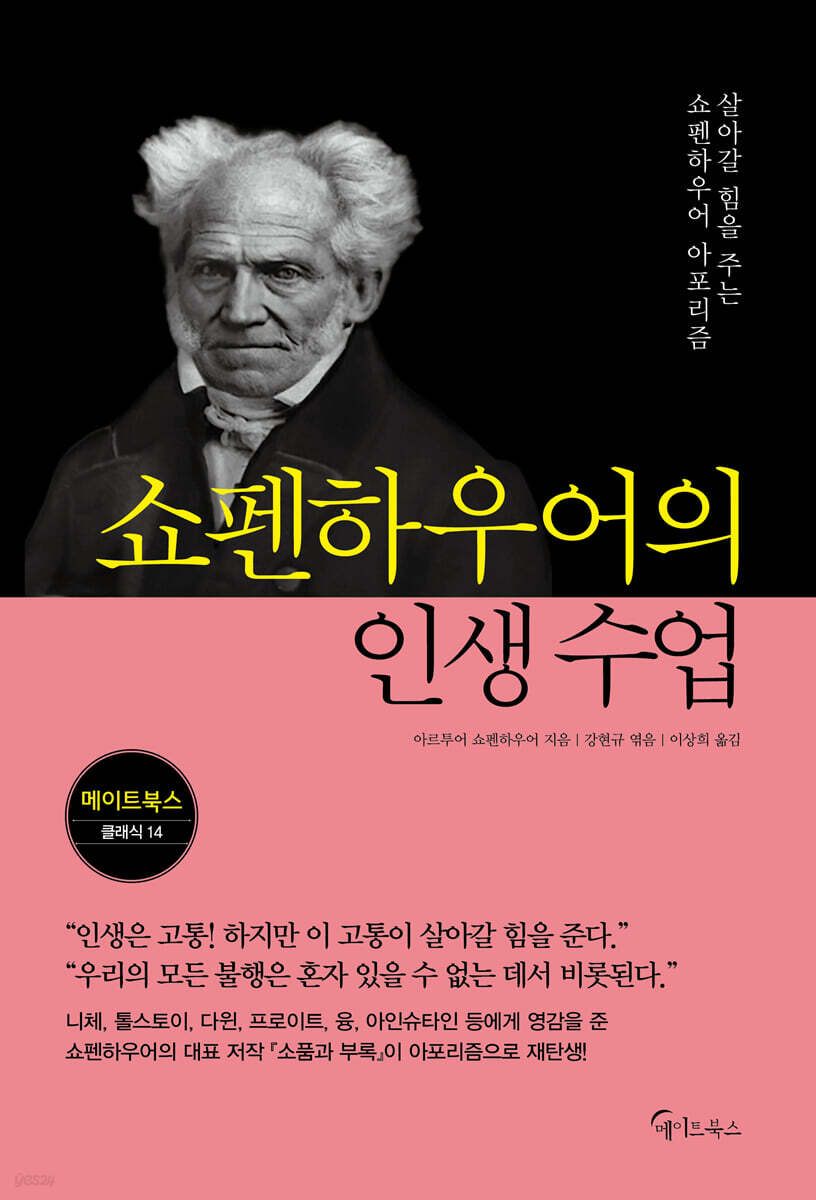
Schopenhauer's Life Lessons
 |
Description
Book Introduction
A book praised by Nietzsche, Jung, Freud, Tolstoy, Camus, and Chaplin! Do you ever worry, "Is this the right way to live?" Is life painful and difficult? Even after achieving a certain level of financial stability, do you feel a sense of emptiness and weariness, leaving you lost? Do you sometimes experience intense emotional upheaval and depression? If this kind of mental crisis leaves you dissatisfied with your current life, making it difficult to feel happiness, read this book. This book is a life guide containing the great philosopher Schopenhauer's straightforward advice on happiness and the essence of life, the essence of human relationships, and the essence of learning, reading, and independent thinking. In this book, Schopenhauer says that life is suffering itself, but this suffering gives us the strength to live, that wealth and fame do not have a great influence on happiness, that we should not waste our lives trying to show off to others and be evaluated by them, that living less unhappiness is the true meaning of living happily, that a crisis of the mind is overcome by inner richness, not wealth and fame, that unhappiness comes from not being able to be alone, so humans must be lonely, that original thinking is much more important than extensive reading, and that we should start by reading the great classics of the past rather than new books. The wise and honest advice in this book will help modern people, weary of the world's unpredictability, reflect on themselves and gain the strength to live fully. Schopenhauer, revered as a great German philosopher, has generously packed his sharp sense of reality and straightforward advice into this one book. His philosophy contained in this book has had a great influence and inspiration on numerous giants and celebrities from various fields, including Friedrich Nietzsche, Einstein, Carl Jung, Wagner, Charles Darwin, Hermann Hesse, Franz Kafka, Camus, Kant, Tolstoy, Dostoevsky, Charlie Chaplin, Thomas Mann, and Borges. Recently, actor Ha Seok-jin said on a TV show, “Life is lonely. There is a reason why modern people are deeply moved by the message of Schopenhauer, 150 years after his death, such as the famous quote by Schopenhauer, “You must know how to be strong even on your own,” which became a hot topic. This is because Schopenhauer's philosophy is not just a philosophy that offers comfort, but a genuine philosophy that speaks to the real life we live. Schopenhauer's language, full of sarcasm and directness, without any hint of comfort, strikes with even greater weight, like a 'hammer blow', in the 21st century, a time of desolate neoliberalism where the loss of humanity and confusion of values are reaching their peak. This book will not necessarily comfort you, but it will provide you with a strange charm that will comfort you after reading it all. Through this book, you will be able to feel the essence of Schopenhauer's life philosophy that everyone knows but has not yet realized. |
- You can preview some of the book's contents.
Preview
index
Editor's Note - Deepen your reflection and gain wisdom!
Translator's Note _ More cool-headed and more modern than anyone else!
Part 1: Theory of Happiness - Aphorisms for Wisdom in Life
Chapter 1: On What Affects Human Happiness
The three assets of life that determine a person's destiny│The most important thing in life is what exists inside him│Each of us lives only within his own consciousness│The level of my consciousness is the most important of all│The scope of happiness is determined by his predetermined nature│If you are rich on the inside, you will not make many demands on fate│The strengths within me that cannot be replaced by social status or wealth│Let us find joy in our own thoughts even in complete solitude│The first value of happiness is personality, which is ourselves│Let us use the personality given to us as advantageously as possible│Maintain health and develop abilities rather than trying to acquire wealth│The difference between what makes a person and what a person possesses│What one possesses is the most essential element of happiness│Wealth and reputation are in a relationship that influences and helps each other
Chapter 2: On What Makes a Human Being
Everything else besides personality is only indirectly related to happiness and satisfaction. If you want to know if he is happy, see if he is a bright person. Health and movement are essential for brightness to bloom. What makes people unhappy is our thoughts about things. Health is the only thing behind it. If you succeed even once in ten, be very happy and encourage yourself. Find the source of joy within yourself to become a happier being. Become a person who has a lot inside yourself. An intelligent life saves a person from many things. If you look for the joy of life outside, that happiness is nothing but a house built on sand.
Chapter 3: On What Humans Have
The desire for wealth is endless and extremely difficult to satisfy. │Satisfaction with possessions depends on the relative amount. │Why owning a lot of things does not bring comfort. │Wealth is like seawater: the more you drink, the thirstier you become. │There is no eternal pain, and no eternal joy.
Chapter 4: On what humans reveal to others
Other people's opinions themselves are not that important to happiness│The value I give myself and what I simply appear to others│Let's live in our own opinions, not in the opinions of others│You can never be happy if you care what others say│Let's not give too much value to other people's opinions│Interest in other people's opinions creates worry and fear│Let's free our lives from the gaze of others│Vanity makes people talkative, but self-esteem makes them quiet│Nothing strengthens courage more than hearing a good reputation│Don't be intoxicated by temporary fame, false fame│It is not fame itself that is valuable, but the achievement of fame│When you give your all in your own way, you will gain posthumous fame.
Chapter 5: On Our Attitude Toward Ourselves
Focus on the disasters you have avoided rather than the joys you have enjoyed. To live happily is to live less unhappily. You should avoid disasters rather than pursue the joys of life. If you build happiness on too broad a scope, it is easy for it to collapse. The present is the only real thing, the only certainty. Among future disasters, worry only about those that are very certain to come. Cherish all the harsh present of everyday life that you pass by without a second thought. Simplify your relationships as much as possible without becoming bored. There is no worse way to happiness than the big world and the luxurious life. If you overcome emptiness with constant stimulation from the outside, you will become unhappy. It becomes easier to act sensibly as you get older. Solitude has many advantages as well as disadvantages, but they are very small. Although you are among them, you are not completely with them. Those who suffer because others are happy can never be happy. Think carefully before putting any plan into action. Stop thinking about unfortunate events that have already happened. You must suppress your imagination in everything about happiness or unhappiness. This is "What if it's not mine?" Let us ask ourselves this often. │Do not try to brighten up the present gloom by guessing only favorable possibilities. │When opening one drawer of the mind, let us close all the others. │Let us prevent it by self-imposed force before it comes from outside. │Many misfortunes befall everyone, so we must give up and endure them. │If we do, create, and learn something, we will not fall into terrible boredom. │The countless events of life are like pictures in a kaleidoscope. │We must be especially careful not to owe interest to time. │Face sudden joys or sorrows calmly and find ourselves. │Do not act foolishly, but think wisely. │We must face the trials and calamities of fate bravely.
Chapter 6: Our Attitude Toward Others
I will not change them, just as I cannot change a stone. │ Understand and understand others only to the extent of your own intelligence. │ Choose whether to be loved or respected by others. │ They value only their own egos, and nothing else. │ Be patient even when faced with unreasonable things among foolish people. │ Do not be too lenient or too affectionate toward others. │ If you forgive and forget their mistakes, they will repeat them. │ Do not make others your role models. │ Do not contradict others' opinions, and refrain from correcting their mistakes. │ If you want them to trust your judgment, speak calmly and without excitement. │ Do not indulge in self-praise, even when you have perfectly good reasons. │ When to pretend to believe what others say and when to pretend not to believe it. │ Write down and remember the procedures for dealing with each person. │ Do not show anger or hatred in any way other than through your actions. │ Do not speak in a strong tone, but leave it to the other person's understanding.
Chapter 7: On Growing Old
The second half of life when you realize that there is nothing to be gained from this world│In autumn, the days become shorter but more vibrant│The reason why our memories become proportionally shorter as we live longer│Why does the remaining life before us seem infinitely long when we are young?│We live with the interest of vitality until we are thirty-six│As we get older, we live our lives less consciously│Only when we reach the end of our lives do we realize what kind of person we are│Life in old age is not sad because passion cannot bring happiness│Serenity in old age is a prerequisite for happiness
Part 2: Theory of Life _ Aphorisms for a Full Life
Chapter 1: On Not Being Extinct by Death
There is no need to fear the moment of transition to death│Time does not exist separately from our perception│Humans are something other than nothing with life│How to recognize the eternity of one's inner being more clearly│Let's live each day without feeling the fear of death│Dying means going to the place from which all life came│How could I exist if the races of the past did not die?
Chapter 2: On the Vanity of Survival
In reality, even the most insignificant present is superior to the most important past. │Every evening, we become poorer by one day. │There is no possibility of obtaining the stability and happiness we always seek. │The denial of the will to live opens the way to survival. │Only at the end of life do we realize this. │The task of life is to make a living and continue living. │When desires are achieved, suffering disappears, but boredom soon sets in.
Chapter 3: On the World's Suffering
It may seem like an exception, but in fact, misfortune is generally the rule. │Why we tend to think only of the little things that bother us. │Disaster is not passive but active. │Each of our lives is a continuous struggle. │Work, hardship, effort, and pain are the fate that humans carry with them throughout their lives. │The measure of human happiness is the lack of pain. │Nevertheless, everyone wants to live well. │Why the phrase “I endured life” is such a wonderful expression. │Let’s get used to seeing this world as a place of suffering.
Chapter 4: On Knowledge and Scholarship
Teachers teach to make money, students learn to gain status. │How can you read so many books yet not think like that? │Why most books are so incredibly boring. │To achieve great things, learning must become the goal in itself.
Chapter 5: On Independent Thinking
Only a very small number of scholars have the ability to think. │ Too much reading prevents independent thinking. │ Those who simply read a lot of books and those who read the book called the world. │ Other people's thoughts acquired through reading are never your own. │ You should read only when the well of your own thoughts has dried up. │ What you discover through independent thinking is of immense value. │ The difference between a thinker and a mere scholar is whether or not they have independent perception. │ Other people's thoughts sprout from other people's minds. │ Those who spend their whole lives reading and those who spend their whole lives thinking. │ You should not completely ignore the real world while reading. │ Mere experience cannot replace thinking as reading does. │ Those who think independently are like monarchs. │ Do not compensate for your own lack of insight by mobilizing others. │ Humans can only be called thinking beings in the broadest sense.
Chapter 6: On Reading and Books
An ignorant rich man without dignity is like a beast. │Beware of the evils of reading that makes you lose the ability to think for yourself. │If you don't have innate talent, reading will only make you a shallow imitator. │The great books in the library have become fossils. │The reason why we shed tears while looking at a thick book list. │The art of not reading is very important in our reading method. │Modern idiot readers who only read newly published books. │Books written by great minds should not be left on the bookshelf. │Only rare, genuine works become eternal books. │Do not confuse making the contents of a book your own with buying it. │It is better to read an important book twice immediately, no matter what it is. │There is no better way to read than the old classics. │The history of literature and art is both joyful and cheerful.
Chapter 7: On Education
The difference between natural and artificial education│Children should be educated so that intuition always precedes concepts│Introduce them to the real world first rather than rushing them into books│This kind of education should be implemented during childhood and adolescence│Each individual's ability has absolutely nothing to do with the maturity of their cognition.
Chapter 8 Parables and Fables that Tell the Essence of Life
The Parable of the Concave Mirror, Which Can Be Used in Various Ways│The Difference Between Beautiful and Sublime Land and Fertile and Rich Land│Other animals avoid humans, but flies land on their noses│The Difference Between an Astronomer and a Philosopher│There is no rose without thorns, but there are many thorns without roses│The fir tree endures with us in good times as well as in bad│I will be the same as I am when winter comes!│Unlike other plants, the tree never dies│I bloom for myself, not for others!│I rise only because I am the sun, and whoever can see me, look at me!│Be patient and endure.
Such patience is the condition for your glory and fame! │He who ascends to the sky in a balloon sees the earth gradually sinking downwards │A man's spiritual greatness increases as he moves further away │To view all things with a bright and joyful gaze │Keep an appropriate distance between you that can endure one another
Translator's Note _ More cool-headed and more modern than anyone else!
Part 1: Theory of Happiness - Aphorisms for Wisdom in Life
Chapter 1: On What Affects Human Happiness
The three assets of life that determine a person's destiny│The most important thing in life is what exists inside him│Each of us lives only within his own consciousness│The level of my consciousness is the most important of all│The scope of happiness is determined by his predetermined nature│If you are rich on the inside, you will not make many demands on fate│The strengths within me that cannot be replaced by social status or wealth│Let us find joy in our own thoughts even in complete solitude│The first value of happiness is personality, which is ourselves│Let us use the personality given to us as advantageously as possible│Maintain health and develop abilities rather than trying to acquire wealth│The difference between what makes a person and what a person possesses│What one possesses is the most essential element of happiness│Wealth and reputation are in a relationship that influences and helps each other
Chapter 2: On What Makes a Human Being
Everything else besides personality is only indirectly related to happiness and satisfaction. If you want to know if he is happy, see if he is a bright person. Health and movement are essential for brightness to bloom. What makes people unhappy is our thoughts about things. Health is the only thing behind it. If you succeed even once in ten, be very happy and encourage yourself. Find the source of joy within yourself to become a happier being. Become a person who has a lot inside yourself. An intelligent life saves a person from many things. If you look for the joy of life outside, that happiness is nothing but a house built on sand.
Chapter 3: On What Humans Have
The desire for wealth is endless and extremely difficult to satisfy. │Satisfaction with possessions depends on the relative amount. │Why owning a lot of things does not bring comfort. │Wealth is like seawater: the more you drink, the thirstier you become. │There is no eternal pain, and no eternal joy.
Chapter 4: On what humans reveal to others
Other people's opinions themselves are not that important to happiness│The value I give myself and what I simply appear to others│Let's live in our own opinions, not in the opinions of others│You can never be happy if you care what others say│Let's not give too much value to other people's opinions│Interest in other people's opinions creates worry and fear│Let's free our lives from the gaze of others│Vanity makes people talkative, but self-esteem makes them quiet│Nothing strengthens courage more than hearing a good reputation│Don't be intoxicated by temporary fame, false fame│It is not fame itself that is valuable, but the achievement of fame│When you give your all in your own way, you will gain posthumous fame.
Chapter 5: On Our Attitude Toward Ourselves
Focus on the disasters you have avoided rather than the joys you have enjoyed. To live happily is to live less unhappily. You should avoid disasters rather than pursue the joys of life. If you build happiness on too broad a scope, it is easy for it to collapse. The present is the only real thing, the only certainty. Among future disasters, worry only about those that are very certain to come. Cherish all the harsh present of everyday life that you pass by without a second thought. Simplify your relationships as much as possible without becoming bored. There is no worse way to happiness than the big world and the luxurious life. If you overcome emptiness with constant stimulation from the outside, you will become unhappy. It becomes easier to act sensibly as you get older. Solitude has many advantages as well as disadvantages, but they are very small. Although you are among them, you are not completely with them. Those who suffer because others are happy can never be happy. Think carefully before putting any plan into action. Stop thinking about unfortunate events that have already happened. You must suppress your imagination in everything about happiness or unhappiness. This is "What if it's not mine?" Let us ask ourselves this often. │Do not try to brighten up the present gloom by guessing only favorable possibilities. │When opening one drawer of the mind, let us close all the others. │Let us prevent it by self-imposed force before it comes from outside. │Many misfortunes befall everyone, so we must give up and endure them. │If we do, create, and learn something, we will not fall into terrible boredom. │The countless events of life are like pictures in a kaleidoscope. │We must be especially careful not to owe interest to time. │Face sudden joys or sorrows calmly and find ourselves. │Do not act foolishly, but think wisely. │We must face the trials and calamities of fate bravely.
Chapter 6: Our Attitude Toward Others
I will not change them, just as I cannot change a stone. │ Understand and understand others only to the extent of your own intelligence. │ Choose whether to be loved or respected by others. │ They value only their own egos, and nothing else. │ Be patient even when faced with unreasonable things among foolish people. │ Do not be too lenient or too affectionate toward others. │ If you forgive and forget their mistakes, they will repeat them. │ Do not make others your role models. │ Do not contradict others' opinions, and refrain from correcting their mistakes. │ If you want them to trust your judgment, speak calmly and without excitement. │ Do not indulge in self-praise, even when you have perfectly good reasons. │ When to pretend to believe what others say and when to pretend not to believe it. │ Write down and remember the procedures for dealing with each person. │ Do not show anger or hatred in any way other than through your actions. │ Do not speak in a strong tone, but leave it to the other person's understanding.
Chapter 7: On Growing Old
The second half of life when you realize that there is nothing to be gained from this world│In autumn, the days become shorter but more vibrant│The reason why our memories become proportionally shorter as we live longer│Why does the remaining life before us seem infinitely long when we are young?│We live with the interest of vitality until we are thirty-six│As we get older, we live our lives less consciously│Only when we reach the end of our lives do we realize what kind of person we are│Life in old age is not sad because passion cannot bring happiness│Serenity in old age is a prerequisite for happiness
Part 2: Theory of Life _ Aphorisms for a Full Life
Chapter 1: On Not Being Extinct by Death
There is no need to fear the moment of transition to death│Time does not exist separately from our perception│Humans are something other than nothing with life│How to recognize the eternity of one's inner being more clearly│Let's live each day without feeling the fear of death│Dying means going to the place from which all life came│How could I exist if the races of the past did not die?
Chapter 2: On the Vanity of Survival
In reality, even the most insignificant present is superior to the most important past. │Every evening, we become poorer by one day. │There is no possibility of obtaining the stability and happiness we always seek. │The denial of the will to live opens the way to survival. │Only at the end of life do we realize this. │The task of life is to make a living and continue living. │When desires are achieved, suffering disappears, but boredom soon sets in.
Chapter 3: On the World's Suffering
It may seem like an exception, but in fact, misfortune is generally the rule. │Why we tend to think only of the little things that bother us. │Disaster is not passive but active. │Each of our lives is a continuous struggle. │Work, hardship, effort, and pain are the fate that humans carry with them throughout their lives. │The measure of human happiness is the lack of pain. │Nevertheless, everyone wants to live well. │Why the phrase “I endured life” is such a wonderful expression. │Let’s get used to seeing this world as a place of suffering.
Chapter 4: On Knowledge and Scholarship
Teachers teach to make money, students learn to gain status. │How can you read so many books yet not think like that? │Why most books are so incredibly boring. │To achieve great things, learning must become the goal in itself.
Chapter 5: On Independent Thinking
Only a very small number of scholars have the ability to think. │ Too much reading prevents independent thinking. │ Those who simply read a lot of books and those who read the book called the world. │ Other people's thoughts acquired through reading are never your own. │ You should read only when the well of your own thoughts has dried up. │ What you discover through independent thinking is of immense value. │ The difference between a thinker and a mere scholar is whether or not they have independent perception. │ Other people's thoughts sprout from other people's minds. │ Those who spend their whole lives reading and those who spend their whole lives thinking. │ You should not completely ignore the real world while reading. │ Mere experience cannot replace thinking as reading does. │ Those who think independently are like monarchs. │ Do not compensate for your own lack of insight by mobilizing others. │ Humans can only be called thinking beings in the broadest sense.
Chapter 6: On Reading and Books
An ignorant rich man without dignity is like a beast. │Beware of the evils of reading that makes you lose the ability to think for yourself. │If you don't have innate talent, reading will only make you a shallow imitator. │The great books in the library have become fossils. │The reason why we shed tears while looking at a thick book list. │The art of not reading is very important in our reading method. │Modern idiot readers who only read newly published books. │Books written by great minds should not be left on the bookshelf. │Only rare, genuine works become eternal books. │Do not confuse making the contents of a book your own with buying it. │It is better to read an important book twice immediately, no matter what it is. │There is no better way to read than the old classics. │The history of literature and art is both joyful and cheerful.
Chapter 7: On Education
The difference between natural and artificial education│Children should be educated so that intuition always precedes concepts│Introduce them to the real world first rather than rushing them into books│This kind of education should be implemented during childhood and adolescence│Each individual's ability has absolutely nothing to do with the maturity of their cognition.
Chapter 8 Parables and Fables that Tell the Essence of Life
The Parable of the Concave Mirror, Which Can Be Used in Various Ways│The Difference Between Beautiful and Sublime Land and Fertile and Rich Land│Other animals avoid humans, but flies land on their noses│The Difference Between an Astronomer and a Philosopher│There is no rose without thorns, but there are many thorns without roses│The fir tree endures with us in good times as well as in bad│I will be the same as I am when winter comes!│Unlike other plants, the tree never dies│I bloom for myself, not for others!│I rise only because I am the sun, and whoever can see me, look at me!│Be patient and endure.
Such patience is the condition for your glory and fame! │He who ascends to the sky in a balloon sees the earth gradually sinking downwards │A man's spiritual greatness increases as he moves further away │To view all things with a bright and joyful gaze │Keep an appropriate distance between you that can endure one another
Detailed image
.jpg)
Into the book
It is clear that what is important for human happiness, or rather for one's entire existence, is something that exists or arises within oneself.
That is, right there, above all else, lies the inner comfort or discomfort that is the result of human feeling, will, and thought.
In other words, the external situation itself only indirectly influences such emotions.
Therefore, even if the external circumstances or conditions are the same, they have completely different effects on each individual, and each individual living in the same environment lives in a different world.
Because people have their own thoughts, feelings, and wills, and they only respond directly to those things.
External things only affect them to the extent that they cause such things.
On stage, one person plays the role of a monarch, another a prime minister or a prince, and a third a servant, a soldier, or a general, but these differences are merely external.
At their core, they are all the same pitiful comedians, suffering from the same pain and poverty.
Life is just like this.
Differences in social status and wealth allow people to play their part, but they do not correspond to intrinsic differences in happiness and satisfaction.
Likewise, within every person there is a poor person suffering from his own pain and poverty.
Although the suffering and poverty may differ materially from person to person, in essence, their form is surprisingly the same for all.
Of course, there are differences in degree, but they are not the same as differences in social status, wealth, or role.
Because everything that exists for humans and happens to humans exists and is created solely within human consciousness.
A spiritual person can find joy in his own thoughts and imagination even in complete solitude.
But a dull person cannot escape painful boredom, no matter how much he changes his social gatherings, plays, outings, or amusements.
A good, harmonious, and gentle character can be content even in difficult circumstances, but a greedy, jealous, selfish, and wicked person cannot be content no matter how wealthy he is.
Therefore, for those of great spiritual and mental character, most of the entertainments that ordinary people pursue are unnecessary, merely annoying and cumbersome.
People spend thousands or even hundreds of times more effort trying to acquire wealth than they do trying to develop intellectual ability, yet what makes a person what they are has a far greater impact on their happiness than what they possess.
Yet, we often see people working tirelessly from morning to night, like ants, to increase the wealth they already have.
They know nothing, their souls are empty and they cannot feel anything else.
The highest spiritual joys are beyond their reach.
It's just a futile effort to occasionally enjoy a fleeting, sensual pleasure that doesn't take much time, but costs a lot of money.
Ultimately, when the end comes, even if he is lucky enough to actually acquire a great fortune, that wealth will pass to his heirs, who can either increase it or squander it.
Such a person, however serious and meaningful his expression, is as foolish as the life of a man wearing a hat with a bell.
Our happiness is greatly influenced by our bright personality.
How closely this relates to our health can be seen by comparing the emotions we experience when we are healthy and energetic with those we experience when we are sick, anxious, and irritable, even when faced with the same external circumstances or events.
It is not the objective, real appearance of things that makes us happy or unhappy, but our thoughts about them, and it is these that make us happy or unhappy.
This is what Efectetus says.
“It is not things that make people unhappy, but our thoughts about things.”
Setting appropriate limits to our rational desire for possessions is not impossible, but it is indeed difficult.
For satisfaction with possessions depends not on the absolute quantity, but only on the relative proportion, on the relationship between what each person wants and what he possesses.
Judging the object of ownership separately is meaningless, like a numerator without a denominator.
Some people don't think about how much they should own and feel content even if they don't own much.
But other people have 100 times more than that, yet they feel unhappy because they don't have the one thing they want.
Yes, the name "Happiness Theory" itself is just a euphemism.
We must begin with the teaching that living happily means living less unhappily, that is, living to a tolerable degree.
Of course, life is not really meant to be enjoyed, but to endure and end the pain.
The Latin expression for this is 'degere vitam, vita defungi (getting by somehow, enduring life)'.
We must be careful not to place so many demands on life that we build happiness on a broad scale.
Happiness built on too broad a scope is fragile and has a much higher chance of disaster, so bad things will eventually happen.
Unlike other ordinary buildings, which are more solid the wider their foundation, the building of our happiness is the opposite.
Therefore, the surest way to avoid great misfortune is to balance all the means available to you and lower your demands appropriately.
You should not model your behavior on others, whether you do or do not do it.
This is because the situations, circumstances, and relationships between me and others are never the same, and differences in personality have different influences and atmospheres on behavior.
Therefore, even if two people do the same thing, it is not the same.
After mature reflection and careful and deep consideration, you should act according to your own character.
This originality is also essential in practical terms.
Otherwise, what you do doesn't match who you are.
Anyone who wants to make others trust their judgment should speak calmly, coolly, and without hesitation.
Since violent actions come from will, people will assume that he made such judgments based on will rather than on cool-headed reason.
For the will is fundamental to man, while knowledge is merely a secondary imposition.
Therefore, it is more likely that the passionate appearance is believed to be that the judgment arises from the excited will rather than that the excitement of the will simply arises from the judgment.
The age-old rule of thumb, “Don’t speak in a harsh tone,” means leaving it up to others to figure out what you mean.
Normally, ordinary people do not have good discernment, so they can only interpret the meaning of something after the moment has passed.
On the other hand, the phrase “speak with a strong tone” means to speak with emotion, which means that everything will turn out in the opposite direction of what was originally intended.
For some people, speaking politely and in a friendly tone, even if the content is rude, poses no immediate danger.
Youth is often called the happy time of life, and old age is called the sad time.
If passion brings happiness, then it would be true.
In youth, we are dragged here and there by these passions, and there is little joy and much pain.
When they reach a cold old age, their passion leaves them.
Life in old age acquires the touch of meditation.
Because perception becomes free and takes a superior position.
Since this awareness is not painful in itself, the more this awareness dominates the consciousness, the happier the human being becomes.
To understand that passion cannot bring happiness and that we need not lament old age for not experiencing certain pleasures, we must keep in mind that all pleasures are negative and all pains are positive.
Because all pleasure is merely the satisfaction of some desire.
The fact that pleasure ceases when desires are satisfied is no more deplorable than the fact that one cannot eat any more after a meal or that one must stay awake after a good night's sleep.
A stream does not form a whirlpool unless it encounters an obstacle.
Just like that, human nature and animal nature are such that when everything proceeds according to our will, we do not notice or realize it ourselves.
We do not proceed according to our will, but we realize such things when we encounter some obstacle.
On the other hand, we feel directly, immediately, and very clearly everything that is contrary to our will, everything that hinders and resists that will, everything that is unpleasant and painful.
We do not feel the health of our entire body, but only the pain in small areas, such as when our shoes are too small and tight.
Like that, we only think about the trivial and insignificant things that bother us, without thinking about what is going perfectly well.
This is because, as I often point out, suffering has an active character, while happiness and peace have a passive character.
Scholars are people who have read a lot of books, thinkers, geniuses, people who teach people of the world, and people who have read the book that is the direct world that supports humanity.
To be precise, truth and life blossom only in one's own fundamental thoughts.
Because we only fully and properly understand our own things.
The thoughts of others that we acquire through reading are nothing more than the leftover food of others or the clothes that others have worn and then discarded.
The relationship between our own thoughts and those of others we read in books is like the relationship between a plant in bloom in spring and the fossil of an ancient plant contained in a rock.
Reading is merely a substitute for independent cognition, and when you read, your thoughts are dragged along by the thoughts of others.
If books are what lead us, it only proves how many mazes there are in books and how bad the results can be.
But those who are guided by the guardian spirit, that is, those who think independently, judge spontaneously, and reason correctly, have a compass that shows them the right path.
Therefore, you should read only when the wellspring of your own thoughts has dried up.
Even for people with very brilliant minds, such cases can often arise.
Conversely, to cast out the power of thought that one possesses simply to pick up a book is to commit a grave sin against the Holy Spirit.
Such people are like those who go out into the open air to see dried plant specimens or beautiful scenery in copperplate engravings.
That is, right there, above all else, lies the inner comfort or discomfort that is the result of human feeling, will, and thought.
In other words, the external situation itself only indirectly influences such emotions.
Therefore, even if the external circumstances or conditions are the same, they have completely different effects on each individual, and each individual living in the same environment lives in a different world.
Because people have their own thoughts, feelings, and wills, and they only respond directly to those things.
External things only affect them to the extent that they cause such things.
On stage, one person plays the role of a monarch, another a prime minister or a prince, and a third a servant, a soldier, or a general, but these differences are merely external.
At their core, they are all the same pitiful comedians, suffering from the same pain and poverty.
Life is just like this.
Differences in social status and wealth allow people to play their part, but they do not correspond to intrinsic differences in happiness and satisfaction.
Likewise, within every person there is a poor person suffering from his own pain and poverty.
Although the suffering and poverty may differ materially from person to person, in essence, their form is surprisingly the same for all.
Of course, there are differences in degree, but they are not the same as differences in social status, wealth, or role.
Because everything that exists for humans and happens to humans exists and is created solely within human consciousness.
A spiritual person can find joy in his own thoughts and imagination even in complete solitude.
But a dull person cannot escape painful boredom, no matter how much he changes his social gatherings, plays, outings, or amusements.
A good, harmonious, and gentle character can be content even in difficult circumstances, but a greedy, jealous, selfish, and wicked person cannot be content no matter how wealthy he is.
Therefore, for those of great spiritual and mental character, most of the entertainments that ordinary people pursue are unnecessary, merely annoying and cumbersome.
People spend thousands or even hundreds of times more effort trying to acquire wealth than they do trying to develop intellectual ability, yet what makes a person what they are has a far greater impact on their happiness than what they possess.
Yet, we often see people working tirelessly from morning to night, like ants, to increase the wealth they already have.
They know nothing, their souls are empty and they cannot feel anything else.
The highest spiritual joys are beyond their reach.
It's just a futile effort to occasionally enjoy a fleeting, sensual pleasure that doesn't take much time, but costs a lot of money.
Ultimately, when the end comes, even if he is lucky enough to actually acquire a great fortune, that wealth will pass to his heirs, who can either increase it or squander it.
Such a person, however serious and meaningful his expression, is as foolish as the life of a man wearing a hat with a bell.
Our happiness is greatly influenced by our bright personality.
How closely this relates to our health can be seen by comparing the emotions we experience when we are healthy and energetic with those we experience when we are sick, anxious, and irritable, even when faced with the same external circumstances or events.
It is not the objective, real appearance of things that makes us happy or unhappy, but our thoughts about them, and it is these that make us happy or unhappy.
This is what Efectetus says.
“It is not things that make people unhappy, but our thoughts about things.”
Setting appropriate limits to our rational desire for possessions is not impossible, but it is indeed difficult.
For satisfaction with possessions depends not on the absolute quantity, but only on the relative proportion, on the relationship between what each person wants and what he possesses.
Judging the object of ownership separately is meaningless, like a numerator without a denominator.
Some people don't think about how much they should own and feel content even if they don't own much.
But other people have 100 times more than that, yet they feel unhappy because they don't have the one thing they want.
Yes, the name "Happiness Theory" itself is just a euphemism.
We must begin with the teaching that living happily means living less unhappily, that is, living to a tolerable degree.
Of course, life is not really meant to be enjoyed, but to endure and end the pain.
The Latin expression for this is 'degere vitam, vita defungi (getting by somehow, enduring life)'.
We must be careful not to place so many demands on life that we build happiness on a broad scale.
Happiness built on too broad a scope is fragile and has a much higher chance of disaster, so bad things will eventually happen.
Unlike other ordinary buildings, which are more solid the wider their foundation, the building of our happiness is the opposite.
Therefore, the surest way to avoid great misfortune is to balance all the means available to you and lower your demands appropriately.
You should not model your behavior on others, whether you do or do not do it.
This is because the situations, circumstances, and relationships between me and others are never the same, and differences in personality have different influences and atmospheres on behavior.
Therefore, even if two people do the same thing, it is not the same.
After mature reflection and careful and deep consideration, you should act according to your own character.
This originality is also essential in practical terms.
Otherwise, what you do doesn't match who you are.
Anyone who wants to make others trust their judgment should speak calmly, coolly, and without hesitation.
Since violent actions come from will, people will assume that he made such judgments based on will rather than on cool-headed reason.
For the will is fundamental to man, while knowledge is merely a secondary imposition.
Therefore, it is more likely that the passionate appearance is believed to be that the judgment arises from the excited will rather than that the excitement of the will simply arises from the judgment.
The age-old rule of thumb, “Don’t speak in a harsh tone,” means leaving it up to others to figure out what you mean.
Normally, ordinary people do not have good discernment, so they can only interpret the meaning of something after the moment has passed.
On the other hand, the phrase “speak with a strong tone” means to speak with emotion, which means that everything will turn out in the opposite direction of what was originally intended.
For some people, speaking politely and in a friendly tone, even if the content is rude, poses no immediate danger.
Youth is often called the happy time of life, and old age is called the sad time.
If passion brings happiness, then it would be true.
In youth, we are dragged here and there by these passions, and there is little joy and much pain.
When they reach a cold old age, their passion leaves them.
Life in old age acquires the touch of meditation.
Because perception becomes free and takes a superior position.
Since this awareness is not painful in itself, the more this awareness dominates the consciousness, the happier the human being becomes.
To understand that passion cannot bring happiness and that we need not lament old age for not experiencing certain pleasures, we must keep in mind that all pleasures are negative and all pains are positive.
Because all pleasure is merely the satisfaction of some desire.
The fact that pleasure ceases when desires are satisfied is no more deplorable than the fact that one cannot eat any more after a meal or that one must stay awake after a good night's sleep.
A stream does not form a whirlpool unless it encounters an obstacle.
Just like that, human nature and animal nature are such that when everything proceeds according to our will, we do not notice or realize it ourselves.
We do not proceed according to our will, but we realize such things when we encounter some obstacle.
On the other hand, we feel directly, immediately, and very clearly everything that is contrary to our will, everything that hinders and resists that will, everything that is unpleasant and painful.
We do not feel the health of our entire body, but only the pain in small areas, such as when our shoes are too small and tight.
Like that, we only think about the trivial and insignificant things that bother us, without thinking about what is going perfectly well.
This is because, as I often point out, suffering has an active character, while happiness and peace have a passive character.
Scholars are people who have read a lot of books, thinkers, geniuses, people who teach people of the world, and people who have read the book that is the direct world that supports humanity.
To be precise, truth and life blossom only in one's own fundamental thoughts.
Because we only fully and properly understand our own things.
The thoughts of others that we acquire through reading are nothing more than the leftover food of others or the clothes that others have worn and then discarded.
The relationship between our own thoughts and those of others we read in books is like the relationship between a plant in bloom in spring and the fossil of an ancient plant contained in a rock.
Reading is merely a substitute for independent cognition, and when you read, your thoughts are dragged along by the thoughts of others.
If books are what lead us, it only proves how many mazes there are in books and how bad the results can be.
But those who are guided by the guardian spirit, that is, those who think independently, judge spontaneously, and reason correctly, have a compass that shows them the right path.
Therefore, you should read only when the wellspring of your own thoughts has dried up.
Even for people with very brilliant minds, such cases can often arise.
Conversely, to cast out the power of thought that one possesses simply to pick up a book is to commit a grave sin against the Holy Spirit.
Such people are like those who go out into the open air to see dried plant specimens or beautiful scenery in copperplate engravings.
--- From the text
Publisher's Review
Insights from a great philosopher revealing the essence of happiness and the secrets of life!
Schopenhauer was always labeled negatively as a cynic, a nihilist, a pessimist, and an outsider, but he was actually a philosopher who loved life and humanity more than anyone else, and who fiercely sought to find the essence of life.
He was simply a realist and an existentialist who faced the reality we live in as it is and spoke about it coolly and without reservation.
He firmly states that this world is full of suffering and unhappiness, and that human happiness depends on how much suffering and unhappiness can be reduced, and that a paradise filled with happiness is only possible in imagination, not reality.
In other words, happiness is just a dream, but suffering is reality.
When we first acknowledge that this world is by no means beautiful and that we humans are by no means rational, and when we look at humans and the world, we can fully understand his philosophy.
His thoughts are summarized in this book, “Etiquette and Appendix,” published in 1851, in which he insightfully explored the meaning of happiness and life. Even now, 170 years later, this book is still widely read by many people and is considered a great classic.
This book, which Schopenhauer published under the title “Etude and Appendix,” which was a selection of writings that he could not include in his first book, “The World as Will and Representation,” brought him great acclaim and popular success.
The ambitiously published "The World as Will and Representation" was so difficult to understand and its context was so difficult to grasp that it sold only a few copies for several decades after its publication, and his presence was said to have been faint.
Unlike "The World as Will and Representation," which was completely ignored, this book was written in a way that the general public could understand, and after its publication, followers of his philosophy began to appear, and it gradually became known to people around the world beyond Europe, gaining worldwide fame.
Contrary to the gloomy predictions of the publisher who published “Etc. and Appendix” at the time, this book soon became the most popular and best-selling of Schopenhauer’s books.
In particular, Schopenhauer is said to have written this book with young readers in mind.
For this reason, since the publication of this book, Schopenhauer's sentences have come to be regarded as the highest quality prose and outstanding literary writing in the German-speaking world.
However, it is by no means easy for modern readers to read the complete translation of “Small and Appendix” as it is.
Although it was written for the general public compared to his first book, it is still a philosophy book and is therefore difficult to read and difficult to finish. In addition, there are many parts that are somewhat difficult to understand because the content related to mythological characters and historical figures is contained in a symbolic and fragmentary manner.
Accordingly, in this translated version, we have extracted only the core contents and added new column titles to suit a modern sensibility without damaging the quality of the original text, in order to help modern readers understand it.
I also re-edited some of the table of contents and added some translation notes.
Schopenhauer was always labeled negatively as a cynic, a nihilist, a pessimist, and an outsider, but he was actually a philosopher who loved life and humanity more than anyone else, and who fiercely sought to find the essence of life.
He was simply a realist and an existentialist who faced the reality we live in as it is and spoke about it coolly and without reservation.
He firmly states that this world is full of suffering and unhappiness, and that human happiness depends on how much suffering and unhappiness can be reduced, and that a paradise filled with happiness is only possible in imagination, not reality.
In other words, happiness is just a dream, but suffering is reality.
When we first acknowledge that this world is by no means beautiful and that we humans are by no means rational, and when we look at humans and the world, we can fully understand his philosophy.
His thoughts are summarized in this book, “Etiquette and Appendix,” published in 1851, in which he insightfully explored the meaning of happiness and life. Even now, 170 years later, this book is still widely read by many people and is considered a great classic.
This book, which Schopenhauer published under the title “Etude and Appendix,” which was a selection of writings that he could not include in his first book, “The World as Will and Representation,” brought him great acclaim and popular success.
The ambitiously published "The World as Will and Representation" was so difficult to understand and its context was so difficult to grasp that it sold only a few copies for several decades after its publication, and his presence was said to have been faint.
Unlike "The World as Will and Representation," which was completely ignored, this book was written in a way that the general public could understand, and after its publication, followers of his philosophy began to appear, and it gradually became known to people around the world beyond Europe, gaining worldwide fame.
Contrary to the gloomy predictions of the publisher who published “Etc. and Appendix” at the time, this book soon became the most popular and best-selling of Schopenhauer’s books.
In particular, Schopenhauer is said to have written this book with young readers in mind.
For this reason, since the publication of this book, Schopenhauer's sentences have come to be regarded as the highest quality prose and outstanding literary writing in the German-speaking world.
However, it is by no means easy for modern readers to read the complete translation of “Small and Appendix” as it is.
Although it was written for the general public compared to his first book, it is still a philosophy book and is therefore difficult to read and difficult to finish. In addition, there are many parts that are somewhat difficult to understand because the content related to mythological characters and historical figures is contained in a symbolic and fragmentary manner.
Accordingly, in this translated version, we have extracted only the core contents and added new column titles to suit a modern sensibility without damaging the quality of the original text, in order to help modern readers understand it.
I also re-edited some of the table of contents and added some translation notes.
GOODS SPECIFICS
- Publication date: November 24, 2023
- Page count, weight, size: 356 pages | 540g | 153*225*23mm
- ISBN13: 9791160024166
- ISBN10: 1160024162
You may also like
카테고리
korean


korean

![GQ KOREA Mark (Monthly): December [2025]](http://librairie.coreenne.fr/cdn/shop/files/8ef265dbbfbf186523ed75ba7319009d.jpg?v=1765340328&width=3840)


