

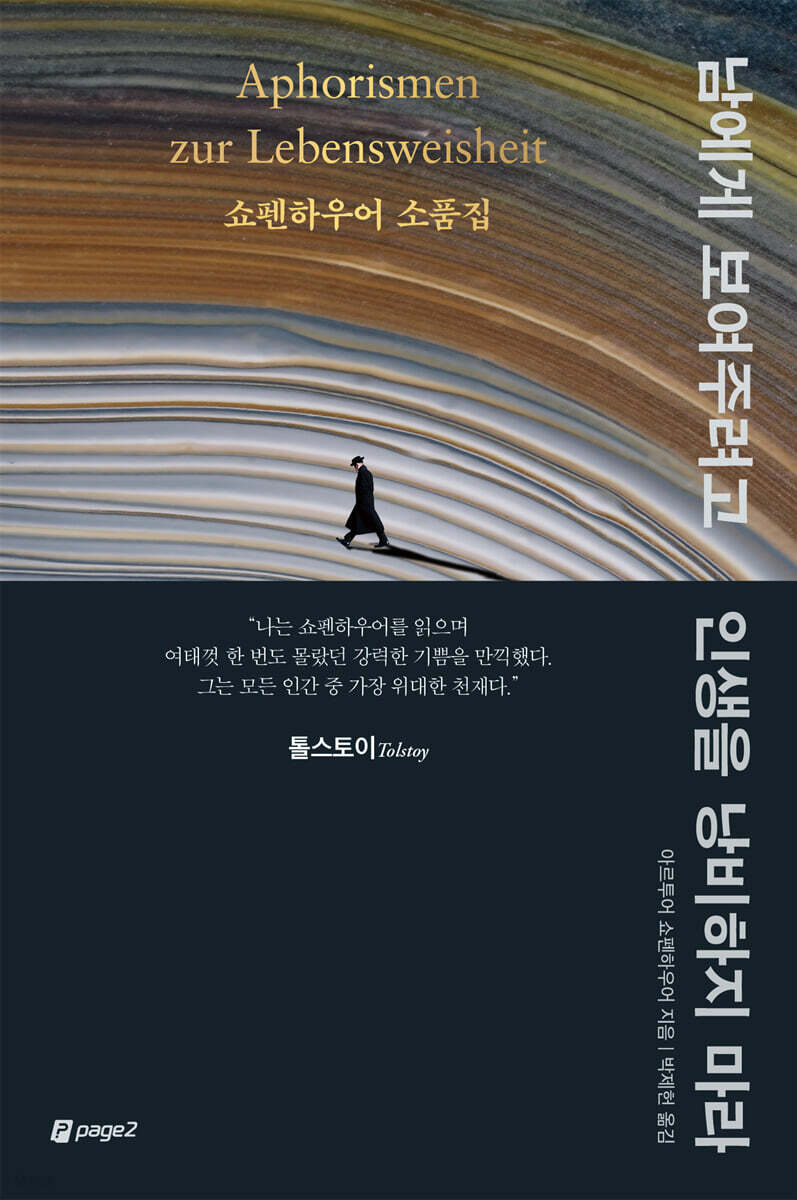
Don't waste your life trying to show off to others.
 |
Description
Book Introduction
“Choose solid loneliness over shallow happiness!”
Schopenhauer's aphorisms on life and wisdom that inspired Nietzsche, Tolstoy, and Einstein
“I experienced a joy as powerful as I had ever known while reading Schopenhauer.” _Tolstoy
“Schopenhauer is the only person who pursued truth even after losing all hope.” _Nietzsche
“There is a clear reason why this book has achieved its current fame.
“Elegant and very practical.” _Robert Zimmer
Schopenhauer, who is called the philosopher of philosophers, has always been followed by labels such as pessimist, critic, and outsider.
But he was a person who pursued the truth of life with a more humane perspective than anyone else.
In this book, published in 1851, he explained the meaning of happiness in a cynical yet realistic way, and even now, 200 years later, it is still read by many people and is considered a classic of philosophy that must be read at least once in one's life.
Schopenhauer's aphorisms on life and wisdom that inspired Nietzsche, Tolstoy, and Einstein
“I experienced a joy as powerful as I had ever known while reading Schopenhauer.” _Tolstoy
“Schopenhauer is the only person who pursued truth even after losing all hope.” _Nietzsche
“There is a clear reason why this book has achieved its current fame.
“Elegant and very practical.” _Robert Zimmer
Schopenhauer, who is called the philosopher of philosophers, has always been followed by labels such as pessimist, critic, and outsider.
But he was a person who pursued the truth of life with a more humane perspective than anyone else.
In this book, published in 1851, he explained the meaning of happiness in a cynical yet realistic way, and even now, 200 years later, it is still read by many people and is considered a classic of philosophy that must be read at least once in one's life.
- You can preview some of the book's contents.
Preview
index
introduction
Ⅰ Basic classification
Ⅱ The nature of the individual
Ⅲ Personal property
Ⅳ Personal externality
V. Recommendations and maxims
- 1.
common things
- 2.
attitude toward oneself
- 3.
Attitude towards others
- 4.
Attitude toward worldly affairs and destiny
Ⅵ About the age difference
Ⅰ Basic classification
Ⅱ The nature of the individual
Ⅲ Personal property
Ⅳ Personal externality
V. Recommendations and maxims
- 1.
common things
- 2.
attitude toward oneself
- 3.
Attitude towards others
- 4.
Attitude toward worldly affairs and destiny
Ⅵ About the age difference
Detailed image
.jpg)
Into the book
I believe that the wisdom of life is a concept inherent entirely in human consciousness.
This is called happiness theory, and happiness theory refers to the technique of living life as happily and enjoyably as possible.
These skills can serve as a guide to becoming a happy being.
However, if we think about this fact purely and objectively (since subjective judgment is important here), we can define it as much better to live a happy life than to become non-existent (the negative form of existence_translator's note) through cool-headed and experienced reflection.
Therefore, from the concept of wisdom of life, the reason we are endlessly obsessed with a happy life is not because we fear death, but because we pursue a happy life itself.
--- p.8
The reason so many people born into wealth squander their enormous inheritances so quickly and helplessly is the boredom that comes from a poor and empty mind.
If you are born rich but poor on the inside, you will try to replace your inner wealth with external wealth by accepting anything from outside, but your efforts will be futile.
It's like an old man trying to look younger by borrowing the energy of a girl.
In this way, inner poverty eventually leads to outer poverty.
--- p.25
In everything humans do, the thing they care most about is what other people think.
If we look closely, we can see that half of human worries and fears come from thoughts about other people.
Frequently wounded and pathologically oversensitive, pride is based on vanity and arrogance, as well as on showing off and boasting.
If only these worries and obsessions were not there, luxury would not even be a tenth of what it is now.
All pride, all issues of face, all stubbornness, no matter how different in kind and extent, are rooted in worry and obsession.
--- p.91
The only time a human being can be himself is when he is alone.
Therefore, he who does not love solitude does not love freedom.
Because humans are free only when they are alone.
Socializing and coercion are inseparable companions, and the stronger each person's individuality in a group, the more difficult it is to make sacrifices.
Accordingly, each person will avoid, tolerate, or love loneliness in proportion to his or her own worth.
In solitude, a miserable man feels his misery, and a great man feels his greatness.
--- p.207
La Bruyère said, 'All our suffering comes from not being able to be alone.'
Most people we come into contact with are morally evil, intellectually dull, or flawed, making sociability a dangerous and even harmful trait.
--- p.215
If I consider someone much more important than they need to be, they will immediately feel like something has been stolen from them.
So in revenge for this, he will try to get something back from me.
Superiority in a relationship arises from one person's not needing the other in any way and from the way he or she demonstrates this.
Accordingly, it is desirable to give the impression that you can get along well without the other person, regardless of whether the other person is a man or a woman.
At times like these, friendship becomes stronger.
Most people don't really get hurt even if they are occasionally insulted.
The more you ignore them, the more they value their friendship.
--- p.263
Because it is only in old age that one becomes rich in experience and knowledge.
Old age is a time when we observe things from many different perspectives, reflect on them, find the connections and links between them, and understand their context for the first time.
Only then can all problems be solved.
Because we have more evidence to illuminate individual concepts, we now understand much more thoroughly the issues we already knew in our youth.
Even things you thought you knew when you were young, when you get older you really know a lot and as a result of reflecting on all aspects, you gain consistent understanding.
This is called happiness theory, and happiness theory refers to the technique of living life as happily and enjoyably as possible.
These skills can serve as a guide to becoming a happy being.
However, if we think about this fact purely and objectively (since subjective judgment is important here), we can define it as much better to live a happy life than to become non-existent (the negative form of existence_translator's note) through cool-headed and experienced reflection.
Therefore, from the concept of wisdom of life, the reason we are endlessly obsessed with a happy life is not because we fear death, but because we pursue a happy life itself.
--- p.8
The reason so many people born into wealth squander their enormous inheritances so quickly and helplessly is the boredom that comes from a poor and empty mind.
If you are born rich but poor on the inside, you will try to replace your inner wealth with external wealth by accepting anything from outside, but your efforts will be futile.
It's like an old man trying to look younger by borrowing the energy of a girl.
In this way, inner poverty eventually leads to outer poverty.
--- p.25
In everything humans do, the thing they care most about is what other people think.
If we look closely, we can see that half of human worries and fears come from thoughts about other people.
Frequently wounded and pathologically oversensitive, pride is based on vanity and arrogance, as well as on showing off and boasting.
If only these worries and obsessions were not there, luxury would not even be a tenth of what it is now.
All pride, all issues of face, all stubbornness, no matter how different in kind and extent, are rooted in worry and obsession.
--- p.91
The only time a human being can be himself is when he is alone.
Therefore, he who does not love solitude does not love freedom.
Because humans are free only when they are alone.
Socializing and coercion are inseparable companions, and the stronger each person's individuality in a group, the more difficult it is to make sacrifices.
Accordingly, each person will avoid, tolerate, or love loneliness in proportion to his or her own worth.
In solitude, a miserable man feels his misery, and a great man feels his greatness.
--- p.207
La Bruyère said, 'All our suffering comes from not being able to be alone.'
Most people we come into contact with are morally evil, intellectually dull, or flawed, making sociability a dangerous and even harmful trait.
--- p.215
If I consider someone much more important than they need to be, they will immediately feel like something has been stolen from them.
So in revenge for this, he will try to get something back from me.
Superiority in a relationship arises from one person's not needing the other in any way and from the way he or she demonstrates this.
Accordingly, it is desirable to give the impression that you can get along well without the other person, regardless of whether the other person is a man or a woman.
At times like these, friendship becomes stronger.
Most people don't really get hurt even if they are occasionally insulted.
The more you ignore them, the more they value their friendship.
--- p.263
Because it is only in old age that one becomes rich in experience and knowledge.
Old age is a time when we observe things from many different perspectives, reflect on them, find the connections and links between them, and understand their context for the first time.
Only then can all problems be solved.
Because we have more evidence to illuminate individual concepts, we now understand much more thoroughly the issues we already knew in our youth.
Even things you thought you knew when you were young, when you get older you really know a lot and as a result of reflecting on all aspects, you gain consistent understanding.
--- p.334
Publisher's Review
“Humans are born with the quality of happiness.”
The more you try to be happy, the more unhappy you become.
The 'theory of happiness' that everyone should pursue happiness is considered an obvious proposition that needs no debate.
But Schopenhauer says that all unhappiness arises from this premise.
He says, "Happiness is just a dream, pain is reality," and through this book, he conveys the wisdom of life that the original meaning of "living happily" is "living less unhappily," that is, living with patience and perseverance.
Everyone is born with the quality of happiness, but we don't realize that we are becoming unhappy because we only pursue happiness through possessions and external things.
In this book, Schopenhauer, in his characteristically cynical style, refutes one by one our prejudices about happiness and considers what kind of happiness we should pursue.
“Just as diligence does not lead to happiness, boredom does not lead to unhappiness.”
“Get rid of the illusion that you can change your destiny with money.”
“Don’t look for what makes you happy, look for what makes you unhappy.”
“The more one realizes the purpose of life, the more unhappy one becomes.”
“Happiness belongs to those who are content with themselves.”
“Perfect happiness does not exist.”
“Sorrow and joy are one body.”
Schopenhauer's unique writing style, which is cool but more realistic than anyone else's, contains guidelines for life that can be carried with you for the rest of your life.
This book will provide those suffering from present unhappiness with an opportunity to realize another way to live in the present and pursue happiness.
A classic of philosophy you must read at least once in your life.
This book corresponds to the short section of Schopenhauer's 『Parerga und Paralipomena』, published in 1851.
'Aphorisms', which were popular among readers, were translated into German and published separately as 'Aphorisms on the Wisdom of Life (Aphorisms zur Lebensweisheit)'. It is a book that stands out for its unique, cheerful style and language about a happy life.
Until now, no other work by Schopenhauer has reached such a wide readership and received such high praise from experts.
And there is a clear reason for this reputation.
Unlike the previous work, which was somewhat difficult and stiff, this book adds to the enjoyment of reading by including a wealth of quotes from philosophers and works from history along with the author's own philosophy on happiness.
This book, which offers enlightenment and entertainment to modern readers despite being nearly 200 years old, deserves to be evaluated as an immortal classic. Preserving the original German text as much as possible, this book will help build intellectual sophistication while also overcoming the lack of philosophical thinking that is often cited as a lack in modern people.
As the book says, "All humans only see the world within the limits of their own understanding and perception," I hope that after reading this book, you will experience a complete shift in how you view the world.
The more you try to be happy, the more unhappy you become.
The 'theory of happiness' that everyone should pursue happiness is considered an obvious proposition that needs no debate.
But Schopenhauer says that all unhappiness arises from this premise.
He says, "Happiness is just a dream, pain is reality," and through this book, he conveys the wisdom of life that the original meaning of "living happily" is "living less unhappily," that is, living with patience and perseverance.
Everyone is born with the quality of happiness, but we don't realize that we are becoming unhappy because we only pursue happiness through possessions and external things.
In this book, Schopenhauer, in his characteristically cynical style, refutes one by one our prejudices about happiness and considers what kind of happiness we should pursue.
“Just as diligence does not lead to happiness, boredom does not lead to unhappiness.”
“Get rid of the illusion that you can change your destiny with money.”
“Don’t look for what makes you happy, look for what makes you unhappy.”
“The more one realizes the purpose of life, the more unhappy one becomes.”
“Happiness belongs to those who are content with themselves.”
“Perfect happiness does not exist.”
“Sorrow and joy are one body.”
Schopenhauer's unique writing style, which is cool but more realistic than anyone else's, contains guidelines for life that can be carried with you for the rest of your life.
This book will provide those suffering from present unhappiness with an opportunity to realize another way to live in the present and pursue happiness.
A classic of philosophy you must read at least once in your life.
This book corresponds to the short section of Schopenhauer's 『Parerga und Paralipomena』, published in 1851.
'Aphorisms', which were popular among readers, were translated into German and published separately as 'Aphorisms on the Wisdom of Life (Aphorisms zur Lebensweisheit)'. It is a book that stands out for its unique, cheerful style and language about a happy life.
Until now, no other work by Schopenhauer has reached such a wide readership and received such high praise from experts.
And there is a clear reason for this reputation.
Unlike the previous work, which was somewhat difficult and stiff, this book adds to the enjoyment of reading by including a wealth of quotes from philosophers and works from history along with the author's own philosophy on happiness.
This book, which offers enlightenment and entertainment to modern readers despite being nearly 200 years old, deserves to be evaluated as an immortal classic. Preserving the original German text as much as possible, this book will help build intellectual sophistication while also overcoming the lack of philosophical thinking that is often cited as a lack in modern people.
As the book says, "All humans only see the world within the limits of their own understanding and perception," I hope that after reading this book, you will experience a complete shift in how you view the world.
GOODS SPECIFICS
- Date of issue: October 30, 2023
- Page count, weight, size: 352 pages | 444g | 125*188*23mm
- ISBN13: 9791169850445
You may also like
카테고리
korean


korean

![GQ KOREA Mark (Monthly): December [2025]](http://librairie.coreenne.fr/cdn/shop/files/8ef265dbbfbf186523ed75ba7319009d.jpg?v=1765340328&width=3840)


