

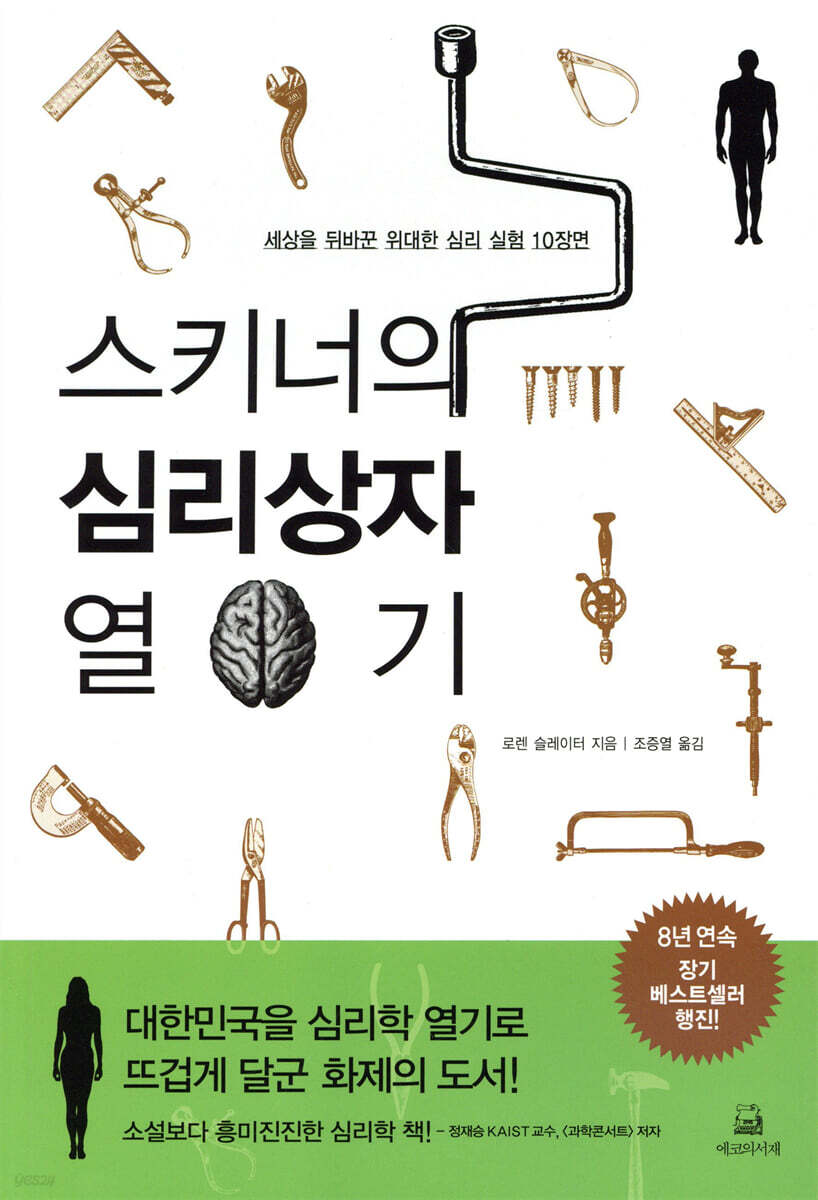
Opening Skinner's psychological box
 |
Description
Book Introduction
This book introduces ten great psychological experiments by brilliant psychologists and psychiatrists of the 20th century that astonished the world with hypotheses and theories about human psychology and nature, such as "What is a human being?" and "What makes a human being human?"
The author unfolds ten experiments in narrative form, questioning their current significance for the world we live in and reexamining them from a contemporary perspective.
'What does Skinner's behaviorism, which states that human behavior is determined by reward and punishment, mean to today's neurophysiologists who study the neural correlates of habit-driven rats?'
The author introduces readers to the background, context, and implied meaning of the experiment through vivid narratives that include interviews with experimenters and personal experiences.
The author unfolds ten experiments in narrative form, questioning their current significance for the world we live in and reexamining them from a contemporary perspective.
'What does Skinner's behaviorism, which states that human behavior is determined by reward and punishment, mean to today's neurophysiologists who study the neural correlates of habit-driven rats?'
The author introduces readers to the background, context, and implied meaning of the experiment through vivid narratives that include interviews with experimenters and personal experiences.
- You can preview some of the book's contents.
Preview
index
preface
1.
Humans are made as they are kneaded.
2.
Why do people submit to unreasonable authority?
3.
The bizarre murder case and the 38 silent witnesses
4.
An experiment on the nature of love
5.
How to put your mind to sleep
6.
Go to a mental hospital with your mind set on it
7.
Is drug addiction a drug problem or a social problem?
8.
Are the memories we remember real memories?
9.
Memory Corporation
10.
Drilling into the brain
Translator's Note
1.
Humans are made as they are kneaded.
2.
Why do people submit to unreasonable authority?
3.
The bizarre murder case and the 38 silent witnesses
4.
An experiment on the nature of love
5.
How to put your mind to sleep
6.
Go to a mental hospital with your mind set on it
7.
Is drug addiction a drug problem or a social problem?
8.
Are the memories we remember real memories?
9.
Memory Corporation
10.
Drilling into the brain
Translator's Note
Into the book
More interesting than the relationship between altruistic acts of helping others and time is the relationship between group size and time.
In general, you would think that the larger the group, the less fearful they would be, the more likely they would be to take risks and be bolder.
Anyway, isn't the scariest time when you're walking alone in a dark slum without streetlights?
Aren't humans the animals that are most afraid and hesitant when they are separated from their protectors and wander alone on the plains teeming with predators of all kinds?
However, Dalley and Latane's experiment challenges the evolutionary theory that larger groups lead to greater security.
The idea is that helping behavior is inhibited by the bystander group.
In general, you would think that the larger the group, the less fearful they would be, the more likely they would be to take risks and be bolder.
Anyway, isn't the scariest time when you're walking alone in a dark slum without streetlights?
Aren't humans the animals that are most afraid and hesitant when they are separated from their protectors and wander alone on the plains teeming with predators of all kinds?
However, Dalley and Latane's experiment challenges the evolutionary theory that larger groups lead to greater security.
The idea is that helping behavior is inhibited by the bystander group.
--- p.106 'The Bizarre Murder Case and the 38 Silent Witnesses'
GOODS SPECIFICS
- Date of issue: July 20, 2005
- Page count, weight, size: 341 pages | 516g | 153*224*30mm
- ISBN13: 9788995688908
- ISBN10: 8995688904
You may also like
카테고리
korean


korean

![ELLE 엘르 스페셜 에디션 A형 : 12월 [2025]](http://librairie.coreenne.fr/cdn/shop/files/b8e27a3de6c9538896439686c6b0e8fb.jpg?v=1766436872&width=3840)


