

Immersive flow
 |
Description
Book Introduction
*SBS Special 'Immersion, Meet Your Best Self' aired
The topic of happiness is thus an eternal concern and homework for humans.
So today, there are countless how-to books on how to become richer, how to become slimmer, how to become successful.
But what happens when you become rich, when you become thin? People become dissatisfied with that state and seek something else.
Because being rich and thin doesn't make you fundamentally happy.
This book is the result of a lifelong research by a scholar seeking an answer to the oldest question of humankind: 'How can humans become happy?'
About 30 years ago, Mihaly Csikszentmihalyi, a young man just starting out in the field of psychology, made a discovery.
That is, “happiness does not come by chance.”
So how can humans experience optimal experiences—the powerful realization that they are happiest and masters of their own destiny? This very question became the focus of Csikszentmihalyi's lifelong research.
He surveyed a large number of people around the world using the Experience Sampling Method (ESM - a method in which people wear pagers and write down their feelings and thoughts each time the pager rings) to determine when people have the most optimal experiences and what characteristics they exhibit at those times.
Optimal experience is the moment when you feel elated and happy because you feel that you are the master of your own destiny.
At this time, our consciousness is organized in an orderly manner and all attention is freely used for the purpose.
Csikszentmihalyi called this state flow because it is a feeling of ease, like flowing water, or a feeling of flying freely in the sky.
Mihaly Csikszentmihalyi said that if we can regulate our consciousness to experience flow more often, the quality of our lives will naturally improve.
This book is not about tricks.
This book makes us seriously reconsider and reflect on the eternal human preoccupation with happiness, the optimal experience, in today's world.
The topic of happiness is thus an eternal concern and homework for humans.
So today, there are countless how-to books on how to become richer, how to become slimmer, how to become successful.
But what happens when you become rich, when you become thin? People become dissatisfied with that state and seek something else.
Because being rich and thin doesn't make you fundamentally happy.
This book is the result of a lifelong research by a scholar seeking an answer to the oldest question of humankind: 'How can humans become happy?'
About 30 years ago, Mihaly Csikszentmihalyi, a young man just starting out in the field of psychology, made a discovery.
That is, “happiness does not come by chance.”
So how can humans experience optimal experiences—the powerful realization that they are happiest and masters of their own destiny? This very question became the focus of Csikszentmihalyi's lifelong research.
He surveyed a large number of people around the world using the Experience Sampling Method (ESM - a method in which people wear pagers and write down their feelings and thoughts each time the pager rings) to determine when people have the most optimal experiences and what characteristics they exhibit at those times.
Optimal experience is the moment when you feel elated and happy because you feel that you are the master of your own destiny.
At this time, our consciousness is organized in an orderly manner and all attention is freely used for the purpose.
Csikszentmihalyi called this state flow because it is a feeling of ease, like flowing water, or a feeling of flying freely in the sky.
Mihaly Csikszentmihalyi said that if we can regulate our consciousness to experience flow more often, the quality of our lives will naturally improve.
This book is not about tricks.
This book makes us seriously reconsider and reflect on the eternal human preoccupation with happiness, the optimal experience, in today's world.
- You can preview some of the book's contents.
Preview
index
Special Recommendation for the Korean Edition - Howard Gardner
Author's Preface
Translator's Preface
1.
Happiness, Rethinking
About this book
Source of dissatisfaction
The shield of culture
Determine your own experience
The path to liberation
2.
Learn about consciousness
What are the limits of consciousness?
Attention, the psychological energy
Ego and Attention
A Disordered State of Consciousness: Psychological Entropy
Ordered state of consciousness: flow
Complexity and the growth of the self
3.
Improving the quality of life through enjoyment
Pleasure and enjoyment
What makes up the pleasure factor?
autotelic experience
4.
Learn about the conditions of flow
Activities that give you flow
Flow and Culture
autotelic personality
People who have experienced flow even in difficult situations
5.
Getting Flow Through Our Body
Higher, faster, stronger
The joy of moving
Sex as Flow
Advanced Control Techniques: Yoga and Martial Arts
Flow Through the Senses: The Joy of Seeing
The Flow of Music: The Joy of Listening
The joy of tasting
6.
Finding Flow Through Intellectual Activities
Memory: The Mother of Science
Rules of the Mental Game
play of words
Dating Clio, the Goddess of History
The Joy of Science
Philosophy: Love of Wisdom
Amateurs and Professionals
A Lifelong Challenge: Learning
7.
Experience flow at work
self-directed workers
Autotelic work
The paradoxical nature of work
Waste of leisure time
8.
Enjoying being alone and together
The conflict between being alone and being together
The pain of loneliness
Taming Solitude
Flow and Home
Have fun with friends
the broader community
9.
Get out of the confusion
Overcoming tragedy
Coping with stress
The power of dissipative structures
The Autotelic Self: A Summary
10.
Creating meaning
What is meaning
Developing Purpose
Make a decision
Restoring harmony
Integrating meaning through life themes
annotation
reference book
Author's Preface
Translator's Preface
1.
Happiness, Rethinking
About this book
Source of dissatisfaction
The shield of culture
Determine your own experience
The path to liberation
2.
Learn about consciousness
What are the limits of consciousness?
Attention, the psychological energy
Ego and Attention
A Disordered State of Consciousness: Psychological Entropy
Ordered state of consciousness: flow
Complexity and the growth of the self
3.
Improving the quality of life through enjoyment
Pleasure and enjoyment
What makes up the pleasure factor?
autotelic experience
4.
Learn about the conditions of flow
Activities that give you flow
Flow and Culture
autotelic personality
People who have experienced flow even in difficult situations
5.
Getting Flow Through Our Body
Higher, faster, stronger
The joy of moving
Sex as Flow
Advanced Control Techniques: Yoga and Martial Arts
Flow Through the Senses: The Joy of Seeing
The Flow of Music: The Joy of Listening
The joy of tasting
6.
Finding Flow Through Intellectual Activities
Memory: The Mother of Science
Rules of the Mental Game
play of words
Dating Clio, the Goddess of History
The Joy of Science
Philosophy: Love of Wisdom
Amateurs and Professionals
A Lifelong Challenge: Learning
7.
Experience flow at work
self-directed workers
Autotelic work
The paradoxical nature of work
Waste of leisure time
8.
Enjoying being alone and together
The conflict between being alone and being together
The pain of loneliness
Taming Solitude
Flow and Home
Have fun with friends
the broader community
9.
Get out of the confusion
Overcoming tragedy
Coping with stress
The power of dissipative structures
The Autotelic Self: A Summary
10.
Creating meaning
What is meaning
Developing Purpose
Make a decision
Restoring harmony
Integrating meaning through life themes
annotation
reference book
Detailed image
Publisher's Review
Flow, a passion that flows naturally like water
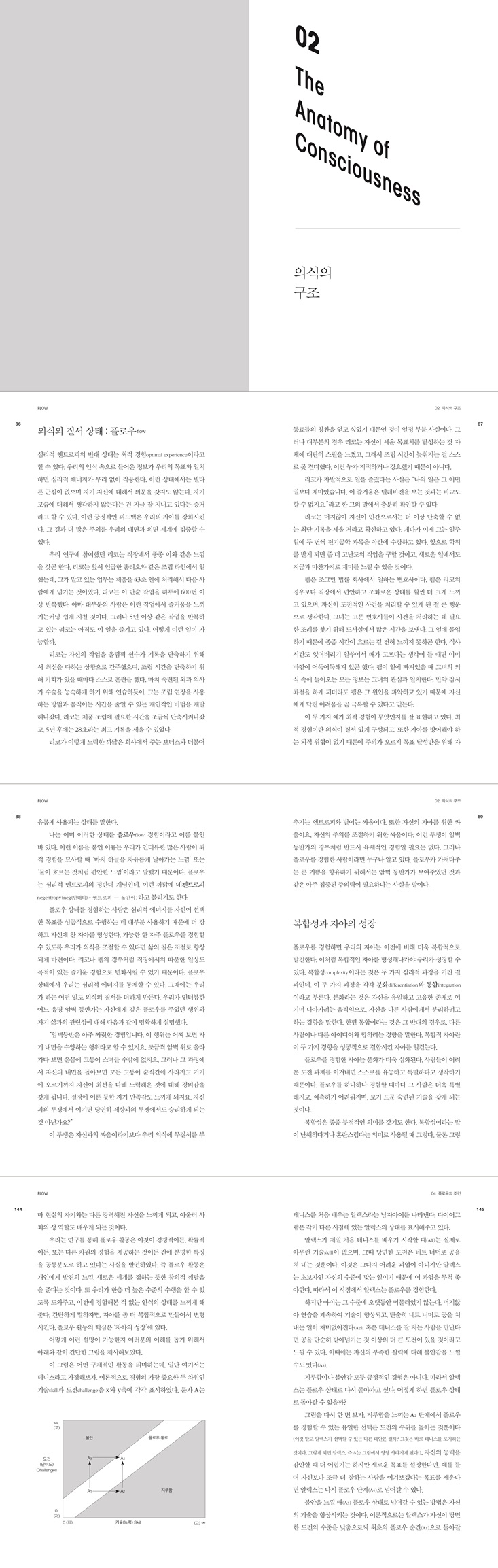
Flow is a psychological state in which one becomes so deeply immersed in an activity that one forgets the passage of time, space, and even oneself.
Flow is considered a concept similar to pleasure or happiness.
We all feel happy when we experience a state of flow and want to stay in that state.
However, flow is more accurately described as complete psychological immersion rather than a feeling of simple joy or enthusiasm.
According to Csikszentmihalyi's research, flow is experienced in very similar ways around the world, whether by older Koreans or office workers in the United States, and has the following eight main components:
Knowing the components of flow will help you figure out how to create the optimal experience.
- A task that has a possibility of success based on the individual's ability (in this case, the task should not be too easy for the individual's ability).
- All attention is fully devoted to the activity being performed.
- There is a clear goal.
- There is immediate feedback on success and failure.
- Deep immersion occurs without awareness of daily life.
- Feel in control of your own actions.
- Consciousness of self disappears.
But paradoxically, after the flow experience, your sense of self becomes stronger.
- The concept of time is distorted.
That is, hours feel like minutes, and minutes feel like hours.
Flow is an activity that is a goal in itself.
It is an experience that is absolutely necessary for human beings to be happy, not just to become rich and loved.
Flow activity occurs when a violinist becomes so absorbed in his performance that he forgets everything else but the music and becomes one with it; when a rock climber concentrates all his consciousness on the next rock, the next foot placement, to climb a rock face; when a dancer becomes so absorbed in the dance that he becomes completely absorbed in it.
A dancer says this when a performance is going well.
“The concentration at that time was very complete.
The mind does not wander and does not think of anything else.
Immerse yourself completely in what you are doing.
...
“The energy flows like water, leaving you feeling relaxed, comfortable, and full of energy.”
It is not easy for us to transform our everyday experiences into flow.
However, anyone can improve their flow ability by controlling the content of their consciousness through sufficient study and training.
Work and Flow - A Very Old Misconception
We perceive work as unpleasant, difficult, and something we have to do.
In fact, throughout history, the vast majority of people have had to give up the opportunity to enjoy life in order to fulfill the dreams of a very small number of powerful people.
Just look at the Taj Mahal in India, the pyramids in Egypt, and the Great Wall of China.
So people try to get away from work and go home to make use of their hard-earned free time, but often when they get home they have no idea what to do.
Paradoxically, work is easier to enjoy than leisure time.
Because work has the conditions necessary for flow activities, such as goals, feedback, rules, and challenges, so you can forget yourself and immerse yourself in the work while being absorbed in it.
Yet, rather than using our own physical and mental resources to experience flow, most of us spend hours watching famous athletes in huge stadiums, idly watching television, or listening to CDs made by millionaire musicians rather than creating our own music.
This kind of proxy participation can temporarily soothe the emptiness that comes from wasting time.
But you can't get the flow experience that comes from taking on challenges.
In fact, it was found that people who were working experienced flow experiences four times more often than those who were watching television.
It's frustrating when we have no control over either our work or our leisure time.
Leisure involving passive consumption of mass media does not make us happy or strong.
“The future belongs not only to the educated, but also to those who are educated to use their free time wisely,” Brightbill said.
People who have experienced flow even in difficult situations
Flow isn't something you can only experience when conditions are right.
Even in situations where we never thought we'd experience flow, people with strong autotelic personalities find ways to overcome adversity and transform it into a manageable experience.
According to Alexander Solzhenitsyn, while in prison, a fellow inmate drew a map of the world on the floor of his cell and imagined himself walking several kilometers every day, traveling to Asia, Europe, and America.
One Vietnam veteran reportedly imagined himself playing 18 holes every day while imprisoned in a prison camp, choosing a golf club and hitting approach shots.
It is said that he was able to keep his mind sharp with this imagination and that he played an excellent golf game after being released.
Solzhenitsyn does a wonderful job of explaining how even the most humiliating situations can be transformed into flow experiences.
“Even as I stood among the dejected prisoners, listening to the shouts of the guards with their guns, poems and images seemed to flood my mind.
At that moment, I was free and happy.
Some prisoners tried to escape by cutting the barbed wire, but there was no barbed wire for me.
“All the prisoners, including me, were still in the prison, but in fact I was on a long flight from there.”
These people are not easily distracted by external threats because they are intrinsically motivated by their actions.
It's about finding new opportunities in whatever situation you find yourself in.
As I said before, flow doesn't come by chance.
Only those who have a purpose and are proactive in their thinking can experience flow.
Flow is a psychological state in which one becomes so deeply immersed in an activity that one forgets the passage of time, space, and even oneself.
Flow is considered a concept similar to pleasure or happiness.
We all feel happy when we experience a state of flow and want to stay in that state.
However, flow is more accurately described as complete psychological immersion rather than a feeling of simple joy or enthusiasm.
According to Csikszentmihalyi's research, flow is experienced in very similar ways around the world, whether by older Koreans or office workers in the United States, and has the following eight main components:
Knowing the components of flow will help you figure out how to create the optimal experience.
- A task that has a possibility of success based on the individual's ability (in this case, the task should not be too easy for the individual's ability).
- All attention is fully devoted to the activity being performed.
- There is a clear goal.
- There is immediate feedback on success and failure.
- Deep immersion occurs without awareness of daily life.
- Feel in control of your own actions.
- Consciousness of self disappears.
But paradoxically, after the flow experience, your sense of self becomes stronger.
- The concept of time is distorted.
That is, hours feel like minutes, and minutes feel like hours.
Flow is an activity that is a goal in itself.
It is an experience that is absolutely necessary for human beings to be happy, not just to become rich and loved.
Flow activity occurs when a violinist becomes so absorbed in his performance that he forgets everything else but the music and becomes one with it; when a rock climber concentrates all his consciousness on the next rock, the next foot placement, to climb a rock face; when a dancer becomes so absorbed in the dance that he becomes completely absorbed in it.
A dancer says this when a performance is going well.
“The concentration at that time was very complete.
The mind does not wander and does not think of anything else.
Immerse yourself completely in what you are doing.
...
“The energy flows like water, leaving you feeling relaxed, comfortable, and full of energy.”
It is not easy for us to transform our everyday experiences into flow.
However, anyone can improve their flow ability by controlling the content of their consciousness through sufficient study and training.
Work and Flow - A Very Old Misconception
We perceive work as unpleasant, difficult, and something we have to do.
In fact, throughout history, the vast majority of people have had to give up the opportunity to enjoy life in order to fulfill the dreams of a very small number of powerful people.
Just look at the Taj Mahal in India, the pyramids in Egypt, and the Great Wall of China.
So people try to get away from work and go home to make use of their hard-earned free time, but often when they get home they have no idea what to do.
Paradoxically, work is easier to enjoy than leisure time.
Because work has the conditions necessary for flow activities, such as goals, feedback, rules, and challenges, so you can forget yourself and immerse yourself in the work while being absorbed in it.
Yet, rather than using our own physical and mental resources to experience flow, most of us spend hours watching famous athletes in huge stadiums, idly watching television, or listening to CDs made by millionaire musicians rather than creating our own music.
This kind of proxy participation can temporarily soothe the emptiness that comes from wasting time.
But you can't get the flow experience that comes from taking on challenges.
In fact, it was found that people who were working experienced flow experiences four times more often than those who were watching television.
It's frustrating when we have no control over either our work or our leisure time.
Leisure involving passive consumption of mass media does not make us happy or strong.
“The future belongs not only to the educated, but also to those who are educated to use their free time wisely,” Brightbill said.
People who have experienced flow even in difficult situations
Flow isn't something you can only experience when conditions are right.
Even in situations where we never thought we'd experience flow, people with strong autotelic personalities find ways to overcome adversity and transform it into a manageable experience.
According to Alexander Solzhenitsyn, while in prison, a fellow inmate drew a map of the world on the floor of his cell and imagined himself walking several kilometers every day, traveling to Asia, Europe, and America.
One Vietnam veteran reportedly imagined himself playing 18 holes every day while imprisoned in a prison camp, choosing a golf club and hitting approach shots.
It is said that he was able to keep his mind sharp with this imagination and that he played an excellent golf game after being released.
Solzhenitsyn does a wonderful job of explaining how even the most humiliating situations can be transformed into flow experiences.
“Even as I stood among the dejected prisoners, listening to the shouts of the guards with their guns, poems and images seemed to flood my mind.
At that moment, I was free and happy.
Some prisoners tried to escape by cutting the barbed wire, but there was no barbed wire for me.
“All the prisoners, including me, were still in the prison, but in fact I was on a long flight from there.”
These people are not easily distracted by external threats because they are intrinsically motivated by their actions.
It's about finding new opportunities in whatever situation you find yourself in.
As I said before, flow doesn't come by chance.
Only those who have a purpose and are proactive in their thinking can experience flow.
GOODS SPECIFICS
- Date of issue: July 5, 2004
- Format: Hardcover book binding method guide
- Page count, weight, size: 528 pages | 797g | 153*224*35mm
- ISBN13: 9788958270096
- ISBN10: 8958270098
You may also like
카테고리
korean


korean

![ELLE 엘르 스페셜 에디션 A형 : 12월 [2025]](http://librairie.coreenne.fr/cdn/shop/files/b8e27a3de6c9538896439686c6b0e8fb.jpg?v=1766436872&width=3840)


