

Archaeology in Everyday Life: My Solo Baekje Journey
 |
Description
Book Introduction
A travelogue of Baekje history by a curator and museum enthusiast.
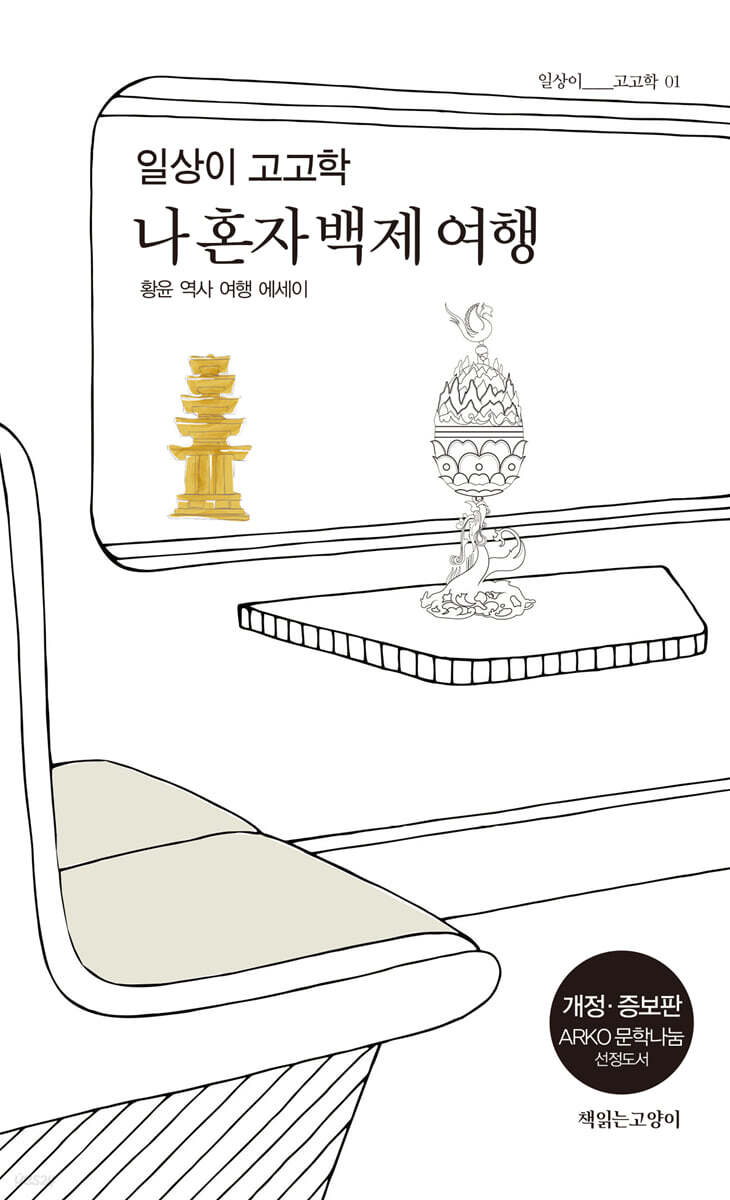
"Daily Life as Archaeology: My Solo Baekje Journey" is a novel introduction to historical travel, demonstrating that historical travel can be as familiar as a neighborhood stroll and as easy and engaging as going to the movies.
It opens our eyes to the value of Baekje relics and sites that we had not been able to appreciate deeply due to our limited background knowledge, and it solves the mystery of why Baekje relics are so exceptionally artistic and beautiful with the insight unique to a dedicated art enthusiast.
"Daily Life as Archaeology: My Solo Baekje Journey" is a novel introduction to historical travel, demonstrating that historical travel can be as familiar as a neighborhood stroll and as easy and engaging as going to the movies.
It opens our eyes to the value of Baekje relics and sites that we had not been able to appreciate deeply due to our limited background knowledge, and it solves the mystery of why Baekje relics are so exceptionally artistic and beautiful with the insight unique to a dedicated art enthusiast.
- You can preview some of the book's contents.
Preview
index
prolog
1.
In search of Hanseong Baekje
Pungnap Earthen Fortress / Gyeongdang History and Culture Park / Pungnap Baekje Cultural Park
Below the villa lies the Baekje Kingdom
What did the castles and buildings of the early Baekje period look like?
King Geunchogo, better described in the Nihon Shoki than in the Samguk Sagi
The story behind Baekje's advanced culture
2.
Hanseong Baekje Museum
Mongchon History Museum / Hanseong Baekje Museum
Check out Baekje folk houses at Mongchon History Museum.
The technology that built the castle
Items given by Baekje to neighboring countries
The best items of Hanseong Baekje: the gilt-bronze crown and gilt-bronze shoes
3.
There are ancient tombs in Seoul too
Bangi-dong Tomb / Seokchon-dong Tomb
Baekje and Goguryeo became sworn enemies
Whose tomb is the Bangi-dong Tomb, Baekje or Silla?
Why King Jangsu, at the age of 83, personally commanded the war against Baekje
The Seokchon-dong tombs, which have disappeared, leaving only eight of the 290 tombs.
4.
King Muryeong's Tomb
Suchon-ri Tomb / Songsan-ri Tomb / Gongju National Museum
The significance of the artifacts excavated from the Suchon-ri tomb
The reason King Muryeong and his wife were buried together 27 months after their deaths
Before King Muryeong, as many as three kings were assassinated.
The only tomb of King Muryeong that has completed its mission
Did King Muryeong live to the end of his days?
5.
Let's go to Buyeo
Daetongsa Temple / Gwanbuk-ri Historic Site / Buyeo National Museum
Daetongsa Temple is the first temple in existence.
Why was a temple built here?
The reason for moving the capital from Gongju to Buyeo
The cornerstone appears! The Gwanbuk-ri ruins, embroidered with tiles.
King Seong regained control of the Han River and then lost it again
The Baekje Gilt-Bronze Incense Burner, a Must-See at Least Once in Your Life
6.
Jeongnimsa Temple Site
Five-story stone pagoda at Jeongnimsa Temple Site
1 night in Buyeo
A national treasure still shrouded in mystery: the five-story stone pagoda at Jeongnimsa Temple Site.
Baekje kiln site on the way to Jeongnimsa Temple
Stone pagoda, a revolutionary design
7.
Baekje in Iksan
Mireuksa Temple / Wanggung-ri Five-story Stone Pagoda
UNESCO Baekje Historic Areas
The protagonists of Seodongyo, King Mu and Mireuksa Temple in Iksan
The majesty of the Mireuksa Temple Stone Pagoda
The Mysterious Story of the Wanggung-ri Ruins
How is a Unified Silla Buddhist statue inside a Baekje pagoda?
Epilogue
What kind of country was Baekje to us?
References
Search
1.
In search of Hanseong Baekje
Pungnap Earthen Fortress / Gyeongdang History and Culture Park / Pungnap Baekje Cultural Park
Below the villa lies the Baekje Kingdom
What did the castles and buildings of the early Baekje period look like?
King Geunchogo, better described in the Nihon Shoki than in the Samguk Sagi
The story behind Baekje's advanced culture
2.
Hanseong Baekje Museum
Mongchon History Museum / Hanseong Baekje Museum
Check out Baekje folk houses at Mongchon History Museum.
The technology that built the castle
Items given by Baekje to neighboring countries
The best items of Hanseong Baekje: the gilt-bronze crown and gilt-bronze shoes
3.
There are ancient tombs in Seoul too
Bangi-dong Tomb / Seokchon-dong Tomb
Baekje and Goguryeo became sworn enemies
Whose tomb is the Bangi-dong Tomb, Baekje or Silla?
Why King Jangsu, at the age of 83, personally commanded the war against Baekje
The Seokchon-dong tombs, which have disappeared, leaving only eight of the 290 tombs.
4.
King Muryeong's Tomb
Suchon-ri Tomb / Songsan-ri Tomb / Gongju National Museum
The significance of the artifacts excavated from the Suchon-ri tomb
The reason King Muryeong and his wife were buried together 27 months after their deaths
Before King Muryeong, as many as three kings were assassinated.
The only tomb of King Muryeong that has completed its mission
Did King Muryeong live to the end of his days?
5.
Let's go to Buyeo
Daetongsa Temple / Gwanbuk-ri Historic Site / Buyeo National Museum
Daetongsa Temple is the first temple in existence.
Why was a temple built here?
The reason for moving the capital from Gongju to Buyeo
The cornerstone appears! The Gwanbuk-ri ruins, embroidered with tiles.
King Seong regained control of the Han River and then lost it again
The Baekje Gilt-Bronze Incense Burner, a Must-See at Least Once in Your Life
6.
Jeongnimsa Temple Site
Five-story stone pagoda at Jeongnimsa Temple Site
1 night in Buyeo
A national treasure still shrouded in mystery: the five-story stone pagoda at Jeongnimsa Temple Site.
Baekje kiln site on the way to Jeongnimsa Temple
Stone pagoda, a revolutionary design
7.
Baekje in Iksan
Mireuksa Temple / Wanggung-ri Five-story Stone Pagoda
UNESCO Baekje Historic Areas
The protagonists of Seodongyo, King Mu and Mireuksa Temple in Iksan
The majesty of the Mireuksa Temple Stone Pagoda
The Mysterious Story of the Wanggung-ri Ruins
How is a Unified Silla Buddhist statue inside a Baekje pagoda?
Epilogue
What kind of country was Baekje to us?
References
Search
Publisher's Review
Historical travel becomes a daily routine
A travelogue of Baekje history by a curator and museum enthusiast.
"Daily Life as Archaeology: My Solo Baekje Journey" is a novel introduction to historical travel, demonstrating that historical travel can be as familiar as a neighborhood stroll and as easy and engaging as going to the movies.
The author's journey to Baekje begins by chance.
After eating breakfast, I left the house to cool my head and waited for the bus without any destination.
If the bus to Sadang comes first, it goes to the National Museum of Korea, and if the bus to Jamsil comes first, it goes to the Hanseong Baekje Museum.
The Baekje history tour begins when, as fate would have it, the Jamsil bus arrives first.
A trip like a walk that I have always taken on a daily basis is one where I move wherever my heart desires, but the content is serious and quite profound.
It opens our eyes to the value of Baekje relics and sites that we had not been able to appreciate deeply due to our limited background knowledge, and it solves the mystery of why Baekje relics are so exceptionally artistic and beautiful with the insight unique to a dedicated art enthusiast.
Author Hwang Yun, author of “How to See a Museum” and “Kim Yu-sin Cuts Off the Horse’s Head,” is the first museum expert and curator of history in Korea who has been a fan of the Three Kingdoms period and has visited countless historical sites and museums, exploring and imagining them.
Baekje, once the preserve of experts, made accessible and accessible.
The remarkable level of Baekje culture was revealed to great interest and excitement when the Gilt-bronze Incense Burner, National Treasure No. 287, was discovered in Buyeo in 1993, relatively recently.
The excellence of Baekje culture was proven when the Baekje historical sites in Gongju, Buyeo, and Iksan were designated as UNESCO World Heritage Sites in 2015.
Despite this, the general public's perception of Baekje has not changed much and it is not even gaining much interest.
Although there is no one who does not know Baekje, the image that remains is biased towards negative aspects such as King Uija, the Three Thousand Palace Ladies, and the defeated nation, while relatively positive evaluations of the high level of splendid culture, the spread of culture to Japan, and the achievements of King Geunchogo remain fragmentary.
It's probably only of interest to a small number of history buffs.
This is understandable because most of the relics are so old that they have already been buried and disappeared, making them unrecognizable without the use of imagination.
Also, the records that remain as the losers of history are not very good, and the shackles of the perception of being a loser obscure the other side.
Baekje's pagoda, born from a revolutionary design that transcended art
According to the Chinese historical book, Book of Zhou, “Baekje had many monks and pagodas.”
Baekje's pagodas started out as wooden pagodas and evolved into stone pagodas, and had a great influence on Japan and later on, on Unified Silla.
There are passages in Japanese records that provide a glimpse into Baekje's culture and influence.
In the first year of Empress Suiko of Japan (593), it is said that “a Buddhist temple was erected in Asuka-dera and a Buddhist ceremony was held. The officials of all generations wore Baekje clothing and the onlookers were delighted.”
In other words, high-ranking Japanese officials gathered for a ceremony to wear Baekje clothing and place a pagoda on top of a sarira container in a temple.
Asuka-dera, the first temple in Japan, was started in 583 and completed in 596. Excavations have revealed that the temple's layout is Goguryeo-style, but the sarira box under the pagoda is Baekje-style, the roof tiles are also Baekje-style, and there were Ido Baekje people who were invited to teach Japanese craftsmen, Ido Baekje people who cast the Buddha statue enshrined in the temple, and Ido pro-Baekje Japanese nobles who sponsored the construction of the temple.
And the two chief priests of the temple are Hyechong, a monk from Baekje, and Hyeja, a monk from Goguryeo. (Page 165)
If you go to Japan, there is a temple called Horyuji.
The Baekje-style one-tower, one-garam structure is adopted in a Japanese style, and the five-story wooden pagoda in particular makes us guess that “this is what a Baekje-made pagoda would have looked like.”
Although all of Baekje's wooden pagodas have disappeared without a trace, "Daily Life is Archaeology, My Solo Baekje Journey" shows that wooden pagodas existed before the Mireuksa Temple Stone Pagoda and the Jeongnimsa Temple Five-Story Stone Pagoda, and that they were of enormous size and scale.
Furthermore, it gave birth to the stone pagoda, which can be said to be a revolutionary design for a pagoda, by efficiently reducing the area of the temple while preventing it from being destroyed by fire or other causes, and it provides a foundation for the Unified Silla Dynasty to later increase the number of pagodas and temples by leaps and bounds. This process is fully experienced.
A new national treasure has been discovered.
Admire the Sarira Reliquary Excavated from the Wangheungsa Temple Site in Buyeo, National Treasure No. 327
The National Museum of Korea's ongoing sold-out special exhibition, "New Treasures," features the only Baekje treasure: National Treasure No. 327, the sarira reliquary excavated from the Wangheungsa Temple site in Buyeo.
This sarira is known to be the oldest existing sarira, and was enshrined in 577 by King Wideok of Baekje (reigned 554-598) at Wangheungsa Temple for his deceased son. It is a treasure that demonstrates the high level of Baekje art.
Sarira is originally something that comes out when a Buddha or a great monk is cremated after entering nirvana. The sarira of a Buddha is called a true body sarira and is treated more highly than the sarira of a great monk.
The sarira box must be kept under the temple tower.
The author explains the reason as follows:
This is because, by the standards of the time, a perfect pagoda was built by placing the relics and then placing a pagoda on top of them.
In other words, just as a person must have a form called a pagoda and a soul called a sarira to become perfect, the same was true for a pagoda. (p. 159)
The following words were written on the reliquary:
??On February 15th of the year of Jeongyu (577), when King Chang of Baekje (King Wideok) built a temple for his deceased prince, the two sarira became three through divine intervention. (丁酉年二月十五日百濟 王昌爲亡王立刹本舍利二枚葬時神化爲三)?? In other words, it is a description of the miraculous event of two sarira becoming three.
However, the fact is that there were no relics inside the excavated artifacts.
What miracle happened when two relics became three and were kept in a pagoda, but then at some point they disappeared from the pagoda? (Page 159)
The beauty of the sarira relics from the Baekje period is worth appreciating in itself, but if you know the story they tell, their meaning becomes on a whole other level.
As can be seen from the royal title, King Wideok's father, King Seong, was named after the King Turning Wheel, who protected Buddhism.
It can be seen that the Wheel-Turning King was modeled after King Ashoka, who unified India and spread the teachings of Buddha by building pagodas throughout the country, and that the King also wanted to become a king like that.
Ultimately, it can be seen that National Treasure No. 287, the Gilt-Bronze Incense Burner, was also used to burn incense for the spirit of the father when building a temple for the father, King Seong.
In this way, 『Daily Life is Archaeology, My Solo Baekje Journey』 is significant in that it places us in front of Baekje relics and provides an opportunity for pure encounter.
By providing basic knowledge about the relics and ruins visible before our eyes, as well as insight into the fragmented history of Baekje and solving it in the right place, it helps us understand the value of Baekje and Baekje culture within the context of the surrounding international history and within the context of Baekje's interpreters.
Composition of Baekje History Tour
『Daily Archaeology, My Solo Baekje Journey』 is broadly divided into a half-day Baekje tour of Hanseong and a two-day, one-night Baekje tour of Gongju, Buyeo, and Iksan.
The Hanseong Baekje itinerary walks through the Pungnap Earthen Fortress, Mongchon Earthen Fortress, Bangi-dong Tombs, and Seokchon-dong Tombs, and tells the story of Baekje's architectural and tomb characteristics, the size and purpose of the earthen fortress, as well as its diplomatic authority maintained through Chinese celadon and its ruling power through advanced culture, such as bestowing black earthenware, especially gilt-bronze crowns and gilt-bronze shoes, to the provinces, and how it became sworn enemies with Goguryeo.
The first day of the 2-day, 1-night Gongju, Buyeo, and Iksan itinerary begins at the Royal Tomb of King Muryeong, then continues to the Gongju National Museum, then to the Buyeo Daetongsa Temple, the Gwanbuk-ri Historic Site, and ends at the Buyeo National Museum, where you can see the Baekje Gilt-bronze Incense Burner, the crown jewel of Baekje relics.
The next day, after a night in Buyeo, we visited the five-story stone pagoda at Jeongnimsa Temple Site and then headed to Iksan, where we continued to Mireuksa Temple and the five-story stone pagoda at Wanggung-ri.
It tells the story of Baekje's desperate efforts to regain control of the Han River, its diplomatic efforts, and the splendid and sophisticated development of Buddhist art, all while being forced to retreat under pressure from Goguryeo.
A travelogue of Baekje history by a curator and museum enthusiast.
"Daily Life as Archaeology: My Solo Baekje Journey" is a novel introduction to historical travel, demonstrating that historical travel can be as familiar as a neighborhood stroll and as easy and engaging as going to the movies.
The author's journey to Baekje begins by chance.
After eating breakfast, I left the house to cool my head and waited for the bus without any destination.
If the bus to Sadang comes first, it goes to the National Museum of Korea, and if the bus to Jamsil comes first, it goes to the Hanseong Baekje Museum.
The Baekje history tour begins when, as fate would have it, the Jamsil bus arrives first.
A trip like a walk that I have always taken on a daily basis is one where I move wherever my heart desires, but the content is serious and quite profound.
It opens our eyes to the value of Baekje relics and sites that we had not been able to appreciate deeply due to our limited background knowledge, and it solves the mystery of why Baekje relics are so exceptionally artistic and beautiful with the insight unique to a dedicated art enthusiast.
Author Hwang Yun, author of “How to See a Museum” and “Kim Yu-sin Cuts Off the Horse’s Head,” is the first museum expert and curator of history in Korea who has been a fan of the Three Kingdoms period and has visited countless historical sites and museums, exploring and imagining them.
Baekje, once the preserve of experts, made accessible and accessible.
The remarkable level of Baekje culture was revealed to great interest and excitement when the Gilt-bronze Incense Burner, National Treasure No. 287, was discovered in Buyeo in 1993, relatively recently.
The excellence of Baekje culture was proven when the Baekje historical sites in Gongju, Buyeo, and Iksan were designated as UNESCO World Heritage Sites in 2015.
Despite this, the general public's perception of Baekje has not changed much and it is not even gaining much interest.
Although there is no one who does not know Baekje, the image that remains is biased towards negative aspects such as King Uija, the Three Thousand Palace Ladies, and the defeated nation, while relatively positive evaluations of the high level of splendid culture, the spread of culture to Japan, and the achievements of King Geunchogo remain fragmentary.
It's probably only of interest to a small number of history buffs.
This is understandable because most of the relics are so old that they have already been buried and disappeared, making them unrecognizable without the use of imagination.
Also, the records that remain as the losers of history are not very good, and the shackles of the perception of being a loser obscure the other side.
Baekje's pagoda, born from a revolutionary design that transcended art
According to the Chinese historical book, Book of Zhou, “Baekje had many monks and pagodas.”
Baekje's pagodas started out as wooden pagodas and evolved into stone pagodas, and had a great influence on Japan and later on, on Unified Silla.
There are passages in Japanese records that provide a glimpse into Baekje's culture and influence.
In the first year of Empress Suiko of Japan (593), it is said that “a Buddhist temple was erected in Asuka-dera and a Buddhist ceremony was held. The officials of all generations wore Baekje clothing and the onlookers were delighted.”
In other words, high-ranking Japanese officials gathered for a ceremony to wear Baekje clothing and place a pagoda on top of a sarira container in a temple.
Asuka-dera, the first temple in Japan, was started in 583 and completed in 596. Excavations have revealed that the temple's layout is Goguryeo-style, but the sarira box under the pagoda is Baekje-style, the roof tiles are also Baekje-style, and there were Ido Baekje people who were invited to teach Japanese craftsmen, Ido Baekje people who cast the Buddha statue enshrined in the temple, and Ido pro-Baekje Japanese nobles who sponsored the construction of the temple.
And the two chief priests of the temple are Hyechong, a monk from Baekje, and Hyeja, a monk from Goguryeo. (Page 165)
If you go to Japan, there is a temple called Horyuji.
The Baekje-style one-tower, one-garam structure is adopted in a Japanese style, and the five-story wooden pagoda in particular makes us guess that “this is what a Baekje-made pagoda would have looked like.”
Although all of Baekje's wooden pagodas have disappeared without a trace, "Daily Life is Archaeology, My Solo Baekje Journey" shows that wooden pagodas existed before the Mireuksa Temple Stone Pagoda and the Jeongnimsa Temple Five-Story Stone Pagoda, and that they were of enormous size and scale.
Furthermore, it gave birth to the stone pagoda, which can be said to be a revolutionary design for a pagoda, by efficiently reducing the area of the temple while preventing it from being destroyed by fire or other causes, and it provides a foundation for the Unified Silla Dynasty to later increase the number of pagodas and temples by leaps and bounds. This process is fully experienced.
A new national treasure has been discovered.
Admire the Sarira Reliquary Excavated from the Wangheungsa Temple Site in Buyeo, National Treasure No. 327
The National Museum of Korea's ongoing sold-out special exhibition, "New Treasures," features the only Baekje treasure: National Treasure No. 327, the sarira reliquary excavated from the Wangheungsa Temple site in Buyeo.
This sarira is known to be the oldest existing sarira, and was enshrined in 577 by King Wideok of Baekje (reigned 554-598) at Wangheungsa Temple for his deceased son. It is a treasure that demonstrates the high level of Baekje art.
Sarira is originally something that comes out when a Buddha or a great monk is cremated after entering nirvana. The sarira of a Buddha is called a true body sarira and is treated more highly than the sarira of a great monk.
The sarira box must be kept under the temple tower.
The author explains the reason as follows:
This is because, by the standards of the time, a perfect pagoda was built by placing the relics and then placing a pagoda on top of them.
In other words, just as a person must have a form called a pagoda and a soul called a sarira to become perfect, the same was true for a pagoda. (p. 159)
The following words were written on the reliquary:
??On February 15th of the year of Jeongyu (577), when King Chang of Baekje (King Wideok) built a temple for his deceased prince, the two sarira became three through divine intervention. (丁酉年二月十五日百濟 王昌爲亡王立刹本舍利二枚葬時神化爲三)?? In other words, it is a description of the miraculous event of two sarira becoming three.
However, the fact is that there were no relics inside the excavated artifacts.
What miracle happened when two relics became three and were kept in a pagoda, but then at some point they disappeared from the pagoda? (Page 159)
The beauty of the sarira relics from the Baekje period is worth appreciating in itself, but if you know the story they tell, their meaning becomes on a whole other level.
As can be seen from the royal title, King Wideok's father, King Seong, was named after the King Turning Wheel, who protected Buddhism.
It can be seen that the Wheel-Turning King was modeled after King Ashoka, who unified India and spread the teachings of Buddha by building pagodas throughout the country, and that the King also wanted to become a king like that.
Ultimately, it can be seen that National Treasure No. 287, the Gilt-Bronze Incense Burner, was also used to burn incense for the spirit of the father when building a temple for the father, King Seong.
In this way, 『Daily Life is Archaeology, My Solo Baekje Journey』 is significant in that it places us in front of Baekje relics and provides an opportunity for pure encounter.
By providing basic knowledge about the relics and ruins visible before our eyes, as well as insight into the fragmented history of Baekje and solving it in the right place, it helps us understand the value of Baekje and Baekje culture within the context of the surrounding international history and within the context of Baekje's interpreters.
Composition of Baekje History Tour
『Daily Archaeology, My Solo Baekje Journey』 is broadly divided into a half-day Baekje tour of Hanseong and a two-day, one-night Baekje tour of Gongju, Buyeo, and Iksan.
The Hanseong Baekje itinerary walks through the Pungnap Earthen Fortress, Mongchon Earthen Fortress, Bangi-dong Tombs, and Seokchon-dong Tombs, and tells the story of Baekje's architectural and tomb characteristics, the size and purpose of the earthen fortress, as well as its diplomatic authority maintained through Chinese celadon and its ruling power through advanced culture, such as bestowing black earthenware, especially gilt-bronze crowns and gilt-bronze shoes, to the provinces, and how it became sworn enemies with Goguryeo.
The first day of the 2-day, 1-night Gongju, Buyeo, and Iksan itinerary begins at the Royal Tomb of King Muryeong, then continues to the Gongju National Museum, then to the Buyeo Daetongsa Temple, the Gwanbuk-ri Historic Site, and ends at the Buyeo National Museum, where you can see the Baekje Gilt-bronze Incense Burner, the crown jewel of Baekje relics.
The next day, after a night in Buyeo, we visited the five-story stone pagoda at Jeongnimsa Temple Site and then headed to Iksan, where we continued to Mireuksa Temple and the five-story stone pagoda at Wanggung-ri.
It tells the story of Baekje's desperate efforts to regain control of the Han River, its diplomatic efforts, and the splendid and sophisticated development of Buddhist art, all while being forced to retreat under pressure from Goguryeo.
GOODS SPECIFICS
- Date of issue: August 15, 2020
- Page count, weight, size: 256 pages | 204g | 112*184*17mm
- ISBN13: 9791186274620
- ISBN10: 118627462X
You may also like
카테고리
korean


korean

![GQ KOREA Mark (Monthly): December [2025]](http://librairie.coreenne.fr/cdn/shop/files/8ef265dbbfbf186523ed75ba7319009d.jpg?v=1765340328&width=3840)


